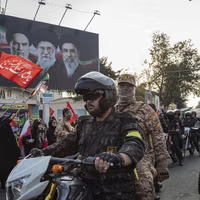
Iran shifting to offensive doctrine, IRGC commander’s adviser says
Iran is shifting from a defensive military doctrine toward an offensive one, with its forces being prepared to conduct operations beyond the country’s borders, Mohammad Reza Naghdi, an adviser to the commander of the Islamic Revolutionary Guard Corps said on Tuesday.
“Whenever conditions require and an order is issued, we must have the capability to take operations to the enemy’s territory and conduct operations away from our own territory,” Naghdi said in an interview with state television.
Naghdi described Iran’s recent war with the United States and Israel as a “real exercise” that allowed its forces to assess their adversaries’ military capabilities in actual combat.
“The latest directives to Iranian commanders emphasized hybrid warfare, which is a mix of coordinated use of military, diplomatic, economic, social and media capabilities,” he added.
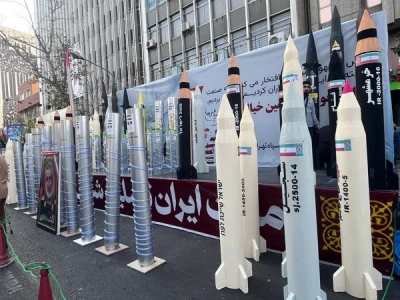
“Our production of ballistic missiles exceeds the number being launched. In other words, we are producing more missiles and making them available to our forces than are being fired on the battlefield. We also have a production capacity for drones that exceeds their rate of use and launch, and we have significant production capacity,” Naghdi said.
“Production of this equipment will continue, and even if the war lasts for several years, ballistic missiles will still be produced and fired at the enemy on the final day of the war,” he added.
File photo shows commercial vessels near the Strait of Hormuz amid ongoing shipping disruptions.
The maritime confrontation around Iran widened Tuesday as US forces struck an Iran-bound vessel and Tehran-backed Houthis attacked a ship in Bab el-Mandeb, even as Pakistan and Qatar signaled progress in mediation over the Strait of Hormuz.
Pakistan’s Interior Minister Mohsin Naqvi met President Masoud Pezeshkian and Foreign Minister Abbas Araghchi in Tehran as Islamabad continued its mediation efforts.
Pakistan’s Defense Minister Khawaja Asif separately said signals from recent days suggested the US and Iran were close to “some sort of an arrangement,” while Qatar said Iran-Oman negotiations had reached an advanced stage.
The diplomatic push came as Washington escalated enforcement of its naval blockade. US Central Command said a Navy helicopter fired two Hellfire missiles at the Panama-flagged Vela Nova after its crew ignored repeated warnings and continued toward an Iranian port, disabling the vessel’s steering gear.
CENTCOM said the blockade remained “in full effect,” adding that US forces had redirected 55 commercial vessels, disabled three and boarded two as of Tuesday.
A deck cargo ship was also attacked by Yemen’s Iran-backed Houthis in the Bab el-Mandeb Strait on Tuesday, killing three crew members, Reuters reported, citing Yemeni coast guard sources and government military officials.
Asharq Al-Awsat reported the same day, citing Yemeni security sources, that IRGC officers were overseeing the Houthis’ escalating military operations in Yemen. Iran’s envoy to the group, Ali Mohammad Rezaei, was personally supervising an operations room managing military and security affairs in Houthi-controlled areas, according to the report.
Tehran, meanwhile, maintained that progress on shipping arrangements with Oman would not by itself reopen the strait. Supreme National Security Council Secretary Mohsen Rezaei said Hormuz would remain closed unless Washington changed its behavior and accepted Iran’s conditions, and that any agreement with Oman on a transit route would be separate from the broader closure.
Mohammad Mokhber, an adviser to Supreme Leader Mojtaba Khamenei, reinforced that position, saying the strait “will not be reopened until Iran’s conditions are met.”
Pressure on shipping also persisted. The Joint Maritime Information Center said IRGC attacks, attempted attacks and harassment continued in the strait, including UAV overflights, hailing and targeted surveillance of merchant vessels.
IRGC spokesperson Hossein Mohebi also warned that energy networks, power plants and global internet-linked infrastructure could be at risk if Iran were threatened again. He said the US had “30 to 40 warships in the region” before the recent 40-day war but that “not even one US warship” remained in the Persian Gulf.
Despite the continuing confrontation, oil flows showed signs of recovery. US Energy Secretary Chris Wright said the seven-day average for oil leaving the Strait of Hormuz had risen to nearly 9 million barrels per day, with total regional flows averaging about 15 million barrels per day when pipeline and export-facility shipments were included.
The Tuesday front page of state-run newspaper Hamshahri features Mojtaba Khamenei at the center and his latest appointments, along with the headline: The new lineup of power
Iran's latest military appointments are consolidating its command structure after the recent war, with hardliners portraying the reshuffle as a shift toward a more unified and offensive posture.
Six veteran military and security figures have been given key positions across the General Staff of the Armed Forces, the Islamic Revolutionary Guard Corps (IRGC), the IRGC Navy and the Basij, in changes that Iranian media and political figures have described as a reorganization of the country's security architecture.
Mehr News Agency said the appointments did not represent the emergence of an entirely new generation at the top of the armed forces, but argued that the changes in commanders' roles and positions were significant.
Their central message, it said, was the "reorganization of the command structure in line with the country's new security environment," combining the experience of veteran commanders with Iran's new defense requirements.
Ibrahim Rezaei, a member of parliament's National Security and Foreign Policy Committee, said the appointments would make the armed forces more offensive and increase "synergy between the armed forces and other state and governmental structures."
Hardliners see message to Washington
Hardline media and political activists have largely interpreted the appointments through the language used in the new commanders' mandates. In particular, the instruction to newly appointed IRGC commander-in-chief Ahmad Vahidi to prepare for "powerful offensive operations against the enemy" has been presented as a message of defiance to the United States.
Ehsan Salehi, a political analyst writing in the hardline Hamshahri newspaper, said the appointments would make Iran "harder for Trump, more difficult to resolve and more unpredictable."
He also linked the appointment of Mohsen Rezaei as secretary of the Supreme National Security Council to a broader message to Washington, arguing that escalation or continued threats and violations of agreements would make Iran's foreign policy and defense posture more aggressive and its influential decision-makers more hardline.
Hardline politician Mohammad-Mehdi Esmaili said the appointments had "consolidated the resistance camp against compromise."
Journalist Nizameddin Mousavi similarly described the reshuffle as a "firm response" to Donald Trump's claim that Iran's senior military commanders had been eliminated. Most of the newly appointed military and security officials, he said, were experienced commanders dating back to the Iran-Iraq war, demonstrating Khamenei's ability to rebuild and reorganize Iran's military leadership.
Reshuffle may strengthen negotiating position
The appointments, however, do not necessarily signal outright opposition to negotiations with Washington.
The emergence of senior military figures in key command and security positions could instead shift the balance toward officials willing to negotiate from what they regard as a position of greater military strength, rather than toward those opposed to negotiations altogether.
Vahidi, who represented the IRGC on the Supreme National Security Council at the time, supported the Islamabad agreement, as did nearly all the other members of the council.
Some Iranian commentators have therefore argued that the reshuffle could ultimately strengthen the case for an understanding with Washington rather than close the door to diplomacy.
Political science professor Morteza Nemati-Zargaran wrote on X that "the appointment of the military commanders appears to be tipping the balance in favor of an understanding with the United States."
Military command structure consolidated
One of the most consequential changes is the further integration of the General Staff of the Armed Forces and the Central Headquarters of Khatam al-Anbiya, a process that appears to have entered a new stage with the appointment of Ali Abdollahi as chief of the General Staff.
Khamenei's decree appointing Abdollahi specifically called for completing the integration process. The Khatam al-Anbiya headquarters has traditionally directed joint military operations, while the General Staff has been responsible for strategic planning.
According to Iranian media and government-aligned analysts, the restructuring, reportedly under consideration since last year on Khamenei's orders, is intended to streamline the chain of command, reduce duplication and bring strategic planning and battlefield operations closer together.
The Student News Network (SNN) said closer integration of the two functions would "shorten the chain of command and minimize the distance between strategic decision-making and operational implementation."
Rouydad24 described the appointments and restructuring as the beginning of "a profound review of the country's defense structure and doctrine" following the recent military confrontations.
The changes, it added, could allow Tehran to increase the resilience of its military structures, reduce parallel functions and rely on more unified command to maximize its defensive and offensive capabilities while preserving Iran's bargaining power and strategic deterrence.
Taeb appointment puts focus on internal security
The appointment of Hossein Taeb as head of the Basij has raised a different concern: the possibility that Iran will increasingly treat domestic unrest as part of a broader security threat linked to foreign adversaries.
Khamenei's decree emphasized "people-based defense," expanding the public intelligence network, using new technologies and organizing neighborhoods.
The language has prompted speculation that future domestic protests could be viewed more explicitly through the lens of threats posed by external enemies.
Conservative politician Abdolreza Davari said the appointment showed that the Basij would no longer serve merely as the IRGC's reserve force, but could become a nationwide social network for the country's security apparatus, extending into neighborhoods and villages.
According to Davari, Khamenei had sent someone close to him to lead an organization whose mission was to "turn people's capabilities into a security network."
Hardline journalist Hossein Kazerouni wrote on Telegram that the emphasis showed that "the domestic front is also considered part of the battlefield of the future."
Pro-Islamic Republic commentator Mohammad-Sadegh Alizadeh said the Basij's new mandate suggested the organization would become more military and intelligence-oriented, with an expanded information-gathering network and greater use of new technologies.
"We should expect new developments in the expansion of the intelligence network and new equipment," he wrote on X.
Iranian security forces shot protester Farid Ramezani during the January protests in Tehran, then targeted his Pahlavi crown tattoo as he lay wounded before killing him with a shot to the forehead, a source familiar with the case told Iran International.
Ramezani, 29, was shot on the evening of Jan. 8 in Tehran's Ariashahr neighborhood, said the source who could not be named for fear of retribution from Iranian authorities.
Ramezani was among hundreds of thousands of protesters who took to the streets of Tehran on Jan. 8 as nationwide demonstrations against the Islamic Republic intensified.
A video obtained by Vahid Online from Ariashahr that same night shows security forces opening a barrage of gunfire on protesters, with repeated shots heard as people scream and run from the scene.
On that night, security forces fired three bullets at Ramezani in total: the first brought Ramezani to the ground, the second was fired at the finger bearing the crown tattoo, and the third struck his forehead and killed him, according to the source.
After his death, Ramezani's family came under intense pressure from security agencies, the source said. Authorities demanded money from the family for the three bullets used to kill him, describing the payment as a “bullet fee,” and withheld his body for about two weeks.
Security agencies also barred the family from burying him in Tehran. His body was transferred to Hashjin in Khalkhal county, in the northwestern province of Ardabil, where he was buried.
The source said security forces imposed tight restrictions on the funeral, preventing a public ceremony and barring the display of Iran’s pre-1979 Lion and Sun flag, a symbol widely used by opponents of the Islamic Republic, at the burial site.
The Pahlavi crown tattooed on his finger is associated with the monarchy which ruled Iran before the establishment of the Islamic Republic in 1979.
Monarchist and other symbols associated with pre-1979 Iran have increasingly appeared among opponents of the clerical establishment.
The targeting of Ramezani's tattoo is not the first such case reported during the January protests. Last month, Iran International reported that security agents used a blade and box cutter to cut away skin and flesh bearing tattoos of Reza Shah Pahlavi and an imperial crown from the arm of 21-year-old protester Amirhossein Nobakht Pardasti before later killing him with a gunshot, according to sources close to his family.
Similar cases have also been documented during earlier protest movements.
One of the best-known was Majidreza Rahnavard, a protester executed in Mashhad in December 2022, following the Woman, Life, Freedom protests.
Rahnavard had a Lion and Sun emblem tattooed on his left forearm. Images released after his arrest showed the arm badly injured and immobilized in a cast and bandages.
A person close to Rahnavard told Iran International that security agents repeatedly struck the tattooed arm with batons and stun guns because of the emblem, eventually breaking it.
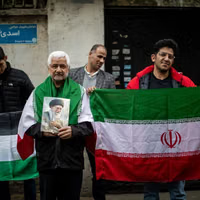
An Islamic Republic supporter holds a photo of Supreme Leader Mojtaba Khamenei during a state-run rally. / Photo by IRNA
Iran's unseen supreme leader has issued his first military decrees, raising a central question about the emerging order under Mojtaba Khamenei: is he tightening his grip on power, or relying on the old security establishment to shore up his authority?
The six decrees named Ali Abdollahi chief of staff of the armed forces, with Kioumars Heydari as his deputy; Ahmad Vahidi commander-in-chief of the Revolutionary Guards, with Mostafa Izadi as his deputy; Ali Azmaei commander of the Guards' navy; and Hossein Taeb, the feared former intelligence chief of the Guards, head of the Basij.
Separately, Mohsen Rezaei, the former Guards commander named Khamenei's military adviser in March, became secretary of the Supreme National Security Council and the leader's representative on the body.
The appointments put veterans of the Guards, intelligence services and Iran-Iraq war generation across the upper reaches of the security establishment. But rather than marking a wholesale changing of the guard, they draw heavily on figures who built their careers under Ali Khamenei — leaving open whether the new supreme leader is imposing his authority on the system or assembling an experienced security bloc whose support he needs to exercise it.
Khamenei's directives suggest the changes are not simply about personnel. In his appointment decree for Vahidi, he called for strengthening the force's capabilities for “maximum deterrence” and maintaining readiness to carry out “powerful offensive operations against the enemy.”
Lawmaker Ebrahim Rezaei described the appointments as “basically an indication of the fact that the Islamic Republic is moving toward a more offensive military structure.”
War commanders move to the top
The clearest sign that Khamenei may be changing how the military is run, rather than merely replacing its commanders, lies in the elevation of Abdollahi and Heydari from the Khatam al-Anbiya Central Headquarters to the two highest positions in the Armed Forces General Staff.
The General Staff is Iran's highest military coordinating body, while Khatam Central Headquarters has a more operational wartime role, coordinating military activity across different branches.
There has been no confirmed announcement that the two bodies have formally merged, but pro-establishment commentator Mohammad-Sadegh Alizadeh said the appointments confirmed a process of centralizing Iran's military command.
“The merger of Khatam al-Anbiya Central Headquarters and the Armed Forces General Staff means concentrating the country's wartime, military and offensive activities,” he wrote on X, adding that Abdollahi's decree explicitly tasked him with completing the process.
Abdollahi previously served as coordination deputy of the General Staff and deputy commander of Iran's police. Heydari commanded the regular Army Ground Forces for more than seven years before moving into Khatam's command structure in late 2025.
Heydari's appointment also preserves a senior regular Army presence near the top of a leadership heavily populated by Revolutionary Guards veterans, suggesting that greater centralization does not necessarily amount to straightforward IRGC domination of the command structure.
Taeb’s return puts domestic security in focus
If the Abdollahi and Heydari appointments point to tighter wartime command, Taeb's return to the Basij reveals the domestic-security side of Khamenei's emerging structure.
Taeb commanded the Basij during the unrest following Iran's disputed 2009 presidential election and later spent more than a decade heading the IRGC Intelligence Organization before his removal in 2022.
Khamenei's decree calls for strengthening what it describes as the Basij's “popular intelligence network,” drawing attention to the surveillance and internal-security component of Taeb's mandate.
New York-based journalist and Middle East writer Séamus Malekafzali said Taeb's return was particularly significant given his intelligence background.
“Taeb spent 13 years after leaving the Basij as the head of IRGC intelligence,” he wrote on X on August 10. Referring to Khamenei's directive for a “grassroots confrontation with enemy threats,” he added that it “certainly sounds like making sure the January protests never happen again.”
Taeb has also long been identified with Mojtaba Khamenei's security network. When he was removed as IRGC intelligence chief in 2022, Jason Brodsky, policy director at United Against Nuclear Iran, described the move as “an earthquake in Iran's intelligence community,” noting his close relationship with both Ali Khamenei and his son.
His return therefore restores a longtime Khamenei confidant to command of an organization embedded across universities, workplaces, neighborhoods and state institutions, and which has played a central role in surveillance, political mobilization and the suppression of protests.
Journalist Morteza Kazemian linked the appointment to worsening economic conditions and public discontent, arguing that Taeb had become one of Khamenei's trusted instruments of security and governance and that the Basij under his command was intended to embody the leadership's “iron fist.”
Rezaei comeback underscores reliance on old guard
If Taeb's return highlights Khamenei's reliance on trusted security figures, Rezaei's comeback makes the generational continuity harder to miss.
Rezaei commanded the Revolutionary Guards from 1981 to 1997, including through most of the Iran-Iraq war, before moving into politics and holding a succession of senior state positions.
He later served at the Expediency Council, repeatedly ran for president and became vice president for economic affairs under Ebrahim Raisi. Khamenei appointed him military adviser in March before naming him secretary of the Supreme National Security Council and his representative on the body less than five months later.
Journalist Ahmad Zeidabadi questioned why Mohammad Bagher Zolghadr had been replaced by Rezaei and what substantive change the appointment was intended to bring.
“What does the appointment of Mohsen Rezaei in place of Mohammad Bagher Zolghadr as secretary of the Supreme National Security Council mean, and what change is it supposed to bring to the way this position operates?” he wrote on X.
Some Iranian social-media users responded with mockery, reviving jokes surrounding Rezaei's repeated presidential campaigns and decades-long circulation through senior state positions.
The criticism reflected one of the broader themes surrounding the reshuffle: that Khamenei's first major appointments have elevated not a new generation of officials, but men who have occupied the Islamic Republic's military and political establishment for decades.
Vahidi promotion highlights hardline continuity
Vahidi's promotion adds another dimension to that continuity: the elevation of a commander whose record spans Iran's external military operations and domestic repression.
Vahidi had served as acting Guards commander following Mohammad Pakpour's death during the war with the United States and Israel. Khamenei formally installed him as commander and promoted him to major general.
He previously held senior roles in the Quds Force and served as defense minister under Mahmoud Ahmadinejad and interior minister under Ebrahim Raisi.
Argentine prosecutors have sought Vahidi in connection with the 1994 bombing of the AMIA Jewish community center in Buenos Aires, which killed 85 people. Iran denies involvement.
Israel's foreign ministry focused its response to the reshuffle on Vahidi and Rezaei, linking both men to allegations surrounding the AMIA case and accusing Tehran of elevating figures associated with attacks abroad.
“The Iranian regime worships terror, rewards its architects and promotes them to the highest levels of power,” the ministry said on X.
The United States has also sanctioned Vahidi over his role as interior minister during the suppression of protests following Mahsa Amini's death in custody in 2022.
But the wartime record of Vahidi, Abdollahi and Taeb also complicates the idea that their elevation simply represents Khamenei extending his personal control over the security apparatus.
President Masoud Pezeshkian accused Vahidi and Abdollahi of taking unilateral military actions that undermined efforts to secure a ceasefire, Iran International reported in April. The report also described a heated confrontation involving Taeb.
All three men now occupy senior positions in the military-security structure under Khamenei, raising the possibility that the new leader has elevated figures whose institutional power was already considerable before he formally appointed them.
Khamenei’s first imprint on security establishment
Several major international outlets interpreted the reshuffle as an early indication of how Khamenei intends to shape the security establishment after succeeding his father.
The Wall Street Journal portrayed the appointments as Khamenei putting his stamp on the national-security system and signaling a tougher approach toward Washington.
“Iran's mysterious ruler signals a hard line on Trump with new leadership,” the newspaper wrote.
The Financial Times focused on the promotion of loyalists and the possibility that Rezaei's return could point toward a harder line on the United States, while Reuters described Rezaei as a close ally of Khamenei and highlighted his recent opposition to extending a ceasefire and his skepticism toward negotiations with Washington.
Those readings emphasize Khamenei's role in choosing the new hierarchy. But the identities of the men he chose point just as strongly to continuity with the security establishment inherited from his father.
Iran International analysts had raised that tension even before the latest decrees.
The deaths of Ali Khamenei and other senior officials created a leadership gap in which his successor was still working to consolidate his position, Kazemian said in May.
After the appointments were announced, journalist Kamyar Behrang argued that the death of Ali Khamenei, who had served as the system's final arbiter, had given the Revolutionary Guards greater room to shape the political order that followed him.
The appointments can therefore be read in both directions. Khamenei is placing his own stamp on the military and security hierarchy, centralizing command and restoring trusted figures to key posts.
But he is doing so largely through men formed under his father's rule — veteran commanders and intelligence officials whose institutional weight may be as important to his authority as their loyalty to him.
The first map of power under Mojtaba Khamenei is taking shape. What remains unclear is whether these men are primarily instruments of his control, or the establishment on which that control depends.
Rising living costs have forced many Iranians to give up cafes and restaurants, turning a once-routine form of leisure into an expense increasingly squeezed out by rent, food and healthcare, messages to Iran International say.
“Cafe and restaurant outings are a form of recreation and something people look forward to, but inflation and rising costs have deprived many people even of that,” one audience member wrote.
Responses to an Iran International question about monthly cafe spending ranged from zero to hundreds of millions of rials. For many respondents, however, “nothing” and “zero” were the recurring answers.
When essentials leave Iranians nothing for a coffee
Several people said they had not visited a cafe or restaurant for months or years because rent, utility bills, medical care, food and debt payments had taken priority.
“How much do we earn in this inflation for anything to be left for recreation? We work from morning until night and can only pay the rent,” one person wrote.
Another said even buying enough food had become difficult.
A cup of coffee sits on a table inside a café in Iran.
“We are trying to be able to provide two meals a day. Going to a cafe has become completely out of reach for us,” the respondent wrote.
Healthcare expenses featured repeatedly in the messages. One person said a root canal on August 10 cost 120 million rials ($65), leaving no money for leisure or cafe visits.
Many Iranian workers earn around 200 million to 250 million rials ($108-$134) a month. The rial trades at around 1.86 million to the dollar on the free market.
Another, a retired education worker, said even one restaurant or cafe visit a year was unaffordable.
“I pay for medicine and doctors in installments,” the retiree wrote.
Others described a gradual erosion of living standards rather than a sudden end to leisure spending. One said the family had gone to cafes or restaurants around three times a month until relatively recently but was now buying basic necessities on credit.
“Expenses such as cafes and restaurants, recreation and travel disappeared a long time ago, and only essential costs such as healthcare, food, rent and installments remain,” another person wrote.
Some said even those essentials were becoming increasingly difficult to afford.
“We have become dependent on money for our daily bread. Where would we find money for cafes or eating out? Buying fruit has become a dream for us,” one person wrote.
Another said the family had been unable to afford recreation or leisure activities for about one or two years and believed much of society was focused primarily on getting by.
A simple cafe order costs millions of rials
Prices listed by cafes on SnappFood application show how quickly even relatively simple orders can add up.
An Americano at cafes reviewed by Iran International started at about 1.1 million rials ($0.59) and reached roughly 3.8 million rials ($2.04) at some establishments. Espresso prices exceeded 3 million rials ($1.61) in some cases.
Breakfast dishes started at around 2 million rials ($1.08) at some cafes, while options including omelets or bread, cheese and herbs could cost more than 4 million rials ($2.15).
One said two drinks and a slice of cake for two people now cost about 12 million rials ($6.45).
Another calculated that buying only a morning espresso every day would cost 60 million to 70 million rials ($32-$38) a month.
Prices vary substantially by city, neighborhood and establishment, but several cafe visits each week can push monthly spending into tens of millions of rials.
Millions spent to preserve a social life
Not everyone has stopped going. Some said they deliberately continued setting aside money for cafes despite rising costs, describing the outings as one of their remaining opportunities for socializing and escaping daily pressures.
Monthly spending among this group commonly ranged from 50 million to 100 million rials ($27-$54), according to figures respondents provided, with some putting their spending at 150 million to 200 million rials ($81-$108) or as much as 300 million rials ($161).
“Every day I buy a shot of coffee and a small bottle of water from a cafe, and maybe a vitamin C drink. I calculated that it comes to around 50 million rials ($27) a month,” one person wrote.
Another said they visited cafes at least 20 times a month.
The spending does not necessarily reflect financial comfort, according to some of the messages. Citizens described paying for cafes as a way to preserve a fragment of ordinary social life despite the squeeze on household budgets.
One person estimated that under current prices, even a relatively frugal young person could face monthly expenses of 150 million to 300 million rials ($81-$161), rising to between 400 million and 700 million rials ($215-$376) with greater spending, whether on cafes or other necessities.
Cafe owners squeezed by debt and closures
Cafe owners and workers who contacted Iran International described the other side of the contraction in discretionary spending: fewer customers alongside rising operating costs and debt.
People gather at a busy café in Tehran, Iran.
One respondent from Khuzestan said debt had forced them out of business.
“I have been unemployed for two months because of debt, I lost my cafe, my bank installments are overdue and there is nothing I can do,” the person wrote.
Businesses also face closures linked to enforcement of Iran's mandatory hijab rules. Another pointed to cafes being sealed in Qazvin over compliance with the dress code.
For many, cafe outings have therefore become another measure of shrinking household choices: eliminated altogether by some families and maintained at considerable cost by others seeking a few hours of social life outside the pressures of everyday expenses.