AI-generated image: A woman holds her wallet at a pharmacy counter as a pharmacist retrieves medicine, illustrating the growing financial burden of healthcare and medication costs in Iran.
Iranians are struggling to afford medicines and medical care, with some foregoing treatment as prices rise, drug shortages spread and insurance coverage falls short, according to accounts from patients.
Messages sent to Iran International on described medical bills consuming much or all of a typical monthly income, even for people covered by Iran’s Social Security Organization, the country’s main state-run social insurer.
One person undergoing tests for an abdominal and pelvic mass said CT and MRI scans, with and without contrast, cost 210 million rials ($113) despite having Social Security insurance.
“How are we supposed to pay these costs with such meager incomes?” the citizen said.
Many Iranian workers earn around 200 million to 250 million rials ($108-$134) a month, meaning the scans alone can cost roughly a month’s income. The rial trades at around 1.86 million to the dollar on the free market.
Another said an echocardiogram, electrocardiogram and clinic appointment cost 120 million rials ($65), with the medical provider requiring payment upfront rather than accepting Social Security insurance.
The patient was given documents to seek reimbursement from the insurer but said the process involved extensive bureaucracy and could result in only around half the money being returned.
A 33-year-old said the cost of dental treatment had left him without half his teeth.
“I feel like I’m 60,” he said. “The bitter part is that this humiliating way of life has become normal for me.”
A pharmacy in Iran
Another worker earning 10 million rials ($5.40) a day said an appointment with an ear, nose and throat doctor cost 5 million rials ($2.70), followed by 8.6 million rials ($4.60) for medicine.
“We really cannot afford to live anymore,” the worker said.
Lawmaker says shortages could worsen
The accounts echo comments from Salman Es’haghi, spokesman for parliament’s Health and Treatment Committee, who said shortages and rising prices were already causing some patients to stop treatment.
Around 43 medicines are in “critical shortage” and nearly 1,000 pharmaceutical products face some degree of shortage, Es’haghi told the Tabnak news website in an interview published Saturday.
Prices for chemotherapy drugs and medicines used by patients with cancer, hemophilia and thalassemia have risen enough to reduce consumption, with some patients stopping treatment because they cannot afford it, he said.
Es’haghi said patients now pay more than 70% of their healthcare expenses themselves, despite policies intended to leave individuals covering around 30% and the government and insurers paying the remainder.
Some hospitals and pharmacies are also refusing to provide certain services or medicines because insurers have delayed reimbursements or failed to pay them in full, he added.
The difficulties described by Iran International’s audience reflected those problems. One viewer said a packet of Sertraline tablets that previously cost 500,000 rials had risen to 8 million rials, a sixteen-fold increase.
Another said the cost of healthcare had left the family worried about something as routine as a child catching a cold during the winter.
“We’re stressed about where we would get the money for treatment if, God forbid, we or our children even catch a cold,” the audience said.
Drug subsidy faces uncertain future
The pressure could intensify if the government removes preferential foreign currency for medicines and medical equipment from the budget for the Iranian year beginning in March 2027, Es’haghi warned.
Iran has used preferential exchange rates to lower the rial cost of importing medicines, pharmaceutical ingredients and medical supplies. Removing that support can expose producers and importers to much higher exchange rates and ultimately increase prices for patients.
Discussions about eliminating the preferential rate have been under way since late 2025, with the government viewing the change as a possible way to address corruption and preferential access to subsidized foreign currency, Es’haghi said.
“If the currency allocated to medicines and medical equipment is removed from next year’s budget, it could become a ‘year of patient slaughter,’” Es’haghi said.
Iran International reported in April that prices for some domestically produced insulin had risen by as much as 212% compared with before the Persian New Year in March, while some imported varieties had increased by as much as 271%.
Pharmaceutical industry figures have attributed rising production costs to a combination of exchange-rate changes, the rial’s depreciation, more expensive raw materials and packaging, higher wages and financing costs, and disruption to supply chains from war.
Es’haghi said more than 70% of medicines had increased in price and argued that authorities should tackle corruption through closer oversight of the pharmaceutical supply chain rather than eliminating subsidized currency.
For patients confronting medical bills comparable to their monthly earnings, however, the pressure is already being measured in delayed care, abandoned treatment and anxiety over whether they can afford the next illness.
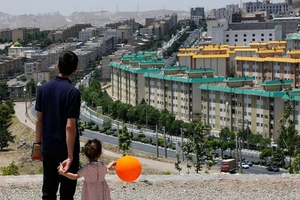
Residential apartment blocks on the outskirts of Tehran.
Average advertised monthly rent in Tehran has climbed above 720 million rials, roughly three times the earnings of many Iranian workers, exposing a widening affordability gap as some tenants face increases of up to 100%, market data showed in late July.
Tindex, an Iran-focused economic data platform tracking housing listings and other market indicators, put average advertised monthly apartment rent in Tehran at about 723 million rials, or roughly $389 at an open-market exchange rate of 1.86 million rials to the dollar, in its late-July data.
The figure is based on advertised properties rather than completed rental agreements, but provides a snapshot of prices confronting tenants searching for homes in the capital.
Monthly salaries for many Iranian workers are commonly put at around 200 million to 250 million rials, equivalent to roughly $108 to $134 at the same exchange rate. That means the average advertised rent can approach three times the upper end of that monthly salary range.
Rent increases reach 100%
The pressure becomes greater when tenants seek to renew their leases.
Rokna News reported on Sunday that rents have risen by 70% to 100% in parts of Tehran, far exceeding the 25% ceiling set for the capital by the Supreme Housing Council.
Prospective tenants look at property listings displayed at a real estate agency in Tehran, Iran.
The findings point to a wide divide between restrictions imposed by authorities and the increases some landlords demand from tenants.
A member of parliament’s construction committee also acknowledged that government rent restrictions are widely disregarded.
“The 25% rent increase is clearly not being observed, and in practice landlords do not implement it,” Alireza Novin said.
Some landlords justify increases of more than 50% by pointing to inflation of around 60%, but rents should not simply rise at the same rate as broader prices, Novin said.
Weak government oversight has left the housing market largely unchecked, according to Novin, who called for stronger enforcement against those who disregard the restrictions.
“If we identify 10 violators and close their places of business, others will also understand that the law must be implemented,” Novin said.
Tenants can file complaints against landlords who breach the ceiling, but pursuing a case can lead to legal proceedings and uncertainty over whether the landlord and tenant can subsequently reach an agreement, according to Novin.
Housing costs reshape how Iranians live
Iran has been grappling with a prolonged housing affordability crisis as property prices and rents have risen faster than wages. Years of high inflation, currency depreciation and rising construction costs have pushed homeownership beyond the reach of many ordinary Iranians while increasing pressure on renters.
The pressure is particularly acute in Tehran, where roughly half of residents are renters.
Buying a home presents an even greater obstacle. Tindex put the average advertised value of a Tehran home at more than 240 billion rials, or about $129,000 at the open-market exchange rate, in late July, placing ownership far beyond the purchasing power of households dependent on ordinary salaries.
The widening gap between incomes and housing costs has also changed how some Iranians live. Tenants have moved from Tehran to cheaper cities or peripheral areas, returned to their parents’ homes or begun sharing smaller apartments with others to divide housing costs.
Housing experts have warned that continued movement toward cheaper areas on the outskirts of major cities could contribute to further expansion of informal settlements.
A view of residential buildings in central Tehran.
The government has sought to ease the burden through rent ceilings, deposit loans and measures intended to protect tenants. But the increases documented in Tehran show how difficult those policies are to enforce when housing costs continue to outrun earnings.
For workers earning around 200 million to 250 million rials a month, an average advertised Tehran rent above 720 million rials amounts to roughly three months of individual pay – before food, transport and other basic household expenses are considered.
A poster for the third season of Iranian reality show Eternal Love
Persian-language reality shows filmed outside Iran are giving young Iranians freedoms that would be impossible on television under the Islamic Republic, while revealing another side of life abroad: uncertainty over work, residency, identity and where ultimately to belong.
A new generation of Persian-language reality television has taken shape beyond the Islamic Republic’s borders, largely in Turkey and on YouTube, where programs built around dating, fashion, relationships and competition can show forms of social life that would be prohibited or heavily censored inside Iran.
The most prominent example is Eternal Love, a Persian-language dating show filmed in Turkey whose format resembles Love Island: young single men and women live together, form relationships and compete for love and prize money.
What looks familiar to international reality-TV audiences carries a different weight in the Iranian context. Contestants flirt, dance and drink, men and women date and touch openly, and women appear without the compulsory dress rules imposed inside Iran — all beyond what broadcasters operating under the Islamic Republic could show.
The popularity of such programs therefore reflects an unusual feature of contemporary Iranian culture: shows that could not legally be made for television at home are produced a short distance away and streamed back to viewers inside the country. Yet behind the relationships, arguments, clothes, tattoos and social-media controversies lies a broader story about migration, changing relations between women and men, economic insecurity, internet celebrity and a generation living somewhere between departure and arrival.
The contestants do not represent all young Iranians. Participation itself requires a degree of selection: the ability to leave Iran, willingness to expose private life, comfort before a camera and the capacity to turn oneself into a media personality. Their significance lies less in statistical representation than in how clearly they display some of the contradictions confronting a section of Iran’s younger generation.
Turkey as destination or waiting room?
For many Iranians, Turkey is not necessarily the final destination of migration but one of its first stops. Geographic proximity, comparatively easy travel and established Iranian communities have turned it into a space between origin and destination, close enough to remain tied culturally and socially to Iran while lying outside the Islamic Republic’s direct restrictions.
At the end of 2025, more than 3.6 million foreign nationals were living in Turkey, according to the International Organization for Migration, including 1,151,969 people with various forms of residence permits. Iranians were also among the main nationalities represented among applicants for and holders of international protection.
The more revealing issue, however, is not simply how many migrants are there but how temporary stays become prolonged lives. Someone who expected to spend months in Turkey may remain for years without knowing whether they will settle there, move to Europe or North America, or eventually return to Iran.
Under those conditions, temporary status becomes more than an immigration category. It shapes decisions about employment, money, relationships and family because long-term planning becomes harder when the country in which someone will live several years from now remains uncertain.
This is one of the central contradictions visible in the reality shows produced abroad. Leaving Iran can bring considerably greater freedom over clothing, dating, appearance and behavior in public, and the contrast is particularly stark in programs such as Eternal Love, where conduct that is ordinary in international reality television would be virtually impossible to broadcast from inside Iran.
A poster for the third season of Iranian reality show Eternal Love
Yet personal freedom does not necessarily bring stability. A migrant may have far greater authority over whom to date or what to wear while holding a temporary residence permit, working irregularly and remaining uncertain about the next country they will be able to call home. Migration therefore becomes more complicated than a simple movement from repression to freedom: someone may gain control over their body and private life while losing certainty over their economic and geographical future.
When attention becomes income
In those circumstances, appearing on a widely watched reality show can have value far beyond entertainment. Visibility itself can become an economic asset, particularly for migrants who may lack secure employment, savings or straightforward access to the labor market.
A contestant who enters a program with a modest following can emerge with thousands of new followers and convert that attention into advertising for clothing stores, beauty services, restaurants and other businesses aimed at Persian-speaking customers. Views and followers acquire monetary value, meaning the competition often continues after filming ends as former contestants try to preserve public attention and convert it into income.
This helps explain the continuing cycle of breakups, disputes, new relationships, accusations and public responses surrounding reality-show participants on social media. It does not mean that every conflict is manufactured, but platforms reward novelty and confrontation, allowing private life itself to become content. Romance, jealousy, friendship and heartbreak can produce views, turning experiences that once belonged largely to private life into part of a person’s professional capital.
The tattoos, piercings, clothing and carefully constructed appearances of many contestants can also be read within this broader context. For someone whose residency, employment and future country may lie partly outside their control, the body remains one of the areas over which they can exercise immediate authority.
For audiences inside Iran, that carries another meaning. The Islamic Republic has spent decades regulating appearance, particularly that of women, through compulsory dress rules and state intervention. A woman appearing freely before a camera without compulsory hijab therefore represents more than a different fashion choice; she also embodies the distance between two systems of living.
At the same time, leaving Iran does not necessarily erase attitudes formed there. Men and women may interact far more freely than Iranian state television permits, yet jealousy, controlling behavior, gender stereotypes and unequal expectations can survive in the new environment. Crossing a political border does not mean every social and cultural boundary has been left behind.
Those seeking fame and those trying to keep it
The sense of suspension extends beyond younger contestants. Some Persian-language programs made abroad are hosted by performers who achieved considerable fame inside Iran before leaving the country, creating a revealing contrast between participants hoping to become public figures and established celebrities trying to preserve or rebuild their careers before an audience they once reached through Iranian cinema or television.
Migration places the two groups in different circumstances but also gives them something in common: uncertainty over what comes next. For a well-known actor living abroad, hosting a YouTube program may offer a lucrative contract, continued access to a large Persian-speaking audience and the beginnings of a new professional life, but it may equally represent a temporary stage or a substitute for a career no longer available in Iran.
The uncertainty becomes clearer when the possibility of return is considered. Migration is not necessarily a one-way journey. Someone may live in Turkey today, try to move to Europe tomorrow and years later return to Iran for family, financial, professional or personal reasons.
There have been cases of Iranians who worked abroad before returning and later distancing themselves in Islamic Republic media from aspects of their previous activities or positions. Such examples cannot be generalized to the diaspora, but they illustrate how fragile the apparent finality of migration can be: someone convinced today that they have left permanently cannot know with certainty where they will live several years from now or what relationship they may then have with the country they left.
Watching possible futures
This may also help explain why reality shows made outside Iran attract such interest among audiences still living inside the country. Viewers are not simply watching young people date, argue or dress differently; they are seeing several possible futures compressed into the same screen — greater personal freedom, migration, unstable work, internet income, fame, failure, onward movement and even return.
That is what makes the shows more revealing than their often superficial plots suggest. They offer a view of a generation that can no longer be divided neatly into those who stayed in Iran and those who left. Some remain closely tied to Iran through language, family, culture and audience while living daily lives that no longer fully belong to the society inside its borders, without yet having put down durable roots elsewhere.
Even the media ecosystem surrounding them reflects that condition. The programs are Iranian in language, audience and cultural reference points but geographically foreign, watched inside Iran while being produced outside the Islamic Republic’s legal and social restrictions. Their participants address an Iranian public while trying to construct careers and identities in another country.
The deeper limbo, then, may not simply be between Iran and Turkey or Iran and Europe, but between a lost certainty and a future that has yet to take shape. Home is no longer only the place that was left behind, while the destination is not necessarily somewhere that has already been reached. The past remains present in language, relationships, fears and habits, while the future may still be too unstable to support a durable new identity.
In that setting, visibility can become more than the pursuit of celebrity. It can offer a way to build status, income and a sense of place when other fixed markers of life — country, profession, community and social position — have become uncertain.
Reality television did not create this condition and cannot explain an entire generation, but by moving Iranian lives into villas and studios outside the country and streaming them back across the border, it has made one part of that experience unusually visible: people who have escaped some of the restrictions of one society without yet acquiring the security of another.
For them, the defining question may no longer be simply whether to leave Iran, remain abroad or return, but where, amid greater freedom and persistent instability, it is possible finally to belong.
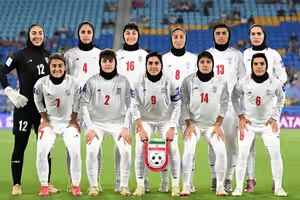
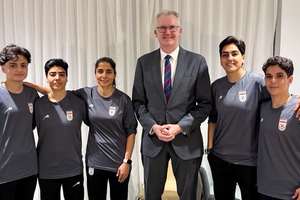
A file photo of the Iranian national football team in Australia
Late last month, Iran's finest striker sat across from the country's judiciary chief and asked him to help her find a job. Last week, two of her former teammates became Australian citizens. Between those two scenes lies everything the Islamic Republic offers its sportswomen.
In the video, Afsaneh Chatrenoor, a national team forward and four-time top scorer of Iran's women's league, faces Gholamhossein Mohseni-Ejei, the cleric who runs the judiciary. She recites her sporting record and asks him to intervene so that she can be formally employed, so that there is something for her when the football ends.
In a normal country, an athlete's livelihood is not the judiciary's business, and no one petitions a security official for a paycheck. The scene works differently in Iran, where basic rights are routed out of ordinary channels and reissued as favors, dependent on the recommendation, the intercession, the mercy of an official.
A woman footballer is first stripped of what makes an athletic career a career: professional contracts, job security, broadcast rights, media coverage, a visible future. Then, for a fraction of what was taken, she must sit before power and ask.
No one expects a footballer to become a dissident against a state that has answered protest with mass executions. But there is a long distance between fighting the system and petitioning it for mercy, and the space between those two points is where the rest of her team now lives.
The one who spoke
Zahra Alizadeh chose a different point on that line. When security forces massacred protesters in January, the forward announced she was leaving the national team in protest. Within hours, her post vanished from Instagram, amid reports of security threats against players and their families and pressure to delete anything that read as dissent.
Alizadeh was no fringe squad member. In the qualifiers that sent Iran to the Women's Asian Cup in Australia, she scored against Bhutan and set up a goal against Singapore. She was never called up again, and within months she walked away from football altogether.
The message to every woman still in the squad was unambiguous: the right to play lasts exactly as long as the silence about the killing does.
The ones who left, and the ones brought back
Weeks later in Australia, the quiet broke. Seven members of the traveling party moved to seek humanitarian protection, a walkout confirmed at the time by Iran International, with US President Donald Trump publicly urging Canberra to take them in.
Five reversed course and flew home. The reversal is not simple to read: it happened in an atmosphere of dread, fear for families in Iran, the watchful presence of federation security officers, and reports of pressure both direct and oblique, with threats attributed to the Revolutionary Guards.
Neither staying nor returning, as the circumstances stood, can honestly be called a free choice.
What the government did next completed the picture. The returned players were paraded at Tehran's Valiasr Square, presented as proof of love of homeland and the collapse of what officials called the asylum plot. The crisis became a pageant.
The star nobody recognized
One moment from that pageant deserves to outlive it.
Golnoush Khosravi, herself a national team player and one of the figures in the Australia episode, was handed a microphone and sent into the crowd at a state rally to ask people what they thought of the women's team and the affair she had been part of. The answers were warm.
People thanked the returned players, said they loved them, said they were proud of them.
Not one of them recognized the national team player holding the microphone.
That is the Islamic Republic's relationship with women's football, compressed into a single scene: a state that buses in crowds to celebrate players it has spent decades making invisible.
Women's matches are almost never broadcast; photography is restricted; the players compete in mandated full cover.
The country's champions can walk any street unrecognized, and when the government finally needed their faces for its own story, it discovered the erasure had worked too well.
In its pageant, the player is not an athlete with an identity, a record and professional rights; she is a prop for a narrative, thanked on camera by people who do not know that the woman interviewing them is on the team.
The invisibility of the women who play has an older twin in the women who watch. Stadiums have been closed to female fans since shortly after the 1979 revolution, a ban that took the life of Sahar Khodayari, the fan who set herself on fire in 2019 facing prison for sneaking into a match, and that has since eased only in small, revocable concessions extracted under FIFA pressure.
The ledger abroad
Meanwhile, the world keeps collecting what Iran discards. Taekwondo fighter Kimia Alizadeh, once the country's only female Olympic medalist, left declaring herself one of millions of oppressed Iranian women and won Olympic bronze for Bulgaria. Chess players Sara Khadem, Mitra Hejazipour and Dorsa Derakhshani now play for Spain, France and the United States. This month, weightlifter Yekta Jamali, who left as a teenage medal prospect, was named best lifter of the German Bundesliga final, according to Persian-language media reports.
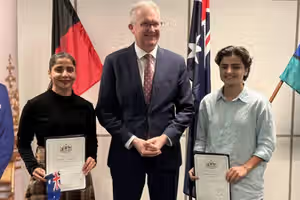
And on Wednesday, in Brisbane, Fatemeh Pasandideh, 22, and Atefeh Ramezanisadeh, 34, the two who did not board the plane home, received Australian citizenship at a ceremony attended by Home Affairs Minister Tony Burke.
Both now train with Brisbane Roar's women's side, and their passports make them eligible, one day, to play for the country that took them in.
"This citizenship is more than a certificate; it is a symbol of hope, safety and the opportunity to build a new future," Ramezanisadeh wrote. Pasandideh remembered "those who lost their lives or remain in prison."
Four roles, no future
One was erased for a sentence of protest. Some left home without the chance to say goodbye. Some came back and were placed inside a propaganda frame. And one, the best striker in the country, sat before the head of the judiciary and asked for a job.
These are not the same choices, and the women who made them do not bear the same responsibility. But they are all products of one structure, a system that recognizes only a few roles for a woman who plays football: silent, exiled, an instrument on a stage, or a supplicant before power.
What appears in none of these frames is the thing itself: an independent athlete whose success could buy her dignity, security and a future in her own country.
Chatrenoor says she does not regret coming home. Pasandideh is 22, with a passport, a club and a career ahead of her. Same team, same tournament, one flight's difference.
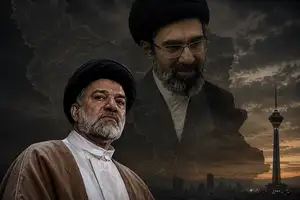
Iranian cleric Mohammad-Bagher Kharrazi was summoned to the Special Clerical Court after calling for the Islamic Republic to be replaced by a more hardline “Islamic government” and outlining plans to mobilize a 250,000-strong network capable of surrounding government sites.
Judiciary spokesperson Asghar Jahangir said on Saturday that legal proceedings began immediately after Kharrazi's recent remarks and that he had now been summoned to the court, which handles cases involving members of the clergy.
“Immediately after his recent remarks, legal action was initiated to prosecute him,” Jahangir said, adding that Kharrazi's case was under criminal investigation and further details would be released after the proceedings.
‘Islamic Republic doesn't work anymore’
In a video released this week, Kharrazi said the Islamic Republic had “reached a stage where, in this form, it simply doesn't work anymore” and said his organization had already drawn up plans for replacing it with an “Islamic government.”
Kharrazi, who heads the Hezbollah of Iran organization, said his group had produced 60 volumes of plans covering state institutions and had maintained what he described as a “shadow government.”
He also outlined a recruitment drive intended to build a nationwide network of 250,000 supporters, saying it could “surround all the ministries” and converge on Tehran following a single announcement.
“Mr. Khamenei and the government must understand that a 250,000-strong organization stands ready to move,” he said.
Kharrazi also attacked President Masoud Pezeshkian, calling him a “buffoon” who “understands nothing,” and said his government “will not reach its end.”
Claims about Khamenei
Kharrazi is tied by marriage to Iran's ruling family: his sister is married to Masoud Khamenei, a brother of Supreme Leader Mojtaba Khamenei.
He has also presented himself as a longtime confidant of the new supreme leader, saying he has known him for four decades and held numerous private meetings with him. In his latest remarks, Kharrazi said Mojtaba Khamenei's thinking was “far more radical than his father's.” His accounts of private conversations and the supreme leader's views cannot be independently verified.
The leader's office had already publicly rejected earlier remarks Kharrazi attributed to Mojtaba Khamenei, including that Pezeshkian's next resignation would be accepted, describing them as unauthenticated and false.
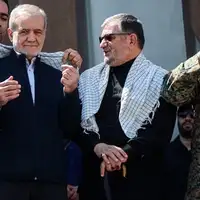
Iran's President Masoud Pezeshkian (left), Parliament Speaker M.B. Ghalibaf, and Judiciary Chief Mohseni-Ejei attend a funeral ceremony for slain Supreme Leader Ali Khamenei in July 2026.
Ending the Iran war could expose the Islamic Republic to one of its greatest vulnerabilities, experts say, as Tehran confronts a battered post-war economy that may strain its ability to finance the institutions underpinning its rule.
From a strictly economic perspective, former US Treasury official and sanctions strategist Miad Maleki says the greater danger to the regime may emerge once the fighting stops and it must govern a country burdened by soaring inflation, reconstruction costs and years of economic decline.
"If the conflict ends today, then you're going to see the economic effect of the war doing its work," Maleki told Eye for Iran.
"That would be very scary if I was an Iranian regime official, having to face the reality of a post-war economy."
Maleki argues Iran is already inside what he describes as a "tipping zone," where years of inflation, currency depreciation and economic mismanagement have steadily eroded purchasing power.
The question, he says, is no longer simply whether the government can continue paying salaries, but whether those salaries still buy enough to sustain loyalty.
"The salary might keep coming," he said. "You just won't be able to afford very basic needs."
The scale of that pressure is reflected in official consumer-price data.
In June, food and non-alcoholic beverage prices were nearly 134% higher than a year earlier, while prices for oils and fats rose about 278% and meat about 172%, according to data from the Statistical Center of Iran.
Those increases squeeze not only ordinary households, counterterrorism and security specialist Roger Macmillan argues, but also lower-ranking members of the Basij, IRGC conscripts and their families—people drawn from the same society on which the state relies to maintain internal security and suppress dissent.
"The real question isn't how much damage a bomb can do," he said. "It's what happens when the money stops moving."
Iran's financial center of gravity
Military pressure has dominated discussion of Iran for months, with much of the debate centered on missile stockpiles, drone production and how long it might take Tehran to rebuild its military capabilities.
Macmillan argues that focus overlooks something more fundamental.
"They are built to absorb military pressure," he said. "But are they able to absorb payroll pressure?"
His argument is not that economic pressure alone will weaken the regime. Rather, he says policymakers should focus on disrupting the broader financial ecosystem that allows the Islamic Republic to function, from government payrolls to military-linked economic networks.
"We need to be looking at the financial center of gravity, which is not just the payroll but also the military bonyads," he said.
Bonyads are powerful quasi-official foundations that expanded after the 1979 Islamic Revolution, with some of the largest developing extensive holdings in sectors including banking, construction, manufacturing, agriculture and energy.
Major foundations enjoy significant economic privileges and limited public oversight, and several are overseen by or closely connected to institutions under the Supreme Leader.
Some have also served as important patronage networks and maintained extensive economic links with Iran's political and security establishment.
For Macmillan, the question is not simply how much revenue those networks generate. It is whether they can continue supporting rank-and-file security forces if inflation keeps eroding wages while the government takes on the additional burden of rebuilding a post-war economy.
"What we need to look at is how we can remove the will, shatter the cohesion and the will of the foot soldiers from the Basij and from the IRGC, and separate them from the state," he said.
The argument represents a different way of thinking about pressure on Iran.
Rather than asking only how much military capability can be destroyed, Macmillan and Maleki argue policymakers should also consider how much financial strain the Islamic Republic can absorb before maintaining the institutions that enforce its rule becomes increasingly difficult.
Peace itself could reduce some war-related economic pressures, particularly if it improves trade conditions or is accompanied by sanctions relief. But Maleki argues it would also force Tehran to confront accumulated economic problems while meeting the costs of reconstruction.
For him, that may be precisely where the regime is most vulnerable.
"The most punishing thing they can do to this regime is send it back to govern Iran in a state of peace and face the reality they had to kill their way out of," Maleki said.