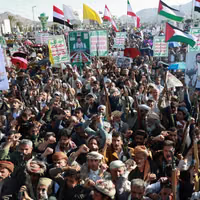
Participants take part in a state-organized Janfada mobilization event in Rasht, northern Iran, on October 15, 2026.
A growing number of former Iranian officials and political figures are calling for an agreement with the United States, while hardliners and military commanders continue to push for confrontation, exposing a deeper struggle over the direction of Tehran’s foreign policy.
Among the latest voices calling for a change of course are former President Hassan Rouhani, former Tehran mayor Gholamhossein Karbaschi and Hossein Marashi, secretary-general of the centrist Executives of Construction party.
Along with several other political figures, they have argued that Iran needs to reduce tensions with the United States and break its prolonged diplomatic impasse if it is to ease economic pressure and resume development.
Their interventions have come against a sharply different message from hardliners and military officials, who continue to frame resistance to Washington and Israel as essential to Iran’s security and warn against concessions under pressure.
The competing messages reflect a broader uncertainty at the heart of Iranian foreign policy: whether Tehran should use diplomacy to secure an exit from its confrontation with the United States or continue to raise the costs for its adversaries in the hope of extracting better terms.
The question has become more urgent after months of direct conflict with the United States, repeated warnings from Washington and Israel and several major waves of domestic unrest since 2018.
Those pressures have left the leadership increasingly sensitive to questions of public legitimacy while also making major diplomatic concessions politically dangerous. Any compromise with Washington risks being portrayed by rival factions as capitulation, giving decision-makers an incentive to postpone choices rather than assume responsibility for them.
Diplomacy without a clear destination
Hamid Aboutalebi, a former diplomat close to Rouhani, described that dilemma in an interview with Khabar Online this week, arguing that Iranian diplomacy has become caught between the urgency of immediate conflicts and the absence of a clearly defined long-term strategy.
The result, in his assessment, is a state of drift in which public expectations increasingly collide with geopolitical realities.
Aboutalebi’s criticism goes beyond whether Iran should or should not negotiate with Washington. He argues that Tehran has failed to clearly define the purpose, scope and desired outcome of diplomacy itself.
Without that clarity, he said, Iran cannot transform developments on the battlefield into political gains and is left “reacting to events rather than shaping them,” particularly in its confrontation with Israel and the United States.
That uncertainty is also visible in the government’s public messaging.
Many Iranians look to diplomacy primarily as a possible route toward economic relief and greater stability. Iranian officials, however, continue to alternate between warnings of further resistance and indications that negotiations remain possible.
The result is an expanding gap between what diplomacy is expected to deliver and what the government is prepared to commit to.
Aboutalebi argues that Iran must move beyond managing one crisis after another and instead define what it wants its foreign policy to achieve over the longer term.
That would require, in his view, deeper regional integration, a structured approach to the nuclear dispute and the development of economic partnerships capable of reducing Iran’s isolation.
The cost of suspended diplomacy
The argument is not new.
Tejarat-e Farda, one of Iran’s leading economic weeklies, has previously described the country’s approach as one of “suspended diplomacy” — a condition in which Tehran neither moves decisively toward confrontation nor commits itself to meaningful negotiations.
The magazine portrayed the consequences in unusually bleak terms, arguing that Iranians had come to recognize what it called the “tragic depth” of the country’s foreign-policy failures, producing not confidence or enthusiasm but “lethargy and despair.”
Writing in 2022, the publication argued that Iranian foreign policy had entered a prolonged state of strategic hesitation driven by domestic political caution, regional pressures and fear of diplomatic steps that might prove difficult to reverse.
The nuclear issue offered perhaps the clearest example.
Political analyst Fatemeh Mosayebi argued at the time that Tehran repeatedly signaled its willingness to engage in dialogue while avoiding concrete commitments, contributing to a cycle of hesitation in which neither Iran nor Western governments wanted to make the first major move.
Four years later, the circumstances are radically different, but the diagnosis retains much of its relevance.
Iran has moved from indirect regional confrontation to war with the United States, while the costs of economic pressure and military escalation have risen substantially. Yet the fundamental question identified in the earlier debate remains unresolved: what outcome is Iranian diplomacy actually intended to achieve?
Domestic rivalry further complicates the answer. Major foreign-policy decisions in Iran carry consequences not only for relations with Washington but also for the balance of power among competing political camps.
A failed compromise can be weaponized by hardliners, while escalation that imposes additional economic or military costs can become ammunition for their opponents.
That dynamic encourages delay. Tejarat-e Farda called it a “suspension of decision,” arguing that postponing difficult choices can ultimately “cost more than confrontation” by prolonging economic pressure without producing corresponding strategic gains.
The increasingly public calls for negotiations suggest that the price of that indecision is becoming harder to ignore.
Figures such as Aboutalebi and Marashi are not simply arguing for another round of talks. Their criticism raises a more fundamental question about whether Iran can continue simultaneously threatening escalation, signaling openness to diplomacy and postponing decisions about the compromises any agreement would ultimately require.
For now, Tehran continues to preserve both possibilities.
But the longer Iran remains caught between confrontation and compromise, the harder it becomes to present uncertainty itself as a strategy.
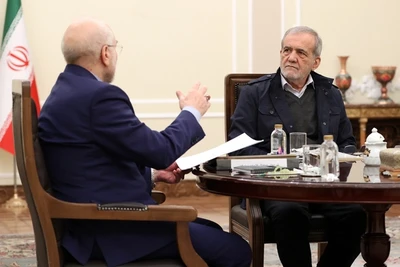
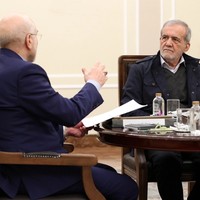
Iranian parliament speaker Mohammad Bagher Ghalibaf (left) and President Masoud Pezeshkian
Iranian Parliament Speaker Mohammad Bagher Ghalibaf says part of the government’s anti-terror financing regulations violates Iranian law, adding that decisions on who is designated as terrorist must remain with the Supreme National Security Council.
In a letter to President Masoud Pezeshkian, Ghalibaf objected to amended government rules that kept national working groups involved in deciding which individuals, groups and organizations should face terrorism-related financial restrictions.
The rules cover measures including freezing or blocking assets.
Ghalibaf said Iranian law gives the Supreme National Security Council responsibility for identifying terrorist individuals, groups and organizations, and that the government could not give that authority to its own working groups.
What did the government change?
The cabinet adopted regulations setting out how terrorism-related financial restrictions should be applied.
They created a national working group to review cases involving people and organizations that could be placed on terrorism-related lists. The group also had a role in decisions that could lead to assets being frozen.
The government later amended the rules so that the working group would be established with the Supreme National Security Council’s approval and operate under its direction.
But the amended rules still allowed the group to make some listing decisions. Ghalibaf said that remained inconsistent with the law because the council itself, rather than a government working group, has the legal authority to determine who Iran considers terrorist.
The letter concerns the government regulation used to implement the law, not Iran’s underlying law against terrorist financing.
It also does not address Iran’s membership in international treaties. The issue is narrower: whether the cabinet gave its working groups powers that Iranian law reserves for the Supreme National Security Council.
Ghalibaf issued the finding through Iran’s established system for reviewing cabinet regulations. His letter says the government must correct the disputed provision within the legal deadline and that the part found unlawful will lose effect if it is not corrected.
Why this matters internationally
The dispute comes as Iran tries to address shortcomings identified by the Financial Action Task Force, or FATF, the international body that sets standards against money laundering and terrorist financing.
Iran has remained on FATF’s high-risk list since 2020. FATF says Tehran has still not completed most of the action plan it accepted in 2016 and continues to call on other countries to apply financial countermeasures.
Those measures are separate from US sanctions, but both make it harder for Iranian banks and businesses to maintain normal relationships with financial institutions abroad.
One of FATF’s outstanding demands is for Iran to have an effective system for identifying and freezing terrorist assets in line with relevant UN Security Council resolutions.
Iran has already changed laws and joined two treaties
Iran has spent years changing its financial laws in response to FATF concerns.
It amended its domestic counter-terror financing law in 2018 and its anti-money-laundering law in 2019.
Last year, Iran also completed accession to two UN treaties that had been politically disputed for years: the Palermo Convention against transnational organized crime and the International Convention for the Suppression of the Financing of Terrorism.
Joining those treaties did not mean Iran joined FATF. FATF is a separate organization that judges whether a country’s laws and enforcement meet its standards.
Joining the treaties was not enough for FATF
Iran joined both treaties with reservations, including conditions allowing it to apply them within the framework of its own constitution and domestic laws.
In the case of the Terrorist Financing Convention, Iran also formally said the Supreme National Security Council would determine which individuals, groups and organizations it considers terrorist.
FATF said in June that Iran’s reservations to both treaties were “overly broad” and that its domestic implementation was still not in line with FATF standards. It also said Iran had failed to address the majority of its original action plan.
So Iran can legally be a party to the UN treaties while still falling short of FATF requirements.
The problem at the center of Ghalibaf’s ruling
The latest dispute goes directly to one of those unresolved questions.
Iran needs a system capable of identifying terrorist-linked individuals and organizations and freezing their assets. But under Iran’s own legal framework, Ghalibaf says the decision about who is considered terrorist must be made by the Supreme National Security Council, not delegated to government working groups.
The government must therefore adjust its implementation rules without weakening the financial controls Iran is trying to demonstrate to FATF.
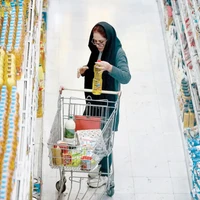
Shoppers browse household and personal-care products at a store in Iran.
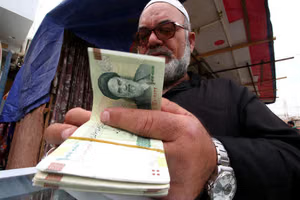
Iran’s central bank governor has dismissed claims of economic collapse, while domestic media reports describe wages failing to cover basic living costs and families struggling to afford medicines, housing and car repairs.
The contrasting accounts highlight the pressure on household finances even as officials say Iran’s economy is withstanding war and sanctions.
Central Bank Governor Abdolnaser Hemmati told an International Monetary Fund meeting in Bangkok this week that claims of economic collapse were an “illusion,” arguing that Iran had shown resilience despite US sanctions and military conflict.
The IMF forecast on Tuesday that Iran’s economy would shrink by 7.6% in 2026.
Hemmati said the central bank’s priorities were to contain inflation, maintain financial stability and keep banking and payment services operating. He said it had helped sustain essential imports by providing foreign currency for food and medicines.
He also urged the IMF to give greater weight to war, sanctions and restrictions on international payments when assessing member countries’ economic performance.
Alongside coverage of his remarks, Iranian outlets including Khabar Online carried reports detailing the erosion of purchasing power and the rising cost of everyday necessities.
Wages cover barely a week
Faramarz Tofighi, a former member of Iran’s Supreme Labor Council, told Khabar Online that the minimum wage now covered only eight days of a family’s living expenses, down from 15 days when it was approved in March.
He estimated the monthly cost of a working household’s basket of goods and services at 91.3 million tomans, far above workers’ earnings.
An increase of several million tomans in wages would do little to ease the pressure unless inflation was brought under control, he said.
Separate reports on medicine costs pointed to difficult choices over how to allocate limited resources.
Akbar Abdollahi-Asl, a senior official at Iran’s Food and Drug Administration, said supply disruptions and financial constraints were forcing authorities to weigh spending on expensive imported medicines against wider access to essential treatments.
A few doses of some specialized imported drugs cost between 200 million and 300 million tomans, he said, straining patients’ finances and the insurance system.
War and mounting economic pressure had made those decisions more difficult, he added.
Repairs postponed, homes out of reach
In Tehran’s Mellat Street and Cheragh Bargh auto-parts district, traders and repair businesses told Khabar Online that prices for some components had risen by 50% to 100% since the Iranian year began in March.
Business owners reported weaker demand as customers’ purchasing power declined. Motorists were spending longer comparing prices or postponing non-essential repairs.
Housing remained beyond the reach of many workers and salaried employees, according to another Khabar Online report quoting Kianoush Goudarzi, head of Tehran’s real estate consultants’ union.
He said prospective buyers struggled to raise enough money or obtain mortgages, leaving demand subdued despite broader inflationary pressures.
Presidential candidate Alireza Zakani attends a rally in Tehran on June 26, 2024.
Tehran’s hardline mayor Alireza Zakani has drawn accusations of using municipal resources to prepare for another presidential bid after announcing a freeze on basic food prices and payments to new parents.
The initiatives have won praise from conservative figures and media outlets, while raising questions about their financing, council oversight and the mayor’s priorities during wartime.
Under Zakani’s “Zero Inflation” plan, launched in late September, prices of 12 basic goods—including meat, rice, cooking oil, pulses and sugar—are to remain fixed for six months at municipal fruit and vegetable markets, Shahrvand supermarkets and the municipality’s online store, Shahrzad.
The scheme comes amid annual food inflation of nearly 130 percent.
Zakani said on television that the goods would be sold at cost, without profit, and that prices for a second six-month period would be announced after the first ended.
He portrayed the initiative as a response to what he called a US economic war against Iranians’ livelihoods. Financing would come from municipal funds, bank facilities and a Central Bank mechanism for settling foreign currency obligations, he said.
The mayor has also announced monthly municipal payments of 35 million to 40 million rials to families who have a child this year. Both initiatives have been widely advertised on billboards across Tehran.
Funding under scrutiny
Nasser Amani, a member of Tehran’s city council, said no formal bill had been submitted to the council and no specific budget approved for the price-freeze scheme.
Abdollah Ramezanzadeh, a spokesman for former reformist President Mohammad Khatami’s government, questioned where the money would come from and why the national government was not adopting the scheme if it made economic sense.
Moderate conservative commentator Mohammad Mohajeri called the plan “empty and nonsensical,” warning on X that it would lead to a “historic disaster.” He urged Tehran’s prosecutor to intervene to prevent what he predicted would become corruption.
Critics have also questioned the fairness of limiting the initiative to Tehran while residents elsewhere face rising prices.
Zakani’s supporters argue that municipal intervention could help poorer households.
Conservative politician Abdolreza Davari wrote on X that lower-income groups would be the main beneficiaries, while the losers would be the “oligarchic network dominating the basic goods market” and Zakani’s political rivals.
Hardline newspapers Kayhan and Javan, the latter affiliated with the Revolutionary Guards, have defended the initiative as an effort to improve livelihoods.
Javan accused critics of viewing every action by the mayor “through a political lens” and urged them to assess the plan’s economic and operational merits rather than speculate about future elections.
A platform for the presidency?
Zakani, a former lawmaker who has served as mayor since 2021, has sought the presidency four times since 2013. The Guardian Council barred his first two attempts. He was approved to run in 2021 and 2024 but withdrew before voting in both contests to support other conservative candidates.
Mehdi Aghrarian, another city council member, told the news website Khabar Online that he had challenged Zakani over his priorities.
“I told him that abandoning the municipality midway through your term, putting the plane on autopilot and heading off to pursue elections was not the right approach,” Aghrarian said.
He described Zakani’s activities as “performative governance” and offered this advice to the next council: “Please choose a mayor who does not want to become president.”
Khabar Online questioned whether Zakani was following the path of Mahmoud Ahmadinejad, who used the Tehran mayoralty as a springboard to the presidency. Reformist politician Ali Soufi drew the same comparison.
Zakani has faced controversy over other municipal initiatives, including the deployment of hijab enforcers and the establishment of so-called “repentance rooms” in metro stations.
After last year’s 12-day war, he made metro and bus rapid transit services free, continuing the policy despite opposition from the city council.
Praise at night-time rallies
A recently circulated video of Zakani attending a night-time pro-establishment gathering has added to speculation about his ambitions. In the footage, a young cleric urges the crowd to chant: “Zakani, hero! Thank you, thank you!”
The news website Rouydad24 questioned who was paying to promote Zakani at the rallies, which it described as increasingly factional.
Participants have chanted against figures including President Masoud Pezeshkian, parliament speaker Mohammad-Bagher Ghalibaf and Foreign Minister Abbas Araghchi, as well as former presidents and other prominent politicians, the website reported.
Zakani, by contrast, has received an unusually warm reception, it said.
Abbas Akhoundi (left) and Mohammad Khatami (center) in front of a cake at Khatami’s birthday celebration at the National Library of Iran in October 2026.
An armed man was arrested over an alleged plot to assassinate a former Iranian minister after a gathering attended by Mohammad Khatami, the former president associated with efforts to reform the Islamic Republic from within, Iran’s Reform Front said.
The event held at the National Library complex in Tehran marked Khatami’s birthday and brought together figures advocating changes to Iran’s domestic and foreign policies.
The suspect allegedly warned that others would pursue the attack on former roads minister Abbas Akhoundi and named additional assassination targets, raising concerns about threats to other political figures.
The reformist coalition said on its Telegram channel that the man confronted Akhoundi’s driver as the former minister was leaving the seminar organized by Khatami’s Baran Foundation.
The driver managed to disarm the attacker during the confrontation, and security personnel and police intervened to arrest him, according to the account, carried by Iranian news website Entekhab.
The account did not identify the suspect or the other purported targets.
On Thursday, the IRGC-affiliated Fars news agency, citing an unnamed security source, reported that the incident occurred several days earlier and remained under investigation.
The source said inquiries with legal authorities had so far found no indications that it was terrorist or organized in nature, and investigators were examining the possibility of a personal motive.
The source also accused foreign and opposition media of "exploiting the incident to deepen political divisions and portray Iran as internally insecure."
Akhoundi challenges official narratives
Akhoundi’s speech, titled “Global transitions, value chains and the architecture of Iran’s development,” challenged official portrayals of American decline and argued for an approach to security rooted in economic development and international engagement.
“Although America’s hegemonic power is diminishing, what is promoted in official media as ‘decline’ is not accurate,” he said. “We are facing the systematic containment of American power by emerging powers, not its destruction.”
He questioned whether Iran should use its position along global trade routes to generate prosperity or seek control over them, arguing that major economies, including China and India, would not tolerate prolonged insecurity along those routes.
Abbas Akhoundi addresses the seminar held at the National Library of Iran in October 2026.
Akhoundi also called for a shift from “threat-based survival” to “development-oriented prosperity.”
“Yes, we have survived, but in poverty,” he said.
Akhoundi questioned the strategy of securing Iran through involvement beyond its borders, including in Yemen and Lebanon. He called for a regional security model centered on cooperation and economic prosperity, arguing that the ambition to dominate the region had become an obstacle to understanding Iran’s place in the world.
His argument included support for increased defense spending, alongside stronger political, social and economic foundations for security.
Khatami questions intervention on Palestinians’ behalf
Khatami, speaking at the same event, condemned Israel’s establishment through what he described as occupation and force, while arguing that decisions about the Palestinians’ future belonged to Palestinians themselves.
“Occupation does not confer legitimacy,” Khatami said. “That is a matter for the Palestinian people themselves.”
He distinguished moral support for people seeking freedom from intervening and confronting a powerful adversary on their behalf.
“For me to leave here, go there, put myself in the place of those people and confront a powerful force on their behalf, only for them to end up suffering greatly and choosing a different path — that is something I cannot accept,” he said.
The Reform Front’s account did not establish any connection between the speeches and the suspect’s alleged intentions.
A Social Security hospital in Tehran has locked its main building and moved treatment into a cramped clinic in its courtyard, a member of the insurer’s healthcare oversight committee said, two months after officials listed it among the capital’s unsafe hospitals.
The main building of Shariat Razavi Hospital, run by the Social Security Organization, the state insurer that covers most of Iran’s workers and retirees, is deteriorating behind locked doors with its costly equipment still inside, Hossein Nategh told the labor-affiliated news agency ILNA on Thursday.
The move has turned a fully equipped hospital into what he called an outpatient clinic with the bare minimum of space, cutting the number of patients it can admit and the specialist care it can offer.
“The clinic set up in the yard has neither enough space for patients’ comfort nor the capacity to provide the services expected of a hospital,” he said.
The hospital’s equipment and funds belong to the workers and insured people who pay for them, Nategh said, and patients should not be left waiting in a cramped courtyard while the main building stands unused.
“If the building has a safety problem, why isn’t it being repaired? And if there is no plan to close it, why aren’t these resources being used?” he said. “This situation amounts to squandering the healthcare assets of the working community.”
He called for the main building to be reopened with its full equipment, or for an official explanation of why it was closed and what has happened to the equipment.
Neither ILNA’s report nor any statement from the Social Security Organization has explained why the building was closed or said what will happen to its equipment.
A list of unsafe hospitals
On August 18, Ali Nasiri, head of Tehran’s crisis management organization, named Shariat Razavi among 17 unsafe hospitals in the capital that were being made safe.
Warnings about the safety of Tehran’s buildings, hospitals among them, are not new. In 2024, the head of the city’s fire department said only 52 of the capital’s 189 hospitals had safety certification and that 125 were high-risk. In late 2025, a deputy fire chief, Kamran Abdoli, said 80,000 unsafe buildings had been identified in Tehran, about 27,000 of them high-risk.
Some of the warnings have ended in deaths. In June 2024, a fire at Qaem Hospital in Rasht, in northern Iran, killed at least nine patients with officials saying afterward that the hospital had never installed a fire suppression system despite earlier warnings. In early 2024, a fire broke out at Gandhi Hospital in Tehran, which fire officials said had received five safety notices beforehand and had faulty fire alarm and suppression systems.
Around the same time, Saeed Karimi, then the health ministry’s deputy for treatment, said about 100 hospitals were operating without a license because they had not fixed problems with safety or hygiene standards or with insurance contracts, and that closing them all at once would damage health services.