• العربية
  • فارسی
Brand
  • Iran Insight
  • Politics
  • Economy
  • Analysis
  • Special Report
  • Opinion
  • Podcast
  • Iran Insight
  • Politics
  • Economy
  • Analysis
  • Special Report
  • Opinion
  • Podcast
  • Theme
  • Language
    • العربية
    • فارسی
  • Iran Insight
  • Politics
  • Economy
  • Analysis
  • Special Report
  • Opinion
  • Podcast
All rights reserved for Volant Media UK Limited
volant media logo
VOICES FROM IRAN

As prices soar, Iranian diets shrink to survival level

Saba Heidarkhani
Saba Heidarkhani

Iran International

Jun 10, 2026, 01:30 GMT+1
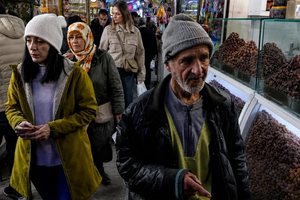
File photo of shoppers browse grocery shelves at a supermarket in Iran as households face rising living costs and inflation. The photo quality was enhanced using AI.

Citizens across Iran say soaring food prices have reduced household diets to the bare minimum needed to stave off hunger, with nutrition and variety increasingly out of reach.

Messages sent to Iran International from cities across the country paint a picture of households slipping steadily down the hierarchy of human needs.

Many say their tables have been reduced to the level of survival, where staying full matters more than quality, variety or nutritional value.

If many families had already removed red meat, fish and even chicken from their diets in recent years, messages received by Iran International suggest that fruit, eggs and dairy products have now also become luxuries for a large share of households.

Instead, they say they rely on filling foods such as pasta, potatoes, onions, bread and plain rice.

One citizen summed up the sense of despair bluntly: "If the Islamic Republic remains, we will be buried in the graveyard of our dreams."

Another said that most days their family eats little beyond potatoes, onions and lentil soup.

The accounts reflect a shift toward the most basic physiological needs required for survival, with little room for long-term health, development or security.

One citizen said that after months of buying food from weekly street vendors because shops had become too expensive, even those purchases are now out of reach.

"I only buy the absolute necessities now, things like potatoes, tomatoes and onions, and even then I buy the lowest-quality produce available," the person said.

File photo of a a woman shopping at a bakery in Tehran, Iran, amid rising food prices and persistent inflation.
100%
File photo of a a woman shopping at a bakery in Tehran, Iran, amid rising food prices and persistent inflation.

A resident of Isfahan said the family's meals now consist largely of potatoes, pasta, or bread and cheese.

Official figures show some food categories rising well into triple digits over the past year while wages have failed to keep pace.

According to Central Bank data for the past month, year-on-year inflation reached 161 percent for milk, cheese and eggs, 267 percent for oils and fats, and 176 percent for meat products.

Citizens reported that lamb currently sells for around 22 million rials ($12.5) per kilogram, while beef costs roughly 15 million rials ($8.5) per kilogram.

Masoud Rasouli, secretary of the Meat Packaging and Protein Industry Association, said in early June that demand for red meat had fallen by about 50 percent compared with the previous year.

Many families told Iran International they had eliminated animal protein entirely from their diets despite warnings from health experts that prolonged protein deficiencies can lead to widespread malnutrition, particularly among children and adolescents.

Doctors have warned that shrinking household food baskets and a shift toward cheaper, lower-quality products could contribute to rising rates of anemia, weakened immune systems and other long-term health problems.

'Nothing but bread and cheese'

Several citizens said an ordinary package of breakfast cheese now costs around 2 million rials ($1.1).

"Many days our lunch and dinner consist only of bread and cheese," one person said. "But even if you live only on bread and cheese, you would still need about 150 million rials ($85) a month."

Iran's minimum monthly wage currently stands at around 160 million rials ($90).

Citizens reported prices of around 250,000 rials ($0.14) for a single egg, more than 10 million rials ($5.6) for a liter of cooking oil, and about 5 million rials ($2.8) for a 2.5-kilogram container of yogurt.

Many said that salaries which barely reach 200 million rials ($113) a month have left them struggling to secure even protein-free meals.

The messages also point to a more troubling development: the gradual replacement of food with whatever can fill an empty stomach.

A resident of Tabriz said they now buy meat stock instead of meat simply to create the flavor of meat in stews.

A mother from Dehloran in Ilam Province said her children have not eaten meat for months and that even chicken has become unaffordable.

Others described selling household belongings to cover food expenses.

"We have cut costs everywhere possible and there is almost nothing left on our table," one citizen said. "I have not eaten a proper meal in a week. We are reaching a point where we cannot afford three meals a day."

For a growing number of Iranians, the question is no longer how to maintain a standard of living, but how to secure enough food to get through another day.

File photo of a billboard featuring Iran's 10,000-rial banknote is seen behind red traffic lights in Tehran, Iran.
100%
File photo of a billboard featuring Iran's 10,000-rial banknote is seen behind red traffic lights in Tehran, Iran.
Banner

Spotlight

  • Tehran pushes back on reported US plan for frozen assets
    INSIGHT

    Tehran pushes back on reported US plan for frozen assets

  • As prices soar, Iranian diets shrink to survival level
    VOICES FROM IRAN

    As prices soar, Iranian diets shrink to survival level

  • Iranian teens say rising costs turn simple wishes into distant dreams
    VOICES FROM IRAN

    Iranian teens say rising costs turn simple wishes into distant dreams

  • Faith in diplomacy further dented by Iran-Israel exchange
    INSIGHT

    Faith in diplomacy further dented by Iran-Israel exchange

  • 'Nothing is over':  Iran-Israel conflict enters a new phase
    ANALYSIS

    'Nothing is over': Iran-Israel conflict enters a new phase

Banner
  • Inflation pushes Iranians to buy food in installments

    Inflation pushes Iranians to buy food in installments

  • Millions face poverty as Iran’s economy reels from war and sanctions

    Millions face poverty as Iran’s economy reels from war and sanctions

•
•
•

More Stories

Iran eco-tourism operators warn of closures as travel dries up

Jun 9, 2026, 11:35 GMT+1
Iran eco-tourism operators warn of closures as travel dries up
100%
A guest room at a traditional Iranian eco-lodge

Tourism businesses report empty rooms, mounting losses and growing pressure to cut jobs as rising living costs push travel out of reach for many households.

Tourism businesses in Iran are struggling to survive as economic hardship and a sharp decline in travel leave eco-lodges empty, operators facing bankruptcy and workers at risk of losing their jobs, according to a report by Shargh newspaper.

Once promoted as a way to boost local economies and preserve traditional lifestyles, eco-lodges across Iran are now grappling with falling visitor numbers, rising costs and mounting financial pressure.

"The damage caused by the war will take months to repair, and tourism will need a long time to return to previous levels," Yavar Abiri, head of Iran's Association of Eco-Lodge Professional Societies, told Shargh.

  • Iran tourism officials stress reshaping global image after war

    Iran tourism officials stress reshaping global image after war

Abiri said many Iranians have shifted their priorities from travel to basic survival as economic uncertainty deepens.

"People are saving whatever money they have for essential needs in case another war breaks out," he said.

Travel slips down household priorities

Tourism operators say domestic travel had already been weakening before the latest economic shocks.

Official statistics cited by Shargh showed that nearly half of Iranian households did not take a single trip during the spring of 2024. Industry representatives say rising prices have forced many families to either cancel travel altogether or cut costs by camping, avoiding restaurants and reducing leisure spending.

Officials have also questioned whether travel remains a priority for many households.

Traditional Iranian rice dishes served at an eco-lodge restaurant
100%
Traditional Iranian rice dishes served at an eco-lodge restaurant

Hani Rastegaran, secretary of the National Travel Services Coordination Headquarters, previously described declining domestic travel as a warning sign for the tourism sector and called for an assessment of whether economic pressure had pushed travel out of family budgets.

Eco-lodges face closures

Mahlagha Mahdavi, who operates an eco-lodge in Shiraz and has worked in the sector for a decade, said the downturn has intensified over the past year.

"We faced a sharp drop in visitors and had to offer significant discounts because people simply could not afford to travel," Mahdavi told Shargh.

She said many eco-lodge employees are women and heads of households, prompting operators to avoid layoffs despite worsening finances.

"We do not know how long we can continue without reducing staff," she said.

Many former tourism operators, according to Mahdavi, have already left the industry, while the profile of travelers has changed. Visitors who once belonged largely to the middle class have been replaced by wealthier Iranians who can no longer justify foreign trips but continue to travel domestically.

Revenue collapses, costs soar

Operators in other provinces described similar challenges. Abas'ad Sharafkhani, who runs an eco-lodge in Hamedan province, said revenue between January and April amounted to only a fraction of what he had expected.

  • Foreign tourist arrivals to Iran plummet 75% after 12-day war, minister says

    Foreign tourist arrivals to Iran plummet 75% after 12-day war, minister says

"Out of the income I had projected, I earned only about 10 percent, and even that barely covered operating costs," he told Shargh.

Sharafkhani said many eco-lodges are nearing complete bankruptcy and that some properties sustained physical damage during the conflict.

He criticized authorities for failing to provide meaningful support or compensation.

Rising prices force cutbacks

Ahmad Kazemi, an eco-lodge operator in Khorasan Razavi province, said inflation has transformed the economics of the business.

"When we started in 2019, a sack of high-quality Iranian rice cost three million rials ($1.8). Now it costs 64 million rials (about $36)," Kazemi told Shargh.

He said accommodation packages that once cost 4000,000 rials ($2.2) now cost between forty and fifty million rials ($22-28), even after operators reduce their profit margins.

To cope with rising expenses, Kazemi said his lodge has removed lunch and dinner services and now offers only accommodation and breakfast.

A traditional courtyard at an eco-lodge in central Iran
100%
A traditional courtyard at an eco-lodge in central Iran

"People are not traveling for leisure the way they used to," he said. "Many now choose short local trips because they are cheaper."

Iran's minimum monthly wage is currently equivalent to about $90–$110, depending on exchange-rate movements, while labor experts estimate that many workers earn around $150 per month on average.

Industry operators told Shargh that without financial support and an improvement in household purchasing power, many of Iran's eco-lodges may be unable to continue operating, threatening jobs and a sector that was once viewed as a growing part of the country's tourism economy.

Iranian teens say rising costs turn simple wishes into distant dreams

Jun 9, 2026, 10:42 GMT+1

Simple pleasures, personal goals and everyday purchases have become out of reach for many Iranian teenagers, who told Iran International that economic hardship is reshaping their lives and dimming their hopes for the future.

Messages sent by teenagers described a growing gap between what they need and what their families can afford, with some saying even routine activities and modest purchases now feel unattainable.

Continue reading

Iranian teens say rising costs turn simple wishes into distant dreams

Jun 9, 2026, 09:37 GMT+1
•
Baharan Azadi
Iranian teens say rising costs turn simple wishes into distant dreams
100%
Iranian youth use their mobile phones as they walk at a park in Tehran

Simple pleasures, personal goals and everyday purchases have become out of reach for many Iranian teenagers, who told Iran International that economic hardship is reshaping their lives and dimming their hopes for the future.

Messages sent by teenagers described a growing gap between what they need and what their families can afford, with some saying even routine activities and modest purchases now feel unattainable.

One teenager said upgrading a computer has become unrealistic after the price of an 8GB DDR5 memory module rose to around 500 million rials (over $280).

Iran's minimum monthly wage is currently worth around $90-$110, depending on exchange-rate fluctuations, while estimates from labor experts put average monthly earnings for many workers at roughly $150.

"With these conditions, buying or upgrading a computer has become a dream," the teenager said.

  • Citizens report growing use of children in Iran security activities

    Citizens report growing use of children in Iran security activities

Another wrote that a mobile phone purchased for 500 million rials (over $280) in February is now worth 930 million rials (over $520).

Others pointed to the disappearance of simple recreational activities from their lives. A 15-year-old said swimming pool fees have more than doubled since early April, while another said that a bicycle that once cost 300 million rials (around $170) now sells for 620 million rials (about $350).

"We Iranian teenagers and young people have reached a point where eating one good meal makes us happy, while our peers in other countries have many things to enjoy," one message said.

Embarrassed to ask

Several teenagers said financial pressure has not only reduced their expectations but also left them feeling ashamed to express their needs.

They described watching their parents struggle with rising living costs and choosing to remain silent about things they want or need.

An 11-year-old girl said her birthday falls in September but she is embarrassed to ask her father to organize a celebration.

She questioned why having a birthday party should be considered a wish rather than a normal part of childhood.

A group of teenagers sit on a bench with skateboards, looking at their phones and talking outside a building.
100%
A group of teenagers sit on a bench with skateboards, looking at their phones and talking outside a building.

A 14-year-old wrote: "Whenever I ask my parents for something, they say they don't have the money. I feel ashamed when I sit at the dinner table."

Another 15-year-old said gym membership fees had tripled.

"I feel guilty asking for things I need because I know dealing with these prices is not easy for my parents," the teenager wrote.

Some others said they increasingly feel like a burden on their families. One wrote that their parents regularly give up their own wishes to provide for their children, while another said the feeling of being an extra weight on the family has become constant.

A 14-year-old girl said she feels guilty whenever her parents buy something for her and has become pessimistic about her future.

Adult worries replace childhood concerns

Some said their attention has shifted from hobbies, friendships and future plans to concerns about war, economic conditions and daily news.

"Whenever I think about war and ceasefires, I cry," one teenager wrote. "Why can't I enjoy life like other teenagers or go to school wearing what I want?"

A 12-year-old asked why children should be preoccupied with current events instead of enjoying their free time.

Several said the issues occupying their minds resemble adult concerns rather than those usually associated with adolescence.

"I should be thinking about having fun and playing, not working or worrying about politics and the price of gold and dollars," one teenager wrote.

Comparisons with teenagers abroad appeared frequently in the messages.

A 16-year-old girl said she works instead of pursuing leisure activities and is often too exhausted to remain on her feet.

A university entrance exam candidate wrote that seeing graduation celebrations in other countries leaves the strongest sense of longing.

Growing uncertainty about the future

Several teenagers said they struggle to imagine a future for themselves at a stage in life when they should be exploring talents, setting goals and pursuing ambitions.

An 18-year-old said the country's conditions have left little motivation even for ordinary daily life, let alone planning for the future.

Another wrote that, despite being only 18, they are already watching their hopes and ambitions fade.

  •  Tehran’s youth emerge from war more cynical, not more hopeful

    Tehran’s youth emerge from war more cynical, not more hopeful

A 15-year-old said economic pressure, exhaustion and disappointment have become part of everyday life and make long-held aspirations feel impossible to achieve.

Some said uncertainty is even shaping major life decisions.

A ninth-grade student wrote that although they would like to choose an academic path based on personal interests, the future feels so unpredictable that passion has become a luxury.

Instead of focusing on dreams, the student said thoughts are dominated by rising prices, war and the memory of those who have died, creating a sense of being trapped with no clear path forward.

Iran judge says asset seizures will weaken diaspora’s anti-regime protests

Jun 9, 2026, 06:47 GMT+1
Iran judge says asset seizures will weaken diaspora’s anti-regime protests
100%
Iranian expatriates rally against the Islamic Republic and in support of exiled Prince Reza Pahlavi on the National Mall, in Washington, DC, on March 29, 2026.

Confiscations of assets belonging to exiled Iranians will weaken their protests in front of the Islamic Republic’s embassies overseas, a judge said on Tuesday.

“When an expatriate sees that a home, shop or any other asset they owned in Tehran, Isfahan or any other Iranian city has been seized, anti-Iran gatherings outside embassies of European and American countries clearly become emptier, weaker and more hopeless,” said the head of Isfahan province’s judiciary, according to judiciary-linked Mizan News.

Asadollah Jafari described the seizures as a judicial tool to counter what he called “the enemy’s economic and media war.”

Iranian judicial authorities have been ordering the seizure of assets belonging to dozens of people, many living abroad, over allegations of cooperation with Israel and actions against national security.

Since the January protests, Iranians abroad have held regular demonstrations outside Iran’s embassies and consulates in Europe, North America and elsewhere, in support of protesters inside Iran and against the Islamic Republic’s crackdown.

Jafari said the confiscation of assets belonging to expatriates are aimed at having a “deterrent effect.”

'Nothing is over': Iran-Israel conflict enters a new phase

Jun 8, 2026, 21:33 GMT+1
•
Negar Mojtahedi
'Nothing is over':  Iran-Israel conflict enters a new phase
100%
This photograph captures two armed soldiers standing in front of a large Lebanese flag during a public event. The scene appears to be part of a security operation or demonstration, with the soldiers positioned in front of a crowd.

Iran and Israel have paused direct attacks, but Tehran's latest warning suggests the conflict may be evolving rather than ending.

On Monday, Iran said it would suspend operations against Israel but warned attacks would resume if Israel continued striking Lebanon.

Israel rejected the condition, with Prime Minister Benjamin Netanyahu accusing Tehran and Hezbollah of trying to create a new equation in which attacks on Israel would no longer carry consequences.

The development has fueled debate over whether the latest ceasefire represents the end of the fighting—or merely the end of its first phase.

A ceasefire tied to Lebanon

For UAE-based analyst Amjad Taha, the answer is straightforward.

"It's a pause rather than a ceasefire or an end of war," he told Iran International.

Taha argues that Tehran's decision to link its ceasefire to Lebanon reveals that the Islamic Republic continues to view regional conflicts through the lens of its proxy network.

"The fact that the Islamic regime right now says it's fighting and its condition in Lebanon ceasefire with its own, it tells us that Iran's, the Islamic Regime still sees Lebanon and other countries as its own proxy and its own extension," he said.

In his view, the current calm risks postponing rather than resolving the underlying conflict.

"If the ceasefire happens right now, we are just postponing another 7th of October-style event, but this time across the Middle East, not just the state of Israel."

Elizabeth Tsurkov, a fellow at the New Lines Institute, sees Iran's Lebanon condition as part of a broader effort to shape the post-war landscape.

"It appears clear that the Iranian regime believes that it won the 40-day war and is therefore trying to establish new rules of the game to project its power and deter Israeli action in Lebanon as well," she said.

Tsurkov also rejected suggestions that apparent tensions between Washington and Jerusalem amount to a coordinated strategy.

"I don't think that this is a matter of bad cop, good cop," she said. "Trump genuinely wants a deal."

Her assessment points to a broader reality emerging from the latest crisis: Lebanon is no longer a separate arena. It has become intertwined with negotiations over Iran, regional deterrence and the future of the ceasefire itself.

A new equation?

The debate over Iran's intentions has exposed sharply different interpretations of the latest escalation. While some see Tehran acting from a position of weakness, others argue it has successfully shaped events since the ceasefire.

Avi Melamed, a former Israeli intelligence official, believes Iran has managed to place itself at the center of multiple interconnected disputes.

"The Iranian regime, as of now, has been quite clearly able to dictate the pace," he said.

Melamed argued that Tehran is attempting to connect "the story of the Hormuz Strait, Iran, the nuclear program and the situation in Lebanon," creating additional pressure points for both Washington and Jerusalem.

As the dispute over Lebanon intensified, Iranian Foreign Minister Abbas Araghchi shared an image on X showing the Iranian and Lebanese flags intertwined, reflecting Tehran's position that the two fronts are inseparable.

Still, Melamed cautioned against drawing firm conclusions.

"I think we are at a phase where you could say that, at the same time, the Iranian regime could mark some significant achievements as far as the Iranian regime is concerned," he said, describing the current situation as an "ongoing ping pong game."

Others reject the notion that Iran is acting from a position of confidence.

John Craig, a former US ambassador and senior fellow at the Transatlantic Leadership Network, sees the latest missile attack as an attempt to undermine diplomacy rather than demonstrate strength.

"Iran is desperate to slow/stop any negotiations," Craig said.

He remains skeptical that the current pause will hold.

"Nothing is over," he said. "The IRGC does not want any agreement. Ever."

For military analyst Andrew Fox, the future of the ceasefire may depend less on Tehran and Jerusalem than on developments in Lebanon.

"I think it very much depends on what happens in Lebanon," Fox said.

While describing Israel's latest response as limited compared with the broader war phase, Fox said the underlying conflict remains unresolved.

"It clearly wasn't a full-scale return to combat operations. It was nothing like the scale or intensity of what we saw during the war phase. But it did send a message."

And despite the current lull, he does not believe hostilities have truly ended.

"I don't think it is an end to hostilities," Fox said. "I don't think it is an end to attempts to overthrow the Iranian regime, but I think it will draw a line under this phase."

That may be the clearest point of agreement among analysts. Whether they view Iran as emboldened, opportunistic or desperate, few believe the latest ceasefire has settled the larger struggle.

Trump continues to pursue negotiations with Tehran. Netanyahu has vowed Israel will respond forcefully to future attacks. And Iran has made clear that its restraint is conditional on events beyond its borders.

The missiles may have stopped flying between Iran and Israel. But by tying its ceasefire to Lebanon, Tehran has ensured that the next test of the truce may come not in Tehran or Tel Aviv, but on Israel's northern border.