Mojtaba Khamenei orders integration of Iran’s top military command bodies
File photo shows IRGC Ground Forces taking part in the Great Prophet 16 military drills in southwestern Iran on February 11, 2021. Commanders and officials from the Khatam al-Anbiya Central Headquarters, Armed Forces General Staff and IRGC attended the exercises.
Iran’s Supreme Leader on Monday ordered the completion of a process to integrate the Armed Forces General Staff with the Khatam al-Anbiya Central Headquarters, Iran’s top operational military command, as he appointed Ali Abdollahi chief of staff.
In his decree appointing Abdollahi, Mojtaba Khamenei listed the integration of the two bodies among three priorities for the new chief, saying the process should be completed in accordance with a plan devised by his late father, Ali Khamenei.
The move is significant as the two institutions have traditionally performed different functions. The General Staff sets military policy, coordinates Iran’s armed services and oversees their preparation, while the Khatam al-Anbiya Central Headquarters serves as the country’s joint operational command, directing forces during wars and major military operations.
Abdollahi had commanded Khatam al-Anbiya since 2025 and continued to act as Iran’s senior operational commander during the current conflict, briefing Mojtaba Khamenei in May on the readiness of the Army, Revolutionary Guards and other armed forces.
His appointment as chief of the General Staff, alongside the order to complete the integration, could therefore bring strategic planning and wartime operational command under a more unified structure.
The change appears to partly reverse a reorganization carried out in 2016, when Ali Khamenei separated the leadership of the General Staff and Khatam al-Anbiya.
Former chief of staff Hassan Firouzabadi said at the time that he had headed both structures, but Khamenei subsequently put Mohammad Bagheri in charge of the General Staff and Gholamali Rashid who was higher-ranking than Bagheri in command of Khatam al-Anbiya, with the latter taking precedence in wartime operations.
In his Monday decree, Khamenei also instructed Abdollahi to improve the readiness of the armed forces and Basij and ensure they can respond rapidly and effectively to conventional, cognitive and hybrid military threats.
Supreme Leader Mojtaba Khamenei appointed six top military commanders Monday, formalizing parts of a wartime leadership structure that operated for months without decrees while leaving several sensitive intelligence posts without publicly named permanent chiefs.
Ali Abdollahi was appointed chief of staff of Iran’s Armed Forces, while former Army Ground Forces commander Kioumars Heydari was named his deputy.
Left: Ali Abdollahi, chief of staff of Iran’s armed forces. Right: Kioumars Heydari, deputy chief of staff of Iran’s armed forces.
Khamenei also formally appointed Ahmad Vahidi as commander-in-chief of the Islamic Revolutionary Guard Corps and promoted him to the rank of major general. Mostafa Izadi, the former commander of the Cyber and New Threats Headquarters of the Khatam al-Anbiya Central Headquarters, was named deputy commander-in-chief of the IRGC.
Left: Ahmad Vahidi, commander-in-chief of the IRGC. Right: Mostafa Izadi, deputy commander-in-chief of the IRGC.
Rear Admiral Ali Azmaei was formally appointed commander of the IRGC Navy, while Hossein Taeb, the powerful former head of the IRGC Intelligence Organization, was named commander of the Basij paramilitary force.
Left: Hossein Taeb, commander of the Basij paramilitary force. Right: Ali Azmaei, commander of the IRGC Navy.
The decrees formally confirm the positions of Vahidi and Azmaei, who had already been publicly presented as commanders of the IRGC and its navy respectively without published appointment orders from Khamenei.
Vahidi had been introduced as IRGC chief after Mohammad Pakpour was killed earlier this year, while Azmaei emerged publicly as the Guards’ naval commander in July following the killing of Alireza Tangsiri.
The decrees settle some of the most consequential vacancies created by US-Israeli strikes since the war began on February 28. Abdollahi replaces Abdolrahim Mousavi, who was killed alongside Pakpour and Defense Minister Aziz Nasirzadeh in strikes on the opening day of the war.
Abdollahi had been serving as commander of the Khatam al-Anbiya Central Headquarters, the joint operational command responsible for coordinating Iran’s armed forces in wartime.
He emerged as one of Tehran’s most visible military commanders during the conflict, repeatedly issuing warnings to the United States and Israel and overseeing a command central to Iran’s missile operations and its use of the Strait of Hormuz as military leverage.
In his Monday decree, Khamenei ordered the completion of a process to integrate the Armed Forces General Staff with the Khatam al-Anbiya Central Headquarters, Iran’s top operational military command, as he appointed Abdollahi chief of staff.
Perhaps the most politically notable appointment is Taeb’s return to command of the Basij, the IRGC’s sprawling paramilitary arm which has played a central role in suppressing domestic protests.
Taeb previously headed the Basij before spending more than a decade at the helm of the IRGC Intelligence Organization. He was removed from that intelligence post in 2022 after a series of security breaches and operations inside Iran attributed to Israel.
Taeb nevertheless remained close to the center of power. He is known as part of the older intelligence-security network surrounding Mojtaba Khamenei, and during the current war he has been involved in high-level political and security deliberations, including disputes over negotiations with the United States.
His appointment to the Basij therefore returns one of the Islamic Republic’s most prominent intelligence and security figures to a major operational position at a time when the leadership remains concerned about both external attack and renewed domestic unrest.
Despite Monday’s sweeping announcement, important gaps remain.
Remaining gaps
Neither of the IRGC’s two principal intelligence bodies has a publicly announced permanent chief. Majid Khademi, who headed the IRGC Intelligence Organization and was also serving as head of its Intelligence Protection Organization, was killed in an April 6 strike in Tehran.
The two bodies perform distinct but complementary roles: the Intelligence Organization focuses heavily on political-security operations and domestic repression, while Intelligence Protection is responsible for counterintelligence, loyalty and preventing infiltration within the Guards.
No permanent replacement has also been publicly announced for Gholamreza Rezaeian, the head of the police Intelligence Organization, who was killed in the opening US-Israeli strikes.
Two other sensitive posts within the Armed Forces General Staff have lacked publicly announced permanent successors for more than a year. Gholamreza Mehrabi, the deputy chief of staff for intelligence, and Mehdi Rabbani, the deputy chief for operations, were killed in Israeli strikes during the June 2025 war.
Cabinet-level vacancies
The military reshuffle also does not resolve two major cabinet-level vacancies created by the current war.
The Defense Ministry remains under acting minister Majid Ebn al-Reza, whom Pezeshkian appointed after Nasirzadeh was killed on February 28. He has continued to represent the ministry in official meetings and international contacts but has not been nominated as permanent defense minister.
The Intelligence Ministry has likewise had no permanent minister since Esmail Khatib was killed in March. Pezeshkian’s office said shortly after his death that an acting minister had been appointed but declined to identify the person, promising that the name would be disclosed later.
No identity has subsequently been made public. Iran International earlier reported that Pezeshkian’s efforts to appoint a permanent intelligence minister had run into resistance from Vahidi and the IRGC leadership.
Those two posts follow a different process from the military commands announced Monday. Although appointments to sensitive ministries such as intelligence and defense are in practice coordinated with and require the approval of the Supreme Leader, they are cabinet positions and cannot simply be filled through a commander-in-chief’s decree.
Under Article 133 of Iran’s constitution, ministers are appointed by the president and must be presented to parliament for a vote of confidence.
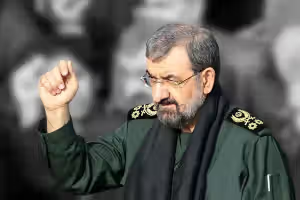
Mohsen Rezaei, a former commander-in-chief of Iran’s Islamic Revolutionary Guards Corps (IRGC), was appointed secretary of the Supreme National Security Council on August 9, 2026.
Mohsen Rezaei, whose four decades in Iran’s ruling establishment span the disputed Karbala-4 offensive, repeated failed presidential campaigns and an Interpol Red Notice over the AMIA bombing, returned to a top security post on Sunday.
The 71-year-old former commander-in-chief of the Revolutionary Guards was appointed secretary of the Supreme National Security Council after Mohammad Bagher Zolghadr resigned little more than four months into the job.
Supreme Leader Mojtaba Khamenei separately appointed Rezaei as his representative on the council, consolidating his position in a body central to decisions on war, diplomacy and Iran's confrontation with the United States.
The appointment adds another chapter to a career spanning command of the Revolutionary Guards through most of the Iran-Iraq war, decades in senior political institutions and four attempts to become president.
It also returns to prominence a figure whose record encompasses one of Iran's most disputed wartime operations, an Interpol Red Notice over the 1994 bombing of a Jewish community center in Argentina and years as a recurring subject of satire among Iranians online.
From Islamist militant to Guards commander
Born Mohsen Sabzevar Rezaei Mir-Ghaed in 1954, Rezaei became involved before the 1979 revolution with Mansouroun, an armed Islamist organization opposed to the monarchy.
Following the revolution, Mansouroun and six other Islamist organizations joined to form the Mojahedin of the Islamic Revolution Organization.
Rezaei's ascent through the new political order was rapid. Ruhollah Khomeini appointed him commander-in-chief of the Revolutionary Guards in 1981, when Rezaei was 27 and Iran was a year into its war with Iraq.
He remained in command until 1997, overseeing the Guards for almost the entire eight-year war and during its transformation from an armed organization into one of Iran's principal centers of military power.
Mohsen Rezaei (second from left) alongside Ali Khamenei (center) during the Iran-Iraq War.
Rezaei left military command in 1997 and moved into the Expediency Council, becoming its longtime secretary. He later served as vice president for economic affairs under President Ebrahim Raisi.
Politics did not deliver the electoral success he sought.
Rezaei entered presidential contests repeatedly, running in 2005 before withdrawing shortly before voting, and contesting elections in 2009, 2013 and 2021 without winning. His repeated appearances on presidential ballots eventually generated a running joke on Persian-language social media that wherever an election was taking place, Rezaei would inevitably become a candidate.
Mohsen Rezaei displays his identification document and inked finger as he registers to run in Iran’s presidential election.
Karbala-4 and a dispute that followed him for decades
No episode of Rezaei's military career has generated more lasting controversy inside Iran than Operation Karbala-4, launched against Iraqi forces in December 1986.
Rezaei was commander of the Revolutionary Guards when Iranian forces embarked on the operation. Accounts from commanders and participants later indicated that Iraqi forces had obtained advance knowledge of the offensive.
Akbar Hashemi Rafsanjani, who commanded Iran's war effort at the political level, later recalled learning shortly before the operation that it had been compromised.
Precise casualty figures remain disputed. Rafsanjani's wartime accounts put the toll at around 1,000 killed, 3,900 missing and 11,000 wounded.
The operation acquired renewed public significance decades later, particularly after the remains of 175 Iranian combat divers were returned to Iran in 2015.
File photo of Iranian forces preparing for Operation Karbala-4 during the Iran-Iraq War.
Rezaei reopened the controversy in 2018 when he wrote that Karbala-4 had been conducted to deceive Iraq before Iran launched the larger Karbala-5 offensive days later.
The description prompted criticism from veterans, former officials and military figures who argued that Karbala-4 had been designed as a genuine major offensive rather than a diversion.
Rezaei later clarified his remarks, saying Karbala-4 had indeed begun as a main operation but had subsequently been turned into a deception after the decision was made to withdraw.
An audio recording of Rezaei speaking to division commander Hossein Kharrazi during the opening phase also attracted attention because Rezaei could be heard instructing forces to continue advancing.
For critics, the episode became a wider argument over wartime accountability: whether commanders persisted with an operation despite evidence that Iraqi forces were prepared for it, and whether the later characterization of it as deception obscured the original plan.
Wanted in Argentina over AMIA bombing
Rezaei's years commanding the Guards also left him facing an international arrest request.
Argentina has sought him in connection with the July 1994 bombing of the AMIA Jewish community center in Buenos Aires, which killed 85 people and injured hundreds.
Interpol's Executive Committee approved a Red Notice for Rezaei and five other suspects in 2007 following a request from Argentina. Its General Assembly upheld the decision later that year.
Argentine authorities say Rezaei participated in a meeting at which the attack was decided. Rezaei and Iran have rejected Iranian responsibility.
His international travel has periodically revived the dispute. Argentina sought his arrest when he visited Qatar in 2022, without success.
Hostages for billions
Rezaei's public comments have also periodically generated controversy at home.
In 2015, he suggested that if the United States attacked Iran, Iranian forces could capture at least 1,000 Americans in the first week and demand billions of dollars for each one's release.
Mohsen Rezaei holds a banknote during a televised debate in Iran.
The proceeds, he suggested, could solve Iran's economic problems.
Such remarks, combined with his unsuccessful presidential campaigns and frequent television appearances, helped create a second public persona far removed from the image of the young wartime commander.
For some users on Persian-language social media, Rezaei became a stock character for political jokes.
That response resurfaced when Mojtaba Khamenei appointed him military adviser following the 2026 war. Users mocked everything from his return to office to the positioning of his belt buckle, which has itself become a longstanding internet meme.
Appointment revives criticism and ridicule online
Rezaei’s return to a senior security position prompted criticism and satire on X, where Iranian users revisited his wartime record, repeated presidential campaigns and controversial public remarks.
“Is Mohsen Rezaei’s military record, particularly during the war with Iraq, really defensible?” one user wrote. “Where does this extraordinary desire come from? From calling the Karbala-4 failure a deception operation, or from his idea of taking hostages to make money?”
Another user invoked the casualties of Karbala-4 more directly.
“Do you know that a huge number of young people in Operation Karbala-4 never saw the next morning?” the user wrote. “Yes, guess who the commander was. That’s right, Mohsen Rezaei.”
Some users instead interpreted the appointment through Iran’s internal power struggles.
One argued that the Revolutionary Guards had gained influence during the war while technocrats controlled the government, leaving the clergy with diminished power. The user portrayed Rezaei, a veteran Guards commander long removed from operational command, as a possible vehicle for restoring some of that influence.
Another suggested Rezaei’s appointment could strengthen parliament speaker Mohammad Bagher Ghalibaf, himself a former senior Guards commander.
Other posts sought to connect the reshuffle to reports of friction involving President Masoud Pezeshkian, with one user asking whether Rezaei’s appointment made previous reports about the president considering resignation more credible.
Mohsen Rezaei, Iran's new secretary of the Supreme National Security Council, speaks at an event.
Speculation over Pezeshkian’s position had begun before Rezaei’s appointment.
Mohammad Bagher Kharrazi, secretary-general of the Hezbollah of Iran political group, predicted the security council reshuffle in remarks circulated widely on social media, portraying it as part of an effort to constrain President Masoud Pezeshkian.
Kharrazi said that Pezeshkian had resigned or threatened to resign 28 times and that Supreme Leader Mojtaba Khamenei had grown frustrated with him and warned that another resignation would be accepted.
“That is why they are changing the Supreme National Security Council, moving Mr Zolghadr and replacing him with Mr Mohsen Rezaei,” Kharrazi said.
The prediction gained renewed attention after Zolghadr stepped down and Rezaei was appointed in his place.
Pezeshkian and Supreme Leader Mojtaba Khamenei’s office have denied accounts that the president repeatedly offered or threatened to resign.
A survivor returns
Rezaei's latest promotion comes at a markedly different moment from the one in which he first accumulated power.
The Supreme National Security Council has undergone rapid leadership changes following the killing of its former secretary Ali Larijani in March and Zolghadr's brief tenure afterward.
Rezaei now takes charge as Iran confronts the consequences of war and negotiations over the Strait of Hormuz, where he has taken an uncompromising public position.
He said in July that control over the waterway was “more important than dozens of atomic bombs,” and more recently said Iran would not accept an unauthorized shipping route through the Strait.
The appointment nevertheless puts a familiar figure back at the center of the system he helped build: a commander whose career has survived military setbacks, electoral defeats, international accusations and decades of political change, and who now again occupies one of the most consequential seats in Iranian national security policy.
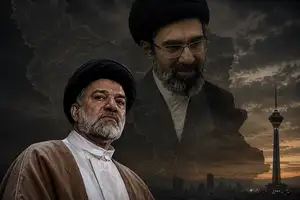
A large banner depicting Iran's supreme leader Mojtaba Khamenei and his slain father and predecessor Ali Khamenei is displayed at an event marking religious processions of Arbaeen, in Iran, Iran August 3, 2026
Mojtaba Khamenei’s continued absence from public view has created an unusual system of authority in Tehran, where decisions are made and justified through written messages attributed to him while responsibility appears dispersed across a core establishment network.
With no public appearance or clear final word from Khamenei, competing figures can interpret his intentions differently, and those with the greatest institutional and military power are best placed to turn their interpretation into policy.
Khamenei has been absent from major political and personal events since becoming supreme leader, including the funeral of his wife and the extensive ceremonies marking his father’s death.
His disappearance has produced contradictory accounts about his condition, ranging from claims that he is in good health to reports of injuries or even the loss of a limb.
Officials and media close to the establishment have meanwhile cited extraordinary security precautions to explain why neither his image nor his voice has been released.
‘In principle’
Whatever the security rationale, Iranians have little means of assessing the new leader’s condition, capabilities or views for themselves. Instead, they encounter him largely through written statements and officials explaining what he means.
The clearest example came in a message attributed to Khamenei concerning negotiations and the memorandum of understanding with the United States.
He allowed President Masoud Pezeshkian to take responsibility for negotiations and effectively permitted the agreement to be signed, while saying that “in principle” he had held a different view.
Those two words immediately became a matter of political interpretation.
The IRGC’s political deputy rejected suggestions that they meant Khamenei fundamentally opposed negotiations. “This interpretation is incorrect and does not correspond with the existing realities,” he said.
But a military adviser to Khamenei offered a different reading: “When the Leader says, ‘in principle, I held a different view,’ it means the path that Agha had in mind was better than the path taken by the Supreme National Security Council.”
The same message could therefore be presented as permission for diplomacy or evidence of reservations about it, with figures claiming proximity to Khamenei effectively speaking on his behalf.
Speaking for the leader
The same process is helping construct Khamenei’s image as a wartime leader.
Ebrahim Jabbari, an adviser to the IRGC commander, has spoken of Khamenei’s “command and mastery” of military affairs and his management of expert meetings of the armed forces.
Supporters have also promoted the slogan “Khamenei has become young again,” presenting the succession as a renewal of leadership during war.
Such accounts give the military and security establishment an important role not merely in implementing the supreme leader’s decisions but in explaining his character, capabilities and intentions to the public.
Foreign leaders have inadvertently reinforced his position. Israeli Prime Minister Benjamin Netanyahu has publicly said Khamenei is alive, while US President Donald Trump has described him as “definitely and 100 percent” involved in negotiations between Tehran and Washington and even raised the possibility of meeting him.
Khamenei is thus presented by his subordinates as directing military affairs and confronting Iran’s enemies, while those same enemies publicly treat him as the ultimate decision-maker — even as he remains absent from public view.
Who decides?
That absence becomes more consequential as Iran confronts the choice between continued confrontation and diplomacy.
Khamenei has apparently authorized negotiations and the signing of an agreement, but messages attributed to him have also promised vengeance. Officials advocating different courses can therefore claim to be acting in accordance with the same leader.
Iran’s military and security institutions possess both the organizational power to act during wartime and an extensive presence in the state’s decision-making and media structures.
When Khamenei’s wishes are unclear, those institutions are better positioned than advocates of compromise to determine how they are translated into policy.
Majid Mousavi, commander of the IRGC Aerospace Force, has called on others to follow the supreme leader’s wishes as his forces carry much of the burden of the current war. Yet precisely what those wishes are remains unclear.
Policy instead emerges through written messages, competing interpretations and repeated invocations of the leader’s authority. Successes can be attributed to his leadership, while responsibility for costly decisions and their consequences is spread across a wider network.
The less Iranians see or hear from Mojtaba Khamenei, the more they must rely on others to tell them what he thinks. As the country weighs war against diplomacy, the question is increasingly not simply what Iran’s supreme leader wants, but who gets to decide what his wishes mean.
Mohsen Rezaei was appointed as Supreme Leader Mojtaba Khamenei’s representative on Iran’s Supreme National Security Council on Sunday, before being named secretary of the powerful security body.
“In view of your valuable experience, I hereby appoint you ... as my representative on the Supreme National Security Council,” Khamenei said in a decree, describing Rezaei as a veteran of the 1980–1988 Iran-Iraq War.
Rezaei commanded the Islamic Revolutionary Guard Corps from 1981 to 1997, including through much of the war. He also serves as a senior military adviser to Khamenei and is a member of the Expediency Council.
Khamenei’s decree also thanked Mohammad Bagher Zolghadr, who had been SNSC secretary and one of the Supreme Leader’s representatives on the council, for his “tireless efforts day and night.” The decree did not say he was stepping down as SNSC secretary.
Shortly after the announcement, IRGC-affiliated Tasnim News reported, citing the president’s office, that President Masoud Pezeshkian had appointed Rezaei as SNSC secretary.
“Following Mohammad Bagher Zolghadr’s resignation as secretary of the Supreme National Security Council and his acceptance of a new responsibility, Mohsen Rezaei has been appointed secretary of the Supreme National Security Council by decree of President Masoud Pezeshkian,” said Tabatabaei, deputy for communications and information at the president’s office.
The SNSC is Iran’s top national security body, coordinating security and foreign policy and bringing together senior political, military and intelligence officials. The president chairs the council, while the Supreme Leader appoints two representatives to it.
Zolghadr, a former senior IRGC commander, took over as SNSC secretary in March, a week after Ali Larijani was killed in US-Israeli strikes. Larijani had returned to the post in August 2025 after previously serving as secretary from 2005 to 2007 and as parliament speaker from 2008 to 2020.
Zolghadr’s resignation
The appointments followed days of reports about Zolghadr’s position.
Earlier on Sunday, Tasnim removed a report announcing Rezaei’s appointment as Khamenei’s representative on the council. The outlet did not explain the deletion. The report had said Rezaei and Saeed Jalili would serve as the Supreme Leader’s two representatives on the SNSC.
Reformist newspaper Sazandegi reported on Friday that Zolghadr had offered his resignation but Pezeshkian had asked him to remain.
A day later, Pezeshkian did not deny that Zolghadr had offered to resign, saying there were “some differences that we are trying to resolve.”
Senior cleric and Khamenei relative Mohammad Bagher Kharrazi had also said on Monday that Rezaei was set to replace Zolghadr.
Iranian cleric Mohammad-Bagher Kharrazi was summoned to the Special Clerical Court after calling for the Islamic Republic to be replaced by a more hardline “Islamic government” and outlining plans to mobilize a 250,000-strong network capable of surrounding government sites.
Judiciary spokesperson Asghar Jahangir said on Saturday that legal proceedings began immediately after Kharrazi's recent remarks and that he had now been summoned to the court, which handles cases involving members of the clergy.
“Immediately after his recent remarks, legal action was initiated to prosecute him,” Jahangir said, adding that Kharrazi's case was under criminal investigation and further details would be released after the proceedings.
‘Islamic Republic doesn't work anymore’
In a video released this week, Kharrazi said the Islamic Republic had “reached a stage where, in this form, it simply doesn't work anymore” and said his organization had already drawn up plans for replacing it with an “Islamic government.”
Kharrazi, who heads the Hezbollah of Iran organization, said his group had produced 60 volumes of plans covering state institutions and had maintained what he described as a “shadow government.”
He also outlined a recruitment drive intended to build a nationwide network of 250,000 supporters, saying it could “surround all the ministries” and converge on Tehran following a single announcement.
“Mr. Khamenei and the government must understand that a 250,000-strong organization stands ready to move,” he said.
Kharrazi also attacked President Masoud Pezeshkian, calling him a “buffoon” who “understands nothing,” and said his government “will not reach its end.”
Claims about Khamenei
Kharrazi is tied by marriage to Iran's ruling family: his sister is married to Masoud Khamenei, a brother of Supreme Leader Mojtaba Khamenei.
He has also presented himself as a longtime confidant of the new supreme leader, saying he has known him for four decades and held numerous private meetings with him. In his latest remarks, Kharrazi said Mojtaba Khamenei's thinking was “far more radical than his father's.” His accounts of private conversations and the supreme leader's views cannot be independently verified.
The leader's office had already publicly rejected earlier remarks Kharrazi attributed to Mojtaba Khamenei, including that Pezeshkian's next resignation would be accepted, describing them as unauthenticated and false.