• العربية
  • فارسی
Brand
  • Iran Insight
  • Politics
  • Economy
  • Analysis
  • Special Report
  • Opinion
  • Podcast
  • Iran Insight
  • Politics
  • Economy
  • Analysis
  • Special Report
  • Opinion
  • Podcast
  • Theme
  • Language
    • العربية
    • فارسی
  • Iran Insight
  • Politics
  • Economy
  • Analysis
  • Special Report
  • Opinion
  • Podcast
All rights reserved for Volant Media UK Limited
volant media logo

Protest crackdown veteran Taeb returns to lead Basij, expand intel network

Aug 10, 2026, 20:01 GMT+1
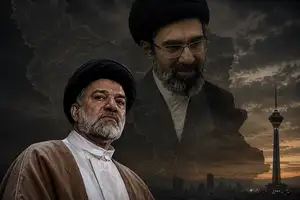
File photo shows Hossein Taeb (right) and Mojtaba Khamenei (left)

Supreme Leader Mojtaba Khamenei appointed veteran intelligence official Hossein Taeb to lead the Basij, giving the former protest crackdown figure a mandate to expand the paramilitary force’s grassroots intelligence network and use of new technologies.

In his decree, Khamenei instructed Taeb to “strengthen the popular intelligence network,” improve training and skills and make greater use of new technologies for what he described as a “people-based” response to enemy threats.

The directive places intelligence gathering prominently among Taeb’s responsibilities at the Basij, whose branches extend through neighborhoods, universities, workplaces and other parts of Iranian society.

With Taeb’s appointment, Khamenei is returning a figure closely associated with the suppression of dissent and protests to a leading role in one of the Islamic Republic’s main domestic security and mobilization organizations.

Taeb previously commanded the Basij during the unrest surrounding the disputed 2009 presidential election, when the force played a major role in suppressing demonstrations.

Taeb’s career has been centered on Iran’s security and intelligence establishment for more than four decades.

Born in Tehran in 1963, the cleric joined the Revolutionary Guards in 1982 and served in IRGC units in Tehran, Qom and Khorasan before moving into the Intelligence Ministry, where he rose to a senior management position.

He also served in counterintelligence at the ministry and later headed the IRGC’s own intelligence protection apparatus.

Return to Basij

His Monday appointment brings him back to an organization he previously led.

Taeb, a longtime ally of Mojtaba Khamenei, was appointed commander of the Basij Resistance Force in 2008, before becoming head of the newly established IRGC Intelligence Organization in October 2009, shortly after the mass protests that followed that year’s presidential election.

He went on to lead IRGC Intelligence for more than a decade, making him one of the most influential figures in the Islamic Republic’s internal security apparatus. The organization grew during his tenure into a powerful intelligence body operating alongside the Intelligence Ministry and became heavily involved in cases concerning political activists, journalists, dual nationals and alleged espionage.

Khamenei’s decree also ordered Taeb to broaden the Basij’s reach under the slogan “Every Iranian, a Basiji,” expand neighborhood and sector-based units, deepen cooperation with state institutions and develop social-service networks centered on mosques. He was also tasked with promoting the Basij model of “popular resistance” abroad.

Taeb replaces Gholamreza Soleimani, who was killed in the US-Israeli war earlier this year.

Most Viewed

Tehran rents hit three times many workers’ monthly pay
1

Tehran rents hit three times many workers’ monthly pay

2
INSIGHT

First red meat, now dairy: Iran’s household diet keeps shrinking

3
VOICES FROM IRAN

Iran’s healthcare crunch forces patients to cut treatment

4

Rezaei named Iran’s top security chief and Khamenei representative

5
ANALYSIS

The strange power of Iran’s absent supreme leader

Banner
Banner
Banner

Spotlight

  • From Karbala-4 to AMIA: Mohsen Rezaei returns to Iran’s security helm
    INSIGHT

    From Karbala-4 to AMIA: Mohsen Rezaei returns to Iran’s security helm

  • The strange power of Iran’s absent supreme leader
    ANALYSIS

    The strange power of Iran’s absent supreme leader

  • First red meat, now dairy: Iran’s household diet keeps shrinking
    INSIGHT

    First red meat, now dairy: Iran’s household diet keeps shrinking

  • Tehran rents hit three times many workers’ monthly pay

    Tehran rents hit three times many workers’ monthly pay

  • Iran’s reality TV boom abroad captures a generation in limbo
    ANALYSIS

    Iran’s reality TV boom abroad captures a generation in limbo

  • What the Islamic Republic does to its women footballers
    ANALYSIS

    What the Islamic Republic does to its women footballers

•
•
•

More Stories

The strange power of Iran’s absent supreme leader

Aug 10, 2026, 00:35 GMT+1
•
Ata Mohamed Tabriz
100%
A large banner depicting Iran's supreme leader Mojtaba Khamenei and his slain father and predecessor Ali Khamenei is displayed at an event marking religious processions of Arbaeen, in Iran, Iran August 3, 2026

Mojtaba Khamenei’s continued absence from public view has created an unusual system of authority in Tehran, where decisions are made and justified through written messages attributed to him while responsibility appears dispersed across a core establishment network.

With no public appearance or clear final word from Khamenei, competing figures can interpret his intentions differently, and those with the greatest institutional and military power are best placed to turn their interpretation into policy.

Khamenei has been absent from major political and personal events since becoming supreme leader, including the funeral of his wife and the extensive ceremonies marking his father’s death.

His disappearance has produced contradictory accounts about his condition, ranging from claims that he is in good health to reports of injuries or even the loss of a limb.

Officials and media close to the establishment have meanwhile cited extraordinary security precautions to explain why neither his image nor his voice has been released.

‘In principle’

Whatever the security rationale, Iranians have little means of assessing the new leader’s condition, capabilities or views for themselves. Instead, they encounter him largely through written statements and officials explaining what he means.

The clearest example came in a message attributed to Khamenei concerning negotiations and the memorandum of understanding with the United States.

He allowed President Masoud Pezeshkian to take responsibility for negotiations and effectively permitted the agreement to be signed, while saying that “in principle” he had held a different view.

Those two words immediately became a matter of political interpretation.

The IRGC’s political deputy rejected suggestions that they meant Khamenei fundamentally opposed negotiations. “This interpretation is incorrect and does not correspond with the existing realities,” he said.

But a military adviser to Khamenei offered a different reading: “When the Leader says, ‘in principle, I held a different view,’ it means the path that Agha had in mind was better than the path taken by the Supreme National Security Council.”

The same message could therefore be presented as permission for diplomacy or evidence of reservations about it, with figures claiming proximity to Khamenei effectively speaking on his behalf.

Speaking for the leader

The same process is helping construct Khamenei’s image as a wartime leader.

Ebrahim Jabbari, an adviser to the IRGC commander, has spoken of Khamenei’s “command and mastery” of military affairs and his management of expert meetings of the armed forces.

Supporters have also promoted the slogan “Khamenei has become young again,” presenting the succession as a renewal of leadership during war.

Such accounts give the military and security establishment an important role not merely in implementing the supreme leader’s decisions but in explaining his character, capabilities and intentions to the public.

Foreign leaders have inadvertently reinforced his position. Israeli Prime Minister Benjamin Netanyahu has publicly said Khamenei is alive, while US President Donald Trump has described him as “definitely and 100 percent” involved in negotiations between Tehran and Washington and even raised the possibility of meeting him.

Khamenei is thus presented by his subordinates as directing military affairs and confronting Iran’s enemies, while those same enemies publicly treat him as the ultimate decision-maker — even as he remains absent from public view.

Who decides?

That absence becomes more consequential as Iran confronts the choice between continued confrontation and diplomacy.

Khamenei has apparently authorized negotiations and the signing of an agreement, but messages attributed to him have also promised vengeance. Officials advocating different courses can therefore claim to be acting in accordance with the same leader.

Iran’s military and security institutions possess both the organizational power to act during wartime and an extensive presence in the state’s decision-making and media structures.

When Khamenei’s wishes are unclear, those institutions are better positioned than advocates of compromise to determine how they are translated into policy.

Majid Mousavi, commander of the IRGC Aerospace Force, has called on others to follow the supreme leader’s wishes as his forces carry much of the burden of the current war. Yet precisely what those wishes are remains unclear.

Policy instead emerges through written messages, competing interpretations and repeated invocations of the leader’s authority. Successes can be attributed to his leadership, while responsibility for costly decisions and their consequences is spread across a wider network.

The less Iranians see or hear from Mojtaba Khamenei, the more they must rely on others to tell them what he thinks. As the country weighs war against diplomacy, the question is increasingly not simply what Iran’s supreme leader wants, but who gets to decide what his wishes mean.

Rezaei named Iran’s top security chief and Khamenei representative

Aug 9, 2026, 19:38 GMT+1
100%

Mohsen Rezaei was appointed as Supreme Leader Mojtaba Khamenei’s representative on Iran’s Supreme National Security Council on Sunday, before being named secretary of the powerful security body.

“In view of your valuable experience, I hereby appoint you ... as my representative on the Supreme National Security Council,” Khamenei said in a decree, describing Rezaei as a veteran of the 1980–1988 Iran-Iraq War.

Rezaei commanded the Islamic Revolutionary Guard Corps from 1981 to 1997, including through much of the war. He also serves as a senior military adviser to Khamenei and is a member of the Expediency Council.

Khamenei’s decree also thanked Mohammad Bagher Zolghadr, who had been SNSC secretary and one of the Supreme Leader’s representatives on the council, for his “tireless efforts day and night.” The decree did not say he was stepping down as SNSC secretary.

Shortly after the announcement, IRGC-affiliated Tasnim News reported, citing the president’s office, that President Masoud Pezeshkian had appointed Rezaei as SNSC secretary.

“Following Mohammad Bagher Zolghadr’s resignation as secretary of the Supreme National Security Council and his acceptance of a new responsibility, Mohsen Rezaei has been appointed secretary of the Supreme National Security Council by decree of President Masoud Pezeshkian,” said Tabatabaei, deputy for communications and information at the president’s office.

The SNSC is Iran’s top national security body, coordinating security and foreign policy and bringing together senior political, military and intelligence officials. The president chairs the council, while the Supreme Leader appoints two representatives to it.

Zolghadr, a former senior IRGC commander, took over as SNSC secretary in March, a week after Ali Larijani was killed in US-Israeli strikes. Larijani had returned to the post in August 2025 after previously serving as secretary from 2005 to 2007 and as parliament speaker from 2008 to 2020.

Zolghadr’s resignation

The appointments followed days of reports about Zolghadr’s position.

Earlier on Sunday, Tasnim removed a report announcing Rezaei’s appointment as Khamenei’s representative on the council. The outlet did not explain the deletion. The report had said Rezaei and Saeed Jalili would serve as the Supreme Leader’s two representatives on the SNSC.

Reformist newspaper Sazandegi reported on Friday that Zolghadr had offered his resignation but Pezeshkian had asked him to remain.

A day later, Pezeshkian did not deny that Zolghadr had offered to resign, saying there were “some differences that we are trying to resolve.”

Senior cleric and Khamenei relative Mohammad Bagher Kharrazi had also said on Monday that Rezaei was set to replace Zolghadr.

Cleric summoned after calling to replace Islamic Republic with ‘Islamic government’

Aug 8, 2026, 09:14 GMT+1
100%

Iranian cleric Mohammad-Bagher Kharrazi was summoned to the Special Clerical Court after calling for the Islamic Republic to be replaced by a more hardline “Islamic government” and outlining plans to mobilize a 250,000-strong network capable of surrounding government sites.

Judiciary spokesperson Asghar Jahangir said on Saturday that legal proceedings began immediately after Kharrazi's recent remarks and that he had now been summoned to the court, which handles cases involving members of the clergy.

“Immediately after his recent remarks, legal action was initiated to prosecute him,” Jahangir said, adding that Kharrazi's case was under criminal investigation and further details would be released after the proceedings.

‘Islamic Republic doesn't work anymore’

In a video released this week, Kharrazi said the Islamic Republic had “reached a stage where, in this form, it simply doesn't work anymore” and said his organization had already drawn up plans for replacing it with an “Islamic government.”

Kharrazi, who heads the Hezbollah of Iran organization, said his group had produced 60 volumes of plans covering state institutions and had maintained what he described as a “shadow government.”

He also outlined a recruitment drive intended to build a nationwide network of 250,000 supporters, saying it could “surround all the ministries” and converge on Tehran following a single announcement.

  • A Khamenei in-law is openly recruiting to replace the Islamic Republic

    A Khamenei in-law is openly recruiting to replace the Islamic Republic

“Mr. Khamenei and the government must understand that a 250,000-strong organization stands ready to move,” he said.

Kharrazi also attacked President Masoud Pezeshkian, calling him a “buffoon” who “understands nothing,” and said his government “will not reach its end.”

Claims about Khamenei

Kharrazi is tied by marriage to Iran's ruling family: his sister is married to Masoud Khamenei, a brother of Supreme Leader Mojtaba Khamenei.

He has also presented himself as a longtime confidant of the new supreme leader, saying he has known him for four decades and held numerous private meetings with him. In his latest remarks, Kharrazi said Mojtaba Khamenei's thinking was “far more radical than his father's.” His accounts of private conversations and the supreme leader's views cannot be independently verified.

The leader's office had already publicly rejected earlier remarks Kharrazi attributed to Mojtaba Khamenei, including that Pezeshkian's next resignation would be accepted, describing them as unauthenticated and false.

Iran hardliners push renewed hijab crackdown despite widespread defiance

Aug 7, 2026, 16:36 GMT+1
•
Maryam Sinaiee
100%

Iranian hardliners are intensifying pressure on authorities to enforce compulsory hijab, as recent cafe closures and online campaigns raise fears of a renewed crackdown despite widespread defiance of the dress code.

Last week, hardline lawmaker Mohammad Naghd-Ali told parliament that another member had told him he cries after every parliamentary session because of the current state of women's dress.

Naghd-Ali fiercely criticized President Masoud Pezeshkian's administration for refusing to implement the controversial hijab law approved in 2024, saying the government was allowing what he described as "nudity” and “immorality" to spread.

Although the new legislation was finalized in 2024, its implementation has been suspended following a decision by the Supreme National Security Council, reportedly out of concern that enforcing it could trigger unrest similar to the nationwide protests that erupted after Mahsa Amini's death in 2022.

Existing compulsory-hijab rules, however, remain legally in force.

Hardline activists have likewise blamed Pezeshkian for what they portray as the country's cultural decline.

"If Pezeshkian's incompetent and secular government continues for another two years, even today's level of dress will become something people long for," conservative commentator Hassan Abbasi wrote on social media. "Pezeshkian is standing against God's command on hijab and wants to return Iran's cultural climate to the Pahlavi era."

Social media campaign seeks broader crackdown

Hardline activists have also intensified an online campaign demanding tougher enforcement.

In recent days they have circulated videos showing unveiled women in tight-fitting sleeveless tops serving customers at a well-known restaurant in Tehran—scenes that would have been almost unimaginable in the capital and other cities until only a few years ago. Such activists frequently describe these styles as "nudity" or "body display."

One hardline X user, allegedly tied to a state institution, wrote: "The first step in confronting unveiled women is confronting cafes and establishments that violate social norms." According to the post, enforcement is currently focused mainly outside Tehran but will gradually expand across the capital.

Hardline journalist Fereshteh Sadeghi similarly shared a photograph of an unveiled woman shopping outside Tehran and criticized those arguing that hijab should not be discussed while the country faces broader security challenges.

"They tell us not to talk about hijab in the middle of a war and not even to take pictures. Then when are we allowed to speak?" she wrote.

Yet Sadeghi also acknowledged the state's failure to restore widespread headscarf compliance.

"The battle to force the hijab back onto women is over; you can't force the hijab on their heads," she wrote in another post, while arguing that authorities should at least establish dress regulations to prevent what she called "body display."

Hijab as a political symbol

For many hardliners, compulsory hijab is not only a religious obligation but also a defining political symbol of the Islamic Republic.

"Hijab is the flag of Islam. Muslim society is recognized through hijab," conservative social media activist Alireza Akbari wrote.

Supporters of compulsory veiling frequently cite a ruling by Supreme Leader Ali Khamenei, who described unveiling as forbidden both religiously and politically.

Journalist Mehrdad Khadir argued in an article published by Asr-e Iran that women's dress is no longer among the public's primary concerns.

"The way women and girls dress is not a concern for the majority of people," he wrote. "The face of the city has changed, and it will not return to what it once was."

According to Khadir, the country's real concerns are the threat of war and the collapse in living standards.

"In the current circumstances," he wrote, "it is unlikely—indeed impossible—that the authorities would surrender their judgment to those tears and turn an issue that has effectively been settled back into a national crisis. If there is anything worth crying over, it is the collapse of people's purchasing power."

Resistance through everyday life

Although enforcement has eased in many areas over recent years, critics argue that this should not be mistaken for legal liberalization because compulsory hijab laws remain fully in force even if they are not consistently applied.

The social landscape has nevertheless changed dramatically. Many women who continue to wear the hijab have also moved away from the traditional all-black chador and highly conservative appearance. Styles often described online as “hijab style” combine headscarves with colorful clothing, modern designs and fashion accessories.

Hardliners reject these styles as well, arguing that they contradict hijab's original purpose of discouraging attention and preserving modesty.

Opponents of compulsory veiling, meanwhile, say the increasingly visible presence of unveiled women reflects persistence rather than freedom.

"The type of clothing women wear in public still depends on the neighborhood, how they travel, even the day and time," one X user wrote. "The fact that we now see bolder styles is the result of the relentless struggle of brave women who accept the risks of dressing that way. Nothing has actually been liberated."

Iran opens second case against jailed protester who appealed to Trump

Aug 6, 2026, 19:24 GMT+1
•
Pooya Jahandar
100%
Ahmad Seyyed-Abdollahi

Iran has opened a second case against Ahmad Seyyed-Abdollahi, who is serving a prison term after posting a video urging Donald Trump to protect demonstrators during January’s nationwide protests, sources familiar with the case told Iran International.

The second case was opened in June on the charge of “propaganda against the establishment” and remains at the preliminary investigation stage, the sources said.

Seyyed-Abdollahi, 32, posted the English-language video on January 4, two days after Trump warned that the United States would come to the aid of peaceful protesters if Iranian authorities opened fire on them.

In the video, Seyyed-Abdollahi urged Trump to act quickly, saying many young Iranians had trusted his words and that help would come too late for those killed.

He added that Iranians would remember those who helped them and would seek to repay their friends in the future.

Seyyed-Abdollahi was first arrested on January 14, ten days after posting the video. He was held for about two months in solitary confinement at Borujen Prison and an intelligence detention facility operated by the Islamic Revolutionary Guard Corps in Isfahan.

He was released on bail on March 10.

Branch One of the Borujen Revolutionary Court later convicted him of “engaging in media activities against national security,” sentenced him to seven months in prison and barred him from government and public services for five years.

He was detained again on July 7 to begin serving the sentence and transferred to Borujen Prison in southwestern Iran’s Chaharmahal and Bakhtiari province, where he remains incarcerated.

Seyyed-Abdollahi was denied access to a lawyer of his choosing during his detention and was at times prevented from contacting his family, according to the sources.

He was among several Iranians who appealed directly to Trump for help during the nationwide protests.

Videos sent to Iran International showed one woman holding a sign reading, “Trump, a symbol of peace. Don’t let them kill us,” while another protester urged him to “do something” as security forces opened fire in Yazdanshahr in Isfahan province.

A protester in the northeastern city of Mashhad also addressed Trump directly and appealed for help during the crackdown.

Trump repeated his warning on January 9, telling Iranian authorities: “You better not start shooting because we’ll start shooting too.”

On January 13, he urged Iranians to continue protesting and wrote that “help is on its way.”

Iranian authorities crushed the protests with lethal force and carried out mass arrests.

The US-based rights group HRANA has reported that more than 50,000 people were arrested during just over six weeks of protests and the ensuing crackdown.

Authorities have since intensified their use of the death penalty against protesters. UN human rights chief Volker Türk said Wednesday that Iran had executed at least 56 people on national security-related charges since March 19, including 27 in cases linked to the January protests.

Amnesty International says at least 60 protest-related defendants, including three who were arrested as children, remain at risk of execution.