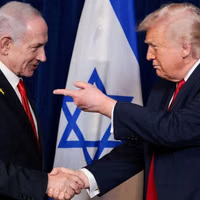
FILE PHOTO: U.S. President Donald Trump points his finger towards Israeli Prime Minister Benjamin Netanyahu as they shake hands during a press conference after meeting at Trump’s Mar-a-Lago club in Palm Beach, Florida, U.S., December 29, 2025. REUTERS/Jonathan Ernst/File Photo
Washington and Tehran may still reach a limited deal, but fundamental disagreements leave open the prospect of renewed escalation, analysts told Iran International, with the period after elections in Israel and the United States emerging as a potential turning point.
Diplomatic efforts are continuing, with Qatar and Pakistan pushing for an agreement and The New Arab reporting Monday, citing sources familiar with mediation efforts, that a breakthrough could be announced this week.
The analysts interviewed by Iran International were more cautious, however, seeing little evidence that either side has made the concessions required for a broader agreement and identifying the coming elections as a factor that could shape the timing of diplomacy or renewed military action.
Danny Citrinowicz, an Iran specialist and former head of the Iran branch in Israeli Defense Intelligence, said continuing diplomatic exchanges did not amount to evidence of an imminent breakthrough because neither side appeared ready to make the compromise required for one.
"In order to have a breakthrough, one side needs to show significant compromise. And I don't see that in the Iranian side," he told Iran International.
Washington wants substantial restrictions on Iran's uranium enrichment capabilities, while Tehran is prioritizing relief from the US blockade and sanctions, alongside the restoration of maritime traffic through the Strait of Hormuz.
Iranian Foreign Minister Abbas Araghchi said Sunday that Tehran's seven-day proposal remained on the table. Under the proposal, Iran would reopen the strait within seven days if Washington accepted Tehran's conditions, paving the way for renewed negotiations.
Alex Vatanka, director of the Iran Program at the Middle East Institute, saw greater scope for a limited arrangement than a comprehensive settlement, arguing that both Trump and Tehran have short-term incentives to reduce tensions without resolving their fundamental differences.
Trump, he argued, faces political pressure ahead of the November 3 midterm elections and could benefit from a diplomatic achievement. Tehran, meanwhile, needs economic relief as the blockade continues to undermine its finances.
"You might have a deal that could create ceasefire conditions for a short period of time, of weeks and months," Vatanka told Iran International.
But he said he had seen little indication that Tehran was willing to accept the kind of comprehensive agreement Trump could present as a major improvement over the 2015 nuclear deal.
Iran's leadership, Vatanka argued, believes it has paid a heavy price for its nuclear program while demonstrating its ability to disrupt the global economy through the Strait of Hormuz. Economic pressures could encourage a narrow agreement, but sweeping concessions risk exposing divisions within the Islamic Republic's leadership.
A deal under the threat of force
The diplomatic activity comes as US President Donald Trump and Israeli Prime Minister Benjamin Netanyahu have intensified warnings of renewed military action.
On Sunday, Trump threatened to "soon finish the job" against Iran unless Tehran changed course, while giving Netanyahu his endorsement ahead of Israel's October 27 election.
Netanyahu, who has explicitly identified the removal of the Islamic Republic as an Israeli objective, has said Israel is prepared to act independently of Washington if necessary.
On Monday, Netanyahu released a video of a telephone conversation with Trump following the US president's endorsement of his reelection campaign.
"Donald, we have a job to finish, you said it, and we'll finish it together. We'll finish it, and no one else will do it," Netanyahu told Trump.
Shayan Samii, a geopolitical and national security analyst, said Trump's combination of negotiations and military threats allowed him to preserve both outcomes: claiming a diplomatic victory if talks succeed or demonstrating resolve through military action if they fail.
"The United States wants to keep the diplomatic avenue still open and valid. Why? Because it helps for domestic political purposes," Samii told Iran International.
"It allows Trump to say, I'm giving diplomacy all the chances in the world, but at the same time I'm keeping the pressure on them."
He also interpreted Trump's endorsement of Netanyahu as an attempt to increase Washington's leverage over the Israeli leader should he remain in power.
Samii suggested Iran or its regional allies could provoke a confrontation ahead of Israel's election, potentially providing a pretext for renewed strikes. He presented this as a possible scenario, not evidence of a planned operation.
Russia could influence the diplomatic track
Russian Foreign Minister Sergei Lavrov's visit to Tehran on Monday added another dimension to the diplomatic maneuvering.
Vatanka said Russia possesses considerably greater leverage over Iran than mediators such as Pakistan, Qatar or Oman, partly because Tehran depends on Moscow for diplomatic support.
That influence could become significant if negotiations require difficult concessions, including a possible arrangement to transfer Iran's highly enriched uranium to Russia.
But Vatanka questioned whether Moscow's interests necessarily aligned with Tehran's.
Russia would mediate "primarily to use it to get what Putin wants from Trump on the Ukraine front," he said.
Vatanka suggested Moscow could seek concessions from Washington over Ukraine in exchange for helping facilitate an agreement with Iran.
Tehran, however, may resist being used as a bargaining chip, particularly if Russian pressure requires abandoning positions the Islamic Republic considers fundamental.
Why the post-election period could prove decisive
If diplomacy fails to produce a breakthrough, Citrinowicz sees renewed escalation as increasingly difficult to avoid — but the elections may affect when it happens.
"With no breakthroughs, escalation is inevitable, because the status quo is unstable," he said.
He cautioned, however, that inevitable did not necessarily mean imminent.
The upcoming elections could influence the timing of any military operation. Israelis vote on October 27, followed by the US midterms on November 3.
Citrinowicz identified the period after the November 3 US midterms but before the newly elected Congress takes office in January as a possible window for military action, particularly if Republicans lose control of one or both chambers.
Vatanka similarly identified the post-election period as a potential turning point, arguing that Washington and Israel could consider additional pressure against Tehran once immediate electoral calculations had passed.
He said options could include continued enforcement of the blockade, limited military strikes and other measures designed to weaken or divide the Iranian establishment.
Yet the prospect of renewed military action raises a deeper question: whether Trump and Netanyahu ultimately seek the same outcome.
Citrinowicz argued that while the two leaders might agree on military targets, their strategic objectives could diverge.
"Netanyahu seeks to topple the regime, and Trump seeks to reach a good agreement with the same regime that Netanyahu seeks to topple," he said.
"Operationally, maybe there will be eye to eye in terms of what to attack, but strategically, I'm not sure if they see eye to eye."
That divergence leaves a central question unresolved: even if Washington and Israel agree on another round of strikes, they may not agree on what those strikes are ultimately meant to achieve.
سرگئی لاوروف، وزیر خارجه روسیه، و عباس عراقچی، وزیر امور خارجه ایران، در نشست خبری مشترک در تهران حضور دارند، ۲۷ مهر، ایسنا
Russia pledged to maintain its political and economic cooperation with Iran during Foreign Minister Sergei Lavrov's visit to Tehran on Monday, as US President Donald Trump welcomed what he described as limited Russian and Chinese support for Tehran.
Trump said Moscow and Beijing had the capacity to provide Tehran with far greater assistance but had so far refrained from doing so.
“Russia could have done a lot more to help Iran. Russia's done very little for Iran,” Trump told reporters on Monday. He said China could also have provided much more assistance and described the limited help from both countries as “a very positive thing.”
Trump's remarks came as Lavrov held talks with Foreign Minister Abbas Araghchi and President Masoud Pezeshkian in Tehran, where Moscow reaffirmed its commitment to its strategic partnership with Iran while calling for a diplomatic solution to the regional conflict.
At a joint press conference with Araghchi, Lavrov said Russia had no intention of abandoning economic and investment agreements with Iran despite the war.
He said Russian specialists were gradually returning to work at Iran's Bushehr nuclear power plant and pointed to continued cooperation on energy and transport projects, including the planned Rasht-Astara railway.
Lavrov also said Moscow had provided humanitarian assistance during the war and would continue supplying food to Iran.
Tehran and Moscow call for diplomacy
Araghchi said Iran and Russia agreed that regional disputes should be addressed politically rather than through military action.
“Our shared view is that regional issues have no military solution and must be pursued through political means,” he said.
Araghchi blamed the United States for insecurity and tensions in the Strait of Hormuz and called on neighboring countries to work toward a joint security arrangement.
“We welcome any initiative that leads to security from within without the presence of foreign forces, and consider it the right move,” he said.
Lavrov said Moscow was prepared to assist efforts to resolve the conflict and called for the restoration of maritime traffic through the Strait of Hormuz.
He also reiterated a longstanding Russian proposal for a collective security framework involving Iran and the six Gulf Cooperation Council countries.
Lavrov arrived in Tehran after talks in Bahrain, where GCC countries had pressed Russia to use its influence with Iran to encourage dialogue and help restore security and navigation through the Strait of Hormuz.
Pezeshkian thanks Russia for wartime support
Pezeshkian thanked Russian President Vladimir Putin, the Russian government and people for their support during the war in his meeting with Lavrov, according to the Iranian presidency.
He called for faster implementation of agreements between Tehran and Moscow and said Iran was ready to expand political and security cooperation with Russia and China, including through BRICS and the Shanghai Cooperation Organization.
Pezeshkian also said Iran would not accept countries imposing their will on others through force and supported resolving regional disputes through dialogue and regional mechanisms.
Lavrov reaffirmed Moscow's willingness to help resolve the conflict and briefed Pezeshkian on his discussions in Bahrain with representatives of countries on the Arabian Peninsula.
The two sides also discussed expanding trade, investment and cooperation on transport, logistics and energy projects.
Iran and Russia have deepened their relationship in recent years. A 20-year Comprehensive Strategic Partnership Treaty signed by Pezeshkian and Putin in January 2025 covers defense, security, energy, trade and transport, but does not require either country to come to the other's defense.
Russia and China aid under scrutiny
Trump's description of Russian and Chinese support as limited follows months of conflicting accounts over the extent of assistance provided to Iran during the war.
Last week, Trump said he did not believe Russia or China was helping Iran “at all,” while acknowledging that any assistance could be at “a very low level.”
US intelligence assessments from recent months, however, have found that both countries have provided military support to Iran in the form of satellite imagery for targeting and components for weapons, Reuters reported, citing two people briefed on the assessments.
Trump has previously warned Moscow and Beijing against deeper involvement in the conflict. He said in July that he trusted both countries not to help Tehran, while warning that involvement would be “very bad for them.”
Trump also said last month that Chinese President Xi Jinping had assured him Beijing would not support Iran after the US president raised the issue during talks in Washington.
China has remained Iran's dominant oil customer despite US sanctions, providing Tehran with an important source of revenue. Reuters has reported that Iran arranged to acquire Chinese-made air-defense missile systems through a Hong Kong-based intermediary, though Beijing denied the report. US intelligence assessments have also found that China provided Iran with weapons components and satellite imagery for targeting, according to people briefed on the assessments.
Russia, meanwhile, has maintained economic, diplomatic and security cooperation with Tehran while stopping short of entering the war directly.
Lavrov's visit underscored that distinction: Moscow pledged to continue its partnership and economic projects with Tehran while simultaneously presenting itself as a potential intermediary in efforts to end the conflict.
At Monday's press conference, Lavrov said Russia was ready to help find a diplomatic solution, while Araghchi said Tehran and Moscow agreed that the region's disputes could not be resolved militarily.
At least 15 women and girls have been reported killed across Iran over the past month, many allegedly by husbands, brothers or other male relatives, Iranian news outlet Rokna reported, as legislation aimed at protecting women from violence remains stalled.
The killings come amid renewed calls to pass legislation aimed at protecting women from violence, which has remained stalled for more than a decade.
Rokna documented cases in Tehran, Isfahan, Tabriz, Kermanshah and Qeshm, among other locations, with victims ranging from teenage girls to elderly women.
The cases included suspected so-called “honor” killings and killings reportedly linked to disputes over separation and family finances. The motives behind several deaths remain unclear, and investigations are ongoing.
Yeganeh Hosseinzai, a 16-year-old victim of child marriage, who was killed in Bakharz, northeastern Iran.
Among the victims was 16-year-old Yeganeh Hosseinzai, who died on October 9 in Bakharz, in northeastern Iran's Razavi Khorasan province, with signs of severe physical assault.
Hosseinzai had been married to a relative at the age of 10 and began living with him at 14. Her husband was arrested on suspicion of her murder.
Mina Soltani, who was killed by her husband in Isfahan, central Iran.
In the central city of Isfahan, 40-year-old Mina Soltani, a mother of two, was killed by her husband on October 8. Before the killing, the man reportedly sent their 21-year-old son out of the house and locked their younger child, aged 10, in a room.
Maryam Yarmohammadi, who was killed by her brother on Qeshm island, southern Iran.
On Qeshm island in southern Iran's Hormozgan province, 28-year-old Maryam Yarmohammadi, a mother of two, was stabbed to death by her brother on October 5. Reports cited a suspected so-called "honor" motive.
An 18-year-old woman was shot dead in Shahroud, in north-central Semnan province, on October 4. Her 19-year-old brother confessed to killing her the following day, with financial and family disputes cited as possible motives.
In Tehran's Majidiyeh neighborhood, a man confessed to strangling his 70-year-old wife, citing suspicions about her as the motive.
In another incident in the capital's Khak-e Sefid neighborhood, a 47-year-old man set fire to a building where his mother-in-law lived after his wife refused to resume their marriage. The September 30 attack killed four people, including two women. The perpetrator also died.
Fereshteh Yousefzadeh and her two daughters, who were killed in a family shooting in Dehloran, western Iran.
In Dehloran, in western Iran's Ilam province, 38-year-old Fereshteh Yousefzadeh and her three children, aged nine and 14, were shot dead by her husband, Mohammad Mohammadi, who subsequently died by suicide.
In the western city of Kermanshah, 46-year-old Fatemeh Lotfi and her 26-year-old daughter, Zahra Shahbazi, were shot dead. The family's 18-year-old son was identified as the main suspect.
A woman and her two children were killed by the father of the family in Tabriz, northwestern Iran.
In Tabriz, northwestern Iran, a 45-year-old man killed his wife and two children before dying by suicide. The children's genders were not disclosed.
In a separate case in the same city, a man killed his wife and moved her body onto a street in an attempt to make her death appear to have resulted from a traffic accident.
Fatemeh-Sadat Tabatabaei was killed in Bam, southeastern Iran.
In Bam, in southeastern Kerman province, the husband of Fatemeh-Sadat Tabatabaei was arrested in connection with her killing. Investigators were also reportedly examining the possible involvement of her father-in-law.
Not all the reported killings involved relatives.
In Tehran, a 27-year-old woman was shot dead at her workplace on October 10 by a man with whom she had previously been in a romantic relationship.
In Saravan, in southeastern Iran's Sistan and Baluchestan province, Mahsa Bozorgzadeh, a young mother, died on October 11 after unidentified assailants poured gasoline over her and set her on fire. The perpetrators and their motive remain unknown.
Rokna said it had excluded additional reported killings because investigations were ongoing or details about the victims and circumstances could not be confirmed. The exact dates of some of the killings it documented were also unavailable.
Separate report highlights wider toll
Separately, the Iranian newspaper Sazandegi reported Friday that at least nine women and girls had been killed by family members or people close to them since September 23.
The newspaper warned that the true scale of femicide in Iran remained unknown because of the lack of comprehensive and transparent official statistics.
The two reports should not be treated as separate tallies, as the extent of overlap between them is unclear
The human rights organization Hengaw documented at least 207 femicides across Iran in 2025, including 31 involving suspected so-called "honor" motives.
According to Hengaw, at least 13 women were killed after rejecting marriage proposals, 10 after seeking divorce, and 10 victims of child marriage were killed by their husbands during the year.
The organization said many of the killings were committed by people close to the victims, including husbands, former husbands, fathers, brothers and other family members.
Lawmaker urges action on stalled protection bill
The reported killings come as legislation intended to protect women against violence remains stalled after more than a decade of disagreements between the government and parliament.
Iranian lawmaker Ahmad Bigdeli, a member of parliament's Social Affairs Committee, called for the bill's passage on October 14, saying it could help prevent killings of women by family members.
"We should not wait for an incident to occur before thinking about legislation or amending the law," Bigdeli told Iranian news outlet Jamaran.
He said the legislation had been moving between parliament and the government for 12 years, with disagreements over its name and wording, including the use of terms such as "violence" and "crime," contributing to delays.
Bigdeli said the proposed law included measures aimed at prevention, criminalization and punishment, arguing that disputes over wording should not stand in the way of its passage.
Iran has no comprehensive domestic violence law to prevent abuse and protect survivors, according to Human Rights Watch, which has criticized discriminatory legal provisions affecting women.
Under Iranian law, fathers and paternal grandfathers who kill their children or grandchildren are exempt from qisas, or retaliatory punishment, although other penalties may apply.
An Iranian ballistic missile launches from a desert test site, sending clouds of dust and smoke into the air.
Iranian military officials warned of a stronger response to any renewed US attack on Monday, as Russia's foreign minister visited Tehran for talks and regional security concerns grew following Houthi attacks on Saudi Arabia.
Russian Foreign Minister Sergei Lavrov met his Iranian counterpart Abbas Araghchi during an official visit, with talks also planned with President Masoud Pezeshkian.
The visit came as Iranian officials discussed the prospect of renewed fighting with the United States and the country's military capabilities.
Russian Foreign Minister Sergei Lavrov (left) and Iranian Foreign Minister Abbas Araghchi hold talks in Tehran on October 19, 2026.
Iran threatens US against new attack
The Revolutionary Guards said that Iran would respond more forcefully to any renewed US military action.
“The US entered the war with all its might, and it is certainly not in a position now to start a new conflict that would bring it any new gains,” Revolutionary Guards spokesman Hossein Mohebi said on Monday.
Mohebi said most US bases in the region were inactive and American forces had moved hundreds of kilometers away from Iran.
Revolutionary Guards deputy commander Mostafa Izadi said US naval forces had moved approximately 700 kilometers away to avoid Iranian missiles, according to the Guards-affiliated Fars news agency.
Senior Guards adviser Mohammadreza Naghdi separately said Iran's missile facilities had survived heavy bombardment and its strategic stockpiles remained intact.
Germany summons Iranian ambassador
Germany summoned Iran's ambassador on Monday over attempted attacks targeting Josef Schuster, head of the Central Council of Jews in Germany, and Volker Beck, chairman of the German-Israeli Society.
“Attacks on Jewish life and on those who defend it are something we will not tolerate - anywhere, and especially not in Germany,” the German Foreign Ministry wrote on X.
The ministry condemned Iran's activities and said the attempted attacks would have legal consequences.
Israeli Foreign Minister Gideon Sa'ar also criticized Araghchi after the Iranian foreign minister accused French President Emmanuel Macron of supporting US military action against Iran.
Sa'ar accused Iran of suppressing protesters at home while criticizing France over its response to unrest.
Regional security concerns grow
Saudi Arabia's Civil Defense said the danger had passed in the southern Najran region after an earlier alert over a potential threat.
The announcement followed a Houthi attack on a Yemeni government military camp in Shabwa province that killed at least 18 people, Reuters reported, citing government and medical sources.
The US State Department urged Americans across the Middle East to exercise heightened vigilance, warning that Houthi attacks could disrupt flights and airspace.
The US Embassy in Riyadh separately warned that Iran and groups supporting it could target American interests overseas.
Economic uncertainty weighs on Iran
The prospect of renewed conflict has also affected economic activity, according to an Iranian lawmaker.
“When conditions are unstable, no one can make decisions about their life and future; they cannot make a deal, invest or take action,” Mohammadmehdi Shahriari, a member of parliament's national security committee, said on Monday.
Shahriari said proposals for negotiations with Washington had been raised and officials should be allowed to formulate a response.
Another lawmaker, Mohammad Rashidi, rejected suggestions that Iran's economy was approaching collapse under US pressure.
Meanwhile, Iran Air chief executive Taher Abdolhay said the national airline had only six operational aircraft despite employing more than 9,000 people, down from a fleet of 40.
Abdolhay cited operational restrictions and air traffic difficulties, adding that the airline had faced obstacles to flights intended to bring medicine into Iran.
The developments featured the competing pressures facing Iran, with officials emphasizing military preparedness and diplomatic engagement as concerns over renewed fighting continue to affect regional security and economic activity.
Visitors take photos and use their mobile phones at the Anzali Free Trade Zone in northern Iran.
Iran's police intelligence agency has sent threatening text messages warning citizens of possible prosecution over online activity, including people who do not use social media, according to accounts shared with Iran International.
Several citizens told the messages appeared designed to spread fear, with some reporting receiving the warnings multiple times a day.
One message cited several articles of Iran's Islamic Penal Code and warned the recipient that their involvement in approving and sharing "criminal content" online was under investigation.
"They send us 20 of these messages a day," one person told.
Another said they regularly received similar warnings but paid no attention to them.
Warnings reach people without social media accounts
Several said the messages were being sent to people who had no social media presence, raising questions about whether authorities were targeting specific online activities or distributing warnings more broadly.
"They send these messages in bulk. My father received one too, even though he doesn't have a social media account at all," one person wrote.
Another citizen said a security guard at their workplace had received a similar message despite using a basic mobile phone and not having Instagram.
One recipient suggested the warnings were being sent randomly because authorities knew large numbers of Iranians were active on social media.
The messages follow previous efforts by Iranian authorities to monitor online activity and warn citizens against publishing content deemed unlawful.
Citizens reject attempts to intimidate social media users
Some recipients responded defiantly, describing the warnings as another attempt by security agencies to discourage public criticism.
A woman checks her mobile phone while walking along a street in Iran.
"They want to create fear. How are you going to frighten people with text messages when they are not afraid of bullets and executions?" one citizen wrote.
Another complained about restrictions on freedom of expression, saying: "We even need permission to breathe. We have no right to protest."
In October 2024, Tehran's prosecutor's office announced legal action against several individuals following online monitoring, citing the publication of "false news" and content allegedly intended to undermine public psychological security.
"If we speak out, our pages are shut down, we are imprisoned, tortured and executed," another wrote.
One citizen pointed to authorities' treatment of memorials for people killed during protests, arguing that a government fearful of the graves of protest victims would also fear social media posts.
Other recipients responded with the phrase "Last days, last desperate measures," expressing their belief that the warnings reflected the authorities' weakening position.
SIM card blocks and security cases add to pressure
Beyond warning messages, some described restrictions on mobile phone services and involvement by security and judicial authorities.
One said their mother's SIM card had been blocked without explanation, and attempts to restore service had resulted in the family's case being referred to the Revolutionary Guards.
"The country's prosecutor's office blocked my mother's phone line for no reason. We tried to get it unblocked, but the matter ended up with the Revolutionary Guards, and they opened a case against us," the person told Iran International.
The citizen said officials had not explained why the SIM card was blocked or identified any alleged offense.
Further attempts to resolve the matter had created serious difficulties for the family, the person added.
Iran International reported on September 24 that SIM cards were being blocked over political Instagram stories and likes, with restrictions previously directed mainly at political activists and journalists increasingly affecting ordinary social media users.
Information received by Iran International on September 12 also pointed to a new wave of SIM card suspensions targeting political and civil activists in several Iranian cities without prior notice.
A healthcare worker attends to a patient in a hospital ward in Iran.
People in Iran have described deteriorating hospital services, rising treatment costs, shortages of medical staff and equipment, and long waits for care, as healthcare workers struggle with low wages and growing workloads, according to accounts shared with Iran International.
The complaints come as health officials report a growing shift from private to public hospitals because of financial hardship, with the country's nursing workforce at roughly half the national standard.
Rising costs and pressure on public hospitals
Four hospitals refused to admit a patient because they lacked specialist doctors, forcing the patient to seek private treatment at a cost of 200 million rials (about $76) in a single night, according to an account sent to Iran International.
The US dollar is trading at around 2.62 million rials in Iran, reflecting the sharp decline in the national currency's purchasing power.
Iran's minimum monthly base wage stands at around 166 million rials ($63), meaning the patient's single-night medical bill exceeded a full month's minimum wage, even before other living expenses.
Another patient said an emergency department at a public hospital charged around 100 million rials (about $38), provided no invoice and said emergency expenses were not covered by insurance.
A resident of Shiraz described worsening conditions at hospitals, where shortages of doctors and nurses have disrupted patient care.
Economic hardship and higher medical tariffs have shifted 30 to 40 percent of patient visits from private facilities to public hospitals this year, Yaser Foroughi, deputy for treatment at Iran University of Medical Sciences, said.
Other patients described overwhelmed medical staff struggling to meet growing demand despite efforts to provide adequate care.
Patients face steep bills and demands for unofficial payments
Several citizens described doctors requesting cash or gold coins outside formal hospital payment procedures before performing surgery.
One patient said a doctor at Tehran's Atieh Hospital quoted 4 billion rials for leg surgery alone, with at least two weeks of hospitalization due to an infection and accommodation for a companion expected to cost another 15 billion rials.
Others complained about rising out-of-pocket expenses and insurance coverage that failed to meet their medical needs.
Equipment shortages and long treatment delays
Patients said hospitals were running short of basic supplies, forcing them to purchase items including bedsheets, syringes and gloves themselves.
Healthcare workers and patients had previously told Iran International in September that syringes, sterile gauze, intravenous cannulas and latex gloves were either scarce or subject to rationing.
Another patient said MRI machines at public hospitals were frequently broken or required waits of up to three months for appointments.
Some private hospitals were also refusing supplementary health insurance, according to accounts submitted to Iran International.
One person said emergency services refused to dispatch an ambulance for their 73-year-old mother, who has cancer, after she fell, because two hours had passed since the fall.
Several patients also complained about declining patience among hospital staff when dealing with patients and their families.
Nurses say they are doing the work of two people
Iran's nursing workforce stands at roughly half the national standard, forcing individual nurses to carry the workload of two people, Ahmad Nejatian, head of Iran's Nursing Organization, said on October 17.
Nurses work an average of 80 hours of overtime each month, Nejatian said.
Healthcare workers linked deteriorating services to severe staffing shortages, exhaustion and inadequate pay.
One nurse said better salaries and living conditions, comparable to those in Persian Gulf countries, Europe and the United States, would improve healthcare workers' ability to care for patients.
A patient hospitalized for 12 days, however, described nurses continuing to treat patients respectfully and work diligently despite severe staff shortages and demanding conditions.
Low wages deepen pressure on healthcare workers
One healthcare worker said medical staff were expected to provide specialized care, particularly in intensive care units, on monthly salaries of just 250 million to 300 million rials ($95–$115), with a housing allowance of 10 million rials (about $4).
Another citizen blamed the government's economic policies for making it increasingly difficult for healthcare workers to concentrate on their duties.
Some nurses have gone months without receiving their salaries, leaving them with little motivation to train new staff, a medical trainee told Iran International in September.
The accounts point to mounting pressure on Iran's healthcare system, with rising treatment costs pushing more patients toward overstretched public hospitals as staff shortages, low wages and equipment shortages constrain the care available to them.