US strikes Iran-bound ship as mediators signal Hormuz breakthrough
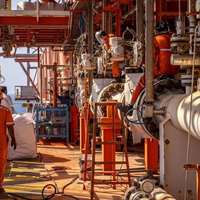
File photo shows commercial vessels near the Strait of Hormuz amid ongoing shipping disruptions.
The maritime confrontation around Iran widened Tuesday as US forces struck an Iran-bound vessel and Tehran-backed Houthis attacked a ship in Bab el-Mandeb, even as Pakistan and Qatar signaled progress in mediation over the Strait of Hormuz.
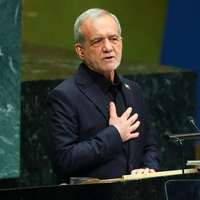
Pakistan’s Interior Minister Mohsin Naqvi met President Masoud Pezeshkian and Foreign Minister Abbas Araghchi in Tehran as Islamabad continued its mediation efforts.
Pakistan’s Defense Minister Khawaja Asif separately said signals from recent days suggested the US and Iran were close to “some sort of an arrangement,” while Qatar said Iran-Oman negotiations had reached an advanced stage.
The diplomatic push came as Washington escalated enforcement of its naval blockade. US Central Command said a Navy helicopter fired two Hellfire missiles at the Panama-flagged Vela Nova after its crew ignored repeated warnings and continued toward an Iranian port, disabling the vessel’s steering gear.
CENTCOM said the blockade remained “in full effect,” adding that US forces had redirected 55 commercial vessels, disabled three and boarded two as of Tuesday.
A deck cargo ship was also attacked by Yemen’s Iran-backed Houthis in the Bab el-Mandeb Strait on Tuesday, killing three crew members, Reuters reported, citing Yemeni coast guard sources and government military officials.
Asharq Al-Awsat reported the same day, citing Yemeni security sources, that IRGC officers were overseeing the Houthis’ escalating military operations in Yemen. Iran’s envoy to the group, Ali Mohammad Rezaei, was personally supervising an operations room managing military and security affairs in Houthi-controlled areas, according to the report.
Tehran, meanwhile, maintained that progress on shipping arrangements with Oman would not by itself reopen the strait. Supreme National Security Council Secretary Mohsen Rezaei said Hormuz would remain closed unless Washington changed its behavior and accepted Iran’s conditions, and that any agreement with Oman on a transit route would be separate from the broader closure.
Mohammad Mokhber, an adviser to Supreme Leader Mojtaba Khamenei, reinforced that position, saying the strait “will not be reopened until Iran’s conditions are met.”
Pressure on shipping also persisted. The Joint Maritime Information Center said IRGC attacks, attempted attacks and harassment continued in the strait, including UAV overflights, hailing and targeted surveillance of merchant vessels.
IRGC spokesperson Hossein Mohebi also warned that energy networks, power plants and global internet-linked infrastructure could be at risk if Iran were threatened again. He said the US had “30 to 40 warships in the region” before the recent 40-day war but that “not even one US warship” remained in the Persian Gulf.
Despite the continuing confrontation, oil flows showed signs of recovery. US Energy Secretary Chris Wright said the seven-day average for oil leaving the Strait of Hormuz had risen to nearly 9 million barrels per day, with total regional flows averaging about 15 million barrels per day when pipeline and export-facility shipments were included.
Turkish President Tayyip Erdogan, Saudi Crown Prince Mohammed bin Salman, and Pakistan's Prime Minister Shehbaz Sharif pose after signing a joint defence agreement in Mecca, Saudi Arabia, August 7, 2026.
Iranian officials and analysts are publicly playing down the threat posed by a new defense pact between Saudi Arabia, Pakistan and Turkey, even as some commentators warn Tehran against underestimating an emerging regional alignment.
Foreign Ministry spokesman Esmail Baghaei said Monday that Iran had no reason to fear that the so-called Mecca Pact was directed against it, portraying the agreement instead as a response to Israeli ambitions and declining regional confidence in US security guarantees.
Seyed Abdollah Motavalian, a hardline commentator writing in the IRGC-affiliated Javan newspaper, similarly described the pact as having “considerable propaganda potential” but facing serious obstacles to becoming a strategic alliance.
He warned Tehran against making hasty decisions, particularly in negotiations with Washington, “based on fear of an alliance that has not yet taken shape amid propaganda hype.”
“Tehran’s strategic skill would be not to allow a political document, before it is tested against reality, to become an imaginary power in the calculations of decision-makers,” Motavalian wrote. “The first defeat in this arena may come not on the battlefield, but in the mind.”
Other Iranian commentary has emphasized the differing interests of the three countries and questioned whether Pakistan or Turkey would be willing to become directly involved in Saudi Arabia’s conflicts.
Their commitments, one analysis in Javan argued, may ultimately be limited to advisory support, weapons sales and joint exercises.
A retreat from Washington?
Iranian officials and state-affiliated media have also sought to interpret the agreement as evidence of Saudi Arabia’s frustration with Washington, particularly over what they describe as inadequate US protection against recent missile and drone attacks.
Tasnim, which is affiliated with the IRGC, argued that repeated attacks and Washington’s inability to contain the threat had pushed Riyadh to diversify its security relationships and reduce its reliance on the United States.
From Tehran’s perspective, that could carry potential benefits. A security architecture less dependent on Washington could weaken the United States’ traditionally dominant role in the region while creating additional complications for Israel.
The pact could also give Riyadh greater leverage in seeking stronger security guarantees from Washington, Iranian analysts said.
Pakistan or Turkey?
The involvement of Pakistan and Turkey nevertheless raises more complicated questions for Tehran.
Pakistan is a nuclear-armed power on Iran’s eastern border and has played an important role mediating between Tehran and Washington during the recent conflict.
Iranian commentators seeking to minimize the threat point out that Islamabad did not act against Iran during the 40-day Iran-US war despite its existing defense relationship with Saudi Arabia, instead helping mediate between the two sides.
Motavalian described Pakistan’s participation as part of “a multilayered deal and an increase in bargaining power,” rather than evidence of “the formation of a coherent war front.”
Turkey may present a different challenge.
Kamran Karami, a Persian Gulf security analyst writing for Donya-e Eqtesad, argued that Ankara’s participation could ultimately prove more consequential for Iran than Pakistan’s.
“For Iran, this development sends a clear message: Turkey is becoming one of the main poles of the Middle East’s new security architecture,” he wrote. Competition between Tehran and Ankara, he added, could gradually expand beyond economics and politics to “the design of the regional order.”
Others see Pakistan as the greater concern precisely because of its recent role as an intermediary with Washington. Tohid Javadi, a Middle East researcher, argued that turning a mediator into a rival security actor could complicate that relationship.
The possibility that other countries, including Egypt, could eventually join the arrangement has added to speculation that it might develop into a broader regional bloc.
Risks of underestimating pact
Not all Iranian commentary accepts the reassuring interpretation.
Asr-e Iran warned that dismissing the agreement as political theater could prove a mistake if it gradually develops military and security mechanisms capable of changing the regional balance.
Saudi Arabia brings financial resources, Pakistan military strength and nuclear capability, and Turkey one of the region’s most powerful armed forces, alongside considerable military experience and geopolitical reach.
Together, Asr-e Iran argued, they could eventually create a deterrent capable of limiting the room for maneuver of other regional powers, including Iran.
Fararu offered a similar warning, arguing that the significance of the pact is greater because it comes after a major Iran-US war whose underlying disputes remain unresolved.
The immediate purpose of such an alliance, it argued, need not be fighting a war. Its significance lies in changing the calculation before one begins.
“If Tehran, or any other actor, knows that an attack on Saudi Arabia could trigger a response from Turkey and Pakistan as well, the cost-benefit calculation of an attack changes,” the analysis said.
“In simple terms, the pact seeks to create a new equation: an attack on Saudi Arabia is no longer just an attack on Saudi Arabia.”
File photo shows IRGC officers during a naval drill in southern Iran
Iranian lawmakers are advancing a sweeping bill aimed at asserting greater control over the Strait of Hormuz, including restrictions on US and Israeli assets in a waterway through which about one-fifth of global oil and LNG supplies passed before the war.
The latest move came Monday, when parliament’s Internal Affairs and Councils Committee approved a provision banning the transit of assets and equipment owned by the United States, Israel and other countries Tehran “hostile,” committee spokesperson Valiollah Bayati said, according to parliament’s official news agency ICANA.
The restriction was among the first five articles approved as lawmakers began a detailed review of the proposed “Strategic Action to Ensure the Sustainable Security of the Strait of Hormuz and the Persian Gulf.”
Representatives from Iran’s Foreign Ministry, armed forces and parliament’s Research Center attended the meeting.
Bayati said the measure was adopted because the countries concerned had used the strait to carry out what he described as hostile actions and attacks against Iran. The remaining articles will be considered at future meetings.
Other provisions under consideration include tighter rules for vessels linked to countries Tehran regards as hostile and charges for maritime services provided to ships using the strait, lawmaker Sodeif Badri said Sunday.
Revenue would be directed toward security, monitoring and development infrastructure.
Badri said parliament was seeking a long-term legal framework for Iran’s management of Hormuz rather than relying on temporary policies, adding that the strait would not return to its pre-war conditions.
The legislation has not yet become law, and the provisions being considered by committees would still require parliamentary approval.
Parliament’s National Security and Foreign Policy Committee, which is leading the review, approved the bill’s general outlines Sunday without opposition among members present, spokesperson Hassan Ghashghavi said.
The Construction Committee has also backed the outlines, while the Internal Affairs and Councils Committee is reviewing parts of the legislation.
The parliamentary effort has gathered momentum since the war, with lawmakers increasingly presenting control of the strait as a strategic lever in Iran’s confrontation with the United States.
The legislation was formally submitted to parliament on July 13. A day later, Ebrahim Azizi, chairman of the National Security and Foreign Policy Committee, said lawmakers were standing firmly by their “red lines,” particularly over management of Hormuz.
“This is the first step,” Azizi wrote on social media, adding that further measures would “take sleep from the eyes of our enemies.”
By late July, 12 proposals had been referred to Azizi’s committee for consolidation into a single bill, according to parliament’s presiding-board spokesperson Abbas Goudarzi. Nine dealt directly with Hormuz and three proposed changes to Iran’s maritime zones law.
The proposals cover restrictions on navigation, penalties for violations and potential revenues from Iran’s management of the strait, suggesting lawmakers are seeking to turn wartime control of Hormuz into a more permanent legal framework.
Commercial vessels are seen in waters near the Strait of Hormuz amid ongoing negotiations over shipping arrangements and the reopening of the waterway.
Iran says the Strait of Hormuz will not reopen until the United States meets its conditions, even as Tehran and Oman move closer to an agreement on a temporary shipping route.
Mohammad-Bagher Zolghadr, secretary of Iran’s Supreme National Security Council, said Saturday that the waterway would remain closed until Washington “corrects its behavior,” spelling out the conditions in a written message.
“Correcting its behavior means that Iran must never again be threatened or humiliated, aggression against Iran and its allies must end permanently, the naval blockade must be lifted, US naval and air forces must withdraw from around Iran, war damages must be compensated, sanctions must be lifted and Iran’s frozen assets must be released,” Zolghadr said.
“The Supreme National Security Council will never back down, whether in war or in negotiations,” he added.
The demands came even as Iran and Oman moved closer to an agreement on a temporary shipping route through the strait.
Foreign Minister Abbas Araghchi said Saturday that the two countries were “very close” to completing negotiations on the route, which is intended as an interim arrangement while technical and legal work continues on a new permanent Traffic Separation Scheme, or TSS.
Araghchi said an agreement with Oman on the route “does not necessarily mean the reopening of the Strait of Hormuz.”
He said reopening remained subject to separate conditions, including the United States compensating for what Tehran considers violations of the Islamabad memorandum of understanding.
The IRGC reinforced that distinction earlier Saturday, saying the Iran-Oman negotiations and a decision to reopen the strait were separate issues.
“Whenever America accepts Iran’s conditions, the Strait of Hormuz will certainly reopen,” IRGC spokesperson Hossein Mohebi said.
Oman, which has been negotiating the shipping arrangements with Tehran, described the talks as proceeding in a “positive and constructive” atmosphere. Its Foreign Ministry also condemned repeated attacks on vessels transiting the strait and urged all sides to avoid actions that could undermine progress in the negotiations.
From Washington, Vice President JD Vance said Iran had told the United States it had no plans to impose tolls in the Strait of Hormuz and that Tehran and Persian Gulf states, particularly Oman, were discussing arrangements for safe passage.
Vance said those discussions included demining and a commitment from Iran not to fire on commercial vessels. Washington expected oil and gas flows from the Persian Gulf to return to pre-conflict levels, he said, but would judge Tehran by its actions.
“We don’t trust, we verify,” Vance said in an interview aired by Fox News Saturday.
US officials have also linked relief from Washington’s pressure campaign to the restoration of shipping. The Wall Street Journal reported Friday that Washington had told mediators it would not accept Iranian restrictions or tolls and that the Trump administration would lift its blockade on Iranian ports if Tehran reopened the waterway without impediments.
President Masoud Pezeshkian, meanwhile, called the United States “untrustworthy” but said Saturday that now was the “best time” to reach an agreement. He said Tehran was discussing diplomacy almost daily in an effort to move Iran out of a state of “neither war nor peace.”
“You cannot fight forever; at some point, it has to be brought to an end,” Pezeshkian said.
The negotiations with Oman may therefore settle how vessels would move through the Strait of Hormuz, but Iranian officials say the decision to reopen it remains contingent on Washington meeting broader demands set by Tehran.
The Wasp-class amphibious assault ship USS Kearsarge (LHD 3) transits the Strait of Hormuz.
The United States imposed fresh sanctions targeting Iran’s financial networks Friday even as US officials said progress had been made toward a deal with Tehran over the Strait of Hormuz and it could be clinched as early as the weekend.
The US Treasury targeted currency exchange houses, shell companies and financial facilitators that Washington said helped Iran move hundreds of millions of dollars through the international financial system.
The State Department said the measures targeted networks Iran used to access oil revenue, evade sanctions and move funds through front companies.
It added that the new sanctions were intended “to cut the financial lifelines that sustain Iran’s ruling elite.”
The statement said Washington would continue targeting banks, exchange houses and other facilitators it says Iran uses to move funds and evade sanctions.
Despite the new sanctions, US officials insist that progress has been made in talks over the Strait of Hormuz.
There has been progress between Oman and Iran over the strait and a deal is expected soon, Reuters reported Friday, citing a US official.
The official said the US would lift its blockade of Iranian ports once an agreement was announced to restore commercial shipping through the strait without impediments.
Bessent says ceasefire could come soon
US Treasury Secretary Scott Bessent separately said a 30- to 60-day ceasefire agreement with Iran could come “shortly, maybe even today, tomorrow,” adding that a deal could reopen the Strait of Hormuz and bring energy prices down.
Bessent also said the strait would “never” return to the way it was, saying Iran had used or tried to use it as a choke point.
“What we are going to see over the next two years, the strait is going to become irrelevant. It is going to become just another body of water,” Bessent said.
He added that “more than 50 or 70%” of the energy currently moving through the strait would instead go through underground pipelines.
Earlier Oman proposal
The latest progress follows weeks of talks between Iran and Oman over a new arrangement for commercial shipping through the Strait of Hormuz.
Iran had earlier rejected an Omani proposal for a 50-50 arrangement dividing the inbound and outbound routes between the two sides, saying it did not sufficiently address Tehran’s security concerns.
Tehran instead proposed that one shipping lane run entirely through Iranian territorial waters and part of the other also pass through Iranian waters, allowing Iran to maintain oversight over traffic in both directions.
US actions would remain performance-based and tied to Iran’s implementation of its commitments, the US official told Reuters.
Turkish President Tayyip Erdogan, Saudi Crown Prince Mohammed bin Salman, and Pakistan's Prime Minister Shehbaz Sharif pose after signing a joint defence agreement in Mecca, Saudi Arabia, August 7, 2026.
Saudi Arabia, Turkey and Pakistan signed a mutual defense pact in Mecca on Friday that never once named a threat, and within hours Iranian officials and clerics had named it for them, mocking the agreement and promising that "the roar of our missiles" will reach its signatories.
The Mecca Joint Defense Agreement, signed as Crown Prince Mohammed bin Salman hosted Turkish President Recep Tayyip Erdogan and Pakistani Prime Minister Shehbaz Sharif, declares that an armed attack on any of the three will be treated as an attack on all.
A Turkish official called the pact "purely defensive," directed at no specific actor and open to other countries in the region.
The signatories' combined weight explains the attention. Turkey fields NATO's second-largest military, Saudi Arabia is one of the world's top oil exporters and home to Islam's holiest sites, and Pakistan is the only nuclear-armed Muslim state.
The pact caps nearly a year of negotiations and builds on last year's Saudi-Pakistani defense agreement, under which some 8,000 Pakistani troops, fighter jets and an air-defense system have already deployed to the kingdom.
The timing needs little decoding. Since the war began on February 28, Iran and its allies have struck US bases and civilian infrastructure across Saudi Arabia, Kuwait, Bahrain, Qatar, the United Arab Emirates, Oman and Jordan, shut the Strait of Hormuz to most shipping, and, through the Houthis, declared a naval embargo on Saudi ports in the Red Sea.
For Riyadh, three years of regional war have also raised a harder question: whether the American security umbrella it built its plans on still opens.
Turkish President Tayyip Erdogan, Saudi Crown Prince Mohammed bin Salman, and Pakistan's Prime Minister Shehbaz Sharif, accompanied by their ministers of Foreign Affairs and Defence, pose after signing a joint defence agreement in Mecca, Saudi Arabia, August 7, 2026.
Tehran answers the question nobody asked
The pact's statement avoided Iran's name. Tehran filled the silence itself.
"The Saudis should know that a paper agreement with Turkey and Pakistan will not bring them security, just as years of one-way nursing of the Americans brought them none," Ebrahim Rezaei, a member of the Iranian parliament's national security committee, wrote on X. "Correct your policies so you no longer need to go begging for security."
The clerical establishment was blunter. "Borrowed security and begging America for security will not save you," Alireza Arafi, the Friday prayer leader in Qom, told regional governments.
"As long as you are with the enemies of Islam and Iran, the roar of our missiles will threaten you."
In Ahvaz, another Friday preacher said Iran was working to extend its missiles' range to 15,000 kilometers so that "the American people, too, will see what it is like to be left in blood and destruction."
For a pact its authors insisted was aimed at no one, the replies arrived from one address.
Riyadh braces, Baghdad moves
The agreement was signed against specific and immediate warnings. A Saudi official told CNN the kingdom is preparing for coordinated attacks on energy facilities, ports and airports by Iraqi militias and Yemen's Houthis "in the very near future," under the guidance of Iran's Revolutionary Guards, citing intelligence that included tracked meetings between militia and Guards personnel and movements of drones and missiles.
Baghdad, unusually, is moving against the same groups. An Iraqi government official told Iran International the country is "on the verge of delivering the final blow" to Iran-backed militias, with intelligence indicating planned operations not only against Saudi Arabia but against Kuwait, Jordan and Syria.
Iraq's armed forces said a security plan is underway to foil any attack on the kingdom, and troops have been ordered to prevent Iraqi territory from being used for missile and drone launches at neighbors.
The warnings follow a week in which the Houthis struck two Saudi tankers in the Red Sea and hit Najran's airport, wounding 11 civilians, including a four-year-old child.
Reporting by Asharq al-Awsat and Israeli media describes a joint Houthi-Iraqi operations room established at Jurf al-Sakhr, the militia stronghold south of Baghdad.
A deal Tehran wants, on terms it dictates
The day's other track ran through Muscat.
Iran's parliament confirmed the framework of an understanding with Oman has been agreed, and lawmaker Ahmad Bakhshayesh Ardestani described its logic with unusual candor: Iran is negotiating with America "in Oman's name," he said, over an arrangement that would leave the strait's management in Iranian hands and charge passing ships a tariff of 7 percent of cargo value, split three-quarters to Tehran and a quarter to Muscat.
President Donald Trump sounded confident and noncommittal at once. "It's obvious they don't want to be hit. They want to make a deal. So, we'll see," he said, adding that gasoline prices would rise only if he had to "do another hit" on Iran.
The Wall Street Journal reported that Arab mediators doubt Iran's diplomats have the authority to deliver any Hormuz deal they sign, as hardliners accuse the negotiating team of giving too much away.
That doubt, in the end, is what Friday's ceremony in Mecca was about. Three of the region's heaviest states have concluded that whatever emerges from the talks, the threat that closed the strait and burned their ports will outlast the paperwork, and they intend to face it attached to one another rather than waiting, separately, for Washington.