Iranian security forces shot protester Farid Ramezani during the January protests in Tehran, then targeted his Pahlavi crown tattoo as he lay wounded before killing him with a shot to the forehead, a source familiar with the case told Iran International.
Ramezani, 29, was shot on the evening of Jan. 8 in Tehran's Ariashahr neighborhood, said the source who could not be named for fear of retribution from Iranian authorities.
Ramezani was among hundreds of thousands of protesters who took to the streets of Tehran on Jan. 8 as nationwide demonstrations against the Islamic Republic intensified.
A video obtained by Vahid Online from Ariashahr that same night shows security forces opening a barrage of gunfire on protesters, with repeated shots heard as people scream and run from the scene.
On that night, security forces fired three bullets at Ramezani in total: the first brought Ramezani to the ground, the second was fired at the finger bearing the crown tattoo, and the third struck his forehead and killed him, according to the source.
After his death, Ramezani's family came under intense pressure from security agencies, the source said. Authorities demanded money from the family for the three bullets used to kill him, describing the payment as a “bullet fee,” and withheld his body for about two weeks.
Security agencies also barred the family from burying him in Tehran. His body was transferred to Hashjin in Khalkhal county, in the northwestern province of Ardabil, where he was buried.
The source said security forces imposed tight restrictions on the funeral, preventing a public ceremony and barring the display of Iran’s pre-1979 Lion and Sun flag, a symbol widely used by opponents of the Islamic Republic, at the burial site.
The Pahlavi crown tattooed on his finger is associated with the monarchy which ruled Iran before the establishment of the Islamic Republic in 1979.
Monarchist and other symbols associated with pre-1979 Iran have increasingly appeared among opponents of the clerical establishment.
The targeting of Ramezani's tattoo is not the first such case reported during the January protests. Last month, Iran International reported that security agents used a blade and box cutter to cut away skin and flesh bearing tattoos of Reza Shah Pahlavi and an imperial crown from the arm of 21-year-old protester Amirhossein Nobakht Pardasti before later killing him with a gunshot, according to sources close to his family.
Similar cases have also been documented during earlier protest movements.
One of the best-known was Majidreza Rahnavard, a protester executed in Mashhad in December 2022, following the Woman, Life, Freedom protests.
Rahnavard had a Lion and Sun emblem tattooed on his left forearm. Images released after his arrest showed the arm badly injured and immobilized in a cast and bandages.
A person close to Rahnavard told Iran International that security agents repeatedly struck the tattooed arm with batons and stun guns because of the emblem, eventually breaking it.
Rising living costs have forced many Iranians to give up cafes and restaurants, turning a once-routine form of leisure into an expense increasingly squeezed out by rent, food and healthcare, messages to Iran International say.
“Cafe and restaurant outings are a form of recreation and something people look forward to, but inflation and rising costs have deprived many people even of that,” one audience member wrote.
Responses to an Iran International question about monthly cafe spending ranged from zero to hundreds of millions of rials. For many respondents, however, “nothing” and “zero” were the recurring answers.
When essentials leave Iranians nothing for a coffee
Several people said they had not visited a cafe or restaurant for months or years because rent, utility bills, medical care, food and debt payments had taken priority.
“How much do we earn in this inflation for anything to be left for recreation? We work from morning until night and can only pay the rent,” one person wrote.
Another said even buying enough food had become difficult.
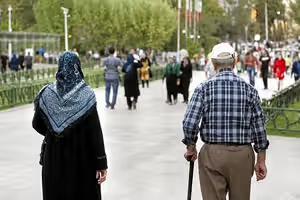
A cup of coffee sits on a table inside a café in Iran.
“We are trying to be able to provide two meals a day. Going to a cafe has become completely out of reach for us,” the respondent wrote.
Healthcare expenses featured repeatedly in the messages. One person said a root canal on August 10 cost 120 million rials ($65), leaving no money for leisure or cafe visits.
Many Iranian workers earn around 200 million to 250 million rials ($108-$134) a month. The rial trades at around 1.86 million to the dollar on the free market.
Another, a retired education worker, said even one restaurant or cafe visit a year was unaffordable.
“I pay for medicine and doctors in installments,” the retiree wrote.
Others described a gradual erosion of living standards rather than a sudden end to leisure spending. One said the family had gone to cafes or restaurants around three times a month until relatively recently but was now buying basic necessities on credit.
“Expenses such as cafes and restaurants, recreation and travel disappeared a long time ago, and only essential costs such as healthcare, food, rent and installments remain,” another person wrote.
Some said even those essentials were becoming increasingly difficult to afford.
“We have become dependent on money for our daily bread. Where would we find money for cafes or eating out? Buying fruit has become a dream for us,” one person wrote.
Another said the family had been unable to afford recreation or leisure activities for about one or two years and believed much of society was focused primarily on getting by.
A simple cafe order costs millions of rials
Prices listed by cafes on SnappFood application show how quickly even relatively simple orders can add up.
An Americano at cafes reviewed by Iran International started at about 1.1 million rials ($0.59) and reached roughly 3.8 million rials ($2.04) at some establishments. Espresso prices exceeded 3 million rials ($1.61) in some cases.
Breakfast dishes started at around 2 million rials ($1.08) at some cafes, while options including omelets or bread, cheese and herbs could cost more than 4 million rials ($2.15).
One said two drinks and a slice of cake for two people now cost about 12 million rials ($6.45).
Another calculated that buying only a morning espresso every day would cost 60 million to 70 million rials ($32-$38) a month.
Prices vary substantially by city, neighborhood and establishment, but several cafe visits each week can push monthly spending into tens of millions of rials.
Millions spent to preserve a social life
Not everyone has stopped going. Some said they deliberately continued setting aside money for cafes despite rising costs, describing the outings as one of their remaining opportunities for socializing and escaping daily pressures.
Monthly spending among this group commonly ranged from 50 million to 100 million rials ($27-$54), according to figures respondents provided, with some putting their spending at 150 million to 200 million rials ($81-$108) or as much as 300 million rials ($161).
“Every day I buy a shot of coffee and a small bottle of water from a cafe, and maybe a vitamin C drink. I calculated that it comes to around 50 million rials ($27) a month,” one person wrote.
Another said they visited cafes at least 20 times a month.
The spending does not necessarily reflect financial comfort, according to some of the messages. Citizens described paying for cafes as a way to preserve a fragment of ordinary social life despite the squeeze on household budgets.
One person estimated that under current prices, even a relatively frugal young person could face monthly expenses of 150 million to 300 million rials ($81-$161), rising to between 400 million and 700 million rials ($215-$376) with greater spending, whether on cafes or other necessities.
Cafe owners squeezed by debt and closures
Cafe owners and workers who contacted Iran International described the other side of the contraction in discretionary spending: fewer customers alongside rising operating costs and debt.
People gather at a busy café in Tehran, Iran.
One respondent from Khuzestan said debt had forced them out of business.
“I have been unemployed for two months because of debt, I lost my cafe, my bank installments are overdue and there is nothing I can do,” the person wrote.
Businesses also face closures linked to enforcement of Iran's mandatory hijab rules. Another pointed to cafes being sealed in Qazvin over compliance with the dress code.
For many, cafe outings have therefore become another measure of shrinking household choices: eliminated altogether by some families and maintained at considerable cost by others seeking a few hours of social life outside the pressures of everyday expenses.
Germany's embassy in Tehran remains on emergency operations because of the security situation in Iran, with its visa section closed to regular visitors and no regular visa appointments being issued, the German Foreign Office told Iran International on Tuesday.
National visa applications from people who have already appeared at the embassy or its external service provider will continue to be processed within the embassy's available capacity, the ministry said. Visas that are ready to be issued will also be handed out at the embassy in Tehran where capacity allows.
"Due to the current security situation in Iran, the embassy and, in particular, the consular and visa section in Tehran continue to operate in emergency mode," the ministry told Iran International. "The visa section is closed to regular visitors until further notice; no regular visa appointments are being issued."
The ministry said the current crisis had worsened an already difficult situation, as the embassy's visa section had been operating with severe technical and staffing limits since events in Iran in June 2025.
It said it was continuing efforts to expand capacity for accepting visa applications from Iran.
Germany has also created separate arrangements for Iranian nationals living in Iran who are seeking visas for family reunification.
Applicants who previously registered on the German embassy's appointment waiting list and have not canceled their registration are being contacted to submit applications in Istanbul through the International Organization for Migration's Family Assistance Programme, the ministry told Iran International.
Priority is being given to applicants whose previously scheduled appointments at the German embassy in Tehran were canceled because of the military conflict in Iran. Appointments will then be offered in chronological order based on the original registrations.
Visa service provider TLScontact is also issuing new appointments to some applicants with preliminary approval under Germany's fast-track procedure for skilled workers.
This applies to eligible applicants who were on the service provider's waiting list as of Jan. 18 or whose appointments were canceled after the embassy closed from Jan. 16.
Since July 15, applicants in several national visa categories, including students and doctors, who were not previously on a waiting list have also been able to register on new waiting lists. It is not yet clear when appointments will be offered to those applicants.
File photo shows Hossein Taeb (right) and Mojtaba Khamenei (left)
Supreme Leader Mojtaba Khamenei appointed veteran intelligence official Hossein Taeb to lead the Basij, giving the former protest crackdown figure a mandate to expand the paramilitary force’s grassroots intelligence network and use of new technologies.
In his decree, Khamenei instructed Taeb to “strengthen the popular intelligence network,” improve training and skills and make greater use of new technologies for what he described as a “people-based” response to enemy threats.
The directive places intelligence gathering prominently among Taeb’s responsibilities at the Basij, whose branches extend through neighborhoods, universities, workplaces and other parts of Iranian society.
With Taeb’s appointment, Khamenei is returning a figure closely associated with the suppression of dissent and protests to a leading role in one of the Islamic Republic’s main domestic security and mobilization organizations.
Taeb previously commanded the Basij during the unrest surrounding the disputed 2009 presidential election, when the force played a major role in suppressing demonstrations.
Taeb’s career has been centered on Iran’s security and intelligence establishment for more than four decades.
Born in Tehran in 1963, the cleric joined the Revolutionary Guards in 1982 and served in IRGC units in Tehran, Qom and Khorasan before moving into the Intelligence Ministry, where he rose to a senior management position.
He also served in counterintelligence at the ministry and later headed the IRGC’s own intelligence protection apparatus.
Return to Basij
His Monday appointment brings him back to an organization he previously led.
Taeb, a longtime ally of Mojtaba Khamenei, was appointed commander of the Basij Resistance Force in 2008, before becoming head of the newly established IRGC Intelligence Organization in October 2009, shortly after the mass protests that followed that year’s presidential election.
He went on to lead IRGC Intelligence for more than a decade, making him one of the most influential figures in the Islamic Republic’s internal security apparatus. The organization grew during his tenure into a powerful intelligence body operating alongside the Intelligence Ministry and became heavily involved in cases concerning political activists, journalists, dual nationals and alleged espionage.
Khamenei’s decree also ordered Taeb to broaden the Basij’s reach under the slogan “Every Iranian, a Basiji,” expand neighborhood and sector-based units, deepen cooperation with state institutions and develop social-service networks centered on mosques. He was also tasked with promoting the Basij model of “popular resistance” abroad.
Taeb replaces Gholamreza Soleimani, who was killed in the US-Israeli war earlier this year.
Award-winning Iranian photo-journalist Yalda Moayeri was sentenced to 15 years in prison on August 8, 2026
Iran marked its annual Journalists’ Day this week as reporters remained behind bars, others faced lengthy prison sentences and rights groups warned that a crackdown on independent reporting has intensified since nationwide anti-government protests erupted earlier this year.
Among those detained is photojournalist Artin Ghazanfari, who has spent nearly seven months in custody and is being held at Greater Tehran Prison despite serious health problems, according to the Defending Free Flow of Information organization (DeFFI).
Ghazanfari, a Baha’i who suffers from heart failure, high blood pressure and asthma, was arrested at his Tehran home on Jan. 18, according to the Committee to Protect Journalists. CPJ said no charges against him had been disclosed.
Amirhossein Rezaei, a journalist and political science student at the University of Tehran, has meanwhile remained in temporary detention for more than three months. Security forces arrested him at his family home in Arak on May 6, according to the Hengaw rights group.
Photojournalist Yalda Moayeri said on social media this week that she had been sentenced in absentia to 15 years in prison by Branch 29 of Tehran’s Revolutionary Court.
Pressure persists
The cases come amid broader pressure on journalists and independent media following the anti-government protests that began in late December and spread across Iran in January.
Authorities imposed a near-total internet shutdown on Jan. 8 as the protests intensified, severely restricting journalists’ ability to report and cutting much of the country off from the outside world.
Iran ranks 177th out of 180 countries in Reporters Without Borders’ 2026 World Press Freedom Index, ahead of only China, North Korea and Eritrea. In March, amid war and a near-total communications blackout, CPJ said at least 15 journalists remained imprisoned in the country.
Concerns extend beyond detention itself to the conditions faced by journalists already serving prison terms.
Iranian-American journalist Reza Valizadeh, imprisoned at Tehran’s Evin Prison, said in a recording obtained by CBS News in June that prisoners were being denied adequate medical treatment. DeFFI said Valizadeh has also been denied family visits for months.
The US government has designated Valizadeh as wrongfully detained. He was sentenced on appeal in January 2025 to 10 years in prison, according to DeFFI.
Wider crackdown
Pressure on the media predates this year’s protests and war.
DeFFI documented judicial or security measures against at least 225 journalists and media outlets in 2025, with at least 148 new cases opened during the year.
Twenty-five journalists or media managers received sentences totaling more than 30 years in prison, while eight media outlets were shut down or banned, according to the organization’s annual report.
DeFFI recorded at least 398 instances in which it said judicial or security bodies violated the rights of journalists and media organizations, including harassment, arbitrary detention, denial of access to lawyers and pressure on journalists’ families.
Mohsen Rezaei was appointed as Supreme Leader Mojtaba Khamenei’s representative on Iran’s Supreme National Security Council on Sunday, before being named secretary of the powerful security body.
“In view of your valuable experience, I hereby appoint you ... as my representative on the Supreme National Security Council,” Khamenei said in a decree, describing Rezaei as a veteran of the 1980–1988 Iran-Iraq War.
Rezaei commanded the Islamic Revolutionary Guard Corps from 1981 to 1997, including through much of the war. He also serves as a senior military adviser to Khamenei and is a member of the Expediency Council.
Khamenei’s decree also thanked Mohammad Bagher Zolghadr, who had been SNSC secretary and one of the Supreme Leader’s representatives on the council, for his “tireless efforts day and night.” The decree did not say he was stepping down as SNSC secretary.
Shortly after the announcement, IRGC-affiliated Tasnim News reported, citing the president’s office, that President Masoud Pezeshkian had appointed Rezaei as SNSC secretary.
“Following Mohammad Bagher Zolghadr’s resignation as secretary of the Supreme National Security Council and his acceptance of a new responsibility, Mohsen Rezaei has been appointed secretary of the Supreme National Security Council by decree of President Masoud Pezeshkian,” said Tabatabaei, deputy for communications and information at the president’s office.
The SNSC is Iran’s top national security body, coordinating security and foreign policy and bringing together senior political, military and intelligence officials. The president chairs the council, while the Supreme Leader appoints two representatives to it.
Zolghadr, a former senior IRGC commander, took over as SNSC secretary in March, a week after Ali Larijani was killed in US-Israeli strikes. Larijani had returned to the post in August 2025 after previously serving as secretary from 2005 to 2007 and as parliament speaker from 2008 to 2020.
Zolghadr’s resignation
The appointments followed days of reports about Zolghadr’s position.
Earlier on Sunday, Tasnim removed a report announcing Rezaei’s appointment as Khamenei’s representative on the council. The outlet did not explain the deletion. The report had said Rezaei and Saeed Jalili would serve as the Supreme Leader’s two representatives on the SNSC.
Reformist newspaper Sazandegi reported on Friday that Zolghadr had offered his resignation but Pezeshkian had asked him to remain.
A day later, Pezeshkian did not deny that Zolghadr had offered to resign, saying there were “some differences that we are trying to resolve.”
Senior cleric and Khamenei relative Mohammad Bagher Kharrazi had also said on Monday that Rezaei was set to replace Zolghadr.