Khamenei fills six top military posts as key intelligence gaps persist
File photo shows a group of IRGC officers
Supreme Leader Mojtaba Khamenei appointed six top military commanders Monday, formalizing parts of a wartime leadership structure that operated for months without decrees while leaving several sensitive intelligence posts without publicly named permanent chiefs.
Ali Abdollahi was appointed chief of staff of Iran’s Armed Forces, while former Army Ground Forces commander Kioumars Heydari was named his deputy.
Left: Ali Abdollahi, chief of staff of Iran’s armed forces. Right: Kioumars Heydari, deputy chief of staff of Iran’s armed forces.
Khamenei also formally appointed Ahmad Vahidi as commander-in-chief of the Islamic Revolutionary Guard Corps and promoted him to the rank of major general. Mostafa Izadi, the former commander of the Cyber and New Threats Headquarters of the Khatam al-Anbiya Central Headquarters, was named deputy commander-in-chief of the IRGC.
Left: Ahmad Vahidi, commander-in-chief of the IRGC. Right: Mostafa Izadi, deputy commander-in-chief of the IRGC.
Rear Admiral Ali Azmaei was formally appointed commander of the IRGC Navy, while Hossein Taeb, the powerful former head of the IRGC Intelligence Organization, was named commander of the Basij paramilitary force.
Left: Hossein Taeb, commander of the Basij paramilitary force. Right: Ali Azmaei, commander of the IRGC Navy.
The decrees formally confirm the positions of Vahidi and Azmaei, who had already been publicly presented as commanders of the IRGC and its navy respectively without published appointment orders from Khamenei.
Vahidi had been introduced as IRGC chief after Mohammad Pakpour was killed earlier this year, while Azmaei emerged publicly as the Guards’ naval commander in July following the killing of Alireza Tangsiri.
The decrees settle some of the most consequential vacancies created by US-Israeli strikes since the war began on February 28. Abdollahi replaces Abdolrahim Mousavi, who was killed alongside Pakpour and Defense Minister Aziz Nasirzadeh in strikes on the opening day of the war.
Abdollahi had been serving as commander of the Khatam al-Anbiya Central Headquarters, the joint operational command responsible for coordinating Iran’s armed forces in wartime.
He emerged as one of Tehran’s most visible military commanders during the conflict, repeatedly issuing warnings to the United States and Israel and overseeing a command central to Iran’s missile operations and its use of the Strait of Hormuz as military leverage.
In his Monday decree, Khamenei ordered the completion of a process to integrate the Armed Forces General Staff with the Khatam al-Anbiya Central Headquarters, Iran’s top operational military command, as he appointed Abdollahi chief of staff.
Taeb’s return to power
Perhaps the most politically notable appointment is Taeb’s return to command of the Basij, the IRGC’s sprawling paramilitary arm which has played a central role in suppressing domestic protests.
Taeb previously headed the Basij before spending more than a decade at the helm of the IRGC Intelligence Organization. He was removed from that intelligence post in 2022 after a series of security breaches and operations inside Iran attributed to Israel.
Taeb nevertheless remained close to the center of power. He is known as part of the older intelligence-security network surrounding Mojtaba Khamenei, and during the current war he has been involved in high-level political and security deliberations, including disputes over negotiations with the United States.
His appointment to the Basij therefore returns one of the Islamic Republic’s most prominent intelligence and security figures to a major operational position at a time when the leadership remains concerned about both external attack and renewed domestic unrest.
Despite Monday’s sweeping announcement, important gaps remain.
Remaining gaps
Neither of the IRGC’s two principal intelligence bodies has a publicly announced permanent chief. Majid Khademi, who headed the IRGC Intelligence Organization and was also serving as head of its Intelligence Protection Organization, was killed in an April 6 strike in Tehran.
The two bodies perform distinct but complementary roles: the Intelligence Organization focuses heavily on political-security operations and domestic repression, while Intelligence Protection is responsible for counterintelligence, loyalty and preventing infiltration within the Guards.
No permanent replacement has also been publicly announced for Gholamreza Rezaeian, the head of the police Intelligence Organization, who was killed in the opening US-Israeli strikes.
Two other sensitive posts within the Armed Forces General Staff have lacked publicly announced permanent successors for more than a year. Gholamreza Mehrabi, the deputy chief of staff for intelligence, and Mehdi Rabbani, the deputy chief for operations, were killed in Israeli strikes during the June 2025 war.
Cabinet-level vacancies
The military reshuffle also does not resolve two major cabinet-level vacancies created by the current war.
The Defense Ministry remains under acting minister Majid Ebn al-Reza, whom Pezeshkian appointed after Nasirzadeh was killed on February 28. He has continued to represent the ministry in official meetings and international contacts but has not been nominated as permanent defense minister.
The Intelligence Ministry has likewise had no permanent minister since Esmail Khatib was killed in March. Pezeshkian’s office said shortly after his death that an acting minister had been appointed but declined to identify the person, promising that the name would be disclosed later.
No identity has subsequently been made public. Iran International earlier reported that Pezeshkian’s efforts to appoint a permanent intelligence minister had run into resistance from Vahidi and the IRGC leadership.
Those two posts follow a different process from the military commands announced Monday. Although appointments to sensitive ministries such as intelligence and defense are in practice coordinated with and require the approval of the Supreme Leader, they are cabinet positions and cannot simply be filled through a commander-in-chief’s decree.
Under Article 133 of Iran’s constitution, ministers are appointed by the president and must be presented to parliament for a vote of confidence.
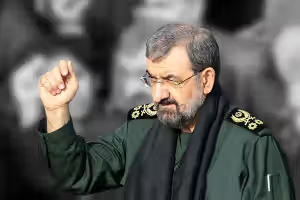
Mohsen Rezaei, a former commander-in-chief of Iran’s Islamic Revolutionary Guards Corps (IRGC), was appointed secretary of the Supreme National Security Council on August 9, 2026.
Mohsen Rezaei, whose four decades in Iran’s ruling establishment span the disputed Karbala-4 offensive, repeated failed presidential campaigns and an Interpol Red Notice over the AMIA bombing, returned to a top security post on Sunday.
The 71-year-old former commander-in-chief of the Revolutionary Guards was appointed secretary of the Supreme National Security Council after Mohammad Bagher Zolghadr resigned little more than four months into the job.
Supreme Leader Mojtaba Khamenei separately appointed Rezaei as his representative on the council, consolidating his position in a body central to decisions on war, diplomacy and Iran's confrontation with the United States.
The appointment adds another chapter to a career spanning command of the Revolutionary Guards through most of the Iran-Iraq war, decades in senior political institutions and four attempts to become president.
It also returns to prominence a figure whose record encompasses one of Iran's most disputed wartime operations, an Interpol Red Notice over the 1994 bombing of a Jewish community center in Argentina and years as a recurring subject of satire among Iranians online.
From Islamist militant to Guards commander
Born Mohsen Sabzevar Rezaei Mir-Ghaed in 1954, Rezaei became involved before the 1979 revolution with Mansouroun, an armed Islamist organization opposed to the monarchy.
Following the revolution, Mansouroun and six other Islamist organizations joined to form the Mojahedin of the Islamic Revolution Organization.
Rezaei's ascent through the new political order was rapid. Ruhollah Khomeini appointed him commander-in-chief of the Revolutionary Guards in 1981, when Rezaei was 27 and Iran was a year into its war with Iraq.
He remained in command until 1997, overseeing the Guards for almost the entire eight-year war and during its transformation from an armed organization into one of Iran's principal centers of military power.
Mohsen Rezaei (second from left) alongside Ali Khamenei (center) during the Iran-Iraq War.
Rezaei left military command in 1997 and moved into the Expediency Council, becoming its longtime secretary. He later served as vice president for economic affairs under President Ebrahim Raisi.
Politics did not deliver the electoral success he sought.
Rezaei entered presidential contests repeatedly, running in 2005 before withdrawing shortly before voting, and contesting elections in 2009, 2013 and 2021 without winning. His repeated appearances on presidential ballots eventually generated a running joke on Persian-language social media that wherever an election was taking place, Rezaei would inevitably become a candidate.
Mohsen Rezaei displays his identification document and inked finger as he registers to run in Iran’s presidential election.
Karbala-4 and a dispute that followed him for decades
No episode of Rezaei's military career has generated more lasting controversy inside Iran than Operation Karbala-4, launched against Iraqi forces in December 1986.
Rezaei was commander of the Revolutionary Guards when Iranian forces embarked on the operation. Accounts from commanders and participants later indicated that Iraqi forces had obtained advance knowledge of the offensive.
Akbar Hashemi Rafsanjani, who commanded Iran's war effort at the political level, later recalled learning shortly before the operation that it had been compromised.
Precise casualty figures remain disputed. Rafsanjani's wartime accounts put the toll at around 1,000 killed, 3,900 missing and 11,000 wounded.
The operation acquired renewed public significance decades later, particularly after the remains of 175 Iranian combat divers were returned to Iran in 2015.
File photo of Iranian forces preparing for Operation Karbala-4 during the Iran-Iraq War.
Rezaei reopened the controversy in 2018 when he wrote that Karbala-4 had been conducted to deceive Iraq before Iran launched the larger Karbala-5 offensive days later.
The description prompted criticism from veterans, former officials and military figures who argued that Karbala-4 had been designed as a genuine major offensive rather than a diversion.
Rezaei later clarified his remarks, saying Karbala-4 had indeed begun as a main operation but had subsequently been turned into a deception after the decision was made to withdraw.
An audio recording of Rezaei speaking to division commander Hossein Kharrazi during the opening phase also attracted attention because Rezaei could be heard instructing forces to continue advancing.
For critics, the episode became a wider argument over wartime accountability: whether commanders persisted with an operation despite evidence that Iraqi forces were prepared for it, and whether the later characterization of it as deception obscured the original plan.
Wanted in Argentina over AMIA bombing
Rezaei's years commanding the Guards also left him facing an international arrest request.
Argentina has sought him in connection with the July 1994 bombing of the AMIA Jewish community center in Buenos Aires, which killed 85 people and injured hundreds.
Interpol's Executive Committee approved a Red Notice for Rezaei and five other suspects in 2007 following a request from Argentina. Its General Assembly upheld the decision later that year.
Argentine authorities say Rezaei participated in a meeting at which the attack was decided. Rezaei and Iran have rejected Iranian responsibility.
His international travel has periodically revived the dispute. Argentina sought his arrest when he visited Qatar in 2022, without success.
Hostages for billions
Rezaei's public comments have also periodically generated controversy at home.
In 2015, he suggested that if the United States attacked Iran, Iranian forces could capture at least 1,000 Americans in the first week and demand billions of dollars for each one's release.
Mohsen Rezaei holds a banknote during a televised debate in Iran.
The proceeds, he suggested, could solve Iran's economic problems.
Such remarks, combined with his unsuccessful presidential campaigns and frequent television appearances, helped create a second public persona far removed from the image of the young wartime commander.
For some users on Persian-language social media, Rezaei became a stock character for political jokes.
That response resurfaced when Mojtaba Khamenei appointed him military adviser following the 2026 war. Users mocked everything from his return to office to the positioning of his belt buckle, which has itself become a longstanding internet meme.
Appointment revives criticism and ridicule online
Rezaei’s return to a senior security position prompted criticism and satire on X, where Iranian users revisited his wartime record, repeated presidential campaigns and controversial public remarks.
“Is Mohsen Rezaei’s military record, particularly during the war with Iraq, really defensible?” one user wrote. “Where does this extraordinary desire come from? From calling the Karbala-4 failure a deception operation, or from his idea of taking hostages to make money?”
Another user invoked the casualties of Karbala-4 more directly.
“Do you know that a huge number of young people in Operation Karbala-4 never saw the next morning?” the user wrote. “Yes, guess who the commander was. That’s right, Mohsen Rezaei.”
Some users instead interpreted the appointment through Iran’s internal power struggles.
One argued that the Revolutionary Guards had gained influence during the war while technocrats controlled the government, leaving the clergy with diminished power. The user portrayed Rezaei, a veteran Guards commander long removed from operational command, as a possible vehicle for restoring some of that influence.
Another suggested Rezaei’s appointment could strengthen parliament speaker Mohammad Bagher Ghalibaf, himself a former senior Guards commander.
Other posts sought to connect the reshuffle to reports of friction involving President Masoud Pezeshkian, with one user asking whether Rezaei’s appointment made previous reports about the president considering resignation more credible.
Mohsen Rezaei, Iran's new secretary of the Supreme National Security Council, speaks at an event.
Speculation over Pezeshkian’s position had begun before Rezaei’s appointment.
Mohammad Bagher Kharrazi, secretary-general of the Hezbollah of Iran political group, predicted the security council reshuffle in remarks circulated widely on social media, portraying it as part of an effort to constrain President Masoud Pezeshkian.
Kharrazi said that Pezeshkian had resigned or threatened to resign 28 times and that Supreme Leader Mojtaba Khamenei had grown frustrated with him and warned that another resignation would be accepted.
“That is why they are changing the Supreme National Security Council, moving Mr Zolghadr and replacing him with Mr Mohsen Rezaei,” Kharrazi said.
The prediction gained renewed attention after Zolghadr stepped down and Rezaei was appointed in his place.
Pezeshkian and Supreme Leader Mojtaba Khamenei’s office have denied accounts that the president repeatedly offered or threatened to resign.
A survivor returns
Rezaei's latest promotion comes at a markedly different moment from the one in which he first accumulated power.
The Supreme National Security Council has undergone rapid leadership changes following the killing of its former secretary Ali Larijani in March and Zolghadr's brief tenure afterward.
Rezaei now takes charge as Iran confronts the consequences of war and negotiations over the Strait of Hormuz, where he has taken an uncompromising public position.
He said in July that control over the waterway was “more important than dozens of atomic bombs,” and more recently said Iran would not accept an unauthorized shipping route through the Strait.
The appointment nevertheless puts a familiar figure back at the center of the system he helped build: a commander whose career has survived military setbacks, electoral defeats, international accusations and decades of political change, and who now again occupies one of the most consequential seats in Iranian national security policy.
Paul J. Saunders, President and CEO, Center for the National Interest
Washington likely underestimated Iran’s ability to withstand the initial US-Israeli strikes, making a negotiated settlement harder to achieve and deepening mistrust, foreign-policy expert Paul Saunders told Iran International.
The United States appeared to believe that military force would quickly weaken the Iranian government and compel Tehran to accept an agreement closer to US terms, Paul Saunders, president and CEO of the Center for the National Interest, said in an interview in Washington DC.
“I think the administration probably … overestimated how easy it would be to use force to bring about a successful agreement,” Saunders said.
Washington and Tehran remain divided over efforts to end the conflict, with the Strait of Hormuz at the center of competing military and diplomatic calculations. Recent reports have offered conflicting accounts of whether an agreement to reopen the waterway is imminent.
Strikes complicated diplomacy
“Targeting Iran’s leadership did more than escalate the military campaign,” Saunders said. “It also posed a direct threat to the survival of the Islamic Republic, making it harder for Washington to persuade Tehran to compromise.”
“I think that, from my point of view, it would have been better not to execute the strike on the Iranian leadership,” Saunders said, adding that the decision increased mistrust and left Washington in a weaker position to negotiate after the initial military action.
The US-Iran Memorandum of Understanding, signed in June, was a 14-point interim framework to end hostilities, restore commercial passage through the Strait of Hormuz, remove the US naval blockade and negotiate a final agreement within 60 days.
In July, Iran suspended implementation of its commitments under the MoU, accusing Washington of effectively abandoning its own obligations.
“In order to get a deal, we needed to have a government to negotiate with,” Saunders said. “When that government is really damaged and destabilized … will that new regime be sufficiently powerful that it will be able to make concessions to the United States?”
Trump has described Iran as being under a “third regime,” arguing that successive layers of the country’s leadership were killed in US and Israeli strikes and that the officials now in charge were different and more reasonable than their predecessors.
Iran’s internal response
Saunders said the political effects of the war extended beyond negotiations to Iran’s domestic response. He said it was predictable that Iranian society would rally behind the state when facing an external attack, even if many people remained unhappy with their government.
“Regardless of how angry or frustrated people might be with their own government, the only thing that they actually want less than their own government interfering in their lives … is someone else’s government doing it,” Saunders said.
“The Iranian government is responding to a threat to its survival, while Iranian society is reacting to an external attack. At the same time, the US president and the American public are weighing how much risk and cost the conflict justifies,” he added.
The conflict is important to Washington but not existential for the United States, Saunders said. He added that the administration had shown sensitivity to growing public concern over the costs of continuing the campaign.
Hormuz remains central
The Strait of Hormuz remains central to Iran’s leverage and to efforts to end the conflict. Commercial traffic through the waterway has fallen sharply, while Iran is also bearing substantial economic costs from the disruption.
Saunders said traders had so far expected the strait to reopen, limiting the immediate impact on global oil prices. But he warned that the economic consequences could become far more serious if the disruption persisted and refiners were forced to adapt to reduced supplies.
An F/A-18F Super Hornet, assigned to Strike Fighter Squadron (VFA) 41, prepares to make an arrested landing on the flight deck of the US Navy Nimitz-class aircraft carrier USS Abraham Lincoln in the Pacific.
President Donald Trump's latest order to investigate leaks about US munitions stockpiles may look like another dispute between the White House and the American media. In Tehran, it is being read as vindication.
Iran's military and state media have spent months portraying the depletion of American interceptors and precision weapons as evidence of a newfound way to impose costs on a vastly more powerful military.
The United States has not run out of weapons, and the Pentagon does not disclose exact inventories. But beneath the propaganda is a real strategic argument.
Iran does not need to match the United States missile for missile. It needs to make the United States expend expensive, slow-to-replace weapons at a rate that becomes difficult to sustain.
Washington increasingly appears to be treating that challenge as an industrial problem, not simply a battlefield one.
Tehran is not hiding the calculation
The clearest evidence comes from the IRGC itself. In a July 23 statement announcing an attack on a US base in Kuwait, the Revolutionary Guards said they would not allow Washington to use what they called "deceptive ceasefires" to replenish its oil and munitions stockpiles before resuming attacks.
The IRGC was not simply claiming to have damaged American forces. It was identifying the time required to replenish US stocks as a factor in how Iran viewed ceasefires and the continuation of the war.
On March 10, IRGC spokesman Ali Mohammad Naeini told American officials that Iran knew their ammunition stocks were being depleted. In April, Aerospace Force commander Majid Mousavi claimed Iran was replenishing its missile and drone capacity faster than the United States could replace weapons sent to the region.
Those statements cannot establish the actual condition of either country's arsenal. They do, however, show that Iranian commanders are treating ammunition consumption as part of the strategic contest.
On July 26, the hardline daily Kayhan ran a report referring to the "running dry" of Pentagon weapons stocks, using American media reports to challenge Washington's claims of overwhelming military power. Tasnim has similarly highlighted estimates of depleted Patriot, THAAD, Tomahawk and other missile inventories.
The claims are propagandistic, but they take aim at a genuine vulnerability.
Iran's advantage
Iran's military model was shaped partly by necessity. A May 13 analysis by the Carnegie Endowment traced Tehran's emphasis on ballistic missiles and drones to decades of sanctions and restricted access to Western military technology.
Rather than attempting to recreate an American-style force built around advanced aircraft and expensive precision systems, Iran invested heavily in weapons it could manufacture domestically and deploy in large numbers.
Carnegie cited estimates putting the cost of a Shahed-136 drone at roughly $20,000 to $50,000. Iranian ballistic missiles are substantially more expensive—roughly $1 million to $2 million by some estimates—but can still cost far less than the defensive systems used against them.
That does not mean a $30,000 drone automatically forces the launch of a multimillion-dollar Patriot interceptor. Air defense is layered. Fighters, guns, electronic warfare and cheaper interceptors can also be used.
Iran can also threaten an array of military and energy targets across the region with weapons flying at different speeds and altitudes. The defender must keep radars active, aircraft airborne and sufficient interceptors available for the threats that matter most.
Iran therefore does not have to win every exchange. It can fail to penetrate most defenses and still impose costs through volume, persistence and geography. That is the part of Iran's approach that an inventory count alone misses.
Politically sensitive numbers
Reuters reported on August 4, citing three people familiar with US military data, that the Army had consumed much of its stock of long-range ground-launched precision missiles during five months of war. Two sources said "virtually all" available ATACMS and Precision Strike Missiles had been used.
The Pentagon has not confirmed those numbers.
Three days later, The Wall Street Journal reported that Trump had ordered investigations into leaks about US munitions stockpiles. According to the report, the administration is seeking $52.9 billion for munitions and another $21 billion specifically to replace stocks depleted during the Iran war.
Trump publicly insists the United States retains "massive" quantities of ammunition. The two positions are not necessarily contradictory. The US military can have enough ammunition to continue current operations while simultaneously concluding that its inventories and production rates are inadequate for another major war.
That matters because Iran is not the Pentagon's only concern, and a potential conflict with China would place vastly greater demands on US stocks.
Future problems
The United States has spent years preparing for the possibility of conflict in the Indo-Pacific while simultaneously supplying Ukraine and maintaining commitments in Europe and the Middle East.
Every Patriot interceptor, Tomahawk or long-range precision missile used against Iran is therefore part of a larger calculation: What remains available if another crisis begins before the first one ends?
That is why the most revealing evidence is not the disputed number of missiles left in storage. It is what Washington is doing to its factories.
On January 6, the Pentagon announced a seven-year agreement aimed at increasing the annual production capacity of the PAC-3 MSE Patriot interceptor from roughly 600 to as many as 2,000.
On July 27, L3Harris announced agreements designed to nearly triple production of propulsion components for PAC-3 and quadruple propulsion production for THAAD. The Pentagon has also brought new suppliers into missile production and launched a program for lower-cost, air-launched cruise missiles that can be manufactured at greater scale.
These are not signs that American military power has collapsed. They are signs that the Pentagon believes industrial capacity itself has become a weapon.
The bigger picture
Iranian state media have turned the US stockpile debate into evidence that Washington has been defeated. That conclusion goes beyond what the public evidence supports.
The United States retains enormous military advantages in intelligence, air power, logistics, precision strike and global deployment. Iran has also suffered severe military, economic and human losses during the war.
But Tehran does appear to have demonstrated something narrower and strategically significant. A weaker state does not necessarily have to compete with America's most advanced technology. It can attack the economics and tempo behind that technology.
Michael Duffey, the Pentagon official responsible for acquisition and sustainment, recently described the shift in American thinking in unusually direct terms. For decades, he said, the United States benefited from its ability to engineer the world's most sophisticated weapons.
"We're no longer in that global environment," Duffey said, arguing that the Pentagon needs not only superior technology but speed and volume.
The argument over whether America's missile stocks are "running out" will continue, particularly while the actual numbers remain classified. The more consequential change is already visible.
Iran spent decades building a military around the assumption that it could not compete with the United States in sophistication. Washington is now spending billions to ensure that its technological superiority does not leave it vulnerable on quantity.
The next arms race is no longer only about who can build the better missile. It is also about who can build the next one fast enough.
Turkish President Tayyip Erdogan, Saudi Crown Prince Mohammed bin Salman, and Pakistan's Prime Minister Shehbaz Sharif pose after signing a joint defence agreement in Mecca, Saudi Arabia, August 7, 2026.
Saudi Arabia, Turkey and Pakistan signed a mutual defense pact in Mecca on Friday that never once named a threat, and within hours Iranian officials and clerics had named it for them, mocking the agreement and promising that "the roar of our missiles" will reach its signatories.
The Mecca Joint Defense Agreement, signed as Crown Prince Mohammed bin Salman hosted Turkish President Recep Tayyip Erdogan and Pakistani Prime Minister Shehbaz Sharif, declares that an armed attack on any of the three will be treated as an attack on all.
A Turkish official called the pact "purely defensive," directed at no specific actor and open to other countries in the region.
The signatories' combined weight explains the attention. Turkey fields NATO's second-largest military, Saudi Arabia is one of the world's top oil exporters and home to Islam's holiest sites, and Pakistan is the only nuclear-armed Muslim state.
The pact caps nearly a year of negotiations and builds on last year's Saudi-Pakistani defense agreement, under which some 8,000 Pakistani troops, fighter jets and an air-defense system have already deployed to the kingdom.
The timing needs little decoding. Since the war began on February 28, Iran and its allies have struck US bases and civilian infrastructure across Saudi Arabia, Kuwait, Bahrain, Qatar, the United Arab Emirates, Oman and Jordan, shut the Strait of Hormuz to most shipping, and, through the Houthis, declared a naval embargo on Saudi ports in the Red Sea.
For Riyadh, three years of regional war have also raised a harder question: whether the American security umbrella it built its plans on still opens.
Turkish President Tayyip Erdogan, Saudi Crown Prince Mohammed bin Salman, and Pakistan's Prime Minister Shehbaz Sharif, accompanied by their ministers of Foreign Affairs and Defence, pose after signing a joint defence agreement in Mecca, Saudi Arabia, August 7, 2026.
Tehran answers the question nobody asked
The pact's statement avoided Iran's name. Tehran filled the silence itself.
"The Saudis should know that a paper agreement with Turkey and Pakistan will not bring them security, just as years of one-way nursing of the Americans brought them none," Ebrahim Rezaei, a member of the Iranian parliament's national security committee, wrote on X. "Correct your policies so you no longer need to go begging for security."
The clerical establishment was blunter. "Borrowed security and begging America for security will not save you," Alireza Arafi, the Friday prayer leader in Qom, told regional governments.
"As long as you are with the enemies of Islam and Iran, the roar of our missiles will threaten you."
In Ahvaz, another Friday preacher said Iran was working to extend its missiles' range to 15,000 kilometers so that "the American people, too, will see what it is like to be left in blood and destruction."
For a pact its authors insisted was aimed at no one, the replies arrived from one address.
Riyadh braces, Baghdad moves
The agreement was signed against specific and immediate warnings. A Saudi official told CNN the kingdom is preparing for coordinated attacks on energy facilities, ports and airports by Iraqi militias and Yemen's Houthis "in the very near future," under the guidance of Iran's Revolutionary Guards, citing intelligence that included tracked meetings between militia and Guards personnel and movements of drones and missiles.
Baghdad, unusually, is moving against the same groups. An Iraqi government official told Iran International the country is "on the verge of delivering the final blow" to Iran-backed militias, with intelligence indicating planned operations not only against Saudi Arabia but against Kuwait, Jordan and Syria.
Iraq's armed forces said a security plan is underway to foil any attack on the kingdom, and troops have been ordered to prevent Iraqi territory from being used for missile and drone launches at neighbors.
The warnings follow a week in which the Houthis struck two Saudi tankers in the Red Sea and hit Najran's airport, wounding 11 civilians, including a four-year-old child.
Reporting by Asharq al-Awsat and Israeli media describes a joint Houthi-Iraqi operations room established at Jurf al-Sakhr, the militia stronghold south of Baghdad.
A deal Tehran wants, on terms it dictates
The day's other track ran through Muscat.
Iran's parliament confirmed the framework of an understanding with Oman has been agreed, and lawmaker Ahmad Bakhshayesh Ardestani described its logic with unusual candor: Iran is negotiating with America "in Oman's name," he said, over an arrangement that would leave the strait's management in Iranian hands and charge passing ships a tariff of 7 percent of cargo value, split three-quarters to Tehran and a quarter to Muscat.
President Donald Trump sounded confident and noncommittal at once. "It's obvious they don't want to be hit. They want to make a deal. So, we'll see," he said, adding that gasoline prices would rise only if he had to "do another hit" on Iran.
The Wall Street Journal reported that Arab mediators doubt Iran's diplomats have the authority to deliver any Hormuz deal they sign, as hardliners accuse the negotiating team of giving too much away.
That doubt, in the end, is what Friday's ceremony in Mecca was about. Three of the region's heaviest states have concluded that whatever emerges from the talks, the threat that closed the strait and burned their ports will outlast the paperwork, and they intend to face it attached to one another rather than waiting, separately, for Washington.
A heavily damaged residential building in Tehran following the 40-day war with the United States and Israel.
Tehran sustained the heaviest damage of any Iranian province during the 40-day conflict with US and Israel, with more than 50,000 homes damaged and the capital accounting for 650 reported strikes, according to a municipal report published on Monday.
The figures, presented at a public event hosted by the University of Tehran's Faculty of Urban Planning, offer the most detailed breakdown yet of damage across the capital following the conflict.
The report says District 4 in northeastern Tehran recorded the highest number of strikes, followed by District 21 in the west, District 1 in the north and District 22 in the northwest.
"The number of strikes in District 4 alone exceeded the combined total recorded in some provinces," Hossein Nouhi, a certified construction expert in Tehran's municipality, said during the event.
According to the report by Tehran Municipality's Urban Planning and Architecture Department, District 4 was hit 90 times, District 21 Tehran sustained 62 strikes, District 1 recorded 57 and District 22 recorded 55. District 17 in southwestern Tehran was the least affected, with three reported strikes.
Housing damage
The municipality said 50,849 residential units across Tehran sustained damage ranging from broken windows and doors to complete destruction.
Around 40,000 homes required minor repairs, about 8,900 suffered more extensive architectural damage, 415 buildings required structural reinforcement or reconstruction and 2,042 homes were completely destroyed and must be rebuilt, according to the report.
District 4 recorded the largest number of damaged residential units with 7,948, followed by District 2 with 4,037, District 15 with 3,490, District 11 with 3,432, District 21 with 3,205 and District 7 with 3,196.
Smoke rises over Tehran following a strike during the 40-day war with the United States and Israel.
The report also found that District 7 had the highest number of completely destroyed homes, with 429 units, followed by District 4 with 325 and District 11 with 248.
Estimated economic and environmental costs
Nouhi put the country's economic losses from the 40-day conflict at an estimated $280 billion, excluding psychological impacts and the cost of restoring industrial production. He argued that the conflict highlighted the need to require shelters in new high-rise developments.
Separately, geologist Mehdi Zare’ estimated that military strikes generated around 10 million metric tons of debris across affected urban areas by August 1. He said the waste includes concrete, steel, glass, asbestos and industrial pollutants that could create long-term environmental and public health risks.
Zare’ also said the demolition and cleanup process released millions of tons of greenhouse gases, adding to the environmental impact of the conflict.