Among the latest voices calling for a change of course are former President Hassan Rouhani, former Tehran mayor Gholamhossein Karbaschi and Hossein Marashi, secretary-general of the centrist Executives of Construction party.
Along with several other political figures, they have argued that Iran needs to reduce tensions with the United States and break its prolonged diplomatic impasse if it is to ease economic pressure and resume development.
Their interventions have come against a sharply different message from hardliners and military officials, who continue to frame resistance to Washington and Israel as essential to Iran’s security and warn against concessions under pressure.
The competing messages reflect a broader uncertainty at the heart of Iranian foreign policy: whether Tehran should use diplomacy to secure an exit from its confrontation with the United States or continue to raise the costs for its adversaries in the hope of extracting better terms.
The question has become more urgent after months of direct conflict with the United States, repeated warnings from Washington and Israel and several major waves of domestic unrest since 2018.
Those pressures have left the leadership increasingly sensitive to questions of public legitimacy while also making major diplomatic concessions politically dangerous. Any compromise with Washington risks being portrayed by rival factions as capitulation, giving decision-makers an incentive to postpone choices rather than assume responsibility for them.
Diplomacy without a clear destination
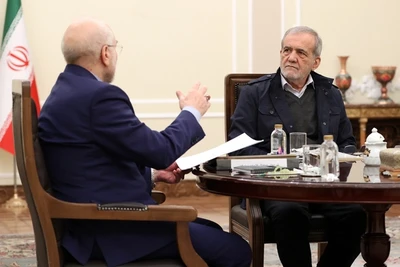
Hamid Aboutalebi, a former diplomat close to Rouhani, described that dilemma in an interview with Khabar Online this week, arguing that Iranian diplomacy has become caught between the urgency of immediate conflicts and the absence of a clearly defined long-term strategy.
The result, in his assessment, is a state of drift in which public expectations increasingly collide with geopolitical realities.
Aboutalebi’s criticism goes beyond whether Iran should or should not negotiate with Washington. He argues that Tehran has failed to clearly define the purpose, scope and desired outcome of diplomacy itself.
Without that clarity, he said, Iran cannot transform developments on the battlefield into political gains and is left “reacting to events rather than shaping them,” particularly in its confrontation with Israel and the United States.
That uncertainty is also visible in the government’s public messaging.
Many Iranians look to diplomacy primarily as a possible route toward economic relief and greater stability. Iranian officials, however, continue to alternate between warnings of further resistance and indications that negotiations remain possible.
The result is an expanding gap between what diplomacy is expected to deliver and what the government is prepared to commit to.
Aboutalebi argues that Iran must move beyond managing one crisis after another and instead define what it wants its foreign policy to achieve over the longer term.
That would require, in his view, deeper regional integration, a structured approach to the nuclear dispute and the development of economic partnerships capable of reducing Iran’s isolation.
The cost of suspended diplomacy
The argument is not new.
Tejarat-e Farda, one of Iran’s leading economic weeklies, has previously described the country’s approach as one of “suspended diplomacy” — a condition in which Tehran neither moves decisively toward confrontation nor commits itself to meaningful negotiations.
The magazine portrayed the consequences in unusually bleak terms, arguing that Iranians had come to recognize what it called the “tragic depth” of the country’s foreign-policy failures, producing not confidence or enthusiasm but “lethargy and despair.”
Writing in 2022, the publication argued that Iranian foreign policy had entered a prolonged state of strategic hesitation driven by domestic political caution, regional pressures and fear of diplomatic steps that might prove difficult to reverse.
The nuclear issue offered perhaps the clearest example.
Political analyst Fatemeh Mosayebi argued at the time that Tehran repeatedly signaled its willingness to engage in dialogue while avoiding concrete commitments, contributing to a cycle of hesitation in which neither Iran nor Western governments wanted to make the first major move.
Four years later, the circumstances are radically different, but the diagnosis retains much of its relevance.
Iran has moved from indirect regional confrontation to war with the United States, while the costs of economic pressure and military escalation have risen substantially. Yet the fundamental question identified in the earlier debate remains unresolved: what outcome is Iranian diplomacy actually intended to achieve?
Domestic rivalry further complicates the answer. Major foreign-policy decisions in Iran carry consequences not only for relations with Washington but also for the balance of power among competing political camps.
A failed compromise can be weaponized by hardliners, while escalation that imposes additional economic or military costs can become ammunition for their opponents.
That dynamic encourages delay. Tejarat-e Farda called it a “suspension of decision,” arguing that postponing difficult choices can ultimately “cost more than confrontation” by prolonging economic pressure without producing corresponding strategic gains.
The increasingly public calls for negotiations suggest that the price of that indecision is becoming harder to ignore.
Figures such as Aboutalebi and Marashi are not simply arguing for another round of talks. Their criticism raises a more fundamental question about whether Iran can continue simultaneously threatening escalation, signaling openness to diplomacy and postponing decisions about the compromises any agreement would ultimately require.
For now, Tehran continues to preserve both possibilities.
But the longer Iran remains caught between confrontation and compromise, the harder it becomes to present uncertainty itself as a strategy.