Rising living costs have forced many Iranians to give up cafes and restaurants, turning a once-routine form of leisure into an expense increasingly squeezed out by rent, food and healthcare, messages to Iran International say.
“Cafe and restaurant outings are a form of recreation and something people look forward to, but inflation and rising costs have deprived many people even of that,” one audience member wrote.
Responses to an Iran International question about monthly cafe spending ranged from zero to hundreds of millions of rials. For many respondents, however, “nothing” and “zero” were the recurring answers.
Rising living costs have forced many Iranians to give up cafes and restaurants, turning a once-routine form of leisure into an expense increasingly squeezed out by rent, food and healthcare, messages to Iran International say.
“Cafe and restaurant outings are a form of recreation and something people look forward to, but inflation and rising costs have deprived many people even of that,” one audience member wrote.
Responses to an Iran International question about monthly cafe spending ranged from zero to hundreds of millions of rials. For many respondents, however, “nothing” and “zero” were the recurring answers.
When essentials leave Iranians nothing for a coffee
Several people said they had not visited a cafe or restaurant for months or years because rent, utility bills, medical care, food and debt payments had taken priority.
“How much do we earn in this inflation for anything to be left for recreation? We work from morning until night and can only pay the rent,” one person wrote.
Another said even buying enough food had become difficult.
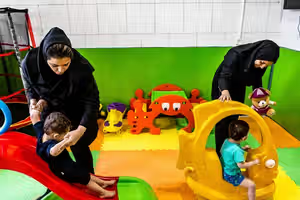
A cup of coffee sits on a table inside a café in Iran.
“We are trying to be able to provide two meals a day. Going to a cafe has become completely out of reach for us,” the respondent wrote.
Healthcare expenses featured repeatedly in the messages. One person said a root canal on August 10 cost 120 million rials ($65), leaving no money for leisure or cafe visits.
Many Iranian workers earn around 200 million to 250 million rials ($108-$134) a month. The rial trades at around 1.86 million to the dollar on the free market.
Another, a retired education worker, said even one restaurant or cafe visit a year was unaffordable.
“I pay for medicine and doctors in installments,” the retiree wrote.
Others described a gradual erosion of living standards rather than a sudden end to leisure spending. One said the family had gone to cafes or restaurants around three times a month until relatively recently but was now buying basic necessities on credit.
“Expenses such as cafes and restaurants, recreation and travel disappeared a long time ago, and only essential costs such as healthcare, food, rent and installments remain,” another person wrote.
Some said even those essentials were becoming increasingly difficult to afford.
“We have become dependent on money for our daily bread. Where would we find money for cafes or eating out? Buying fruit has become a dream for us,” one person wrote.
Another said the family had been unable to afford recreation or leisure activities for about one or two years and believed much of society was focused primarily on getting by.
A simple cafe order costs millions of rials
Prices listed by cafes on SnappFood application show how quickly even relatively simple orders can add up.
An Americano at cafes reviewed by Iran International started at about 1.1 million rials ($0.59) and reached roughly 3.8 million rials ($2.04) at some establishments. Espresso prices exceeded 3 million rials ($1.61) in some cases.
Breakfast dishes started at around 2 million rials ($1.08) at some cafes, while options including omelets or bread, cheese and herbs could cost more than 4 million rials ($2.15).
One said two drinks and a slice of cake for two people now cost about 12 million rials ($6.45).
Another calculated that buying only a morning espresso every day would cost 60 million to 70 million rials ($32-$38) a month.
Prices vary substantially by city, neighborhood and establishment, but several cafe visits each week can push monthly spending into tens of millions of rials.
Millions spent to preserve a social life
Not everyone has stopped going. Some said they deliberately continued setting aside money for cafes despite rising costs, describing the outings as one of their remaining opportunities for socializing and escaping daily pressures.
Monthly spending among this group commonly ranged from 50 million to 100 million rials ($27-$54), according to figures respondents provided, with some putting their spending at 150 million to 200 million rials ($81-$108) or as much as 300 million rials ($161).
“Every day I buy a shot of coffee and a small bottle of water from a cafe, and maybe a vitamin C drink. I calculated that it comes to around 50 million rials ($27) a month,” one person wrote.
Another said they visited cafes at least 20 times a month.
The spending does not necessarily reflect financial comfort, according to some of the messages. Citizens described paying for cafes as a way to preserve a fragment of ordinary social life despite the squeeze on household budgets.
One person estimated that under current prices, even a relatively frugal young person could face monthly expenses of 150 million to 300 million rials ($81-$161), rising to between 400 million and 700 million rials ($215-$376) with greater spending, whether on cafes or other necessities.
Cafe owners squeezed by debt and closures
Cafe owners and workers who contacted Iran International described the other side of the contraction in discretionary spending: fewer customers alongside rising operating costs and debt.
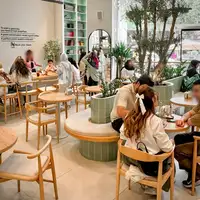
People gather at a busy café in Tehran, Iran.
One respondent from Khuzestan said debt had forced them out of business.
“I have been unemployed for two months because of debt, I lost my cafe, my bank installments are overdue and there is nothing I can do,” the person wrote.
Businesses also face closures linked to enforcement of Iran's mandatory hijab rules. Another pointed to cafes being sealed in Qazvin over compliance with the dress code.
For many, cafe outings have therefore become another measure of shrinking household choices: eliminated altogether by some families and maintained at considerable cost by others seeking a few hours of social life outside the pressures of everyday expenses.
Workers at the Hashuni mine, part of the Kerman Coal Mines Company, in southern Iran.
Workers across Iran’s mining, industrial and municipal sectors say they have gone months without full pay, while some employers have also cut staff, deepening pressure on households already struggling with rising living costs.
Messages sent to Iran International describe wage arrears ranging from several weeks to eight months at mining operations in different parts of the country. Iran International could not independently verify the accounts.
The wife of an employee at the Sanghan iron ore mine in Khaf, northeastern Iran, said her husband, who has worked there for 24 years, had not received a salary for three months despite receiving his work statement through late June.
Workers at the Chah Firouzeh copper mine in Kerman province were still waiting for their June wages, according to another message.
At Gol Gohar in Sirjan, also in Kerman, workers had gone eight months without pay and some employees had been dismissed without receiving wages owed to them, another message said.
Similar complaints have emerged from major industrial companies.
Employees at MAPNA Locomotive in Karaj, west of Tehran, have gone four months without full wages, according to information received by Iran International.
One employee said workers received just 20% of their salary last month and that the payment problems began during the 40-day war and have continued since. Staff are reluctant to protest because they fear layoffs and are already under severe financial pressure, the employee said.
Contract employees at Iran Air have also reported reduced and delayed pay since the war. One employee said salaries had not returned to previous levels even after the company’s revenues recovered, adding that workers who complained risked losing their jobs.
In Sari, a northern city near the Caspian Sea, another source told Iran International that municipal employees and workers had gone three months without pay.
“We really don’t know where to turn,” the source said.
Household pressure
The wage problems come amid broader economic strains acknowledged by senior Iranian officials.
Central Bank Governor Abdolnasser Hemmati said Friday there was “no doubt that Iran’s economy faces serious problems,” adding that war and economic pressure had worsened inflation and unemployment. He rejected, however, suggestions that the economy faced an “imminent collapse.”
Even for workers receiving their wages, earnings increasingly fall short of basic living costs.
The semi-official ILNA news agency reported that many households exhaust their salaries before the middle of the month, forcing them to rely on installment plans and credit for routine expenses.
Majid Rahmati, a member of Tehran’s Coordination Council of Islamic Labor Councils, said in May that the minimum monthly household living basket had risen to around 70 million tomans, while married workers were receiving roughly 24 million tomans a month.
Iran’s statutory base minimum wage is around 16.6 million tomans a month before benefits, according to a Labor Ministry wage directive reported by the Tasnim news agency.
For those waiting months to be paid, the problem is compounded by what workers describe as a lack of effective recourse.
Some employees told Iran International they feared layoffs if they protested over unpaid wages, while others said complaints to labor authorities had failed to produce results.
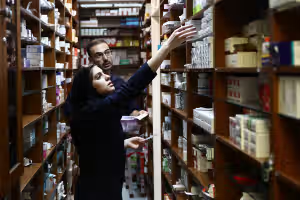
AI-generated image: A woman holds her wallet at a pharmacy counter as a pharmacist retrieves medicine, illustrating the growing financial burden of healthcare and medication costs in Iran.
Iranians are struggling to afford medicines and medical care, with some foregoing treatment as prices rise, drug shortages spread and insurance coverage falls short, according to accounts from patients.
Messages sent to Iran International on described medical bills consuming much or all of a typical monthly income, even for people covered by Iran’s Social Security Organization, the country’s main state-run social insurer.
One person undergoing tests for an abdominal and pelvic mass said CT and MRI scans, with and without contrast, cost 210 million rials ($113) despite having Social Security insurance.
“How are we supposed to pay these costs with such meager incomes?” the citizen said.
Many Iranian workers earn around 200 million to 250 million rials ($108-$134) a month, meaning the scans alone can cost roughly a month’s income. The rial trades at around 1.86 million to the dollar on the free market.
Another said an echocardiogram, electrocardiogram and clinic appointment cost 120 million rials ($65), with the medical provider requiring payment upfront rather than accepting Social Security insurance.
The patient was given documents to seek reimbursement from the insurer but said the process involved extensive bureaucracy and could result in only around half the money being returned.
A 33-year-old said the cost of dental treatment had left him without half his teeth.
“I feel like I’m 60,” he said. “The bitter part is that this humiliating way of life has become normal for me.”
A pharmacy in Iran
Another worker earning 10 million rials ($5.40) a day said an appointment with an ear, nose and throat doctor cost 5 million rials ($2.70), followed by 8.6 million rials ($4.60) for medicine.
“We really cannot afford to live anymore,” the worker said.
Lawmaker says shortages could worsen
The accounts echo comments from Salman Es’haghi, spokesman for parliament’s Health and Treatment Committee, who said shortages and rising prices were already causing some patients to stop treatment.
Around 43 medicines are in “critical shortage” and nearly 1,000 pharmaceutical products face some degree of shortage, Es’haghi told the Tabnak news website in an interview published Saturday.
Prices for chemotherapy drugs and medicines used by patients with cancer, hemophilia and thalassemia have risen enough to reduce consumption, with some patients stopping treatment because they cannot afford it, he said.
Es’haghi said patients now pay more than 70% of their healthcare expenses themselves, despite policies intended to leave individuals covering around 30% and the government and insurers paying the remainder.
Some hospitals and pharmacies are also refusing to provide certain services or medicines because insurers have delayed reimbursements or failed to pay them in full, he added.
The difficulties described by Iran International’s audience reflected those problems. One viewer said a packet of Sertraline tablets that previously cost 500,000 rials had risen to 8 million rials, a sixteen-fold increase.
Another said the cost of healthcare had left the family worried about something as routine as a child catching a cold during the winter.
“We’re stressed about where we would get the money for treatment if, God forbid, we or our children even catch a cold,” the audience said.
Drug subsidy faces uncertain future
The pressure could intensify if the government removes preferential foreign currency for medicines and medical equipment from the budget for the Iranian year beginning in March 2027, Es’haghi warned.
Iran has used preferential exchange rates to lower the rial cost of importing medicines, pharmaceutical ingredients and medical supplies. Removing that support can expose producers and importers to much higher exchange rates and ultimately increase prices for patients.
Discussions about eliminating the preferential rate have been under way since late 2025, with the government viewing the change as a possible way to address corruption and preferential access to subsidized foreign currency, Es’haghi said.
“If the currency allocated to medicines and medical equipment is removed from next year’s budget, it could become a ‘year of patient slaughter,’” Es’haghi said.
Iran International reported in April that prices for some domestically produced insulin had risen by as much as 212% compared with before the Persian New Year in March, while some imported varieties had increased by as much as 271%.
Pharmaceutical industry figures have attributed rising production costs to a combination of exchange-rate changes, the rial’s depreciation, more expensive raw materials and packaging, higher wages and financing costs, and disruption to supply chains from war.
Es’haghi said more than 70% of medicines had increased in price and argued that authorities should tackle corruption through closer oversight of the pharmaceutical supply chain rather than eliminating subsidized currency.
For patients confronting medical bills comparable to their monthly earnings, however, the pressure is already being measured in delayed care, abandoned treatment and anxiety over whether they can afford the next illness.
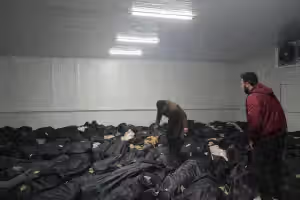
Bodies wrapped in black body bags lie at Kahrizak morgue following the deadly crackdown on anti-government protests in Iran in January 2026.
President Masoud Pezeshkian drew angry reactions from Iranians after rejecting higher estimates of those killed in Iran's January protests and calling those who cite such figures "traitors" in an interview published on Wednesday.
Pezeshkian described the protests as a "riot" and accused people abroad of falsely inflating the death toll.
"Those sitting abroad who present themselves as intellectuals and scholars, yet say 30,000 or 40,000 people were killed, are dishonorable and traitors," he said in the video interview.
His remarks prompted a wave of criticism from citizens who sent messages to Iran International, with many accusing the president himself of bearing responsibility for the killings.
"Mr. Pezeshkian, this is disgraceful. Stop lying and have some shame," one said. "Your hands are stained with the blood of tens of thousands of Iranian protesters. Curse all of you killers and the remaining figures of the Islamic Republic."
Others argued that even the official death toll acknowledged by his administration warranted accountability.
Crowds take part in anti-government protests in Tehran in January 2026.
"Sitting there and saying 3,000 people were killed – first of all, this is not about the number," one citizen from Arak said. "Even if it were those 3,000 people you admit were killed, you should answer for every single one of them."
Another viewer wrote that if Iran had "a normal government," Pezeshkian should face punishment simply for acknowledging that thousands had been killed.
"So if, by your own account, 3,000 people were killed, that's acceptable?" another message read.
Government figures disputed
In mid-February, Pezeshkian's office published a list containing the names of 2,986 people it said were killed during the January protests, saying it had been compiled using data from the Legal Medicine Organization and cross-checked with the National Organization for Civil Registration.
The figure is far below Iran International's editorial board estimate of at least 36,500 people killed during the crackdown. Several international media outlets have also cited similar estimates.
Pezeshkian has repeatedly accused protesters of carrying out armed attacks and sabotage.
In his latest interview, he again described protesters as having been armed by US President Donald Trump, referred to the crackdown as an "incident" and said demonstrations had turned into a "riot" in which "difficult events" occurred.
One person responded by invoking a Quranic verse.
"If your memory serves you, the Quran you probably believe in says killing one innocent person is like killing all humanity," the message read. "Yet you speak about 3,000 deaths as though nothing important happened."
Another accused the president of contradicting earlier official accounts.
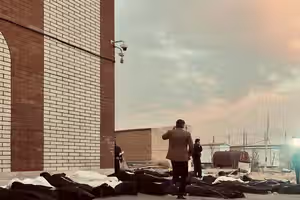
Bodies wrapped in blankets lie outside Alghadir Hospital in eastern Tehran following anti-government protests in January 2026.
"It is interesting that you say terrorists killed the victims, yet you become angry at those who say the real figure is 40,000 and call them traitors," he wrote. "That amounts to admitting that the terrorists you blamed were actually yourselves."
Activists challenge official narrative
Human rights activist and former political prisoner Mehdi Mahmoudian also criticized Pezeshkian's remarks.
"Please explain who killed the several thousand people whose deaths you yourself do not deny, and what those responsible for this crime should be called," Mahmoudian wrote.
Separately, critics resurfaced comments by Mojtaba Lotfi, a cleric and former aide to the late Grand Ayatollah Hossein Ali Montazeri, who argued that the government's casualty list had been censored.
Referring to his hometown of Najafabad, Lotfi wrote that local records indicated at least 30 victims from the city had been omitted from the official list, suggesting the government's figures were incomplete.
An image of a home-made steak that an Iranian user posted on X
A social media exchange about steak struck a chord among Iranian users this week, turning one young user's dream into a broader conversation about economic hardship and political frustration.
Replying to a couple who shared photos of a home-cooked steak after losing weight together, the 20-year-old user wrote: "Please don't laugh at me, but one of my dreams is to eat steak once in my life."
The exchange quickly spread across Persian-language social media, drawing more than 750,000 views and over 11,000 likes.
When the couple later revealed their meal had cost around 1.5 million tomans, the user replied: "Sister, I live for three weeks on 1.5 million... what are you talking about?"
Others responded with a mixture of empathy and anger.
"We're not laughing," one user wrote. "We're cursing the ones responsible for making steak one of our dreams."
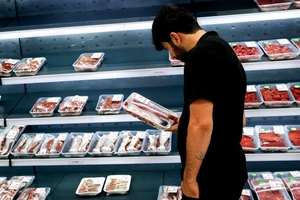
Another observed that with meat costing around two million tomans per kilogram, "it's clear most of society has never eaten steak."
The exchange reflected a broader reality: for many Iranians, red meat has shifted from an ordinary part of the diet to an occasional luxury—or, for some, an aspiration.
In June 2025, Masoud Rasouli, secretary of the Meat Production and Packaging Association, said annual meat consumption had fallen had fallen to as little as seven kilograms per person from a previous average of 18 kilograms.
While some people still managed to consume around 20 kilograms a year, he said, others no longer ate red meat at all.
The decline has continued amid persistent inflation, repeated currency depreciation, the removal of preferential exchange rates for many essential imports, and the economic effects of conflict and sanctions.
Although the minimum wage rose by around 60 percent in March 2026, analysts say it has failed to keep pace with the cost of a basic nutritional basket, while many households already spend between 50 and 70 percent of their income on housing.
One reply captured the gradual narrowing of everyday diets:
"The most luxurious thing I've eaten in about seven months was an Italian pizza. Honestly, these days I can't even afford grilled chicken."
The shift is visible across many households. Families that once regularly bought red meat have increasingly turned to chicken, then eggs, and in some cases to cheaper staples as rising prices steadily narrowed their choices.
The viral exchange did not reveal an unknown hardship. It simply gave it a sentence, offering many users another way to express both economic despair and political frustration.
One comment perhaps best captured the connection many Iranians drew between everyday hardship and the country's political order:
"Iran will be free soon, and then I'll treat you to a proper steak, God willing."