Iran’s inflation surges further as consumer prices hit new highs
Iran’s official data show inflation accelerating again amid a war with the United States and Israel, with prices more than fivefold higher than in 2021 and food costs rising even faster, hitting poorer and rural households hardest despite signs of monthly easing.
The Statistical Center of Iran has released its latest Consumer Price Index (CPI) report for March 2026, showing a continued acceleration in inflation across the country.
The CPI, calculated with a base year of 2021 (index = 100), reached 542.3 in March 2026. This means that average prices for goods and services have increased more than 5.4 times compared to 2021—equivalent to a cumulative rise of approximately 442% over four years.
Year-on-year inflation (compared to March 2025) climbed to 71.8%, up 3.7 percentage points from the previous month. Annual inflation (covering the 12 months ending March 2026) was reported at 50.6%, also rising by 3.1 percentage points month-on-month.
Food prices driving inflation
The sharpest increases continue to come from food and essential goods—a critical issue in Iran, where food accounts for a large share of household spending, particularly among lower-income groups.
Year-on-year inflation in the category of food, beverages, and tobacco reached 112.5%, up from 105.4% in February.
Within this category, several subgroups recorded extreme price increases compared to March 2025:
Bread and cereals: 140%
Meat (red and poultry) and related products: 135%
Oils and fats: 219%
Fruits and nuts: 104.2%
Dairy products (milk, cheese, eggs): 116.8%
Vegetables and legumes: 46.4%
Monthly inflation for food slowed to 8.6% in March (from 15.5% in February), but price levels remain significantly elevated.
Non-food inflation and services
The non-food and services category recorded 50.4% year-on-year inflation, slightly higher than February’s 49%.
Key contributors include 72.8% in furniture and household maintenance, 90.4% in miscellaneous goods and services, and 67.5% in transportation.
Housing and utilities—including rent, water, electricity, gas, and fuel—saw a comparatively lower increase of 34.9%, making it the least inflationary major category.
Monthly inflation in non-food goods and services stood at 3.5%.
Inequality and regional disparities
The report also highlights widening inequality in inflation burdens:
Annual inflation for the second income decile (among the poorest households) was 54.2%, while for the tenth decile (the wealthiest households), it was 49.2%.
The inflation gap between income groups widened to 5 percentage points, up from 4.1 points in February—indicating that lower-income households are disproportionately affected.
The CPI index reached 531.8 in urban areas and 606.2 in rural areas, with annual inflation at 49.6% and 56.8%, respectively.
Interpreting the data
While these figures are based on official data, they should be read with some caution. Iran’s statistical system is fragmented, and key indicators such as inflation have at times been reported differently by institutions like the Statistical Center and the Central Bank. Methodological choices—such as weighting, sampling, and price collection—can also affect the final estimates.
At the same time, independent assessments and observable market signals—particularly exchange rate movements and the pricing of essential goods—often point to inflationary pressures that feel more severe at the household level than headline figures suggest. This gap between reported averages and lived experience is especially visible in food markets, where price increases tend to be both faster and more immediately felt.
Taken together, the latest data confirm that year-on-year inflation continues to accelerate, even as monthly figures show temporary moderation. The persistence of high food inflation, combined with widening inequality and regional disparities, suggests that inflationary pressures remain deeply embedded in Iran’s economy.
A leaked internal directive from the IRGC’s missile command appears to show that the use of civilian locations to conceal, support and in some cases facilitate missile launch operations is not ad hoc, but structured, documented and built into operational planning.
The 33-page document shared with Iran International by the hacktivist group Edalat-e Ali (Ali’s Justice) has been marked “very confidential” and is titled Instruction for Identification, Maintenance, and Use of Positions.
The document is attributed to the Specialized Documents Center of the Intelligence and Operations Deputy of the IRGC's missile command.
A framework for missile operations
What emerges from the directive is a bureaucratic framework for missile deployment that goes well beyond hardened silos or underground “missile cities.”
The text lays out categories of launch positions, inspection procedures, coding systems, site records, chains of responsibility and rules for maintaining access to a wide network of locations that can be used before, during and after missile fire.
Its significance lies not only in the variety of launch positions it defines, but in the explicit inclusion of non-military environments in that system.
In its introduction, the document says missile positions are an inseparable part of missile warfare tactics and argues that the enemy’s growing ability to detect, track and destroy missile systems requires special rules for identifying, selecting, using and maintaining such positions.
It adds that the use of “deception,” “cover” and “normalization” alongside other methods would make the force more successful in using those positions.
That language is important. It suggests the document is not merely about protecting fixed military assets. It is about making missile units harder to distinguish from their surroundings and harder to detect in the first place.
The implication of the directive is that it describes a system for embedding missile activity within ordinary civilian geography.
Rather than relying only on conventional military facilities, the document sets out a model in which missile units can move across a wider landscape of pre-identified sites selected for concealment, access and operational utility.
The result is a structure that appears designed to preserve launch capability while reducing visibility and complicating detection.
The clearest indication comes in the section on what the document describes as artificial dispersion or cover positions. These include service, industrial and sports centers, as well as sheds and warehouses – places that are civilian in function or appearance, but can be repurposed to hide missile units.
The conditions listed for such sites include being enclosed, not overlooked by surrounding buildings, and either lacking CCTV cameras or allowing them to be switched off.
Taken together, those requirements point to a deliberate screening process for civilian sites that can be used as missile cover. The concern is not only protection from attack, but invisibility within the civilian landscape.
The broader structure of the document reinforces that conclusion. It contains sections on site identities, naming and coding, inspections of routes and positions, record maintenance and responsibilities across intelligence, operations, engineering, communications, safety, health and counterintelligence.
This is the language of a standing system, not an improvised wartime workaround.
An Iranian couple walks near Iranian missiles in a park in Tehran, March 26, 2026.
A system for concealment
Farzin Nadimi, a senior defense and security analyst at the Washington Institute who reviewed the document for Iran International’s The Lead with Niusha Saremi, said the text points to a database-driven effort to identify areas around missile bases that can be used for different kinds of positions.
He said the IRGC missile force appears to have mapped not only launch positions, but also dispersal, deception and technical positions – the latter being places suitable for storing launchers and support vehicles and, when needed, preparing missiles for firing.
“These technical positions,” Nadimi said, “can include large, covered spaces such as industrial sheds or sports halls, where missile launchers and support vehicles can be brought inside, and where missiles can be mounted onto launchers, warheads attached and, in the case of liquid-fueled systems, fueling operations carried out.”
That point is critical. If civilian-looking or civilian-owned structures are being used not only to shelter launchers, but also to prepare them for launch, then the document describes more than concealment. It describes the embedding of missile operations inside civilian infrastructure.
A network built for dispersal
Nadimi also said the directive places repeated emphasis on speed – getting launch vehicles into these buildings quickly before launch and returning them to cover quickly afterward.
In his reading, the database tied to these positions includes technical features of each site, access routes and nearby facilities, including the nearest medical center, police station and military post.
It also, he added, records whether use of the property can be coordinated in advance with the owner, including contact details, or whether occupation could occur without prior coordination in urgent cases.
If so, that would suggest the system extends down to the level of property access and local civilian surroundings, turning seemingly ordinary sites into preplanned nodes in a missile network.
The document’s own emphasis on route inspection, site profiles, records and coded classification supports the picture of a missile force operating through a dispersed support architecture rather than through fixed bases alone.
Iranian missiles displayed in a park (March 26, 2026)
Why this puts civilians at risk
Nadimi warned that the use of civilian environments is especially troubling because many IRGC launchers are themselves designed to blend into civilian traffic.
“Many of these launchers essentially resemble civilian vehicles or trailers,” he said.
He added that larger launchers for Khorramshahr missiles can be covered with a white casing that makes them look like an ordinary white civilian trailer, while the towing vehicle is also typically white.
Smaller launchers, he said, are often painted not in conventional camouflage but in ways that make them less conspicuous in civilian surroundings.
That observation fits closely with the document’s emphasis on cover, concealment and post-launch disappearance. The combination of disguised launch vehicles and preidentified civilian sites suggests an operational doctrine built around blending missile units into non-military space.
According to Nadimi, this has direct consequences under the laws of war.
“The use of civilian environments, structures and buildings for this purpose is unlawful under the laws of war,” he said. “It removes the protection those buildings would otherwise have and turns them into legitimate military targets.”
The danger, he added, is that civilians living or working in such places may have no idea a missile launcher is being hidden in their vicinity until they themselves are exposed to attack.
An organized doctrine, not an exception
The leaked directive therefore appears to document something broader than the existence of underground missile facilities or dispersed launch sites.
It points to an organized method for extending missile operations into the civilian sphere – using industrial buildings, service facilities, sports complexes, warehouses and other non-military spaces as part of a launch architecture designed to survive surveillance, evade detection and preserve firing capability under wartime pressure.
In that sense, the document is not just about positions where missiles are launched from. It is about how a military force can fold launch operations into everyday civilian geography – and in doing so, transfer the risks of missile warfare onto places and people that outwardly have nothing to do with it.
An Iranian man whose viral plea for Donald Trump’s help drew millions of views says he was forced to flee the country after being targeted by the Revolutionary Guard, warning from exile that negotiating with Tehran would allow its repression to continue.
Ali Rezaei Majd still looks toward the rugged peaks of the Zagros Mountains — just beyond them now, across the border in Iraqi territory.
More than six feet tall, with a muscular build, tattoos etched across his body, and long, thick, curly hair, Majd is a presence that’s hard to ignore.
He looks like a fighter. The truth is — he is one.
A proud Lor from Iran’s tribal province of Lorestan, Majd comes from a people known for their deep connection to their land — and for their resilience. The Lors are an Iranian ethnic group rooted in the Zagros region, with a long history shaped by life in the mountains and a culture that values strength, independence and loyalty.
His life has been on the run since early January, when he posted a video from his hometown that would soon be seen around the world.
In it, holding up his Iranian ID, he made a direct plea to then-President Donald Trump and the American people:
“I’m speaking to you from inside Iran… not as a politician, not as a soldier, but as a human being living under fear and oppression every single day… Please don’t forget us.”
The video struck a nerve — garnering over nine million views on Instagram. The English version was also viewed nearly two million times.
But it also made him a target.
Majd says the Islamic Revolutionary Guard Corps (IRGC) began searching for him. With operatives closing in, he fled — crossing mountainous terrain with the help of Kurdish people.
“I was in a prison for 30 years. Iran was like a prison for me,” he told the Eye for Iran podcast.
“When you grow up in a prison, you risk everything for freedom — even for one day.”
Today, his safety remains uncertain, with threats from a regime never far behind.
Now in exile, he is speaking out — with one message above all:
“We cannot make a deal with them. Dealing with them means letting this cancer continue.”
Majd says many of his friends were killed when the regime unleashed force — including heavily armed units — against what he describes as a largely defenseless population.
“When you come to the streets in Iran, you’re going to die,” he said. “They don’t shoot to stop you — they shoot to kill.”
He also has a message for the West — and for the media.
Watching coverage from abroad, Majd says he is frustrated by calls to halt military operations, arguing they misunderstand the reality inside Iran.
“I see many channels trying to stop this operation… saying this is the wrong way,” he said. “But this regime is a threat to the whole world.”
For him, this moment represents something else — a rare opportunity.
“This is the best chance to stop this regime,” he said. “If you don’t stop them, they will become more dangerous.”
He considers himself lucky to be alive.
And now, he says, it is his responsibility to carry the voices of those who can no longer speak.
“The best of us — the bravest — they are gone. So I have to speak for them.”
Majd described the violence he witnessed in chilling terms: “It was like a video game. They were just shooting people — so easily.”
Despite the danger and despite what he says are ongoing threats from regime operatives — Majd continues to speak publicly.
Because for him — and for those who can no longer speak — silence is not an option.
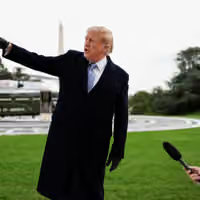
US President Donald Trump offered an upbeat but confusing picture of his approach to Iran on Sunday, saying a deal could come soon even as he floated the possibility of seizing Iranian oil and hinted at military options that could deepen the conflict.
Speaking to reporters aboard Air Force One, Trump said Washington was making progress in “direct and indirect” negotiations with Tehran and that a deal could emerge quickly.
But he also said he would like the United States to “take the oil in Iran” in an interview with the Financial Times, floating the idea of seizing Kharg Island, the terminal through which most of Iran’s crude exports pass.
“I could only say that we’re doing extremely well in that negotiation. But you never know where they’re at, because we negotiate with them, and then we always have to bomb them,” he told reporters.
“I think we’ll make a deal with them, pretty sure. But it is possible we won’t.”
Markets have struggled to interpret the shifting signals. Oil prices have surged more than 60 percent over the past month amid fears the war could disrupt global energy supplies, with Brent crude trading near $116 a barrel.
Hours before Trump’s remarks, Iran’s parliament speaker Mohammad Bagher Ghalibaf posted a cryptic message on social media using trading jargon that many interpreted as a jab at the US president and his announcements.
“Pre-market so-called ‘news’ or ‘Truth’ is often just a setup for profit-taking. Basically, it’s a reverse indicator,” he wrote. “Do the opposite: If they pump it, short it. If they dump it, go long.”
Ghalibaf has been mentioned in several unofficial reports as playing a leading role in contacts with Washington. Trump referred to him in the FT interview, saying he had authorised more Pakistan-flagged ships to pass through the Strait of Hormuz.
Aboard Air Force One shortly afterward, Trump suggested that “regime change” had effectively already taken place and that he was now dealing with “professionals.”
“We’re dealing with different people than anybody’s dealt with before. It’s a whole different group of people,” he said. “So I would consider that regime change, and frankly they’ve been very reasonable.”
But the president’s remarks left observers unsure whether diplomacy or escalation would shape the next phase of the conflict, which shows little sign of subsiding after a month of fighting.
Pakistan has renewed its offer to mediate between Washington and Tehran. Prime Minister Shehbaz Sharif said after talks with the foreign ministers of Turkey and Egypt that Islamabad stood ready to help bring both sides to the negotiating table.
The Wall Street Journal reported that Trump is weighing a plan that could involve US forces entering Iran to seize its stockpile of enriched uranium, a move that would represent a dramatic escalation if pursued.
The United States can seize the moment to support regime change and forge a strategic partnership with a democratic Iran that could yield over $1 trillion in revenue for American firms over the next decade.
This is not wishful thinking; it's a conservative estimate grounded in Iran's untapped potential, benchmarked against its neighbors like Turkey, the UAE, and Saudi Arabia.
A free Iran represents the single largest untapped pro-American economic opportunity of the 21st century. Conservative modeling shows over $1 trillion in US export revenues, millions of American jobs, decisive energy-price stabilization, and the permanent collapse of the world’s most dangerous state sponsor of terrorism, without US occupation or nation-building.
Iran is the last large greenfield market opportunity in the world. It combines industrial sophistication, underinvestment, labor arbitrage, and a large population base. We can turn the North Korea of the Middle East into the South Korea of the region.
What makes Iran different is the rare convergence of scale, capability, and readiness. Iran is not a fragile post-conflict state; it is a compressed modern economy held back by ideology, not capacity.
It graduates roughly 250,000 engineers annually, with STEM penetration rivaling that of advanced industrial nations, and has a global diaspora poised for immediate reverse brain drain. Its 90-million-plus, urbanized population sits in a demographic sweet spot, young, educated, and consumer-ready, creating instant market scale.
Geographically, Iran is a natural Eurasian bridge, linking the Caspian Sea to the Persian Gulf and serving as a credible alternative logistics corridor between East and West.
Unlike hydrocarbon-only economies, Iran combines energy abundance with deep industrial and manufacturing capability, enabling it to build, not merely extract.
Finally, Iran’s vast diaspora is highly productive and skilled economically and professionally. In America alone, Iranian Americans have helped create trillions of dollars in value and millions of jobs via such companies. We estimate that millions in the diaspora will return at least part-time and invest in the vast potential to rebuild Iran into an economic powerhouse.
For 47 years, the Islamic Republic has squandered Iran's vast resources on terrorism, proxy wars, and nuclear ambitions, leaving its economy in ruins and its infrastructure crumbling. But imagine a free Iran—a secular, democratic nation restored to its pre-1979 glory as a US ally, recognizing Israel, and joining an expanded Abraham Accords, perhaps rebranded as the Cyrus Accords in honor of ancient Persian tolerance.
Under a committed, democratic Iranian government, anchored by investment protections and US-approved financing, the country would embark on a "catch-up" phase of massive modernization. Half of that $1 trillion in US sales could materialize in the first five alone, concentrated in high-value sectors that create millions of American jobs.
Take aviation, where Iran's fleet is a relic of sanctions and neglect. Replacing at least 250 wide-body jets, narrow-body aircraft, infrastructure upgrades, and maintenance services, could generate $150 billion over a decade. This isn't charity; it's smart business, revitalizing an industry starved of growth.
The transportation and automotive sectors offer another $150 billion. With demand for a million electric vehicles, think Tesla, plus passenger cars, trucks, agricultural machinery, and EV charging networks, American innovators stand to dominate. Iran's roads and farms have been starved of investment; a free market would unleash pent-up demand for quality US products.
Even in military and security, opportunities abound for $250 billion modernization: command systems, ISR technology, training, and sustainment. A post-regime Iran would pivot from sponsoring Hezbollah and Hamas to partnering against terrorism, creating long-term contracts for US defense firms while bolstering regional stability.
The energy sector alone could deliver $300 billion in non-ownership revenues through services, reconstruction, equipment, and technology licensing. Upstream drilling tech, midstream pipelines, downstream refining upgrades, and risk-management services would flow to companies like ExxonMobil and Halliburton. Iran's reserves are among the world's largest; a reliable, transparent supplier could help stabilize global prices and reduce dependence on adversaries such as Russia.
Beyond these, additional sectors from water infrastructure and AI networks to biotechnology, healthcare, finance, and entertainment could add $350 billion. U.S. firms in IT, pharmaceuticals, and consumer goods would tap into an educated, 90+ million-strong market eager for American products. Tourism could boom with resorts and hotels, while mining critical minerals would secure supply chains for American tech. Wall Street could be the main driver of many of the deals, which will generate significant fees and other services revenue.
Iran's prolonged underinvestment means explosive growth post-opening, outpacing even the post-Soviet Eastern Europe boom. Unlike risky ventures elsewhere, this would be backed by vast natural resources and a government that prioritizes U.S. ties and includes safeguards against corruption.
Critics will cry "interventionism," but the Iranian people are already fighting—with bare hands against foreign mercenaries like Hezbollah, Hashd al-Shabi, and Fatemiyoun. They need the regime’s killing capacity neutralized—its surveillance, command nodes, and imported mercenaries degraded—so civil resistance can succeed.
A free Iran isn't just good for Iranians; it's the biggest strategic global win for America since winning WWII and defeating the Soviet Union. It offers the largest economic and peace dividend since the fall of the Soviet Union. It would dismantle the axis of evil, secure the Middle East, and deliver prosperity that echoes and expands the pre-Khomeini era when Iran was a pillar of peace. Iran can catch up on what it lost in 47 years in just 10 years.
The regime is a rotting corpse; let's bury it and build a future where Iran and America thrive together. The opportunity is here; let’s seize it.
Iran’s recent attempted strike on a joint UK–US military base in the Indian Ocean, some 4,000 km from its territory, marks more than an escalation — it is a wake-up call for the West, experts told Iran International.
On March 20, Iran fired two long-range ballistic missiles at the Diego Garcia base, a target long considered beyond its declared range of around 2,000 kilometers.
Iran’s attempted long-range strike — which US officials say did not hit its target — marks the first time Tehran has demonstrated the ability to reach as far as Diego Garcia.
For years, Iran claimed its missile range was capped at around 2,000 kilometers. That claim now appears increasingly untenable.
The attempted strike exposes a reality that can no longer be ignored, experts told this week's episode of Eye for Iran: Tehran’s missile capabilities extend far beyond the Middle East, its hardened arsenal has withstood sustained US and Israeli strikes, and the conflict is now colliding with critical global pressure points — from the Strait of Hormuz to the growing likelihood of a broader military phase.
A threat no longer abstract
Iran’s ballistic missile threat is no longer abstract — it is real and expanding.
Both Janatan Sayeh, an Iran expert at the Foundation for Defense of Democracies (FDD), and Farzin Nadimi, a defense and military expert with the Washington Institute for Near East Policy, warned on the Eye for Iran podcast that Tehran’s capabilities now extend far beyond previously stated limits — potentially reaching as far as the United Kingdom.
“This should not come as a surprise,” Sayeh said. He noted that Iranian missiles and drones have already been used on European soil through Russia.
“The difference now is that the regime itself can launch them directly from Iranian territory," said Sayeh.
The shift marks a critical evolution — from indirect projection of force to direct long-range capability — underscoring the growing reach of Iran’s arsenal.
Even if unsuccessful, the Diego Garcia strike signals a move from regional containment to global reach — with direct implications for Europe and beyond.
In his State of the Union address last month, President Donald Trump cautioned that Iran’s missile program could soon put the United States within reach — a claim that, in light of recent developments, is no longer theoretical.
Missile cities: A durable arsenal
That expanded reach is underpinned by an infrastructure designed not just to deter — but to endure.
Nadimi said Iran has long possessed the technical ability to extend the range of its missiles, including through payload modification and dual-use space-launch technology.
More significantly, he described a vast network of hardened underground facilities — some “the size of a small city” — buried deep beneath mountainous terrain and reinforced structures, making them extraordinarily difficult to destroy.
These so-called “missile cities” are often positioned near — and in some cases beneath — civilian infrastructure, including residential neighborhoods and public spaces, complicating targeting while increasing their survivability.
“Many of these missile bases are so deep that even the most powerful bunker-buster bombs cannot reach them… some are as deep as 500 meters and the size of a small city," Nadimi told Eye for Iran.
Strait of Hormuz: Global Stakes
The implications extend far beyond military capability.
The Strait of Hormuz — through which roughly one-fifth of the world’s oil supply passes — has emerged as a central pressure point in the conflict.
Disruptions tied to the war have already rattled global energy markets, with prices reacting to uncertainty around shipping routes and potential escalation.
Joel Rubin, former Deputy Assistant Secretary of State in the Obama administration, warned on Eye for Iran that Iran’s actions reflect a broader strategic calculus.
“This is how Iran behaves,” he said. “They are willing to disrupt and destroy the global economy to protect themselves.”
Dr. Walid Phares, foreign policy expert, advisor to past US presidents and author, described the Strait not as a theoretical chokepoint, but as an active military theater — where Iranian missile systems along the coastline could trigger direct US intervention to secure global shipping lanes.
President Donald Trump has repeatedly said the United States would reopen the Strait “with or without” allied support — underscoring the scale of the economic stakes.
“Which tells me that ground forces, limited special forces, Marines, now we understand, may be used," said Phares, author of Iran: An Imperialist Republic and US Policy.
Talks as strategy, not solution
Even as diplomatic efforts continue, both sides appear to be using negotiations as part of a broader strategic game.
Rubin pointed to a narrowing political and economic window in Washington, suggesting the US is unlikely to sustain prolonged negotiations as domestic pressure builds.
Phares also framed talks not as a pathway to de-escalation, but as part of a parallel track where diplomacy unfolds alongside active military preparation.
In this environment, negotiations are not replacing escalation — they are occurring within it.
Toward escalation: troops and targets
On the ground, signs of a deeper military phase are becoming more pronounced.
The Pentagon is weighing sending up to 10,000 additional ground troops to the Middle East, according to reporting by The Wall Street Journal and Axios — a move that would significantly expand US combat presence in the region.
The deployment would include infantry and armored units, adding to thousands of Marines and paratroopers already moving into position.
Officials say forces could be staged within striking distance of Iran, including near Kharg Island, a critical oil export hub that handles the vast majority of the country’s crude exports.
Military planners are also reportedly developing options for a “final blow,” including a large-scale bombing campaign and the potential use of ground forces.
No final decision has been made — but the scale and positioning of forces point toward preparation, not restraint.
A region already shifting
At the same time, regional dynamics are beginning to shift.
The United Arab Emirates has publicly warned — in a Wall Street Journal op-ed by its ambassador to Washington — that a simple ceasefire is not enough, signaling growing alignment among US partners around the need for a more decisive outcome.
In Lebanon — long considered firmly within Iran’s sphere of influence — mounting pressure on Hezbollah, moves to marginalize IRGC influence, and the withdrawal of Iran’s ambassador from Beirut point to potential cracks in Tehran’s regional posture.
For many observers, the attempted strike toward Diego Garcia marks a turning point because of what it revealed: the range and the probable intent, all are now visible.