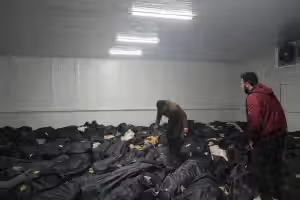
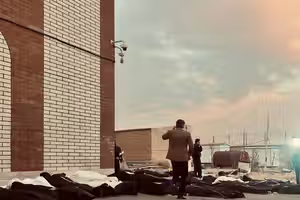
In an interview published on Thursday, Pezeshkian acknowledged that thousands had been killed but rejected estimates putting the toll at 30,000 to 60,000.
“Some media outlets and journalists said that 40,000 or 60,000 people were killed in Iran,” Pezeshkian said.
He said authorities responded by publishing names and national identification numbers of those they said had been killed and inviting people to provide names that were missing.
“But those sitting outside the country, presenting themselves as concerned, informed and sometimes as intellectuals and academics, turned a figure of around 3,000 into 30,000 or 40,000 and misled public opinion,” he said.
Pezeshkian described those behind the higher estimates as “cowards” and “traitors to the country.”
Trump figure rejected
Pezeshkian also rejected US President Donald Trump's account of the crackdown.
Trump said at a NATO summit in Ankara in July that Iranian authorities had killed 54,000 protesters and argued that the scale of the killings had prevented demonstrators from overthrowing the Islamic Republic.
“They can’t take over because they’re dead. They killed them,” Trump said at the time.
Pezeshkian said Trump had acknowledged that protesters had received outside support, accusing Washington of seeking to exploit unrest inside Iran.
“Trump himself explicitly said that they had armed these people and supported them, so it was clear what their objective was,” Pezeshkian said.
Trump's comments cited above, however, described the protesters as unarmed and Iranian security forces as having machine guns.
Pezeshkian acknowledged that some of those involved in the protests had legitimate grievances and that innocent people had been caught up in the violence.
“We had problems, and we still have them,” he said. “Some people were legitimately raising their problems, but another group wanted to use this environment to pursue their sinister objectives.”
He also acknowledged failures in the authorities' handling of the unrest.
“Because we were not sufficiently prepared to manage the situation, many people were harmed,” Pezeshkian said. “Many young people lost their lives and others lost parts of their bodies.”
“We should not have allowed things to reach this point,” he added.
Iran International reported in January that more than 36,500 people were killed by security forces during the January 8-9 crackdown, based on classified documents, field reports and accounts from medical workers, witnesses and victims' families reviewed by its Editorial Board.
The figure included information from internal Iranian government and security documents.
Remarks draw backlash
Pezeshkian's comments prompted criticism from government opponents and some Iranians who challenged both his death toll and his description of people reporting higher figures as traitors.
Mehdi Mahmoudian, a human rights activist and former political prisoner, called on Pezeshkian to explain responsibility for the deaths that the president himself acknowledged.
“Please explain who killed those several thousand people whose deaths you yourself do not deny, and what should the perpetrators of this crime be called?” Mahmoudian wrote on X.
A previously published account by dissident cleric Mojtaba Lotfi was also recirculated following Pezeshkian's remarks. Lotfi said local checks in his hometown of Najafabad had identified at least 30 names missing from the government's list of those killed, arguing that the official count was incomplete.
Iran International also received messages from citizens disputing Pezeshkian's account and criticizing his comments, with some saying that disagreements over the final number did not justify the killing of protesters.