The killing of 36,500 people in just two days represents a scale of violence without precedent in the history of repression under the Islamic Republic – and one that stands out even when compared with some of the deadliest episodes of state violence and full-scale wars worldwide.
The figure is not final and could still rise.
The killing of 36,500 people in just two days represents a scale of violence without precedent in the history of repression under the Islamic Republic—and one that stands out even when compared with some of the deadliest episodes of state violence and full-scale wars worldwide. The figure is not final and could still rise.
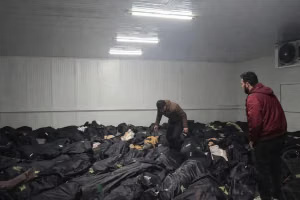
Information obtained and published by Iran International this week indicates that Iranian authorities killed more than 36,500 people over a 48-hour period during the national uprising.
Even conflicts that later came to be described as “genocidal” involved far lower casualty rates over comparable periods.
Put differently, the figure implies 18,250 deaths per day, 760 per hour, 13 per minute, or one person killed every five seconds.
At the height of the war in Gaza, the deadliest single day recorded roughly 400 fatalities. During the most intense phase of urban bombardment in the Iran-Iraq war, Iraqi missile and air strikes killed an average of 188 Iranian civilians per day. The scale of the recent killings far exceeds both.
It also surpasses the deadliest crackdowns carried out by authoritarian governments such as Syria under Hafez al-Assad or Iraq under Saddam Hussein.
Figures released by Gaza’s Health Ministry, which is under Hamas control, place the total number of people killed in Israeli strikes at around 71,000. Israeli officials say 17,000 to 20,000 Hamas fighters were among the dead, suggesting 51,000 to 54,000 civilian fatalities.
Those deaths occurred over roughly two years following October 7, 2023 – an average of 70 to 74 deaths per day. The single deadliest day, reported on March 18, 2025, saw about 400 fatalities, though the civilian share remains unclear.
During approximately 80 days of missile and aerial attacks on Iranian cities, 15,000 civilians were killed – about 188 per day.
The Sha’baniyah uprising in Iraq lasted about a month from March to April 1991. Iraqi forces killed between 30,000 and 100,000 people over roughly three weeks, using tanks, artillery, and attack helicopters – an estimated 1,400 to 4,800 deaths per day.
In 1982, Syrian forces besieged the city of Hama for 27 days, killing 10,000 to 40,000 people – between 370 and 1,480 per day – in a campaign involving air power and heavy artillery.
Killings under the Islamic Republic
Limited access to information and the absence of independent media mean that the full scale of protest crackdowns during the 1990s remains poorly documented. Demonstrations in cities including Shiraz, Arak, Mashhad, and Islamshahr were suppressed with force, but detailed casualty records are scarce.
One of the harshest episodes occurred in 1992, during the suppression of protests at the Tollab district in Mashhad. Estimates suggest up to 50 people were killed.
In the July 9, 1999, crackdown on student protests at Tehran University, the number of fatalities has been estimated at between seven and nine.
Protests following Iran’s disputed 2009 presidential election began on June 13 and continued into early 2010. Major demonstrations took place on several dates, including June 12, 13, 15 and 20; July 19; August 5; November 4; December 7; and February 14.
Across the duration of the movement, estimates place the number of people killed at between 70 and 112. The deadliest single day came during Ashura ceremonies, on December 27, 2009, though precise figures are unavailable. Various sources have put the number of deaths that day at between eight and 37.
Nationwide protests erupted again between December 29, 2017, and January 8, 2018, marked by the widespread use of monarchist slogans. Authorities reported 25 deaths, while external sources cited figures of up to 50.
A far deadlier wave followed in November 2019, when protests began on November 15 and lasted roughly a week. Authorities imposed a total internet shutdown, and security forces carried out what human rights organizations later described as the most severe crackdown to date.
Human rights groups have independently identified at least 324 victims by name, while other investigations, including reporting by Reuters, estimated the death toll at as many as 1,500, with the majority of killings occurring on November 16 and 17.
The protests known as Woman, Life, Freedom began on September 17, 2022, and continued into early 2023. Authorities did not release official casualty figures. Independent estimates place the number of people killed at between 540 and 600.
Even official figures point to unprecedented violence
Iranian authorities have officially acknowledged 3,117 deaths, categorizing victims as civilians, security forces, or what they call “terrorists.” While observers consider this breakdown unreliable, the admission itself is unprecedented.
Even in the 12-day war, the authorities reported 276 civilian deaths, though given the Islamic Republic’s track record, the accuracy of those figures has also been widely questioned.
Even if the official figure of the crackdown deaths were accepted at face value, it would imply 1,559 deaths per day – a daily toll higher than that of a full-scale war, more than three times the deadliest day in Gaza, and nearly eight times the daily civilian death rate during the Iran–Iraq war.
Some media outlets have cited lower estimates of around 6,000 deaths. Even those figures would still place the January killings beyond any comparable episode in Iran’s recent history –and alongside the most severe mass killings of civilians in the modern era.