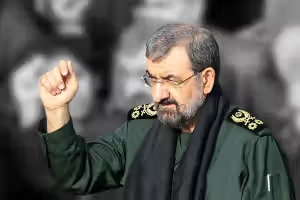
Mohsen Rezaei, a former commander-in-chief of Iran’s Islamic Revolutionary Guards Corps (IRGC), was appointed secretary of the Supreme National Security Council on August 9, 2026.
Mohsen Rezaei, whose four decades in Iran’s ruling establishment span the disputed Karbala-4 offensive, repeated failed presidential campaigns and an Interpol Red Notice over the AMIA bombing, returned to a top security post on Sunday.
The 71-year-old former commander-in-chief of the Revolutionary Guards was appointed secretary of the Supreme National Security Council after Mohammad Bagher Zolghadr resigned little more than four months into the job.
Supreme Leader Mojtaba Khamenei separately appointed Rezaei as his representative on the council, consolidating his position in a body central to decisions on war, diplomacy and Iran's confrontation with the United States.
The appointment adds another chapter to a career spanning command of the Revolutionary Guards through most of the Iran-Iraq war, decades in senior political institutions and four attempts to become president.
It also returns to prominence a figure whose record encompasses one of Iran's most disputed wartime operations, an Interpol Red Notice over the 1994 bombing of a Jewish community center in Argentina and years as a recurring subject of satire among Iranians online.
From Islamist militant to Guards commander
Born Mohsen Sabzevar Rezaei Mir-Ghaed in 1954, Rezaei became involved before the 1979 revolution with Mansouroun, an armed Islamist organization opposed to the monarchy.
Following the revolution, Mansouroun and six other Islamist organizations joined to form the Mojahedin of the Islamic Revolution Organization.
Rezaei's ascent through the new political order was rapid. Ruhollah Khomeini appointed him commander-in-chief of the Revolutionary Guards in 1981, when Rezaei was 27 and Iran was a year into its war with Iraq.
He remained in command until 1997, overseeing the Guards for almost the entire eight-year war and during its transformation from an armed organization into one of Iran's principal centers of military power.
Mohsen Rezaei (second from left) alongside Ali Khamenei (center) during the Iran-Iraq War.
Rezaei left military command in 1997 and moved into the Expediency Council, becoming its longtime secretary. He later served as vice president for economic affairs under President Ebrahim Raisi.
Politics did not deliver the electoral success he sought.
Rezaei entered presidential contests repeatedly, running in 2005 before withdrawing shortly before voting, and contesting elections in 2009, 2013 and 2021 without winning. His repeated appearances on presidential ballots eventually generated a running joke on Persian-language social media that wherever an election was taking place, Rezaei would inevitably become a candidate.
Mohsen Rezaei displays his identification document and inked finger as he registers to run in Iran’s presidential election.
Karbala-4 and a dispute that followed him for decades
No episode of Rezaei's military career has generated more lasting controversy inside Iran than Operation Karbala-4, launched against Iraqi forces in December 1986.
Rezaei was commander of the Revolutionary Guards when Iranian forces embarked on the operation. Accounts from commanders and participants later indicated that Iraqi forces had obtained advance knowledge of the offensive.
Akbar Hashemi Rafsanjani, who commanded Iran's war effort at the political level, later recalled learning shortly before the operation that it had been compromised.
Precise casualty figures remain disputed. Rafsanjani's wartime accounts put the toll at around 1,000 killed, 3,900 missing and 11,000 wounded.
The operation acquired renewed public significance decades later, particularly after the remains of 175 Iranian combat divers were returned to Iran in 2015.
File photo of Iranian forces preparing for Operation Karbala-4 during the Iran-Iraq War.
Rezaei reopened the controversy in 2018 when he wrote that Karbala-4 had been conducted to deceive Iraq before Iran launched the larger Karbala-5 offensive days later.
The description prompted criticism from veterans, former officials and military figures who argued that Karbala-4 had been designed as a genuine major offensive rather than a diversion.
Rezaei later clarified his remarks, saying Karbala-4 had indeed begun as a main operation but had subsequently been turned into a deception after the decision was made to withdraw.
An audio recording of Rezaei speaking to division commander Hossein Kharrazi during the opening phase also attracted attention because Rezaei could be heard instructing forces to continue advancing.
For critics, the episode became a wider argument over wartime accountability: whether commanders persisted with an operation despite evidence that Iraqi forces were prepared for it, and whether the later characterization of it as deception obscured the original plan.
Wanted in Argentina over AMIA bombing
Rezaei's years commanding the Guards also left him facing an international arrest request.
Argentina has sought him in connection with the July 1994 bombing of the AMIA Jewish community center in Buenos Aires, which killed 85 people and injured hundreds.
Interpol's Executive Committee approved a Red Notice for Rezaei and five other suspects in 2007 following a request from Argentina. Its General Assembly upheld the decision later that year.
Argentine authorities say Rezaei participated in a meeting at which the attack was decided. Rezaei and Iran have rejected Iranian responsibility.
His international travel has periodically revived the dispute. Argentina sought his arrest when he visited Qatar in 2022, without success.
Hostages for billions
Rezaei's public comments have also periodically generated controversy at home.
In 2015, he suggested that if the United States attacked Iran, Iranian forces could capture at least 1,000 Americans in the first week and demand billions of dollars for each one's release.
Mohsen Rezaei holds a banknote during a televised debate in Iran.
The proceeds, he suggested, could solve Iran's economic problems.
Such remarks, combined with his unsuccessful presidential campaigns and frequent television appearances, helped create a second public persona far removed from the image of the young wartime commander.
For some users on Persian-language social media, Rezaei became a stock character for political jokes.
That response resurfaced when Mojtaba Khamenei appointed him military adviser following the 2026 war. Users mocked everything from his return to office to the positioning of his belt buckle, which has itself become a longstanding internet meme.
Appointment revives criticism and ridicule online
Rezaei’s return to a senior security position prompted criticism and satire on X, where Iranian users revisited his wartime record, repeated presidential campaigns and controversial public remarks.
“Is Mohsen Rezaei’s military record, particularly during the war with Iraq, really defensible?” one user wrote. “Where does this extraordinary desire come from? From calling the Karbala-4 failure a deception operation, or from his idea of taking hostages to make money?”
Another user invoked the casualties of Karbala-4 more directly.
“Do you know that a huge number of young people in Operation Karbala-4 never saw the next morning?” the user wrote. “Yes, guess who the commander was. That’s right, Mohsen Rezaei.”
Some users instead interpreted the appointment through Iran’s internal power struggles.
One argued that the Revolutionary Guards had gained influence during the war while technocrats controlled the government, leaving the clergy with diminished power. The user portrayed Rezaei, a veteran Guards commander long removed from operational command, as a possible vehicle for restoring some of that influence.
Another suggested Rezaei’s appointment could strengthen parliament speaker Mohammad Bagher Ghalibaf, himself a former senior Guards commander.
Other posts sought to connect the reshuffle to reports of friction involving President Masoud Pezeshkian, with one user asking whether Rezaei’s appointment made previous reports about the president considering resignation more credible.
Mohsen Rezaei, Iran's new secretary of the Supreme National Security Council, speaks at an event.
Speculation over Pezeshkian’s position had begun before Rezaei’s appointment.
Mohammad Bagher Kharrazi, secretary-general of the Hezbollah of Iran political group, predicted the security council reshuffle in remarks circulated widely on social media, portraying it as part of an effort to constrain President Masoud Pezeshkian.
Kharrazi said that Pezeshkian had resigned or threatened to resign 28 times and that Supreme Leader Mojtaba Khamenei had grown frustrated with him and warned that another resignation would be accepted.
“That is why they are changing the Supreme National Security Council, moving Mr Zolghadr and replacing him with Mr Mohsen Rezaei,” Kharrazi said.
The prediction gained renewed attention after Zolghadr stepped down and Rezaei was appointed in his place.
Pezeshkian and Supreme Leader Mojtaba Khamenei’s office have denied accounts that the president repeatedly offered or threatened to resign.
A survivor returns
Rezaei's latest promotion comes at a markedly different moment from the one in which he first accumulated power.
The Supreme National Security Council has undergone rapid leadership changes following the killing of its former secretary Ali Larijani in March and Zolghadr's brief tenure afterward.
Rezaei now takes charge as Iran confronts the consequences of war and negotiations over the Strait of Hormuz, where he has taken an uncompromising public position.
He said in July that control over the waterway was “more important than dozens of atomic bombs,” and more recently said Iran would not accept an unauthorized shipping route through the Strait.
The appointment nevertheless puts a familiar figure back at the center of the system he helped build: a commander whose career has survived military setbacks, electoral defeats, international accusations and decades of political change, and who now again occupies one of the most consequential seats in Iranian national security policy.
A man looks at the packaging of red meat at a supermarket in Iran, undated file photo
Soaring food prices are reshaping what Iranian families eat, with new figures showing a steep decline in dairy consumption alongside a longer retreat from red meat as household purchasing power erodes.
Annual dairy consumption has fallen from around 130 kilograms per person in 2010 to just 40 kilograms today, according to Ali Ehsan Zafari, head of Iran's Dairy Cooperatives Union.
According to the latest figures from the Statistical Center of Iran, dairy products in July cost around 147 percent more than a year earlier.
The fall in consumption leaves Iran well below both international and regional levels. Global dairy consumption averages roughly 117–119 kilograms per person annually, according to the UN Food and Agriculture Organization (FAO), while neighboring Turkey consumes more than 250 kilograms per capita.
At 40 kilograms, Iran's consumption is now roughly one-third of the global average.
Meat disappears
The retreat from dairy follows a longer change in Iranian diets as years of inflation and declining purchasing power have pushed households away from more expensive sources of animal protein.
FAO data show Iran's red meat supply fell to approximately 623,000 metric tons last year, around 20 percent lower than in 2024 and nearly 39 percent below its 2010 level.
Over much of that period, poultry offered families a cheaper alternative. Per capita poultry consumption has risen by roughly 40 percent since 2010, suggesting households have increasingly substituted chicken for more expensive beef and lamb.
The comparison with Turkey illustrates how differently consumption has developed across the two neighboring countries.
Poultry consumption in Turkey also rose by about 40 percent over the same period, but red meat consumption increased by 146 percent. FAO estimates put per capita red meat consumption in Turkey at roughly 3.9 times the Iranian level.
The figures do not by themselves explain the reasons for the divergence, but Iran's shift toward cheaper poultry has taken place during a prolonged erosion of household purchasing power and repeated surges in food prices.
Fewer alternatives
That substitution is becoming harder as inflation spreads across virtually every source of animal protein.
Prices of beef, lamb and chicken were all around 149 percent higher in July than a year earlier, according to the Statistical Center of Iran. Dairy prices rose by a similar 147 percent.
The latest increases follow the recent war, which added to existing inflationary pressures and accelerated price rises across basic goods.
For years, households unable to afford beef and lamb could turn to chicken. The sharp increase in poultry prices now threatens that fallback, while the collapse in dairy consumption suggests even relatively basic sources of animal protein are becoming harder for many families to afford.
The consequences are potentially significant, particularly for lower-income households and children whose diets depend on affordable sources of protein and calcium.
But the figures also point to a broader change in Iranian living standards: families are not simply paying more for the same food. They are changing what they eat, and increasingly giving up foods that were once ordinary parts of the household diet.
After years of substituting cheaper foods for more expensive ones, the narrowing range of affordable alternatives raises a more immediate question: what is left to substitute?
Iran is moving to ratify the Caspian treaty it left dormant for seven years, choosing the depths of a war to settle the status of its one quiet frontier, and reopening the oldest wound in its modern diplomacy: the belief that Tehran signed away half a sea.
President Masoud Pezeshkian's government has sent the 2018 Convention on the Legal Status of the Caspian Sea to parliament for ratification, ending years in which the treaty sat untouched and reviving a charged argument over the country's historical rights, energy interests and position in the strategically vital basin.
The convention, signed by the leaders of Iran, Russia, Azerbaijan, Kazakhstan and Turkmenistan in the Kazakh port of Aktau in August 2018, takes effect only once all five littoral states ratify it. The other four completed the process long ago. Tehran, alone, held back.
The charge that shadows the bill is older than the bill itself: a belief, widely held in Iran and rooted in readings of its 1921 and 1940 treaties with Moscow, that the country was entitled to half the Caspian and stands to end up with barely a tenth.
The convention in fact allocates no national shares at all, but the ghost of the fifty percent has trailed every Iranian discussion of the sea since Aktau.
The timing sharpens the argument. The move lands in the middle of a war that has set Iran's southern coast under nightly strikes and closed the Strait of Hormuz, leaving the Caspian corridor to Russia carrying an outsized share of the country's commerce and its strategic weight.
What the treaty actually does is narrower than either its champions or its critics suggest.
It defines the Caspian as a "special and unique landlocked body of water," placing it outside the UN Convention on the Law of the Sea. Each coastal state receives 15 nautical miles of fully sovereign territorial waters and a further 10 nautical miles of exclusive fishing rights, with the remaining surface designated a shared navigation zone.
The wealth, however, is postponed. Article 8 leaves ownership and delimitation of the seabed and its oil and gas to "bilateral or multilateral agreements between the states concerned."
Russia, Kazakhstan and Azerbaijan have largely settled their boundaries in the sea's north; the lines involving Iran, Azerbaijan and Turkmenistan remain unresolved, tangled in the complexity of dividing energy-rich waters.
A century-old dispute over Iran's share
Before the Soviet collapse, the Caspian was governed by the 1921 and 1940 treaties between Tehran and Moscow, which recognized equal navigation and fishing rights but drew no maritime boundaries.
The Soviet breakup turned two littoral states into five, and Iran has argued since that the sea should be divided equally, 20 percent to each.
Russia, Kazakhstan and Azerbaijan instead adopted a modified median-line method, a formula that, because of Iran's concave coastline, would shrink Tehran's share of the sea and its bed to roughly 11 to 13 percent. Iran has never accepted that division.
The government's case: a sealed northern flank
The government presents ratification as completing the Caspian's legal framework, deepening cooperation among the littoral states and, above all, keeping outside powers away.
Officials point to Article 3, which bars the armed forces of non-coastal countries from the Caspian, as the convention's central security prize, a provision long championed by both Tehran and Moscow.
Defa Press, an outlet affiliated with Iran's armed forces, wrote that the clause would "turn Iran's northern borders into a secure region, far removed from scenarios of foreign military intervention," at a moment when the country faces pressure along its southern and western frontiers.
The critics' case: ratifying before the real negotiation
Opponents argue parliament is sequencing the deal backwards: locking in the framework before the seabed, where the money lies, has been divided.
They note that the northern states have already parceled out much of the seabed and pressed ahead with oil and gas development, while fields shared with Iran, including Alborz, remain in limbo.
Dariush Safarnejad, an international affairs analyst, told the Revolutionary Guards-linked Javan newspaper that lawmakers should return the bill to the government, since supplementary agreements that were meant to be completed within six months of the 2018 signing have never been finalized.
Approving the convention without them, he warned, "could provide other Caspian states with legal grounds in the future and influence the security, political and geopolitical dynamics of the Caspian region."
Shoaib Bahman, an international relations analyst focused on Eurasia, told the same paper that ratifying before the seabed boundaries are set would "effectively reduce Iran's legal leverage in future negotiations and could undermine its claim to a 20% share of the Caspian Sea."
Pipelines, corridors and the Turkic map
The critics' second front is Article 14, under which undersea pipelines require the consent only of the states whose sectors they cross, not all five. Bahman argued the clause could open the way for eastern Caspian producers to export oil and gas directly toward Europe, eroding Iran's transit position.
Mehdi Seif-Tabrizi, a Russia specialist, offered a more measured reading to the news website Fararu. Iran's 15 miles of territorial waters and 10 miles of fishing rights are guaranteed, he said, and "the real dispute concerns the seabed and subsoil," not the surface percentages that dominate the public argument.
Yet he shares the strategic worry: that the long-discussed Trans-Caspian pipeline from Turkmenistan or Kazakhstan to Azerbaijan could finally be built.
"That could strengthen Azerbaijan's position and, in turn, reinforce the Zangezur corridor and the so-called Turkic World project," he said. "If Iran ratifies the convention, it would remove one of the most important legal obstacles to implementing those projects."
The opposition joins the attack
Criticism has come from beyond the establishment's factions. Exiled Prince Reza Pahlavi wrote on X that ratifying the agreement without the Iranian people's mandate and without "a clear and comprehensive guarantee of Iran's historic rights" is "deeply concerning and constitutes a serious threat to Iran's national interests."
Iran's rights in the Caspian, he added, "are not negotiable, nor can they be relinquished. Any action that undermines these rights will be recorded in the historical memory of the Iranian nation, and those responsible will ultimately be held accountable by the people of Iran."
Saeed Ghasseminejad, a senior Pahlavi adviser, went further, alleging that Hassan Rouhani's government had already "ceded Iran's share of the Caspian Sea" and that Pezeshkian and parliament speaker Mohammad-Bagher Ghalibaf now seek to "legalize and make that concession permanent."
He called the move "the biggest surrender of Iran's land and waters to foreign powers since the Qajar-era humiliations."
Iranian cleric Mohammad-Bagher Kharrazi was summoned to the Special Clerical Court after calling for the Islamic Republic to be replaced by a more hardline “Islamic government” and outlining plans to mobilize a 250,000-strong network capable of surrounding government sites.
Judiciary spokesperson Asghar Jahangir said on Saturday that legal proceedings began immediately after Kharrazi's recent remarks and that he had now been summoned to the court, which handles cases involving members of the clergy.
“Immediately after his recent remarks, legal action was initiated to prosecute him,” Jahangir said, adding that Kharrazi's case was under criminal investigation and further details would be released after the proceedings.
‘Islamic Republic doesn't work anymore’
In a video released this week, Kharrazi said the Islamic Republic had “reached a stage where, in this form, it simply doesn't work anymore” and said his organization had already drawn up plans for replacing it with an “Islamic government.”
Kharrazi, who heads the Hezbollah of Iran organization, said his group had produced 60 volumes of plans covering state institutions and had maintained what he described as a “shadow government.”
He also outlined a recruitment drive intended to build a nationwide network of 250,000 supporters, saying it could “surround all the ministries” and converge on Tehran following a single announcement.
“Mr. Khamenei and the government must understand that a 250,000-strong organization stands ready to move,” he said.
Kharrazi also attacked President Masoud Pezeshkian, calling him a “buffoon” who “understands nothing,” and said his government “will not reach its end.”
Claims about Khamenei
Kharrazi is tied by marriage to Iran's ruling family: his sister is married to Masoud Khamenei, a brother of Supreme Leader Mojtaba Khamenei.
He has also presented himself as a longtime confidant of the new supreme leader, saying he has known him for four decades and held numerous private meetings with him. In his latest remarks, Kharrazi said Mojtaba Khamenei's thinking was “far more radical than his father's.” His accounts of private conversations and the supreme leader's views cannot be independently verified.
The leader's office had already publicly rejected earlier remarks Kharrazi attributed to Mojtaba Khamenei, including that Pezeshkian's next resignation would be accepted, describing them as unauthenticated and false.
Paul J. Saunders, President and CEO, Center for the National Interest
Washington likely underestimated Iran’s ability to withstand the initial US-Israeli strikes, making a negotiated settlement harder to achieve and deepening mistrust, foreign-policy expert Paul Saunders told Iran International.
The United States appeared to believe that military force would quickly weaken the Iranian government and compel Tehran to accept an agreement closer to US terms, Paul Saunders, president and CEO of the Center for the National Interest, said in an interview in Washington DC.
“I think the administration probably … overestimated how easy it would be to use force to bring about a successful agreement,” Saunders said.
Washington and Tehran remain divided over efforts to end the conflict, with the Strait of Hormuz at the center of competing military and diplomatic calculations. Recent reports have offered conflicting accounts of whether an agreement to reopen the waterway is imminent.
Strikes complicated diplomacy
“Targeting Iran’s leadership did more than escalate the military campaign,” Saunders said. “It also posed a direct threat to the survival of the Islamic Republic, making it harder for Washington to persuade Tehran to compromise.”
“I think that, from my point of view, it would have been better not to execute the strike on the Iranian leadership,” Saunders said, adding that the decision increased mistrust and left Washington in a weaker position to negotiate after the initial military action.
The US-Iran Memorandum of Understanding, signed in June, was a 14-point interim framework to end hostilities, restore commercial passage through the Strait of Hormuz, remove the US naval blockade and negotiate a final agreement within 60 days.
In July, Iran suspended implementation of its commitments under the MoU, accusing Washington of effectively abandoning its own obligations.
“In order to get a deal, we needed to have a government to negotiate with,” Saunders said. “When that government is really damaged and destabilized … will that new regime be sufficiently powerful that it will be able to make concessions to the United States?”
Trump has described Iran as being under a “third regime,” arguing that successive layers of the country’s leadership were killed in US and Israeli strikes and that the officials now in charge were different and more reasonable than their predecessors.
Iran’s internal response
Saunders said the political effects of the war extended beyond negotiations to Iran’s domestic response. He said it was predictable that Iranian society would rally behind the state when facing an external attack, even if many people remained unhappy with their government.
“Regardless of how angry or frustrated people might be with their own government, the only thing that they actually want less than their own government interfering in their lives … is someone else’s government doing it,” Saunders said.
“The Iranian government is responding to a threat to its survival, while Iranian society is reacting to an external attack. At the same time, the US president and the American public are weighing how much risk and cost the conflict justifies,” he added.
The conflict is important to Washington but not existential for the United States, Saunders said. He added that the administration had shown sensitivity to growing public concern over the costs of continuing the campaign.
Hormuz remains central
The Strait of Hormuz remains central to Iran’s leverage and to efforts to end the conflict. Commercial traffic through the waterway has fallen sharply, while Iran is also bearing substantial economic costs from the disruption.
Saunders said traders had so far expected the strait to reopen, limiting the immediate impact on global oil prices. But he warned that the economic consequences could become far more serious if the disruption persisted and refiners were forced to adapt to reduced supplies.
An F/A-18F Super Hornet, assigned to Strike Fighter Squadron (VFA) 41, prepares to make an arrested landing on the flight deck of the US Navy Nimitz-class aircraft carrier USS Abraham Lincoln in the Pacific.
President Donald Trump's latest order to investigate leaks about US munitions stockpiles may look like another dispute between the White House and the American media. In Tehran, it is being read as vindication.
Iran's military and state media have spent months portraying the depletion of American interceptors and precision weapons as evidence of a newfound way to impose costs on a vastly more powerful military.
The United States has not run out of weapons, and the Pentagon does not disclose exact inventories. But beneath the propaganda is a real strategic argument.
Iran does not need to match the United States missile for missile. It needs to make the United States expend expensive, slow-to-replace weapons at a rate that becomes difficult to sustain.
Washington increasingly appears to be treating that challenge as an industrial problem, not simply a battlefield one.
Tehran is not hiding the calculation
The clearest evidence comes from the IRGC itself. In a July 23 statement announcing an attack on a US base in Kuwait, the Revolutionary Guards said they would not allow Washington to use what they called "deceptive ceasefires" to replenish its oil and munitions stockpiles before resuming attacks.
The IRGC was not simply claiming to have damaged American forces. It was identifying the time required to replenish US stocks as a factor in how Iran viewed ceasefires and the continuation of the war.
On March 10, IRGC spokesman Ali Mohammad Naeini told American officials that Iran knew their ammunition stocks were being depleted. In April, Aerospace Force commander Majid Mousavi claimed Iran was replenishing its missile and drone capacity faster than the United States could replace weapons sent to the region.
Those statements cannot establish the actual condition of either country's arsenal. They do, however, show that Iranian commanders are treating ammunition consumption as part of the strategic contest.
On July 26, the hardline daily Kayhan ran a report referring to the "running dry" of Pentagon weapons stocks, using American media reports to challenge Washington's claims of overwhelming military power. Tasnim has similarly highlighted estimates of depleted Patriot, THAAD, Tomahawk and other missile inventories.
The claims are propagandistic, but they take aim at a genuine vulnerability.
Iran's advantage
Iran's military model was shaped partly by necessity. A May 13 analysis by the Carnegie Endowment traced Tehran's emphasis on ballistic missiles and drones to decades of sanctions and restricted access to Western military technology.
Rather than attempting to recreate an American-style force built around advanced aircraft and expensive precision systems, Iran invested heavily in weapons it could manufacture domestically and deploy in large numbers.
Carnegie cited estimates putting the cost of a Shahed-136 drone at roughly $20,000 to $50,000. Iranian ballistic missiles are substantially more expensive—roughly $1 million to $2 million by some estimates—but can still cost far less than the defensive systems used against them.
That does not mean a $30,000 drone automatically forces the launch of a multimillion-dollar Patriot interceptor. Air defense is layered. Fighters, guns, electronic warfare and cheaper interceptors can also be used.
Iran can also threaten an array of military and energy targets across the region with weapons flying at different speeds and altitudes. The defender must keep radars active, aircraft airborne and sufficient interceptors available for the threats that matter most.
Iran therefore does not have to win every exchange. It can fail to penetrate most defenses and still impose costs through volume, persistence and geography. That is the part of Iran's approach that an inventory count alone misses.
Politically sensitive numbers
Reuters reported on August 4, citing three people familiar with US military data, that the Army had consumed much of its stock of long-range ground-launched precision missiles during five months of war. Two sources said "virtually all" available ATACMS and Precision Strike Missiles had been used.
The Pentagon has not confirmed those numbers.
Three days later, The Wall Street Journal reported that Trump had ordered investigations into leaks about US munitions stockpiles. According to the report, the administration is seeking $52.9 billion for munitions and another $21 billion specifically to replace stocks depleted during the Iran war.
Trump publicly insists the United States retains "massive" quantities of ammunition. The two positions are not necessarily contradictory. The US military can have enough ammunition to continue current operations while simultaneously concluding that its inventories and production rates are inadequate for another major war.
That matters because Iran is not the Pentagon's only concern, and a potential conflict with China would place vastly greater demands on US stocks.
Future problems
The United States has spent years preparing for the possibility of conflict in the Indo-Pacific while simultaneously supplying Ukraine and maintaining commitments in Europe and the Middle East.
Every Patriot interceptor, Tomahawk or long-range precision missile used against Iran is therefore part of a larger calculation: What remains available if another crisis begins before the first one ends?
That is why the most revealing evidence is not the disputed number of missiles left in storage. It is what Washington is doing to its factories.
On January 6, the Pentagon announced a seven-year agreement aimed at increasing the annual production capacity of the PAC-3 MSE Patriot interceptor from roughly 600 to as many as 2,000.
On July 27, L3Harris announced agreements designed to nearly triple production of propulsion components for PAC-3 and quadruple propulsion production for THAAD. The Pentagon has also brought new suppliers into missile production and launched a program for lower-cost, air-launched cruise missiles that can be manufactured at greater scale.
These are not signs that American military power has collapsed. They are signs that the Pentagon believes industrial capacity itself has become a weapon.
The bigger picture
Iranian state media have turned the US stockpile debate into evidence that Washington has been defeated. That conclusion goes beyond what the public evidence supports.
The United States retains enormous military advantages in intelligence, air power, logistics, precision strike and global deployment. Iran has also suffered severe military, economic and human losses during the war.
But Tehran does appear to have demonstrated something narrower and strategically significant. A weaker state does not necessarily have to compete with America's most advanced technology. It can attack the economics and tempo behind that technology.
Michael Duffey, the Pentagon official responsible for acquisition and sustainment, recently described the shift in American thinking in unusually direct terms. For decades, he said, the United States benefited from its ability to engineer the world's most sophisticated weapons.
"We're no longer in that global environment," Duffey said, arguing that the Pentagon needs not only superior technology but speed and volume.
The argument over whether America's missile stocks are "running out" will continue, particularly while the actual numbers remain classified. The more consequential change is already visible.
Iran spent decades building a military around the assumption that it could not compete with the United States in sophistication. Washington is now spending billions to ensure that its technological superiority does not leave it vulnerable on quantity.
The next arms race is no longer only about who can build the better missile. It is also about who can build the next one fast enough.