British man pleads guilty to arson attack on Iran International offices
A 19-year-old British man pleaded guilty Friday to an arson offence over an April attack on offices linked to Iran International in northwest London, while a teenage co-defendant denied the more serious charge of arson being reckless as to whether life was endangered.
Nathan Dunn, appearing by video link at London’s Old Bailey, pleaded guilty to “arson being reckless as to whether life is endangered,” according to an Iran International journalist in the courtroom.
17-year-old co-defendant, who cannot be identified for legal reasons, pleaded not guilty to the main offence but admitted the lesser charge of arson. The Crown has not accepted that plea, and he is expected to stand trial on the main charge from February 1, 2027. The trial is expected to last about a week.
The third defendant, Oisin McGuinness, 21, pleaded guilty to all three charges against him. He had been charged alongside Dunn and the 17-year-old defendant. In addition to the charge they faced together, McGuinness was charged with dangerous driving in connection with a black SUV pursued by police after the incident, as well as a drug-related offence.
The court also discussed further procedural hearings, including a date in October for medical reports. The 17-year-old is on conditional bail.
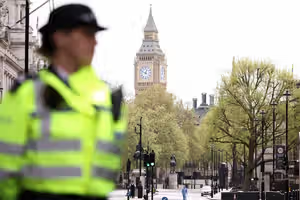
The charges stem from an April 15 incident in which an ignited container was thrown into a car park near Iran International’s studios. The premises belong to Volant Media, the London-based broadcaster’s parent company. The device extinguished itself and caused no injuries or damage.
Iran International said after the attack that a suspicious vehicle had been denied entry to its London site shortly before the incendiary device was thrown. The broadcaster has said the incident came amid increased threats and harassment targeting its journalists and their families.
US Secretary of State Marco Rubio meets Greek Foreign Minister Giorgos Gerapetritis in Washington, March 1, 2025. (Marco Rubio/X)
For years, diplomacy between Iran and the United States has largely been conducted through a familiar group of intermediaries.
Oman has traditionally provided the most discreet and trusted channel, while Qatar, Pakistan and Turkey have used their relations with both sides to facilitate contacts or transmit messages.
Yet the continuing deadlock in negotiations has now encouraged Washington to widen the diplomatic circle.
In recent days, Austria and Greece have separately opened contacts with Tehran after consultations with US Secretary of State Marco Rubio, according to media reports.
The unexpected involvement of Austria and Greece suggests that European diplomacy, long marginalized in the Iran-US relationship, may be making a cautious return in the context of a regional military escalation.
The sequence of recent contacts is striking. US Secretary of State Marco Rubio met Austrian Foreign Minister Beate Meinl-Reisinger in Washington on August 11 and spoke by telephone with Greek Foreign Minister George Gerapetritis the following day. On August 13, both European ministers held separate conversations with Iranian Foreign Minister Abbas Araghchi. Although the US State Department denied asking them to transmit messages, the timing was probably not coincidental. The State Department subsequently confirmed that Iran had been discussed, while Austria formally offered Vienna as a venue for potential future talks. Greece emphasized freedom of navigation and maritime security in its exchanges with Tehran.
This is not yet formal mediation. Neither Austria nor Greece has the experience, access or accumulated trust that Oman possesses. Their involvement should instead be understood as an exploratory attempt to identify additional channels at a moment when traditional diplomacy is struggling. The proliferation of intermediaries itself is revealing: it demonstrates not the vitality of the diplomatic process, but its fragmentation.
Austria’s possible role is rooted in diplomatic history. Vienna hosted negotiations that culminated in the July 14, 2015 nuclear agreement, formally known as the Joint Comprehensive Plan of Action (JCPOA). It is also home to the International Atomic Energy Agency, which would likely play a central role in verifying any future settlement concerning Iranian nuclear activities. Austria can therefore offer more than a neutral meeting room. It provides an institutional environment closely associated with nuclear diplomacy, technical verification and the memory of an agreement that once appeared capable of containing the Iranian nuclear crisis.
Vienna nevertheless carries contradictory symbolism. For Iranian officials, it recalls the JCPOA’s acceptance of limited Iranian enrichment for civilian purposes and the partial lifting of sanctions. But it also evokes the subsequent collapse of the agreement after the first Trump administration withdrew from it in 2018. Austria cannot repair that breach of confidence on its own. Its principal advantage is therefore procedural rather than political: it can provide a discreet and credible setting in which the United States, Iran and the IAEA might clarify their positions.
Greece brings a different form of leverage. As one of the world’s leading maritime nations, it has direct interests in the security of the Strait of Hormuz and the Red Sea. The disruption of navigation through Hormuz is not an abstract geopolitical problem for Athens. It affects Greek-owned shipping, insurance costs, energy prices and the stability of international trade. Greece can consequently address Iran not only as a European Union member and US ally, but also as the representative of an industry directly exposed to the consequences of escalation.
This maritime dimension may make Athens useful in discussions focused on practical arrangements rather than an immediate comprehensive agreement. Measures guaranteeing freedom of navigation, reducing threats against commercial vessels or creating communication mechanisms to prevent incidents at sea could be easier to negotiate than the most divisive nuclear and security questions. Greece could contribute technical knowledge and political advocacy to such discussions, although it lacks the capacity to provide Iran with the sanctions relief or security guarantees Tehran ultimately seeks.
The emergence of Austria and Greece also exposes the decline of the traditional European powers in the Iranian diplomatic arena. France, Germany and the United Kingdom were central to the nuclear negotiations that began in the early 2000s. Since then, however, the credibility of the European trio has deteriorated in Tehran and the three countries are facing bilateral diplomatic crises in their relations with Tehran. Iranian leaders accuse them of failing to protect the economic benefits of the nuclear agreement after the American withdrawal and of increasingly aligning themselves with Washington’s coercive approach. The mutual distrust generated by sanctions, mutual accusations of security “infiltration” and spying, regional conflict and disputes over Iran’s nuclear activities has left little space for the earlier model of European mediation.
This marginalization is being reinforced by the widening security confrontation. The Financial Times reported Wednesday that Iran had considered attacking US military targets in Europe, including in Bulgaria and Cyprus, if Washington further escalated the war.
Reuters reported Wednesday that a NATO official said the alliance was prepared to address any threat and take necessary action to defend its members. The official cited four occasions earlier this year when NATO air defenses intercepted Iranian ballistic missiles heading toward Turkey, saying they demonstrated the strength and effectiveness of NATO’s deterrence and defense posture.
Smaller European countries may therefore benefit from carrying less political baggage. Austria is associated more closely with dialogue than with strategic pressure and maintained substantial economic and energy ties with the Islamic Republic throughout the 1990s and 2000s. Greece, for its part, has generally remained outside the most confrontational debates over Iran. Yet their relative neutrality should not be overstated. Both countries are members of the European Union and close partners of the United States. Tehran will ultimately judge their usefulness by their ability to secure concrete concessions from Washington, not by the cordiality of their diplomatic rhetoric.
Their involvement also reflects the widening international cost of the conflict. The restriction of traffic through Hormuz, a corridor through which roughly one-fifth of global oil consumption normally passes, has transformed the crisis from a bilateral confrontation into a global economic emergency. Washington wants the strait reopened, while Tehran sees control over navigation as one of its most powerful remaining sources of leverage. Austria and Greece are entering the process because the consequences of failure now extend far beyond the Middle East.
The immediate objective should therefore be modest. Vienna and Athens are unlikely to replace Muscat, Doha or Islamabad, and multiplying intermediaries can produce contradictory messages and allow both Iran and the United States to avoid making difficult decisions. Their most useful contribution would be to support a coordinated diplomatic framework: Austria concentrating on nuclear verification and the venue for talks, Greece on maritime security, and traditional regional mediators on political communication and guarantees. Ultimately, no mediator can compensate for a lack of political will to pursue a diplomatic solution rather than military escalation. Austria and Greece cannot make that choice on behalf of Washington and Tehran, but they may help create the conditions in which diplomacy becomes possible.
Their return is therefore neither a diplomatic breakthrough nor an irrelevant gesture. It reflects an increasingly marginalized Europe urgently seeking new ways around a dangerous impasse. If carefully coordinated, these unlikely European channels could help prepare the ground for renewed negotiations. Otherwise, they risk becoming yet another improvised attempt to contain a conflict that its principal actors have so far proved unable to resolve. Europe nevertheless has a strong interest in assuming a more active diplomatic role: European states are already bearing many of the conflict’s economic and security consequences, yet they possess neither the political leverage to shape a settlement nor the military capacity – and, in most cases, the willingness – to impose one.
Zahhak Receives the Daughters of Jamshid, a manuscript illustration made in Tabriz, Iran, in the 1520s, in ink, gold and opaque watercolor on paper. Courtesy of Khalili Collections / CC-BY-SA 3.0 IGO.
In the Persian classic Shahnameh, Ferdowsi tells the story of Zahhak, the usurper king who is kissed on each shoulder by Ahriman, the spirit of evil, and finds two black snakes growing from the wounds.
Cut them off and they grow back. The only way to keep them quiet is to feed them, every day, with the brains of two young men. Zahhak reigns for a thousand years on a diet of sacrificed youth, propped up not by loyalty but by appetite.
The story has always worked as a parable for Iranian tyranny. What I think it misses, applied to the Islamic Republic today, is the arithmetic. Ali Khamenei did not build two snakes. He built three.
The Artesh, Iran’s conventional army, was the first snake, inherited from the Shah and never fully trusted. The IRGC was the second, created in 1979 specifically because the revolution did not trust the first. The Basij was folded into the IRGC as its third head.
It is worth remembering that all three answer, on paper as much as in practice, to a single neck. The Iranian constitution names the Supreme Leader as Commander-in-Chief of the Armed Forces in their entirety, Artesh, IRGC and Basij alike. There is no independent chain of command outside the Supreme Leader’s authority for a general to retreat into. Politicians and Western commentators in both London and Washington keep waiting for one of these heads to turn on the body. They’re waiting for the wrong signal, because they’re analysing 1979, not 2026.
When the Shah’s generals stood aside in February 1979, they did so because the Artesh of that era was a conscript institution led by officers who owed their careers to a monarch, not a movement, and who had no ideological stake in what came next. That Artesh is not today’s Artesh.
Ali Khamenei spent decades solving exactly that problem. Senior appointments in today’s Artesh are subject to security and ideological vetting tied to the Supreme Leader’s military apparatus. The Middle East Forum has documented how senior promotions require approval from the Supreme Leader’s office following scrutiny of an officer’s security and ideological background. The men at the top of the Artesh are appointees of the system, not survivors of it.
This is why this month’s move to complete the integration of the Armed Forces General Staff with the Khatam al-Anbiya Central Headquarters matters more than it has been given credit for. Mojtaba Khamenei, who inherited a system his father spent more than four decades constructing, has now moved to formalise a process of centralisation that had earlier been discussed but was not visibly underway in operational terms.
The lesson learned from 2025 and the Twelve-Day War, according to Iran’s own state reporting, was that redundant command structures slow decision-making. The latest restructuring is intended to reduce that redundancy and further narrow the distinction between the operational command of the Artesh and the IRGC. The underlying logic is clear: the system has little interest in preserving institutional space in which one military arm might begin to think or act independently of the others.
I would also gently push back on those looking for salvation in Iran’s reformists. Pezeshkian’s presidency provides a civilian face and international cover for the negotiating track, and that function matters. But it is not independence.
Ghalibaf is a former senior IRGC commander who has spent decades inside the Islamic Republic’s political and security establishment. Araghchi is a capable diplomat entrusted with representing Tehran in negotiations. Both men operate inside the system’s tolerances, not outside them. Reading their willingness to negotiate as evidence of a moderate faction pulling against a hardline one mistakes tactics for structure.
When Iran has had to cede ground, at Bürgenstock or Islamabad, it has ceded it in the way a company reprices a product: reluctantly, and only as far as survival requires. Ghalibaf gets attacked by the influential ultra-hardline Paydari Front for talking to Americans, and he absorbs it, because someone in the system has to run the diplomatic track.
None of this means the system is stable in the way it looks stable. Ali Khamenei is dead. His son, who has still not been seen or heard in public, inherited the office by appointment and is still consolidating the very apparatus his father designed. The strain is real. But strain inside a structure is not the same as a fracture between its parts. The three heads bicker over how much brain they are fed and by whom, not over whether to keep feeding.
So when I hear commentary asking whether this is the moment the Artesh finally breaks from the regime, or whether Ghalibaf represents the pragmatic wing that might yet reform the system from within, I think of Zahhak.
Nobody in that story is saved by one of the snakes deciding it has had enough. The snakes do not turn on the king. The rupture comes from outside the machinery of the court: Kaveh the blacksmith rises first, turning private grievance into public revolt, rallying the people and creating the conditions for Fereydun’s return. Fereydun then defeats Zahhak and binds him at Damavand. Until that structure itself breaks, all three snakes answer to the same shoulders.
Canada says immigration applications are assessed individually in response to cases of Iranians who completed mandatory military service with the Revolutionary Guards receiving letters warning they could be deemed inadmissible on security grounds.
In a statement to Iran International, Immigration, Refugees and Citizenship Canada (IRCC) said “membership in the IRGC and service in the IRGC are distinct considerations” for assessing inadmissibility.
Individuals who served as a result of compulsory military service are assessed individually, the department said, adding that “conscription alone does not necessarily result in inadmissibility.”
IRCC said final decisions are made by immigration officers after reviewing submitted documents, relevant case law and recommendations from security partners, including the Canada Border Services Agency (CBSA) and the Canadian Security Intelligence Service (CSIS).
Conscripts receive fairness letters
Documents and accounts obtained by Iran International indicate that Iranian applicants whose only declared connection to the IRGC was compulsory military service have received Procedural Fairness Letters (PFLs) raising possible inadmissibility.
The letters notify applicants that their cases are being assessed under paragraph 34(1)(f) of the Immigration and Refugee Protection Act (IRPA) over possible membership in an organization believed to engage in terrorism.
A finding of inadmissibility can result in the refusal of an application for permanent residence and can also affect accompanying family members.
Iran International reviewed a PFL issued to an applicant on Aug. 6 that explicitly cited the applicant’s mandatory military service with the IRGC.
“On form IMM 5546, you indicated that you served your mandatory military service with the IRGC,” the letter said, giving the applicant 30 days to submit additional information before a decision is made.
IRGC designation and compulsory service
Canada designated the IRGC a terrorist entity under the Criminal Code in June 2024, after years of debate that included concerns over Iranians who had been conscripted into the force.
A separate measure expanded later that year makes senior Iranian government officials who served at any point since June 23, 2003 inadmissible to Canada.
IRCC said procedural fairness letters give applicants an opportunity to provide additional information before a final decision is made. Community advocates and legal representatives, however, say the recent volume of letters has created widespread uncertainty among Iranians with a history of compulsory IRGC service.
Advocates estimate that thousands of Iranian families in Canada could be affected by security reviews stemming from mandatory conscription.
Several applicants also told Iran International they had participated in anti-government demonstrations and human rights rallies since arriving in Canada and feared possible repercussions if they were eventually returned to Iran.
“We served in the military solely because it is mandatory under Iranian law,” one applicant said on condition of anonymity because of security concerns. “Yet, my spouse is now also facing potential inadmissibility.”
The applicant said they were hesitant to submit evidence detailing their opposition activities in Canada because they feared the information could endanger their family if they were ultimately forced to return to Iran.
IRCC said no final decision is made until information submitted by an applicant during the response period has been evaluated.
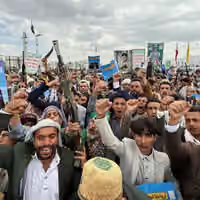
An Islamic Republic supporter holds a photo of Supreme Leader Mojtaba Khamenei during a state-run rally. / Photo by IRNA
Iran's unseen supreme leader has issued his first military decrees, raising a central question about the emerging order under Mojtaba Khamenei: is he tightening his grip on power, or relying on the old security establishment to shore up his authority?
The six decrees named Ali Abdollahi chief of staff of the armed forces, with Kioumars Heydari as his deputy; Ahmad Vahidi commander-in-chief of the Revolutionary Guards, with Mostafa Izadi as his deputy; Ali Azmaei commander of the Guards' navy; and Hossein Taeb, the feared former intelligence chief of the Guards, head of the Basij.
Separately, Mohsen Rezaei, the former Guards commander named Khamenei's military adviser in March, became secretary of the Supreme National Security Council and the leader's representative on the body.
The appointments put veterans of the Guards, intelligence services and Iran-Iraq war generation across the upper reaches of the security establishment. But rather than marking a wholesale changing of the guard, they draw heavily on figures who built their careers under Ali Khamenei — leaving open whether the new supreme leader is imposing his authority on the system or assembling an experienced security bloc whose support he needs to exercise it.
Khamenei's directives suggest the changes are not simply about personnel. In his appointment decree for Vahidi, he called for strengthening the force's capabilities for “maximum deterrence” and maintaining readiness to carry out “powerful offensive operations against the enemy.”
Lawmaker Ebrahim Rezaei described the appointments as “basically an indication of the fact that the Islamic Republic is moving toward a more offensive military structure.”
War commanders move to the top
The clearest sign that Khamenei may be changing how the military is run, rather than merely replacing its commanders, lies in the elevation of Abdollahi and Heydari from the Khatam al-Anbiya Central Headquarters to the two highest positions in the Armed Forces General Staff.
The General Staff is Iran's highest military coordinating body, while Khatam Central Headquarters has a more operational wartime role, coordinating military activity across different branches.
There has been no confirmed announcement that the two bodies have formally merged, but pro-establishment commentator Mohammad-Sadegh Alizadeh said the appointments confirmed a process of centralizing Iran's military command.
“The merger of Khatam al-Anbiya Central Headquarters and the Armed Forces General Staff means concentrating the country's wartime, military and offensive activities,” he wrote on X, adding that Abdollahi's decree explicitly tasked him with completing the process.
Abdollahi previously served as coordination deputy of the General Staff and deputy commander of Iran's police. Heydari commanded the regular Army Ground Forces for more than seven years before moving into Khatam's command structure in late 2025.
Heydari's appointment also preserves a senior regular Army presence near the top of a leadership heavily populated by Revolutionary Guards veterans, suggesting that greater centralization does not necessarily amount to straightforward IRGC domination of the command structure.
Taeb’s return puts domestic security in focus
If the Abdollahi and Heydari appointments point to tighter wartime command, Taeb's return to the Basij reveals the domestic-security side of Khamenei's emerging structure.
Taeb commanded the Basij during the unrest following Iran's disputed 2009 presidential election and later spent more than a decade heading the IRGC Intelligence Organization before his removal in 2022.
Khamenei's decree calls for strengthening what it describes as the Basij's “popular intelligence network,” drawing attention to the surveillance and internal-security component of Taeb's mandate.
New York-based journalist and Middle East writer Séamus Malekafzali said Taeb's return was particularly significant given his intelligence background.
“Taeb spent 13 years after leaving the Basij as the head of IRGC intelligence,” he wrote on X on August 10. Referring to Khamenei's directive for a “grassroots confrontation with enemy threats,” he added that it “certainly sounds like making sure the January protests never happen again.”
Taeb has also long been identified with Mojtaba Khamenei's security network. When he was removed as IRGC intelligence chief in 2022, Jason Brodsky, policy director at United Against Nuclear Iran, described the move as “an earthquake in Iran's intelligence community,” noting his close relationship with both Ali Khamenei and his son.
His return therefore restores a longtime Khamenei confidant to command of an organization embedded across universities, workplaces, neighborhoods and state institutions, and which has played a central role in surveillance, political mobilization and the suppression of protests.
Journalist Morteza Kazemian linked the appointment to worsening economic conditions and public discontent, arguing that Taeb had become one of Khamenei's trusted instruments of security and governance and that the Basij under his command was intended to embody the leadership's “iron fist.”
Rezaei comeback underscores reliance on old guard
If Taeb's return highlights Khamenei's reliance on trusted security figures, Rezaei's comeback makes the generational continuity harder to miss.
Rezaei commanded the Revolutionary Guards from 1981 to 1997, including through most of the Iran-Iraq war, before moving into politics and holding a succession of senior state positions.
He later served at the Expediency Council, repeatedly ran for president and became vice president for economic affairs under Ebrahim Raisi. Khamenei appointed him military adviser in March before naming him secretary of the Supreme National Security Council and his representative on the body less than five months later.
Journalist Ahmad Zeidabadi questioned why Mohammad Bagher Zolghadr had been replaced by Rezaei and what substantive change the appointment was intended to bring.
“What does the appointment of Mohsen Rezaei in place of Mohammad Bagher Zolghadr as secretary of the Supreme National Security Council mean, and what change is it supposed to bring to the way this position operates?” he wrote on X.
Some Iranian social-media users responded with mockery, reviving jokes surrounding Rezaei's repeated presidential campaigns and decades-long circulation through senior state positions.
The criticism reflected one of the broader themes surrounding the reshuffle: that Khamenei's first major appointments have elevated not a new generation of officials, but men who have occupied the Islamic Republic's military and political establishment for decades.
Vahidi promotion highlights hardline continuity
Vahidi's promotion adds another dimension to that continuity: the elevation of a commander whose record spans Iran's external military operations and domestic repression.
Vahidi had served as acting Guards commander following Mohammad Pakpour's death during the war with the United States and Israel. Khamenei formally installed him as commander and promoted him to major general.
He previously held senior roles in the Quds Force and served as defense minister under Mahmoud Ahmadinejad and interior minister under Ebrahim Raisi.
Argentine prosecutors have sought Vahidi in connection with the 1994 bombing of the AMIA Jewish community center in Buenos Aires, which killed 85 people. Iran denies involvement.
Israel's foreign ministry focused its response to the reshuffle on Vahidi and Rezaei, linking both men to allegations surrounding the AMIA case and accusing Tehran of elevating figures associated with attacks abroad.
“The Iranian regime worships terror, rewards its architects and promotes them to the highest levels of power,” the ministry said on X.
The United States has also sanctioned Vahidi over his role as interior minister during the suppression of protests following Mahsa Amini's death in custody in 2022.
But the wartime record of Vahidi, Abdollahi and Taeb also complicates the idea that their elevation simply represents Khamenei extending his personal control over the security apparatus.
President Masoud Pezeshkian accused Vahidi and Abdollahi of taking unilateral military actions that undermined efforts to secure a ceasefire, Iran International reported in April. The report also described a heated confrontation involving Taeb.
All three men now occupy senior positions in the military-security structure under Khamenei, raising the possibility that the new leader has elevated figures whose institutional power was already considerable before he formally appointed them.
Khamenei’s first imprint on security establishment
Several major international outlets interpreted the reshuffle as an early indication of how Khamenei intends to shape the security establishment after succeeding his father.
The Wall Street Journal portrayed the appointments as Khamenei putting his stamp on the national-security system and signaling a tougher approach toward Washington.
“Iran's mysterious ruler signals a hard line on Trump with new leadership,” the newspaper wrote.
The Financial Times focused on the promotion of loyalists and the possibility that Rezaei's return could point toward a harder line on the United States, while Reuters described Rezaei as a close ally of Khamenei and highlighted his recent opposition to extending a ceasefire and his skepticism toward negotiations with Washington.
Those readings emphasize Khamenei's role in choosing the new hierarchy. But the identities of the men he chose point just as strongly to continuity with the security establishment inherited from his father.
Iran International analysts had raised that tension even before the latest decrees.
The deaths of Ali Khamenei and other senior officials created a leadership gap in which his successor was still working to consolidate his position, Kazemian said in May.
After the appointments were announced, journalist Kamyar Behrang argued that the death of Ali Khamenei, who had served as the system's final arbiter, had given the Revolutionary Guards greater room to shape the political order that followed him.
The appointments can therefore be read in both directions. Khamenei is placing his own stamp on the military and security hierarchy, centralizing command and restoring trusted figures to key posts.
But he is doing so largely through men formed under his father's rule — veteran commanders and intelligence officials whose institutional weight may be as important to his authority as their loyalty to him.
The first map of power under Mojtaba Khamenei is taking shape. What remains unclear is whether these men are primarily instruments of his control, or the establishment on which that control depends.
Iran is moving to ratify the Caspian treaty it left dormant for seven years, choosing the depths of a war to settle the status of its one quiet frontier, and reopening the oldest wound in its modern diplomacy: the belief that Tehran signed away half a sea.
President Masoud Pezeshkian's government has sent the 2018 Convention on the Legal Status of the Caspian Sea to parliament for ratification, ending years in which the treaty sat untouched and reviving a charged argument over the country's historical rights, energy interests and position in the strategically vital basin.
The convention, signed by the leaders of Iran, Russia, Azerbaijan, Kazakhstan and Turkmenistan in the Kazakh port of Aktau in August 2018, takes effect only once all five littoral states ratify it. The other four completed the process long ago. Tehran, alone, held back.
The charge that shadows the bill is older than the bill itself: a belief, widely held in Iran and rooted in readings of its 1921 and 1940 treaties with Moscow, that the country was entitled to half the Caspian and stands to end up with barely a tenth.
The convention in fact allocates no national shares at all, but the ghost of the fifty percent has trailed every Iranian discussion of the sea since Aktau.
The timing sharpens the argument. The move lands in the middle of a war that has set Iran's southern coast under nightly strikes and closed the Strait of Hormuz, leaving the Caspian corridor to Russia carrying an outsized share of the country's commerce and its strategic weight.
What the treaty actually does is narrower than either its champions or its critics suggest.
It defines the Caspian as a "special and unique landlocked body of water," placing it outside the UN Convention on the Law of the Sea. Each coastal state receives 15 nautical miles of fully sovereign territorial waters and a further 10 nautical miles of exclusive fishing rights, with the remaining surface designated a shared navigation zone.
The wealth, however, is postponed. Article 8 leaves ownership and delimitation of the seabed and its oil and gas to "bilateral or multilateral agreements between the states concerned."
Russia, Kazakhstan and Azerbaijan have largely settled their boundaries in the sea's north; the lines involving Iran, Azerbaijan and Turkmenistan remain unresolved, tangled in the complexity of dividing energy-rich waters.
A century-old dispute over Iran's share
Before the Soviet collapse, the Caspian was governed by the 1921 and 1940 treaties between Tehran and Moscow, which recognized equal navigation and fishing rights but drew no maritime boundaries.
The Soviet breakup turned two littoral states into five, and Iran has argued since that the sea should be divided equally, 20 percent to each.
Russia, Kazakhstan and Azerbaijan instead adopted a modified median-line method, a formula that, because of Iran's concave coastline, would shrink Tehran's share of the sea and its bed to roughly 11 to 13 percent. Iran has never accepted that division.
The government's case: a sealed northern flank
The government presents ratification as completing the Caspian's legal framework, deepening cooperation among the littoral states and, above all, keeping outside powers away.
Officials point to Article 3, which bars the armed forces of non-coastal countries from the Caspian, as the convention's central security prize, a provision long championed by both Tehran and Moscow.
Defa Press, an outlet affiliated with Iran's armed forces, wrote that the clause would "turn Iran's northern borders into a secure region, far removed from scenarios of foreign military intervention," at a moment when the country faces pressure along its southern and western frontiers.
The critics' case: ratifying before the real negotiation
Opponents argue parliament is sequencing the deal backwards: locking in the framework before the seabed, where the money lies, has been divided.
They note that the northern states have already parceled out much of the seabed and pressed ahead with oil and gas development, while fields shared with Iran, including Alborz, remain in limbo.
Dariush Safarnejad, an international affairs analyst, told the Revolutionary Guards-linked Javan newspaper that lawmakers should return the bill to the government, since supplementary agreements that were meant to be completed within six months of the 2018 signing have never been finalized.
Approving the convention without them, he warned, "could provide other Caspian states with legal grounds in the future and influence the security, political and geopolitical dynamics of the Caspian region."
Shoaib Bahman, an international relations analyst focused on Eurasia, told the same paper that ratifying before the seabed boundaries are set would "effectively reduce Iran's legal leverage in future negotiations and could undermine its claim to a 20% share of the Caspian Sea."
Pipelines, corridors and the Turkic map
The critics' second front is Article 14, under which undersea pipelines require the consent only of the states whose sectors they cross, not all five. Bahman argued the clause could open the way for eastern Caspian producers to export oil and gas directly toward Europe, eroding Iran's transit position.
Mehdi Seif-Tabrizi, a Russia specialist, offered a more measured reading to the news website Fararu. Iran's 15 miles of territorial waters and 10 miles of fishing rights are guaranteed, he said, and "the real dispute concerns the seabed and subsoil," not the surface percentages that dominate the public argument.
Yet he shares the strategic worry: that the long-discussed Trans-Caspian pipeline from Turkmenistan or Kazakhstan to Azerbaijan could finally be built.
"That could strengthen Azerbaijan's position and, in turn, reinforce the Zangezur corridor and the so-called Turkic World project," he said. "If Iran ratifies the convention, it would remove one of the most important legal obstacles to implementing those projects."
The opposition joins the attack
Criticism has come from beyond the establishment's factions. Exiled Prince Reza Pahlavi wrote on X that ratifying the agreement without the Iranian people's mandate and without "a clear and comprehensive guarantee of Iran's historic rights" is "deeply concerning and constitutes a serious threat to Iran's national interests."
Iran's rights in the Caspian, he added, "are not negotiable, nor can they be relinquished. Any action that undermines these rights will be recorded in the historical memory of the Iranian nation, and those responsible will ultimately be held accountable by the people of Iran."
Saeed Ghasseminejad, a senior Pahlavi adviser, went further, alleging that Hassan Rouhani's government had already "ceded Iran's share of the Caspian Sea" and that Pezeshkian and parliament speaker Mohammad-Bagher Ghalibaf now seek to "legalize and make that concession permanent."
He called the move "the biggest surrender of Iran's land and waters to foreign powers since the Qajar-era humiliations."