The full moon rises in the background over an oil rig at the Kashagan offshore oil field in the Caspian sea in western Kazakhstan
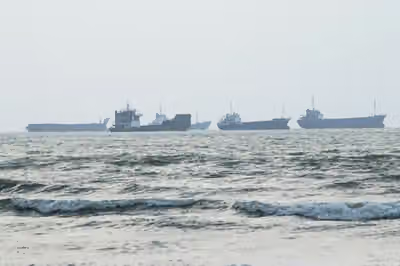
As Azerbaijan and other Caspian Sea states deepen partnerships with Western energy companies to extract more oil and gas from aging offshore fields, Iran stands apart as the only Caspian littoral country that produces no hydrocarbons from the sea at all.
Across the region, governments are racing to modernize reservoir management as competition for long-term gas supply intensifies.
Azerbaijan is pressing ahead with multibillion-dollar pressure-enhancement projects to sustain output from mature fields, while Kazakhstan and Turkmenistan are expanding offshore production with foreign capital and advanced technology.
Western majors, international service firms and even Persian Gulf state companies are reshaping the Caspian’s energy map—locking in production and export capacity for decades.
Iran, by contrast, lacks both the equipment and the partners to participate. Its only seismic survey vessel in the Caspian was decommissioned nearly two decades ago, and its sole offshore drilling platform has remained inactive for years.
The result is not simply underinvestment, but effective exclusion: while neighbors upgrade offshore infrastructure and extend field life, Iran has been left on the sidelines.
Contrast: Azerbaijan
Nowhere is the contrast clearer than in Azerbaijan’s flagship Shah Deniz gas field.
Operated by a consortium led by Britain’s BP, the field has attracted more than $30 billion in investment and supplies gas to Georgia, Turkey and much of Europe.
With production from its active phases expected to decline in the coming decade, Azerbaijan has moved early, signing contracts worth nearly $3 billion for large-scale pressure-enhancement facilities designed to sustain output, cut emissions and unlock additional reserves.
“Eliminating pressure decline is now the central priority,” Elham Shaban, director of the Caspian Oil Studies Center in Azerbaijan, told Iran International, noting that further contracts with Western and domestic firms are expected to be finalized in the coming months.
Iran’s handicap
Iran faces a parallel challenge at home—without comparable tools to address it. South Pars, the giant gas field it shares with Qatar and which supplies roughly 70 percent of Iran’s domestic consumption, has begun to experience pressure decline.
While Qatar installed modern pressure-enhancement systems years ago with Western support and has since signed contracts worth nearly $30 billion to expand production and liquefaction capacity, Iran has turned to local contractors, signing agreements worth $17 billion for smaller platforms and less powerful compressors.
Funding for those projects, however, has yet to materialize. Iranian oil officials have warned that gas shortages this winter could reach a record 300 million cubic meters per day, underscoring the gap between technical need and execution.
The same pattern extends to Iran’s oil sector. Roughly 80 percent of Iran’s producing oil fields are in the second half of their lifespan, with annual decline rates estimated at 8 to 12 percent.
Limited access to advanced recovery technologies has left Iran with a recovery rate of about 24 percent—only marginally above its natural baseline.
Not even China
By comparison, Saudi Arabia has raised recovery rates above 50 percent through decades of cooperation with Western firms, while Azerbaijan extended the life of its Azeri-Chirag-Gunashli fields by signing a long-term redevelopment agreement with BP and its partners.
Elsewhere around the Caspian, foreign capital continues to flow. Kazakhstan has attracted tens of billions of dollars to develop the Kashagan field, the region’s largest, while Turkmenistan’s offshore sector is operated almost entirely by the UAE’s Dragon Oil.
Iran’s Arab neighbours Arab have also expanded into gas development and transport infrastructure, reinforcing a regional energy network from which Tehran remains largely absent, despite its close political ties with Moscow and Beijing.
China, Iran’s largest trading partner, made no direct investment in Iranian or Russian energy projects in the first half of this year, while channeling more than $20 billion into Kazakhstan and the Middle East under its Belt and Road Initiative.
For Iran, sanctions and technological isolation have turned the Caspian from a shared resource into a widening strategic divide.
Faced with economic crisis, social defiance and regional strain, Iran’s supreme leader Ali Khamenei continues to invoke earlier moments of “glory,” treating defeat and mismanagement as moral triumphs rather than political failures.
This approach has been a defining feature of his 36-year rule: confronting challenges not by reassessing the past but by recasting it.
That pattern was again on display in a December 15 speech, in which Khamenei returned to the state narrative forged after the 1980s war with Iraq—known officially as the “Sacred Defense.”
The Iran–Iraq war, which ended in 1988 without a clear winner, inflicted enormous human and financial losses on both countries, leaving hundreds of thousands dead.
In its immediate aftermath, Iran’s theocratic rulers embedded their interpretation of the conflict into public space. Murals across the country depicted blood-stained bodies of “martyrs” alongside grieving children.
Khamenei delivered his latest speech in an event commemorating the martyrs of that war in Karaj, Iran’s fourth-largest city, just west of Tehran. He called for a “transfer of the values and motivations of the Sacred Defense era to the new generation through artistic effort and persistent follow-up.”
Rather than grappling with present-day realities, he looked backward, framing sacrifice and “martyrdom” as enduring virtues for a new generation.
No mistakes
In his speech, Khamenei acknowledged Iran’s dire condition but sought to project optimism.
“Despite all the hardships and difficulties, there exist numerous positive points and considerable readiness within the country to move toward Islam and the Revolution,” he said, adding that “these must be strengthened.”
Political analyst Jamshid Barzegar told Iran International TV that the remarks reflected a leadership unwilling to accept responsibility.
“Not only does Khamenei fail to alleviate the poverty and other problems he has imposed on the nation, he does not seem to have a plan to correct his mistakes,” Barzegar said.
He also questioned Khamenei’s assertion that society is moving “toward revolution and Islam,” noting that the supreme leader himself abandoned revolutionary and Islamic rhetoric after the 12-day war with Israel, shifting instead toward nationalist themes that emphasized Persian identity over religious ideology.
No course correction
Khamenei’s retreat into past narratives—coming shortly after the unveiling of a replica statue depicting a Roman emperor prostrating before a Persian king—has projected an image of uncertainty rather than authority.
That impression was reinforced by the handling of the Karaj speech itself. Its broadcast was delayed until the following day, apparently for security reasons, suggesting the establishment has not forgotten the shock—if not the humiliation—of the June assault and its personal aftermath for Khamenei.
The unusually brief version posted on his website also hinted at heavy editing, possibly to avoid missteps.
Economic analyst Mohammad Machinchian criticized Khamenei’s reference to “numerous positive points,” arguing that it bore little resemblance to everyday reality.
“Only in recent days nearly all Iranians suffered heavy financial losses due to unusual price hikes,” Machinchian said. “But Khamenei is captivated by the distant past and seeks to follow the same path that has led to the current impasse.”
Iranian authorities have stepped up pressure on civil society, media and political activists in several cities in an apparent effort to deter any protests over higher fuel prices, according to people familiar with the matter.
Several civil and media activists have been summoned by security and law enforcement bodies after posting critical or analytical content on social media, the sources said.
During the summons, they were warned to refrain from publishing material about fuel and energy price increases so as not to create what officials described as a “tense atmosphere.”
The number of summonses and warning calls has increased in provincial towns, the sources added, with the measures broadened to reach a wider circle of local activists.
Sources also said security personnel have been working extended hours to handle a growing volume of new summonses.
The moves come as the government rolled out a new fuel pricing scheme on earlier in December, introducing a three-tier pricing system for gasoline.
President Masoud Pezeshkian defended the decision on Thursday, saying prices had been adjusted but that the plan imposed “no pressure on anyone.”
Economists have cautioned, however, that higher energy prices are likely to feed directly into transport costs and, in turn, push up prices for other goods and services.
Security agencies appear particularly sensitive to public reaction to fuel prices given the legacy of November 2019, when a sudden gasoline price hike triggered nationwide protests that were met with a sweeping crackdown, leaving many dead and hundreds detained.
Iran is not a war-torn country, yet four decades of Islamic Republic rule have driven mass emigration. UN data show over five million registered refugees or asylum seekers since 1980, with millions more leaving legally – about one in every 15 Iranians now living abroad.
So why have millions of Iranians chosen to endure the hardship of life far from home rather than remain under the Islamic Republic?
This report draws on official United Nations figures for Iranian refugees and asylum seekers, which begin in 1980 – about a year into the Islamic Revolution.
The UN High Commissioner for Refugees (UNHCR) published no figures for Iranian refugees or asylum seekers before 1980, although UNHCR has been collecting refugee statistics since 1951.
Before the establishment of the Islamic Republic in 1979, there were no recorded asylum cases, aside from scholarship students and legal Iranian migrants.
There are, however, personal accounts involving a small number of members of the Tudeh Party – a pro-Soviet Iranian communist party – who fled to the former Soviet Union. One such account concerns Ataollah Safavi, a former Tudeh Party member who, after fleeing to the Soviet Union, was sent to Siberian forced labor camps.
Ali Khamenei kisses the hand of Ruhollah Khomeini, the founder of the Islamic Republic, in an undated image.
First decade: War years under Khomeini’s leadership
The first wave of Iranian asylum began in 1980. Shortly after the Islamic Republic was established, Iranians could still migrate relatively easily using passports issued under the previous government.
In this period, a large number of Iranians traveled legally to the United States.
From 1980, the registration of Iranian asylum seekers began with 44 cases, marking the start of a trend that would accelerate through the decade.
The first ten years, from 1980 to 1989, coincided with the eight-year Iran–Iraq war, the presidency of Ali Khamenei, and the premiership of Mirhossein Mousavi, while Ruhollah Khomeini served as Supreme Leader.
Over that decade, more than 312,000 Iranians were registered as refugees, according to United Nations data.
The peak came in 1985, when more than 88,000 refugees were recorded in a single year – the highest annual total of the decade.
(From left) Ali Khamenei, Akbar Hashemi Rafsanjani, and Mousavi Ardebili
Second decade: Khamenei takes charge
In 1989, Ali Khamenei began his tenure as Supreme Leader of the Islamic Republic, and Akbar Hashemi Rafsanjani took office as president – ushering in what Iran’s official political language calls the “reconstruction” era, a term used for the post–Iran-Iraq war drive to rebuild state capacity and the economy.
By the end of Rafsanjani’s presidency, inflation compared to his first year was up 478%, and the record for Iran’s annual inflation is still attributed to his government at more than 49%.
Against that economic backdrop, the trend in Iranian asylum intensified.
Over the 1990–1999 period, nearly 1.06 million Iranians were registered as refugees, with the peak in 1991, when 130,000 refugees were recorded.
After 1997 – often described in Iran as the start of the “reform era” – the pace of refugee registrations eased for a time, falling to below 100,000 a year.
Former presidents Mahmoud Ahmadinejad (left) and Mohammad Khatami
Third decade: Reform and Ahmadinejad
In 1997, the election of Mohammad Khatami ushered in a period often described as Iran’s “reform” era, bringing a measure of optimism to parts of Iranian society.
During the first three years of Khatami’s presidency, the number of Iranians registered as refugees and asylum seekers declined modestly, before reversing course and rising again.
From 2000 to 2009, nearly 1.1 million Iranians were registered as refugees or asylum seekers, although some cases initially recorded as asylum claims may have been reclassified as refugee status in subsequent years.
A similar pattern emerged under Mahmoud Ahmadinejad, whose early presidency also saw a year-on-year decline in asylum registrations. That trend, however, reversed after his first two years in office.
In 2009, as protests known as the Green Movement erupted following Iran’s disputed presidential election, refugee and asylum registrations reached their highest level of the decade.
The ministers of foreign affairs of France, Germany, the European Union, Iran, the United Kingdom and the United States as well as Chinese and Russian diplomats announcing the framework for a comprehensive agreement on the Iranian nuclear program (Lausanne, April 2, 2015)
Fourth decade: Nuclear tensions and the JCPOA
In the decade spanning 2010 to 2019, Iran’s migration pressures unfolded alongside an increasingly fraught nuclear dispute and repeated economic shocks.
Unlike earlier periods, the trend in Iranian asylum did not ease after Hassan Rouhani took office in 2013, remaining on an upward path even after the JCPOA – the 2015 nuclear accord formally known as the Joint Comprehensive Plan of Action – was signed between Tehran and world powers.
After Donald Trump became US president in 2017, asylum registrations by Iranians rose sharply, reflecting the renewed strain that followed his administration’s tougher posture toward Tehran.
The same period also coincided with the rise of ISIS in Syria and Iraq, adding another layer of regional instability.
Over the decade as a whole, around 1.5 million Iranians were registered as refugees or asylum seekers.
A scene of 2019 protests in Tehran
From Bloody November 2019 to today
“Bloody Aban” is the term commonly used by Iranians to refer to the November 2019 crackdown on nationwide protests, an episode that marked a turning point in the country’s recent political and economic trajectory.
From 2020, Iran’s economic conditions deteriorated further, adding to pressures already created by sanctions and domestic mismanagement.
In the years following 2019, the overall trend in Iranian asylum and refugee registrations moved upward, with the exception of 2022, when the numbers temporarily eased.
This period was also shaped by the COVID-19 pandemic, which compounded existing strains.
In Iran, pandemic-related restrictions were imposed in 2019 and were fully lifted in 2022.
Across the six years that followed, 1,266,000 people were registered as asylum seekers or refugees.
One in every 15 Iranians lives outside Iran
United Nations data show that trends in Iranian asylum do not closely track changes of administrations in Tehran, suggesting that leaving the country has been driven more by long-term structural pressures than by shifts between governments.
There is no single, definitive figure for the total number of Iranians living abroad.
Domestic sources such as Iran’s Migration Observatory estimate the number of Iranian migrants at around two million.
Iran’s Foreign Ministry places the figure at about four million, a total that includes people born in Iran as well as a second generation born abroad.
Even so, UN data show that from 1980, when registrations of Iranian asylum seekers began, until today, 5,183,000 Iranians have been registered as asylum seekers or refugees, reflecting the scale of forced or protection-based departures over more than four decades. Of that total, nearly 4,142,000 are recorded as refugees.
Taken together with estimates that nearly two million Iranians have also left the country through legal migration, the combined figures point to a stark conclusion: roughly one in every 15 Iranians now lives outside the country.
From the outside, Iran’s migration story can appear singular. In reality, it spans legal migration and forced displacement, driven by a combination of economic pressure and political anxiety.
Many Iranians describe the same trade-off: accepting language barriers, unfamiliar cultures, and separation from family in exchange for the belief that staying offers little stability or future.
Iran has built a covert network to keep its aviation sector operating despite sweeping international sanctions, using front companies, smuggling routes and deceptive flight practices, according to a joint report by the Institute for National Security Studies and ColEven.
The report said Iran operates “a sophisticated, law-evading mechanism to support its aviation industry,” relying on shell and front companies in countries with limited transparency, including parts of Africa, Southeast Asia and Central Asia, to acquire aircraft and components and transfer them rapidly to avoid detection.
Aircraft are moved through layered ownership structures and “burst activity” transfers before filing flight plans that pass near Iran, allowing planes to enter Iranian airspace and make “fabricated critical malfunction” emergency landings, after which they are absorbed into Iranian fleets, the report said.
It said airlines such as Mahan Air and Qeshm Fars Air function as logistical arms of the Islamic Revolutionary Guard Corps, operating under the Quds Force to move weapons, equipment and funds to regional proxy groups, adding that the sector has shifted “from a civilian transportation tool to a core component of the regime’s economic and security strategy.”
The report said sanctions have severely degraded Iran’s civil aviation, with about 60% of passenger aircraft grounded and the average fleet age at around 28 years, forcing airlines to cannibalize planes for spare parts and rely on smuggling networks to remain operational.
It added that the aviation sector illustrates “a sophisticated integration of state, market, and underground networks that operate in regulatory gray zones and disrupt efforts to globally enforce the sanctions,” even after the UN Security Council reimposed sanctions under the snapback mechanism and the US maintained broad restrictions under laws such as IFCA, ISA and CAATSA.
Most authoritative energy forecasts, including Iran’s own official estimates, agree that global oil demand will peak in the next decade and then enter irreversible decline, a frightening outlook for Tehran.
For an economy that still derives around 40–50% of government revenue and up to 70% of export earnings from crude, this is not a distant warning. It is an existential deadline.
Iran has, at best, one final 25-year window—and more realistically just under a decade—to execute the most expensive economic transformation in its modern history.
The cost of such a transition is conservatively estimated by analysts and think-tank scenarios at $1.8–2.4 trillion: major water-transfer systems, more than 150 gigawatts of solar and wind capacity, high-speed rail, technology manufacturing hubs, and incentives to slow the accelerating brain drain.
Iran currently lacks both the funds and, under sanctions, access to the necessary capital.
Numbers speak
Oil production capacity peaked in 2018 at roughly 4.8 million barrels per day and now struggles to remain above 3.8 million. Under widely accepted net-zero trajectories, Iran’s oil revenue in 2045 could fall to roughly a fifth of current levels.
Model estimates based on Iran’s latest development plan and historical benchmarks suggest that, to merely maintain living standards after 2040, non-oil exports would need to grow at approximately 19% annually for two decades.
It is not impossible but highly improbable—a feat achieved only by China and South Korea under very different political and institutional conditions.
But where would the money come from?
Foreign direct investment amounted to roughly $1.2 billion in the most recent recorded year—lower than Yemen and Syria.
The National Development Fund, repeatedly tapped for budget deficits, now holds less than $10 billion in liquid assets, according to its own reporting and parliamentary audits.
The Tehran Stock Exchange bleeds capital and remains dominated by quasi-state entities. Primary U.S. sanctions make international borrowing almost impossible.
‘Post-oil’
Even if every sanction were lifted tomorrow, Iran would still require more than a decade of sustained 8–10% annual GDP growth to generate the domestic savings needed for a post-oil transition—a rate it has not achieved in a single year since 2002.
Yet official planning still largely overlooks the challenge.
The Seventh National Development Plan (2023–27) mentions “post-oil” only twice and allocates less than 1% of investment to renewable energy.
A leaked 2041 energy balance from the Ministry of Energy continues to assume oil and gas will supply 82% of primary energy, a projection incompatible with any plausible global scenario.
Energy economists agree on one principle: building a new economic pillar capable of replacing oil rents takes 20–25 years. Iran’s decisive megaprojects must therefore break ground before 2030.
If the country fails to secure $250–300 billion in committed, contract-signed investment by the end of this decade, the window will effectively close.
Time running out
Iran is not starting from weakness in its fundamentals: a young and educated population, world-class engineers, strategic geography, and a diaspora that remitted an estimated $8–10 billion last year.
It possesses every advantage for a successful post-oil future except the one that matters most: a state capable of earning broad legitimacy and institutional trust.
Acknowledging the approaching post-oil cliff would require recognising that the current economic model has faced severe structural difficulties for decades.
The Islamic Republic may endure another decade or two on discounted oil sales to China and intensified domestic control. But the prospect of Iran becoming a prosperous, technologically confident middle-income nation—the future promised to every child born after 1979—becomes extremely difficult without fundamental reform.
Absent a major political rupture, that vision is likely to fade between 2030 and 2035.
“Woman, Life, Freedom” was not just about compulsory hijab. It was the first collective cry of a generation that already senses its economic future slipping away—and that time to reclaim it is running out.