• العربية
  • فارسی
BrandBrand
  • Iran Insight
  • Politics
  • Economy
  • Analysis
  • Special Report
  • Opinion
  • Podcast
  • Live TV
  • Iran Insight
  • Politics
  • Economy
  • Analysis
  • Special Report
  • Opinion
  • Podcast
  • Live TV
  • Theme
  • Language
    • العربية
    • فارسی
  • Iran Insight
  • Politics
  • Economy
  • Analysis
  • Special Report
  • Opinion
  • Podcast
  • Live TV
All rights reserved for Volant Media UK Limited
volant media logo

Iran’s own surveys reveal demand for 'fundamental change'

Behrouz Turani
Behrouz Turani

Iran International

Oct 7, 2026, 07:30 GMT+1

Two surveys emerging from within or around Iran's political establishment paint a bleak picture of public confidence: deep skepticism toward state institutions, single-digit trust in political officials and overwhelming demand for change.

What they reveal much less clearly is what kind of change Iranians actually want, partly because answering such questions openly can carry serious consequences.

One, presented by Ebrahim Hajiani, a former director of the state-affiliated Iranian Students Polling Agency (ISPA), says the proportion of Iranians seeking "fundamental political change" has risen from 8 to 67 percent in two decades.

The other, supervised by Ali Rabiei, social adviser to President Masoud Pezeshkian, found that about 53 percent supported fundamental reforms, 19 percent wanted regime change and 13 percent favored minor structural adjustments. Only 9 percent supported preserving the status quo.

Despite their different methodologies and categories, the findings converge on one broad conclusion: dissatisfaction with Iran's political and social institutions is deep, and relatively few respondents appear content with the status quo. Hajiani's "fundamental political change," however, cannot automatically be equated with regime change.

The trust figures are similarly stark.

According to Hajiani, only 7 to 8 percent of respondents trust political officials, while trust in the three branches of government ranges between 25 and 30 percent.

Rabiei's survey found trust in the judiciary at just over 30 percent, against more than 54 percent who expressed distrust. The executive branch was trusted by just over 25 percent, while more than 59 percent expressed distrust. Parliament was trusted by 23 percent, with more than 59 percent saying they distrusted it.

The security institutions fare better. Hajiani found that 53 percent trust the regular Army, while both the Islamic Revolutionary Guard Corps and the police are trusted by 46 percent.

Both researchers describe the findings in terms of an institutional crisis. Hajiani speaks of a "crisis of authority" or "crisis of reference," while Rabiei identifies a "crisis of efficiency, trust and political representation."

Hajiani also identifies 2022, the year the Woman, Life, Freedom uprising erupted, as a social watershed, dividing Iranian society into a "before" and "after" in attitudes towards dress codes, family dynamics, religion and the role of women.

Rabiei, meanwhile, argues that a "broad social middle" still exists: a large segment of society that is dissatisfied but seeks reform, stability and gradual improvement rather than upheaval. He says this constituency is poorly represented in the media, political parties and state institutions.

His figures provide some support for that interpretation, but the conclusion should be treated cautiously. The surveys themselves illustrate why.

Hajiani says around 70 percent of those approached by pollsters do not respond. That raises an obvious question over whether those willing to participate are representative of those who refuse, particularly when questions concern the legitimacy of the political system.

Sharq newspaper has previously noted that refusals and evasive answers are particularly common on questions touching on the legitimacy of the government and political system.

In an environment where opposition activity can bring serious consequences, respondents may have reason to be cautious about openly expressing support for replacing the Islamic Republic.

That does not necessarily mean the polling itself is dishonest. Even a methodologically rigorous survey can produce guarded responses when the questions are politically sensitive.

There are other limitations. Neither of the reports as publicly presented provides sufficient detail about sample size, methodology or response rates to allow a full assessment of representativeness.

Their institutional connections also warrant caution: Rabiei is a presidential adviser, while Hajiani is a former head of a state-affiliated polling organization.

A potentially more consequential problem is harder to measure: who agrees to answer sensitive questions, how those questions are framed, and which findings ultimately become public.

That makes precise conclusions about how many Iranians want reform, fundamental change or the replacement of the Islamic Republic difficult to draw from these surveys alone.

Still, even research emerging from institutions connected to Iran's establishment describes a society in which confidence in political leaders is extremely low, demand for substantial change is widespread and only a small minority appears satisfied with the status quo.

Most Viewed

Iran escalates Starlink threats over fears of losing internet control
1

Iran escalates Starlink threats over fears of losing internet control

2
ANALYSIS

Houthi gains reversed at Bab al-Mandab, but Iran’s leverage runs deeper

3
VOICES FROM IRAN

Iran workers face delayed wages, lost benefits and job fears

4

Saudi Arabia, Turkey and Pakistan activate defense pact over Houthi attacks

5

Netanyahu predicts Iran regime’s fall, Tehran warns war could engulf region

Banner
Banner

Spotlight

  • Iran’s own surveys reveal demand for 'fundamental change'

    Iran’s own surveys reveal demand for 'fundamental change'

  • Iran executes nearly two people a week since January protests

    Iran executes nearly two people a week since January protests

  • Iran, US back to ‘square one’ as diplomacy stalls
    INSIGHT

    Iran, US back to ‘square one’ as diplomacy stalls

  • Houthi gains reversed at Bab al-Mandab, but Iran’s leverage runs deeper
    ANALYSIS

    Houthi gains reversed at Bab al-Mandab, but Iran’s leverage runs deeper

  • Iranians cross into Armenia to earn what they cannot at home

    Iranians cross into Armenia to earn what they cannot at home

  • Clothes, diaries, dolls: Iran forces raid slain protesters’ rooms

    Clothes, diaries, dolls: Iran forces raid slain protesters’ rooms

  • Why Iran’s oil minister quit at a critical moment for exports
    INSIGHT

    Why Iran’s oil minister quit at a critical moment for exports

  • IRGC commander, son helped build new oil-sales network
    EXCLUSIVE

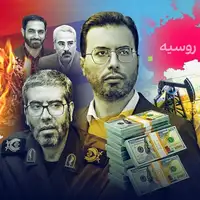
    IRGC commander, son helped build new oil-sales network

Banner
Banner
•
•
•

More Stories

Iran, US back to ‘square one’ as diplomacy stalls

Oct 6, 2026, 17:31 GMT+1
•
Behrouz Turani
100%
A portrait of Iran's slain Supreme Leader Ali Khamenei is displayed during a Janfada rally in Mashhad, October 6, 2026

Rhetoric is hardening on both sides of the Iran-US standoff, with even Iranian analysts traditionally optimistic about diplomacy warning that relations are slipping back to “square one” as military and economic pressure intensifies.

President Masoud Pezeshkian added to that sense of a narrowing diplomatic opening this week, declaring that “talks are meaningless” while Washington maintains what he described as a naval siege and fails to honor its existing commitments.

Pezeshkian said Tehran would not negotiate under military pressure or abandon its seven conditions for de-escalation, a position that leaves little obvious room for compromise as the US builds up forces in the region and tensions around the Strait of Hormuz continue.

Veteran foreign policy analyst Ali Bigdeli, who has traditionally taken a relatively optimistic view of diplomacy with Washington, told Fararu on Tuesday that Iran-US relations had effectively returned to “square one,” with deep mistrust and uncertainty prevailing in both capitals.

He also warned that the increased US military presence in the region, combined with mounting economic pressure on Iran, raised the risk of miscalculation.

Hardline newspaper Kayhan seized on Pezeshkian’s remarks, calling for an immediate and complete withdrawal from Qatar-mediated diplomatic channels.

The English-language Tehran Times portrayed his refusal to negotiate under naval pressure as “a principled rejection” of unilateral Western coercion.

On Monday night, international maritime security agencies issued four attack warnings within four hours following new projectile strikes on commercial oil tankers transiting the Strait of Hormuz.

Seven attacks on commercial vessels have been reported in the strait in the past week, according to maritime intelligence reports, which also describe direct radio warnings from the Revolutionary Guards Navy ordering some tankers to turn around.

IRGC-linked daily Javan highlighted the rapid succession of attack advisories and radio interdictions as evidence that CENTCOM’s naval presence has failed to guarantee freedom of navigation through the waterway.

But the same confrontation that hardliners portray as evidence of Iranian leverage is also generating warnings about its economic cost.

Economic daily Donya-ye Eghtesad argued that shadow fleets and off-radar transfers may allow crude oil to continue moving, but cannot reliably provide the raw materials needed by Iranian industry.

Once existing stocks of industrial inputs are exhausted, the newspaper warned, the combination of disrupted shipping and severed formal banking channels could push domestic industry into deeper decline.

Some Iranian outlets have increasingly focused on the possibility that a single security incident could upset the fragile balance altogether.

Moderate outlet Rouydad24 pointed to reports that American bombers were moved from RAF Fairford in Britain amid concerns about a possible Iranian or IRGC drone threat, as well as a US national security meeting last week with Iran and Yemen on the agenda.

The outlet warned that a single security incident could become a political trigger for escalation, sharply narrowing the distance between negotiation and confrontation.

Diplomatic channels have not disappeared, but harder positions in Tehran and Washington, an expanding US military presence, repeated incidents around Hormuz and growing economic pressure leave increasingly little room for error.

The emerging message from Iranian commentary is that a prolonged stalemate carries risks in either direction: deeper economic deterioration if it continues, and potentially rapid military escalation if it breaks.

Tehran police warn cafes over live music, DJs and hookah

Oct 6, 2026, 11:23 GMT+1
100%
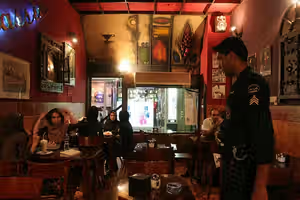
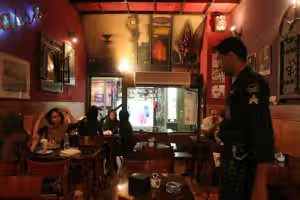
A DJ performs as people gather for drinks at a café in Iran.

Police in Tehran have warned cafes that they could face closure or lose their licenses for hosting live music, using DJs or serving hookah, extending a broader campaign of enforcement against businesses over entertainment, mandatory hijab rules and support for protests.

Ali Rafiei, head of Tehran's police department responsible for monitoring businesses and public venues, said cafes must operate strictly within the activities covered by their licenses.

“Cafes must operate only within their licensed line of business,” Rafiei said. “Serving hookah, hosting live music or DJs, and gambling-related activities are among the violations that will be dealt with.”

He said police would take action as soon as such activities were identified. Businesses could first receive warnings and be required to provide written assurances, while repeated violations could result in their licenses being revoked.

Cafes face wider scrutiny

The warning follows a series of closures targeting cafes, restaurants, shops, gyms and cultural venues across Iran in recent months.

100%
People gather at a café in Iran.

At least 42 businesses were reported sealed between late July and mid-August in different cities.

Authorities in Ardabil also announced the closure of three coffee shops and the arrest of 16 people during the same period.

Closures have not been limited to entertainment or licensing violations. Businesses have also been sealed over the enforcement of Iran's mandatory hijab rules and over support for nationwide protests.

  • Cafés close, tolerance ends: Iran’s post-war shift on compulsory hijab

    Cafés close, tolerance ends: Iran’s post-war shift on compulsory hijab

  • From cafes to buskers, Tehran tightens its grip on the fabric of everyday life

    From cafes to buskers, Tehran tightens its grip on the fabric of everyday life

Young people and public space

Rafiei said police monitoring of cafes extended beyond activities inside the establishments.

He pointed to Tehran's Sanai and Iranshahr streets, saying cars cruising through the area, sidewalk setups by cafes and groups of young people gathering without what he described as a clear purpose had contributed to congestion and complaints.

100%
Women gather at a café in Iran.

He said blocking sidewalks or public space could also lead to enforcement action. Police generally issue a warning and seek a written commitment from the operator before sealing a business, he added.

Continued violations could ultimately result in the cancellation of a business license, according to Rafiei.

  • Iran seals dozens of businesses in renewed hijab crackdown

    Iran seals dozens of businesses in renewed hijab crackdown

  • Iran shuts down Tehran cafe over alcohol use and dancing

    Iran shuts down Tehran cafe over alcohol use and dancing

Protest support has also drawn penalties

The pressure on cafe operators has also extended to owners who supported the January protests.

In one case, Iran's Supreme Court in September upheld the prison sentence and confiscation of assets imposed on Sadegh Saedinia, the head of Saedinia Properties and Industries and a supporter of the protests.

100%
Women gather at a café in Iran.

Saedinia was sentenced to 12 years, six months and one day in prison and barred from working in the cafe industry for two years after completing his sentence. All branches of his cafe business were sealed following his arrest.

The judiciary said the case involved social media posts, participation in gatherings, closing cafes and shops, and encouraging employees to take part in protests.

100%
Young men and women gather for drinks and food at a café in Iran.

The latest police warning adds live music, DJs and hookah service to a growing list of activities that can expose cafe operators to sanctions, alongside mandatory hijab enforcement, use of public space and support for demonstrations.

Why Iran’s oil minister quit at a critical moment for exports

Oct 6, 2026, 08:34 GMT+1
•
Maryam Sinaiee
100%
Iranian Oil Minister Mohsen Paknejad

Iran’s oil minister left office as exports fell sharply and questions mounted over billions of dollars in sanctioned crude sales, bringing disputes over oil intermediaries, corporate management and political pressure into focus.

President Masoud Pezeshkian initially rejected Paknejad’s resignation, submitted some time earlier because of “personal issues,” but accepted it after the minister again pressed to step down, deputy presidential communications chief Mehdi Tabatabaei said.

Paknejad’s departure, the first by a minister from Pezeshkian’s cabinet, followed weeks of Iranian media reports linking his position to disputes over sanctioned oil sales, major energy projects and management of Persian Gulf Petrochemical Industries Company (PGPIC).

  • What can Iran’s new oil chief change under the US blockade?

    What can Iran’s new oil chief change under the US blockade?

Pezeshkian appointed National Iranian Oil Company (NIOC) managing director Hamid Bovard as acting oil minister. The government has not indicated whether Bovard will remain a caretaker or be nominated for the post.

Export crisis raises questions

Several Iranian outlets had linked Paknejad’s resignation to disagreements with Pezeshkian during cabinet meetings over the oil ministry’s handling of sanctioned crude sales.

Other reported disputes concerned delays to major projects, including development of the South Pars gas field, and the network of intermediaries entrusted with selling Iranian oil and returning the proceeds while circumventing sanctions.

Paknejad left as Iran’s floating oil inventories were approaching exhaustion and questions mounted over around 80 million barrels handed to intermediaries, Rouydad24 wrote.

The website questioned whether “personal reasons” adequately explained the timing, arguing that replacing the official overseeing the sector would not resolve falling exports, foreign currency shortages, unpaid oil revenues and the opaque structure of sanctioned sales.

Eghtesad Online website similarly questioned why Pezeshkian accepted a resignation that had been pending for some time when Iranian oil exports had approached zero.

Billions at stake in trustee system

The use of trusted intermediaries to sell crude under sanctions has become a central controversy surrounding the oil ministry, with lawmakers and media raising questions over unpaid revenues and the allocation of oil.

One intermediary, Hassan Aghayari, owed several billion dollars, ILNA reported on September 13, citing a letter Bovard sent to a senior supervisory body while serving as NIOC chief.

  • Iran oil exports vanish as regional flows surpass prewar levels

    Iran oil exports vanish as regional flows surpass prewar levels

The contract allowing Aghayari to sell oil was concluded on the minister’s order without approval from the sanctions-countering task force, Bovard wrote, according to ILNA. The oil ministry denied the report.

Around 80 million barrels were separately handed to four intermediaries following the Islamabad agreement, lawmaker Valiollah Bayati told Hamshahri newspaper. Hossein Shamkhani, son of former Supreme National Security Council secretary Ali Shamkhani, was among them, Bayati said.

More than 86 million barrels were allocated to trustees without guarantees, lawmaker Hossein Samsami said. Around 30 million barrels reached final buyers, leaving the status of more than 56 million barrels unclear, according to Samsami.

The accounts have raised questions over how intermediaries were selected, what guarantees were required and why further allocations went to people who allegedly owed money from previous oil sales.

Battle over petrochemical giant

Paknejad’s departure has also been linked to a dispute with Mohammad Shariatmadari, head of PGPIC, Iran’s largest petrochemical holding company.

The oil ministry sought to replace Shariatmadari with Hassan Abbaszadeh in July 2026. PGPIC rejected the move, saying it lacked the procedures required under stock-market regulations and board approval. Shariatmadari remained with support from the presidential office.

Paknejad was unwilling to remain as minister if Shariatmadari kept his position, Iranian media reported. Meetings ordered by Pezeshkian failed to settle the dispute, according to those reports.

Shortly before the resignation was accepted, editor of the oil-focused outlet Miz-e Naft Vahid Hajipourwrote on X that Paknejad had been given an ultimatum at a cabinet meeting over Shariatmadari’s continued tenure.

“Paknejad did not accept,” Hajipour wrote, adding that Pezeshkian consequently decided to end cooperation with the minister.

Political pressure

Political pressure offers another explanation. Parliament speaker Mohammad Bagher Ghalibaf was angered by the removal of his ally Hossein Ghorbanzadeh from PGPIC’s board and Paknejad’s refusal to reinstate him, journalist Hatef Salehi wrote on X on October 1.

Ghalibaf subsequently pressed Pezeshkian to remove Paknejad, Salehi said.

  • Islamic Republic's 'slow meltdown' leaves it fewer ways out, analysts say

    Islamic Republic's 'slow meltdown' leaves it fewer ways out, analysts say

“If the oil minister is replaced in the coming days, the roots of the decision should be sought in Ghorbanzadeh’s longstanding friendship and relationship with Ghalibaf, not in the government’s strategy,” Salehi wrote.

The competing accounts leave no single explanation for Paknejad’s departure, placing it instead at the intersection of an export crisis, disputed sanctioned oil sales, a battle over one of Iran’s biggest companies and reported political pressure over control of key posts.

Pezeshkian nominates missile-industry veteran as defense minister

Oct 5, 2026, 18:37 GMT+1
100%
File photo shows President Masoud Pezeshkian addressing the parliament in August 2024.

Iranian President Masoud Pezeshkian has nominated Mehrdad Akhlaghi Ketabchi as defense minister, moving to fill a post left vacant since Defense Minister Aziz Nasirzadeh was killed in US-Israeli strikes in February.

Sasan Valizadeh, an adviser to the president’s deputy for parliamentary affairs, said Pezeshkian sent the nomination to Parliament Speaker Mohammad Bagher Ghalibaf under Article 133 of the constitution, which requires ministers to win a parliamentary vote of confidence. Lawmakers are expected to review Akhlaghi Ketabchi’s program and policies before scheduling the vote.

The Defense Ministry has been run by Majid Ebn-e-Reza since March 2, when Pezeshkian appointed him acting minister after Nasirzadeh’s death on February 28. Ebn-e-Reza, previously the deputy defense minister, has represented the ministry in domestic and foreign meetings but was never nominated for the permanent post.

Akhlaghi Ketabchi is a longtime Defense Ministry official with deep roots in Iran’s missile and aerospace industries. He was listed by the UN Security Council in 2007 as head of the Shahid Bagheri Industrial Group, a Defense Ministry entity linked to Iran’s ballistic missile program. His name returned to the UN sanctions list when earlier sanctions on Iran were re-applied in September 2025.

Then-defense minister Hossein Dehghan appointed him head of the Aerospace Industries Organization in November 2014. The United States also sanctioned him in 2020, identifying him as director of the Defense Industries Organization and citing conventional arms-related activities.

The nomination also raises the question of how the appointment was cleared at the top of Iran’s political system. Defense ministers are formally nominated by the president and confirmed by parliament, but the post is among the sensitive ministries whose nominees have traditionally been coordinated with and approved by the supreme leader beforehand.

That process is less transparent under Supreme Leader Mojtaba Khamenei, who has not made a public appearance since taking office. Decisions, appointments and written messages have continued to be issued in his name, but officials have not said whether or how his approval was obtained for Akhlaghi Ketabchi’s nomination.

Iran escalates Starlink threats over fears of losing internet control

Oct 5, 2026, 11:32 GMT+1
100%
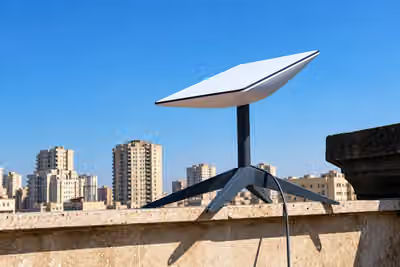
A Starlink satellite internet terminal is seen installed on a rooftop in Iran.

Iranian authorities have stepped up warnings against Starlink as the cost-of-living crisis deepens and the prospect of renewed public protests grows, signaling mounting concern over citizens’ access to satellite internet.

The latest warning came from Mohammad Amin Aghamiri, secretary of the Supreme Council of Cyberspace and head of the National Cyberspace Center, who raised the possibility of treating satellite internet infrastructure as a military target.

“If satellite internet infrastructure is used as a tool of war, naturally this infrastructure can become a legitimate military target,” Aghamiri said Monday at a conference on online businesses organized by Iran’s cyber police.

  • Iran official warns Starlink could end state control of internet

    Iran official warns Starlink could end state control of internet

Aghamiri described satellite internet and Starlink as potential threats and said the Islamic Republic was technically prepared to counter them.

Referring to the January protests as a “coup,” Aghamiri said authorities had succeeded in disabling Starlink terminals during the unrest.

Officials and state media have repeatedly described anti-government protests as riots or attempted coups and attributed them to foreign actors, including the United States and Israel.

Internet shutdowns and protests

Internet restrictions have long been used by Iranian authorities during periods of widespread unrest.

  • Starlink next door could loosen Iran’s grip on internet

    Starlink next door could loosen Iran’s grip on internet

The Islamic Republic imposed a sweeping internet shutdown during the November 2019 protests and has since restricted or cut connectivity at different points, including during the Woman, Life, Freedom uprising, the 12-day war and the January 2026 protests.

After the 40-day war began in late February, authorities again cut internet access. The restrictions lasted 88 days, becoming the longest digital blackout in the world.

Concerns surrounding Starlink have grown alongside an increased US military presence in the region, worsening economic conditions and domestic discontent.

Internet and cybersecurity expert Davoud Sajjadi told Iran International on October 1 that Starlink allows users to bypass filtering and other government mechanisms designed to control internet access.

The ability to connect outside those systems has made the technology a growing concern for officials, Sajjadi said.

Diplomatic pressure and Starlink seizures

Iran has also pursued diplomatic and law-enforcement measures against the satellite service.

The Foreign Ministry summoned Norway’s ambassador on Sunday to protest continued Starlink operations in Iran.

Norway is the country through which the Starlink network is registered with the International Telecommunication Union, and Iranian authorities say Oslo is therefore responsible for preventing what they describe as unauthorized operations inside Iran.

Foreign Ministry delivered a formal protest to the Norwegian ambassador and called on Norway to take action to halt Starlink operations in Iran.

Authorities have simultaneously intensified efforts to stop the import and distribution of Starlink equipment.

Hossein Rahimi, head of Iran’s Economic Security Police, previously said police seized 997 Starlink devices and related equipment during the first four months of the current Iranian year, which started in mid-March, and arrested 163 people in connection with their import and distribution.

Efforts to stop the entry and distribution of Starlink equipment increased after the 12-day war, Rahimi added.

Official warns Starlink could force power cuts

The extent of official concern was underscored by a Communications Ministry official who warned that widespread Starlink access could undermine the government’s existing mechanisms for controlling cyberspace.

“The spread of Starlink drives the final nail into the coffin of cyberspace governance,” Mohammad Hafez Hakami, deputy minister for technology, innovation and international affairs at the Communications Ministry, said on September 30.

“Those concerned about Starlink have been warning about it for two years, but not even a single line of policy has been developed on the issue,” Hakami said. “If this trend continues, we will be forced to cut electricity in the next crisis.”

Hakami also warned that the expansion of Starlink and direct-to-cell technology could render mechanisms such as device registration and user identification ineffective.

“Starlink, as a new tool that evades governance, is fundamentally no longer based on our network,” Hakami said.

Direct-to-cell technology allows mobile phones to connect directly to satellites without relying on conventional telecommunications towers.

The prospect of satellite connections operating independently of domestic networks poses a particular challenge to authorities because shutting down conventional internet infrastructure would no longer necessarily disconnect users.

Starlink enters broader debate over information access

Israeli Prime Minister Benjamin Netanyahu also highlighted Starlink during his September 24 address to the United Nations General Assembly, holding up one of the devices while discussing access to information in Iran.

“The Iranian regime is especially afraid when their people have this. This is a communications device, Starlink, that allows people to access truth, to exercise choice and to exercise freedom of thought and freedom of speech.”

Netanyahu said Starlink could give Iranians access to what he called “truth,” as well as choice, freedom of thought and freedom of speech.

The growing focus on Starlink now extends across several arms of the Iranian state, from diplomatic pressure and equipment seizures to technical countermeasures and warnings of military action.