Iran is moving to ratify the Caspian treaty it left dormant for seven years, choosing the depths of a war to settle the status of its one quiet frontier, and reopening the oldest wound in its modern diplomacy: the belief that Tehran signed away half a sea.
President Masoud Pezeshkian's government has sent the 2018 Convention on the Legal Status of the Caspian Sea to parliament for ratification, ending years in which the treaty sat untouched and reviving a charged argument over the country's historical rights, energy interests and position in the strategically vital basin.
The convention, signed by the leaders of Iran, Russia, Azerbaijan, Kazakhstan and Turkmenistan in the Kazakh port of Aktau in August 2018, takes effect only once all five littoral states ratify it. The other four completed the process long ago. Tehran, alone, held back.
The charge that shadows the bill is older than the bill itself: a belief, widely held in Iran and rooted in readings of its 1921 and 1940 treaties with Moscow, that the country was entitled to half the Caspian and stands to end up with barely a tenth.
The convention in fact allocates no national shares at all, but the ghost of the fifty percent has trailed every Iranian discussion of the sea since Aktau.
The timing sharpens the argument. The move lands in the middle of a war that has set Iran's southern coast under nightly strikes and closed the Strait of Hormuz, leaving the Caspian corridor to Russia carrying an outsized share of the country's commerce and its strategic weight.
What the treaty actually does is narrower than either its champions or its critics suggest.
It defines the Caspian as a "special and unique landlocked body of water," placing it outside the UN Convention on the Law of the Sea. Each coastal state receives 15 nautical miles of fully sovereign territorial waters and a further 10 nautical miles of exclusive fishing rights, with the remaining surface designated a shared navigation zone.
The wealth, however, is postponed. Article 8 leaves ownership and delimitation of the seabed and its oil and gas to "bilateral or multilateral agreements between the states concerned."
Russia, Kazakhstan and Azerbaijan have largely settled their boundaries in the sea's north; the lines involving Iran, Azerbaijan and Turkmenistan remain unresolved, tangled in the complexity of dividing energy-rich waters.
A century-old dispute over Iran's share
Before the Soviet collapse, the Caspian was governed by the 1921 and 1940 treaties between Tehran and Moscow, which recognized equal navigation and fishing rights but drew no maritime boundaries.
The Soviet breakup turned two littoral states into five, and Iran has argued since that the sea should be divided equally, 20 percent to each.
Russia, Kazakhstan and Azerbaijan instead adopted a modified median-line method, a formula that, because of Iran's concave coastline, would shrink Tehran's share of the sea and its bed to roughly 11 to 13 percent. Iran has never accepted that division.
The government's case: a sealed northern flank
The government presents ratification as completing the Caspian's legal framework, deepening cooperation among the littoral states and, above all, keeping outside powers away.
Officials point to Article 3, which bars the armed forces of non-coastal countries from the Caspian, as the convention's central security prize, a provision long championed by both Tehran and Moscow.
Defa Press, an outlet affiliated with Iran's armed forces, wrote that the clause would "turn Iran's northern borders into a secure region, far removed from scenarios of foreign military intervention," at a moment when the country faces pressure along its southern and western frontiers.
The critics' case: ratifying before the real negotiation
Opponents argue parliament is sequencing the deal backwards: locking in the framework before the seabed, where the money lies, has been divided.
They note that the northern states have already parceled out much of the seabed and pressed ahead with oil and gas development, while fields shared with Iran, including Alborz, remain in limbo.
Dariush Safarnejad, an international affairs analyst, told the Revolutionary Guards-linked Javan newspaper that lawmakers should return the bill to the government, since supplementary agreements that were meant to be completed within six months of the 2018 signing have never been finalized.
Approving the convention without them, he warned, "could provide other Caspian states with legal grounds in the future and influence the security, political and geopolitical dynamics of the Caspian region."
Shoaib Bahman, an international relations analyst focused on Eurasia, told the same paper that ratifying before the seabed boundaries are set would "effectively reduce Iran's legal leverage in future negotiations and could undermine its claim to a 20% share of the Caspian Sea."
Pipelines, corridors and the Turkic map
The critics' second front is Article 14, under which undersea pipelines require the consent only of the states whose sectors they cross, not all five. Bahman argued the clause could open the way for eastern Caspian producers to export oil and gas directly toward Europe, eroding Iran's transit position.
Mehdi Seif-Tabrizi, a Russia specialist, offered a more measured reading to the news website Fararu. Iran's 15 miles of territorial waters and 10 miles of fishing rights are guaranteed, he said, and "the real dispute concerns the seabed and subsoil," not the surface percentages that dominate the public argument.
Yet he shares the strategic worry: that the long-discussed Trans-Caspian pipeline from Turkmenistan or Kazakhstan to Azerbaijan could finally be built.
"That could strengthen Azerbaijan's position and, in turn, reinforce the Zangezur corridor and the so-called Turkic World project," he said. "If Iran ratifies the convention, it would remove one of the most important legal obstacles to implementing those projects."
The opposition joins the attack
Criticism has come from beyond the establishment's factions. Exiled Prince Reza Pahlavi wrote on X that ratifying the agreement without the Iranian people's mandate and without "a clear and comprehensive guarantee of Iran's historic rights" is "deeply concerning and constitutes a serious threat to Iran's national interests."
Iran's rights in the Caspian, he added, "are not negotiable, nor can they be relinquished. Any action that undermines these rights will be recorded in the historical memory of the Iranian nation, and those responsible will ultimately be held accountable by the people of Iran."
Saeed Ghasseminejad, a senior Pahlavi adviser, went further, alleging that Hassan Rouhani's government had already "ceded Iran's share of the Caspian Sea" and that Pezeshkian and parliament speaker Mohammad-Bagher Ghalibaf now seek to "legalize and make that concession permanent."
He called the move "the biggest surrender of Iran's land and waters to foreign powers since the Qajar-era humiliations."
Iranian cleric Mohammad-Bagher Kharrazi was summoned to the Special Clerical Court after calling for the Islamic Republic to be replaced by a more hardline “Islamic government” and outlining plans to mobilize a 250,000-strong network capable of surrounding government sites.
Judiciary spokesperson Asghar Jahangir said on Saturday that legal proceedings began immediately after Kharrazi's recent remarks and that he had now been summoned to the court, which handles cases involving members of the clergy.
“Immediately after his recent remarks, legal action was initiated to prosecute him,” Jahangir said, adding that Kharrazi's case was under criminal investigation and further details would be released after the proceedings.
‘Islamic Republic doesn't work anymore’
In a video released this week, Kharrazi said the Islamic Republic had “reached a stage where, in this form, it simply doesn't work anymore” and said his organization had already drawn up plans for replacing it with an “Islamic government.”
Kharrazi, who heads the Hezbollah of Iran organization, said his group had produced 60 volumes of plans covering state institutions and had maintained what he described as a “shadow government.”
He also outlined a recruitment drive intended to build a nationwide network of 250,000 supporters, saying it could “surround all the ministries” and converge on Tehran following a single announcement.
“Mr. Khamenei and the government must understand that a 250,000-strong organization stands ready to move,” he said.
Kharrazi also attacked President Masoud Pezeshkian, calling him a “buffoon” who “understands nothing,” and said his government “will not reach its end.”
Claims about Khamenei
Kharrazi is tied by marriage to Iran's ruling family: his sister is married to Masoud Khamenei, a brother of Supreme Leader Mojtaba Khamenei.
He has also presented himself as a longtime confidant of the new supreme leader, saying he has known him for four decades and held numerous private meetings with him. In his latest remarks, Kharrazi said Mojtaba Khamenei's thinking was “far more radical than his father's.” His accounts of private conversations and the supreme leader's views cannot be independently verified.
The leader's office had already publicly rejected earlier remarks Kharrazi attributed to Mojtaba Khamenei, including that Pezeshkian's next resignation would be accepted, describing them as unauthenticated and false.
An F/A-18F Super Hornet, assigned to Strike Fighter Squadron (VFA) 41, prepares to make an arrested landing on the flight deck of the US Navy Nimitz-class aircraft carrier USS Abraham Lincoln in the Pacific.
President Donald Trump's latest order to investigate leaks about US munitions stockpiles may look like another dispute between the White House and the American media. In Tehran, it is being read as vindication.
Iran's military and state media have spent months portraying the depletion of American interceptors and precision weapons as evidence of a newfound way to impose costs on a vastly more powerful military.
The United States has not run out of weapons, and the Pentagon does not disclose exact inventories. But beneath the propaganda is a real strategic argument.
Iran does not need to match the United States missile for missile. It needs to make the United States expend expensive, slow-to-replace weapons at a rate that becomes difficult to sustain.
Washington increasingly appears to be treating that challenge as an industrial problem, not simply a battlefield one.
Tehran is not hiding the calculation
The clearest evidence comes from the IRGC itself. In a July 23 statement announcing an attack on a US base in Kuwait, the Revolutionary Guards said they would not allow Washington to use what they called "deceptive ceasefires" to replenish its oil and munitions stockpiles before resuming attacks.
The IRGC was not simply claiming to have damaged American forces. It was identifying the time required to replenish US stocks as a factor in how Iran viewed ceasefires and the continuation of the war.
On March 10, IRGC spokesman Ali Mohammad Naeini told American officials that Iran knew their ammunition stocks were being depleted. In April, Aerospace Force commander Majid Mousavi claimed Iran was replenishing its missile and drone capacity faster than the United States could replace weapons sent to the region.
Those statements cannot establish the actual condition of either country's arsenal. They do, however, show that Iranian commanders are treating ammunition consumption as part of the strategic contest.
On July 26, the hardline daily Kayhan ran a report referring to the "running dry" of Pentagon weapons stocks, using American media reports to challenge Washington's claims of overwhelming military power. Tasnim has similarly highlighted estimates of depleted Patriot, THAAD, Tomahawk and other missile inventories.
The claims are propagandistic, but they take aim at a genuine vulnerability.
Iran's advantage
Iran's military model was shaped partly by necessity. A May 13 analysis by the Carnegie Endowment traced Tehran's emphasis on ballistic missiles and drones to decades of sanctions and restricted access to Western military technology.
Rather than attempting to recreate an American-style force built around advanced aircraft and expensive precision systems, Iran invested heavily in weapons it could manufacture domestically and deploy in large numbers.
Carnegie cited estimates putting the cost of a Shahed-136 drone at roughly $20,000 to $50,000. Iranian ballistic missiles are substantially more expensive—roughly $1 million to $2 million by some estimates—but can still cost far less than the defensive systems used against them.
That does not mean a $30,000 drone automatically forces the launch of a multimillion-dollar Patriot interceptor. Air defense is layered. Fighters, guns, electronic warfare and cheaper interceptors can also be used.
Iran can also threaten an array of military and energy targets across the region with weapons flying at different speeds and altitudes. The defender must keep radars active, aircraft airborne and sufficient interceptors available for the threats that matter most.
Iran therefore does not have to win every exchange. It can fail to penetrate most defenses and still impose costs through volume, persistence and geography. That is the part of Iran's approach that an inventory count alone misses.
Politically sensitive numbers
Reuters reported on August 4, citing three people familiar with US military data, that the Army had consumed much of its stock of long-range ground-launched precision missiles during five months of war. Two sources said "virtually all" available ATACMS and Precision Strike Missiles had been used.
The Pentagon has not confirmed those numbers.
Three days later, The Wall Street Journal reported that Trump had ordered investigations into leaks about US munitions stockpiles. According to the report, the administration is seeking $52.9 billion for munitions and another $21 billion specifically to replace stocks depleted during the Iran war.
Trump publicly insists the United States retains "massive" quantities of ammunition. The two positions are not necessarily contradictory. The US military can have enough ammunition to continue current operations while simultaneously concluding that its inventories and production rates are inadequate for another major war.
That matters because Iran is not the Pentagon's only concern, and a potential conflict with China would place vastly greater demands on US stocks.
Future problems
The United States has spent years preparing for the possibility of conflict in the Indo-Pacific while simultaneously supplying Ukraine and maintaining commitments in Europe and the Middle East.
Every Patriot interceptor, Tomahawk or long-range precision missile used against Iran is therefore part of a larger calculation: What remains available if another crisis begins before the first one ends?
That is why the most revealing evidence is not the disputed number of missiles left in storage. It is what Washington is doing to its factories.
On January 6, the Pentagon announced a seven-year agreement aimed at increasing the annual production capacity of the PAC-3 MSE Patriot interceptor from roughly 600 to as many as 2,000.
On July 27, L3Harris announced agreements designed to nearly triple production of propulsion components for PAC-3 and quadruple propulsion production for THAAD. The Pentagon has also brought new suppliers into missile production and launched a program for lower-cost, air-launched cruise missiles that can be manufactured at greater scale.
These are not signs that American military power has collapsed. They are signs that the Pentagon believes industrial capacity itself has become a weapon.
The bigger picture
Iranian state media have turned the US stockpile debate into evidence that Washington has been defeated. That conclusion goes beyond what the public evidence supports.
The United States retains enormous military advantages in intelligence, air power, logistics, precision strike and global deployment. Iran has also suffered severe military, economic and human losses during the war.
But Tehran does appear to have demonstrated something narrower and strategically significant. A weaker state does not necessarily have to compete with America's most advanced technology. It can attack the economics and tempo behind that technology.
Michael Duffey, the Pentagon official responsible for acquisition and sustainment, recently described the shift in American thinking in unusually direct terms. For decades, he said, the United States benefited from its ability to engineer the world's most sophisticated weapons.
"We're no longer in that global environment," Duffey said, arguing that the Pentagon needs not only superior technology but speed and volume.
The argument over whether America's missile stocks are "running out" will continue, particularly while the actual numbers remain classified. The more consequential change is already visible.
Iran spent decades building a military around the assumption that it could not compete with the United States in sophistication. Washington is now spending billions to ensure that its technological superiority does not leave it vulnerable on quantity.
The next arms race is no longer only about who can build the better missile. It is also about who can build the next one fast enough.
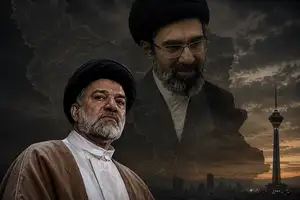
AI-generated illustration depicting Mohammad-Bagher Kharrazi (foreground) and Iran's Supreme Leader Mojtaba Khamenei (background) against a map of Iran and Tehran's skyline.
A cleric tied by marriage to Iran's ruling family has declared the Islamic Republic obsolete, telling followers that a shadow government already exists and urging them to build a 250,000-strong network to replace the system with an "Islamic government."
The roughly five-minute video of Mohammad-Bagher Kharrazi, released Wednesday, shows the head of the Hezbollah of Iran organization addressing a religious gathering, the kind of mosque pulpit from which much of Iran's clerical politics is conducted. What he delivered from it was not a sermon but an organizational plan.
"Before Mr. Saeed Jalili ever said 'I make the shadow government,' we had formed the shadow government, and we still have it... We have 60 thick volumes of plans covering the smallest details of every organ and institution," Kharrazi said, brushing aside the hardline politician who popularized the term.
"We have prepared plans for implementing the guardianship system, even for how to convert the Islamic Republic into an Islamic government. We have the organization and the planning. But because this transition has not happened, they are taking the Islamic Republic from us”
The Islamic Republic, he told the crowd, "has reached a stage where, in this form, it simply doesn't work anymore."
The arithmetic of a takeover
What separates the video from ordinary hardline grievance is that Kharrazi laid out numbers, methods and targets.
Each follower, he said, should recruit 17 people, and each of those another 17. "If we do this and organize at least 250 people in every city, with a thousand cities that makes 250,000 people," he said.
He offered to bankroll the first gathering himself, "at Hezbollah's own expense," promised a meeting of one hundred thousand, and told the audience the network would "surround all the ministries." The crowd answered with a salavat, the blessing on the Prophet that in such gatherings signals assent.
At another point he set the threshold at 530 organizers per city, a figure drawn not from arithmetic but from devotion: in the abjad letter-numerology cherished in his circles, he ties the number to the name of Fatemeh, the Prophet's daughter. The two figures do not reconcile, and may not be meant to.
He then described the endgame: "With one announcement, everyone comes to Tehran, and that single announcement will finish the work. Mr. Khamenei and the government must understand that a 250,000-strong organization stands ready to move."
The government of President Masoud Pezeshkian, he assured his listeners, "will not reach its end. Have no doubt."
Contempt for the republic, president by president
Kharrazi's case against the republic half of the Islamic Republic was delivered as a roll call. "Why should Mr. Hashemi win a vote in this country? Why should Mr. Ahmadinejad win a vote in this country? Why should Mr. Rouhani win a vote? Why should Mr. Pezeshkian win a vote?" The list, spanning nearly every president of the past four decades, implied that the office itself, not its occupants, is the error.
For the current occupant he reserved open abuse, calling Pezeshkian "this buffoon" who "understands nothing," and cursing the physician he blamed for promoting him: "God damn the accursed Marandi, Khamenei's doctor, who foisted Pezeshkian on the nation."
He damned the Guardian Council for approving such candidates, a complaint carrying its own footnote: the same council disqualified Kharrazi himself when he tried to run for president in 2013.
The faithful, he complained, have been reduced to carrying other men's loads. "Hezbollahi forces in this country have become pack mules," he said.
"What business do we have being pack mules for Ghalibaf, who understands nothing of the religion of Islam?"
‘Mojtaba is more radical than his father’
The video's most consequential claims concern the man Kharrazi presents as his patron. Describing "forty years of friendship, not mere acquaintance, and numerous private meetings," he told the crowd that the new supreme leader wants what he wants: "Mojtaba's thinking is far more radical than his father's."
He offered what he framed as an insider's history: that Mojtaba Khamenei was cast out of his father's office for three years by its deputy chief of staff, confined to his home and reduced to ferrying intelligence letters, with even some of his circle pushed away.
Kharrazi claimed credit for protecting the movement through that period: "They wanted to tear out Hezbollah by the roots. I did not let them."
None of these accounts can be independently verified, and they describe a man who has not been seen or heard in public since his selection five months ago.
The claims also come with a fresh credibility problem attached. Only days earlier, the leader's office publicly branded Kharrazi's previous quotations of Mojtaba Khamenei, that Pezeshkian's next resignation after 28 attempts would be accepted, as unauthenticated and false, warning that such material "serves the objectives of the ill-wishers and sworn enemies of the Iranian nation." Pezeshkian denied the resignation as well.
Kharrazi's response to that rebuke may be the most revealing sentence he has produced.
In a statement styled like a senior cleric's communique, he said he accepts the denial "out of respect" for the late and current leaders, "but we hope that after the important coming changes in those offices, this denial will still stand."
The changes he has in mind are not abstract. In the same week, Kharrazi announced that the new leader intends to remove Mohammad-Bagher Zolghadr as secretary of the Supreme National Security Council and hand the post to Mohsen Rezaei, his military aide.
"They are going to replace Mr. Zolghadr, and Mr. Mohsen Rezaei will take his place," he said, adding that Foreign Minister Abbas Araghchi has been told he has no right to intervene in the negotiations. A man rebuked for speaking in the leader's name answered by announcing the leader's next appointments.
The family and the record
Kharrazi, 65, is as embedded in the Islamic Republic's aristocracy as a cleric can be. His father, Ayatollah Mohsen Kharrazi, sits in the Assembly of Experts; his uncle, Kamal Kharrazi, ran Iran's diplomacy for years and headed its Strategic Council on Foreign Relations until died from injuries sustained in recent Israeli airstrikes in April; his brother Sadegh is a veteran diplomat; his sister is married to Masoud Khamenei, another of Ali Khamenei's sons.
Reuters has reported that the Nobitex cryptocurrency exchange, sanctioned by Washington for helping the Revolutionary Guards evade sanctions, belongs to the Kharrazi family.
His own record is a catalogue of the spectacular. In his 2013 presidential bid he promised to lift sanctions within months, to recover "the territories separated from Iran," from Tajikistan to Azerbaijan, without a drop of blood, and to triple the value of Iran's crashed currency, vowing to bring the dollar from above 3,000 tomans back down to 1,000.
The Guardian Council struck him from the ballot, and even before it did, the Hezbollah coordination council of East Azarbaijan province publicly disowned his group, accusing him of misusing the movement's name and the leader's, and reminding him that by the leader's own explicit guidance, any private quotation attributed to him is to be considered untrue. Thirteen years later, the leader's office is issuing him the same reminder about a different Khamenei.
In clips that went viral this year, he proposed building a nuclear bomb and detonating it in the Atlantic to send a tsunami toward the American coast, and mused about igniting a race war inside the United States.
He studied under Mohammad-Taghi Mesbah-Yazdi, the late theorist whose school long argued that the republic's elections were a concession to be outgrown, which is to say the manifesto is not his invention, only its loudest current recital.
Three readings of one video
The puzzle is not what Kharrazi said but what it means that he can keep saying it. In a state that imprisons filmmakers and poets for far less, a man has now twice in one week put words in the supreme leader's mouth, insulted the president on camera and announced a plan to encircle the ministries, without a knock on his door.
However it is read, the collision at the heart of the video is documented on both sides. The government's own leaked polling shows a society that has drifted decisively from clerical rule, with barely nine percent wanting things to stay as they are. The loudest organizing energy inside the system, on this week's evidence, wants to move the opposite way.
One reading is that the leader's office will now be forced to do more than issue denials, and that Kharrazi's next video will be his last.
A second is bleaker for the system: that there is no functioning leader capable of silencing anyone, and the in-law is filling a vacuum with his own voice.
A third, voiced in exile commentary, is that Kharrazi is not speaking for the present leadership at all but building a following for the day the question of who leads is reopened, including a future in which his own brother-in-law's household sits closer to the throne.
Under any of the three, the fact stands: five months into the new reign, the most detailed public plan for ending the Islamic Republic has come not from its opponents but from inside its founding family's circle, and it points toward more theocracy, not less.
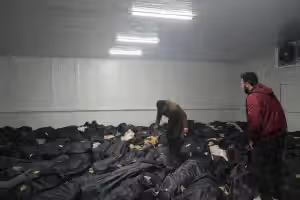
Bodies wrapped in black body bags lie at Kahrizak morgue following the deadly crackdown on anti-government protests in Iran in January 2026.
President Masoud Pezeshkian drew angry reactions from Iranians after rejecting higher estimates of those killed in Iran's January protests and calling those who cite such figures "traitors" in an interview published on Wednesday.
Pezeshkian described the protests as a "riot" and accused people abroad of falsely inflating the death toll.
"Those sitting abroad who present themselves as intellectuals and scholars, yet say 30,000 or 40,000 people were killed, are dishonorable and traitors," he said in the video interview.
His remarks prompted a wave of criticism from citizens who sent messages to Iran International, with many accusing the president himself of bearing responsibility for the killings.
"Mr. Pezeshkian, this is disgraceful. Stop lying and have some shame," one said. "Your hands are stained with the blood of tens of thousands of Iranian protesters. Curse all of you killers and the remaining figures of the Islamic Republic."
Others argued that even the official death toll acknowledged by his administration warranted accountability.
Crowds take part in anti-government protests in Tehran in January 2026.
"Sitting there and saying 3,000 people were killed – first of all, this is not about the number," one citizen from Arak said. "Even if it were those 3,000 people you admit were killed, you should answer for every single one of them."
Another viewer wrote that if Iran had "a normal government," Pezeshkian should face punishment simply for acknowledging that thousands had been killed.
"So if, by your own account, 3,000 people were killed, that's acceptable?" another message read.
Government figures disputed
In mid-February, Pezeshkian's office published a list containing the names of 2,986 people it said were killed during the January protests, saying it had been compiled using data from the Legal Medicine Organization and cross-checked with the National Organization for Civil Registration.
The figure is far below Iran International's editorial board estimate of at least 36,500 people killed during the crackdown. Several international media outlets have also cited similar estimates.
Pezeshkian has repeatedly accused protesters of carrying out armed attacks and sabotage.
In his latest interview, he again described protesters as having been armed by US President Donald Trump, referred to the crackdown as an "incident" and said demonstrations had turned into a "riot" in which "difficult events" occurred.
One person responded by invoking a Quranic verse.
"If your memory serves you, the Quran you probably believe in says killing one innocent person is like killing all humanity," the message read. "Yet you speak about 3,000 deaths as though nothing important happened."
Another accused the president of contradicting earlier official accounts.
Bodies wrapped in blankets lie outside Alghadir Hospital in eastern Tehran following anti-government protests in January 2026.
"It is interesting that you say terrorists killed the victims, yet you become angry at those who say the real figure is 40,000 and call them traitors," he wrote. "That amounts to admitting that the terrorists you blamed were actually yourselves."
Activists challenge official narrative
Human rights activist and former political prisoner Mehdi Mahmoudian also criticized Pezeshkian's remarks.
"Please explain who killed the several thousand people whose deaths you yourself do not deny, and what those responsible for this crime should be called," Mahmoudian wrote.
Separately, critics resurfaced comments by Mojtaba Lotfi, a cleric and former aide to the late Grand Ayatollah Hossein Ali Montazeri, who argued that the government's casualty list had been censored.
Referring to his hometown of Najafabad, Lotfi wrote that local records indicated at least 30 victims from the city had been omitted from the official list, suggesting the government's figures were incomplete.
Iran and Oman appear close to agreeing new navigation arrangements in the Strait of Hormuz, but Tehran insists any reopening must take place under a new post-war security framework rather than a return to the pre-war status quo.
Iranian officials have sought to temper expectations that technical talks with Oman will lead to the immediate reopening of the strategic waterway, stressing that any agreement would be bilateral, exclude the United States and preserve what they describe as Iran's new security role in the Strait.
Foreign Ministry spokesman Esmaeil Baghaei said on Wednesday that Iran and Oman had agreed on the geographical coordinates of proposed transit routes and were finalizing a joint statement.
But he stressed that the understanding "cannot, by itself, mean that the Strait will become safe for passing vessels," arguing that the US naval blockade and other "aggressive and threatening actions" against Iran remained the principal obstacles.
Deputy Foreign Minister Kazem Gharibabadi later said a proposed transit arrangement under discussion with Oman could remain in place for between two and four months. He added that although a US return to its commitments under the Islamabad memorandum was a prerequisite for reopening the Strait, it would not by itself be sufficient.
The same message was echoed by Iran's security establishment.
Fars News, which is affiliated with the Revolutionary Guards, quoted a source close to Iran's negotiating team as saying the Strait would reopen only after Washington took concrete steps to implement its commitments.
The source accused the United States of derailing the normalization of shipping through military strikes, the naval blockade and the suspension of waivers for Iranian oil and petrochemical exports.
‘No return to pre-war order’
Iranian officials have repeatedly argued that the negotiations are intended to establish a new framework for managing traffic through the Strait rather than simply restore previous arrangements.
Saeed Ajorlou, a member of the Iranian negotiating team's media committee, said Article 5 of the Islamabad memorandum envisages "Iranian arrangements" governing the Strait, under which security, mine clearance, maritime services and other operational matters would be administered by Tehran.
Those arrangements, he said, could remain in force for "one, two or three months," depending on the progress of wider negotiations.
"The transit regime in the Strait of Hormuz should not return to its pre-war status," Ajorlou said. "This principle must be consolidated both on the ground and in official documents and agreements."
Nour News, a media outlet closely associated with Iran's Supreme National Security Council, echoed that position, describing the talks with Oman as technical negotiations over vessel traffic management that "do not necessarily amount to an agreement to reopen Hormuz."
The outlet said broader political issues remained unresolved, including implementation of commitments under the Islamabad memorandum, the release of Iranian financial assets and arrangements concerning the future security and management of the Strait.
‘The sole rule-maker’
Members of parliament reinforced the government's position.
Hassan Ghashghavi, spokesman for parliament's National Security and Foreign Policy Committee, said Tehran would reject any southern shipping corridor that the United States sought to impose "through pressure and threats."
"Conditions in the Strait of Hormuz will absolutely not return to what they were before the war," he said.
Other lawmakers likewise argued that preserving Iran's authority over the Strait was a matter of national sovereignty and security, warning that no agreement undermining those principles would be accepted.
Hardline commentators broadly welcomed the tougher position.
Former IRIB presenter Masoud Barati wrote on X that Iranian management of the Strait meant Tehran should remain "the sole rule-maker," maintain full intelligence oversight over shipping and retain the authority to act against violators.
Others questioned whether turning Hormuz into another long-term confrontation would ultimately serve Iran's interests.
One user argued that "the Strait of Hormuz, like the nuclear programme and other policies, will become another lever working against the interests of the Iranian people."
Another wrote: "You kept the country waiting for 30 years over nuclear energy. In the end the facilities were bombed and not even enough electricity was generated for a single village. Is it the Strait of Hormuz's turn as a pretext to confront the world now?"