Trial set for three defendants charged over alleged arson near Iran International
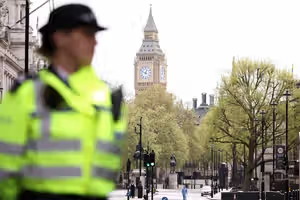
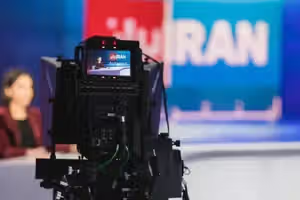
A trial date has been set for three defendants charged over an alleged arson incident near Iran International’s studios in northwest London, with the case scheduled to begin on January 25, 2027, at the Central Criminal Court.
At a preliminary hearing on Friday that lasted about 30 minutes, Oisin McGuinness, 21, and Nathan Dunn, 19, appeared by video link before Mrs. Justice Cheema-Grubb at the Central Criminal Court.
A third defendant, who is under 16 and cannot be named for legal reasons, is also charged in the case.
No pleas were entered at Friday’s hearing. A Plea and Trial Preparation Hearing has been set for August 28, 2026, when pleas are expected to be heard. The trial is listed for three weeks.
McGuinness, Dunn and the third defendant are charged with arson with intent to endanger life, contrary to the Criminal Damage Act 1977.
The charges relate to an alleged incident on April 15, 2026, when an ignited container was thrown into a car park near the network’s studios in northwest London.
There were no reports of injuries or damage following the attempted attack. Officers pursued a black SUV which later crashed on Ballards Lane in Finchley.
McGuinness also faces a charge of dangerous driving, contrary to the Road Traffic Act 1988, in relation to alleged driving on Ballards Lane and Woodberry Way.
McGuinness and Dunn were remanded in custody. The third defendant is on remand under local authority supervision.
All charges are alleged and have not been proven.
In a statement, Iran International said the attack highlights increasing pressure on its journalists and their families, particularly following the recent war involving Iran.
The broadcaster said its staff and their relatives have faced threats and harassment, describing the situation as an effort to silence independent reporting.
Fuel shortages and tighter rationing are pushing drivers across Iran into a growing gasoline black market, with citizens describing long lines at gas stations and sharply inflated prices in messages sent to Iran International.
The accounts describe growing frustration over restricted access to subsidized gasoline and arbitrary limits imposed by operators, leaving many motorists dependent on costly unofficial sales.
“One day there’s quota left on your card, the next day it says your quota is finished,” one citizen said. “They even steal the few drops of gasoline they give people.”
Iran uses a subsidized fuel quota system controlled through electronic fuel cards. Every private vehicle receives a monthly gasoline allocation at discounted prices, while extra consumption is charged at higher rates.
Under Iran’s latest pricing system introduced in late 2025, the first 60 liters of gasoline each month cost 15,000 rials per liter (about $0.008), the next 100 liters cost 30,000 rials ($0.017), and any amount above 160 liters costs 50,000 rials ($0.028).
Despite heavy fuel subsidies, Iran’s minimum monthly wage is now worth less than $90 because of inflation and the sharp decline of the rial.
Another driver said he could not use his personal fuel card on Wednesday because his monthly allocation had already run out. The station operator, he said, agreed to provide a fuel card only if payment was handed directly to him, and even then limited sales to 15 liters at 70,000 rials ($0.038) per liter.
President Masoud Pezeshkian said in late April that the country faced “some shortages” in sectors including energy and fuel.
On May 9, Esmail Saghab Esfahani, vice president and head of Iran’s Strategic Energy Policy and Management Organization, said damage during the war had affected parts of the country’s gas and fuel infrastructure and disrupted some gasoline production capacity.
He said Iran had “no choice but to conserve” fuel consumption for at least the next 18 to 24 months.
But Oil Minister Mohsen Paknejad said on April 29 there were no concerns over fuel supply or distribution.
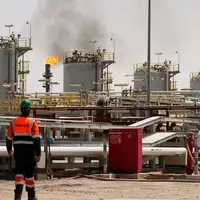
File Photo: A worker adjusts fuel pumps at a gas station in Iran
Black market prices rise
A resident of Bandar Abbas in southern Iran said drivers often wait more than an hour at gas stations, even with personal fuel cards, while gasoline is “widely available” on the black market at 150,000 rials, about $0.08, per liter.
In Zahedan, in southeastern Iran, one resident said gasoline shortages and tighter controls had accelerated illegal fuel sales.
“Everything has been left without oversight,” the resident said. “Sometimes 20 liters of gasoline is sold on the street for 10 million rials ($5.5).”
One driver from Isfahan said operators demanded between 1 million rials ($0.55) and 4 million rials ($2.22) to provide access to only 15 liters.
Citizens also described growing congestion at gas stations nationwide, with drivers saying some stations on major routes had limited purchases to 15 liters.
A resident of Sistan and Baluchestan said 70 liters of gasoline now costs around 50 million rials, about $28, while many villagers must drive hundreds of kilometers to reach hospitals or provincial centers.
For many Iranians, the shortages have become less a matter of conservation than another daily pressure in an increasingly strained economy.
More Iranians are moving back in with family or taking on roommates after losing jobs and struggling to keep up with rising rents in major cities, according to messages sent to Iran International.
“I worked at a petrochemical company and got fired. Since we can no longer afford rent, my wife, two children and I have moved back into my parents’ house,” one citizen told Iran International.
Another, a woman supporting her household alone, said she was forced to share her home after losing her job at a restaurant.
“I am the head of my household and after losing my job at a restaurant, I had no choice but to get a roommate to reduce rent and living costs while raising my teenage child,” she told Iran International.
Shargh newspaper reported on Thursday that more tenants in Tehran and other large cities are turning to shared housing, returning to parents’ homes or leaving the capital altogether as rent and living costs climb.
The newspaper cited residents who said they were searching for roommates for the first time after years of living independently, while others described plans to move back with family members or relocate to smaller cities after losing income.
A 45-year-old woman who had lived alone in central Tehran for two decades told Shargh she was considering taking in roommates because she could no longer afford rent on her own.
“More than two decades passed living alone and now I have to change my standards,” she told the newspaper. “Paying 400 million rials ($220) in rent in Tehran’s Bahar neighborhood is impossible for me.”
Another resident said he and his brother were looking for a third housemate after his workplace suspended operations and stopped paying salaries.
File photo: Iranians move household belongings as soaring rents and economic pressure force many families to move back in with parents or relatives.
Reverse migration from Tehran
Shargh said some residents were preparing to leave Tehran entirely after years in the capital, describing what it called a wave of reverse migration driven by economic hardship and shrinking work opportunities.
One editor told the newspaper she was returning to her hometown Kashan in her mid-40s after more than two decades in Tehran because rising costs and declining work in publishing left her unable to continue living independently.
“I thought I would return to Kashan after retirement, not in middle age because I can no longer survive economically in Tehran,” she told Shargh.
The report also pointed to signs of tighter housing supply, citing online property listings and real estate agents who said available rental units had declined while demand increased, particularly after displacement linked to the conflict with Israel.
Erosion of independence
Sociologist Abdolvahab Shahlibar told Shargh that shared housing in Iran is increasingly a financial necessity rather than a lifestyle choice.
“Efforts to improve quality of life have in many cases been replaced by efforts to preserve basic survival,” Shahlibar told the newspaper, warning that being forced to return to parents’ homes or abandon independent living could reshape social relationships and personal identity.
Countries should pay Iran annual fees for fiber-optic cables that pass beneath the Strait of Hormuz, an Iranian lawmaker said, saying that hundreds of billions of dollars in financial transactions move through the lines each day.
“The Strait of Hormuz is a God-given treasure, like other mines and reserves placed at Iran’s disposal,” said Hossein Ali Hajideligani, a member of Iran parliament’s presiding board.
The Strait of Hormuz is a critical route for the digital economy, with several undersea fiber-optic cables running across the seabed and linking India and Southeast Asia to Europe through the Persian Gulf states and Egypt.
Iran had previously warned that submarine cables in the Strait of Hormuz were a vulnerable point for the region’s digital economy, raising concerns about potential attacks on critical infrastructure.
Last week, IRGC-linked media called for Iran to generate revenue from undersea internet cables passing through the Strait of Hormuz, framing the waterway not only as an energy and shipping chokepoint but also as a digital pressure point.
Hajieligani said Iran should also impose fees on ships passing through the waterway, citing guidance he attributed to Supreme Leader Mojtaba Khamenei’s messages.
He also called for an end to negotiations with the United States, saying Washington had “miscalculated” and was using the process to buy time rather than accept what he called Iran’s “absolute right.”
He said the US was the one that sought a ceasefire and alleged that Washington was after buying time for domestic political purposes.
Iran’s foreign minister accused the United Arab Emirates on Thursday of direct involvement in military operations against Iran, escalating Tehran’s criticism of regional states during a BRICS meeting in New Delhi.
Abbas Araghchi made the remarks in response to comments by the Emirati representative and added that he had avoided naming the UAE in his main speech “for the sake of unity.”
“But the truth is that the UAE was directly involved in the aggression against my country,” Araghchi said. “When the attacks started, they didn't even issue a condemnation.”
He accused Abu Dhabi of providing bases, airspace, territory, intelligence and other facilities to the United States and Israel during the attacks.
Araghchi said Iran had not attacked the UAE, but had targeted US military bases and facilities on Emirati soil.
He urged the UAE to reconsider its policy toward Iran, saying neither the US military presence nor ties with Israel had protected it.
His remarks came against the backdrop of the war involving Iran, the United States and Israel, during which Tehran said it targeted US military positions in response to attacks on Iran.
They also followed reports that Israeli Prime Minister Benjamin Netanyahu had visited Abu Dhabi during the war and that Israel had provided the UAE with military equipment. The UAE rejected reports of the visit.
Araghchi cited the reports in his remarks, saying the UAE had become “an active partner in this aggression.”
The office of Israeli Prime Minister Benjamin Netanyahu said Wednesday he had made a secret visit to the United Arab Emirates during the US-Israeli war with Iran earlier this year and met UAE President Sheikh Mohammed bin Zayed.
Iran sought to rally BRICS countries against US and Israeli military action on Thursday, casting the regional conflict as resistance to American power as concerns over maritime security and energy disruption dominated the bloc’s foreign ministers meeting in New Delhi.
Foreign Minister Abbas Araghchi urged the bloc to oppose what he called the politicization of international institutions and take action against countries violating the UN Charter.
“The West's false sense of superiority and immunity must be shattered by all of us,” Araghchi said in a statement during the gathering.
His remarks come as Iran faces deepening economic strain, a collapsing currency and growing public frustration at home, weakening the image of resilience officials have sought to project.
High inflation and repeated protests over living costs have laid bare Iran’s domestic vulnerabilities, even as Tehran seeks to project itself as a challenger to Western influence.
The two-day meeting opened under the shadow of the Iran-US-Israel war, exposing divisions within an expanded BRICS bloc split by competing regional interests and differing ties with Washington.
The United States and Israel launched strikes on Iran on February 28 targeting military bases, missile infrastructure, nuclear facilities and senior commanders in an effort to weaken Tehran’s military capabilities and nuclear program.
Iran launched missile and drone attacks on Israel, US military assets and infrastructure linked to American allies in the Persian Gulf region.
Indian Foreign Minister Subrahmanyam Jaishankar warned that instability around key shipping lanes threatened the global economy.
India's Foreign Minister Subrahmanyam Jaishankar shakes hands with Iran's Foreign Minister Abbas Araqchi during the BRICS foreign ministers' meeting at Bharat Mandapam in New Delhi, India May 14, 2026.
“Safe and unimpeded maritime flows through international waterways, including the Strait of Hormuz and the Red Sea, remain vital for global economic well-being,” Jaishankar said in opening remarks.
Iran has disrupted shipping through the Strait of Hormuz following joint US and Israeli strikes on its territory, issuing warnings to commercial vessels and tankers in the strategic waterway.
Traffic through the strait, which carries roughly one-fifth of global oil and gas trade, declined sharply as tanker operators suspended transit and vessels rerouted over security concerns.
The disruptions drew criticism from Western governments, Persian Gulf Arab states and shipping groups, which warned that threats to one of the world’s most important maritime chokepoints could destabilize global trade and energy markets.
BRICS was founded by Brazil, Russia, India and China before South Africa joined in 2011. The bloc later expanded to include Egypt, Ethiopia, Indonesia, Iran and the UAE.
Araghchi used his address to accuse Washington and Israel of carrying out attacks against Iran and urged BRICS countries to take a firmer position on the conflict.
“Iran is asking BRICS members and all responsible members of the international community to explicitly condemn violations of international law by the United States and Israel,” he said.
Araghchi also portrayed BRICS as part of an emerging global order less dominated by Western powers and said developing countries faced similar political and economic pressure from Washington.
India's Foreign Minister Subrahmanyam Jaishankar addresses the BRICS foreign ministers' meeting at Bharat Mandapam in New Delhi, India May 14, 2026.
His comments did not address Iran’s own military and proxy activities across the region, including attacks by Iran-backed armed groups in Iraq, Yemen and Lebanon against neighboring countries and US-linked targets in recent years.
Tehran also launched missile and drone attacks on Arab states aligned with Washington during the conflict, targeting military facilities and energy infrastructure in the UAE, Qatar, Bahrain, Kuwait and Saudi Arabia.
The regional governments condemned the strikes as violations of sovereignty that threatened regional stability and energy supplies.
Differences inside BRICS have complicated efforts to reach a unified position on the conflict, particularly between Iran and the UAE, which support opposing sides in the war.
Despite the divisions, diplomats said discussions were continuing toward a possible joint statement before the meeting concludes on Friday.