The warnings came during a day that also saw Iran execute two protesters detained during the January uprising, the Revolutionary Guards threaten a tanker in the Strait of Hormuz, and Yemeni government forces launch a major offensive against the Iran-backed Houthis.
Netanyahu says Iran is fighting for survival
Iran’s leadership is weaker than at any point since its establishment and is fighting for survival, Netanyahu said at a ceremony marking the third anniversary of the October 7 attack.
“The tyranny is weaker than it has ever been since its establishment. It is fighting for its life, and its end is to disappear — or rather, to pass from the world,” Netanyahu said.
Netanyahu portrayed the October 7 attack as the opening stage of an Iranian-led effort to destroy Israel. He described what he called a three-pronged Iranian strategy involving armed groups surrounding Israel, thousands of missiles aimed at the country and nuclear weapons intended to destroy it.
“That was Iran’s three-pronged plan. But through our combined efforts, we crushed it, stage by stage,” Netanyahu said.
Israel struck Iran’s ballistic missile stockpiles and severely damaged its nuclear program, including scientists, facilities and infrastructure, Netanyahu added.
Iran’s Armed Forces General Staff chief Ali Abdollahi issued his own warning later Monday, saying any renewed conflict would spread beyond Iran and Israel.
“If a new war begins, its fire will engulf everyone,” Abdollahi said.
Iran would respond immediately and without limits if the United States launched another strike, regardless of whether Washington acted before or after congressional elections or at Israel’s urging, Abdollahi added.
IRGC threatens tanker in Strait of Hormuz
The military warnings coincided with a confrontation in the Strait of Hormuz, where a tanker turned back after the Revolutionary Guards hailed the vessel and threatened to target it if it continued its inbound transit, the United Kingdom Maritime Trade Operations said.
The encounter took place 11 nautical miles north of Khasab, Oman. The tanker’s master complied with the instruction and reversed course, UKMTO said.
The episode came as energy shipments through Hormuz showed signs of recovery. At least three liquefied natural gas shipments had exited the strait since late last week, extending a rebound in traffic, Bloomberg reported, citing ship-tracking data. Outbound LNG flows nevertheless remained more than 75% below prewar levels.
Iranian lawmaker Hassan Ghashghavi separately warned neighboring countries that their infrastructure could be targeted if Iranian infrastructure came under attack.
“We have told our neighbors that our security is your security, and our insecurity is your insecurity,” Ghashghavi, spokesman for parliament’s national security and foreign policy committee, said.
Yemen offensive puts Houthis under pressure
Yemen’s government forces opened another regional front on Monday, launching an operation against the Iran-backed Houthis and announcing advances around the Bab el-Mandeb Strait.
Government forces took control of the strait and Dhubab airport and cut the road between Dhubab and Mokha, military spokesperson Colonel Majed al-Nuzaili said. Hundreds of Houthi fighters were surrounded in Dhubab, he added.
The Saudi-led coalition said it struck 324 targets during the operation and provided air protection over Bab el-Mandeb and air cover for Yemeni government forces.
Yemen’s presidential council earlier announced the launch of “Operation Dawn of Yemen,” which it said was intended to retake Sanaa and restore state institutions.
The developments placed the Strait of Hormuz and Bab el-Mandeb, two strategic waterways at opposite ends of the Arabian Peninsula, at the center of Monday’s regional developments.
Executions and economic strain at home
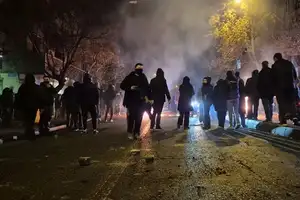
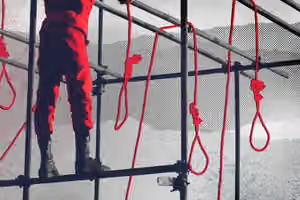
Inside Iran, the judiciary confirmed the executions of Alireza Sepahi and Alireza Raisi, two protesters detained during the January 2026 protests.
The two men were defendants in the Alikhani Square case in Isfahan, in which five others had previously been executed. Iran’s Supreme Court upheld death sentences for 12 defendants in the case in July.
UN Special Rapporteur on human rights in Iran Mai Sato condemned Sepahi’s execution and raised concerns about his treatment and judicial process. Sepahi’s lawyer was still seeking a review when the execution was carried out, Sato said.
Prince Reza Pahlavi’s communications office later vowed to pursue accountability for those involved in the executions through fair trials.
Economic difficulties also remained prominent. Workers across several sectors told Iran International that employers were delaying or splitting wage payments and cutting benefits, with some employees taking second jobs to meet everyday expenses.
The combination of military warnings abroad and political, economic and security developments at home kept the possibility of renewed conflict and its consequences at the center of Iran’s news on Monday.