• العربية
  • فارسی
Brand
  • Iran Insight
  • Politics
  • Economy
  • Analysis
  • Special Report
  • Opinion
  • Podcast
  • Live TV
  • Iran Insight
  • Politics
  • Economy
  • Analysis
  • Special Report
  • Opinion
  • Podcast
  • Live TV
  • Theme
  • Language
    • العربية
    • فارسی
  • Iran Insight
  • Politics
  • Economy
  • Analysis
  • Special Report
  • Opinion
  • Podcast
  • Live TV
All rights reserved for Volant Media UK Limited
volant media logo

Al-Qaeda is Iran's quiet backup if the war turns, expert says

Kambiz Tavana
Kambiz Tavana

Iran International

Oct 2, 2026, 10:15 GMT+1
Sara Harmouch, chief executive of H9 Defense and an adjunct professor at George Washington University, during an interview with Iran International in Washington, DC

Iran has spent two decades keeping al-Qaeda close as a partner it can deny, and could turn to it if the war with the United States escalates, a counterterrorism expert told Iran International. With Hezbollah and Hamas weakened, she said, it is the card Tehran has left.

Sara Harmouch, chief executive of H9 Defense and an adjunct professor at George Washington University, said the relationship is no longer a historical footnote.

"Who is better to rise as a secret proxy for Iran than al-Qaeda?" she said. "Al-Qaeda keeps a low profile and continues to maintain plausible deniability."

Intelligence circulating in the Middle East and among the Arab states of the Persian Gulf, which US and Western officials have not confirmed, suggests that Saif al-Adel, al-Qaeda's de facto leader, who has long been based in Iran, is preparing attacks if the war widens, Harmouch said. That would suit both sides, she said: Iran could deny involvement, and al-Qaeda could return to the world stage against Western interests.

"It's all possible, and it's not far-fetched," she said. Iran, she added, had helped with the operations, funding and logistics of the September 11 attacks. "So why wouldn't they now, especially if they're in such a difficult situation with the war?"

The 9/11 Commission found that Iran allowed several of the hijackers to transit its territory but found no evidence that Tehran knew of the plot. A US federal court later found Iran liable in a civil case brought by victims' families, a judgment Iran did not contest.

'Pragmatism always trumps ideology'

Washington, Harmouch argued, still treats the rivalry between Sunni and Shia Islam as a wall. In 2024 she wrote that al-Qaeda was becoming "Iran's ace in the hole," with Adel at the center. Western outlets turned the piece down, she said, because editors would not accept cooperation across the sectarian line.

"Someone who has not been to the region at all felt compelled to tell me, oh, but there's a Sunni-Shia divide," she said.

She made the argument instead on the podcast of Michael Morell, a former acting director of the CIA. Two years later, she said, the same pattern is being reported as news: al-Qaeda in Yemen has stopped fighting the Houthis, and the cooperation has spread to al-Shabaab in Somalia.

"Pragmatism always trumps ideology," she said.

As evidence of that shift, Harmouch pointed to a drone unit the Houthis helped al-Qaeda set up, a joint meeting of al-Qaeda in Yemen, al-Shabaab and the Houthis, and a claim that the Houthis paid al-Qaeda $65,000 in recent months for an attack carried out on their behalf.

Al-Qaeda has publicly rejected UN findings that it cooperates with the Houthis and has stepped up anti-Houthi propaganda, which she read as cover rather than a break.

The leader who avoids the camera

Adel, she said, is why the silence in Yemen was predictable. Al-Qaeda has never publicly named him leader because he is in Iran, and unlike Osama bin Laden he avoids the camera. A 52-minute al-Qaeda video released around this year's September 11 anniversary used old footage of Hamza bin Laden and quoted Adel's book without showing him. In that book, she said, the word "deception" appears 99 times.

In her account, the relationship took shape after 2001, when al-Qaeda figures fled Afghanistan for Iran. Tehran detained some and sent others home. It kept Adel, under what former CIA director George Tenet later called a loose house arrest. Adel stayed close to Qassem Soleimani, the Revolutionary Guards' Quds Force commander, and, Harmouch said, told him: "We are partners. We're not enemies. We are partners in changing the world."

She traced episodes that, she said, show the house arrest was never a cage: the 2003 Riyadh bombings, which US officials said were directed in part from Iran; a 2013 plot to derail a train between Toronto and New York, which Canadian police said had direction from al-Qaeda elements in Iran; and, after Abu Musab al-Zarqawi began killing Shia in Iraq, a turn from hospitality to coercion, including the holding of members of bin Laden's family.

In a 2007 letter, bin Laden called Iran "our main artery for funds, personnel, and communications" and warned against attacking it. In 2008, she said, Ayman al-Zawahiri praised the Revolutionary Guards for strengthening al-Qaeda in Yemen.

In Syria, she said, the relationship worked like a proxy arrangement. Iran released Muhsin al-Fadhli, who went on to move money and fighters into the Syrian war. In 2015 it freed Abu Khayr al-Masri and other senior figures in a prisoner exchange; Harmouch said the Quds Force used them to split the forces of Abu Muhammad al-Jolani, now Syria's president, Ahmad al-Sharaa.

Abu Muhammad al-Masri, al-Qaeda's second in command, remained in Iran until Israeli agents killed him in Tehran in 2020. The US Treasury has since sanctioned Iranian-based networks for supporting al-Qaeda.

After Zawahiri was killed in 2022, Adel's rise closed the circle, she said. Since the Hamas attack of October 7, 2023, he has told affiliates to stop hitting Iran's proxies. What unites them, in his words as she rendered them, is greater than what unites their enemies: one God, one qibla, the direction of prayer, and one political goal. His statements and Tehran's have lined up on the Red Sea, on protests at American universities, and on Afghanistan.

'There is no winning'

A deal, or a harder US campaign, would not end the problem, Harmouch said. Iran fights by attrition and will absorb losses the United States will not, and when it cannot control what happens outside its borders, it turns on its own population.

The cells inside the United States that are often cited as a threat have not produced a directed attack, she said. They may not exist, or Tehran may be holding them as leverage that disappears once used.

The likelier diversion, in her view, is an al-Qaeda attack Iran can disown, buying time to rebuild. A nuclear announcement is possible, she said, but less necessary since Iran's closure of the Strait of Hormuz showed what it could do to American gasoline prices.

"I don't think there is winning a war against Iran," she said. "As long as it's still in the fight, it is winning."

Most Viewed

Iran oil exports vanish as regional flows surpass prewar levels
1

Iran oil exports vanish as regional flows surpass prewar levels

2
INSIGHT

US ‘feedback’ leaves Iran debating the price of diplomacy

3

Iranian weapons, Chinese supplies fuel Houthi advance in Yemen - WSJ

4

Trump says renewed bombing of Iran after midterms 'possible'

5
INSIGHT

Tehran weighs what comes next if US diplomacy fails

Banner
Banner

Spotlight

  • Can the Caspian give Iran a way around Hormuz?
    ANALYSIS

    Can the Caspian give Iran a way around Hormuz?

  • An account of espionage: From banks and phone lines to Malard missile base blast
    SPECIAL REPORT

    An account of espionage: From banks and phone lines to Malard missile base blast

  • Iranian press sees diplomacy alive but narrowing after US response
    INSIGHT

    Iranian press sees diplomacy alive but narrowing after US response

  • Leaked Kremlin plan undercuts Moscow's claims on ruble-rial trade with Iran
    INSIGHT

    Leaked Kremlin plan undercuts Moscow's claims on ruble-rial trade with Iran

  • Iran oil exports vanish as regional flows surpass prewar levels

    Iran oil exports vanish as regional flows surpass prewar levels

  • 670 bridges, 380 tunnels: The network that moves Iran's army and its missiles
    SPECIAL REPORT

    670 bridges, 380 tunnels: The network that moves Iran's army and its missiles

  • Iran turns to younger children in postwar ideological push
    ANALYSIS

    Iran turns to younger children in postwar ideological push

Banner
Banner
Banner
•
•
•

More Stories

Can the Caspian give Iran a way around Hormuz?

Oct 2, 2026, 09:21 GMT+1
•
Umud Shokri
100%
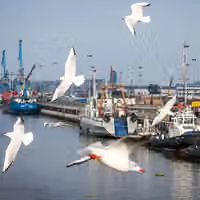
File photo: Ships dock at Anzali Port on Iran’s Caspian Sea coast

With war disrupting Iran’s southern trade routes, Tehran is looking north to the Caspian for alternatives. But the available evidence suggests they cannot replace its crucial oil exports.

More cargo moving across the Caspian could help Iran keep supplies coming in. But rising freight totals do not show whether Tehran has found a practical alternative for exporting oil.

To establish that, we need to know what is being shipped, where it is going and what trade it replaces.

Grain and industrial goods can ease shortages; crude needs its own export infrastructure and buyers. Iran’s oil swaps at Neka show both what the northern route can offer and what it cannot.

What the freight numbers measure

Russia’s Ministry of Transport reported 1.8 million tonnes of freight on the trans-Caspian route in 2025 and 1.3 million tonnes in the first half of 2026. It separately reported maritime freight of 2.8 million tonnes in 2025 and about 4.5 million tonnes in the first seven months of 2026.

The figures point to increased activity, but the ministry does not break the cargo down by Iranian origin, Iranian destination or commodity.

The North–South Transport Corridor spans several countries, routes and modes. Cargo can transit Iran without being Iranian trade or move between other participating countries.

A corridor-wide increase could reflect transit shipments, trade between third countries or Iranian goods rerouted from elsewhere. The aggregate numbers do not distinguish among them.

Nor should the route and maritime figures be added together as if they measure the same flow. The ministry presents them separately and does not provide enough detail to establish how their coverage overlaps.

Evidence of genuine substitution requires knowing what cargo moved, where and which route it replaced. Grain rerouted from a southern port to northern Iran would demonstrate substitution for that cargo.

A shipment merely transiting Iran would demonstrate corridor use, not replacement of lost Iranian trade.

Imports and exports are different problems

Northern routes can still be valuable for Iran. Food, feed and industrial inputs can support domestic supply during a disruption. But that resilience should not be confused with replacing oil revenue.

Around 90% of Iran’s crude exports normally pass through Kharg Island in the Persian Gulf, according to Reuters. Bringing goods into northern Iran does not automatically provide the terminals, pipelines and shipping arrangements needed to move Iranian crude to international buyers.

Iran’s ports have nominal annual capacity of about 300 million tonnes, but only around 30 million tonnes is in the north, according to figures cited by Al Jazeera. One large vessel in the south can potentially carry as much cargo as 20 Caspian ships.

The question is not simply whether trade can move north, but whether those routes can serve the same economic purpose at comparable scale.

Neka was not an oil-export system

Iran’s Neka terminal was connected by pipeline to refineries in Tehran and Tabriz. Under previous oil-swap arrangements, crude from Caspian producers was delivered to Neka and processed in northern Iran. Iran then made an equivalent volume of its own crude available for export through Kharg.

The arrangement helped supply northern refineries while freeing Iranian crude elsewhere for export. It did not eliminate reliance on southern export infrastructure.

Swap volumes peaked at about 110,000 barrels per day in June 2006, fell to almost zero by 2011 and did not subsequently resume at scale, according to Lee and Kalyuzhnova. Changes in relative pricing were among the factors that made the route less attractive.

Infrastructure alone therefore does not create a durable oil route. The economics of each barrel, the terms of any swap and the availability of buyers matter too.

Any claim that Neka now provides a meaningful export alternative requires current evidence: how much crude is arriving, whether it is being refined, swapped or exported, and where any exported Iranian barrels actually leave the country.

Who controls the alternative?

Moscow’s transport ministry links freight growth to Russian-Iranian cooperation and identifies the unfinished Rasht–Astara railway as a key project.

The more important question is whether Iranian access depends on a limited number of suppliers, carriers, financiers or cross-border arrangements. Iran could gain another route while still having little control over the terms on which it operates.

That is not inevitable. A corridor involving several suppliers and transport partners could give Tehran more options.

The test is whether cargo can move regularly at competitive cost, with workable payment and customs arrangements, without a single partner becoming a bottleneck.

What would an alternative look like?

The available figures establish that activity on parts of the northern corridor has increased. They do not establish how much Iranian trade has been rerouted, whether those routes are commercially sustainable or whether they can substitute for oil-export capacity.

The Caspian may give Iran useful alternatives for specific shipments. Whether that amounts to strategic diversification depends on what Iran can move, at what scale, where it can send it and who sets the terms.

For now, rising freight totals are a starting point for that analysis, not proof that Iran has built a northern substitute for its oil-export system.

Iran links under scrutiny in separate Flydubai, UK airbase investigations

Oct 1, 2026, 22:51 GMT+1
100%
Travelers board a FlyDubai aircraft at Ben Gurion International Airport after a separate FlyDubai flight from the United Arab Emirates to Israel was diverted to Saudi Arabia following an emergency signal, in Lod, near Tel Aviv, Israel, September 30, 2026. REUTERS

Iran on Thursday was linked by US and Israeli officials to the Flydubai incident, the second such case after British police opened a probe into possible Tehran involvement in a suspected RAF Fairford plot and arrested a dual UK-Iranian national.

US President Donald Trump raised the prospect of an Iranian connection, saying investigators were examining whether Tehran had a role in the incident and that, based on what he was hearing, he believed there could be one.

“We're working on it right now,” Trump said. “I would say the answer based on what I'm hearing, is yes. But we're working on it right now.”

Asked whether the co-pilot could have been placed on the flight by Iran’s Revolutionary Guards or radicalized separately, Trump said: “It could have been. Yeah.”

Trump also warned Iran of retaliation if investigators established its involvement.

“Oh they’ll be hit, very hard, don’t worry,” he told reporters Thursday. “You just ask them. They know what happened. They’ll be hit very hard.”

Israeli agencies investigate

Israel’s Mossad and Shin Bet intelligence and security agencies are also investigating the incident and whether the Omani co-pilot acted alone or was directed by others, according to i24News. Israeli officials said no Iranian involvement had been identified so far, and an initial assessment was that the co-pilot likely acted alone.

Prime Minister Benjamin Netanyahu said Thursday that the co-pilot had undergone Islamist radicalization but that it was too early to determine whether he had connections to Iran.

“I think it's too early to say whether he had any connections with Iran or with anyone else,” Netanyahu said, adding that he expected more clarity within days.

The flight from Dubai to Tel Aviv was diverted to Saudi Arabia after the co-pilot allegedly stabbed the captain and tried to bring down the aircraft. Passengers subdued him, and a reserve crew aboard the plane landed it safely in Saudi Arabia.

The United Arab Emirates has launched its own investigation into the circumstances and motives behind the incident, including whether it involved terrorist intent, prior planning or outside direction.

Iran role in UK airbase plot

The Flydubai developments came days after a separate investigation in Britain raised questions about possible Iranian involvement in a suspected plot involving RAF Fairford, an airbase used by US bombers in operations against Iran.

British counter-terrorism police on Thursday arrested a dual UK-Iranian national in London on suspicion of preparing terrorist acts as part of the investigation. Police said they were examining “all possible angles — including possible foreign state involvement.”

The arrest followed the detention Sunday of five British men in their 20s near RAF Fairford. They were arrested on suspicion of terrorism and explosives offenses but were later released on bail.

Police said petrol was found in the vans used by the men but no improvised explosive devices were discovered.

British Prime Minister Andy Burnham said Wednesday there were “strong indications that Iran played a part in what happened over the weekend at RAF Fairford,” while stressing that the case remained an ongoing police investigation.

Iran denies involvement

Foreign Minister Abbas Araghchi rejected Burnham’s assertion, pointing to the release of the initial five suspects on bail.

“I can confirm Iran's belief that releasing supposed terrorists working for foreign states really says it all,” Araghchi wrote on X. “You're barking up the wrong tree.”

Iran summoned Britain’s ambassador in Tehran on Thursday to protest the accusations, with the Foreign Ministry describing them as baseless.

The Flydubai and RAF Fairford investigations are separate, and authorities have not established Iranian responsibility in either case.

Iran oil exports vanish as regional flows surpass prewar levels

Oct 1, 2026, 18:55 GMT+1
•
Dalga Khatinoglu
100%
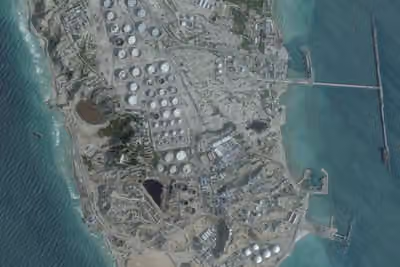
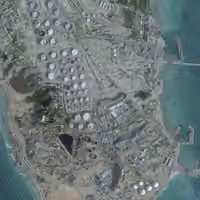
FILE PHOTO: A satellite image shows an oil terminal at Kharg Island, Iran, February 25, 2026.

New tanker-tracking data shows that Iran’s new oil exports have effectively ground to a halt, while crude exports from Arab countries in the region surpassed pre-war levels in the final week of September.

Data from commodities intelligence firm Kpler shows that regional crude exports reached their highest level since the war began in late February.

Average crude exports stood at around 16.5 million barrels per day in September, but the seven-day average rose to around 19.5 million barrels per day in the final week of the month, surpassing the pre-war level of approximately 17 million barrels per day.

By contrast, Iran has not loaded any new oil at its terminals since mid-August, while no Iranian oil cargo has crossed the US blockade line since mid-July. Data from tanker-tracking firm TankerTrackers also points to a halt in new Iranian crude shipments.

Homayoun Falakshahi, a senior analyst at Kpler, told Iran International that the halt in loadings has forced Iran to cut oil production to roughly the level required for domestic consumption, around 1.8 million barrels per day—roughly half its pre-war output.

Iran’s oil exports

Kpler data, seen by Iran International, shows that since mid-July, no Iranian oil cargo has crossed the blockade line and travelled through Asian waters toward China.

Iran continued loading oil for several weeks and, by mid-August, had stored around 67 million barrels aboard tankers anchored in its southern waters. But as access to empty tankers became increasingly limited, new loadings also came to a halt.

TankerTrackers data indicates that Iran’s oil terminals were effectively inactive in terms of crude loadings throughout September.

As of last week, around 15 million barrels of Iranian oil remained on the water in Asian waters. Falakshahi said most of those cargoes had already been sold, meaning Iran effectively has no new oil available for delivery to Chinese buyers.

China is the only major buyer of Iranian crude and purchased an average of around 1.5 million barrels per day from the Islamic Republic over the past year.

Iran also exported around 500,000 barrels per day of oil products and liquefied petroleum gas (LPG) last year to buyers including the UAE, China and other Asian countries. Those flows have also stopped since the start of the naval blockade.

Arab oil exports recover

By contrast, Arab countries in the region have restored much of their oil exports and established alternative routes for transporting crude.

Kpler says their crude exports averaged at least 16.5 million barrels per day in September, roughly matching their pre-war average. In the final week of the month, however, exports rose substantially further.

Before the war, nearly 17 million barrels per day of crude and 6.3 million barrels per day of oil products from Iran and Arab countries in the region, including Oman, were shipped to global markets through the Strait of Hormuz, the Gulf of Oman and the Red Sea—a combined 23.3 million barrels per day.

In the final week of September, crude exports from these countries reached nearly 19.5 million barrels per day, above the pre-war level. Oil-product exports, however, stood at around 3 million barrels per day, less than half their pre-war level.

Overall, crude and oil-product exports from the region reached more than 22.4 million barrels per day in the final week of September, just 900,000 barrels per day below the pre-war level.

The comparison is particularly striking because Iran accounted for around 2 million barrels per day of crude and oil-product exports before the war. Excluding Iran, exports from Arab countries in the region have therefore risen above their pre-war level, largely offsetting the disappearance of Iranian supplies from the market.

OPEC data shows that the UAE, which left the group in May, increased oil production to more than 3.8 million barrels per day in August—around 700,000 barrels per day above its pre-war level.

No new data has yet been released on UAE oil production in September. The country has production capacity of close to 5 million barrels per day.

Iranian weapons, Chinese supplies fuel Houthi advance in Yemen - WSJ

Oct 1, 2026, 10:24 GMT+1
100%
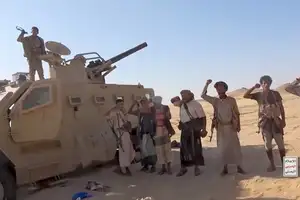
Iran-aligned Houthi fighters occupy a firing position in a screengrab from a video said to show Houthi fighters attacking Saudi-backed forces in the location given by the source as al Jawf governorate, Yemen, in this screengrab taken from a video released by Houthi Military Media on September 15, 2026.

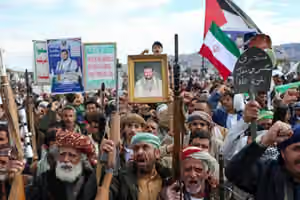
Iranian weapons and growing supplies of Chinese dual-use components have helped Yemen's Houthis expand their territory and strengthen their ability to threaten shipping through the Red Sea, the Wall Street Journal reported.

The Iran-backed group has seized Red Sea islands and expanded along Yemen's mainland coast in recent weeks, including taking the port city of Mokha, according to the report. It has also asserted control over the Bab al-Mandeb Strait, a key route for global trade and energy shipments.

The Houthis, estimated to have about 350,000 fighters, had prepared for the offensive for months, moving weapons and thousands of troops toward Mokha in August and using their control of telecommunications networks to monitor opponents, the Journal said.

  • US officials met Iran-aligned Houthis in Oman - Reuters

    US officials met Iran-aligned Houthis in Oman - Reuters

  • Iran-backed Houthis attack Saudi cities and energy facilities, wounding at least 73

    Iran-backed Houthis attack Saudi cities and energy facilities, wounding at least 73

Iranian technology at the core

The Houthis lack a conventional navy but use Iranian-designed missiles, explosive drones, sea mines, armed fast boats and drone boats to project power along Yemen's coast.

Their arsenal includes ballistic and cruise missiles, anti-ship weapons and drones drawing heavily on Iranian technology and components, according to the report.

Around 2015, Iran's Quds Force began sending components for Iranian-designed missiles and drones and dispatched trainers to help the Houthis build weapons themselves, the Journal said.

The assistance helped turn the group into a force capable of attacking Saudi oil infrastructure, disrupting Red Sea shipping and threatening US forces.

100%
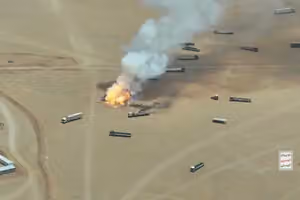
Houthi fighters stand in front of what they say is a downed Saudi jet, at a location given as Yemen, in this still image from a handout video released on September 16, 2026.

China becomes another supply source

"The Houthis now have a new source for the supplies they need to launch their attacks: China," the Journal reported.

Chinese companies are supplying dual-use goods that can serve civilian and military purposes, including components important to Houthi drone programs, according to UN reports and arms experts cited by the newspaper.

The shift comes as traditional Iranian smuggling routes have faced greater disruption. For years, Iran's Revolutionary Guards used small fishing boats to move arms, drone components and missile parts to the Houthis, but many shipments have been intercepted by US forces and Yemeni groups opposed to the Houthis.

  • Iran’s weakened axis still bites as Houthis escalate against Saudi Arabia

    Iran’s weakened axis still bites as Houthis escalate against Saudi Arabia

  • Iran-backed Houthis advance near key Red Sea shipping route as Yemeni forces retreat

    Iran-backed Houthis advance near key Red Sea shipping route as Yemeni forces retreat

Red Sea threat grows

The Houthis have also used Djibouti as a transit point for weapons and traded small arms with al-Shabaab in Somalia, according to UN reports cited by the Journal.

Since announcing a blockade on Saudi shipping on July 20, the group has struck seven vessels in the Red Sea and one in the Gulf of Aden, the report said. Four of the ships were Saudi-flagged.

The Houthis have also targeted Saudi energy infrastructure with missiles and drones, although Riyadh has reported no damage from those attacks.

UK points to Iran role in suspected plot near RAF Fairford

Sep 30, 2026, 20:31 GMT+1
100%

British Prime Minister Andy Burnham said on Wednesday there are “strong indications” Iran played a role in a suspected plot near RAF Fairford airbase used by US forces to carry out strikes on the Islamic Republic.

“But of course, it remains an ongoing, complex and serious police investigation,” he told BBC. “We are working closely with our colleagues in the United States of America.”

Five British men in their 20s were arrested on suspicion of terrorism and explosives offenses after three white vans were found near the base.

Police recovered petrol but found no viable explosives, and all five suspects were later released on bail as the investigation continued.

The base is home to the US Air Force’s 501st Combat Support Wing and also serves as a forward operating site for Air Force Global Strike Command.

Fairford has supported major US military operations, including the 1991 Persian Gulf War, the 2003 invasion of Iraq and this year’s US-Israeli strikes on Iran.

US Secretary of State Marco Rubio subsequently said a foreign state was involved, without naming it, while President Donald Trump said the men had planned "big damage."

Iran has denied involvement. Iran’s Revolutionary Guards (IRGC) said in July that bases used for attacks on Iranian territory could be considered legitimate targets.

Before Burnham’s remarks, British authorities had not publicly linked the incident to Iran, though counter-terrorism police said they were investigating possible foreign state involvement, including whether proxies may have been “knowingly or unknowingly working on behalf of a foreign state.”

Police said Tuesday that petrol, but no improvised explosive device, was found in the vans used by the men. They also defended releasing the suspects on bail after criticism, including from Trump.

The Times reported that one suspect called emergency services shortly before his arrest, with investigators considering whether the incident was surveillance, a “dry run” or an attempt to send a message to the British government.

Britain said in January that its services had tracked more than 20 potentially lethal Iran-backed plots over the previous year targeting dissidents, journalists and members of the Jewish community.

In June, 24 Western governments accused Iran’s IRGC intelligence apparatus, the Quds Force and Iran’s intelligence ministry of plotting attacks in Europe, North America and Australia, including against Iranian dissidents and Jewish and Israeli interests.