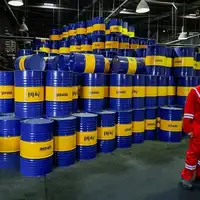
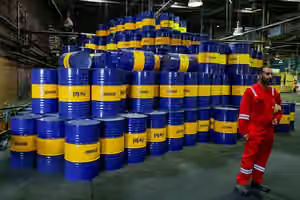
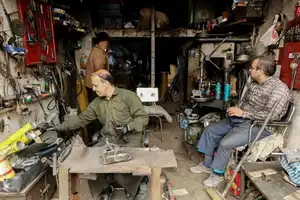
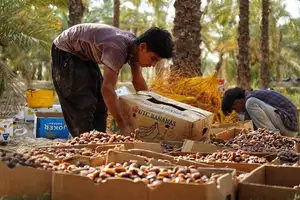
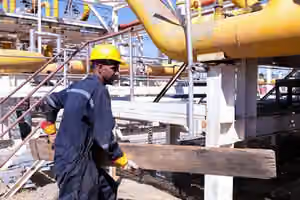
File photo of workers at an industrial facility in Iran.
Workers across several sectors in Iran say employers are delaying or splitting wage payments, cutting benefits and warning staff they could lose their jobs for protesting, as inflation and rising living costs deepen pressure on households.
Messages sent to Iran International by employees at companies spanning the automotive, energy, pharmaceutical and aviation industries describe wages arriving weeks or months late, with some workers saying they have taken second jobs to cover everyday expenses.
Several employees said their salaries were being paid in installments rather than on schedule. Others described losing workplace benefits or being told to resign if they objected to payment delays.
Delayed wages and disappearing benefits
Two workers at Megamotor, a subsidiary of automaker Saipa, criticized the company's wage and benefit payments in messages to Iran International.
Salary payments became irregular after the 40-day war, one worker said.
“We are suffering greatly and do not know how we can provide for our families.”
Another Megamotor employee said some wages and benefits, including overtime and meal allowances, were no longer being paid to workers, while managers and supervisors continued to receive overtime and other benefits.
Low pay at Saipa Yadak has forced most employees to work for the Snapp ride-hailing service from the afternoon until late at night, an employee of the auto-parts company said.
Some of the company's resources are spent on government ceremonies or large payments to senior managers, the employee added.
Workers at Bahman Motor are also facing financial and psychological pressure, an employee of the automaker said.
The company has declined to make payments to employees even as it continues constructing new industrial buildings, according to the employee.
File photo of workers carrying out construction and maintenance work in Iran.
The accounts come as Iran's economic problems have deepened in recent months alongside the Islamic Republic's regional policies, tighter sanctions and a sharp decline in the value of the national currency.
Rapid inflation and declining purchasing power have increased pressure on household budgets and made basic goods harder to afford for a broad section of the population.
Iran International reported in August that workers at mines and companies had gone months without receiving wages.
Workers say complaints put jobs at risk
Employees at other companies described wages being divided into installments and said challenging the delays could put their jobs at risk.
Salaries at Imen Tak Pishro in Jajrud are paid in installments and employees who object are warned they could be dismissed, one worker told.
Another employee previously told Iran International that their employer paid three months of overdue salaries in two installments.
Mapna has not paid workers at 25 power plants for 40 days, an employee of the company said.
At pharmaceutical company Arya Tinagen, salaries remained unpaid 11 days into the month, an employee said.
“The company has cut all employee benefits, from meals to the monthly benefit card. If we complain, they tell us to resign and leave.”
Messages in recent days have also described overdue wages, unpaid insurance contributions and warnings of dismissal across a range of workplaces.
An employee at Yasuj University of Medical Sciences said at the time that staff had gone three months without salaries and were warned they could lose their jobs if they pursued their demands.
Second jobs and unemployment fears
For some workers, irregular wages and rising living costs have made additional employment a necessity. For others, the concern is whether their main job will survive at all.
An employee at Ata Airlines said inflation, the rising exchange rate and aviation sanctions had led the carrier to cut jobs.
The airline had previously borrowed billions of tomans in an effort to avoid dismissing employees, according to the worker.
Employees at Kish Air said they had been instructed not to report for work until further notice and had not received a year's worth of performance-related payments.
Concerns extend beyond individual companies.
Large numbers of factories at the Shamsabad industrial estate have shut down, one person familiar with employment conditions there told Iran International.
The person said they had filled out around 50 job applications for factories in the industrial estate without receiving an offer.
The accounts follow broader signs of concern about employment. In an Iran International survey published in August, 92% of respondents said they had witnessed unemployment among people around them.
Iran is reviewing Washington’s response to a seven-day proposal sent through intermediaries, a senior foreign ministry official said on Sunday, as other officials offered differing assessments of whether further negotiations with the United States were needed.
Iran reviews US response
Iran’s seven-day proposal, outlined by Foreign Minister Abbas Araghchi in New York, was sent to Washington through intermediaries and the United States subsequently provided its views on the plan, Deputy Foreign Minister Kazem Gharibabadi said Sunday.
“The proposal that Mr. Araghchi outlined in New York, Iran’s seven-day plan, was sent to the United States through intermediaries, and they provided their views on the plan,” Gharibabadi said.
The US response is being reviewed inside Iran and Tehran will communicate its final position through the appropriate channel once that process is complete, Gharibabadi said. Iran was also maintaining readiness for “other scenarios,” he added.
Parliament deputy speaker Hamid-Reza Haji Babaei separately said negotiations with Washington were taking place, while expressing little confidence that they would ultimately produce an understanding.
“Negotiations with the United States are in fact underway now,” Haji Babaei said.
Alaeddin Boroujerdi, a member of parliament’s National Security and Foreign Policy Committee, said US proposals had recently been conveyed through Qatar, although he did not know their details.
Foreign Ministry spokesman Esmaeil Baghaei said US proposals remained focused on the nuclear issue and Iran had already responded. He also rejected President Donald Trump’s remark that Washington did not know who represented Iran in negotiations, saying a six-member committee under the Supreme National Security Council was overseeing the process.
Lawmakers differ on further talks
Despite the exchanges, parliament’s National Security and Foreign Policy Committee spokesman Hassan Ghashghavi said there were no unresolved substantive issues requiring new negotiations.
“We are, in my view, at a post-negotiations stage both on the Strait of Hormuz and on the conditions,” Ghashghavi said.
Another committee member, Ebrahim Rezaei, said Iran would not retreat from its conditions and presented diplomacy and military pressure as the alternatives facing Washington.
“The Americans must either surrender to our diplomats or surrender to Iran’s missiles. We have no other proposal for them,” Rezaei said.
Nuclear debate continues as rial falls
The nuclear program remained part of the diplomatic debate. Baghaei said Iran remained bound by its obligations under the Treaty on the Non-Proliferation of Nuclear Weapons for as long as it remained a member.
Parliament will consider a possible withdrawal from the NPT while maintaining uranium enrichment, parliament board member Alireza Salimi said.
Iran is also considering a Russian offer to take custody of its uranium enriched to 60%, with a final decision to be based on its national interests, Baghaei said.
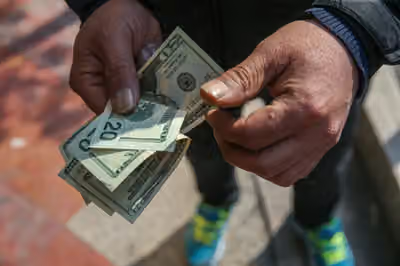
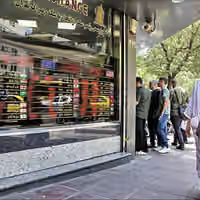
The diplomatic maneuvering coincided with further pressure on Iran’s currency, with the US dollar rising above 2.7 million rials on the free market on Sunday.
The statements put the focus on Tehran’s review of Washington’s response, with Iranian officials differing over whether the next step requires further negotiations or a decision on proposals already exchanged.
Iran’s currency fell to another record low against the dollar on Sunday, extending its decline during a US campaign aimed at restricting the Islamic Republic’s oil exports and financial flows.
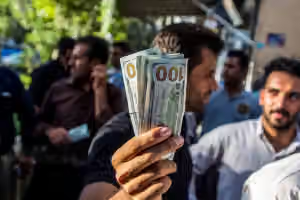
The dollar traded at 2.723 million rials on the open market earlier on October 4, up 1.3% from the previous day.
The euro climbed above 3.06 million rials and the British pound surpassed 3.59 million rials.
US pressure targets oil revenue
Washington has sought in recent weeks to restrict the Iranian government's financial lifelines through a naval blockade, efforts to prevent Iranian oil exports and measures targeting channels used to move oil revenue.
US Treasury Secretary Scott Bessent said on October 3 that Iran would have no oil cargoes on the water this week and would earn no revenue from such shipments, describing it as a first.
Bessent described the US military campaign, naval blockade and economic isolation of the Islamic Republic as interconnected elements of Washington’s strategy.
Iranian parliament deputy speaker Ali Nikzad had earlier said the United States would “never” be able to reduce Iran’s oil exports to zero.
Government moves to curb currency slide
Iranian authorities are seeking ways to contain the currency’s decline and inflation as economic pressure increases.
Tasnim news agency, which is affiliated with the Revolutionary Guards, reported on Sunday that five Iranian banks were selling up to $10,000 to each person over 18 at a rate of 2.57 million rials per dollar on the second day of an official foreign currency program.
The banks participating in the program are Mellat, Tejarat, Melli, Saderat and Saman, according to Tasnim.
Lawmaker Mehdi Kouchakzadeh criticized the central bank program during an online parliamentary session on Sunday, questioning why it had been introduced at what he described as a time of severe foreign currency shortages.
“Other than their friends, dealers and thieves, who can afford to buy this $10,000?” Kouchakzadeh said. “This is money for butterfly skin patients and struggling people that is going into the pockets of capitalists and thieves.”
Kouchakzadeh called the policy a “crime” and urged parliament speaker Mohammad Bagher Ghalibaf to prevent its implementation.
The physical management of foreign currency was of “fundamental importance,” Ghalibaf said in response, promising to pursue the issue.
Supreme National Security Council Secretary Mohsen Rezaei attended a meeting of the government’s economic coordination headquarters on October 3 and said the country was going through one of its most difficult periods.
Despite the deepening economic crisis and growing pressure on citizens, the Islamic Republic continues to pursue policies that have fueled confrontation, particularly its standoff with the United States and its nuclear program.
Rowers Kimia Zarei and Zeinab Norouzi celebrate with their gold medals after winning the women’s lightweight double sculls
Iranian women have delivered a record-breaking performance at the 2026 Asian Games, winning medals across an unusually broad range of sports and achieving a series of firsts for the country.
From first women’s gold medals in rowing and taekwondo to first female medalists in weightlifting and first women’s medal in a running event, the Games in Japan have produced breakthroughs across disciplines in which Iranian women have historically had little presence on the continental podium.
The results are particularly striking given the restrictions Iranian women face under the Islamic Republic over what they wear, which sports they can compete in and the resources available to them.
Perhaps the most striking came on the water.
Within about 20 minutes on September 24, Iranian women won their country’s first two Asian Games rowing golds. Fatemeh Mojallal won the lightweight single sculls before Kimia Zarei and Zeinab Norouzi took gold in the lightweight double sculls.
Mojallal also won bronze in the single sculls, while Zarei and Norouzi added silver in the double sculls. Mahsa Javer, Soha Fakhri, Saghi Maleki and Hengameh Kamyab took silver in the quadruple sculls.
Iranian climber Sarina Ghaffari competes at the 2026 Asian Games in Aichi-Nagoya, Japan.
Iranian women finished the rowing competition with two golds, two silvers and a bronze.
The achievement came after preparations were severely disrupted by the war.
Zarei told the Olympic Council of Asia that the rowers spent around 50 days training at home after their camp was cancelled, using rowing machines rather than getting on the water.
They eventually returned to camp despite the continuing conflict.
“We risked our lives because we wanted this moment,” Zarei said, adding that Iranian women and athletes in particular face “very unique challenges.”
Iran’s Zahra Kahrizi competes in padel at the 2026 Asian Games in Aichi-Nagoya, Japan.
Women were excluded from many disciplines after the 1979 Islamic Revolution and remain required to compete under state-mandated dress rules. Their access to facilities, funding and international competition has also frequently lagged behind that of male athletes.
Four years ago, the death of Mahsa Amini in morality-police custody sparked the Woman, Life, Freedom uprising, which grew into a broader challenge to state restrictions on women.
Since then, young Iranian women have increasingly defied compulsory hijab and other limits on their public lives, driving a social transformation that has continued despite the state’s efforts to reassert control.
Women’s participation in sport has also steadily expanded, sometimes producing success in disciplines where an Iranian female presence at elite international level is relatively recent.
Hengameh Hadiyani competes in artistic gymnastics at the Asian Games
Twenty-year-old Hengameh Hadiyani made history simply by competing, becoming the first Iranian woman to take part in artistic gymnastics at the Asian Games since the 1979 revolution.
She competed in the vault qualification, placing 13th.
Iranian women had effectively been excluded from international gymnastics for decades, with officials citing mandatory dress requirements as an obstacle to participation.
As recently as 2023, a senior Iranian sports official said standard gymnastics attire was incompatible with the Islamic Republic’s “cultural standards.”
But Hadiyani’s full-body competition outfit, designed to comply with Iran’s dress rules while allowing her to compete, drew widespread attention and praise.
Zahra Zarei competes in the women’s 400 metres at the 2026 Asian Games, where she won silver
In athletics, Zahra Zarei ran the 400 metres in 52.38 seconds to win silver, becoming the first Iranian woman to win an Asian Games medal in a running event.
There was another first in weightlifting.
Reihaneh Karimi, 20, lifted a combined 243kg in the 77kg category to take bronze, becoming Iran’s first female Asian Games medalist in weightlifting.
Two days later, 17-year-old Mahsa Beheshti added bronze in the 86kg category.
Iran only began fielding women internationally in weightlifting in recent years. In Nagoya, it produced two medalists, one just 17.
Saghar Moradi Sheikhlari celebrates with her gold medal after winning the women’s under-67kg taekwondo title.
Another landmark came on Friday, when 19-year-old Saghar Moradi Sheikhlari won the women’s under-67kg taekwondo title, becoming the first Iranian woman to win an Asian Games gold in the sport.
A day later, Fatemeh Ahmadi won bronze in women’s taekwondo +67 kg.
Iranian women also took silver in kabaddi after losing a closely fought final 37-34 to India. It continued an unusual run of consistency for the team, which has now won a medal at five consecutive Asian Games, including gold in 2018.
In karate, Fatemeh-Zahra Saeidabadi won silver in the women’s under-55kg competition, while Fatemeh Sadeghi, Sepideh Amini and Zeinab Hosseini took another silver in team kata. Fatemeh Barmaki added bronze in kurash.
Reyhaneh Karimi celebrates after a successful attempt in the women’s 77kg weightlifting event, where she won bronze.
Iran also won bronze in mixed team shooting through Hanieh Rostamian and Vahid Golkhandan.
Not every breakthrough came with a medal. Meshkatolzahra Safi and Mandegar Farzami became the first Iranian women to win singles matches in tennis at an Asian Games, both advancing from the opening round in Nagoya.
Female athletes also competed in mixed events in tennis, table tennis, archery and the mixed 4x400-metre relay.
Their presence across those events further reflected the breadth of the women’s contribution to Iran’s Games.
Hanieh Rostamian and Vahid Golkhandan celebrate after winning bronze for Iran in the mixed team shooting event at the 2026 Asian Games.
Across rowing, athletics, weightlifting and taekwondo, Iranian women rewrote several parts of the country’s Asian Games record within the space of a few days.
Zarei has said she hopes the visibility of athletes like her can encourage another generation of Iranian girls.
“I always try to show the good part of an athlete’s life and motivate the girls at home,” she told the Olympic Council of Asia.
“I always try to show them that you can do this, you can do that, and you can be successful.”
Patients receive treatment at Imam Khomeini Hospital in Tehran.
Iranians are selling livestock, cars and furniture to pay for treatment their insurance no longer covers, and a member of parliament's health committee says the system has reached the point where falling ill can end in death rather than care.
"We have reached a point where we hope people don't get sick, because if they do, the end of that illness is not treatment. It is death," Salman Es'haghi, spokesman for parliament's Health and Treatment Committee, told the labor-affiliated news agency ILNA.
The pressure cannot simply be blamed on war and sanctions, Es'haghi said, accusing the authorities of failing to tackle corruption and poor decision-making as households struggle to pay for medicines, equipment and diagnostic tests.
A separate ILNA report from clinics in Tehran found the same thing from the other side: insured patients waiting weeks or months for diagnostic services, or paying privately for tests they could not get through the Social Security Organization, the state insurer that covers most of Iran's workers and retirees.
A couple sells their sheep and their car
Es'haghi described a rural couple who had sold their livestock and their Pride, the cheap Iranian-built car that was for decades the country's most common, after being told the wife needed a heart valve.
"A man and a woman from one of the villages came to see me," he said. "They said they had several sheep and a Pride, and they had sold them because they were told they needed to buy a heart valve for his wife."
The couple paid 13 billion rials for the valve, about $5,000 at Saturday's open-market rate, or six and a half years of the minimum wage, Eshaghi said. They were then told it was unsuitable and that they would need another.
"A suitable, high-quality valve costs close to 42 billion rials," he said, about $16,000, or 21 years of the minimum wage. "Which patient can pay 42 billion rials?"
Many farming families were selling animals, vehicles and other assets to cover both the equipment and the surgery, he said.
"We have unfortunately closed our eyes to our people dying because of a lack of medicine and the high cost of treatment," Es'haghi said.
Insurance leaves patients exposed
Iran's health insurance funds have stopped protecting patients from the cost of care, Es'haghi said.
"Our insurance funds have effectively declared bankruptcy, but they don't say it out loud," he said. "Because they don't acknowledge their own bankruptcy, they have shifted that bankruptcy onto the people."
More than 80 percent of treatment costs are now paid directly by patients, he said, without giving a source for the figure.
ILNA's reporting on the Social Security Organization points the same way. Nearly 9.9 million people insured by the organization in Tehran province have access to just 36 medical facilities it owns, including 16 polyclinics, according to official figures the agency cited. That is roughly one polyclinic for every 620,000 insured people.
Seeing a doctor is only the beginning
For many patients, getting an appointment does not mean they can complete the treatment prescribed.
At the Abureihan Social Security clinic in Tehran, one woman told ILNA that the ultrasound service the clinic once offered had disappeared.
"This place used to have ultrasound, but it hasn't had it for some time, and now I have to pay a huge amount outside," she said.
Another patient said the clinic had no mammography.
A middle-aged woman in severe abdominal pain said she could not afford the imaging and examinations she had been prescribed.
"I am in severe pain, but further imaging, tests and doctors are beyond what I can afford," she said.
She was the household's breadwinner, she said, earning money from weaving carpets while her husband was out of work. When she was referred to another hospital, she learned the care there would not be free either.
"I have to wait until the carpet is sold and I get the money," she said.
Spokesman for parliament's Health and Treatment Committee Salman Es'haghi
Weeks or months of waiting
Patients who stay inside the Social Security system face long queues instead.
Those referred to larger centers such as Milad Hospital, the organization's flagship hospital in Tehran, must often start over, ILNA reported, because diagnostic departments may accept orders only from the hospital's own doctors. That means another appointment, another consultation, and another wait for imaging or tests.
"These appointments are really useful for someone with a chronic illness who needs constant monitoring, not for someone who has an acute problem right now, today," one patient said.
The squeeze is hardest on retirees and lower-income households who cannot turn to private care.
An elderly woman said she kept making the long trip to a Social Security clinic because private doctors were too expensive, even though she still had to get some medicines and tests elsewhere.
"It's crowded, it's far away and getting here is difficult for me, but because the doctors here are good and my treatment costs less, I still come," she said.
'Why don't we import medicine?'
Es'haghi rejected the argument that Iran's medicine shortages can be explained by sanctions and the war.
"Whenever something happens, we say there is a war, there is no medicine, there are sanctions," he said.
Patients wait for care at the Abureihan Social Security clinic in Tehran.
Iran should be able to use its relationships with Russia and China to obtain medicines and pharmaceutical ingredients, he said.
"We can import medicine and pharmaceutical raw materials from Russia and China. Why don't we?" he said. "If we are vigilant, if there is the will and if we fight corruption, I can tell you seriously that supplying medicine and pharmaceutical raw materials has nothing to do with the war."
Figures presented at official meetings showed some pharmaceutical and medical equipment companies had sharply increased their profits during the war, he said.
"Why don't they tell these companies that during wartime they should at least accept a minimum profit margin so that people don't face such hardship?"
Inflation deepens the squeeze
The health crisis is unfolding as household purchasing power collapses.
Consumer prices in September were 89.8 percent higher than a year earlier, according to the Statistical Center of Iran, and average inflation over the preceding twelve months reached 73.6 percent. Food and drink prices had already risen 127.5 percent year on year in August.
The rial's fall to record lows has raised the local cost of imported medicines, equipment and pharmaceutical ingredients.
The strain is visible in the volume of demand on a system that cannot meet it. Social Security facilities in Tehran recorded more than 18.1 million outpatient visits in the Iranian year that ended in March, including about 8.5 million doctor consultations and 9.6 million visits for diagnostic and other services.
For poorer patients, each extra appointment means transport costs, lost wages and another delay. The result, ILNA said, is that some workers and retirees are forced to choose between paying privately, waiting, or abandoning part of their treatment.
IRGC General Gholamreza Jalali has been heading Iran’s National Organization for Passive Defense since 2005.
Senior Iranian military and security officials have been photographed wearing smartwatches, drawing fresh criticism of their basic security discipline after years of reports that Israel has used electronic devices around Iranian commanders to track and kill them.
The images drew widespread reactions after they were posted on X on Friday by Ali Gholhaki, a conservative commentator with ties to Iran's security establishment. Some Iranian outlets describe him as close to parliament speaker Mohammad-Bagher Ghalibaf.
The pictures show smartwatches on the wrists of three men: Gholamreza Jalali, who heads the Passive Defense Organization, the body that protects Iran's critical infrastructure; Reza Farahi, a Defense Ministry official; and Ali Shamkhani, the former secretary of the Supreme National Security Council.
Shamkhani was killed in US-Israeli airstrikes on February 28, on the first day of the current war. He had survived an Israeli strike in June 2025.
Asked about his watch by a Fars News reporter, Jalali asked whether people had smart televisions at home and said his device was effectively the same thing.
Gholhaki rejected the comparison. The man in charge of protecting the country's critical infrastructure, he argued, faces a different order of risk from an ordinary citizen, and such devices are hard to justify for senior security officials when Israel has repeatedly exploited electronic lapses to track Iranian personnel.
Smartwatches can transmit location and activity data through GPS, Bluetooth, Wi-Fi or a paired phone, and some carry microphones and other sensors.
The US military has long restricted location-tracking devices, smartwatches included, in operational areas because they can expose movements and routines; in 2018, a fitness app's public heat map revealed the outlines of American bases from soldiers' running routes.
'Careless use'
The row touches a much larger argument inside the Islamic Republic about repeated intelligence failures.
During the 12-day war in June 2025, Iran's Cyber Security Command banned officials and their security teams from using any device connected to public communication or telecommunications networks, Fars reported, as concern grew that mobile tracking was being used for targeted assassinations.
The directive named smartphones, laptops and smartwatches, and warned that switching a device off might not prevent it from being located.
It came too late. The New York Times later reported, citing Iranian and Israeli officials, that Israel tracked and targeted senior Iranian leaders and nuclear scientists in that war by hacking the phones of their bodyguards and drivers.
On June 16, 2025, the Supreme National Security Council met in a bunker deep beneath a mountain in western Tehran; none of the officials carried phones, but the Israelis found the meeting through the phones of the bodyguards who had driven them there. The bodyguards had long been exempt from the strict phone bans imposed on the commanders themselves, even after earlier assassinations.
Gholhaki tied the smartwatches directly to those failures, arguing that complacency had helped Israel and the United States kill senior military, security and political figures in successive wars. He called for fundamental changes in security practice and renewed his demand for a broad postwar inquiry into how the failures happened.
Gholhaki himself was among a group of Telegram channel operators arrested by the Revolutionary Guards' counterintelligence arm in 2022, accused of disturbing public opinion and publishing classified documents.
A blogger on death row
The judiciary has shown no such tolerance for ordinary Iranians accused of far smaller breaches.
Marziyeh "Sevda" Ebrahimi Shamsabadi, a 33-year-old blogger from Bandar Abbas who has been held since March, was sentenced to death in August by a Revolutionary Court on charges including insulting the supreme leader, intelligence activity on behalf of hostile governments, and taking and sending photographs to Persian-language media abroad.
One allegation concerned a photograph she was said to have taken, from a distance, of a site hit by a missile. She was held in solitary confinement for 20 days and faced severe pressure during interrogation.