Iran reviews US response to seven-day proposal as officials debate next steps
Iran is reviewing Washington’s response to a seven-day proposal sent through intermediaries, a senior foreign ministry official said on Sunday, as other officials offered differing assessments of whether further negotiations with the United States were needed.
Iran reviews US response
Iran’s seven-day proposal, outlined by Foreign Minister Abbas Araghchi in New York, was sent to Washington through intermediaries and the United States subsequently provided its views on the plan, Deputy Foreign Minister Kazem Gharibabadi said Sunday.
“The proposal that Mr. Araghchi outlined in New York, Iran’s seven-day plan, was sent to the United States through intermediaries, and they provided their views on the plan,” Gharibabadi said.
The US response is being reviewed inside Iran and Tehran will communicate its final position through the appropriate channel once that process is complete, Gharibabadi said. Iran was also maintaining readiness for “other scenarios,” he added.
Parliament deputy speaker Hamid-Reza Haji Babaei separately said negotiations with Washington were taking place, while expressing little confidence that they would ultimately produce an understanding.
“Negotiations with the United States are in fact underway now,” Haji Babaei said.
Alaeddin Boroujerdi, a member of parliament’s National Security and Foreign Policy Committee, said US proposals had recently been conveyed through Qatar, although he did not know their details.
Foreign Ministry spokesman Esmaeil Baghaei said US proposals remained focused on the nuclear issue and Iran had already responded. He also rejected President Donald Trump’s remark that Washington did not know who represented Iran in negotiations, saying a six-member committee under the Supreme National Security Council was overseeing the process.
Lawmakers differ on further talks
Despite the exchanges, parliament’s National Security and Foreign Policy Committee spokesman Hassan Ghashghavi said there were no unresolved substantive issues requiring new negotiations.
“We are, in my view, at a post-negotiations stage both on the Strait of Hormuz and on the conditions,” Ghashghavi said.
Another committee member, Ebrahim Rezaei, said Iran would not retreat from its conditions and presented diplomacy and military pressure as the alternatives facing Washington.
“The Americans must either surrender to our diplomats or surrender to Iran’s missiles. We have no other proposal for them,” Rezaei said.
Nuclear debate continues as rial falls
The nuclear program remained part of the diplomatic debate. Baghaei said Iran remained bound by its obligations under the Treaty on the Non-Proliferation of Nuclear Weapons for as long as it remained a member.
Parliament will consider a possible withdrawal from the NPT while maintaining uranium enrichment, parliament board member Alireza Salimi said.
Iran is also considering a Russian offer to take custody of its uranium enriched to 60%, with a final decision to be based on its national interests, Baghaei said.
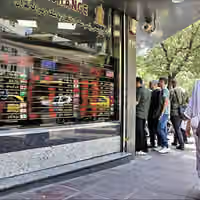
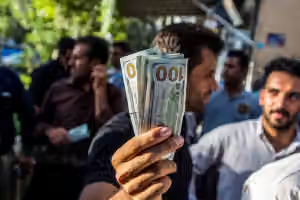
The diplomatic maneuvering coincided with further pressure on Iran’s currency, with the US dollar rising above 2.7 million rials on the free market on Sunday.
The statements put the focus on Tehran’s review of Washington’s response, with Iranian officials differing over whether the next step requires further negotiations or a decision on proposals already exchanged.
Iran’s currency fell to another record low against the dollar on Sunday, extending its decline during a US campaign aimed at restricting the Islamic Republic’s oil exports and financial flows.
The dollar traded at 2.723 million rials on the open market earlier on October 4, up 1.3% from the previous day.
The euro climbed above 3.06 million rials and the British pound surpassed 3.59 million rials.
US pressure targets oil revenue
Washington has sought in recent weeks to restrict the Iranian government's financial lifelines through a naval blockade, efforts to prevent Iranian oil exports and measures targeting channels used to move oil revenue.
US Treasury Secretary Scott Bessent said on October 3 that Iran would have no oil cargoes on the water this week and would earn no revenue from such shipments, describing it as a first.
Bessent described the US military campaign, naval blockade and economic isolation of the Islamic Republic as interconnected elements of Washington’s strategy.
Iranian parliament deputy speaker Ali Nikzad had earlier said the United States would “never” be able to reduce Iran’s oil exports to zero.
Government moves to curb currency slide
Iranian authorities are seeking ways to contain the currency’s decline and inflation as economic pressure increases.
Tasnim news agency, which is affiliated with the Revolutionary Guards, reported on Sunday that five Iranian banks were selling up to $10,000 to each person over 18 at a rate of 2.57 million rials per dollar on the second day of an official foreign currency program.
The banks participating in the program are Mellat, Tejarat, Melli, Saderat and Saman, according to Tasnim.
Lawmaker Mehdi Kouchakzadeh criticized the central bank program during an online parliamentary session on Sunday, questioning why it had been introduced at what he described as a time of severe foreign currency shortages.
“Other than their friends, dealers and thieves, who can afford to buy this $10,000?” Kouchakzadeh said. “This is money for butterfly skin patients and struggling people that is going into the pockets of capitalists and thieves.”
Kouchakzadeh called the policy a “crime” and urged parliament speaker Mohammad Bagher Ghalibaf to prevent its implementation.
The physical management of foreign currency was of “fundamental importance,” Ghalibaf said in response, promising to pursue the issue.
Supreme National Security Council Secretary Mohsen Rezaei attended a meeting of the government’s economic coordination headquarters on October 3 and said the country was going through one of its most difficult periods.
Despite the deepening economic crisis and growing pressure on citizens, the Islamic Republic continues to pursue policies that have fueled confrontation, particularly its standoff with the United States and its nuclear program.
US President Donald Trump gestures during a rally at Butler High School in Vandalia, Ohio, US, October 3, 2026.
US President Donald Trump said Saturday he was approaching a decision on Iran, warning Tehran faced the “easy way or the hard way” as the Pentagon kept military options open amid continued attacks on commercial vessels in the Strait of Hormuz.
“We have a decision that I’ll make about Iran,” Trump told reporters. “Iran has been decimated, so the only question is it’ll either be the easy way or the hard way.”
Trump also said Iran was “virtually giving up” any plans to obtain a nuclear weapon, while reiterating that Tehran would never be allowed to acquire one.
Defense Secretary Pete Hegseth gave a clearer indication of what the harder option could involve, saying the Pentagon was working to ensure Trump retained “all the options he needs on the table” if Iran refused to abandon its nuclear ambitions.
“Iran will never, ever, ever have a nuclear weapon,” Hegseth said, describing Trump as “hell-bent and determined” to prevent it.
Pentagon preserves military options
Hegseth declined to say whether the USS Theodore Roosevelt carrier strike group, dispatched from San Diego last week, would be sent to the Middle East, saying his job was to give Trump the widest possible “decision space.”
He said Iran was trying to rebuild missile and other military capabilities damaged by US strikes but argued that damage to its defense industry had slowed that effort.
The military pressure has remained concentrated around the Strait of Hormuz, where Hegseth claimed Washington, rather than Tehran, now controlled the waterway. He described the US blockade as “ironclad” and said traffic was moving back toward pre-war levels.
Commercial vessels, however, continue to face attacks.
Iranian state media reported Saturday that another oil tanker had been hit in the strait. The IRGC-affiliated Fars News identified the vessel as the Ore Vinst and claimed it had been traveling under US escort when it was targeted while heading toward Oman.
The United States has not reacted to the claim yet.
The incident followed a series of attacks on ships transiting Hormuz even as Washington has escorted vessels through the waterway and sought to restore energy flows.
US says pressure campaign is cutting Iran’s revenue
The blockade is also intended to deny Tehran the oil income Washington says it needs to rebuild its military capabilities.
Treasury Secretary Scott Bessent said Iran would have no oil shipments at sea this week and therefore no revenue from those cargoes, describing the blockade and subsequent economic isolation as the next stages of a campaign that began with US military strikes.
“We had kinetic [action], we destroyed their navy, their air force, substantially depleted their drone and missile capability,” Bessent said.
“Then we went to what the president calls the Iron Wall and the blockade,” he added. “And now we have Operation Economic Outcast and we are isolating them economically like it’s never happened before.”
White House Communications Director Steven Cheung also said Iranian oil exports had been “stopped completely” and cited a Bloomberg report putting inflation at almost 90%.
Iran’s government has acknowledged increasing economic pressure while rejecting Washington’s claim that its strategy is succeeding.
President Masoud Pezeshkian said Saturday his government had adopted a “new posture” to manage what he described as exceptional conditions.
“The enemy’s plan in recent months has been to cut the country’s vital arteries with the aim of putting pressure on the Iranian people,” he wrote on X.
Pezeshkian said the pressure had increased but argued that government measures and public cooperation had prevented Iran’s adversaries from achieving their objectives.
Diplomatic channel remains open
Trump’s pending decision comes with diplomacy still technically alive but with no clear sign of a breakthrough after the latest contacts between Washington and Tehran.
The conservative Sobh-e No newspaper which is close to Iran’s chief negotiator Mohammad Bagher Ghalibaf reported Saturday that Iran was reviewing a US proposal conveyed through Qatar setting out a roadmap and timetable for further negotiations.
The paper said Tehran continued to demand that Washington first meet its commitments, including sanctions relief and the release of frozen Iranian funds, and that Iran’s principal conditions remained unchanged.
Those contacts follow talks in New York that failed to produce an agreement, with the two sides remaining divided over the terms for ending the war and reopening Hormuz.
For now, Trump has continued to present the choice as Iran’s: accept a deal under mounting military and economic pressure or face what he calls the “hard way.”
Patients receive treatment at Imam Khomeini Hospital in Tehran.
Iranians are selling livestock, cars and furniture to pay for treatment their insurance no longer covers, and a member of parliament's health committee says the system has reached the point where falling ill can end in death rather than care.
"We have reached a point where we hope people don't get sick, because if they do, the end of that illness is not treatment. It is death," Salman Es'haghi, spokesman for parliament's Health and Treatment Committee, told the labor-affiliated news agency ILNA.
The pressure cannot simply be blamed on war and sanctions, Es'haghi said, accusing the authorities of failing to tackle corruption and poor decision-making as households struggle to pay for medicines, equipment and diagnostic tests.
A separate ILNA report from clinics in Tehran found the same thing from the other side: insured patients waiting weeks or months for diagnostic services, or paying privately for tests they could not get through the Social Security Organization, the state insurer that covers most of Iran's workers and retirees.
A couple sells their sheep and their car
Es'haghi described a rural couple who had sold their livestock and their Pride, the cheap Iranian-built car that was for decades the country's most common, after being told the wife needed a heart valve.
"A man and a woman from one of the villages came to see me," he said. "They said they had several sheep and a Pride, and they had sold them because they were told they needed to buy a heart valve for his wife."
The couple paid 13 billion rials for the valve, about $5,000 at Saturday's open-market rate, or six and a half years of the minimum wage, Eshaghi said. They were then told it was unsuitable and that they would need another.
"A suitable, high-quality valve costs close to 42 billion rials," he said, about $16,000, or 21 years of the minimum wage. "Which patient can pay 42 billion rials?"
Many farming families were selling animals, vehicles and other assets to cover both the equipment and the surgery, he said.
"We have unfortunately closed our eyes to our people dying because of a lack of medicine and the high cost of treatment," Es'haghi said.
Insurance leaves patients exposed
Iran's health insurance funds have stopped protecting patients from the cost of care, Es'haghi said.
"Our insurance funds have effectively declared bankruptcy, but they don't say it out loud," he said. "Because they don't acknowledge their own bankruptcy, they have shifted that bankruptcy onto the people."
More than 80 percent of treatment costs are now paid directly by patients, he said, without giving a source for the figure.
ILNA's reporting on the Social Security Organization points the same way. Nearly 9.9 million people insured by the organization in Tehran province have access to just 36 medical facilities it owns, including 16 polyclinics, according to official figures the agency cited. That is roughly one polyclinic for every 620,000 insured people.
Seeing a doctor is only the beginning
For many patients, getting an appointment does not mean they can complete the treatment prescribed.
At the Abureihan Social Security clinic in Tehran, one woman told ILNA that the ultrasound service the clinic once offered had disappeared.
"This place used to have ultrasound, but it hasn't had it for some time, and now I have to pay a huge amount outside," she said.
Another patient said the clinic had no mammography.
A middle-aged woman in severe abdominal pain said she could not afford the imaging and examinations she had been prescribed.
"I am in severe pain, but further imaging, tests and doctors are beyond what I can afford," she said.
She was the household's breadwinner, she said, earning money from weaving carpets while her husband was out of work. When she was referred to another hospital, she learned the care there would not be free either.
"I have to wait until the carpet is sold and I get the money," she said.
Spokesman for parliament's Health and Treatment Committee Salman Es'haghi
Weeks or months of waiting
Patients who stay inside the Social Security system face long queues instead.
Those referred to larger centers such as Milad Hospital, the organization's flagship hospital in Tehran, must often start over, ILNA reported, because diagnostic departments may accept orders only from the hospital's own doctors. That means another appointment, another consultation, and another wait for imaging or tests.
"These appointments are really useful for someone with a chronic illness who needs constant monitoring, not for someone who has an acute problem right now, today," one patient said.
The squeeze is hardest on retirees and lower-income households who cannot turn to private care.
An elderly woman said she kept making the long trip to a Social Security clinic because private doctors were too expensive, even though she still had to get some medicines and tests elsewhere.
"It's crowded, it's far away and getting here is difficult for me, but because the doctors here are good and my treatment costs less, I still come," she said.
'Why don't we import medicine?'
Es'haghi rejected the argument that Iran's medicine shortages can be explained by sanctions and the war.
"Whenever something happens, we say there is a war, there is no medicine, there are sanctions," he said.
Patients wait for care at the Abureihan Social Security clinic in Tehran.
Iran should be able to use its relationships with Russia and China to obtain medicines and pharmaceutical ingredients, he said.
"We can import medicine and pharmaceutical raw materials from Russia and China. Why don't we?" he said. "If we are vigilant, if there is the will and if we fight corruption, I can tell you seriously that supplying medicine and pharmaceutical raw materials has nothing to do with the war."
Figures presented at official meetings showed some pharmaceutical and medical equipment companies had sharply increased their profits during the war, he said.
"Why don't they tell these companies that during wartime they should at least accept a minimum profit margin so that people don't face such hardship?"
Inflation deepens the squeeze
The health crisis is unfolding as household purchasing power collapses.
Consumer prices in September were 89.8 percent higher than a year earlier, according to the Statistical Center of Iran, and average inflation over the preceding twelve months reached 73.6 percent. Food and drink prices had already risen 127.5 percent year on year in August.
The rial's fall to record lows has raised the local cost of imported medicines, equipment and pharmaceutical ingredients.
The strain is visible in the volume of demand on a system that cannot meet it. Social Security facilities in Tehran recorded more than 18.1 million outpatient visits in the Iranian year that ended in March, including about 8.5 million doctor consultations and 9.6 million visits for diagnostic and other services.
For poorer patients, each extra appointment means transport costs, lost wages and another delay. The result, ILNA said, is that some workers and retirees are forced to choose between paying privately, waiting, or abandoning part of their treatment.
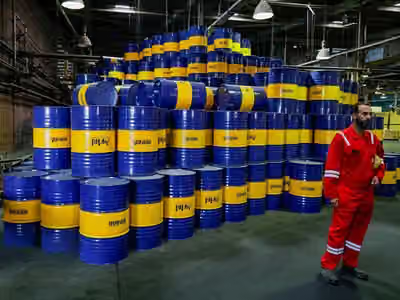
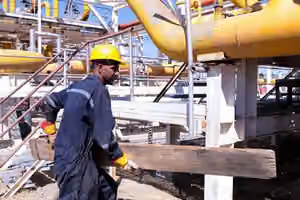
A worker at the Iranol oil refinery in Tehran, Iran, September 29, 2026
Iran’s worsening economic crisis has opened an increasingly bitter argument over who is responsible, as the government points to outside pressure and market psychology while hardliners accuse Tehran’s own economic officials of making the situation worse.
On Thursday, the end of Iran’s market week, the rial fell to another record low. Year-on-year inflation has reached almost 90 percent, with food prices rising even faster.
The deterioration comes as US sanctions and a naval blockade squeeze Iran’s sources of revenue. The blockade has severely constrained oil exports, while Washington on Thursday expanded sanctions into the automotive and rail sectors, targeting some of the country’s largest industrial companies.
US Treasury Secretary Scott Bessent has seized on the rial’s collapse as evidence that Washington’s pressure campaign is working, saying this week that it had driven the currency to its lowest level in history.
Iranian Economy Minister Ali Madanizadeh rejected Bessent’s assessment, telling the official IRNA news agency Thursday that predictions of an imminent economic collapse had repeatedly proved wrong.
“They want to create unrest and stress among the people so they rush to the currency market and the exchange rate increases; otherwise, these statements serve no purpose, and we will not allow this to happen,” he said.
The Central Bank has offered a similar diagnosis. It said Friday that the exchange rate was not “fully consistent with the economy’s fundamental variables,” attributing much of the gap to heightened uncertainty, psychological pressure and market expectations.
The bank announced Wednesday that it planned to inject $2 billion in banknotes into the market. So far, however, the intervention has failed to halt the rial’s slide.
‘The Central Bank shoots it into its own goal’
Hardliners have challenged the government’s explanation, arguing that sanctions and the war cannot by themselves account for the surge in the exchange rate and prices.
Nadergholi Ebrahimi, a hardline lawmaker, claimed in an online interview Thursday that the war had contributed no more than 25% to the recent rise in prices and accused government economic officials of deliberately fueling inflation.
Threatening to seek the impeachment of economic ministers, he accused them of waging an “economic sedition” that was reducing the public’s ability to withstand economic pressure and increasing dissatisfaction.
Hossein Samsami, an economist and hardline lawmaker, has also attacked the Central Bank’s handling of the exchange rate.
“Today, the currency is the enemy’s tool in an all-out economic war, and the measure of its success is the devaluation of our national currency,” Samsami wrote on X.
But he accused the Central Bank itself of helping drive that process by following an exchange rate he said was artificially determined by Iran’s enemies.
“The enemy passes the ball, and the Central Bank shoots it into its own goal!” he wrote.
Inflation approaches 90 percent
Whatever the relative weight of sanctions, war, expectations and domestic policy, their combined effect is increasingly visible in household finances.
According to the Statistical Center of Iran, annual inflation has reached 73.6%, while year-on-year inflation rose to a record 89.8%.
Food and beverage prices have risen substantially faster than overall inflation, hitting lower-income households particularly hard because they devote a larger share of their income to food and other essentials.
Accelerating prices have also eroded the value of government food vouchers introduced after subsidized foreign-exchange rates for a range of goods were removed amid a sharp depreciation of the rial and economic protests in December and January.
Although the government pledged to increase the value of the vouchers in line with rising prices, it has yet to do so.
Wages fall behind as prices surge
The pressure is also increasingly visible among salaried workers.
Videos circulating on social media in recent weeks have shown teachers and nurses saying low wages have left them with no choice but to resign after years in their professions.
Ali Farhadi, spokesman for Iran’s Education Ministry, dismissed reports of widespread teacher resignations as a “rumor” on Friday.
The dispute has become another front in the broader argument over the economic crisis, with government supporters alleging that expressions of discontent are being amplified to encourage unrest and critics accusing authorities of dismissing genuine economic grievances.
Samsami, however, has placed greater responsibility for the hardship on domestic economic policy than on Washington.
“The pressure imposed on people’s livelihoods by misguided economic policies is far greater than that caused by sanctions and the naval blockade,” he wrote, adding: “We are not at an impasse. By reforming our policies, we can control inflation even under these sanctions.”
A teacher embraces a young student in a girls’ classroom in Iran's southern port city of Bushehr, September 2026
Iran’s Education Ministry dismissed reports of teacher resignations over working conditions and security pressure as a “rumor,” despite numerous videos of teachers announcing departures and a teachers’ council warning of a growing exodus.
Education Ministry spokesman Ali Farhadi said Friday that reports of teacher resignations were “not true” and accused unspecified actors of trying to undermine in-person education.
“The resignation of teachers is a rumor,” Farhadi told the Tasnim news agency, saying teachers and students had welcomed the return to classrooms across the country, including in southern provinces such as Hormozgan.
But the Coordinating Council of Iranian Teachers’ Trade Associations has offered a sharply different account, saying numerous videos and reports of resignations have emerged from different parts of the country in recent weeks.
The council said teachers were leaving because of a combination of wages below the poverty line, worsening living conditions, administrative pressures and what it described as the securitization of the profession, including dismissals, suspensions, arrests and legal cases against teachers and union activists.
It warned that experienced teachers were being driven out of classrooms by policies that had pushed the education system toward decline.
Videos circulating on social media in recent days have shown teachers announcing their resignations and citing financial hardship, workload and a lack of recognition for their work.
The dispute comes as Iran’s education system is already grappling with teacher shortages and longstanding discontent over pay and working conditions.
Teachers have repeatedly protested over salaries and benefits, including at a demonstration outside the Planning and Budget Organization in Tehran in September.
Labor activists have also warned that financial pressures are forcing some teachers to work multiple jobs, while shortages of teaching staff are affecting the quality of education.
The resignations have emerged against a wider backdrop of pressure on teachers and union activists, who in recent years have faced arrests, prison sentences, dismissal and suspension from work.
The Coordinating Council rejected the government’s portrayal of the unrest in schools as the product of outside agitation, arguing that the discontent stems instead from conditions within the education system itself.
Whether the resignations amount to the “wave” described by the teachers’ council is difficult to establish. The pressures it says are driving teachers out are considerably easier to document.