Hamid Kouhsari was carrying a wounded woman on his back through the streets of Gorgan on January 8 when security forces shot him from behind. He spent the next eight months in hiding with his leg untreated, before leaving Iran.
Kouhsari, 31, told Iran International that during the January 2026 uprising he saw security forces use violence unlike anything he had witnessed before in Gorgan, the capital of Golestan province in northern Iran, including the shooting of a toddler in the face. He spoke from a location that is being withheld because he fears reprisals from the Iranian authorities.
Security forces opened fire directly on crowds on January 8 as demonstrations swelled across the city, he said.
"You couldn't believe what you were seeing," he said. "They pointed their weapons directly at the crowd and opened fire. People were falling like sparrows."
Kouhsari had taken part in the November 2019 protests and in the 2022 protests that followed the death in morality police custody of Mahsa Amini, who had been detained for allegedly violating Iran's hijab rules. Nothing he saw then, he said, compared with January.
"It was unimaginable," he said. "They were firing bursts into the middle of the crowd."
‘The hardest part’
The scene that affected him most, Kouhsari said, involved a couple carrying a child he thought was about two years old.
"The hardest part for me was when there was a husband and wife with a child, about two years old, in their arms," he said.
All three were caught in the gunfire, he said. The father was hit below the waist, and the mother in her face, neck and abdomen. Kouhsari and others moved the parents toward people helping the wounded.
In the chaos, his attention turned to their child.
"I was thinking about the child in all that fear and panic," he said.
He realized he could no longer hear the toddler crying, he said, and then saw the child lying near the curb.
"I was just praying the child wasn't dead, that they were unconscious," he said.
When he picked the child up, he saw a severe gunshot wound to the face.
"Half of the child's face was gone from the bullet," he said.
Kouhsari said he screamed and began crying, then carried the child to a woman helping the wounded.
"I told her, 'This is their child too. Wherever you sent the mother and father, send the child there as well.'"
He never learned what happened to the family.
Shot while carrying a wounded woman
Later that night, another wounded woman begged him for help.
"Help me. Don't let them kill me," he recalled her saying.
Kouhsari lifted her onto his back and began carrying her toward the crowd.
"I told her, even if I die myself, I won't let you die here," he said.
As he neared the other protesters, security forces shot him from behind in the right leg.
He managed a few more steps before collapsing. Protesters pulled him into the crowd and used scarves and shoelaces to stem the bleeding.
Video reviewed by Iran International shows Kouhsari lying in a house where he was hiding, his wounded leg bleeding into a container, visibly in pain.
A screengrab of footage showing Hamid Kouhsari receiving makeshift treatment for a gunshot wound to his right leg while in hiding after the January 8 protests in Gorgan.
He could not risk going to a hospital, he said, and was afraid even to try to get medicine from a pharmacy, because wounded protesters were being identified and detained.
"I wasn't afraid of being shot," he said. "I was terrified they would come and take me away."
That fear came from what happened after the November 2019 protests. Kouhsari said he was detained and later summoned to a Revolutionary Guards facility in Gorgan, where over several hours he was pressured into recording a confession.
His father, he said, was a veteran of the 1980-88 Iran-Iraq war and was wounded in it. Decades later, the son was shot by his own country's security forces in the street.
A doctor who later examined his leg privately told him it needed surgery because of damage to the bone and nerves, Kouhsari said.
The operation never happened.
Kalashnikovs, pellet guns and lasers
Kouhsari said he saw security forces use Kalashnikov-type rifles and pellet guns on January 8, as well as a weapon he could not identify.
He also described gunmen positioned above the streets, and protesters being marked with lasers before they were shot from those elevated positions.
"They would keep the laser on them even when they went into the crowd," he said. "The sniper from above would shoot the people they had marked with the laser."
Separate CCTV footage from Gorgan on January 9, obtained and verified by Iran International, shows security forces using lasers during the crackdown.
Kouhsari said Reza Asadi, a protester killed by live fire in Gorgan on January 8, was among those he saw marked with a laser before being shot.
CCTV footage obtained and verified by Iran International shows security forces using lasers in Gorgan on January 9, a day after Hamid Kouhsari said protesters were targeted with similar tactics.
A body taken, a family kept searching
Among those killed that night was Kouhsari's relative Mostafa Kouhsari, a father of two from Azadshahr, about 75 kilometers east of Gorgan.
Mostafa was shot at around 9 p.m., Kouhsari said, and died on the way to the hospital as protesters tried to save him.
Revolutionary Guards forces took his body, Kouhsari said, and for four days the family had no word of where he was. After days of searching, they found him at a morgue in Gonbad-e Kavus, a city in the north of the province.
Mostafa Kouhsari was shot by security forces during the January 8 protests and died on the way to hospital, according to his relative Hamid Kouhsari.
Intelligence agents then escorted the body back to Viro, a village east of Gorgan, and pressed the family not to hold a public funeral, Kouhsari said. Mostafa was buried there at around 6 a.m.
The pressure continued after the burial. The family held no memorial at the village mosque and instead marked the third, seventh and 40th days after his death, the customary points of mourning in Iran, privately at Mostafa's home.
Others close to him were also killed, Kouhsari said, but some of their families had asked him not to name them for fear of reprisals.
Eight months in hiding
With his leg still badly injured, Kouhsari went into hiding.
For about eight months, he said, he moved between car washes, cattle sheds, abandoned houses and remote villas belonging to friends.
"When I heard the sound of police, the hair on my body would stand up," he said.
Friends brought him food and medicine. The surgery the doctor had said he needed never took place.
His fear of being found grew after a friend was detained. The man revealed information under torture, Kouhsari said, and he became increasingly afraid the authorities could identify him.
In the end, facing the threat of arrest and fearing for his life, he was forced to leave Iran.
A final goodbye
Before leaving, Kouhsari photographed his home after emptying it of his belongings.
He could not properly say goodbye to much of his family, he said, and does not know when he will see them again.
"Saying goodbye to my mother was very hard," he said.
Hamid Kouhsari
One of his last memories is of saying goodbye to his dog, whom he left with a friend.
"When I was saying goodbye to my dog, I saw my whole family in that animal," he said.
"The night I left Iran, for the first time in eight months I was able to sleep peacefully."
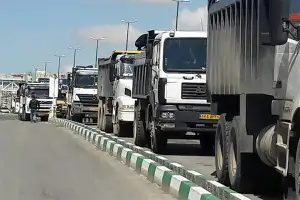
Staff at a repair workshop in Isfahan’s Amir Kabir industrial district, where businesses serving trucks and heavy machinery have reported a sharp drop in activity. (ILNA)
Business at one of central Iran’s main heavy-vehicle service hubs has fallen by about 30% from a year earlier, offering a ground-level view of an economy where soaring food prices, a battered currency and weaker freight activity are squeezing workers and small businesses.
The Amir Kabir industrial area in Isfahan is home to mechanics, machinists, body shops, battery specialists and parts dealers serving trucks, construction equipment and mining machinery. Labor news agency ILNA said activity across the district had fallen sharply as transport demand weakened and the cost of keeping vehicles on the road climbed.
“When freight activity slows and less cargo is being moved, drivers face serious problems,” a person working in the district told ILNA. “Most drivers bought their vehicles on installment, so besides making loan payments, they also have to cover the high cost of supporting their families.”
The slowdown comes as Iranian households face some of the steepest price increases in years. Official data for September showed consumer prices were 89.8% higher than a year earlier, while average inflation over the preceding 12 months reached 73.6%. Food and drink prices had already risen 127.5% year on year in August.
Reuters reported in September that food prices had more than doubled while the wider economy was being squeezed by sanctions, restrictions on oil exports and the costs of the seven-month conflict with the United States.
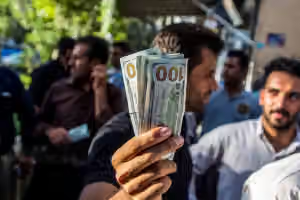
Iran’s currency has added another layer of pressure. The rial fell beyond 2.5 million to the US dollar on the free market earlier this week, a record low, compared with roughly 1.1 million a year earlier.
For businesses dependent on imported equipment, that fall feeds quickly into prices.
“Parts dealers buy according to the day’s dollar rate,” an Amir Kabir business operator said, adding that prices often fail to come back down even when the rial temporarily strengthens.
“The consumer and the worker end up carrying the greatest burden,” he said.
The industrial district illustrates how weakness in one part of Iran’s economy spreads quickly into others.
A single truck can generate work for engine mechanics, gearbox specialists, machinists, painters, welders, upholsterers and parts sellers before it gets back on the road. When freight volumes fall, drivers delay repairs and workshops lose business.
“There’s a deep slowdown across the industrial area,” the tradesperson said. “It’s not that the vehicles don’t need work. Purchasing power and liquidity have fallen sharply.”
Some vehicles are repaired but then sit idle because there is no cargo to move, he said. Even when transport work is available, delayed payments from cargo owners leave drivers and workshops short of cash.
That weakness is also reflected in accounts shared with Iran International, with Iranians describing cuts to spending on food, housing and medicine as savings run down and private-sector job losses spread.
Cheap parts bring expensive problems
Workshop owners are also grappling with replacement parts that they say are either prohibitively expensive or of poorer quality.
A local tradesperson told ILNA that original components for older European and American heavy vehicles had become difficult to obtain, leaving operators increasingly dependent on Chinese-made replacements.
“In the past, if you rebuilt a Volvo or Mack with original parts, it could run for years without another major repair,” he said. “Now poor-quality parts mean repeated breakdowns.”
Original parts can still sometimes be found, he added, but at prices that often make them uneconomical for truck owners already dealing with loans, insurance and weaker freight income.
The result is a cycle in which operators choose cheaper parts, suffer more frequent failures and return to workshops while having less money available to pay for the repairs.
The downturn is beginning to affect hiring and job security.
A machining workshop may employ 10 to 12 people repairing engine blocks, crankshafts and other heavy components. With business down and insurance, municipal charges and other expenses still rising, workshop owners may stop taking on workers or begin cutting staff, according to ILNA.
“A workshop with 10 or 12 workers may no longer want to expand its workforce and may even reduce the number of employees because its income cannot cover its costs,” a local business owner said.
The impact could outlast the immediate downturn. Training an experienced technician can take about a decade, he said, but workshops have less incentive to bring in apprentices when they are unsure whether they can retain existing staff.
Pressure reaches beyond Isfahan
The problems in Amir Kabir mirror a broader contraction in everyday economic activity as the government struggles with reduced oil revenues, sanctions and restrictions on trade.
US pressure has sharply reduced Iran’s access to foreign currency from oil exports, while sanctions evasion has become more costly. That has made imported equipment and raw materials harder to finance just as the rial’s fall raises their local-currency price.
For the workers and drivers in Isfahan, however, the crisis comes down to a simpler calculation: there is less work, while virtually everything needed to do that work costs more.
“If prices are going to remain high, then at the very least the volume of work has to increase,” a local tradesperson told ILNA. “Businesses need enough cash flow to keep operating.”
Travelers board a FlyDubai aircraft at Ben Gurion International Airport after a separate FlyDubai flight from the United Arab Emirates to Israel was diverted to Saudi Arabia following an emergency signal, in Lod, near Tel Aviv, Israel, September 30, 2026. REUTERS
Iran on Thursday was linked by US and Israeli officials to the Flydubai incident, the second such case after British police opened a probe into possible Tehran involvement in a suspected RAF Fairford plot and arrested a dual UK-Iranian national.
US President Donald Trump raised the prospect of an Iranian connection, saying investigators were examining whether Tehran had a role in the incident and that, based on what he was hearing, he believed there could be one.
“We're working on it right now,” Trump said. “I would say the answer based on what I'm hearing, is yes. But we're working on it right now.”
Asked whether the co-pilot could have been placed on the flight by Iran’s Revolutionary Guards or radicalized separately, Trump said: “It could have been. Yeah.”
Trump also warned Iran of retaliation if investigators established its involvement.
“Oh they’ll be hit, very hard, don’t worry,” he told reporters Thursday. “You just ask them. They know what happened. They’ll be hit very hard.”
Israeli agencies investigate
Israel’s Mossad and Shin Bet intelligence and security agencies are also investigating the incident and whether the Omani co-pilot acted alone or was directed by others, according to i24News. Israeli officials said no Iranian involvement had been identified so far, and an initial assessment was that the co-pilot likely acted alone.
Prime Minister Benjamin Netanyahu said Thursday that the co-pilot had undergone Islamist radicalization but that it was too early to determine whether he had connections to Iran.
“I think it's too early to say whether he had any connections with Iran or with anyone else,” Netanyahu said, adding that he expected more clarity within days.
The flight from Dubai to Tel Aviv was diverted to Saudi Arabia after the co-pilot allegedly stabbed the captain and tried to bring down the aircraft. Passengers subdued him, and a reserve crew aboard the plane landed it safely in Saudi Arabia.
The United Arab Emirates has launched its own investigation into the circumstances and motives behind the incident, including whether it involved terrorist intent, prior planning or outside direction.
Iran role in UK airbase plot
The Flydubai developments came days after a separate investigation in Britain raised questions about possible Iranian involvement in a suspected plot involving RAF Fairford, an airbase used by US bombers in operations against Iran.
British counter-terrorism police on Thursday arrested a dual UK-Iranian national in London on suspicion of preparing terrorist acts as part of the investigation. Police said they were examining “all possible angles — including possible foreign state involvement.”
The arrest followed the detention Sunday of five British men in their 20s near RAF Fairford. They were arrested on suspicion of terrorism and explosives offenses but were later released on bail.
Police said petrol was found in the vans used by the men but no improvised explosive devices were discovered.
British Prime Minister Andy Burnham said Wednesday there were “strong indications that Iran played a part in what happened over the weekend at RAF Fairford,” while stressing that the case remained an ongoing police investigation.
Iran denies involvement
Foreign Minister Abbas Araghchi rejected Burnham’s assertion, pointing to the release of the initial five suspects on bail.
“I can confirm Iran's belief that releasing supposed terrorists working for foreign states really says it all,” Araghchi wrote on X. “You're barking up the wrong tree.”
Iran summoned Britain’s ambassador in Tehran on Thursday to protest the accusations, with the Foreign Ministry describing them as baseless.
The Flydubai and RAF Fairford investigations are separate, and authorities have not established Iranian responsibility in either case.
Four men detained during Iran’s nationwide January protests have been sentenced to death by Tehran Revolutionary Courts, HRANA reported Thursday, as rights groups warn of mounting use of capital punishment against protest detainees.
HRANA identified three of the men as Khosrow Mohammadi-Nia, Masoud Tushmalani and Sirvan Shabani, all from Kermanshah province in western Iran. The fourth, Mehdi Nami, was prosecuted separately.
Citing information received from Iran, HRANA said Branch 23 of the Tehran Revolutionary Court tried Mohammadi-Nia, Tushmalani and Shabani in a joint case and sentenced them to death on charges including “moharebeh” or “waging war against God,” “assembly and collusion with the intent to disrupt national security” and “operational activity in favor of hostile states.”
HRANA said judges Karimi and Taghizadeh issued the ruling.
Security forces arrested the three in Eslamshahr during the January protests, according to HRANA. Tushmalani was initially released on bail but was detained again several days later.
The three are being held at Qezel Hesar prison in Karaj. HRANA said Shabani is around 22 years old, while Mohammadi-Nia and Tushmalani are between 30 and 50.
A woman prosecuted in the same case was sentenced to five years in prison, HRANA said. The group did not identify her and said it was still investigating details of the allegations against her.
Separately, HRANA said Mehdi Nami, who was also detained during the January protests, had been sentenced to death by a Tehran Revolutionary Court on a charge of “operating in favor of hostile governments.”
The verdicts come amid a series of death sentences and executions involving people detained during nationwide protests that began in late December 2025 and intensified in January.
Human Rights Watch and the Abdorrahman Boroumand Center said in September that Iranian authorities had announced the executions of at least 29 protest detainees between March 18 and the end of August. Five were executed publicly.
The groups said 16 of the 29 had not been accused of killing anyone, with some convicted over alleged acts such as damaging public property, throwing stones or entering government buildings. They said such conduct does not meet the threshold for capital punishment under international human rights law.
The organizations also documented allegations of torture, coerced confessions, denial of access to lawyers of the defendants’ choosing and accelerated judicial proceedings. In some protest-related cases, the period between arrest and execution was little more than five weeks.
US President Donald Trump said renewed large-scale bombing of Iran after the November midterm elections was "possible," while rejecting Tehran's latest ceasefire proposal as insufficient, according to an interview with TIME published on Thursday.
Asked directly whether Washington could ramp up bombing after the midterms, Trump replied: "Possible."
He declined to discuss potential targets but said the United States had spent the past six months replenishing its weapons stocks. "We're stocking up at levels we've never done before," he said.
Iran proposal 'not good enough'
Trump said he rejected an Iranian ceasefire proposal presented over the weekend because its terms fell short of what Washington now wanted.
"They made an offer to open up the Strait," he said, referring to the Strait of Hormuz. "It's just, it's just, it's not good enough. Nearly."
Trump said conditions he might have accepted a year earlier were no longer sufficient after months of war. He also said Iran wanted an agreement but that Washington was seeking broader terms.
"They want to make a deal, but I want to make the real deal," he said.
Asked why the war had continued into a seventh month after he initially suggested a much shorter campaign, Trump said the decision was deliberate.
"Only because I wanted to go further," he said. "I could have stopped then, but I wanted to go further."
Trump said the initial US strikes had already achieved their objective against Iran's nuclear facilities, but he decided to continue because he did not want Tehran rebuilding its capabilities "in some different form."
He said Iran had been severely weakened, saying: “Their economy is gone. Their inflation is at 300% or something like that. Their navy is gone. Their air force is gone. Everything’s gone.”
Trump said US operations had destroyed Iran's nuclear, naval, air and radar capabilities.
"I've destroyed their nuclear capability. I've destroyed their navy, 159 ships are at the bottom of the sea. I've destroyed their air force. All their planes are gone. I've destroyed their radar," he said.
He also said traffic through the Strait of Hormuz had reached a record level the previous night, arguing that Iran had lost its ability to control the waterway.
"They said we're going to close. I said, 'Well, you close it, you're going to have big trouble.' We took it over," Trump said. "You have to see the coastline. Everything is obliterated."
TIME also asked Trump about his recent threat to "annihilate Iran."
"Yeah, I would do that. It's possible," Trump said.
Asked how such a threat fit with his description of himself as a president of peace, Trump replied: "Because by annihilating Iran, we've created peace in the world. With Iran, I don't think you could ever have peace."
He said Iranian authorities had killed between 72,000 and 75,000 protesters in protests earlier this year.
"It's unbelievable. It's a bloodbath," Trump said.
Nuclear issue remains central
Trump repeatedly said preventing Iran from obtaining a nuclear weapon remained his central objective.
"Iran cannot have a nuclear power because they are crazy and you can't let crazy people have nuclear weapons," he said while discussing US support for Israel.
Later, while talking about the US economy and the cost of the war, Trump said he had "no choice" but to confront Tehran.
"I have to put out the fire in the Islamic Republic," he said. "Let nut jobs have nuclear weapons, you'll see some real problems. I had no choice. I'd do it again today."
Trump also said he believed the eventual outcome in Iran would resemble the result of the US operation in Venezuela.
"We're doing very well in Iran too," he said. "It's a much bigger area, much bigger country, much further away. And - but the result is going to be the same."
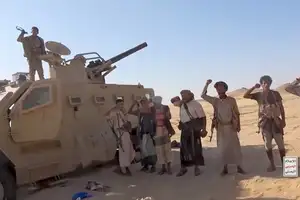
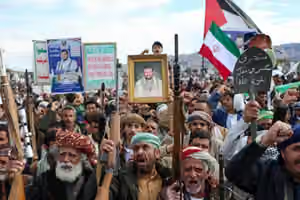
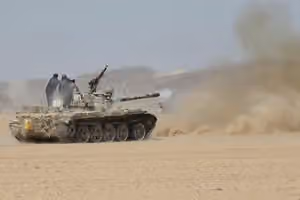
Iran-aligned Houthi fighters occupy a firing position in a screengrab from a video said to show Houthi fighters attacking Saudi-backed forces in the location given by the source as al Jawf governorate, Yemen, in this screengrab taken from a video released by Houthi Military Media on September 15, 2026.
Iranian weapons and growing supplies of Chinese dual-use components have helped Yemen's Houthis expand their territory and strengthen their ability to threaten shipping through the Red Sea, the Wall Street Journal reported.
The Iran-backed group has seized Red Sea islands and expanded along Yemen's mainland coast in recent weeks, including taking the port city of Mokha, according to the report. It has also asserted control over the Bab al-Mandeb Strait, a key route for global trade and energy shipments.
The Houthis, estimated to have about 350,000 fighters, had prepared for the offensive for months, moving weapons and thousands of troops toward Mokha in August and using their control of telecommunications networks to monitor opponents, the Journal said.
The Houthis lack a conventional navy but use Iranian-designed missiles, explosive drones, sea mines, armed fast boats and drone boats to project power along Yemen's coast.
Their arsenal includes ballistic and cruise missiles, anti-ship weapons and drones drawing heavily on Iranian technology and components, according to the report.
Around 2015, Iran's Quds Force began sending components for Iranian-designed missiles and drones and dispatched trainers to help the Houthis build weapons themselves, the Journal said.
The assistance helped turn the group into a force capable of attacking Saudi oil infrastructure, disrupting Red Sea shipping and threatening US forces.
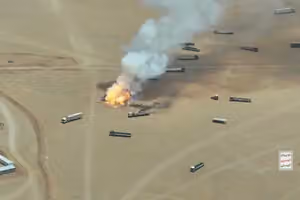
Houthi fighters stand in front of what they say is a downed Saudi jet, at a location given as Yemen, in this still image from a handout video released on September 16, 2026.
China becomes another supply source
"The Houthis now have a new source for the supplies they need to launch their attacks: China," the Journal reported.
Chinese companies are supplying dual-use goods that can serve civilian and military purposes, including components important to Houthi drone programs, according to UN reports and arms experts cited by the newspaper.
The shift comes as traditional Iranian smuggling routes have faced greater disruption. For years, Iran's Revolutionary Guards used small fishing boats to move arms, drone components and missile parts to the Houthis, but many shipments have been intercepted by US forces and Yemeni groups opposed to the Houthis.
The Houthis have also used Djibouti as a transit point for weapons and traded small arms with al-Shabaab in Somalia, according to UN reports cited by the Journal.
Since announcing a blockade on Saudi shipping on July 20, the group has struck seven vessels in the Red Sea and one in the Gulf of Aden, the report said. Four of the ships were Saudi-flagged.
The Houthis have also targeted Saudi energy infrastructure with missiles and drones, although Riyadh has reported no damage from those attacks.