• العربية
  • فارسی
Brand
  • Iran Insight
  • Politics
  • Economy
  • Analysis
  • Special Report
  • Opinion
  • Podcast
  • Live TV
  • Iran Insight
  • Politics
  • Economy
  • Analysis
  • Special Report
  • Opinion
  • Podcast
  • Live TV
  • Theme
  • Language
    • العربية
    • فارسی
  • Iran Insight
  • Politics
  • Economy
  • Analysis
  • Special Report
  • Opinion
  • Podcast
  • Live TV
All rights reserved for Volant Media UK Limited
volant media logo

Iran death-row protester shot, tortured in custody

Farnoosh Faraji
Farnoosh Faraji

Iran International

Sep 30, 2026, 12:19 GMT+1
Iranians take part in anti-government protests in January 2026.

Iranian security forces shot death-row protester Alireza Sepahi four times during his arrest at home before subjecting him to weeks of torture in custody, according to a former cellmate who described his treatment.

Sepahi, detained over protests in January and sentenced to death in Isfahan, now has his case before the sentence enforcement office, raising concerns over his execution.

“I personally saw the four places where the pellets had hit his legs,” the former prisoner told Iran International, adding that Sepahi told him his initial recovery took about two months.

Held in a security ward at Dastgerd Prison in Isfahan, Sepahi suffered a stroke on July 28, when two other prisoners were executed, including his cousin Abolfazl Sepahi. He was hospitalized before being returned to prison.

He was sentenced to death in the Alikhani Square case, a mass prosecution of protesters accused of involvement in unrest in Isfahan in which the Islamic Republic says four security personnel were killed.

Shot during arrest

Security forces arrested Sepahi at home following the January protests, ordering his family onto the floor before going upstairs to his room.

One officer restrained him before another said, “Hold him. I want to shoot him.”

The officers shot him in both lower legs, with two more pellets striking his thighs as he was taken away. One remained lodged in his thigh bone and required surgery.

100%
Death-row protester Alireza Sepahi

After two days in hospital, he was transferred to another detention facility. His mother, brother and teenage sister were also detained.

Torture during interrogation

Sepahi spent about 26 days undergoing interrogation and torture at the facility, according to the former prisoner.

His mother was at times brought into an adjoining room so she could hear or witness the torture. Interrogators struck him in the face and hit the wounds on his legs with a hose until they began bleeding again.

“I will sign whatever you tell me to,” Sepahi shouted during the torture, based on the account.

Civil rights activist Mehdi Mahmoudian said on September 12 that Sepahi and several other defendants in the case were tortured in detention.

Several defendants told the court they had faced torture, sexual assault and threats of rape to extract statements against one another, Mahmoudian said, adding that a significant part of the case and resulting sentences rested on those statements.

Statements challenged in court

Sepahi told the judge during his trial that security forces had shot him during his arrest, his former cellmate said.

When the judge suggested the shots might have been fired as he tried to escape, Sepahi responded: “What escape? They shot me inside my own room.”

Other defendants who had previously made statements against him also told the court that their accounts had been extracted under torture.

Some were beaten and subjected to mock executions after returning from court and forced to write new statements against Sepahi and other defendants.

Sepahi’s mother, Somayeh, is serving a five-year sentence at Dowlatabad Prison on charges including “assembly and collusion,” “acting against national security” and “rebellion.”

Most Viewed

Iran’s shrinking air links raise costs, strain regional ties
1

Iran’s shrinking air links raise costs, strain regional ties

2
EXCLUSIVE

Key IRGC intelligence figure in Iran’s oil sales identified: Who is Mostafa Ahadi?

3
INSIGHT

Iranian hardliners turn on Ghalibaf and judiciary after lawmaker’s sentencing

4

IRGC outlet accuses reformists of feeding Trump's pressure campaign

5

US-Iran contacts continue as terms of possible deal remain disputed

Banner
Banner

Spotlight

  • Iranian hardliners turn on Ghalibaf and judiciary after lawmaker’s sentencing
    INSIGHT

    Iranian hardliners turn on Ghalibaf and judiciary after lawmaker’s sentencing

  • German-based aid worker gets 10-year prison sentence in Iran

    German-based aid worker gets 10-year prison sentence in Iran

  • The body as a battleground: Iran's resistance etched in ink and blood
    SPECIAL REPORT

    The body as a battleground: Iran's resistance etched in ink and blood

  • Khamenei’s vision of Iranian power faces a test of reality
    ANALYSIS

    Khamenei’s vision of Iranian power faces a test of reality

  • Why Trump said no to Iran’s Hormuz proposal
    ANALYSIS

    Why Trump said no to Iran’s Hormuz proposal

  • Iran’s oil industry has too many masters
    OPINION

    Iran’s oil industry has too many masters

  • Iran wrong to expect midterms to restrain Trump, former US official says

    Iran wrong to expect midterms to restrain Trump, former US official says

Banner
Banner
  • Iran court sentences 10 protesters to death in Isfahan

    Iran court sentences 10 protesters to death in Isfahan

  • Executions in Isfahan renew calls to end German city partnership

    Executions in Isfahan renew calls to end German city partnership

  • Iran executes two protesters amid heavy security in Isfahan

    Iran executes two protesters amid heavy security in Isfahan

•
•
•

More Stories

Iran debtors face prison, hiding and suicide attempts

Sep 30, 2026, 04:22 GMT+1
100%
Prisoners are seen behind bars in Iran, where thousands have been imprisoned over unpaid financial obligations.

Years in prison or hiding, suicide attempts and severe financial hardship are among the consequences of Iran’s imprisonment of people over unpaid financial obligations, according to an IHRDC report published Tuesday.

According to a report published Tuesday by the Iran Human Rights Documentation Center (IHRDC), the findings draw on 10 confidential interviews conducted between March 2024 and July 2026 with debtors and close relatives of people subjected to financial enforcement.

All requested anonymity because of the stigma and other risks associated with imprisonment for debt.

One case concerns a man identified by the pseudonym Borna, whose sister told IHRDC that he spent two years in hiding after falling behind on payments linked to a marital financial obligation of 300 gold coins. He attempted suicide by jumping from a fourth-floor building and later spent about three years in prison.

His sister said a trial court found that Borna lacked the means to pay and ordered his release, but an appellate court required him to first pay 14 gold coins in arrears. IHRDC cited the case as evidence that people recognized as unable to pay can nevertheless remain exposed to detention.

The report also recounts the case of a young woman who was arrested at about 16 for theft and remained imprisoned for nearly three years after completing her sentence because she could not repay 400,000 tomans, which the report put at about $400 at the time. According to testimony cited by IHRDC, she attempted suicide in prison by swallowing depilatory powder and suffered lasting internal injuries.

The individual accounts are set against official figures showing that an average of 10,087 people were held in “imprisonment until payment” for civil financial judgments on any given day in 2022-23, representing 4.3% of Iran’s average prison population. The figure excludes people held over blood money and those on day release.

IHRDC’s open-source database separately recorded at least 88,078 releases of imprisoned debtors across all 31 provinces between 2016 and 2026. The organization said available figures represent minimums and do not capture everyone affected by financial detention.

Under Article 3 of Iran’s Law on the Enforcement of Financial Judgments, a debtor can be imprisoned at a creditor’s request until the judgment is satisfied, a court accepts an insolvency claim or the creditor consents to release. IHRDC said people genuinely unable to pay can still face detention because of procedural and evidentiary barriers, including missed deadlines and difficulties securing witnesses, collateral or legal assistance.

Iran told the United Nations during its 2025 Universal Periodic Review that no one is imprisoned merely for failing to fulfill a contractual obligation and that detention is reserved for people who have the means to pay but refuse. IHRDC said its examination of the law, statistics and witness accounts found that assurance “does not hold.”

IHRDC called for abolishing imprisonment for genuine inability to pay and replacing it with measures including asset tracing, wage attachment and installment plans based on a debtor’s ability to pay, while retaining sanctions for proven fraud, concealment or deliberate refusal to pay despite having the means.

German-based aid worker gets 10-year prison sentence in Iran

Sep 29, 2026, 23:26 GMT+1
•
Negar Mojtahedi
100%
Serkan Eren, founder of the Stuttgart-based humanitarian organization STELP.

Years in prison or hiding, suicide attempts and severe financial hardship are among the consequences of Iran’s imprisonment of people over unpaid financial obligations, according to an IHRDC report published Tuesday.

A German-based humanitarian worker has been sentenced to 10 years in prison in Iran after entering the country to help vulnerable Iranians, Stuttgart-based aid organization STELP said.

Serkan Eren, the 42-year-old founder of STELP, was convicted over alleged contacts with a country Iran considers hostile, according to the organization. STELP has not identified the country or disclosed further details, citing concerns for Eren and others involved.

Eren, a Turkish citizen and longtime resident of Germany, has been in Iranian custody for more than a year.

He entered Iran in late June 2025 as the 12-day war was drawing to a close. Five days later, after a ceasefire had taken effect, he headed toward the Iraqi border to leave the country. He never made it out.

STELP called the verdict unjustified and said the sentence did not reflect the circumstances of his case.

“The ten-year prison sentence given to Serkan Eren is not about what he has done. It is about what the Islamic Republic wants,” Shahin Milani, executive director of the Iran Human Rights Documentation Center, told Iran International.

Milani said Eren's charitable work offered little protection from what he described as Tehran's established practice of using foreign detainees as political leverage.

“Even working for a charitable organization does not protect foreign nationals,” he said.

Contemporaneous German reporting provides a detailed account of why Eren went to Iran and the precautions he took before entering.

German-Iranians had approached STELP seeking help for relatives inside the country, according to the Stuttgarter Zeitung. Eren said he was in contact with seven elderly Iranians, some of them ill, whom he hoped to help reach Turkey. He also intended to bring food into Tehran.

The risks were apparent before he crossed the border.

Eren deliberately left behind a satellite phone, bulletproof vest and helmet, fearing such equipment could cause Iranian authorities to mistake him for an agent or saboteur. Instead, he crossed from Turkey into Iran on foot with little more than a backpack.

Once inside, those concerns intensified. Eren later described armed checkpoints on his route to Tehran where he was forced to strip naked during searches.

More than a year later, an Islamic Republic court convicted him over alleged contacts with a hostile country.

Human rights lawyer Gissou Nia said humanitarian status has not historically insulated either foreign aid workers or Iranian charities from pressure by the authorities.

“Unfortunately, being a humanitarian aid worker is not a shield when it comes to the Islamic Republic detaining and arbitrarily imprisoning individuals,” Nia told Iran International.

She cited the case of Belgian humanitarian worker Olivier Vandecasteele, who was detained in Iran in 2022 and later sentenced to a lengthy prison term before being released in 2023 in a prisoner exchange involving Assadollah Assadi, an Iranian diplomat imprisoned in Belgium over a foiled bomb plot.

“This is a pattern that we've seen before,” Nia said.

Nia also pointed to the treatment of humanitarian organizations operating inside Iran. The Imam Ali Popular Students Relief Society, a prominent independent charity that worked with impoverished families and vulnerable children, was dissolved following years of pressure from Iranian authorities.

The Center for Human Rights in Iran reported in 2022 that an appeals court upheld an order dissolving the organization after authorities arrested several of its members and accused its founder of offenses including insulting Iran's leadership and acting against national security.

The case, Nia said, illustrates how work designed to remain outside politics can itself become politically charged in Iran.

“Even the sort of non-politicized work of humanitarian aid organizations has been politicized in some ways,” she said.

Eren's Turkish citizenship adds another layer to efforts to secure his release.

Despite living in Germany and running a Stuttgart-based organization, Eren does not hold German citizenship. Germany's Foreign Office has said it is aware of his case but that responsibility rests with Turkish authorities because he is a Turkish national. STELP says it has been working closely with Ankara since his detention.

Nia said his ties to Germany nevertheless give Berlin reason to remain engaged.

“I anticipate that Germany will raise the case, especially because he was working for a German-based organization,” she said. “And the Turkish government will probably be involved as well, because he is a Turkish citizen.”

The sentence has already drawn calls for Eren's release in Germany. Baden-Württemberg Minister-President Cem Özdemir said he would continue pushing for Eren to be freed immediately.

Eren has spent years working in humanitarian crises. He began aid work during Europe's 2015 refugee crisis and received Germany's Federal Order of Merit in 2023 for his humanitarian service.

Before entering Iran, he openly questioned whether authorities would allow him into the country at all.

“It’s arbitrary,” Eren told the Stuttgarter Zeitung at the time.

He nevertheless hoped his status as a humanitarian worker would help protect him.

It did not.

Disease, drug shortages grip overcrowded Iran prison

Sep 29, 2026, 09:13 GMT+1
•
Farnoosh Faraji
100%
File photo of a prison in Iran.

Prisoners at an Iran prison face severe overcrowding, infectious diseases and shortages of food, medicine and medical care, according to accounts obtained by Iran International.

The accounts from Dastgerd Prison in the central city of Isfahan describe crowded wards, poor sanitation and severe obstacles to treatment, with several people familiar with conditions there describing the spread of meningitis and other infections.

“Meningitis and colds are rampant in the prison, and there are no pills or medicine,” a former prisoner told Iran International.

Around 10,000 people are being held at Dastgerd, compared with a standard capacity of about 4,000 to 5,000, according to information.

Food shortages compound overcrowding

Nutrition is so poor that many prisoners have become physically weak and more vulnerable to illness.

100%
File photo of the inside of Isfahan’s Dastgerd Prison, published by rights groups. Image enhanced using AI.

Breakfast is not distributed on some days, and lunch and dinner are rationed. Food can also be difficult to obtain from the prison shop, even as cigarettes remain consistently available and various drugs are easily accessible inside.

Some wards hold between 1,300 and 1,500 prisoners, another person familiar with conditions at Dastgerd said. The combination of overcrowding and inadequate sanitation has helped diseases spread.

Prisoners, particularly political ones, in some cases deprived of phone calls, treatment, medicine, adequate food, sanitation, correspondence and some judicial rights.

Iran International reported on July 21 that prisoners must register to visit the medical center. In rooms housing around 40 people, only two are allowed to seek medical attention each week.

Meningitis spreads as prisoner deaths mount

Several accounts received in recent months point to the spread of meningitis at Dastgerd. Iran International previously reported that the disease had reached several wards and that a number of prisoners were transferred to hospital.

Two prisoners had meningitis when one former inmate arrived at Dastgerd. One suffered a seizure in the admissions section and died, while the other died after being transferred to hospital.

  • January protesters trapped in 'hell' of Greater Tehran prison, inmates say

    January protesters trapped in 'hell' of Greater Tehran prison, inmates say

The former inmate said prisoners had in previous years received meningitis and tetanus vaccines upon arrival, but the vaccinations were no longer being administered during the person's recent detention.

More than 70 prisoners have died from illnesses over roughly the past five months, according to another person familiar with conditions at the prison. At least 15 of those who had died by September 21 were from a single ward.

Prisoners suspected of having meningitis have in some cases been sent to hospitals for spinal fluid testing. Some were returned to Dastgerd before completing treatment and recovering.

100%
File photo of the inside of Isfahan’s Dastgerd Prison, published by rights groups. Image enhanced using AI.

The prison is also infested with bedbugs and other pests, according to accounts. Recent Iran International coverage documented bedbugs, fleas and ticks alongside increasing skin conditions and infections in the wards.

Blankets and bedding are heavily contaminated, one former prisoner said, with some inmates developing serious eye infections that leave them unable to open their eyes in the morning.

The person needed nearly two months of treatment after being released on bail, including regular injections and intravenous fluids during the first two weeks.

Fever, chills, body aches and infections of the lungs, throat, eyes and ears were widespread. Some prisoners contracted several illnesses at once, leaving them severely weakened.

Medicine shortages restrict treatment

Severe medicine shortages have compounded the health problems, while political prisoners can face particular difficulties gaining access to the prison clinic.

Denial of treatment has in some cases been used to exert pressure on political prisoners, according to one former inmate.

Prison authorities told inmates that the clinic had burned down, that medicine was unavailable and that there was no budget to buy supplies.

One prisoner offered to deposit 500 million rials into a prison account to pay for medicine. The offer was accepted, but most of the supplies subsequently purchased were acetaminophen and basic cold remedies, with insufficient antibiotics available for serious infections.

  • Iranian Activist Put in Solitary for Exposing Bedbugs at Tehran Prison

    Iranian Activist Put in Solitary for Exposing Bedbugs at Tehran Prison

Families have also tried to bring necessary medication into the prison, only for authorities in some cases to refuse delivery or confiscate part of the medicine during inspections.

Sedatives, sleeping pills and drugs, by contrast, are widely available among prisoners, according to the former inmate.

Families of slain protesters challenge Pezeshkian over UN remarks

Sep 27, 2026, 09:46 GMT+1
100%
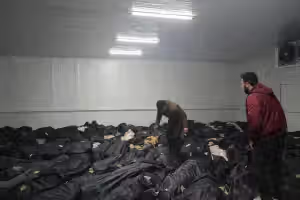
The bodies of slain protesters at an unnamed morgue in Iran (January 2026)

Relatives of protesters killed during Iran’s January crackdown challenged President Masoud Pezeshkian’s portrayal of the unrest as foreign-driven, saying their family members were unarmed and had no links to foreign governments, after his UN General Assembly address on Wednesday.

Pezeshkian accused protesters of being incited by the United States and Israel and receiving weapons to disrupt Iran’s security. He also defended system supporters who took to the streets during the unrest.

The sisters of Sina Kazemi, Emad Mavedatipour and Babak Sadeghi Mohseni responded on X, saying their brothers were unarmed when they were killed on January 8 or 9 and were not acting on behalf of any foreign government.

“I testify that my brother was unarmed when he was killed by the Islamic Republic of Iran’s forces on January 8, 2026,” Kazemi’s sister wrote. “He was not acting on behalf of any foreign government. I seek truth, justice, and accountability.”

Mavedatipour’s sister posted the same account of her brother, saying he was unarmed when he was killed on January 9 and denying that he acted for a foreign government.

Sadeghi Mohseni’s sister said her brother was unarmed when he was killed on January 8 and also called for “truth, justice, and accountability.”

The sister of Ahmad Khosravani, a 21-year-old professional basketball player, said her brother was completely unarmed when Iranian forces killed him on January 9.

“He was not acting on behalf of any foreign government,” she wrote. “They shot him directly in the heart.”

Fathers challenge Pezeshkian

Two other bereaved fathers challenged the government's account in separate video messages sent to Iran International.

The father of Erfan Abdipour, an architecture student who also worked at his brother’s restaurant, called on Pezeshkian to publish evidence if authorities had any showing that his son had received military training or carried a weapon.

“My request is that if you have evidence showing that he received military training, was instructed or had a weapon, or anything else that night, publish it,” Abdipour’s father said.

Abdipour had gone to protest on the night he was killed, his father said, questioning what his son could have been trying to seize in an area he described as having no military barracks or security facility.

The father of Pouria Bagheri separately rejected the government's explanation for the scale of the killings.

“I categorically reject the overall argument that such widespread killing was foreign actors work.”

Bagheri’s father questioned why authorities shut down the internet and electricity and said that security agents removed surveillance cameras from shops. He also asked why officials brought government supporters onto the streets two days later if foreign-backed armed groups posed the extensive threat described by authorities.

“Why did you bring your own supporters into the streets two days later? With what guarantee?” he said. “Was it not because you were in control?”

January crackdown

The protests began on December 28, 2025, following a sharp fall in the rial and rising prices before spreading across all 31 provinces and developing into a broader challenge to the Islamic Republic.

The deadliest violence came on January 8 and 9. Amnesty International said verified videos and eyewitness testimony showed security forces using rifles and shotguns against protesters, frequently firing at heads and torsos.

Iran International’s Editorial Board concluded in January that more than 36,500 people were killed by security forces on January 8 and 9 after reviewing classified government documents, field reports and accounts from medical workers, witnesses and victims’ families.

  • Over 36,500 killed in Iran's deadliest massacre, documents reveal

    Over 36,500 killed in Iran's deadliest massacre, documents reveal

The UN Fact-Finding Mission on Iran later said security forces used lethal force against protesters and bystanders, including children, who posed no imminent threat of death or serious injury.

Iranian authorities initially put the death toll at 3,117. The government subsequently published 3,038 names, according to the UN mission, which said it believes the actual number may be significantly higher.

US President Donald Trump cited increasingly higher death tolls from Iran’s January protest crackdown in successive remarks, putting the number at 32,000 on February 20, 42,000 in later comments and subsequently 45,000.

Iran upholds death sentence for Red Crescent worker after coerced confession

Sep 26, 2026, 11:21 GMT+1
•
Pooya Jahandar
100%
Mozhdeh Hashemi Bazargani

Iran's Supreme Court has upheld the death sentence of Mozhdeh Hashemi Bazargani, a 27-year-old Red Crescent worker who said in a recording from Qazvin prison that interrogators beat her until her teeth broke and made her sign a confession, a source told Iran International.

Hashemi Bazargani was denied a lawyer of her own choosing throughout the proceedings, the source said. She is held in Qazvin Central Prison, in the city 150 kilometers west of Tehran, and is accused of sending the location of a military site to "the enemy," a charge she has denied.

In an audio message from prison earlier this year, she said security agents raided her home at 2:30 in the morning on April 4, cutting through the door with a metal grinder. She had been living with her elderly, ailing mother.

After her arrest, she said, she was beaten with a pipe and a baton on the head, neck and shoulders during long interrogations, breaking two teeth and leaving her with dizziness, shortness of breath and heart problems. No doctor came to examine her despite visible bruising and injuries, and her requests to be taken to the coroner's office to document the beating went unanswered.

Interrogators pressed her to confess, she said. "They pin a thousand charges on me. They force me: whatever we tell you, you have to write it down and sign it."

She said they beat her while she was blindfolded and cut her interrogation answers into a video presenting her as a terrorist. The charges put to her included espionage and receiving money from abroad. The confession footage was broadcast on Qazvin's provincial state television channel.

She also rejected the accusation of taking any money.

Her physical and mental condition is poor, the source told Iran International. Under the pressure of detention she has suffered seizures and lost consciousness several times, and was hospitalized before being returned to prison after a partial recovery.

In her message she also spoke of her mother in the town of Alvand, near Qazvin, who she said had been left with no one to care for her.

Iran's judiciary has issued sentences ranging from long prison terms to death against dozens of people this year on charges of espionage, sending information abroad or contact with hostile states, many of them arrested after the January protests.

Confessions broadcast on state television have repeatedly been described by defendants and their families as obtained under torture, and Revolutionary Court trials in such cases are closed to public scrutiny of the evidence.