Iran executes man arrested during January protests

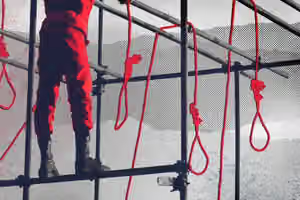
Iran has executed Siavash Jamshidi Kheirabadi, who was arrested during January’s protests in Shahrekord, the judiciary’s Mizan news agency announced Saturday.
Iran has executed Siavash Jamshidi Kheirabadi, who was arrested during January’s protests in Shahrekord, the judiciary’s Mizan news agency announced Saturday.
The judiciary said Jamshidi had been sentenced to death for moharebeh, or “enmity against God,” over accusations that he fired at security forces on January 8.
It also listed a conviction for assembly and collusion against national security. The Supreme Court upheld the sentence following an appeal, it said.
Authorities said Jamshidi was arrested two days after the alleged shooting and cited weapons seizures, officers’ accounts, witness statements, messages attributed to him and purported confessions. The report did not identify anyone killed or wounded in the shooting.
No information about his prosecution had been made public before the execution announcement. The judiciary said a lawyer attended his trial but did not name the lawyer, court branch or judges, or provide trial dates, the judgment or details of his defense. It did not specify when or where the execution took place.
The announcement follows the executions of Ali Hemmati Sistani and Majid Nikandish, two men arrested during the January protests in Mashhad, on Wednesday.
A joint statement by 46 countries at the UN Human Rights Council this week expressed concern over the execution of more than 30 protesters following the January crackdown and called for a halt to executions, citing reports of torture, forced confessions and violations of fair-trial rights.







Iranian security forces shot civilians at close range, pursued fleeing protesters and prevented wounded people from receiving help during the 2022 Woman, Life, Freedom uprising in Kurdish cities, according to Amnesty International’s investigation into the crackdown.
The organization documented the unlawful killing of 95 Kurdish protesters and bystanders, including 13 children, across 17 counties in Kurdistan, Kermanshah and West Azerbaijan provinces.
Its findings describe repeated patterns of lethal force used to disperse demonstrations, punish protesters and deter further gatherings.
Among those killed was Yahya Rahimi, a 30-year-old man shot in his car in Sanandaj on October 8, 2022, apparently in retaliation for sounding his horn in solidarity with protesters while stuck in traffic.
Sources interviewed by Amnesty said plain-clothes agents smashed Rahimi’s car windows. Shortly after, an agent aimed a shotgun at his head and fired metal pellets from about half a metre away.
Amnesty verified five videos supporting accounts of the killing and reviewed his burial certificate, which recorded extensive brain damage and shattered skull bones caused by a fast-moving projectile.
Wounded protesters left without help
The investigation also documented cases in which security forces obstructed assistance after shooting people.
Shahou Bahmani, 36, was fatally shot in Sanandaj on November 17, 2022, during protests following a memorial gathering for people killed earlier in the uprising.
According to eyewitnesses cited by Amnesty, Bahmani remained bleeding for 30 to 40 minutes while security forces fired at protesters trying to help him. People took him to hospital after the forces withdrew. He was declared dead shortly after arrival.
“The agents would shoot anyone in their sight,” one witness, identified as Iman, told Amnesty.
The organization reviewed two videos showing Bahmani wounded and bleeding as people attempted to assist him, as well as his death certificate.
In Kermanshah, Minoo Majidi was killed on September 20 while fleeing police Special Cohorts on motorcycles. Amnesty said the agents chased protesters and bystanders while repeatedly firing shotguns loaded with metal pellets, hitting Majidi at close range.
Bystanders were also killed. Fereydoon Faraji was shot in Baneh on October 27 while looking out of a window at his workplace as security forces fired at people fleeing the crackdown.
A more militarized response
Amnesty recorded 35 unlawful killings in Kurdistan province, 19 in Kermanshah and 41 in West Azerbaijan.
It found that forces in the three provinces adopted a more militarized response than elsewhere, frequently deploying military-grade firearms soon after protests began.
Weapons included assault rifles, designated marksman rifles, sub-machine guns and heavy machine guns mounted on pickup trucks.
The organization said the lethal force in the documented killings was used to disperse, intimidate or punish people, rather than defend against an imminent threat of death or serious injury.
Kurdish and Baluchi victims together accounted for about 62% of the 326 people Amnesty recorded as killed during protest dispersals or in areas with a militarized security presence.
That figure includes 106 Baluchi protesters and bystanders killed in Sistan and Baluchistan.
Amnesty concluded that the disproportionately high toll could not be explained by protest size alone.
It found that murder and torture against Kurdish and Baluchi protesters were committed with discriminatory intent on political and ethnic grounds, meeting the elements of the crime against humanity of persecution.
The uprising began after the death in custody of Zhina Mahsa Amini, a Kurdish woman arrested by morality police in Tehran in September 2022.
Amnesty said it sought comments from Iran’s leadership and senior officials before publishing its investigation on September 16, 2026. It had received no responses by publication.
Iran’s Education Ministry dismissed reports of teacher resignations over working conditions and security pressure as a “rumor,” despite numerous videos of teachers announcing departures and a teachers’ council warning of a growing exodus.
Education Ministry spokesman Ali Farhadi said Friday that reports of teacher resignations were “not true” and accused unspecified actors of trying to undermine in-person education.
“The resignation of teachers is a rumor,” Farhadi told the Tasnim news agency, saying teachers and students had welcomed the return to classrooms across the country, including in southern provinces such as Hormozgan.
But the Coordinating Council of Iranian Teachers’ Trade Associations has offered a sharply different account, saying numerous videos and reports of resignations have emerged from different parts of the country in recent weeks.
The council said teachers were leaving because of a combination of wages below the poverty line, worsening living conditions, administrative pressures and what it described as the securitization of the profession, including dismissals, suspensions, arrests and legal cases against teachers and union activists.
It warned that experienced teachers were being driven out of classrooms by policies that had pushed the education system toward decline.
Videos circulating on social media in recent days have shown teachers announcing their resignations and citing financial hardship, workload and a lack of recognition for their work.
The dispute comes as Iran’s education system is already grappling with teacher shortages and longstanding discontent over pay and working conditions.
Teachers have repeatedly protested over salaries and benefits, including at a demonstration outside the Planning and Budget Organization in Tehran in September.
Labor activists have also warned that financial pressures are forcing some teachers to work multiple jobs, while shortages of teaching staff are affecting the quality of education.
The resignations have emerged against a wider backdrop of pressure on teachers and union activists, who in recent years have faced arrests, prison sentences, dismissal and suspension from work.
The Coordinating Council rejected the government’s portrayal of the unrest in schools as the product of outside agitation, arguing that the discontent stems instead from conditions within the education system itself.
Whether the resignations amount to the “wave” described by the teachers’ council is difficult to establish. The pressures it says are driving teachers out are considerably easier to document.
An appeals court in Tehran has upheld a one-year prison sentence for renowned actress Elnaz Shakerdoost over an Instagram story mourning people killed during January’s protests, her lawyer said Friday.
The ruling also upheld a two-year ban on political, online and artistic activity imposed by Branch 23 of Tehran’s Revolutionary Court, which convicted her of “propaganda against the system.”
Her lawyer, Houshang Pourbabayi, said the post expressed grief and sympathy for those killed and contained no call for collective action or reference to state institutions.
Shakerdoost, 42, is one of Iran’s best-known film actresses and has worked in Iranian cinema for more than two decades. In 2019, she won the performance prize at the International Political Film Festival of Carcassonne in France for When the Moon Was Full, which also won the festival’s Grand Prize.
In August, human rights activists reported that nearly 100 prominent Iranians, including artists and filmmakers, had been summoned by security agencies or judicial authorities after speaking out against the new wave of executions, particularly the public hanging of protesters in Isfahan.
More than 20 of those summoned were well-known film and television actors, a civil rights activist said.
The report said those targeted had been among public figures posting against the executions under the hashtag “No to executions.”
Shortly after the brutal crackdown on January protests, acclaimed Iranian filmmaker Jafar Panahi warned that the Islamic Republic was intimidating artists to erase evidence of the massacre, citing the killing of a fellow director as the reality the authorities were trying to suppress.
Panahi said on Instagram that the killing of filmmaker Javad Ganji has been followed by an escalating campaign of intimidation against artists aimed at erasing the truth about protest deaths.
Panahi said directors Majid Barzegar and Behtash Sanaeiha were separately summoned and harshly interrogated for hours over a joint statement condemning state violence, warning that more cinema professionals are expected to face summons and that heavy judicial cases are already open.
Hamid Kouhsari was carrying a wounded woman on his back through the streets of Gorgan on January 8 when security forces shot him from behind. He spent the next eight months in hiding with his leg untreated, before leaving Iran.
Kouhsari, 31, told Iran International that during the January 2026 uprising he saw security forces use violence unlike anything he had witnessed before in Gorgan, the capital of Golestan province in northern Iran, including the shooting of a toddler in the face. He spoke from a location that is being withheld because he fears reprisals from the Iranian authorities.
Security forces opened fire directly on crowds on January 8 as demonstrations swelled across the city, he said.
"You couldn't believe what you were seeing," he said. "They pointed their weapons directly at the crowd and opened fire. People were falling like sparrows."
Kouhsari had taken part in the November 2019 protests and in the 2022 protests that followed the death in morality police custody of Mahsa Amini, who had been detained for allegedly violating Iran's hijab rules. Nothing he saw then, he said, compared with January.
"It was unimaginable," he said. "They were firing bursts into the middle of the crowd."
‘The hardest part’
The scene that affected him most, Kouhsari said, involved a couple carrying a child he thought was about two years old.
"The hardest part for me was when there was a husband and wife with a child, about two years old, in their arms," he said.
All three were caught in the gunfire, he said. The father was hit below the waist, and the mother in her face, neck and abdomen. Kouhsari and others moved the parents toward people helping the wounded.
In the chaos, his attention turned to their child.
"I was thinking about the child in all that fear and panic," he said.
He realized he could no longer hear the toddler crying, he said, and then saw the child lying near the curb.
"I was just praying the child wasn't dead, that they were unconscious," he said.
When he picked the child up, he saw a severe gunshot wound to the face.
"Half of the child's face was gone from the bullet," he said.
Kouhsari said he screamed and began crying, then carried the child to a woman helping the wounded.
"I told her, 'This is their child too. Wherever you sent the mother and father, send the child there as well.'"
He never learned what happened to the family.
Shot while carrying a wounded woman
Later that night, another wounded woman begged him for help.
"Help me. Don't let them kill me," he recalled her saying.
Kouhsari lifted her onto his back and began carrying her toward the crowd.
"I told her, even if I die myself, I won't let you die here," he said.
As he neared the other protesters, security forces shot him from behind in the right leg.
He managed a few more steps before collapsing. Protesters pulled him into the crowd and used scarves and shoelaces to stem the bleeding.
Video reviewed by Iran International shows Kouhsari lying in a house where he was hiding, his wounded leg bleeding into a container, visibly in pain.
He could not risk going to a hospital, he said, and was afraid even to try to get medicine from a pharmacy, because wounded protesters were being identified and detained.
"I wasn't afraid of being shot," he said. "I was terrified they would come and take me away."
That fear came from what happened after the November 2019 protests. Kouhsari said he was detained and later summoned to a Revolutionary Guards facility in Gorgan, where over several hours he was pressured into recording a confession.
His father, he said, was a veteran of the 1980-88 Iran-Iraq war and was wounded in it. Decades later, the son was shot by his own country's security forces in the street.
A doctor who later examined his leg privately told him it needed surgery because of damage to the bone and nerves, Kouhsari said.
The operation never happened.
Kalashnikovs, pellet guns and lasers
Kouhsari said he saw security forces use Kalashnikov-type rifles and pellet guns on January 8, as well as a weapon he could not identify.
He also described gunmen positioned above the streets, and protesters being marked with lasers before they were shot from those elevated positions.
"They would keep the laser on them even when they went into the crowd," he said. "The sniper from above would shoot the people they had marked with the laser."
Separate CCTV footage from Gorgan on January 9, obtained and verified by Iran International, shows security forces using lasers during the crackdown.
Kouhsari said Reza Asadi, a protester killed by live fire in Gorgan on January 8, was among those he saw marked with a laser before being shot.
A body taken, a family kept searching
Among those killed that night was Kouhsari's relative Mostafa Kouhsari, a father of two from Azadshahr, about 75 kilometers east of Gorgan.
Mostafa was shot at around 9 p.m., Kouhsari said, and died on the way to the hospital as protesters tried to save him.
Revolutionary Guards forces took his body, Kouhsari said, and for four days the family had no word of where he was. After days of searching, they found him at a morgue in Gonbad-e Kavus, a city in the north of the province.
Intelligence agents then escorted the body back to Viro, a village east of Gorgan, and pressed the family not to hold a public funeral, Kouhsari said. Mostafa was buried there at around 6 a.m.
The pressure continued after the burial. The family held no memorial at the village mosque and instead marked the third, seventh and 40th days after his death, the customary points of mourning in Iran, privately at Mostafa's home.
Others close to him were also killed, Kouhsari said, but some of their families had asked him not to name them for fear of reprisals.
Eight months in hiding
With his leg still badly injured, Kouhsari went into hiding.
For about eight months, he said, he moved between car washes, cattle sheds, abandoned houses and remote villas belonging to friends.
"When I heard the sound of police, the hair on my body would stand up," he said.
Friends brought him food and medicine. The surgery the doctor had said he needed never took place.
His fear of being found grew after a friend was detained. The man revealed information under torture, Kouhsari said, and he became increasingly afraid the authorities could identify him.
In the end, facing the threat of arrest and fearing for his life, he was forced to leave Iran.
A final goodbye
Before leaving, Kouhsari photographed his home after emptying it of his belongings.
He could not properly say goodbye to much of his family, he said, and does not know when he will see them again.
"Saying goodbye to my mother was very hard," he said.
One of his last memories is of saying goodbye to his dog, whom he left with a friend.
"When I was saying goodbye to my dog, I saw my whole family in that animal," he said.
"The night I left Iran, for the first time in eight months I was able to sleep peacefully."
Four men detained during Iran’s nationwide January protests have been sentenced to death by Tehran Revolutionary Courts, HRANA reported Thursday, as rights groups warn of mounting use of capital punishment against protest detainees.
HRANA identified three of the men as Khosrow Mohammadi-Nia, Masoud Tushmalani and Sirvan Shabani, all from Kermanshah province in western Iran. The fourth, Mehdi Nami, was prosecuted separately.
Citing information received from Iran, HRANA said Branch 23 of the Tehran Revolutionary Court tried Mohammadi-Nia, Tushmalani and Shabani in a joint case and sentenced them to death on charges including “moharebeh” or “waging war against God,” “assembly and collusion with the intent to disrupt national security” and “operational activity in favor of hostile states.”
HRANA said judges Karimi and Taghizadeh issued the ruling.
Security forces arrested the three in Eslamshahr during the January protests, according to HRANA. Tushmalani was initially released on bail but was detained again several days later.
The three are being held at Qezel Hesar prison in Karaj. HRANA said Shabani is around 22 years old, while Mohammadi-Nia and Tushmalani are between 30 and 50.
A woman prosecuted in the same case was sentenced to five years in prison, HRANA said. The group did not identify her and said it was still investigating details of the allegations against her.
Separately, HRANA said Mehdi Nami, who was also detained during the January protests, had been sentenced to death by a Tehran Revolutionary Court on a charge of “operating in favor of hostile governments.”
The verdicts come amid a series of death sentences and executions involving people detained during nationwide protests that began in late December 2025 and intensified in January.
Human Rights Watch and the Abdorrahman Boroumand Center said in September that Iranian authorities had announced the executions of at least 29 protest detainees between March 18 and the end of August. Five were executed publicly.
The groups said 16 of the 29 had not been accused of killing anyone, with some convicted over alleged acts such as damaging public property, throwing stones or entering government buildings. They said such conduct does not meet the threshold for capital punishment under international human rights law.
The organizations also documented allegations of torture, coerced confessions, denial of access to lawyers of the defendants’ choosing and accelerated judicial proceedings. In some protest-related cases, the period between arrest and execution was little more than five weeks.