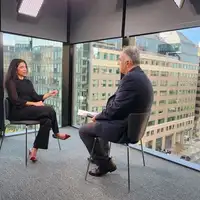
The Islamic Republic is in a "slow meltdown" that may not bring it down soon but is narrowing its options as the economy sinks, repression deepens and divisions open up among its own hardliners, analysts told Iran International's Eye for Iran podcast.
"I just don't see a pathway to rehabilitation," said Kamran Bokhari, a strategic forecaster and senior resident fellow at the Middle East Policy Council.
“This regime cannot go back to what it was.”
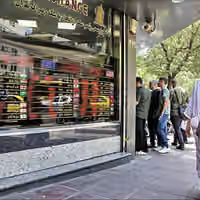
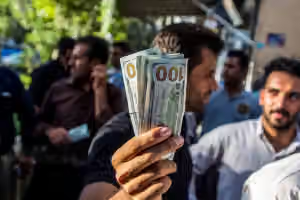
The pressure is coming from every direction. The rial fell past 2.5 million to the dollar this week, a record low; at that rate the minimum monthly wage of 166 million rials is worth about $66.
On Wednesday, Washington extended sanctions to Iran's auto and rail industries, on top of a naval blockade of Iranian ports and a campaign against sanctions evasion that have already cut deep into oil revenue and access to foreign currency.
At home, two people detained after January's nationwide protests were executed this week, and four others arrested during the unrest have recently been sentenced to death.
An appeals court upheld sentences of 74 lashes against the singer Parastoo Ahmadi and seven musicians and organizers over a concert she performed without a headscarf, filmed and posted online.
Human Rights Watch and the Abdorrahman Boroumand Center documented 29 executions between March and the end of August of people arrested in connection with the protests. Five were carried out in public.
'They want to show they're in charge'
Alberto Fernandez, a former US diplomat and vice president of the Middle East Media Research Institute, said the repression should be read alongside the economic pressure.
"They want to show they're in charge," he said. Extreme violence, he said, is one way of demonstrating to Iranians and to the world that the state can still impose its will. The more it relies on that, the more it shows both the power it has left and the pressure it is trying to hold down.
"The challenge of the regime is not the war," Bokhari said. "The challenge is governance and economic statecraft."
Three senior Iranian sources told Reuters last month that the US campaign against oil exports and sanctions evasion was becoming increasingly hard to withstand. The average monthly wage now covers less than a third of a household's basic costs, Reuters reported.
Even if Tehran wins some sanctions relief, Bokhari said, he sees little prospect of it recovering what it had.
"Regimes take a long time to undergo a meltdown," he said. "That meltdown was happening even before this war."
The price of eggs
David Patrikarakos, a special correspondent for the Daily Mail and an author, said he watches one basic indicator.
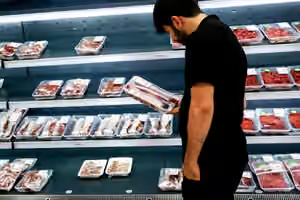
"I have become a keen watcher of the price of Iranian eggs," he said.
When he spoke with people inside Iran during the war, he said, the conversation kept returning to the cost of necessities.
"When the basics become too expensive, no government can deal with that," he said. "You can only terrorize people back into their homes for so many things. If they're starving, they can't afford food, there's nothing you can do."
The authorities appear to know it. More than 6,000 people have been arrested since the war began, Reuters reported this week, as officials worry about renewed protests.
But repression has limits. Bokhari called it a "precision instrument" that can backfire when used too broadly.
"You can oppress people, but if you start to do it at scale, then it can backfire," he said. "At some point, your own security forces will say, 'Where is this going?'"
'The butter part is going out'
If the Islamic Republic survives, Fernandez said, one model is what he called the "North Koreanization" or "Houthization" of Iran: a poorer, more predatory state that can still repress at home and project force abroad while its economy and institutions are hollowed out.
That was never the plan. The Islamic Republic wanted revolutionary and military power abroad and a functioning society and middle class at home, Fernandez said, the old combination of guns and butter.
"Well, the butter part is going out," he said.
Without a reversal, he said, Iran could become "a more ramshackle predatory state." "It still can bite, but it becomes much more fragile, much more fractious."
That trajectory would run against Iran's own sense of itself and the aspirations of its educated population, Patrikarakos said. "The Iranian self-image is wanting to take part in the world."
Even the Islamic Republic, for all its decades of confrontation with the West, never sought North Korea's isolation, he said.
"They don't want to go down the North Korea path," Bokhari said. "The question is, can they avoid it?"
As the options narrow, he said, survival is overriding everything else. "Regime survival is now more than ever before the primary imperative."
What to watch
Bokhari said he is watching for infighting that can no longer be contained. "I'm also watching for signs of infighting, where different elements of the regime start to disagree to a point where the disagreement isn't behind closed doors," he said.
Fernandez said the visible divisions are no longer mainly between moderates and conservatives, the old frame for Iranian politics, but among hardline factions themselves.
He is also watching the currency, and how long Tehran can hold out without real relief. Iran's leaders may be looking to the US midterm elections and the next Congress in the hope that politics in Washington will ease the pressure, he said. If that hope fails, they face a long period of no war and no peace while the squeeze continues.
The Islamic Republic has survived periods when it looked weaker, more isolated and less popular than before. Survival and recovery are not the same thing. The price of food, the value of the rial, unrest in the streets, fractures at the top and the loyalty of the security forces will show how far the meltdown has gone.
"This situation is untenable," Bokhari said.
You can watch Eye for Iran on YouTube or listen on any podcast platform.
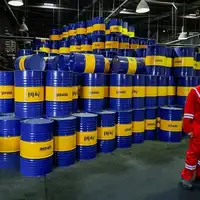
A worker at the Iranol oil refinery in Tehran, Iran, September 29, 2026
Iran’s worsening economic crisis has opened an increasingly bitter argument over who is responsible, as the government points to outside pressure and market psychology while hardliners accuse Tehran’s own economic officials of making the situation worse.
On Thursday, the end of Iran’s market week, the rial fell to another record low. Year-on-year inflation has reached almost 90 percent, with food prices rising even faster.
The deterioration comes as US sanctions and a naval blockade squeeze Iran’s sources of revenue. The blockade has severely constrained oil exports, while Washington on Thursday expanded sanctions into the automotive and rail sectors, targeting some of the country’s largest industrial companies.
US Treasury Secretary Scott Bessent has seized on the rial’s collapse as evidence that Washington’s pressure campaign is working, saying this week that it had driven the currency to its lowest level in history.
Iranian Economy Minister Ali Madanizadeh rejected Bessent’s assessment, telling the official IRNA news agency Thursday that predictions of an imminent economic collapse had repeatedly proved wrong.
“They want to create unrest and stress among the people so they rush to the currency market and the exchange rate increases; otherwise, these statements serve no purpose, and we will not allow this to happen,” he said.
The Central Bank has offered a similar diagnosis. It said Friday that the exchange rate was not “fully consistent with the economy’s fundamental variables,” attributing much of the gap to heightened uncertainty, psychological pressure and market expectations.
The bank announced Wednesday that it planned to inject $2 billion in banknotes into the market. So far, however, the intervention has failed to halt the rial’s slide.
‘The Central Bank shoots it into its own goal’
Hardliners have challenged the government’s explanation, arguing that sanctions and the war cannot by themselves account for the surge in the exchange rate and prices.
Nadergholi Ebrahimi, a hardline lawmaker, claimed in an online interview Thursday that the war had contributed no more than 25% to the recent rise in prices and accused government economic officials of deliberately fueling inflation.
Threatening to seek the impeachment of economic ministers, he accused them of waging an “economic sedition” that was reducing the public’s ability to withstand economic pressure and increasing dissatisfaction.
Hossein Samsami, an economist and hardline lawmaker, has also attacked the Central Bank’s handling of the exchange rate.
“Today, the currency is the enemy’s tool in an all-out economic war, and the measure of its success is the devaluation of our national currency,” Samsami wrote on X.
But he accused the Central Bank itself of helping drive that process by following an exchange rate he said was artificially determined by Iran’s enemies.
“The enemy passes the ball, and the Central Bank shoots it into its own goal!” he wrote.
Inflation approaches 90 percent
Whatever the relative weight of sanctions, war, expectations and domestic policy, their combined effect is increasingly visible in household finances.
According to the Statistical Center of Iran, annual inflation has reached 73.6%, while year-on-year inflation rose to a record 89.8%.
Food and beverage prices have risen substantially faster than overall inflation, hitting lower-income households particularly hard because they devote a larger share of their income to food and other essentials.
Accelerating prices have also eroded the value of government food vouchers introduced after subsidized foreign-exchange rates for a range of goods were removed amid a sharp depreciation of the rial and economic protests in December and January.
Although the government pledged to increase the value of the vouchers in line with rising prices, it has yet to do so.
Wages fall behind as prices surge
The pressure is also increasingly visible among salaried workers.
Videos circulating on social media in recent weeks have shown teachers and nurses saying low wages have left them with no choice but to resign after years in their professions.
Ali Farhadi, spokesman for Iran’s Education Ministry, dismissed reports of widespread teacher resignations as a “rumor” on Friday.
The dispute has become another front in the broader argument over the economic crisis, with government supporters alleging that expressions of discontent are being amplified to encourage unrest and critics accusing authorities of dismissing genuine economic grievances.
Samsami, however, has placed greater responsibility for the hardship on domestic economic policy than on Washington.
“The pressure imposed on people’s livelihoods by misguided economic policies is far greater than that caused by sanctions and the naval blockade,” he wrote, adding: “We are not at an impasse. By reforming our policies, we can control inflation even under these sanctions.”
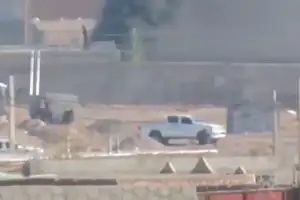
At least five people were reported killed on Friday in an attack near Zahedan in southeastern Iran, as the Revolutionary Guards confirmed a roadside bombing in the area that killed one of its fighters.
Haalvsh, which covers developments in Sistan-Baluchestan, said five members of the IRGC-Quds’s Fatemiyoun militia were killed in the Rudmahi area near Zahedan after an explosive device detonated beside their vehicle and gunmen opened fire.
Iran's Revolutionary Guards gave a different account, confirming a roadside bombing in the province but saying one fighter was killed. The IRGC Ground Force said what it described as "terrorists" had planted a bomb along a road in Sistan-Baluchestan and carried out an indiscriminate attack.
The Guards did not identify the person killed, mention Fatemiyoun or give a precise location for the incident.
Conflicting accounts of Zahedan attack
Haalvsh said the attack took place at about 6:30 a.m. as the men were patrolling the Kaleh-Pedeh route in the Rudmahi area in a Land Cruiser equipped with a DShK heavy machine gun.
Citing eyewitnesses, the outlet said an explosive device was detonated as the vehicle passed and that gunmen opened fire after the blast destroyed the vehicle.
The identities of those reported killed have not been released.
Haalvsh said local sources continued to put the death toll at five and identified all of those killed as Fatemiyoun members, but said it had not been able to independently verify the precise number of deaths.
Fatemiyoun is a militia linked to the IRGC's Quds Force and made up largely of Afghan Shiites. It was formed with Iranian support and fought alongside forces loyal to Bashar al-Assad during Syria's civil war. The United States sanctioned the group in 2019.
Haalvsh said Friday's incident was the second deadly attack on forces it identified as Fatemiyoun in Rudmahi in less than a month. It reported in September that four members deployed in the area by the IRGC were killed when gunmen attacked them during a patrol.
The outlet has also reported the deployment of hundreds of Fatemiyoun members to several parts of Sistan-Baluchestan, including areas around Zahedan, Mirjaveh, Rask, Saravan, Zabol, Chabahar, Konarak and Iranshahr.
Hours of fighting in Rask
The violence on Friday was not limited to Zahedan.
Haalvsh said Iranian military and security forces moved in Rask county at about 5:30 a.m., triggering fighting with armed men that lasted more than six hours.
Heavy gunfire and explosions were heard during the confrontation, according to the outlet, which said reinforcements and additional military equipment were sent to the area.
Armored vehicles, pickup trucks and civilian cars with private license plates were seen at the scene, while a vehicle carrying a heavy weapon was also deployed, Haalvsh reported.
Local sources cited by the outlet said reconnaissance quadcopters and explosive drones were used during the operation.
Haalvsh said the identity and affiliation of the gunmen remained unknown and that no reliable information had emerged about casualties or damage.
IRGC-linked Fars news agency, citing an unnamed source, said security forces had begun an operation against armed groups in Rask on Friday morning and that "a number" of gunmen had been killed. Fars said the operation was continuing.
Intelligence facility targeted
An intelligence ministry facility in Nokabad, the administrative center of Taftan county, was also attacked by gunmen early Friday, according to the Baloch Human Rights Documentation Network.
The group said the attackers fired at the building. Local sources also reported an explosion and said a grenade may have been used.
On Thursday, the IRGC said six gunmen were killed during fighting with security forces in the Manzelab area. The Guards' Quds regional headquarters said its forces had identified and "destroyed" what it described as an armed "terrorist-Takfiri" cell that had been preparing an attack.
Haalvsh said that clash began at about 6 a.m. and continued for several hours, with heavy gunfire and rocket-propelled grenade fire heard in the area.
The IRGC said explosive devices were recovered but did not identify the armed group or name those killed.
A police officer, Alireza Sanchouli, was also killed in a separate armed attack on a checkpoint at the entrance to Rask, according to Iranian reports.
At least one person was killed earlier in the week during another confrontation with security forces in Iranshahr.
Last month, a roughly nine-hour battle in the Bakhshan area of Saravan killed three IRGC members and four gunmen. Reports at the time linked the armed side to the People's Fighters Front, an alliance formed in late 2025 that includes several Baluch armed groups, among them Jaish al-Adl.
Iranian authorities regularly describe armed groups operating in Sistan-Baluchestan as terrorist organizations. The southeastern province has seen repeated armed attacks, insurgent activity and clashes between security forces and gunmen in recent weeks.
Hamid Kouhsari was carrying a wounded woman on his back through the streets of Gorgan on January 8 when security forces shot him from behind. He spent the next eight months in hiding with his leg untreated, before leaving Iran.
Kouhsari, 31, told Iran International that during the January 2026 uprising he saw security forces use violence unlike anything he had witnessed before in Gorgan, the capital of Golestan province in northern Iran, including the shooting of a toddler in the face. He spoke from a location that is being withheld because he fears reprisals from the Iranian authorities.
Security forces opened fire directly on crowds on January 8 as demonstrations swelled across the city, he said.
"You couldn't believe what you were seeing," he said. "They pointed their weapons directly at the crowd and opened fire. People were falling like sparrows."
Kouhsari had taken part in the November 2019 protests and in the 2022 protests that followed the death in morality police custody of Mahsa Amini, who had been detained for allegedly violating Iran's hijab rules. Nothing he saw then, he said, compared with January.
"It was unimaginable," he said. "They were firing bursts into the middle of the crowd."
‘The hardest part’
The scene that affected him most, Kouhsari said, involved a couple carrying a child he thought was about two years old.
"The hardest part for me was when there was a husband and wife with a child, about two years old, in their arms," he said.
All three were caught in the gunfire, he said. The father was hit below the waist, and the mother in her face, neck and abdomen. Kouhsari and others moved the parents toward people helping the wounded.
In the chaos, his attention turned to their child.
"I was thinking about the child in all that fear and panic," he said.
He realized he could no longer hear the toddler crying, he said, and then saw the child lying near the curb.
"I was just praying the child wasn't dead, that they were unconscious," he said.
When he picked the child up, he saw a severe gunshot wound to the face.
"Half of the child's face was gone from the bullet," he said.
Kouhsari said he screamed and began crying, then carried the child to a woman helping the wounded.
"I told her, 'This is their child too. Wherever you sent the mother and father, send the child there as well.'"
He never learned what happened to the family.
Shot while carrying a wounded woman
Later that night, another wounded woman begged him for help.
"Help me. Don't let them kill me," he recalled her saying.
Kouhsari lifted her onto his back and began carrying her toward the crowd.
"I told her, even if I die myself, I won't let you die here," he said.
As he neared the other protesters, security forces shot him from behind in the right leg.
He managed a few more steps before collapsing. Protesters pulled him into the crowd and used scarves and shoelaces to stem the bleeding.
Video reviewed by Iran International shows Kouhsari lying in a house where he was hiding, his wounded leg bleeding into a container, visibly in pain.
A screengrab of footage showing Hamid Kouhsari receiving makeshift treatment for a gunshot wound to his right leg while in hiding after the January 8 protests in Gorgan.
He could not risk going to a hospital, he said, and was afraid even to try to get medicine from a pharmacy, because wounded protesters were being identified and detained.
"I wasn't afraid of being shot," he said. "I was terrified they would come and take me away."
That fear came from what happened after the November 2019 protests. Kouhsari said he was detained and later summoned to a Revolutionary Guards facility in Gorgan, where over several hours he was pressured into recording a confession.
His father, he said, was a veteran of the 1980-88 Iran-Iraq war and was wounded in it. Decades later, the son was shot by his own country's security forces in the street.
A doctor who later examined his leg privately told him it needed surgery because of damage to the bone and nerves, Kouhsari said.
The operation never happened.
Kalashnikovs, pellet guns and lasers
Kouhsari said he saw security forces use Kalashnikov-type rifles and pellet guns on January 8, as well as a weapon he could not identify.
He also described gunmen positioned above the streets, and protesters being marked with lasers before they were shot from those elevated positions.
"They would keep the laser on them even when they went into the crowd," he said. "The sniper from above would shoot the people they had marked with the laser."
Separate CCTV footage from Gorgan on January 9, obtained and verified by Iran International, shows security forces using lasers during the crackdown.
Kouhsari said Reza Asadi, a protester killed by live fire in Gorgan on January 8, was among those he saw marked with a laser before being shot.
CCTV footage obtained and verified by Iran International shows security forces using lasers in Gorgan on January 9, a day after Hamid Kouhsari said protesters were targeted with similar tactics.
A body taken, a family kept searching
Among those killed that night was Kouhsari's relative Mostafa Kouhsari, a father of two from Azadshahr, about 75 kilometers east of Gorgan.
Mostafa was shot at around 9 p.m., Kouhsari said, and died on the way to the hospital as protesters tried to save him.
Revolutionary Guards forces took his body, Kouhsari said, and for four days the family had no word of where he was. After days of searching, they found him at a morgue in Gonbad-e Kavus, a city in the north of the province.
Mostafa Kouhsari was shot by security forces during the January 8 protests and died on the way to hospital, according to his relative Hamid Kouhsari.
Intelligence agents then escorted the body back to Viro, a village east of Gorgan, and pressed the family not to hold a public funeral, Kouhsari said. Mostafa was buried there at around 6 a.m.
The pressure continued after the burial. The family held no memorial at the village mosque and instead marked the third, seventh and 40th days after his death, the customary points of mourning in Iran, privately at Mostafa's home.
Others close to him were also killed, Kouhsari said, but some of their families had asked him not to name them for fear of reprisals.
Eight months in hiding
With his leg still badly injured, Kouhsari went into hiding.
For about eight months, he said, he moved between car washes, cattle sheds, abandoned houses and remote villas belonging to friends.
"When I heard the sound of police, the hair on my body would stand up," he said.
Friends brought him food and medicine. The surgery the doctor had said he needed never took place.
His fear of being found grew after a friend was detained. The man revealed information under torture, Kouhsari said, and he became increasingly afraid the authorities could identify him.
In the end, facing the threat of arrest and fearing for his life, he was forced to leave Iran.
A final goodbye
Before leaving, Kouhsari photographed his home after emptying it of his belongings.
He could not properly say goodbye to much of his family, he said, and does not know when he will see them again.
"Saying goodbye to my mother was very hard," he said.
Hamid Kouhsari
One of his last memories is of saying goodbye to his dog, whom he left with a friend.
"When I was saying goodbye to my dog, I saw my whole family in that animal," he said.
"The night I left Iran, for the first time in eight months I was able to sleep peacefully."
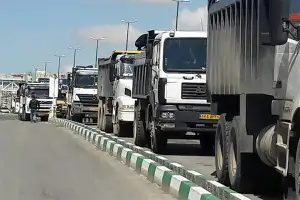
Staff at a repair workshop in Isfahan’s Amir Kabir industrial district, where businesses serving trucks and heavy machinery have reported a sharp drop in activity. (ILNA)
Business at one of central Iran’s main heavy-vehicle service hubs has fallen by about 30% from a year earlier, offering a ground-level view of an economy where soaring food prices, a battered currency and weaker freight activity are squeezing workers and small businesses.
The Amir Kabir industrial area in Isfahan is home to mechanics, machinists, body shops, battery specialists and parts dealers serving trucks, construction equipment and mining machinery. Labor news agency ILNA said activity across the district had fallen sharply as transport demand weakened and the cost of keeping vehicles on the road climbed.
“When freight activity slows and less cargo is being moved, drivers face serious problems,” a person working in the district told ILNA. “Most drivers bought their vehicles on installment, so besides making loan payments, they also have to cover the high cost of supporting their families.”
The slowdown comes as Iranian households face some of the steepest price increases in years. Official data for September showed consumer prices were 89.8% higher than a year earlier, while average inflation over the preceding 12 months reached 73.6%. Food and drink prices had already risen 127.5% year on year in August.
Reuters reported in September that food prices had more than doubled while the wider economy was being squeezed by sanctions, restrictions on oil exports and the costs of the seven-month conflict with the United States.
Iran’s currency has added another layer of pressure. The rial fell beyond 2.5 million to the US dollar on the free market earlier this week, a record low, compared with roughly 1.1 million a year earlier.
For businesses dependent on imported equipment, that fall feeds quickly into prices.
“Parts dealers buy according to the day’s dollar rate,” an Amir Kabir business operator said, adding that prices often fail to come back down even when the rial temporarily strengthens.
“The consumer and the worker end up carrying the greatest burden,” he said.
The industrial district illustrates how weakness in one part of Iran’s economy spreads quickly into others.
A single truck can generate work for engine mechanics, gearbox specialists, machinists, painters, welders, upholsterers and parts sellers before it gets back on the road. When freight volumes fall, drivers delay repairs and workshops lose business.
“There’s a deep slowdown across the industrial area,” the tradesperson said. “It’s not that the vehicles don’t need work. Purchasing power and liquidity have fallen sharply.”
Some vehicles are repaired but then sit idle because there is no cargo to move, he said. Even when transport work is available, delayed payments from cargo owners leave drivers and workshops short of cash.
That weakness is also reflected in accounts shared with Iran International, with Iranians describing cuts to spending on food, housing and medicine as savings run down and private-sector job losses spread.
Cheap parts bring expensive problems
Workshop owners are also grappling with replacement parts that they say are either prohibitively expensive or of poorer quality.
A local tradesperson told ILNA that original components for older European and American heavy vehicles had become difficult to obtain, leaving operators increasingly dependent on Chinese-made replacements.
“In the past, if you rebuilt a Volvo or Mack with original parts, it could run for years without another major repair,” he said. “Now poor-quality parts mean repeated breakdowns.”
Original parts can still sometimes be found, he added, but at prices that often make them uneconomical for truck owners already dealing with loans, insurance and weaker freight income.
The result is a cycle in which operators choose cheaper parts, suffer more frequent failures and return to workshops while having less money available to pay for the repairs.
The downturn is beginning to affect hiring and job security.
A machining workshop may employ 10 to 12 people repairing engine blocks, crankshafts and other heavy components. With business down and insurance, municipal charges and other expenses still rising, workshop owners may stop taking on workers or begin cutting staff, according to ILNA.
“A workshop with 10 or 12 workers may no longer want to expand its workforce and may even reduce the number of employees because its income cannot cover its costs,” a local business owner said.
The impact could outlast the immediate downturn. Training an experienced technician can take about a decade, he said, but workshops have less incentive to bring in apprentices when they are unsure whether they can retain existing staff.
Pressure reaches beyond Isfahan
The problems in Amir Kabir mirror a broader contraction in everyday economic activity as the government struggles with reduced oil revenues, sanctions and restrictions on trade.
US pressure has sharply reduced Iran’s access to foreign currency from oil exports, while sanctions evasion has become more costly. That has made imported equipment and raw materials harder to finance just as the rial’s fall raises their local-currency price.
For the workers and drivers in Isfahan, however, the crisis comes down to a simpler calculation: there is less work, while virtually everything needed to do that work costs more.
“If prices are going to remain high, then at the very least the volume of work has to increase,” a local tradesperson told ILNA. “Businesses need enough cash flow to keep operating.”
Masoud Pezeshkian and Khaled bin Mohamed bin Zayed Al Nahyan, Crown Prince of the United Arab Emirates
Iranian officials and media have sharply condemned Israeli Prime Minister Benjamin Netanyahu’s visit to the UAE, warning Abu Dhabi over its deepening ties with Israel amid renewed tensions over three disputed Persian Gulf islands.
Iran’s Foreign Ministry on Thursday condemned Netanyahu’s visit, warning of what it called the “very dangerous consequences” of an Israeli presence in the region.
The ministry said any move that provides “a platform for destabilizing actors to enter the region” would ultimately harm regional countries by fueling division and instability. It called on governments to prevent their territories from becoming “a platform for destabilizing actions” against neighboring states.
Mohsen Rezaei, secretary of Iran’s Supreme National Security Council, issued a more direct warning to the UAE on Wednesday.
“Just as hosting US military bases has not brought you security, hosting the butcher of Gaza will not have positive consequences either,” he wrote on X. “Learn from the recent war, stop starting wars and refrain from making baseless claims about the Iranian islands.”
The hardline Javan newspaper, affiliated with the Revolutionary Guards (IRGC), described Rezaei’s remarks as “a clear warning to Abu Dhabi,” saying Iran’s neighbors could pay a price for policies they believed would bring them greater security.
The rhetoric comes as the UAE’s security relationship with Israel faces fresh scrutiny following an attempted attack aboard a Flydubai flight from Dubai to Tel Aviv.
Israeli and Emirati authorities are investigating the incident, while US President Donald Trump said Thursday that investigators were examining a possible Iranian connection, although no evidence of Tehran’s involvement has been made public.
Iranian media intensify criticism
The criticism in Iranian media has increasingly gone beyond Netanyahu’s visit, with conservative outlets portraying the UAE as an active participant in efforts to contain Iran and questioning whether its cooperation with Israel extends beyond diplomacy.
Nour News, which is close to the Supreme National Security Council, accused the UAE of pursuing a two-track policy — publicly advocating de-escalation and dialogue with Iran while maintaining close security ties with the United States and Israel and pressing its claims to the disputed islands.
The website also portrayed Netanyahu’s visit as part of broader Israeli-Emirati efforts to reshape the regional security order and increase pressure on Saudi Arabia, though it offered no evidence of a coordinated plan.
Sobh-e No, considered close to parliament speaker Mohammad-Bagher Ghalibaf, warned that cooperation with a country involved in a war against Iran, whether military or intelligence-related, could affect Tehran’s security calculations.
The newspaper questioned whether the UAE’s role had been limited to hosting political meetings or whether its security cooperation with Israel had extended to the military confrontation with Iran.
Economic ties under strain
The increasingly hostile rhetoric comes against a history of extensive economic ties between Iran and the UAE, although Abu Dhabi suspended trade with Iran in August amid the war.
In 2024, around $21 billion of Iranian imports came from the UAE, accounting for roughly 30% of the total, according to World Trade Organization data. The UAE was also one of Iran’s largest destinations for non-oil exports.
The country has also long served as a hub for Iranian companies and intermediaries involved in moving goods and money around US sanctions.
Some Iranian conservatives are now arguing that those economic ties gave the UAE excessive influence over Tehran’s policy.
Conservative political activist Ali Gholhaki accused the UAE of profiting from sanctions on Iran while increasingly using its influence in Israel’s favor. He also alleged the existence of a “UAE lobby” inside Iran that had prevented Tehran from taking punitive measures against Abu Dhabi.
Calls for retaliation
The rhetoric has gone further among some figures close to Iran’s political establishment, with calls for direct retaliation against the UAE.
Mehdi Mohammadi, a strategic adviser to parliament speaker Ghalibaf, accused the UAE of cooperating with Netanyahu in launching a war against the Islamic Republic in a commentary published by the conservative Alef website.
“There is not much difference between them and the Israelis,” Mohammadi wrote.
“This time, the Emiratis should taste in Dubai, Sharjah and Ras al-Khaimah what they have brought about in Africa, Yemen, Somalia and the Arabian Peninsula. It is time for flames of light to be seen in the middle of Dubai.”
The rhetoric marks a sharp deterioration in Iranian discourse toward a neighbor with which Tehran had until recently sought de-escalation and maintained extensive commercial ties, with Netanyahu’s visit intensifying an already widening rupture over Israel, regional security and the disputed islands.