• العربية
  • فارسی
BrandBrand
  • Iran Insight
  • Politics
  • Economy
  • Analysis
  • Special Report
  • Opinion
  • Podcast
  • Live TV
  • Iran Insight
  • Politics
  • Economy
  • Analysis
  • Special Report
  • Opinion
  • Podcast
  • Live TV
  • Theme
  • Language
    • العربية
    • فارسی
  • Iran Insight
  • Politics
  • Economy
  • Analysis
  • Special Report
  • Opinion
  • Podcast
  • Live TV
All rights reserved for Volant Media UK Limited
volant media logo

Two more January protesters executed in Iran

Oct 5, 2026, 12:32 GMT+1
Alireza Sepahi, right, and Alireza Raisi, two protesters detained in connection with the January 2026 protests who were executed on October 5, 2026.

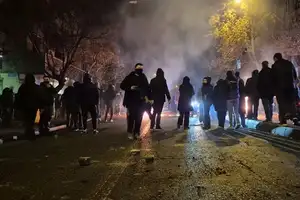
The Islamic Republic executed two more people detained in connection with the January 2026 protests, bringing to seven the number put to death in the Alikhani Square case in Isfahan, rights groups and the judiciary reported Monday.

Alireza Sepahi and Alireza Raisi were executed at dawn at Isfahan Central Prison, also known as Dastgerd Prison, the Hengaw Organization for Human Rights reported.

HRANA also reported Sepahi’s execution, citing lawyer Shahrzad Shahbazi.

Mizan, the judiciary-affiliated news agency, confirmed the executions several hours later on Monday.

The two men were among 12 defendants sentenced to death in the case known as the Alikhani Square case, which stems from the January protests in Isfahan.

Married one day before execution

Sepahi married his fiancée, Mahshad Kashani, from prison one day before his execution, Nobel Peace Prize laureate and lawyer Shirin Ebadi wrote on Telegram.

“He became a groom yesterday, and today they executed him,” Ebadi wrote.

Sepahi and Kashani had been engaged before their arrests. Kashani was also detained and sentenced to five years in prison.

“Behind every number the Islamic Republic adds to the list of executions is a life that could have continued for decades,” Ebadi wrote.

Sources familiar with the case told Iran International on Sunday that Sepahi and Raisi had been transferred to solitary confinement at Dastgerd Prison ahead of the implementation of their death sentences.

The office of exiled Prince Reza Pahlavi called on governments, human rights organizations, international bodies and civil and political activists on Sunday to use all available means to prevent the executions.

Seven executions in one case

Sepahi had previously been scheduled for execution on July 28 alongside his cousin Abolfazl Sepahi Badjani and Amirhossein Safari Hosseinabadi, two other defendants in the Alikhani Square case.

Sepahi suffered a stroke before being transferred for execution and was taken to a hospital in Isfahan. Abolfazl Sepahi and Safari were executed that day.

Ghaem Hosseini was executed on August 20, while Gol-Mohammad Mohammadi and Erfan Esfandiari were executed on July 19.

The executions of Sepahi and Raisi brought the number of people executed in the case to seven.

Iran International reported on July 8 that 12 defendants in the Alikhani Square case had been sentenced to death.

State media said four government security personnel were killed during clashes with protesters at Alikhani Square on January 8.

UN expert raises concerns over treatment

Mai Sato, the UN special rapporteur on human rights in Iran, raised what she described as “serious concerns” about the treatment of defendants and fair-trial standards in the Alikhani Square case.

“According to reports, Alireza Sepahi’s mother was tortured in front of him, and he and his cousin were beaten and tortured in front of their family,” Sato wrote in Persian on X.

Sepahi’s death sentence was carried out “while his lawyer was still seeking a way to have the case reviewed,” Sato added.

Information obtained by Iran International’s Fact-Finding Campaign indicated Sepahi was struck by four shotgun pellets during his arrest at home and was later tortured in detention.

The latest executions came two days after Siavash Jamshidi Kheirabadi, another person detained during the January protests, was executed on October 3.

Most Viewed

Iranian currency hits another record low under US economic pressure
1

Iranian currency hits another record low under US economic pressure

2

Trump weighs Iran decision with ‘all options’ on the table

3

Khamenei adviser warns UAE as tensions with Tehran escalate

4

Iran reviews US response to seven-day proposal as officials debate next steps

5
ANALYSIS

Security meeting, military buildup: US weighs next move on Iran?

Banner
Banner

Spotlight

  • What can Iran’s new oil chief change under the US blockade?
    ANALYSIS

    What can Iran’s new oil chief change under the US blockade?

  • Islamic Republic's 'slow meltdown' leaves it fewer ways out, analysts say
    PODCAST

    Islamic Republic's 'slow meltdown' leaves it fewer ways out, analysts say

  • Officials trade blame as Iran’s economy sinks deeper

    Officials trade blame as Iran’s economy sinks deeper

  • As the rial sinks, Iranians seek shelter in almost anything else
    INSIGHT

    As the rial sinks, Iranians seek shelter in almost anything else

  • Shot in leg, forced into hiding: Iran protester recounts January crackdown

    Shot in leg, forced into hiding: Iran protester recounts January crackdown

  • Al-Qaeda is Iran's quiet backup if the war turns, expert says

    Al-Qaeda is Iran's quiet backup if the war turns, expert says

Banner
Banner
Banner
  • Iran executes two protesters amid heavy security in Isfahan

    Iran executes two protesters amid heavy security in Isfahan

  • Iran death-row protester shot, tortured in custody

    Iran death-row protester shot, tortured in custody

  • Iran executes man arrested during January protests

    Iran executes man arrested during January protests

•
•
•

More Stories

Iran escalates Starlink threats over fears of losing internet control

Oct 5, 2026, 11:32 GMT+1
100%
A Starlink satellite internet terminal is seen installed on a rooftop in Iran.

Iranian authorities have stepped up warnings against Starlink as the cost-of-living crisis deepens and the prospect of renewed public protests grows, signaling mounting concern over citizens’ access to satellite internet.

The latest warning came from Mohammad Amin Aghamiri, secretary of the Supreme Council of Cyberspace and head of the National Cyberspace Center, who raised the possibility of treating satellite internet infrastructure as a military target.

“If satellite internet infrastructure is used as a tool of war, naturally this infrastructure can become a legitimate military target,” Aghamiri said Monday at a conference on online businesses organized by Iran’s cyber police.

  • Iran official warns Starlink could end state control of internet

    Iran official warns Starlink could end state control of internet

Aghamiri described satellite internet and Starlink as potential threats and said the Islamic Republic was technically prepared to counter them.

Referring to the January protests as a “coup,” Aghamiri said authorities had succeeded in disabling Starlink terminals during the unrest.

Officials and state media have repeatedly described anti-government protests as riots or attempted coups and attributed them to foreign actors, including the United States and Israel.

Internet shutdowns and protests

Internet restrictions have long been used by Iranian authorities during periods of widespread unrest.

  • Starlink next door could loosen Iran’s grip on internet

    Starlink next door could loosen Iran’s grip on internet

The Islamic Republic imposed a sweeping internet shutdown during the November 2019 protests and has since restricted or cut connectivity at different points, including during the Woman, Life, Freedom uprising, the 12-day war and the January 2026 protests.

After the 40-day war began in late February, authorities again cut internet access. The restrictions lasted 88 days, becoming the longest digital blackout in the world.

Concerns surrounding Starlink have grown alongside an increased US military presence in the region, worsening economic conditions and domestic discontent.

Internet and cybersecurity expert Davoud Sajjadi told Iran International on October 1 that Starlink allows users to bypass filtering and other government mechanisms designed to control internet access.

The ability to connect outside those systems has made the technology a growing concern for officials, Sajjadi said.

Diplomatic pressure and Starlink seizures

Iran has also pursued diplomatic and law-enforcement measures against the satellite service.

The Foreign Ministry summoned Norway’s ambassador on Sunday to protest continued Starlink operations in Iran.

Norway is the country through which the Starlink network is registered with the International Telecommunication Union, and Iranian authorities say Oslo is therefore responsible for preventing what they describe as unauthorized operations inside Iran.

Foreign Ministry delivered a formal protest to the Norwegian ambassador and called on Norway to take action to halt Starlink operations in Iran.

Authorities have simultaneously intensified efforts to stop the import and distribution of Starlink equipment.

Hossein Rahimi, head of Iran’s Economic Security Police, previously said police seized 997 Starlink devices and related equipment during the first four months of the current Iranian year, which started in mid-March, and arrested 163 people in connection with their import and distribution.

Efforts to stop the entry and distribution of Starlink equipment increased after the 12-day war, Rahimi added.

Official warns Starlink could force power cuts

The extent of official concern was underscored by a Communications Ministry official who warned that widespread Starlink access could undermine the government’s existing mechanisms for controlling cyberspace.

“The spread of Starlink drives the final nail into the coffin of cyberspace governance,” Mohammad Hafez Hakami, deputy minister for technology, innovation and international affairs at the Communications Ministry, said on September 30.

“Those concerned about Starlink have been warning about it for two years, but not even a single line of policy has been developed on the issue,” Hakami said. “If this trend continues, we will be forced to cut electricity in the next crisis.”

Hakami also warned that the expansion of Starlink and direct-to-cell technology could render mechanisms such as device registration and user identification ineffective.

“Starlink, as a new tool that evades governance, is fundamentally no longer based on our network,” Hakami said.

Direct-to-cell technology allows mobile phones to connect directly to satellites without relying on conventional telecommunications towers.

The prospect of satellite connections operating independently of domestic networks poses a particular challenge to authorities because shutting down conventional internet infrastructure would no longer necessarily disconnect users.

Starlink enters broader debate over information access

Israeli Prime Minister Benjamin Netanyahu also highlighted Starlink during his September 24 address to the United Nations General Assembly, holding up one of the devices while discussing access to information in Iran.

“The Iranian regime is especially afraid when their people have this. This is a communications device, Starlink, that allows people to access truth, to exercise choice and to exercise freedom of thought and freedom of speech.”

Netanyahu said Starlink could give Iranians access to what he called “truth,” as well as choice, freedom of thought and freedom of speech.

The growing focus on Starlink now extends across several arms of the Iranian state, from diplomatic pressure and equipment seizures to technical countermeasures and warnings of military action.


Iran demolishes prison despite warnings of erasing evidence of mass killings

Oct 4, 2026, 01:22 GMT+1
100%
A watchtower of Rajaeishahr Prison before demolition

One of the last watchtowers at Iran’s Rajaei Shahr (Gohardasht) prison was demolished Saturday, as authorities dismantle a site of mass political executions despite longstanding warnings that its destruction could erase evidence of crimes against humanity.

The prison in Karaj in western Tehran was one of the sites of the 1988 massacre of political prisoners. The exact nationwide toll remains unknown amid official secrecy, but rights groups estimate that around 5,000 people were executed across Iran.

Gohardasht was central to the prosecution of Hamid Nouri, a former Iranian prison official sentenced to life imprisonment by a Swedish court in 2022 for war crimes and murder over his role in the executions there. His conviction was upheld on appeal, but Sweden released him in June 2024 in a prisoner exchange with Iran.

Authorities have presented the prison’s redevelopment as a project to provide cultural facilities, university space and parks following its closure in 2023.

Warnings over destruction of evidence

When the prison closed in August 2023, the Norway-based Iran Human Rights organization called for urgent action to prevent its demolition, warning that evidence of atrocities could be lost before the full scope of the crimes was established.

“Gohardasht Prison is the place where crimes against humanity were committed by those who currently hold key positions in the Islamic Republic,” its director, Mahmood Amiry-Moghaddam, said at the time.

“We still don’t know the full scope of those crimes and destroying the evidence is without doubt one of the key motivations behind its closure.”

The organization described the closure as part of a systematic effort to erase traces of state crimes. Its warning came after Nouri’s conviction, while his appeal was still pending.

Executions at Rajaei Shahr continued long after the 1980s. Iran Human Rights said at least 530 people were executed there on murder charges alone between 2015 and 2022.

The group also cited reported efforts to destroy or alter Khavaran cemetery in southeastern Tehran, where victims of the 1988 massacre were buried in unmarked mass graves. Victims’ families had appealed to the UN human rights chief to prevent destruction or interference at the cemetery, it said.

Authorities promise parks and cultural facilities

A Saturday report by Iran’s state-linked Student News Network described the falling watchtower as the end of a familiar urban landmark. It did not address the prison’s role in the 1988 massacre or the warnings about preserving evidence.

Officials have justified the closure by citing a law requiring prisons to move outside cities, alongside complaints about prison-related traffic and other neighborhood problems.

Judiciary chief Gholamhossein Mohseni Ejei ordered the closure in April 2023. The prison was emptied by August that year, with prisoners transferred to Ghezel Hesar, according to the state media account.

Demolition of the perimeter walls began in the final month of the Iranian year ending in March 2026 and intensified in September, the report said. The head of Iran’s prisons organization described their removal as necessary to settle the land’s future and enable new projects.

Authorities say the roughly 60-hectare site will include green space, a women’s park, a cultural center, an auditorium and an art gallery. They have also pledged to retain the main prison building for university and cultural uses.

'They shot on sight': Amnesty details 2022 protest killings in Kurdish areas

Oct 3, 2026, 00:55 GMT+1
100%
A scene of protests in Sanandaj in September 2022

Iranian security forces shot civilians at close range, pursued fleeing protesters and prevented wounded people from receiving help during the 2022 Woman, Life, Freedom uprising in Kurdish cities, according to Amnesty International’s investigation into the crackdown.

The organization documented the unlawful killing of 95 Kurdish protesters and bystanders, including 13 children, across 17 counties in Kurdistan, Kermanshah and West Azerbaijan provinces.

Its findings describe repeated patterns of lethal force used to disperse demonstrations, punish protesters and deter further gatherings.

Among those killed was Yahya Rahimi, a 30-year-old man shot in his car in Sanandaj on October 8, 2022, apparently in retaliation for sounding his horn in solidarity with protesters while stuck in traffic.

Sources interviewed by Amnesty said plain-clothes agents smashed Rahimi’s car windows. Shortly after, an agent aimed a shotgun at his head and fired metal pellets from about half a metre away.

Amnesty verified five videos supporting accounts of the killing and reviewed his burial certificate, which recorded extensive brain damage and shattered skull bones caused by a fast-moving projectile.

Wounded protesters left without help

The investigation also documented cases in which security forces obstructed assistance after shooting people.

Shahou Bahmani, 36, was fatally shot in Sanandaj on November 17, 2022, during protests following a memorial gathering for people killed earlier in the uprising.

According to eyewitnesses cited by Amnesty, Bahmani remained bleeding for 30 to 40 minutes while security forces fired at protesters trying to help him. People took him to hospital after the forces withdrew. He was declared dead shortly after arrival.

“The agents would shoot anyone in their sight,” one witness, identified as Iman, told Amnesty.

The organization reviewed two videos showing Bahmani wounded and bleeding as people attempted to assist him, as well as his death certificate.

In Kermanshah, Minoo Majidi was killed on September 20 while fleeing police Special Cohorts on motorcycles. Amnesty said the agents chased protesters and bystanders while repeatedly firing shotguns loaded with metal pellets, hitting Majidi at close range.

Bystanders were also killed. Fereydoon Faraji was shot in Baneh on October 27 while looking out of a window at his workplace as security forces fired at people fleeing the crackdown.

A more militarized response

Amnesty recorded 35 unlawful killings in Kurdistan province, 19 in Kermanshah and 41 in West Azerbaijan.

It found that forces in the three provinces adopted a more militarized response than elsewhere, frequently deploying military-grade firearms soon after protests began.

Weapons included assault rifles, designated marksman rifles, sub-machine guns and heavy machine guns mounted on pickup trucks.

The organization said the lethal force in the documented killings was used to disperse, intimidate or punish people, rather than defend against an imminent threat of death or serious injury.

Kurdish and Baluchi victims together accounted for about 62% of the 326 people Amnesty recorded as killed during protest dispersals or in areas with a militarized security presence.

That figure includes 106 Baluchi protesters and bystanders killed in Sistan and Baluchistan.

Amnesty concluded that the disproportionately high toll could not be explained by protest size alone.

It found that murder and torture against Kurdish and Baluchi protesters were committed with discriminatory intent on political and ethnic grounds, meeting the elements of the crime against humanity of persecution.

The uprising began after the death in custody of Zhina Mahsa Amini, a Kurdish woman arrested by morality police in Tehran in September 2022.

Amnesty said it sought comments from Iran’s leadership and senior officials before publishing its investigation on September 16, 2026. It had received no responses by publication.

Iran denies teachers are quitting despite viral resignation videos

Oct 2, 2026, 19:38 GMT+1
100%
A teacher embraces a young student in a girls’ classroom in Iran's southern port city of Bushehr, September 2026

Iran’s Education Ministry dismissed reports of teacher resignations over working conditions and security pressure as a “rumor,” despite numerous videos of teachers announcing departures and a teachers’ council warning of a growing exodus.

Education Ministry spokesman Ali Farhadi said Friday that reports of teacher resignations were “not true” and accused unspecified actors of trying to undermine in-person education.

“The resignation of teachers is a rumor,” Farhadi told the Tasnim news agency, saying teachers and students had welcomed the return to classrooms across the country, including in southern provinces such as Hormozgan.

But the Coordinating Council of Iranian Teachers’ Trade Associations has offered a sharply different account, saying numerous videos and reports of resignations have emerged from different parts of the country in recent weeks.

The council said teachers were leaving because of a combination of wages below the poverty line, worsening living conditions, administrative pressures and what it described as the securitization of the profession, including dismissals, suspensions, arrests and legal cases against teachers and union activists.

It warned that experienced teachers were being driven out of classrooms by policies that had pushed the education system toward decline.

Videos circulating on social media in recent days have shown teachers announcing their resignations and citing financial hardship, workload and a lack of recognition for their work.

The dispute comes as Iran’s education system is already grappling with teacher shortages and longstanding discontent over pay and working conditions.

Teachers have repeatedly protested over salaries and benefits, including at a demonstration outside the Planning and Budget Organization in Tehran in September.

Labor activists have also warned that financial pressures are forcing some teachers to work multiple jobs, while shortages of teaching staff are affecting the quality of education.

The resignations have emerged against a wider backdrop of pressure on teachers and union activists, who in recent years have faced arrests, prison sentences, dismissal and suspension from work.

The Coordinating Council rejected the government’s portrayal of the unrest in schools as the product of outside agitation, arguing that the discontent stems instead from conditions within the education system itself.

Whether the resignations amount to the “wave” described by the teachers’ council is difficult to establish. The pressures it says are driving teachers out are considerably easier to document.

Iran court upholds film star’s jail term over post mourning protest victims

Oct 2, 2026, 17:05 GMT+1
100%
Elnaz Shakerdoost

An appeals court in Tehran has upheld a one-year prison sentence for renowned actress Elnaz Shakerdoost over an Instagram story mourning people killed during January’s protests, her lawyer said Friday.

The ruling also upheld a two-year ban on political, online and artistic activity imposed by Branch 23 of Tehran’s Revolutionary Court, which convicted her of “propaganda against the system.”

Her lawyer, Houshang Pourbabayi, said the post expressed grief and sympathy for those killed and contained no call for collective action or reference to state institutions.

Shakerdoost, 42, is one of Iran’s best-known film actresses and has worked in Iranian cinema for more than two decades. In 2019, she won the performance prize at the International Political Film Festival of Carcassonne in France for When the Moon Was Full, which also won the festival’s Grand Prize.

In August, human rights activists reported that nearly 100 prominent Iranians, including artists and filmmakers, had been summoned by security agencies or judicial authorities after speaking out against the new wave of executions, particularly the public hanging of protesters in Isfahan.

More than 20 of those summoned were well-known film and television actors, a civil rights activist said.

The report said those targeted had been among public figures posting against the executions under the hashtag “No to executions.”

Shortly after the brutal crackdown on January protests, acclaimed Iranian filmmaker Jafar Panahi warned that the Islamic Republic was intimidating artists to erase evidence of the massacre, citing the killing of a fellow director as the reality the authorities were trying to suppress.

Panahi said on Instagram that the killing of filmmaker Javad Ganji has been followed by an escalating campaign of intimidation against artists aimed at erasing the truth about protest deaths.

Panahi said directors Majid Barzegar and Behtash Sanaeiha were separately summoned and harshly interrogated for hours over a joint statement condemning state violence, warning that more cinema professionals are expected to face summons and that heavy judicial cases are already open.