• العربية
  • فارسی
BrandBrand
  • Iran Insight
  • Politics
  • Economy
  • Analysis
  • Special Report
  • Opinion
  • Podcast
  • Live TV
  • Iran Insight
  • Politics
  • Economy
  • Analysis
  • Special Report
  • Opinion
  • Podcast
  • Live TV
  • Theme
  • Language
    • العربية
    • فارسی
  • Iran Insight
  • Politics
  • Economy
  • Analysis
  • Special Report
  • Opinion
  • Podcast
  • Live TV
All rights reserved for Volant Media UK Limited
volant media logo

Netanyahu predicts Iran’s fall, top general warns of new war

Oct 5, 2026, 14:16 GMT+1
Israeli Prime Minister Benjamin Netanyahu (middle) attends a ceremony marking the third anniversary of the October 7 attack on October 5, 2026.

Israeli Prime Minister Benjamin Netanyahu predicted the eventual fall of Iran’s leadership while the Islamic Republic’s top armed forces commander warned a new conflict would engulf the region, sharpening exchanges over the prospect of renewed fighting on Monday.

The warnings came during a day that also saw Iran execute two protesters detained during the January uprising, the Revolutionary Guards threaten a tanker in the Strait of Hormuz, and Yemeni government forces launch a major offensive against the Iran-backed Houthis.

Netanyahu says Iran is fighting for survival

Iran’s leadership is weaker than at any point since its establishment and is fighting for survival, Netanyahu said at a ceremony marking the third anniversary of the October 7 attack.

“The tyranny is weaker than it has ever been since its establishment. It is fighting for its life, and its end is to disappear — or rather, to pass from the world,” Netanyahu said.

Netanyahu portrayed the October 7 attack as the opening stage of an Iranian-led effort to destroy Israel. He described what he called a three-pronged Iranian strategy involving armed groups surrounding Israel, thousands of missiles aimed at the country and nuclear weapons intended to destroy it.

“That was Iran’s three-pronged plan. But through our combined efforts, we crushed it, stage by stage,” Netanyahu said.

Israel struck Iran’s ballistic missile stockpiles and severely damaged its nuclear program, including scientists, facilities and infrastructure, Netanyahu added.

Iran’s Armed Forces General Staff chief Ali Abdollahi issued his own warning later Monday, saying any renewed conflict would spread beyond Iran and Israel.

“If a new war begins, its fire will engulf everyone,” Abdollahi said.

Iran would respond immediately and without limits if the United States launched another strike, regardless of whether Washington acted before or after congressional elections or at Israel’s urging, Abdollahi added.

IRGC threatens tanker in Strait of Hormuz

The military warnings coincided with a confrontation in the Strait of Hormuz, where a tanker turned back after the Revolutionary Guards hailed the vessel and threatened to target it if it continued its inbound transit, the United Kingdom Maritime Trade Operations said.

The encounter took place 11 nautical miles north of Khasab, Oman. The tanker’s master complied with the instruction and reversed course, UKMTO said.

The episode came as energy shipments through Hormuz showed signs of recovery. At least three liquefied natural gas shipments had exited the strait since late last week, extending a rebound in traffic, Bloomberg reported, citing ship-tracking data. Outbound LNG flows nevertheless remained more than 75% below prewar levels.

Iranian lawmaker Hassan Ghashghavi separately warned neighboring countries that their infrastructure could be targeted if Iranian infrastructure came under attack.

“We have told our neighbors that our security is your security, and our insecurity is your insecurity,” Ghashghavi, spokesman for parliament’s national security and foreign policy committee, said.

Yemen offensive puts Houthis under pressure

Yemen’s government forces opened another regional front on Monday, launching an operation against the Iran-backed Houthis and announcing advances around the Bab el-Mandeb Strait.

Government forces took control of the strait and Dhubab airport and cut the road between Dhubab and Mokha, military spokesperson Colonel Majed al-Nuzaili said. Hundreds of Houthi fighters were surrounded in Dhubab, he added.

The Saudi-led coalition said it struck 324 targets during the operation and provided air protection over Bab el-Mandeb and air cover for Yemeni government forces.

Yemen’s presidential council earlier announced the launch of “Operation Dawn of Yemen,” which it said was intended to retake Sanaa and restore state institutions.

The developments placed the Strait of Hormuz and Bab el-Mandeb, two strategic waterways at opposite ends of the Arabian Peninsula, at the center of Monday’s regional developments.

Executions and economic strain at home

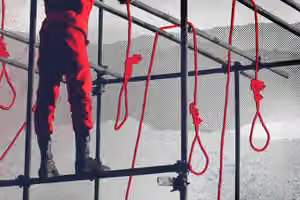
Inside Iran, the judiciary confirmed the executions of Alireza Sepahi and Alireza Raisi, two protesters detained during the January 2026 protests.

The two men were defendants in the Alikhani Square case in Isfahan, in which five others had previously been executed. Iran’s Supreme Court upheld death sentences for 12 defendants in the case in July.

UN Special Rapporteur on human rights in Iran Mai Sato condemned Sepahi’s execution and raised concerns about his treatment and judicial process. Sepahi’s lawyer was still seeking a review when the execution was carried out, Sato said.

Prince Reza Pahlavi’s communications office later vowed to pursue accountability for those involved in the executions through fair trials.

Economic difficulties also remained prominent. Workers across several sectors told Iran International that employers were delaying or splitting wage payments and cutting benefits, with some employees taking second jobs to meet everyday expenses.

The combination of military warnings abroad and political, economic and security developments at home kept the possibility of renewed conflict and its consequences at the center of Iran’s news on Monday.

Most Viewed

Iranian currency hits another record low under US economic pressure
1

Iranian currency hits another record low under US economic pressure

2

Trump weighs Iran decision with ‘all options’ on the table

3

Khamenei adviser warns UAE as tensions with Tehran escalate

4

Iran reviews US response to seven-day proposal as officials debate next steps

5
ANALYSIS

Security meeting, military buildup: US weighs next move on Iran?

Banner
Banner

Spotlight

  • What can Iran’s new oil chief change under the US blockade?
    ANALYSIS

    What can Iran’s new oil chief change under the US blockade?

  • Islamic Republic's 'slow meltdown' leaves it fewer ways out, analysts say
    PODCAST

    Islamic Republic's 'slow meltdown' leaves it fewer ways out, analysts say

  • Officials trade blame as Iran’s economy sinks deeper

    Officials trade blame as Iran’s economy sinks deeper

  • As the rial sinks, Iranians seek shelter in almost anything else
    INSIGHT

    As the rial sinks, Iranians seek shelter in almost anything else

  • Shot in leg, forced into hiding: Iran protester recounts January crackdown

    Shot in leg, forced into hiding: Iran protester recounts January crackdown

  • Al-Qaeda is Iran's quiet backup if the war turns, expert says

    Al-Qaeda is Iran's quiet backup if the war turns, expert says

Banner
Banner
Banner
  • Iranian currency hits another record low under US economic pressure

    Iranian currency hits another record low under US economic pressure

  • Security meeting, military buildup: US weighs next move on Iran?

    Security meeting, military buildup: US weighs next move on Iran?

  • Two more January protesters executed in Iran

    Two more January protesters executed in Iran

•
•
•

More Stories

Two more January protesters executed in Iran

Oct 5, 2026, 12:32 GMT+1
100%
Alireza Sepahi, right, and Alireza Raisi, two protesters detained in connection with the January 2026 protests who were executed on October 5, 2026.

The Islamic Republic executed two more people detained in connection with the January 2026 protests, bringing to seven the number put to death in the Alikhani Square case in Isfahan, rights groups and the judiciary reported Monday.

Alireza Sepahi and Alireza Raisi were executed at dawn at Isfahan Central Prison, also known as Dastgerd Prison, the Hengaw Organization for Human Rights reported.

HRANA also reported Sepahi’s execution, citing lawyer Shahrzad Shahbazi.

Mizan, the judiciary-affiliated news agency, confirmed the executions several hours later on Monday.

The two men were among 12 defendants sentenced to death in the case known as the Alikhani Square case, which stems from the January protests in Isfahan.

Married one day before execution

Sepahi married his fiancée, Mahshad Kashani, from prison one day before his execution, Nobel Peace Prize laureate and lawyer Shirin Ebadi wrote on Telegram.

“He became a groom yesterday, and today they executed him,” Ebadi wrote.

Sepahi and Kashani had been engaged before their arrests. Kashani was also detained and sentenced to five years in prison.

“Behind every number the Islamic Republic adds to the list of executions is a life that could have continued for decades,” Ebadi wrote.

Sources familiar with the case told Iran International on Sunday that Sepahi and Raisi had been transferred to solitary confinement at Dastgerd Prison ahead of the implementation of their death sentences.

The office of exiled Prince Reza Pahlavi called on governments, human rights organizations, international bodies and civil and political activists on Sunday to use all available means to prevent the executions.

Seven executions in one case

Sepahi had previously been scheduled for execution on July 28 alongside his cousin Abolfazl Sepahi Badjani and Amirhossein Safari Hosseinabadi, two other defendants in the Alikhani Square case.

Sepahi suffered a stroke before being transferred for execution and was taken to a hospital in Isfahan. Abolfazl Sepahi and Safari were executed that day.

  • Iran executes two protesters amid heavy security in Isfahan

    Iran executes two protesters amid heavy security in Isfahan

Ghaem Hosseini was executed on August 20, while Gol-Mohammad Mohammadi and Erfan Esfandiari were executed on July 19.

The executions of Sepahi and Raisi brought the number of people executed in the case to seven.

Iran International reported on July 8 that 12 defendants in the Alikhani Square case had been sentenced to death.

State media said four government security personnel were killed during clashes with protesters at Alikhani Square on January 8.

UN expert raises concerns over treatment

Mai Sato, the UN special rapporteur on human rights in Iran, raised what she described as “serious concerns” about the treatment of defendants and fair-trial standards in the Alikhani Square case.

“According to reports, Alireza Sepahi’s mother was tortured in front of him, and he and his cousin were beaten and tortured in front of their family,” Sato wrote in Persian on X.

  • Iran death-row protester shot, tortured in custody

    Iran death-row protester shot, tortured in custody

Sepahi’s death sentence was carried out “while his lawyer was still seeking a way to have the case reviewed,” Sato added.

Information obtained by Iran International’s Fact-Finding Campaign indicated Sepahi was struck by four shotgun pellets during his arrest at home and was later tortured in detention.

  • Iran executes man arrested during January protests

    Iran executes man arrested during January protests

The latest executions came two days after Siavash Jamshidi Kheirabadi, another person detained during the January protests, was executed on October 3.

Iran escalates Starlink threats over fears of losing internet control

Oct 5, 2026, 11:32 GMT+1
100%
A Starlink satellite internet terminal is seen installed on a rooftop in Iran.

Iranian authorities have stepped up warnings against Starlink as the cost-of-living crisis deepens and the prospect of renewed public protests grows, signaling mounting concern over citizens’ access to satellite internet.

The latest warning came from Mohammad Amin Aghamiri, secretary of the Supreme Council of Cyberspace and head of the National Cyberspace Center, who raised the possibility of treating satellite internet infrastructure as a military target.

“If satellite internet infrastructure is used as a tool of war, naturally this infrastructure can become a legitimate military target,” Aghamiri said Monday at a conference on online businesses organized by Iran’s cyber police.

  • Iran official warns Starlink could end state control of internet

    Iran official warns Starlink could end state control of internet

Aghamiri described satellite internet and Starlink as potential threats and said the Islamic Republic was technically prepared to counter them.

Referring to the January protests as a “coup,” Aghamiri said authorities had succeeded in disabling Starlink terminals during the unrest.

Officials and state media have repeatedly described anti-government protests as riots or attempted coups and attributed them to foreign actors, including the United States and Israel.

Internet shutdowns and protests

Internet restrictions have long been used by Iranian authorities during periods of widespread unrest.

  • Starlink next door could loosen Iran’s grip on internet

    Starlink next door could loosen Iran’s grip on internet

The Islamic Republic imposed a sweeping internet shutdown during the November 2019 protests and has since restricted or cut connectivity at different points, including during the Woman, Life, Freedom uprising, the 12-day war and the January 2026 protests.

After the 40-day war began in late February, authorities again cut internet access. The restrictions lasted 88 days, becoming the longest digital blackout in the world.

Concerns surrounding Starlink have grown alongside an increased US military presence in the region, worsening economic conditions and domestic discontent.

Internet and cybersecurity expert Davoud Sajjadi told Iran International on October 1 that Starlink allows users to bypass filtering and other government mechanisms designed to control internet access.

The ability to connect outside those systems has made the technology a growing concern for officials, Sajjadi said.

Diplomatic pressure and Starlink seizures

Iran has also pursued diplomatic and law-enforcement measures against the satellite service.

The Foreign Ministry summoned Norway’s ambassador on Sunday to protest continued Starlink operations in Iran.

Norway is the country through which the Starlink network is registered with the International Telecommunication Union, and Iranian authorities say Oslo is therefore responsible for preventing what they describe as unauthorized operations inside Iran.

Foreign Ministry delivered a formal protest to the Norwegian ambassador and called on Norway to take action to halt Starlink operations in Iran.

Authorities have simultaneously intensified efforts to stop the import and distribution of Starlink equipment.

Hossein Rahimi, head of Iran’s Economic Security Police, previously said police seized 997 Starlink devices and related equipment during the first four months of the current Iranian year, which started in mid-March, and arrested 163 people in connection with their import and distribution.

Efforts to stop the entry and distribution of Starlink equipment increased after the 12-day war, Rahimi added.

Official warns Starlink could force power cuts

The extent of official concern was underscored by a Communications Ministry official who warned that widespread Starlink access could undermine the government’s existing mechanisms for controlling cyberspace.

“The spread of Starlink drives the final nail into the coffin of cyberspace governance,” Mohammad Hafez Hakami, deputy minister for technology, innovation and international affairs at the Communications Ministry, said on September 30.

“Those concerned about Starlink have been warning about it for two years, but not even a single line of policy has been developed on the issue,” Hakami said. “If this trend continues, we will be forced to cut electricity in the next crisis.”

Hakami also warned that the expansion of Starlink and direct-to-cell technology could render mechanisms such as device registration and user identification ineffective.

“Starlink, as a new tool that evades governance, is fundamentally no longer based on our network,” Hakami said.

Direct-to-cell technology allows mobile phones to connect directly to satellites without relying on conventional telecommunications towers.

The prospect of satellite connections operating independently of domestic networks poses a particular challenge to authorities because shutting down conventional internet infrastructure would no longer necessarily disconnect users.

Starlink enters broader debate over information access

Israeli Prime Minister Benjamin Netanyahu also highlighted Starlink during his September 24 address to the United Nations General Assembly, holding up one of the devices while discussing access to information in Iran.

“The Iranian regime is especially afraid when their people have this. This is a communications device, Starlink, that allows people to access truth, to exercise choice and to exercise freedom of thought and freedom of speech.”

Netanyahu said Starlink could give Iranians access to what he called “truth,” as well as choice, freedom of thought and freedom of speech.

The growing focus on Starlink now extends across several arms of the Iranian state, from diplomatic pressure and equipment seizures to technical countermeasures and warnings of military action.

What can Iran’s new oil chief change under the US blockade?

Oct 5, 2026, 01:58 GMT+1
•
Umud Shokri
100%
A view of the Strait of Hormuz, with vessels traveling through the waterway.

Iran’s oil minister Mohsen Paknejad resigned Sunday, leaving acting minister Hamid Bovard with crude exports choked by a US blockade and scrutiny of intermediaries used to sell sanctioned oil, raising questions over what he can change.

President Masoud Pezeshkian accepted Paknejad’s resignation on October 4 and appointed Bovard, chief executive of the National Iranian Oil Company (NIOC), to lead the ministry temporarily.

The presidential office said Paknejad had sought to resign some time earlier for personal reasons and that Pezeshkian initially wanted him to remain, eventually accepting the resignation at Paknejad’s insistence.

That leaves little verified basis for attributing his departure to the blockade or any particular dispute inside the oil industry. The more answerable question is what Bovard inherits — and which of the pressures facing Iran’s most important source of revenue are actually within the Oil Ministry’s control.

A blockade no minister can lift

The immediate problem is physical: Iran is struggling to get new oil to its customers.

Iran International reported, citing Kpler and TankerTrackers, that no Iranian crude cargo has crossed the US blockade line toward China since mid-July and that no new crude has been loaded at Iranian terminals since mid-August.

Iran initially kept deliveries going from crude already stored aboard tankers. By mid-August, around 67 million barrels had accumulated on vessels in Iran’s southern waters. But access to empty tankers became increasingly limited, bringing new loadings to a halt.

Iran’s crude production has consequently fallen to about 1.8 million barrels per day, roughly the amount required for domestic consumption and around half its pre-war output, according to Kpler.

The decline follows an already sharp fall in exports. Crude and condensate loadings were estimated at around 220,000 to 255,000 barrels per day in August, down from about 740,000 in July and roughly two million in March.

Paknejad, shortly before his resignation was announced, said revenue from oil already sold was continuing to reach Iran.

That is not necessarily at odds with the collapse in new loadings. Payments can continue for cargoes sold and delivered earlier even after the physical flow of fresh crude slows. The larger problem for the government is how long those revenues can be sustained without new oil entering the export system.

Here, Bovard’s room for maneuver is limited. A new minister cannot by himself remove a US naval blockade, provide empty tankers or reopen a route to China. Any meaningful recovery in export volumes would depend largely on a change in the conditions surrounding the blockade.

An oil-sales system Bovard can influence

The ministry has more direct control over another problem: how sanctioned oil is sold and how the proceeds are returned.

Iran has long relied on intermediaries, commonly known as trustees, to sell crude and move the proceeds because sanctions restrict its access to conventional banking channels. The system has become increasingly controversial as cases involving unpaid revenues and heavily indebted intermediaries have emerged.

Iran International reported on September 8, based on two confidential documents from the Oil Ministry and Supreme National Security Council, that large oil cargoes had been handed on credit and at steep discounts to four trustees who already carried substantial debts from earlier transactions.

One confidential letter said the four had been granted an unusually high discount of $8.50 per barrel despite outstanding debts and failures to return proceeds from previous oil sales.

The investigation also identified Mohammad Javad Bavand, appointed by Paknejad as special assistant for supervision of oil trading, as a central figure in managing a new network of intermediaries. Subsequent documents obtained by Iran International showed an 86-million-barrel oil consignment being assigned to four indebted trustees.

The cases form part of a broader dispute over oil revenues that have failed to return to the state. Iran International previously reported that the head of the State Inspection Organization had acknowledged at least $1.6 billion misappropriated by intermediaries, while 59 criminal cases had been opened.

The Oil Ministry has defended the trustee system as a necessity created by sanctions and rejected allegations that it failed to supervise the firms involved. But the controversy poses a problem that is more directly within a minister’s reach than the blockade: who receives oil to sell, on what terms, what guarantees are required and what happens when proceeds are not returned.

Bovard’s appointment is relevant here because he comes directly from NIOC, putting an official familiar with the operational side of the industry at the head of the ministry.

He also inherits a ministry that has faced disputes over appointments and authority. Iranian media have reported friction surrounding Mohammad Shariatmadari’s continued leadership of Persian Gulf Petrochemical Industries Company, including disagreement over attempts to replace him.

There is no established evidence that either the Shariatmadari dispute or the trustee controversy prompted Paknejad’s resignation, particularly given the presidential office’s account that he left for personal reasons. Their significance is instead in what they show about the management system Bovard is taking over.

What can actually change?

The two main challenges confronting Bovard therefore require very different responses.

The blockade is largely beyond the ministry’s control. Even an experienced NIOC executive cannot restore export routes or tanker access through an administrative reshuffle.

The internal oil-sales system is different. Bovard could have greater influence over how intermediaries are chosen, whether indebted trustees continue receiving cargoes, what payment guarantees they must provide, how overdue proceeds are pursued and how closely oil transactions are supervised.

No such changes were announced with his appointment.

That makes the significance of the reshuffle relatively straightforward to assess. If Iranian terminals resume loading crude and exports to China restart, the decisive factor will probably be a change in the blockade or the wider conflict.

If the ministry changes the way trustees are selected, tightens guarantees, recovers overdue revenues or alters the officials managing sanctioned oil sales, those would be changes Bovard can more directly influence.

Paknejad’s resignation therefore does not by itself explain what is happening to Iran’s oil exports or signal a new policy. Bovard inherits an external constraint he has little power to remove and an internal sales system over which he may have considerably more room to act.

Whether the change at the top matters will depend on which of those problems, if either, begins to change.

Iran’s Olympiad paradox: Building scientific talent for a future abroad

Oct 4, 2026, 19:35 GMT+1
•
Umud Shokri
100%
Iran’s national Astronomy and Astrophysics Olympiad team, which won five gold medals at the 19th International Olympiad on Astronomy and Astrophysics (IOAA 2026) in Hanoi, Vietnam, October 4, 2026.

Iran’s scientific Olympiad system has become a pipeline of elite talent into universities feeding sensitive nuclear, missile and technology sectors, even as many of the same high achievers leave the country for better opportunities abroad.

The system produced another striking result this weekend, when Iran’s five-member team won five gold medals at the International Olympiad on Astronomy and Astrophysics in Hanoi, securing the world championship for a third consecutive year.

The achievement is part of a much longer record. Iran has spent decades identifying exceptional schoolchildren, training them intensively and directing them toward mathematics, physics, engineering, computer science and other technical disciplines.

International victories bring prestige, but the students themselves are arguably more valuable. They form part of the human capital on which Iran’s universities, technology sector and some of its most strategically important industries depend.

That is also where the system encounters its central contradiction. Iran has proved remarkably effective at finding and developing scientific talent. It has had considerably more difficulty keeping it.

A pipeline for elite science

Iran’s Olympiad program is not simply a collection of international competitions. It is the upper end of an extensive system for identifying gifted students while they are still in school.

The Young Scholars Club organizes national Olympiads across mathematics, physics, chemistry, biology, informatics, astronomy and other disciplines, with many successful competitors coming through Iran’s selective schools for gifted students, commonly known as Tizhooshan.

Students who advance through successive rounds receive specialized instruction well beyond the standard school curriculum. A small number are eventually selected for international teams and spend months preparing to compete against the strongest students from other countries.

Participation has grown sharply. Some 121,000 students entered Iran’s scientific Olympiads in the Iranian year ending in March 2026, up from 87,000 the previous year, an increase of about 40% and the highest participation in a decade.

There are substantial incentives for those who reach the top. International gold medalists in established scientific Olympiads can receive exemptions from Iran’s fiercely competitive national university entrance examination, or Konkoor, giving them a privileged route into the country’s leading universities and technical programs.

The results extend well beyond astronomy. Iran has repeatedly won medals in mathematics, physics, chemistry, biology and informatics, including some of the highest placements in international competition.

For the state, those performances provide visible evidence that sanctions and international isolation have not prevented Iran from cultivating world-class scientific ability.

There is substance to that claim. Repeated success shows that Iran has developed an effective mechanism for discovering exceptional students and preparing them to compete at the highest level.

But Olympiad results demonstrate concentrated excellence rather than the overall strength of Iran’s education system. A small group of highly selected students can receive intensive training and state support while ordinary schools face shortages, unequal resources and deteriorating economic conditions.

More revealing is what happens to the medalists after they leave school.

From Olympiad medals to strategic universities

Research into the careers of International Mathematical Olympiad medalists illustrates how concentrated Iran’s elite science pipeline has become.

Among 75 Iranian mathematics medalists whose undergraduate education could be established in one study covering medalists from 1986 to 2005, 71 attended Sharif University of Technology and the other four went to the University of Tehran.

The concentration provides a direct link between Iran’s Olympiad system and two of the institutions at the center of its scientific establishment.

Sharif is widely regarded as Iran’s leading engineering and technical university. It has also had longstanding connections with research areas tied to Iran’s nuclear, missile and defense sectors.

Several research bodies located at the university have been sanctioned by the United States under authorities targeting proliferation of weapons of mass destruction.

European sanctions have gone further, citing Sharif’s cooperation with organizations involved in Iran’s ballistic missile program and its connections with entities associated with nuclear research and uranium enrichment.

The University of Tehran has its own history of research touching sensitive fields. Its academics have worked in areas relevant to missiles, drones, aerospace technology and nuclear science, as well as projects connected to Iran’s space program.

The university also played an early role in the development of Iran’s nuclear infrastructure. Its Atomic Center, established in the 1960s around a US-supplied research reactor, was transferred to the Atomic Energy Organization of Iran in 1974 and became the Tehran Nuclear Research Center.

None of this means Olympiad winners are systematically recruited into nuclear or missile programs. There is no evidence of such a direct mechanism, and the overwhelming majority of teaching and research at Iran’s major universities is civilian.

The connection is one of human capital.

The mathematics, physics, computing and problem-solving skills cultivated through Olympiad training are also essential to artificial intelligence, aerospace engineering, advanced computing, cybersecurity, nuclear science and missile development.

The universities that attract Iran’s strongest students supply engineers and researchers to a broad range of institutions, from civilian technology firms and research centers to parts of the defense and nuclear establishment.

For a heavily sanctioned state, such expertise has particular value.

Restrictions on imports, technology transfers, investment and international research collaboration make indigenous scientific capacity more important. Iran may struggle to obtain certain foreign technologies or advanced equipment, but scientific expertise developed domestically is considerably harder to restrict.

The Olympiad system therefore serves a purpose beyond medals. It identifies unusually capable students early, concentrates resources on their development and helps direct them toward disciplines important both to Iran’s economy and to sectors the state considers strategically vital.

But producing that talent does not mean Iran gets to keep it.

The talent drain

Studies of Iranian Olympiad medalists suggest that a substantial proportion eventually build their lives elsewhere.

Among 82 Iranian International Mathematical Olympiad medalists whose current location could be established in one study, 49 — around 60% — were living abroad.

The same research found a strong relationship between studying abroad and permanent migration. More than 70% of Olympiad medalists who pursued either undergraduate or doctoral education overseas eventually remained abroad, while those educated entirely in their home countries were considerably more likely to stay.

Other figures circulated in Iran have been even more dramatic.

In 2022, the secretary-general of the Iranian Talent Association said that 82 or 83 members of a group of 86 Olympiad medalists tracked by the organization had emigrated, arguing that inadequate support for talented young people inside Iran was a major factor.

Iranian officials disputed that figure and cited research suggesting that a majority of a much larger group of international Olympiad winners still lived in Iran or had returned after studying abroad.

The samples and methodologies differ, making the figures difficult to compare directly. But the broader problem of migration among Iran’s most highly educated young people is widely acknowledged.

For students who spend years preparing to compete at international level, the contrast between opportunities inside and outside Iran can be stark.

At home they face inflation, currency depreciation, weakened salaries, limited research funding, shortages of modern laboratory equipment, bureaucratic restrictions and obstacles to international scientific cooperation.

Sanctions deepen many of those pressures by limiting access to equipment, software, financing and research partnerships.

The qualities that make these students valuable to Iran also make them unusually mobile.

An international Olympiad medal is a credential recognized by universities around the world. A student emerging from Sharif with an Olympiad background can compete for places at elite graduate schools, research laboratories and technology companies abroad.

The investment that makes the student valuable inside Iran therefore also increases their ability to leave it.

Maryam Mirzakhani remains the best-known example.

She won mathematics Olympiad gold medals for Iran as a teenager, studied at Sharif and later moved to the United States, where she became a professor at Stanford University and the first woman to win the Fields Medal.

Her career demonstrated both sides of Iran’s Olympiad system: its ability to identify exceptional talent and its difficulty retaining the long-term scientific benefits of that talent.

That does not mean every medalist leaves. Many remain in Iran and contribute to universities, research centers, technology companies and industry. Some who study overseas also maintain scientific ties with Iran or eventually return.

But the loss carries disproportionate weight when those leaving represent some of the most intensively selected and trained scientific talent the country produces.

The Olympiad paradox

Iran’s investment in scientific Olympiads therefore remains rational even when some of its most successful products emigrate.

The system discovers talent that might otherwise go unnoticed, raises scientific standards, gives exceptional students opportunities and produces genuine international achievements.

It also develops scientists and engineers in disciplines Iran considers essential to its economic and technological future.

Under sanctions, that logic becomes even stronger. When technology, equipment and capital are difficult to import, investing in people becomes one of the few capabilities a country can develop largely from within.

Yet that strategy depends on more than discovering talented teenagers.

Iran can identify an exceptional student at 15, provide intensive training, waive the university entrance examination, send them to Sharif and celebrate when they defeat competitors from dozens of countries.

What the Olympiad system cannot provide is the research environment, professional freedom, economic security and long-term career prospects that determine where that student chooses to live at 25 or 35.

That gap can turn Iran’s investment into an unintended subsidy for institutions abroad.

Iranian families, schools and public institutions bear much of the cost of discovering and developing globally competitive students. Foreign universities, laboratories and companies can later recruit scientists and engineers whose foundational training has already been completed.

For Iran, the implications extend beyond academia. The same talent that can strengthen a university laboratory or technology company can also contribute to aerospace, artificial intelligence, nuclear research and other strategically important sectors.

This weekend’s five astronomy gold medals show that the first part of Iran’s system continues to work exceptionally well. For a third consecutive year, Iranian students have demonstrated that they can compete with the best young scientific talent in the world.

The harder measure of success comes years later: whether Iran can offer those students a future compelling enough to keep the talent it worked so hard to discover.


Trump weighs Iran decision with ‘all options’ on the table

Oct 4, 2026, 03:59 GMT+1
100%
US President Donald Trump gestures during a rally at Butler High School in Vandalia, Ohio, US, October 3, 2026.

US President Donald Trump said Saturday he was approaching a decision on Iran, warning Tehran faced the “easy way or the hard way” as the Pentagon kept military options open amid continued attacks on commercial vessels in the Strait of Hormuz.

“We have a decision that I’ll make about Iran,” Trump told reporters. “Iran has been decimated, so the only question is it’ll either be the easy way or the hard way.”

Trump also said Iran was “virtually giving up” any plans to obtain a nuclear weapon, while reiterating that Tehran would never be allowed to acquire one.

Defense Secretary Pete Hegseth gave a clearer indication of what the harder option could involve, saying the Pentagon was working to ensure Trump retained “all the options he needs on the table” if Iran refused to abandon its nuclear ambitions.

“Iran will never, ever, ever have a nuclear weapon,” Hegseth said, describing Trump as “hell-bent and determined” to prevent it.

Pentagon preserves military options

Hegseth declined to say whether the USS Theodore Roosevelt carrier strike group, dispatched from San Diego last week, would be sent to the Middle East, saying his job was to give Trump the widest possible “decision space.”

He said Iran was trying to rebuild missile and other military capabilities damaged by US strikes but argued that damage to its defense industry had slowed that effort.

The military pressure has remained concentrated around the Strait of Hormuz, where Hegseth claimed Washington, rather than Tehran, now controlled the waterway. He described the US blockade as “ironclad” and said traffic was moving back toward pre-war levels.

Commercial vessels, however, continue to face attacks.

Iranian state media reported Saturday that another oil tanker had been hit in the strait. The IRGC-affiliated Fars News identified the vessel as the Ore Vinst and claimed it had been traveling under US escort when it was targeted while heading toward Oman.

The United States has not reacted to the claim yet.

The incident followed a series of attacks on ships transiting Hormuz even as Washington has escorted vessels through the waterway and sought to restore energy flows.

US says pressure campaign is cutting Iran’s revenue

The blockade is also intended to deny Tehran the oil income Washington says it needs to rebuild its military capabilities.

Treasury Secretary Scott Bessent said Iran would have no oil shipments at sea this week and therefore no revenue from those cargoes, describing the blockade and subsequent economic isolation as the next stages of a campaign that began with US military strikes.

“We had kinetic [action], we destroyed their navy, their air force, substantially depleted their drone and missile capability,” Bessent said.

“Then we went to what the president calls the Iron Wall and the blockade,” he added. “And now we have Operation Economic Outcast and we are isolating them economically like it’s never happened before.”

White House Communications Director Steven Cheung also said Iranian oil exports had been “stopped completely” and cited a Bloomberg report putting inflation at almost 90%.

Iran’s government has acknowledged increasing economic pressure while rejecting Washington’s claim that its strategy is succeeding.

President Masoud Pezeshkian said Saturday his government had adopted a “new posture” to manage what he described as exceptional conditions.

“The enemy’s plan in recent months has been to cut the country’s vital arteries with the aim of putting pressure on the Iranian people,” he wrote on X.

Pezeshkian said the pressure had increased but argued that government measures and public cooperation had prevented Iran’s adversaries from achieving their objectives.

Diplomatic channel remains open

Trump’s pending decision comes with diplomacy still technically alive but with no clear sign of a breakthrough after the latest contacts between Washington and Tehran.

The conservative Sobh-e No newspaper which is close to Iran’s chief negotiator Mohammad Bagher Ghalibaf reported Saturday that Iran was reviewing a US proposal conveyed through Qatar setting out a roadmap and timetable for further negotiations.

The paper said Tehran continued to demand that Washington first meet its commitments, including sanctions relief and the release of frozen Iranian funds, and that Iran’s principal conditions remained unchanged.

Those contacts follow talks in New York that failed to produce an agreement, with the two sides remaining divided over the terms for ending the war and reopening Hormuz.

For now, Trump has continued to present the choice as Iran’s: accept a deal under mounting military and economic pressure or face what he calls the “hard way.”