Iran defense official says Trump ‘talks too much’ over Hormuz
Majid Ebnolreza, acting defense minister of the Islamic Republic, dismissed US President Donald Trump’s remarks that the Strait of Hormuz is part of US territory, saying Trump “talks too much.”
Addressing the US naval blockade and economic campaign against Iran, Ebnolreza said: “We rely on Iranian youth and Iranian knowledge, and we will get through these circumstances.”
Iranian rials and US dollars are exchanged in Tehran. (File photo)
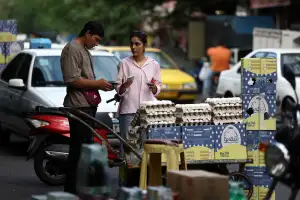
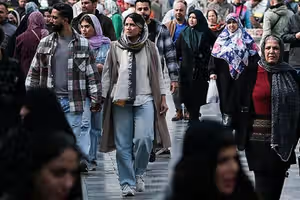
Iranians described deepening financial hardship and questioned whether economic pressure can change government policy as the dollar hit a historic 2 million rials, extending the currency's sharp decline on Sunday.
The US dollar reached 2 million rials on Iran's open market, crossing a threshold it had approached rapidly in recent days.
“We saw revolution, war, sanctions, rising prices and hardship,” one person told Iran International. “Now that we are over 50, we worry about our children, their jobs, their future, education, university and marriage costs. Pressure from outside, pressure from inside. How much can one endure?”
The dollar stood at around 1.865 million rials at the beginning of last week, putting its rise at more than 7% in less than a week. It has more than doubled from around 958,000 rials during the same period last year.
The British pound climbed above 2.72 million rials, while the euro approached 2.34 million rials. Rates can vary between sources because open-market trading is informal and fragmented.
Iranians describe pressure from all sides
The currency's latest fall comes days after US President Donald Trump announced what he called the “most crushing economic operation ever taken against any country,” warning of unprecedented economic isolation and consequences for countries whose financial institutions, businesses or government entities continue providing Tehran with an economic lifeline.
“Oil smuggling, swap lines, cash transfers, exchange houses, ship registries, front companies – it all needs to stop NOW,” Trump wrote on Truth Social, calling on US allies to join the campaign.
Messages sent to Iran International in response to a question about US economic pressure largely focused on the burden borne by ordinary people rather than its effect on the Islamic Republic.
“Iran has been under sanctions for nearly 50 years and the Islamic Republic is still governing,” one person said. “These measures do not work. They only leave the Iranian people poorer and hungrier, without medicine, healthcare or housing.”
Others questioned whether greater economic pressure could force authorities to change course.
“I don't think the government will come under pressure because it covers its budget deficit from people's pockets,” another respondent said. “The tip of the sanctions spear is aimed directly at the people; healthcare, nutrition, education and sports are all at risk.”
Rial's decline compounds daily hardship
Market participants point to high inflation, growing demand for foreign currency, declining foreign-exchange revenues and concern over sanctions as factors driving demand for dollars.
Political uncertainty, disruption to regional oil exports and the deadlock between the Islamic Republic and the United States have added to inflation expectations.
The currency slide comes alongside electricity and water shortages that have disrupted production and daily life. Further rial depreciation can raise the cost of imported raw materials and essential goods, adding to pressure on household budgets.
Some Iranians who contacted Iran International argued that economic pressure would be more effective if directed at assets held abroad by officials and their relatives.
“When they can freeze the foreign accounts of officials and their children, then you can call it pressure on the government,” one respondent said. “Seize their assets.”
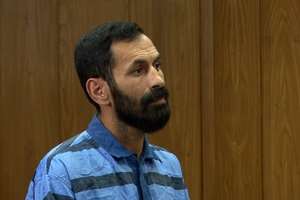
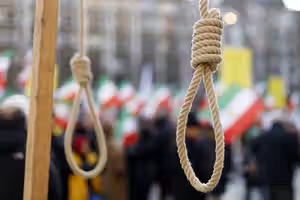
Iran executed another detainee from the January protests after the Supreme Court upheld his death sentence, the judiciary announced on Sunday.
The judiciary accused Majid Adineh of taking “operational action” for Israel, the United States and hostile groups and cooperating with them against Iran’s security and national interests.
Adineh was put to death at dawn. A Revolutionary Court in Karaj had also ordered the confiscation of all his property.
He was arrested with another person on January 9 near Karaj by intelligence forces of the Revolutionary Guards' Alborz provincial branch.
Adineh’s case included charges of “enmity against God through deliberate arson, collusion against internal security, propaganda against the Islamic Republic and unauthorized possession of weapons.”
Iranian authorities have long used broadly worded charges such as espionage, acting against national security, armed rebellion, enmity against God and corruption on earth to crush dissent and remove political opponents. Human rights organizations say these labels are routinely applied to protesters, dissidents and political prisoners to portray them as security threats and provide a legal pretext for execution.
Executions accelerate
Adineh's execution came one week after Shahram Sadeghi, another January protest detainee.
An Iran International review shows about 60 political prisoners have been executed since the beginning of the Iranian calendar year in March, while dozens more have received death sentences on political charges.
UN High Commissioner for Human Rights Volker Türk said on August 5 that at least 56 political prisoners were executed since March 19, including 27 whose cases were connected to the January protests. More than 100 others faced execution, Türk added.
Türk called the lack of fair-trial guarantees "deeply troubling," citing reports of confessions obtained under torture and cases in which only weeks separated arrest from execution.
Amnesty International, Human Rights Watch and UN experts have documented repeated cases in which such convictions were issued by revolutionary courts after grossly unfair or highly expedited proceedings, with defendants denied meaningful access to lawyers and verdicts based on torture-tainted forced confessions. Rights groups therefore describe many executions carried out under these charges as arbitrary and politically motivated, warning that the authorities’ allegations should not be treated as independently established facts.
A billboard in Tehran featuring Iran’s Supreme Leader Mojtaba Khamenei and senior military commanders.
Mojtaba Khamenei has not been seen or heard publicly, leaving his condition and circumstances unclear as officials govern in his name, interpret messages attributed to him and invoke his authority on questions ranging from negotiations with Washington to the conduct of the war.
Khamenei’s absence from public view has not stopped competing factions from claiming his backing. Written messages attributed to him, some open to competing interpretations, have provided material for both advocates and opponents of negotiations. But the competition to define what the supreme leader wants is not necessarily an equal one.
In wartime, military and security institutions have greater power than advocates of compromise to turn their interpretation of his wishes into action. Senior commanders occupy key decision-making positions, control the forces conducting the war and repeatedly invoke the leader’s authority in explaining military and political choices.
That imbalance has given hawkish figures greater room to portray Mojtaba as opposed to compromise, even though messages attributed to him have both permitted negotiations and called for retribution.
Iran’s leader is not only central to decisions on war and peace but also, as commander-in-chief of the armed forces, at the center of the country’s power structure during crises.
The Iran-Iraq war and last year’s 12-day war with Israel and the United States demonstrated how the supreme leader’s role extends beyond military command to political cohesion, public mobilization and connecting decisions on the battlefield with society.
Mojtaba’s absence from public view has raised a different question: how supreme authority is exercised during a war when the leader himself is neither seen nor heard.
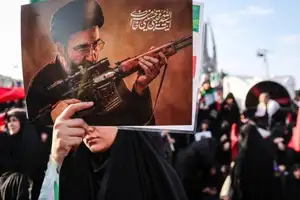
A poster featuring Mojtaba Khamenei on a street in Tehran.
Written messages attributed to Mojtaba, alongside repeated references by officials to his views and wishes, have become a means of asserting his authority over decisions and maintaining cohesion among supporters of the Islamic Republic.
They also turn the leader’s name into a source of authority under which costly decisions can be pursued, even as responsibility for implementing them and their consequences is dispersed across the political and military establishment.
Authority without a public appearance
Mojtaba has not appeared at major political, state or personal events, including the funeral of his wife and the large funeral ceremonies for his father.
His absence has produced conflicting accounts about his health, ranging from assertions that he is completely healthy to reports that he was injured or lost a limb, creating uncertainty around a leader whose name remains central to decision-making.
Security concerns have been offered as the principal explanation for keeping him out of public view.
“Security experts have strongly advised him not to reveal himself, even through the release of his voice, let alone an image,” Mohammad-Hossein Khoshvaght, secretary of the Fararu website, said.
Hamshahri newspaper has similarly argued that releasing an audio recording could make it possible to extract some of the speaker’s physical and physiological characteristics.
The secrecy prevents an independent assessment of Mojtaba’s health, his ability to address the public or his positions on major issues. It also allows multiple officials to speak for him and attribute decisions to his authority without the leader publicly clarifying his own position.
Ambiguous message divides officials over talks
A written message attributed to Mojtaba showed how that system can produce competing interpretations.
The message used the Persian expression “Al al-osul,” broadly meaning “in principle,” in discussing negotiations, while leaving responsibility with President Masoud Pezeshkian and effectively permitting an agreement to be signed.
The wording quickly became the subject of competing interpretations among figures presenting themselves as familiar with the leader’s position.
“Some people have interpreted the phrase ‘in principle, I had a different view’ to mean that the supreme leader is fundamentally opposed to negotiations, whereas this interpretation is incorrect and does not correspond with the existing realities,” the Revolutionary Guards’ political deputy said.
Mohsen Rezaei, the new secretary of the Supreme National Security Council, offered a different interpretation.
“When the leader says, ‘in principle, I had a different view,’ it means the path he had in mind was better than the path taken by the Supreme National Security Council,” Rezaei said.
The disagreement allows one camp to present the message as opposition to negotiations and another to read it as conditional approval.
Without a public appearance or unequivocal order from Mojtaba himself, such ambiguity diffuses responsibility for policy while giving greater room to institutions with the organizational and coercive power to make their interpretation prevail.
In practice, that can favor figures who view continued war as the necessary course and promote a message of a “powerful Iran,” using the prospect of continuing conflict as leverage against the United States and Israel.
Military network invokes Khamenei’s ‘authority’
Mojtaba’s physical absence has not meant an absence of authority. Instead, officials across the military and political establishment repeatedly invoke his name to validate policy.
Ebrahim Jabbari, an adviser to the Revolutionary Guards commander, has spoken of Mojtaba’s “command and oversight” of military affairs and his management of expert meetings involving the armed forces, presenting him as directly engaged in running the country’s defense establishment.
Such accounts allow difficult military and political decisions to be presented as products of the absent leader’s orders and judgment even when no public directive has been issued.
Khoshvaght has described Mojtaba’s selection as a decision made by the political system itself, reflecting a network of authority that has increasingly operated without transparent lines of responsibility.
Iran’s adversaries have, in a different way, reinforced the portrayal of Mojtaba as the ultimate decision-maker. Israeli Prime Minister Benjamin Netanyahu has said Mojtaba is alive, while US President Donald Trump has described him as “definitely, 100 percent” involved in negotiations between Tehran and Washington and has raised the prospect of meeting him.
Those remarks allow supporters to depict Mojtaba as a leader recognized by Iran’s adversaries and standing against them, while officials around him present “resistance” and readiness for further war as expressions of Iranian power.
Command appointments strengthen war camp
The combination of an absent leader and decisions made largely through military and security institutions has blurred responsibility for Iran’s political and wartime choices.
Successes can be attributed to the judgment of the leader, while the human and economic costs are dispersed across a network of institutions and officials. Ambiguous messages can meanwhile be interpreted by rival factions to support their preferred policies.
That balance gives greater weight to military figures such as Revolutionary Guards Aerospace Force commander Majid Mousavi, whose forces carry a major share of the fighting and who has called on officials to follow the leader’s wishes.
Precisely what those wishes entail remains unclear. The same leader who permitted negotiations and an agreement has also promised retribution, leaving commanders considerable scope to determine which message takes precedence.
Recent command appointments made in Mojtaba’s name form part of the same shift. While some consolidated the existing structure, comments by Mohammad-Reza Naghdi, an adviser to Iran’s supreme leader and the Revolutionary Guards, indicated that the objective was to move Iran’s military posture from defensive to offensive.
Rezaei’s appointment to lead the Supreme National Security Council adds another military figure to a central decision-making position. He has spoken against compromise with Washington and raised the possibility of changing Iran’s nuclear doctrine.
Together, the appointments and increasingly assertive rhetoric from military figures have strengthened the camp arguing against accommodation and in favor of a more offensive posture.
War policy takes shape without public order
Iran’s current war policy is therefore taking shape without a single, unambiguous public command from its supreme leader. Instead, it is emerging through written messages open to interpretation, appointments, calls for retribution and a shrinking political space for those advocating accommodation.
An Iranian flag bearing images of senior Iranian leaders at a gathering in Tehran.
Media outlets close to the leadership have given little room to arguments for accommodation, while senior figures increasingly speak of retaliation, confrontation and obedience to the leader.
Mojtaba remains physically absent but politically ubiquitous, his name appearing beneath written messages and in the statements of officials who interpret his wishes.
The result is a system in which the supreme leader’s authority remains central even as his own voice is absent – giving a pro-war camp already strongly represented across military, security, political and media institutions greater room to define what he wants and, through that interpretation, shape the direction of the war.
IRGC commander-in-chief Ahmad Vahidi praised Iran’s state broadcaster for its performance during the war with the US, throwing his weight behind an institution that has clashed with President Masoud Pezeshkian and drawn criticism from Parliament Speaker Mohammad Bagher Ghalibaf.
In a message to IRIB chief Peyman Jebelli, Vahidi described the broadcaster’s performance as a “valuable effort” and “effective role-playing,” saying it had made an important contribution to strengthening the Islamic Republic’s “media front” during the conflict.
Vahidi’s endorsement comes against the backdrop of a broader power struggle between Pezeshkian and senior Guards commanders. Iran International reported in April, citing sources close to the presidential office, that Pezeshkian had accused Vahidi and other senior IRGC commanders of acting unilaterally during the war, undermining ceasefire prospects and pushing Iran toward economic disaster.
Pezeshkian has also repeatedly criticized IRIB. In May, he said the broadcaster presented an unrealistic picture of conditions in the country and needed a serious overhaul.
The confrontation escalated in July when Pezeshkian’s office accused IRIB of censoring part of a televised interview in which the president said the late Supreme Leader Ali Khamenei had privately instructed officials to negotiate with the United States despite publicly ruling out talks. The broadcaster did not publicly explain why the remarks were omitted.
Ghalibaf has had his own clashes with the broadcaster. In July, parliament accused IRIB of censorship after it abruptly cut short a pre-recorded interview with the speaker as he discussed the release of Iranian assets abroad.
Parliament said roughly 20 minutes covering politically sensitive issues had not been aired, including possible IAEA inspections, frozen Iranian assets, the reported $300 billion reconstruction credit in the US-Iran memorandum of understanding and Ghalibaf’s response to President Donald Trump.
IRIB said the interview had been divided into two installments, but parliament said it had received no advance notice that parts would be withheld.
This week, Ghalibaf renewed his criticism, saying IRIB had failed to achieve the necessary results in “cognitive warfare” and referring to what he called the broadcaster’s “structural, approach and performance inefficiencies.”
Iran's central bank governor says hyperinflation has not happened. A leading Tehran economist says it already has. Whatever it is called, the shelves tell the same story.
Abdolnasser Hemmati, governor of the Central Bank of Iran, used a special broadcast on Wednesday to argue that the country's monetary crisis remains under control. "Some thought hyperinflation would happen," he said. "For now, it has not."
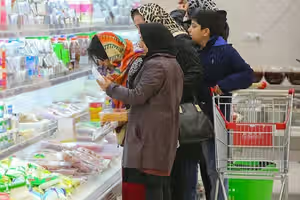
Later in the same program, describing how the government has kept the country running, he offered a defense that its critics will find more revealing than reassuring. Go into the market, he said, and you will see that basic goods are there. "I know it's expensive, but it's there."
The rebuttal arrived the same day. In an interview with Khabar Online, Farshad Momeni, professor of economics at Allameh Tabatabai University in Tehran, was asked whether Iran stands on the threshold of hyperinflation. "Hyperinflation has already happened," he answered.
While the two men argued over the name, Hemmati was proposing to raise the state food coupon by 23 percent, to 12.3 million rials a month. At market exchange rates, that is about $6.40.
An argument about a word
Both men are, in a narrow sense, right, and the gap between them is a definition.
The standard economists use, set out by Phillip Cagan in 1956, puts hyperinflation at 50 percent a month. By that measure Iran is nowhere near it: monthly inflation in the month of Tir (ended on July 22) was 3.1 percent. Looser conventions treat triple-digit annual rates as hyperinflation, and by that measure parts of the Iranian economy have already crossed the line.
Which is where Momeni takes his stand. He cites the statistics center's own reports showing that inflation lands hardest on low-income groups and deprived provinces. "Triple-digit inflation has already turned up in some regions in these official reports," he said, "and if we look at unofficial reports, the picture is far worse."
The dispute is not academic point-scoring. "Hyperinflation" has become one of the most heavily used words in Iranian economic discourse, deployed by lawmakers, newspapers and economists with increasing frequency and decreasing precision.
Iranians have lived with double-digit inflation for the better part of five decades, which is Momeni's own point: with one or two exceptions, he says, Iran's economy has been held captive by inflationary policies for 55 years.
A word that has described the ordinary condition of Iranian life for half a century stops carrying information. The reaching for a bigger one is a sign that the old word has stopped working, and that people are trying to name something they have not felt before.
The official figures give the reaching some grounding. Point-to-point inflation in Tir stood at 87.9 percent, and for food and drink at 128.1 percent. Those rates sit on top of a minimum wage of about 166 million rials a month, roughly $87 at market rates, and typical earnings of 200 to 300 million rials, about $105 to $157. Against food prices that have more than doubled in a year, a $6.40 coupon covers a fraction of a week.
What inflation does to a country
Momeni's larger argument is that inflation of this duration is not an economic problem that also has social effects; it is a solvent.
He points to John Maynard Keynes in The Economic Consequences of the Peace, who wrote that inflation beyond a certain point makes every contract unstable.
"That includes all contracts," Momeni said: "the constitution, ordinary laws, even the rules governing family life. In that atmosphere, kleptocracy takes the place of cooperation and trust." He notes that even Lionel Robbins, a market fundamentalist by his description, warned that phenomena such as Nazism and fascism were born of high inflation.
He also reaches for a historical case that carries an unmistakable warning for the government he is addressing. Analysts asking why the Chinese public accepted the fall of the nationalist government, he said, tend to answer that Mao and his allies controlled inflation in each province they took, while the nationalists could not.
Momeni's sharpest criticism is reserved for how officials talk about all this. They warn about the dangers of inflation as though they were bystanders.
"They play the role of the opposition themselves," he said. "They perform these deadly tricks and then hold a funeral for the consequences." Officials, he argued, should be reporting their remedies, not their alarm.
He extends the same skepticism to the labor figures. Official unemployment stands at 7.6 percent, which he called one of the most astonishing claims available, given a Plan and Budget Organization report showing that only one third of the working-age population is employed, with two thirds playing no part in national production.
Inflation and joblessness compound, he said, and "when inflation and unemployment come together, we have entered the abyss of misery."
The governor's toolkit
Hemmati's account of the government's response is a catalogue of technical interventions carried out under severe constraint.
He said oil exports have almost entirely stopped, that Iran's foreign reserves are blocked by the United States while neighbors in the same position can still draw on theirs, and that about $12 billion of Iranian funds in Qatar, which was to have been made accessible under earlier understandings, remains frozen. Preliminary banking agreements had been signed, he said, but nothing operational has followed.
On Iraq, he said Baghdad had promised to address its outstanding debts, while noting that Iraq's own oil revenues had slowed and that its payments to its own employees had been delayed.
He said a meeting with Iraq's prime minister had produced agreement to use Iranian funds held at the Trade Bank of Iraq as backing for guarantees to Iranian contractors. At the BRICS summit he proposed what he called a financial corridor among member states, using their digital assets to reduce dependence on other countries' currencies.
Hemmati's own figures show the strain behind the reassurance. Foreign currency allocated for basic goods and agriculture over five months was about 8 percent lower than a year earlier, and currency available to manufacturers fell roughly 30 percent.
The coupon program alone requires about 870 trillion rials a month, some $455 million, and the government drew $2.5 billion from the National Development Fund before the new year (March 20) to keep it running for four months. He said the government does not want to fund it by printing money.
He was blunt about the limits. Purchasing power has fallen, he said, and while Turkey raised wages in step when its inflation reached 60 to 70 percent, Iran's fixed-income earners, teachers, workers, civil servants, the bottom three income deciles, receive increases of 20 to 25 percent that leave them further behind each year.
The end of the chain
Whatever the argument is called at the top, its shape at the bottom is not in dispute.
Mostafa Pourdehghan, a member of parliament's industries and mines committee, has warned that Iran is heading towards hyperinflation, putting liquidity at a record 170 quadrillion rials and citing Hemmati for a figure of minus three percent economic growth over five months. He has called for an emergency committee on inflation and prices.
Below that, according to reporting by the ILNA news agency, companies that laid workers off and later recalled them have not paid wages since late May, and the returning workers have lost both the substitute income they found and their entitlement to unemployment insurance.
Akbar Shokat, executive secretary of the Workers' House in Qom province, said most of the workforce lives below the poverty line after years of wage suppression and has almost no resilience left, warning that workers could not endure more than another two months. In July, about 1,600 workers at the Tabriz Machine Manufacturing group struck over unpaid wages.
Hemmati and Momeni are arguing about which word describes the Iranian economy. In the shops, where a month's wages no longer reach the end of the month, the argument was settled some time ago.