Journalists are not supposed to become the story. We are usually on the other side of it. Someone lives through an event and we write about it. Someone is gone and we report their passing. A crisis unfolds and we try to find the right words to tell its story.
But sometimes life reverses the roles. The narrator becomes the subject of the story.
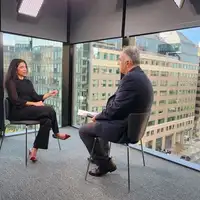
Today, Farahnaz Espad, one of Iran International’s finest news anchors, died of cancer at the age of 37. Hearing the news, I found myself thinking of Reza Haghighatnejad, an editor at RFE/RL’s Radio Farda and one of Iran’s most accomplished political journalists, who also died of cancer in 2022.
Perhaps because I see a bitter similarity in their fates. Two Iranian journalists; two young, talented and hardworking people whose lives were deeply bound up with Iran — with its news, its people, their concern for what was happening to it, and their hope that perhaps tomorrow life for Iranians might be a little better than it is today.
Both developed cancer far from Iran, and both died far from home.
I remember Farahnaz for her calm. For a dignity that even illness could not take from her. There was an unassuming humility and kindness in the way she carried herself, the kind some people bring into every room without even trying. She was hopeful. She was calm.
She wanted to go back to work.
Perhaps “going back to work” sounds like a small wish. But for Farahnaz, work was not merely a job. She wanted to stand in front of the camera again, read the news from Iran, begin her day with Iran and end it with Iran. Illness had kept her away from the newsroom, but it had not severed the thread connecting her to her professional life.
Reza’s death a few years ago was a reminder of much the same thing.
Reza was one of those journalists for whom Iran was never merely the subject of his work. Iran was his abiding concern — something he read about, wrote about, researched and worried about. He lived in exile, but much of his mind and his work remained in the country where he could no longer continue his professional life.
Even after death, his fate remained bitter. Reza died of cancer in Berlin at the age of 45. His body was sent to Iran so he could be buried in the soil he came from. But security forces seized his body after it arrived, preventing his family from saying goodbye to him as they wished and from burying him in his hometown.
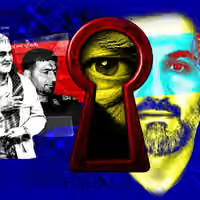
Farahnaz Espad (Left) and Reza Haghighatnejad (Right)
Sometimes I think exile, for an Iranian journalist, is more than geographical distance.
One day, you begin working as a journalist in Tehran, Shiraz, Isfahan or another city, with the simple idea that you will write about the society in which you live. Then a day comes when, to continue doing that same work, you have to leave your country. Your desk moves. Your newsroom moves. The language spoken on the street you walk down every morning changes. Your home changes. Your friends scatter. Years pass.
But the subject of your work does not change.
It is still Iran.
You wake up in a city thousands of kilometers from Tehran, and the first thing you read is news from Iran. You spend your day immersed in the crises, protests, elections, prisons, hopes and disappointments of people you may not have seen in person for years. You talk about the future of a country when you yourself do not know when you will be able to return to it without fear.
It is a strange contradiction: sometimes you spend most of your years away from your homeland while devoting most of your professional life and your thoughts to that same homeland.
Farahnaz and Reza were like that. And I do not want to remember them only through their illness and death. Cancer was the final chapter of their lives; it was not the whole book.
What came before mattered more: curiosity, work, concern, hope, friendship, laughter, long hours in the newsroom, stories written and read, questions asked, and that essential belief every journalist carries — that knowing the truth, telling it and understanding it more deeply still matters.
But there is something in both their stories that I find deeply painful.
They were people who thought about Iran, worked on Iran and wanted a better life for the people of Iran. Yet they themselves were denied one of the most basic possibilities of an ordinary life: to live at “home,” to work there, to grow old there and one day, when the time came, to close their eyes in their own country, surrounded by family and memories.
That should not be something one has to wish for.
Staying in your homeland should not be a privilege.
Exile should not be the price of journalism.
No one should have to choose between their profession and their country simply for speaking and writing.
And perhaps that is why today, as I write the news of Farahnaz’s death, I am not grieving only the loss of a friend and colleague. I grieve for a generation of Iranian journalists who packed their bags, built homes in other cities, spoke about their homeland from distant studios and newsrooms, and spent years of their lives waiting for an Iran they might one day be able to return to freely. Some of them never got to see that day.
Reza did not.
Neither did Farahnaz.
A journalist is meant to bear witness to history, not become a victim of geography. A journalist is supposed to tell the news, not have their illness or death in exile become a headline written by their colleagues.
But sometimes that is exactly what happens.
Today we read Farahnaz’s name in the news, just as we read Reza’s a few years ago. And behind those two names, for me, one simple wish remains:
That one day Iran will be a place where its journalists can stay; where they can ask questions, write, make mistakes, write again, live, grow old — and not be forced away from “home” to do the work they love.
A day when an Iranian journalist’s share of their homeland is more than having it as the subject of their stories.
Until that day, we are left with the memory of those who are gone — and with stories that, this time, contrary to our professional habit, we have to write about the storytellers themselves.
May the memory of Farahnaz Espad and Reza Haghighatnejad live on.
Crowds take part in anti-government protests in Tehran in January 2026.
Seven months after the January massacre, Iranians answering an Iran International call-out describe lives still bent around it: sleep and nerves that never recovered, friendships remade or broken, politics hardened, and a future they struggle to picture.
For many, life now divides in two: before January, and after. The same images return again and again in their accounts: the sound of gunfire, the people killed beside them, the friends and children who went out to protest and never came home.
“Time stopped for me after January 9,” one respondent wrote. “My life was divided into before and after the protests, and I never became the person I was before,” another said.
The responses vary widely. Some describe depression, recurring nightmares, anger and an inability to return to ordinary routines. Others say the experience made them more politically engaged and more determined to join future protests.
Together, they offer a picture of an upheaval whose consequences for some participants and witnesses have extended from the streets into private life.
‘All those scenes keep playing like a film’
Descriptions of psychological distress were among the most frequent responses.
One person who said they witnessed young people being killed described recurring nightmares, depression, crying at night and a sense that there was no future.
“I can no longer walk with a good feeling on streets where blood was spilled or do the everyday things I used to do,” the respondent wrote.
Another described being unable to escape the memories.
“I could never return to normal life. All those scenes keep playing in front of my eyes like a film – those streets and the faces of people who were dying.”
For some, particular dates have themselves become reminders. One said seeing the numbers 8 and 9, corresponding to the dates of the protests, now causes their heart rate to rise.
Others described guilt over having survived.
“Every day, I have to answer to my conscience for breathing,” one person wrote.
The effects described went beyond grief. Some said their relationship with ordinary pleasures, familiar streets and even other people had changed.
“I don't make fun of young people anymore,” one wrote. “I realized that anyone, regardless of their job, style or appearance, can be a Kaveh the Blacksmith against Zahhak.”
The reference draws on two figures from Persian mythology: Kaveh, a blacksmith who leads a revolt, and Zahhak, a tyrannical ruler.
Anger repeatedly accompanied grief in the responses, with some saying executions, rising prices and what they see as continuing injustice had deepened rather than diminished it.
“At first I was very happy, then angry and hopeless, and then hopeful,” one wrote. “Now I am waiting and angry, with flames of suppressed anger; sometimes hopeless and sometimes hopeful. But we know we have to go to the end.”
Another wrote: “Those two nights ended, but a piece of me broke away and remained alone somewhere.”
Yet despair was not the only consequence described. Some said January had made them more willing to take risks and participate again.
“I became braver and more determined to achieve freedom,” one person wrote.
“Other than some of my hair turning grey, the biggest change is that I have prepared myself to repay my debt with the next call,” another said, referring to a future call for protests.
For these respondents, the memories of January have become a reason to continue rather than withdraw.
Politics enters personal relationships
Some responses described a shift in political understanding, including greater attention to the Islamic Republic's institutions, propaganda and political currents.
“January made me understand the propaganda system of this regime and its operatives,” one person wrote. “My political knowledge increased greatly. I learned about left and right. I understood how I was being played and why this regime has lasted 47 years.”
Political divisions have also entered friendships and family relationships.
One described the biggest change simply as: “Cutting ties with fence-sitting relatives and friends!”
For some, the reaction of people around them to protesters being killed, the crackdown and arguments about Iran's political future became a new measure for deciding which relationships to maintain.
Others described the opposite effect: a stronger sense of connection with fellow Iranians.
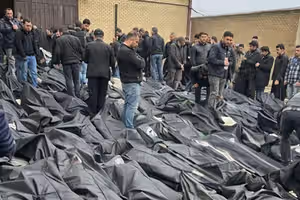
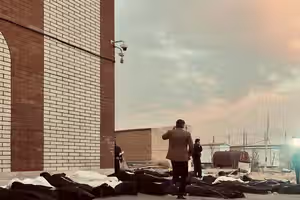
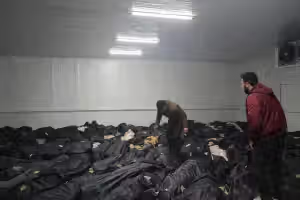
Bodies wrapped in blankets lie outside Alghadir Hospital in eastern Tehran following anti-government protests in January 2026.
“In one sentence, I am proud of my Iranian compatriots because on January 8 and 9 we stood together,” one wrote.
Another cited the “courage, strength and self-sacrifice of a nation” as one of the enduring impressions of the protests.
‘We are alone’
Several said January also changed their expectations of foreign powers and whether outside intervention could alter Iran's future.
“We are alone and should not hope for any power to save us or bring us freedom, except through our own efforts,” one person wrote.
For others, grief, anger and political determination now coexist rather than replacing one another.
“The January protests changed something in me forever,” one respondent wrote. “Since that day, I have become angrier, more wounded and more depressed, but I have not been broken.”
For those who sent responses to Iran International, January remains more than a date marking a political confrontation. It has become a dividing line in their own lives – separating who they were before the protests from who they became afterward.
X-ray images show more than 100 pellets lodged in each leg of a patient wounded in Iran’s January crackdown.
I stop people from bleeding to death. As a trauma and vascular interventional radiologist in Los Angeles, I find catastrophic bleeding and stop it within minutes. Still, I wasn’t prepared for what I saw in victims of Iran’s January protests inside and outside the country.
Iran’s repression follows survivors through three places: into the hospital, where their wounds may identify them; into their bodies, where pellets and pain remain; and into exile, where scars, flashbacks and fear continue years later.
Every injured protester I advised feared the healthcare system; not the physicians trying to help them, but what might happen if their wounds identified them.
Healthcare should be a red line. Patients must be able to seek treatment without being punished for their wounds, and clinicians must be free to treat them without intimidation. Yet UN experts reported that Iranian security forces entered medical facilities, attempted to arrest wounded protesters and detained people in and around them.
From Los Angeles, I joined physicians working through MAHSA Medical to provide free, confidential telehealth guidance to injured civilians. I also worked through a network of doctors in the United States connected to colleagues and relatives practicing inside Iran.
Through WhatsApp and Telegram, I spoke directly with injured civilians and examined them on live video whenever security and connectivity allowed. We reviewed photographs, medical imaging and prerecorded audio and video from homes where protesters were hiding.
Patients told us they feared that even seeking antibiotics or pain medication from a pharmacy could flag them as protest casualties. They suffered silently at home while we tried to provide what limited care we could from thousands of miles away.
During one live video call, I saw a young man with a deep wound across his right hand and significant active bleeding. He said security forces had attacked him with a machete-like blade, cutting to the tendons. The injury required formal evaluation and likely surgical repair, but he feared its pattern would identify him as a protester.
Instead of a hand-surgery suite, we discussed temporary stabilization using household materials. Even while bleeding and in severe pain, he remained remarkably composed. After years of treating catastrophic trauma, I had never witnessed that combination of physical pain, acute fear and resolve. This was not equivalent care. It was harm reduction when seeking ordinary care felt dangerous.
The pellet injuries were even more pervasive. Patients ranged from teenagers to women in their 70s. Some had clusters of 20 or more fragments in one region; others carried more than 100. I reviewed pellets involving the face and eyes, neck, chest, hands, hips, upper thighs and urogenital region—near structures whose injury can cause blindness, catastrophic bleeding, nerve damage, sexual or reproductive harm, disability or death.
In the cases I reviewed, I estimated that more than 95% of the retained pellets could never safely be removed. Fragments were embedded between the small joints of hands and knuckles, within or beside larger joints and near delicate neurovascular structures. Searching surgically for each tiny fragment could damage a nerve, blood vessel, tendon or joint and cause more harm than leaving it in place.
That does not make the pellets harmless. They can chronically irritate nerves and joints, causing pain, stiffness, reduced mobility and recurrent inflammation. Unlike a single projectile with one wound track, a shotgun discharge can scatter dozens of permanent foreign bodies across tissues too delicate to explore safely.
The eyes reveal the scale of this harm. During the January 2026 crackdown, more than 400 gunshot-related eye injuries were documented at a single Tehran hospital, according to physicians cited by the Guardian.
Doctors described permanent blindness and eyes damaged beyond repair. This continued a pattern seen during the 2022 Woman, Life, Freedom uprising, when ophthalmologists reported at least 580 significant eye injuries. The nationwide toll remains unknown.
As a trauma and vascular interventional radiologist in Los Angeles, I stop catastrophic bleeding within minutes. Still, I wasn’t prepared for the injuries suffered by victims of Iran’s January protests.
Years after the streets fall silent, a pellet lodged beside a nerve or within a joint can turn an ordinary movement into both pain and memory. Each bend of a finger can evoke the gunfire, fear and moment the survivor was wounded.
But the wounds can also become evidence against the wounded. Reuters reported that Revolutionary Guards and police sought hospital records to find protesters who had already been discharged. The Associated Press reported that some physicians removed pellets or altered records to help patients avoid detection.
A retained pellet does not prove a person’s beliefs or conduct, but in this environment it can become a physical marker of suspected protest participation. Identification can expose a survivor to arrest, detention and prosecution, including proceedings carrying the death penalty.
Medical records, scans and forensic examinations should be preserved securely, not transformed into instruments of surveillance. When the injured avoid hospitals, they lose not only treatment but contemporaneous documentation of what happened.
I encounter the other end of this process as a volunteer physician evaluator with the Physicians for Human Rights Asylum Network. In a forensic medical evaluation, I assess whether an asylum seeker’s scars, chronic injuries and psychological symptoms are medically consistent with the history of persecution the person reports.
Medicine cannot decide whether someone legally qualifies for asylum, identify an assailant from a scar alone or prove every detail of an event. It can document findings, consider alternative explanations and explain how closely the clinical evidence corresponds to the account provided.
One man, now in his early 40s, reported that his persecution began in his mid-20s and recurred over nearly two decades. His family operated a wedding hall where music and men and women celebrating together drew repeated Basij or IRGC intervention. He described repeated detention, including solitary confinement without meaningful legal process. In one assault, he suffered penetrating knife wounds to his thigh and posterior chest, requiring emergency vascular surgery and about a month in hospital.
Years later, I documented extensive scarring, diminished pulses, muscle loss and chronic vascular and neurological complications medically consistent with severe penetrating trauma near the femoral artery. Such an injury can cause massive hemorrhage, shock, loss of the limb and death. A wound cannot prove an assailant’s subjective intent, but it can establish that the violence was life-threatening.
Nearly two decades after the persecution began, he still reported pain, nightmares, insomnia, flashbacks and hypervigilance. News from Iran and disrupted communication with his family impaired his concentration and work. He had escaped the immediate danger, but the danger continued to organize his life.
I have seen the same continuum in other survivors: scars medically consistent with accounts of beatings and lashings, alongside panic, dissociation, depression and hypervigilance that can persist long after someone has escaped. Not every enduring injury is visible, and no single symptom can prove what happened. But trauma-informed forensic evaluation can document what violence leaves behind.
Executions and deportation remain part of the stakes, but they are not the center of this medical story. Amnesty International has documented protesters subjected to incommunicado detention, denial of medical care and torture-tainted proceedings, including cases carrying the death penalty. For survivors seeking protection abroad, return can mean renewed exposure to the institutions they identify as their persecutors.
The response must begin with protecting the independence of medicine. Iranian clinicians must be able to treat patients without intimidation or punishment. International investigators should document attacks on patients, health workers and facilities. Governments reviewing asylum claims should protect confidentiality and provide access to qualified forensic evaluation.
No one should have to choose between leaving a disabling injury untreated and revealing themselves to those they fear.
As an Iranian American, this work is personal. But my medical conclusions must rest on examinations, imaging, clinical evidence and candor about what those findings can and cannot establish. A wound is not merely a mark of what happened to one body. Properly treated and independently documented, it can become part of the record of what happened to a society.
Iran’s authorities may try to frighten the wounded away from hospitals, intimidate those who treat them and suppress the evidence left behind. Medicine cannot stop that machinery alone. But it can care for the injured, protect the integrity of their stories and preserve what repression is designed to make disappear.
Two women sit at a cafe in Tehran, one looking at her mobile phone
Iranian lawmakers have advanced sweeping legislation that could send people to prison for speaking to journalists, academic cooperation and unauthorized contact with foreign embassies, dramatically expanding the conduct security agencies could treat as foreign infiltration.
The bill would also give the Intelligence Ministry and the Revolutionary Guards’ Intelligence Organization a central role in establishing prohibited foreign links, potentially handing prosecutors a broad new set of offenses in a judicial system repeatedly criticized by rights groups over due process.
Parliament approved the general framework of the bill on Sunday, though its current text has not been made public.
The latest publicly available draft contains 19 articles imposing prison terms, professional bans and other penalties across journalism, academia, civil society, culture and communications with foreign individuals and organizations.
Approval of the general framework does not mean lawmakers have approved each provision, and the final legislation could differ substantially.
But if its central provisions survive, the legislation would create an extensive new framework for prosecuting alleged foreign influence as authorities intensify prosecutions over perceived links to foreign governments and media.
What could land someone in prison?
Among the most far-reaching provisions is Article 7, which would prohibit sending messages, photographs, videos, audio or other data to non-Iranian media or people engaged in media activity abroad.
The offense would carry a prison sentence, with potentially harsher punishment if the communication occurred under a work arrangement, was deemed intended to undermine national security or took place during “crisis,” “unrest” or “rioting.”
Article 6 would prohibit interviews or other communication with media deemed hostile, including American or Israeli-funded outlets. Speaking to other foreign media would require notification through an Intelligence Ministry system, with failure to notify also punishable by imprisonment.
Under Article 5, the Intelligence Ministry would annually publish a list of foreign governments, universities and institutions approved for scholarships, academic agreements, conferences and scientific cooperation.
Collaboration with institutions outside that list could bring imprisonment, as could sending medical, research or archaeological samples to them.
Private individuals and organizations communicating with foreign embassies or institutions would meanwhile need to notify authorities and obtain written authorization, with limited exceptions for personal and civil-status matters.
NGOs, associations and political parties would be barred from accepting financial benefits from foreign governments, institutions or embassies without approval from a committee including the Intelligence Ministry and IRGC Intelligence.
Violations could bring imprisonment, lengthy bans on social and cultural activity and dissolution of the organization.
Film, documentary, theater, music and book projects involving “prohibited foreign direction or support” could result in permanent professional bans if authorities determine that they question religious rules, portray Iran negatively or promote what the bill calls anti-Islamic culture.
Organizing certain foreign-linked courses or workshops, including online programs, could also bring prison terms, as could knowingly participating in them.
Broad crimes, powerful investigators
The breadth of the prohibited conduct is compounded by the powers given to Iran’s security agencies.
The draft names the Intelligence Ministry and IRGC Intelligence as the principal investigative authorities responsible for presenting evidence of prohibited foreign direction or involvement to judicial authorities.
The criteria they would be tasked with establishing are broad.
Article 1 covers people acting under the supervision, direction, training or guidance of a wide range of foreign governments, international organizations and other non-Iranian entities.
Potential harms include damaging national security or territorial integrity, but also undermining public trust in the political system or reducing electoral participation. Severe prison sentences are envisaged in some circumstances.
Another provision indicates that ignorance of a prohibited foreign connection would not necessarily eliminate criminal liability if authorities conclude negligence or carelessness resulted in harm.
Cases would be heard by Revolutionary Courts, which could also order confiscation of assets and professional bans.
New charges in a system under scrutiny
By criminalizing a much wider range of foreign contacts and communications, the bill could give investigators and prosecutors additional charges in cases involving alleged foreign links.
That prospect is particularly consequential given the record of Iran’s Revolutionary Courts and security agencies.
Human Rights Watch has documented restrictions on access to independent lawyers in national security cases and said Revolutionary Courts regularly fall short of fair-trial standards.
The group reported in February that state-affiliated media had broadcast hundreds of purported confessions, including statements describing collaboration with foreign intelligence agencies and sharing protest footage with Persian-language media abroad.
Amnesty International has similarly documented what it describes as systemic denial of access to lawyers and forced confessions during the January crackdown, including detainees being made to confess to sending protest images to media outside Iran.
The overlap with conduct contemplated by the proposed legislation is striking.
The bill would therefore arrive in a system already accustomed to prosecuting alleged foreign connections, but with a substantially expanded range of conduct explicitly available for prosecution.
It would also criminalize certain foreign-directed economic activity and allow enhanced punishment for other crimes committed under alleged foreign supervision or guidance.
If passed into law in its available or a similar form, the legislation would move the concept of foreign “infiltration” far beyond conventional espionage.
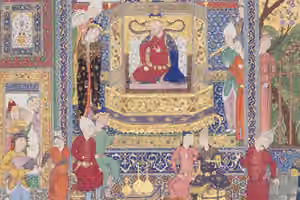
Zahhak Receives the Daughters of Jamshid, a manuscript illustration made in Tabriz, Iran, in the 1520s, in ink, gold and opaque watercolor on paper. Courtesy of Khalili Collections / CC-BY-SA 3.0 IGO.
In the Persian classic Shahnameh, Ferdowsi tells the story of Zahhak, the usurper king who is kissed on each shoulder by Ahriman, the spirit of evil, and finds two black snakes growing from the wounds.
Cut them off and they grow back. The only way to keep them quiet is to feed them, every day, with the brains of two young men. Zahhak reigns for a thousand years on a diet of sacrificed youth, propped up not by loyalty but by appetite.
The story has always worked as a parable for Iranian tyranny. What I think it misses, applied to the Islamic Republic today, is the arithmetic. Ali Khamenei did not build two snakes. He built three.
The Artesh, Iran’s conventional army, was the first snake, inherited from the Shah and never fully trusted. The IRGC was the second, created in 1979 specifically because the revolution did not trust the first. The Basij was folded into the IRGC as its third head.
It is worth remembering that all three answer, on paper as much as in practice, to a single neck. The Iranian constitution names the Supreme Leader as Commander-in-Chief of the Armed Forces in their entirety, Artesh, IRGC and Basij alike. There is no independent chain of command outside the Supreme Leader’s authority for a general to retreat into. Politicians and Western commentators in both London and Washington keep waiting for one of these heads to turn on the body. They’re waiting for the wrong signal, because they’re analysing 1979, not 2026.
When the Shah’s generals stood aside in February 1979, they did so because the Artesh of that era was a conscript institution led by officers who owed their careers to a monarch, not a movement, and who had no ideological stake in what came next. That Artesh is not today’s Artesh.
Ali Khamenei spent decades solving exactly that problem. Senior appointments in today’s Artesh are subject to security and ideological vetting tied to the Supreme Leader’s military apparatus. The Middle East Forum has documented how senior promotions require approval from the Supreme Leader’s office following scrutiny of an officer’s security and ideological background. The men at the top of the Artesh are appointees of the system, not survivors of it.
This is why this month’s move to complete the integration of the Armed Forces General Staff with the Khatam al-Anbiya Central Headquarters matters more than it has been given credit for. Mojtaba Khamenei, who inherited a system his father spent more than four decades constructing, has now moved to formalise a process of centralisation that had earlier been discussed but was not visibly underway in operational terms.
The lesson learned from 2025 and the Twelve-Day War, according to Iran’s own state reporting, was that redundant command structures slow decision-making. The latest restructuring is intended to reduce that redundancy and further narrow the distinction between the operational command of the Artesh and the IRGC. The underlying logic is clear: the system has little interest in preserving institutional space in which one military arm might begin to think or act independently of the others.
I would also gently push back on those looking for salvation in Iran’s reformists. Pezeshkian’s presidency provides a civilian face and international cover for the negotiating track, and that function matters. But it is not independence.
Ghalibaf is a former senior IRGC commander who has spent decades inside the Islamic Republic’s political and security establishment. Araghchi is a capable diplomat entrusted with representing Tehran in negotiations. Both men operate inside the system’s tolerances, not outside them. Reading their willingness to negotiate as evidence of a moderate faction pulling against a hardline one mistakes tactics for structure.
When Iran has had to cede ground, at Bürgenstock or Islamabad, it has ceded it in the way a company reprices a product: reluctantly, and only as far as survival requires. Ghalibaf gets attacked by the influential ultra-hardline Paydari Front for talking to Americans, and he absorbs it, because someone in the system has to run the diplomatic track.
None of this means the system is stable in the way it looks stable. Ali Khamenei is dead. His son, who has still not been seen or heard in public, inherited the office by appointment and is still consolidating the very apparatus his father designed. The strain is real. But strain inside a structure is not the same as a fracture between its parts. The three heads bicker over how much brain they are fed and by whom, not over whether to keep feeding.
So when I hear commentary asking whether this is the moment the Artesh finally breaks from the regime, or whether Ghalibaf represents the pragmatic wing that might yet reform the system from within, I think of Zahhak.
Nobody in that story is saved by one of the snakes deciding it has had enough. The snakes do not turn on the king. The rupture comes from outside the machinery of the court: Kaveh the blacksmith rises first, turning private grievance into public revolt, rallying the people and creating the conditions for Fereydun’s return. Fereydun then defeats Zahhak and binds him at Damavand. Until that structure itself breaks, all three snakes answer to the same shoulders.
From left: Tara Farhangian, Yaser Azadeh and Homa Teymouri, and Mahmoud Ghanbari-Rad.
Iranian courts have handed down a new wave of prison terms and other punishments against protesters, activists and citizens accused of national security offenses, as the judicial crackdown that followed January’s nationwide protests continues months later.
At least six people were sentenced in five cases reported by the Human Rights Activists News Agency (HRANA) on Wednesday and Thursday, with punishments ranging from eight months to 10 years in prison. One 21-year-old student was also sentenced to flogging and exile.
Rights groups have documented thousands of arrests since January and raised repeated concerns over denial of access to lawyers, torture and coerced confessions.
Iran Human Rights said in July that more than 70 January protesters were facing execution in Isfahan Central Prison alone, while HRANA reported in June that authorities in Zahedan had issued verdicts against 111 people detained during the protests.
Couple sentenced together
Homa Teymouri and her husband, Yaser Azadeh, who were arrested at their home during the January protests, have each been sentenced to five years in prison, HRANA reported, citing United Students.
Branch 15 of the Tehran Revolutionary Court convicted Teymouri of “assembly and collusion against national security” and also imposed a two-year travel ban, a two-year prohibition on social media activity and confiscation of her phone. HRANA said Azadeh also received five years but did not specify the charges or court branch.
Teymouri holds a master’s degree in political thought from Tarbiat Modares University and Azadeh a master’s in Western philosophy from Shahid Beheshti University.
Student given prison, lashes and exile
Tara Farhangian, a 21-year-old physical education student arrested during the January protests, was sentenced in Qorveh to one year in prison, 31 lashes and two years of exile in Zabol, according to HRANA, citing Kolbar News.
A criminal court convicted her of “disrupting public peace and order” and “resisting officers,” while the Revolutionary Court separately fined her 120 million tomans for “propaganda against the regime” and “assembly and collusion to commit a crime against national security.”
Farhangian, who studies at Hamedan University, had previously been released on bail.
Ten years over ‘message to foreign media’
Leila Moallemi, a Mashhad resident held in Vakilabad Prison, has been sentenced to 10 years over information she allegedly provided to a media outlet outside Iran during the war, HRANA reported.
A source close to her family said the case concerned a voice message and information she sent to the outlet. HRANA said the precise charges and judicial branch remained unclear. Moallemi was arrested on May 28.
Her case comes amid heightened pressure on people accused of providing information to foreign media or governments during the conflict. HRANA documented 40 political and security-related executions between March 18 and June 3.
Two years for Tehran IT specialist
Mahmoud Ghanbari-Rad, a 40-year-old network security specialist held in Greater Tehran Prison, was sentenced to two years for “assembly and collusion against national security,” HRANA reported.
Ghanbari-Rad was arrested at his Tehran home in May and initially held in Evin Prison. HRANA said he was denied access to a lawyer during part of his detention.
In a call from prison, he rejected the case against him and said he had been pressured to accept the charges.
Sentenced over prison writings
Civil rights activist Mehdi Mahmoudian was sentenced in absentia to eight months for “propaganda against the regime,” based on writings he produced in prison that were subsequently published.
Mahmoudian, who has previously served time on the same charge, was arrested again on January 31 after signing a statement and released on bail the following month.
He faces a separate hearing before another branch of the Tehran Revolutionary Court on September 27.