• العربية
  • فارسی
Brand
  • Iran Insight
  • Politics
  • Economy
  • Analysis
  • Special Report
  • Opinion
  • Podcast
  • Live TV
  • Iran Insight
  • Politics
  • Economy
  • Analysis
  • Special Report
  • Opinion
  • Podcast
  • Live TV
  • Theme
  • Language
    • العربية
    • فارسی
  • Iran Insight
  • Politics
  • Economy
  • Analysis
  • Special Report
  • Opinion
  • Podcast
  • Live TV
All rights reserved for Volant Media UK Limited
volant media logo
INSIGHT

Ghalibaf's hunger warning sparks hardline backlash over showing weakness

Maryam Sinaiee
Maryam Sinaiee

Iran International

Aug 21, 2026, 22:00 GMT+1
Iranian Parliament Speaker Ghalibaf during a visit to Najaf in Iraq.

A warning by parliament speaker Mohammad Bagher Ghalibaf that Iran cannot endure if its people go hungry has exposed tensions in Tehran over acknowledging economic strain, with hardliners arguing that signs of weakness will encourage further US pressure.

Speaking at a meeting with Iranian and Iraqi businesspeople at the Iranian Embassy in Baghdad on Thursday, Ghalibaf stressed that economic strength must accompany military power.

“No matter how much military power we have, if people are hungry and we do not have financial circulation and economic growth, we will not endure,” he said. He also called for planning to confront what he described as unjust sanctions.

His remarks drew criticism from hardline commentators, who argued that acknowledging the impact of US economic pressure could help Washington.

Masoud Barati, a former state television presenter, wrote on X that Ghalibaf’s comments, coming as US President Donald Trump escalated his economic campaign against Iran, conveyed “a message of weakness.”

He said such a message reinforced the image of a weak Iran and encouraged the enemy to increase pressure. Warnings against projecting weakness were also a recurring theme in Friday prayers across Iran, whose broad themes are set by a government institution.

The dispute comes as the Trump administration prepares what Treasury Secretary Scott Bessent has described as the “toughest sanctions in history” on Iran, combining the existing US blockade with unprecedented sanctions aimed at collapsing the Islamic Republic.

Bessent also said the United States was seeking the “greatest coordinated economic isolation in the history of the world” and would press allies and other countries, including China, to join the campaign.

US Vice President JD Vance has said Tehran will not be able to withstand the pressure indefinitely, whether for “a couple of weeks or a couple of months or possibly longer.”

Vance acknowledged that Iran is also applying economic pressure on the United States, but said Tehran is feeling the greater impact.

Iranian-Canadian political analyst Shahir Shahid-Sales argued in a post on X that increasing economic pressure would not leave the Islamic Republic passively watching its own collapse.

“This system has no choice but to launch a widespread war, especially when such a decision is backed by high and false confidence,” he wrote, warning that ordinary Iranians would pay the price of the confrontation.

Tehran rejects pressure campaign

Iran’s Foreign Ministry on Thursday condemned the broad economic and trade sanctions, calling them evidence of the “anti-human, lawless and hegemonic nature” of the US government.

“Sanctions and economic pressure are the other side of the coin of war and military aggression,” the ministry said.

Foreign Minister Abbas Araghchi, meanwhile, dismissed what Trump has called “Economic D-Day” as a diversion from America’s own economic problems.

“The so-called ‘Economic D-Day’ is a diversion from America's own crisis: unprecedented debt and surging interest costs,” Araghchi wrote on X. “Doubling down on failed policies will only bring further defeat—and enmity of Iranians. US economic terrorism threatens global economy and sovereignty worldwide.”

In another post, he described the “most crushing economic operation in history” as a repeated scenario destined to fail.

President Masoud Pezeshkian, however, has repeatedly acknowledged Iran’s deteriorating economic situation in speeches and interviews, adding to the contrast between Tehran’s public dismissal of Washington’s strategy and concerns voiced by senior officials about conditions at home.

Friday prayers rally against US pressure

Friday prayer leaders across Iran responded extensively to US officials’ warnings over the economic campaign, while reiterating support for keeping the Strait of Hormuz closed.

Habibollah Ghafouri in Kermanshah described the renewed talk of sanctions and economic blockade as a clear admission of the “enemies’ failure against the Iranian nation and the Islamic front” after what he called their failure on the military front.

In Ardabil, Hassan Ameli called Trump’s statements a “major psychological operation,” saying they were intended to influence public sentiment and Iran’s markets.

In Semnan, Morteza Motiei argued that the United States was facing its own high costs, logistical challenges and international pressure rather than inflicting greater damage on Iran.

In Sari, Mohammad-Bagher El-Eini said Iran had seized control of the Strait of Hormuz and was holding America “by the throat,” vowing that the pressure would continue until the United States was destroyed and predicting the eventual destruction of US military forces.

Reza Nouri, the Friday prayer leader in Bojnourd, also warned regional countries over what he described as a naval blockade of Iran, saying that if Iran could not import or export goods, “no one should be able to do so.”

The contrasting messages point to a growing tension in Tehran’s response to Washington’s economic campaign: while senior officials acknowledge the need to strengthen the economy and prepare for prolonged pressure, hardliners fear that publicly admitting economic vulnerability could encourage the United States to intensify it.

Most Viewed

A poem hailed as Khamenei's prophecy is an acrostic: Born of Satan
1

A poem hailed as Khamenei's prophecy is an acrostic: Born of Satan

2
ANALYSIS

Can Iran's fragile economy survive Trump's 'Economic D-Day'?

3
ANALYSIS

UAE trade halt threatens one of Iran’s remaining economic lifelines

4
ANALYSIS

Turkey’s gas pivot leaves Iran with fewer cards to play

5

Iran executes fifth defendant over January protests in Isfahan

Banner
Banner
Banner

Spotlight

  • Ghalibaf's hunger warning sparks hardline backlash over showing weakness
    INSIGHT

    Ghalibaf's hunger warning sparks hardline backlash over showing weakness

  • Iran crude loadings plunge to one-seventh of pre-war level as blockade bites
    ANALYSIS

    Iran crude loadings plunge to one-seventh of pre-war level as blockade bites

  • Turkey’s gas pivot leaves Iran with fewer cards to play
    ANALYSIS

    Turkey’s gas pivot leaves Iran with fewer cards to play

  • Can Iran's fragile economy survive Trump's 'Economic D-Day'?
    ANALYSIS

    Can Iran's fragile economy survive Trump's 'Economic D-Day'?

  • The unlikely return of European diplomacy in the Iran-US conflict
    ANALYSIS

    The unlikely return of European diplomacy in the Iran-US conflict

  • For Iranian journalists, exile can last a lifetime
    OPINION

    For Iranian journalists, exile can last a lifetime

•
•
•

More Stories

With the war quieting, Iran's hijab crackdown gathers pace again

Aug 21, 2026, 10:09 GMT+1
•
Maryam Sinaiee
100%

The men who spent the war demanding control of the Strait of Hormuz have returned to demanding control of women's clothing. As the fighting subsides, Iran's hardliners are pressing to revive a hijab law the state itself suspended for fear of new protests.

The push is coming from figures with real leverage, including inside the judiciary, and it has two aims: harsher enforcement of the dress code now, and an end to the suspension of Iran's strict Hijab and Chastity law.

Tehran Prosecutor Ali Salehi said on Monday the judiciary was preparing to move against cafes, restaurants and clothing stores for "committing acts contrary to public chastity and selling unconventional clothing."

On Thursday he went further, ordering judicial authorities to identify and confront what he called "organized and networked actors" promoting unveiling, whom he accused of spreading corruption in public places and offending public sentiment.

The closures were already underway. In recent weeks authorities have shut cafes, restaurants, shops and sports clubs in more than 15 cities, including Tehran, over hijab violations by customers or staff.

  • Iran seals dozens of businesses in renewed hijab crackdown

    Iran seals dozens of businesses in renewed hijab crackdown

Women have also been blocked from obtaining motorcycle licenses, despite a government decision sent to police in February.

The reformist daily Shargh wrote on Wednesday that the resistance appeared to have little to do with law or road safety, and everything to do with what women would be wearing on the bikes.

'Hijab is a flag'

The pressure is louder on the street and online than in the institutions.

Hijab has moved to the front of the placards and slogans at the nightly pro-government rallies, according to social media users who follow them. Those gatherings drew some unveiled women in the early weeks of the war. They are far smaller now, and the crowd is almost entirely hardline.

Their target is often President Masoud Pezeshkian, who has not submitted the Hijab and Chastity law to government bodies for implementation, and whom demonstrators accuse of letting unveiled women multiply.

Pezeshkian has not objected to the law itself. The decision to freeze it was taken above him, out of fear that enforcing it would set off a new wave of anti-government protests.

Female hardliners have held their own gatherings in cities including Isfahan and Mashhad. Outside the governor's office in Isfahan, one placard carried a line attributed to Israeli Prime Minister Benjamin Netanyahu: "Unveiled women are our free soldiers."

Online, hardliners have been circulating footage of women walking, exercising, dancing and singing in shopping centers, cafes and streets, demanding that the authorities act against women they call "naked."

"Do you see the widespread wave of hijab tweets? The message is completely clear: the authorities have made up their minds to put an end to this situation. I can't wait for the operational phase to begin as soon as possible," one hardline user wrote.

The argument they make for themselves is that the veil is not a rule but a banner. "Hijab is the flag of the Islamic Republic and must not be allowed to fall," runs a common formulation.

"Hijab is not merely a secondary religious ruling; hijab is a flag," a hardline cleric posted. "If there is leniency over it, it will lead to the destruction of the family and the weakening of other religious laws." His patience, he warned, and that of others like him, could run out.

Other users have been keeping score. One noted that the same voices who spent the war demanding control of the Strait of Hormuz, guaranteed revenues from the waterway and a seat at the table of global oil pricing had "returned to factory settings," their attention back on women’s clothing.

A law too dangerous to use

The Hijab and Chastity law, finalized in 2024, is harsher than anything before it, and includes provisions that would let civilian groups confront women over their clothing.

It has never been enforced. Implementation was suspended over fears it would set off protests on the scale of those that followed Mahsa Amini's death, and the Supreme National Security Council's decision still stands.

The freeze carries the late supreme leader's authority. Interior Ministry spokesman Ali Zeynivand said this month that it was decided under Ali Khamenei and has not changed, and that Pezeshkian, too, supports it.

Meanwhile, the streets have moved. Unveiled women are far more visible than a year ago, and many now dress in ways that would have been unthinkable in public not long before.

Women's rights activists warn against reading that as the end of compulsory hijab. Women employed in government offices and institutions are still held to the dress code, and unveiled women are still turned away from some buildings and services unless they cover their hair, arms and legs.

Some users see the easing as a product of the war rather than a change of policy, and expect it to end with the fighting. "If the situation becomes more stable, I doubt the authorities will refrain from bringing their repressive forces back onto the streets to enforce hijab on women," one wrote.

Even among those who support compulsory hijab, some think a crackdown now would backfire. Morteza Panahian, a young cleric who has also criticized the refusal to license women motorcyclists, wrote that anyone blaming the spread of unveiling on the law's suspension had evidently never read the law.

"This law is so impossible to implement that, if it is promulgated, the pace of unveiling will double," he wrote.

Gasoline survey reignites debate over politically risky fuel reform in Iran

Aug 21, 2026, 01:33 GMT+1
•
Maryam Sinaiee
100%

A gasoline policy survey by Iran’s energy optimization chief has reignited debate over how the Pezeshkian administration should tackle the country’s fuel deficit without triggering another politically dangerous price shock.

The poll was conducted by Esmail Saghab-Esfahani, Iran’s vice president and head of the Organization for Optimization and Strategic Management of Energy, who launched it on X on Monday and closed it two days later.

Under Iran’s current system, subsidized gasoline quotas are allocated to vehicles through fuel cards, with motorists able to buy a limited monthly amount at a lower price and additional fuel at a higher rate.

Saghab-Esfahani’s survey offered three alternatives: keeping the existing system while giving each citizen an additional tradable 30-liter quota; selling gasoline above current quotas at 870,000 rials per liter; or limiting supply to domestically produced gasoline without additional imports.

About 50% favored a model that would maintain existing quotas while allocating an additional 30 liters of gasoline per person based on national ID numbers. The additional quota could be transferred or sold to others at a mutually agreed market price.

Another 34% supported supplying gasoline beyond existing quotas at about 870,000 rials per liter, while 15% favored supplying gasoline in line with domestic production without additional imports.

Slightly more than 14,000 people took part. Critics, however, questioned whether the results could be considered representative of public opinion, citing the relatively low use of X in Iran, particularly in rural areas.

Iran’s gasoline imbalance is estimated at about 10% of consumption, according to the Khorasan newspaper, which has argued that the problem needs to be addressed but warned against using a policy that could create a much larger economic and social shock.

The economic newspaper Donya-e-Eqtesad argued that the results should not be interpreted as a definitive expression of public support for gasoline reform.

“People have shown greater preference for the option that, compared with queues at gas stations and 870,000-rial gasoline, imposes less direct harm on them,” the newspaper wrote. “This difference is important, because the policymaker should not conclude from the higher vote that society has accepted all aspects of the plan.”

The newspaper also questioned why the survey did not include a fourth option combining non-price and structural measures, such as reducing the use of fuel-intensive vehicles, expanding imports of hybrid and electric cars, improving fuel-efficiency standards, developing public transportation, combating smuggling and gradually reforming the auto industry.

It also argued that shifting gasoline quotas from vehicles to individuals would not necessarily reduce consumption if fuel remained cheap and vehicles continued to be inefficient. At best, it said, the measure could make the distribution of subsidies fairer and reduce smuggling or misuse of some fuel cards.

The methodology also drew criticism from users who participated in the discussion. Mohammad Reza Felfalani, a civil-society activist working on water, energy and environmental issues, wrote: “It is unfair to ask people to make a decision or assessment with this amount of data. If you yourselves are designing a plan with this amount of data, give us the right to worry about Iran’s future.”

Financial markets analyst Mohammad Shahrestani warned that none of the proposed options would be cost-free under current economic conditions.

“None of these ideas will be without cost under the current economic and livelihood conditions; a cost that may be irreparable,” he wrote, challenging those who oppose negotiations to offer a solution to the fuel problem that they can implement.

Another commenter warned that any gasoline reform would risk failure unless the government first explained how it intended to control the prices of goods and services that could rise as higher transportation costs feed through the economy. The user warned that such a plan could become vulnerable to unrest on the scale of the January protests.

Hardliner roots of the proposal

Saghab-Esfahani says he does not belong to any political faction, but his positions have often been close to those of conservative hardliners such as former presidential candidate Saeed Jalili. His appointment by President Masoud Pezeshkian in November 2025 drew criticism from reformists.

He has personally shown greater support for a model linking gasoline rations to individual citizens rather than vehicles. The model is among the policies previously promoted by Jalili and featured prominently in his campaign during the last presidential election.

That connection has led some critics to accuse Saghab-Esfahani of framing the survey’s choices in a way that would produce a result favorable to his preferred model and to political groups aligned with him.

One commenter accused the government of trying to impose a proposal developed by supporters of former President Mahmoud Ahmadinejad and Jalili over the past eight years.

“You ignored the criticism of every expert and now want to topple the Pezeshkian government by forcing this plan through, and then you stage a survey?” the user wrote.

Another argued that the wording of the choices was designed to steer respondents toward the government’s preferred option, warning that giving every citizen a tradable gasoline credit could become the Pezeshkian administration’s “Achilles’ heel” during wartime.

A further commenter said none of the proposed options could solve the problem and accused the government of using the poll to seek legitimacy for a predetermined policy.

Warnings over a price shock

Many Iranian experts and media outlets acknowledge the need to address the gasoline imbalance while warning against a sudden price shock. The central disagreement is whether consumption should be controlled through sharp price increases or through a combination of quotas, gradual price adjustments, demand management, public transportation and supply-side reforms.

The Khorasan newspaper, in an editorial titled “Do Not Perform Surgery for a 10% Deficit,” argued that if the core problem is an imbalance of roughly 10% between gasoline production and consumption, the government should not resort to a policy capable of creating a much larger economic and social shock.

“The dimensions of the potential consequences may be much greater than the original problem,” the paper argued.

The warning carries particular weight in Iran, where previous fuel-price increases have triggered unrest. A gasoline price increase in 2019 led to widespread protests that were violently suppressed, while an earlier increase in 2007 sparked riots in several parts of the country, including Tehran.

For the Pezeshkian administration, the challenge therefore goes beyond how gasoline quotas are allocated. It must address a persistent fuel imbalance without allowing a reform intended to ease pressure on the energy system to become a new source of economic hardship, political conflict and social unrest.

Can Iran's fragile economy survive Trump's 'Economic D-Day'?

Aug 20, 2026, 18:00 GMT+1
•
Behrouz Turani
100%
An Iranian woman buys eggs in Tehran / Photo by Reuters

Donald Trump has promised an “Economic D-Day” against Iran, a threat Tehran dismissed as another failed US policy. But with inflation, shipping costs and supply strains already biting, how much more pressure can Iran’s fragile economy absorb?

President Donald Trump on Wednesday announced what he called the “most crushing economic operation ever taken against any country,” threatening unprecedented economic isolation and consequences for countries whose financial institutions, businesses or government entities continue providing Tehran with an economic lifeline.

“Oil smuggling, swap lines, cash transfers, exchange houses, ship registries, front companies — it all needs to stop NOW,” Trump wrote on Truth Social, calling on US allies to join the campaign.

Iranian Foreign Minister Abbas Araghchi dismissed the announcement on Thursday as “doubling down on failed policies,” while Iran’s Foreign Ministry called the campaign “economic terrorism” and a “crime against humanity,” saying Tehran would continue resisting US military, economic and political pressure.

The Trump administration, however, is signaling that the campaign could go considerably further than existing sanctions.

Treasury Secretary Scott Bessent told CNBC on Thursday that Washington would impose the “toughest sanctions in history” on Iran and said the administration would outline its measures on Monday.

“It is going to work in Iran and we are going to collapse this regime,” Bessent said.

He said countries continuing to do business with Tehran would face US enforcement actions. Asked whether that could include China, which buys the overwhelming majority of Iran’s shipped oil, Bessent said some conversations were better held privately.

Bessent also suggested that “maximum economic pressure” could reduce the likelihood of another major military phase, describing the economic campaign and the US naval blockade as a “one-two punch.”

Already under strain

Even before the new US economic campaign was announced, Iranian economic reporting was documenting the price the confrontation was already imposing at home: higher shipping costs, pressure on medicine supplies and further strain on household budgets.

Emergency Central Bank allocations have enabled round-the-clock clearance of wheat and pharmaceutical imports at Shahid Rajaee Port in Bandar Abbas, yet reports by ILNA and Donya-ye Eghtesad said container freight rates remained 35 to 40 percent above baseline because of persistent war-risk surcharges.

The pressure is also reaching medicine supplies. On Monday, a major pharmaceutical company in Tehran said the government could no longer provide the foreign currency it required at subsidized rates, warning that some medicines could disappear from shelves or be sold at two to three times current prices.

Donya-ye Eghtesad has linked elevated shipping costs to domestic production bottlenecks, arguing that more expensive freight raises the cost of imported intermediate goods and adds to broader inflationary pressure.

The paper said temporary customs measures were treating symptoms rather than causes, with high insurance premiums and port congestion continuing to increase raw-material costs.

“So long as transit protocols remain uncodified,” the daily wrote, “industrial input costs will remain elevated, eroding domestic purchasing power daily.”

Those pressures are hitting an economy already struggling with steep inflation. Iran’s 12-month inflation rate reached 66 percent in July, while food prices were 128 percent higher than a year earlier. War, sanctions and disruptions to trade and imports have further squeezed household purchasing power.

Cooking oil, meat and dairy products have moved beyond the reach of many working- and middle-class families. Iranian reports describe households cutting back on staples and non-essential spending, while a kilogram of lamb can consume up to 10 percent of a minimum-wage worker’s monthly income.

Housing costs have also intensified the squeeze. Rents have risen sharply in major cities including Tehran, Mashhad and Isfahan despite nominal government caps, increasing housing insecurity and pushing some families toward cheaper districts or shared accommodation.

Iranian reports increasingly describe teachers, civil servants and office workers struggling to maintain their living standards despite holding multiple jobs. Peripheral provinces including Ilam, Sistan-Baluchestan and Kurdistan face even greater economic pressure.

Less leverage at Hormuz

Compounding that vulnerability, Iran may also be losing some of the strategic leverage it hoped to gain from disrupting traffic through the Strait of Hormuz.

CNN reported Wednesday that more than 80 percent of recent liquid cargo transits through Hormuz had either used the Omani route or traveled with transponders switched off and likely followed it.

Axios separately reported that the US military was operating a shipping corridor along the Omani side of the Strait, helping 15 to 20 tankers enter or leave the Persian Gulf each night.

The reports suggest Iran could be left absorbing many of the economic consequences of disruption at Hormuz while gaining less bargaining power from it.

That also changes the context of Iran’s negotiations with Oman over navigation through the Strait. Foreign Ministry spokesman Esmaeil Baghaei said Iranian and Omani technical teams had agreed on geographic coordinates and navigation lanes for a proposed shipping scheme.

Iranian economic commentary had portrayed formalization of such an arrangement as important to lowering insurance and shipping costs. But if Washington can increasingly move vessels through an Oman-side corridor without an agreement that gives Tehran a central role, Iran may have less ability to use the Strait to extract political or economic concessions.

Iran has endured decades of US sanctions and built extensive networks to circumvent them, giving Tehran reason to doubt whether another pressure campaign can force a change in course.

But the starting point this time is different: an economy already weakened by inflation, disrupted trade and the costs of war, while one of Tehran’s most important sources of leverage appears to be eroding.

Trump has yet to spell out the full measures behind his “Economic D-Day.” Bessent says those details will come Monday. The question is whether Washington can close enough of Iran’s remaining economic lifelines to impose pressure Tehran cannot absorb — or whether the Islamic Republic can once again adapt while passing much of the cost on to ordinary Iranians.

A poem hailed as Khamenei's prophecy is an acrostic: Born of Satan

Aug 20, 2026, 13:11 GMT+1
•
Arash Sohrabi
100%
Iran's late Supreme Leader Ali Khamenei

Days before he was killed, Ali Khamenei gave a poem to a translator, a senior cleric says. Iranian outlets published it as his prophecy of his own martyrdom. Then readers ran down the first letters: I am Ali Khamenei, born of Satan.

The account comes from Mohammad-Ali Mousavi Jazayeri, the former Friday prayer leader of Ahvaz and a former member of the Assembly of Experts, in a video that spread across Persian social media this week.

Jazayeri says he heard the story from Abbas Hazbavi, an Arabic-language poet from Khuzestan. By that account, intermediaries told Hazbavi after meeting Khamenei that the leader had urgent business with him, and a call from the office followed.

Hazbavi says he went on the first day of Ramadan, around ten days before Khamenei was killed on February 28, and that the supreme leader handed him a poem and asked him to render it into Arabic. The Khuzestan news site Sobh-e Khouzestan published the interview along with the full Persian text.

Hazbavi was a plausible choice. An established religious poet, he has translated Khomeini's ghazals into Arabic and has publicly recited his own Arabic rendering of Khamenei's verse. The office would have had his number.

The poem reads, on the surface, exactly as its promoters wanted. "Alas, I came late to my purpose," one line runs, "and heard the meaning of martyrdom from the beloved's lips." Another appears to name the month: "If the tyrant has marked my body as his target, in Esfand my soul will set out after the lovers." Khamenei was killed on the ninth day of Esfand (February 28).

The trouble is in the margin. Taking the first letter of each of the poem's 22 hemistiches in order produces a sentence: man Ali Khamenei zadeh-ye Sheytanam. "I am Ali Khamenei, born of Satan."

The device is a classical one. Persian poets have used the acrostic, known in traditional prosody as movashshah, for centuries to conceal a name or a dedication in the opening letters of successive lines. Twenty-two letters forming a grammatical sentence is not coincidence; someone built it deliberately.

Who that was is the question the story leaves open. Iran International cannot verify Jazayeri's account, Hazbavi's, or the poem's authorship, and there is no evidence that Khamenei wrote the poem.

What the establishment's own account supplies is the route the poem travelled: through the supreme leader's office, into a translator's hands, and out into print under Khamenei's name. Every step of that journey is described by his admirers, not his enemies.

100%
Left: ILNA's report presenting the poem as Ali Khamenei's own, under the headline "The leader who counted the moments to martyrdom." Right: the same address today, after the agency removed it.

It landed among outlets primed to want it. The verses ran on ILNA, Hamshahri and Khabar Online, among others, at a time when Iranian media were combing Khamenei's life for signs he had foreseen his own end.

ILNA's version, headlined "The leader who counted the moments to martyrdom," has since been taken down.

Too late to delete

On Persian social media, where the poem returned to circulation this week with the first letters marked in red, the mood has been close to disbelief.

"Apparently Khamenei ordered a poem he could pass off as his own," one widely shared post said. "The poet delivered, all right. Now the state sites have finally noticed and they're deleting it."

"At first I thought it was a joke," another user wrote. "They've pulled it from a lot of sites, but it's still up on the eulogists' channels."

Others turned to the question of where the poem came from. "So someone inside the leader's own house did this," one post said, speculating about who in Khamenei's circle might have arranged it.

One user drew out the reversal at the heart of the affair: "They wanted to show a miracle, that he foresaw his own martyrdom. The very poem they are using as proof says the opposite: that he was born of Satan."

The appetite the poem fed is well documented. In the weeks after Khamenei's killing, Iranian media ran a steady stream of material presenting him as having anticipated it, including a genuine ghazal of his that Hamshahri Online published under the headline "The ghazal the martyred leader wrote for his own martyrdom."

The flood has been large enough that Khamenei's own Office for the Preservation and Publication of Works has had to issue a denial over a different poem attributed to him after a cleric recited it publicly, saying the attribution and the story around it "are entirely untrue."

Jazayeri's own history gives the episode a final turn. In 1989, when the Assembly of Experts chose Khamenei to succeed Khomeini, it was Jazayeri who proposed that the new leader be addressed as an ayatollah rather than by his actual, lesser clerical rank.

Thirty-seven years later, the same cleric put his name to a poem whose hidden line calls him the son of the devil.

The phrase itself has been used against Khamenei before. In January, the US ambassador to Israel, Mike Huckabee, called him "a true son of Satan" in a post on X.

What is new is where Iranians found it this week: inside a poem his own admirers were circulating as scripture.

Pezeshkian admin says infiltration bill violates rights, could drive brain drain

Aug 19, 2026, 14:23 GMT+1
•
Niloufar Goudarzi
100%

President Masoud Pezeshkian's government has formally opposed a bill aimed at countering foreign intelligence infiltration, saying it violates citizens' rights, restricts academic ties and could accelerate the emigration of Iranian experts and researchers.

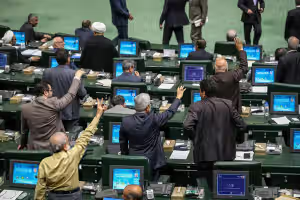
Iranian lawmakers on Sunday, August 16, approved the general principles of the "Plan to Counter the Infiltration of Intelligence Services and Foreign Governments or Institutions" by 183 votes in favor, four against and five abstentions.

The vote means parliament approved the proposal in principle but has not yet approved its individual articles or penalties. The publicly available version contains 19 articles, though lawmakers have said the details have not been finalized.

Majid Ansari, President Masoud Pezeshkian's vice president for legal affairs, said on Wednesday that the cabinet had reviewed the proposal in October last year, and sent its formal opposition to parliament because of what he described as fundamental problems in its provisions.

"The government's official position is opposition to this proposal," Ansari told the state-run IRNA news agency.

Government cites rights concerns

Ansari said the proposal conflicted with several constitutional principles covering citizens' rights, fundamental rights and individual freedoms, and in some cases was also inconsistent with Sharia law.

He said the measure would sharply restrict academic contacts between Iranian universities, researchers and specialists and institutions abroad.

"To achieve the country's important scientific goals, we must work to facilitate communication and the exchange of scientific information, but the provisions of this proposal will create serious restrictions on the country's scientific growth and development," he said.

Ansari said researchers, doctors and academics need ties with international institutions to prevent their work from becoming stagnant and warned that broad restrictions on contacts could push more specialists to leave Iran.

"If every type of contact and communication faces restrictions and is criminalized by law, naturally they will prefer to migrate and carry out their scientific and research activities in a free environment," Ansari said.

  • Iran’s new infiltration bill could make ordinary contact a crime

    Iran’s new infiltration bill could make ordinary contact a crime

Government says existing laws are enough

The Pezeshkian government said Iran already has laws and security agencies with powers to deal with foreign intelligence activity and does not need new legislation in its current form.

Ansari said any new legislation should instead be prepared with the participation of the government and judiciary and submitted as a government bill after legal, judicial, social and political review.

He called on parliament to remove the proposal from its agenda or subject it to a more detailed two-stage review, saying its broad criminal provisions required input from the judiciary.

Draft restricts foreign contacts

The publicly available draft extends beyond acts normally associated with espionage and covers a wide range of contacts between Iranians and foreign individuals and institutions.

One provision would require individuals, private companies and state bodies to notify authorities and receive written permission from the Foreign Ministry, or an Iranian embassy or consulate abroad, before contacts with foreign embassies, offices or non-Iranian organizations inside or outside Iran.

The draft provides limited exemptions for matters including civil registration and personal-status issues. Violations could result in fines and restrictions on social rights.

Another article would ban providing information, reports or statistics to foreign intelligence services, non-Iranian groups or institutions, or foreign nationals without permission from the Intelligence Ministry. It provides for prison terms and, in some cases, a permanent ban from the job through which the information was obtained or supplied.

  • Iran’s intelligence mocked by allies and foes over 'secret' Israel files

    Iran’s intelligence mocked by allies and foes over 'secret' Israel files

The draft would also make sending photographs, video, audio or other data to non-Iranian media or people engaged in media work outside Iran punishable by prison.

Interviews or other communication with some US- or Israeli-funded media would also be punishable by prison, while interviews with other foreign media would have to be reported to an Intelligence Ministry system.

Foreign visitors and academic ties

The proposal also contains restrictions affecting foreign nationals in Iran.

Foreigners who enter or remain in Iran without completing required legal procedures could be deported and fined the equivalent of 10,000 euros.

Foreign nationals who entered legally but carried out cultural activities deemed contrary to national security or the state's general policies could face the same penalties. Other offenses committed by foreign nationals in Iran could carry penalties one degree more severe than otherwise prescribed.

The Intelligence Ministry would also be required to publish each year a list of foreign governments, universities and institutions approved for scholarships, grants, academic agreements, conferences and other scientific cooperation.

Scientific cooperation with universities or institutions not on that list, as well as sending medical, research or archaeological samples to them, could result in a prison sentence.

Supporters say measure is needed after wars

Mohammad Saleh Jokar, a lawmaker from Yazd and head of parliament's Internal Affairs and Councils Committee, defended the need for stronger measures against infiltration but said the details of the proposal had not yet been finalized.

Jokar said Iran had suffered major damage from infiltration before and during what he called the 12-day war with Israel and the US last year and the 40-day war with the US this year, adding that foreign adversaries had used different channels to collect information.

He said the assassinations of a number of Iranian commanders and officials were linked to infiltration and said hostile networks inside Iran had used messages, money, weapons and other resources to pursue their objectives.

Jokar said parliament needed to identify and close routes used for infiltration, whether they involved a physical or virtual presence inside the country.

But he also said the proposal's individual provisions required detailed consideration by lawmakers and rejected suggestions that the currently circulating text had been finalized.

  • Iran’s ‘infiltration’ bill sparks backlash over sweeping reach

    Iran’s ‘infiltration’ bill sparks backlash over sweeping reach

Legal scholar warns of vague offenses

Mohsen Borhani, a prominent legal scholar and faculty member at the University of Tehran's law school, also sharply criticized the proposal.

Borhani said its wording was vague and could put the freedom of citizens, academics, political and social activists and artists at risk.

He pointed to language in the draft covering acts such as "showing a dark image of the country," promoting what authorities consider "anti-Islamic culture," taking part in courses deemed incompatible with Iranian culture and making policy proposals considered contrary to the state's fundamental interests.

The draft provides penalties for some cultural activity carried out under foreign direction, including permanent restrictions on some artistic work, and provides prison sentences for some educational courses and workshops involving specified foreign institutions.

Article 1 also provides lengthy prison terms for some policy or legislative proposals made under foreign direction if authorities determine they damaged national security, fundamental state interests, public trust or electoral participation.

Borhani said such broad wording could allow selective enforcement and urged the government, the Science Ministry, the Culture Ministry and other institutions to oppose the measure.

Criticism spreads on social media

Some Iranian social media users also reacted with alarm after parliament's Sunday vote, focusing on the proposal's restrictions on education, media contacts and links with the outside world.

"The biggest point in the proposal is that it lays the groundwork for closing off scholarships for Iranian students," one user on X wrote.

Another user described the measure as "cutting ties with the world on the path to turning Iran into North Korea," saying the proposal could bring media, scientific and civil contacts with foreign institutions under tighter security control.

"Welcome to the world's largest prison," another user wrote, pointing to proposed prison terms for interviews with some US media and restrictions on contact with foreign embassies without government permission.

The posts reflected concern among some social media users that the proposal could sharply restrict academic, media and civil contacts with organizations outside Iran. They do not represent a scientific measure of Iranian public opinion.

The draft remains subject to change. Parliament's vote on Sunday approved only its general principles, and lawmakers have not yet approved the individual articles or penalties contained in the publicly available text.