A still image from a video obtained by Reuters on June 5, 2026, shows US forces conducting an interdiction of the sanctioned stateless oil tanker Davina in the Indo-Pacific region, according to the U.S. Indo-Pacific Command.
Iranian crude loadings have fallen to about one-seventh of their pre-war level under the US naval blockade, while Chinese receipts of Iranian oil and fuel exports have also dropped sharply, tanker-tracking data reviewed by Iran International shows.
Data from commodities intelligence firm Kpler shows Iran has loaded an average of about 287,000 barrels per day (bpd) of crude so far this month, compared with roughly 2 million bpd before the Middle East war.
China, meanwhile, has received an average of just 523,000 bpd of Iranian crude so far this month. That compares with an average of about 800,000 bpd over the previous two months and more than 1.7 million bpd at the beginning of the war.
The United States reimposed a maritime blockade against the Islamic Republic in mid-July. As a result, more than 40 million barrels of Iranian oil stored on tankers in the Persian Gulf and Gulf of Oman have become effectively trapped, Kpler estimates.
Iran has stored 83 million barrels of oil outside the blockade zone, including 43 million barrels in the South China Sea, Yellow Sea and East China Sea. But with China sharply reducing its purchases, Tehran could run out of oil available for delivery to China in roughly five months if the current export rate persists.
Iran also exported around 256,000 bpd of fuel oil, or mazut, last year. Exports remained at roughly 220,000 bpd during the first two months of this year, but have plunged to just 61,000 bpd this month.
Iran had also been exporting a similar volume of LPG before the war. Those exports have now almost come to a halt.
According to Central Bank of Iran (CBI) data, the country’s crude oil and fuel oil exports were worth $57.5 billion last year, accounting for about 55% of Iran’s total exports. Crude oil, petroleum products and LPG together accounted for roughly 65% of the country’s total exports.
The sharp decline in exports of these commodities is likely not only to leave the government facing a massive budget shortfall, but also to create serious difficulties in securing the foreign currency needed to finance imports.
Iran imported nearly $78 billion worth of goods last year, including about $3 billion in gasoline, CBI data shows. Even if the country were to maintain its non-oil exports at last year’s level, they would not be sufficient to finance even half of its goods imports.
The situation is particularly difficult because Iran’s steel industry, which had generated as much as $5 billion a year in export revenues for the Islamic Republic, has been severely damaged by the recent war. The domestic market is now also facing a shortage of steel.
Iran was also a net importer of services last year, running a deficit of about $15 billion. Combined with its $78 billion in goods imports, that means Iran needed roughly $93 billion in foreign exchange to cover goods imports and its net services deficit.
Even if Iran manages to maintain its remaining non-oil exports at last year’s level, those revenues would cover only around one-third of those needs if crude oil, petroleum products, LPG and steel exports are excluded.
The pressure could increase further after US President Donald Trump on Wednesday threatened an “economic D-Day” against Iran, pledging economic warfare and isolation on an unprecedented scale after saying Tehran had failed to make a deal.
The threatened measures could make sanctions evasion more difficult and expose Iran’s already weakened foreign trade to additional challenges.
Yemen analyst Mohammad al-Basha (left) in an interview with Iran International's Kambiz Tavana in Washington DC on August 20, 2026.
Yemen’s Houthis have become a more effective ally for Iran than Hezbollah, using Iranian support and their strategic Red Sea position to pursue both Tehran’s interests and their own agenda, Yemen analyst Mohammad al-Basha told Iran International.
The Houthis’ position distinguishes them from other members of Iran’s regional network, Al-Basha said. The group seized Sanaa in 2014 and became the de facto government, inheriting the conventional military of North Yemen while taking control of territory containing roughly 80 percent of the population.
“So you’re not just talking about a militia or an insurgency; they became a de facto authority,” Al-Basha said.
That combination of territorial control, state institutions and geography has given the Houthis advantages that Hezbollah and Iran-backed groups in Iraq do not possess, he said.
Iraqi armed groups wield significant influence but do not control the government, while Lebanon’s Hezbollah has operated as a powerful armed and political force within Lebanon rather than as the state itself.
The Houthis also sit along the Red Sea and Bab al-Mandab, one of the world’s most important maritime chokepoints, while Yemen’s mountainous terrain and extensive tunnel systems make the group difficult to target from the air.
Those factors have given the Houthis “an edge” and made them “more effective as an ally for Iran than Hezbollah,” Al-Basha said.
The comparison comes as other parts of Iran’s regional network have been weakened. Al-Basha said the so-called Axis of Resistance is weaker than it was before the October 7, 2023 Hamas attack on Israel, pointing to pressure on Hamas and Hezbollah and the fall of Bashar al-Assad’s government in Syria, which severed a key land route between Iran and its Lebanese ally.
Iran’s military backing
Iran, meanwhile, has invested heavily in the military capabilities that make the Houthis’ strategic position consequential. Al-Basha said Tehran has provided anti-ship ballistic missiles, anti-ship cruise missiles, land-attack cruise missiles and long-range drones, while the Islamic Revolutionary Guard Corps and its Quds Force remain central to the relationship.
“The Houthis will not be as strong as they are today without Iran,” Al-Basha said.
He said intercepted shipments heading toward Yemen continue to demonstrate the importance of Iranian support, including components for weapons the Houthis have presented as domestically produced. The group has developed some local manufacturing and assembly capabilities, he said, but Iranian support remains particularly important to its advanced missile and drone arsenal.
The relationship differs from Tehran’s former model with Hezbollah in another significant respect. Al-Basha said Iran has not generally provided the Houthis with financial support on the scale it once provided the Lebanese group. Tehran at times supplied discounted cooking gas and crude through Iraqi and secondary markets that the Houthis could resell, he said, but its most important contribution has been weapons.
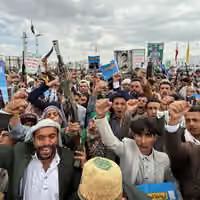
Houthi supporters attend an anti-Saudi rally amid an escalation with the kingdom, in Sanaa, Yemen, July 31, 2026.
Reports coming out of Yemen also indicate that an Iranian ambassador and a Quds Force representative have returned to Houthi-controlled territory, Al-Basha said. He said the ambassador has appeared in public photographs, while the Quds Force representative also appears to be back, with both widely understood to coordinate the relationship between Tehran and the Houthi leadership.
“Their natural partners are the Quds Force and the Guard,” Al-Basha said.
He contrasted Iran’s military support with a Saudi convoy he had recently seen carrying heavy equipment for power stations into Yemen. Iran, he said, has provided drones and ballistic missiles rather than power, electricity or food for Yemenis.
Al-Basha also described the relationship as increasingly public. He pointed to Houthi-linked delegations attending the funeral of Iran’s late supreme leader and subsequent Iranian engagement with the Houthi authorities as signs that ties once conducted more covertly are becoming increasingly visible.
An agenda of their own
The Houthis, however, are not simply acting on Tehran’s behalf. Al-Basha said they deliberately chose the current confrontation to support Iran while simultaneously exploiting changes in regional shipping to pursue their own objectives against Saudi Arabia.
With shipping through the Strait of Hormuz disrupted, Saudi Arabia has been forced to move more crude through its east-west pipeline toward the Red Sea, increasing the strategic importance of Bab al-Mandab, he said. The Houthis saw an opportunity to increase pressure on Riyadh and the international community at a moment when their own finances are strained.
Al-Basha said Iran had invested in the Houthis’ ballistic missile and drone programs, creating an expectation that they would support Tehran. But the timing also serves the Houthis’ interests as they seek greater control over airspace and shipping access as well as financial concessions from Saudi Arabia.
The group is seeking around $100 million a month in salary support and billions of dollars in reparations, Al-Basha said. Iran International has previously reported on a Houthi maritime embargo against Saudi-linked shipping and the diversion of Saudi tankers away from Bab al-Mandab.
The financial demands come as the Houthis struggle to sustain the areas they control. Al-Basha said the group collects revenue from ports, communications, aviation, taxation and customs, but much of that income is being prioritized for the war effort.
He cited signs of financial distress including the leasing of endowment properties around mosques and government offices to generate revenue. He also described people fighting over food at public events and eating from garbage, while noting that an online “I am hungry” campaign was visible but not as widespread as some accounts suggested.
That economic pressure is part of what is driving the current confrontation with Saudi Arabia, Al-Basha said. The Houthis calculate that Riyadh has more to lose from another major war in Yemen and can therefore be pressured into paying for a return to calm.
“Houthis know they have nothing to lose, and that’s why they’re going all in against Saudi Arabia,” he said. “They know that Saudi has a lot to lose.”
Bab al-Mandab leverage
The group’s ambitions extend beyond extracting financial concessions. Al-Basha described control of Bab al-Mandab as the “crown jewel” of its current military campaign, saying taking the strait would strengthen the Houthis against Yemeni government forces and give them a more direct means of threatening maritime traffic.
“They have fire control over the Red Sea,” Al-Basha said, but physical control of Bab al-Mandab would mean “you don’t need any more drones, missiles to threaten the ships. You could just send out a boat.”
Al-Basha said the Houthis also have ambitions beyond Yemen, describing an “expansionist model” that includes activity in the Horn of Africa and recruitment in Sudan. He cautioned against underestimating the group’s own power, saying it derives not only from Iranian support but from its determination, political agenda and broader ambitions.
Houthi supporters shout slogans during an anti-Saudi rally amid an escalation with the kingdom, in Sanaa, Yemen, July 31, 2026.
For now, the Houthis have also been careful to avoid bringing the United States directly into their confrontation with Saudi Arabia. Al-Basha said they are not attacking US assets and have emphasized that they are not completely closing Bab al-Mandab, allowing them to exert pressure while limiting the risk of an immediate US response.
“If they will continue attacking Saudi Arabia and continuing to be very disruptive, sooner or later US will be dragged into this war,” Al-Basha said.
For Tehran, the Houthis now offer something increasingly difficult to replicate elsewhere in its regional network: an allied armed movement that also controls territory, institutions and a substantial military structure beside a critical global shipping route.
Iranian weapons remain central to that power, Al-Basha said, but the Houthis have their own revenue sources, political objectives and regional ambitions. It is that combination of Iranian military support and independent territorial power that, in his assessment, has made them a more effective ally for Tehran than Hezbollah.
A worker at a natural gas facility in Iran. Turkey imported 4.536 bcm of Iranian gas in the first half of 2026, up 34 percent from a year earlier.
The expiry of a 25-year gas contract has exposed a shift in the Iran-Turkey energy relationship, with Ankara now enjoying more supply options while Tehran risks losing one of its most dependable export markets.
The contract expired on July 29 after governing Iranian pipeline gas supplies to Turkey for 25 years. Signed in 1996, with deliveries beginning in 2001, it provided for up to 9.6 billion cubic meters (bcm) of gas annually through the Tabriz-Ankara pipeline.
Turkish sector sources said the war prevented the two sides from holding negotiations on a new agreement before the deadline, while existing gas flows could continue temporarily under force-majeure arrangements. No new long-term contract has been publicly announced.
The expiry is particularly significant because Iranian supplies were rising sharply immediately before the agreement lapsed. Turkey imported 4.536 bcm of Iranian gas in the first half of 2026, up 34 percent from a year earlier. In June alone, Iran supplied 883 million cubic meters, narrowly behind Azerbaijan and ahead of Russia among Turkey’s pipeline suppliers.
That complicates any assumption that the expiry automatically means the end of Iranian gas exports to Turkey. Instead, it has opened a period in which Ankara must decide how much Iranian gas it still needs and under what terms, while Tehran risks losing or reducing one of its relatively stable sources of export revenue.
The uncertainty has become more consequential as Washington intensifies economic pressure on Tehran. US President Donald Trump on Wednesday announced what he called an “Economic D-Day” against Iran, threatening economic consequences for countries whose financial institutions, businesses or government entities provide Tehran with what he described as economic lifelines. Trump did not name Turkey or specify how the campaign would affect its purchases of Iranian natural gas. But the announcement adds another potential complication to any attempt by Ankara and Tehran to turn the temporary post-expiry arrangement into a new long-term agreement.
Iran’s gas vulnerabilities
Iran holds the world’s second-largest proven natural gas reserves, yet its export performance remains far below its potential. Production has long been constrained by aging fields, limited investment, insufficient access to technology and exceptionally high domestic consumption.
The South Pars field, shared with Qatar, remains central to Iranian gas production. Israeli strikes in March damaged processing facilities linked to the field and temporarily disrupted exports, although production was subsequently restored at several offshore platforms and gas was redirected to other processing facilities.
The damage has not yet been fully repaired. Iranian Oil Minister Mohsen Paknejad said in August that the war had knocked out about 95 million cubic meters of gas production and that reconstruction of four damaged refineries was continuing. He said the lost capacity was expected to return to the network by the end of September.
Rystad Energy estimates that repairing energy-related infrastructure damaged across the region could cost between $34 billion and $58 billion. Iran accounts for the largest number of affected facilities, with its repair bill potentially reaching $19 billion under the consultancy’s high-damage scenario.
These wartime losses compound problems that predate the conflict. Sanctions have restricted access to investment, technology and international markets, while domestic demand for electricity generation, heating and petrochemicals frequently takes priority over exports.
For Tehran, the Tabriz-Ankara pipeline has therefore been more than simply another commercial route. It has provided revenue, political leverage and a direct energy relationship with one of the region’s largest economies. A substantial reduction in exports to Turkey would leave Iran more dependent on limited pipeline sales to Iraq and Armenia, swaps and other short-term arrangements.
Turkey’s stronger hand
Turkey enters the post-contract period in a far stronger position than when the agreement was signed three decades ago.
Its annual gas demand generally ranges between 50 and 60 bcm, but its supply portfolio has become increasingly diversified. Russia remains a major supplier through Blue Stream and TurkStream, while Azerbaijan supplies gas through the Southern Gas Corridor. LNG has also become an increasingly important component of Turkish supply.
Turkey has expanded LNG import and storage capacity and signed long-term supply agreements with international producers, while domestic production from the Black Sea has continued to grow. Those developments give Ankara substantially more flexibility than it possessed when Iranian pipeline gas became a major part of its energy system.
That does not mean Iranian gas has become irrelevant. Turkish Energy Minister Alparslan Bayraktar said before the contract expired that Turkey could still need the Iranian pipeline for supply security. Turkish sector sources have also described Iranian gas as among the country's cheapest sources.
The combination gives Ankara considerable leverage. Iran still offers competitively priced pipeline gas delivered through existing infrastructure, but Turkey is no longer as dependent on that supply and has more alternatives with which to negotiate.
What happens after the expiry
Several outcomes remain possible. Turkey and Iran could eventually negotiate another long-term supply agreement, reach a shorter transitional arrangement, reduce contracted volumes or retain Iranian gas primarily as a source of additional supply during periods of high demand.
For Turkey, the calculation will involve not only price and physical supply but also reliability and geopolitical risk. Iranian gas has repeatedly been affected by winter shortages, infrastructure problems and now war, while tighter US economic pressure could create additional uncertainty surrounding payments and future contractual arrangements.
For Iran, the stakes are considerably higher. Reduced exports to Turkey would cut foreign-exchange earnings and further expose the gap between Iran’s enormous gas reserves and its limited ability to monetize them internationally.
The expiration of the old agreement therefore does not yet represent the end of the Iran-Turkey gas relationship. Gas continues to move, and both countries retain reasons to preserve the connection.
But the balance underlying that relationship has changed. Turkey has more suppliers, more infrastructure and greater bargaining power, while Iran faces damaged facilities, sanctions, war and renewed US efforts to restrict its remaining sources of foreign revenue.
The question is no longer whether the 25-year contract will expire. It already has. The question now is whether the gas trade that survived its expiry can be converted into another durable agreement — and on whose terms.
A gasoline policy survey by Iran’s energy optimization chief has reignited debate over how the Pezeshkian administration should tackle the country’s fuel deficit without triggering another politically dangerous price shock.
The poll was conducted by Esmail Saghab-Esfahani, Iran’s vice president and head of the Organization for Optimization and Strategic Management of Energy, who launched it on X on Monday and closed it two days later.
Under Iran’s current system, subsidized gasoline quotas are allocated to vehicles through fuel cards, with motorists able to buy a limited monthly amount at a lower price and additional fuel at a higher rate.
Saghab-Esfahani’s survey offered three alternatives: keeping the existing system while giving each citizen an additional tradable 30-liter quota; selling gasoline above current quotas at 870,000 rials per liter; or limiting supply to domestically produced gasoline without additional imports.
About 50% favored a model that would maintain existing quotas while allocating an additional 30 liters of gasoline per person based on national ID numbers. The additional quota could be transferred or sold to others at a mutually agreed market price.
Another 34% supported supplying gasoline beyond existing quotas at about 870,000 rials per liter, while 15% favored supplying gasoline in line with domestic production without additional imports.
Slightly more than 14,000 people took part. Critics, however, questioned whether the results could be considered representative of public opinion, citing the relatively low use of X in Iran, particularly in rural areas.
Iran’s gasoline imbalance is estimated at about 10% of consumption, according to the Khorasan newspaper, which has argued that the problem needs to be addressed but warned against using a policy that could create a much larger economic and social shock.
The economic newspaper Donya-e-Eqtesad argued that the results should not be interpreted as a definitive expression of public support for gasoline reform.
“People have shown greater preference for the option that, compared with queues at gas stations and 870,000-rial gasoline, imposes less direct harm on them,” the newspaper wrote. “This difference is important, because the policymaker should not conclude from the higher vote that society has accepted all aspects of the plan.”
The newspaper also questioned why the survey did not include a fourth option combining non-price and structural measures, such as reducing the use of fuel-intensive vehicles, expanding imports of hybrid and electric cars, improving fuel-efficiency standards, developing public transportation, combating smuggling and gradually reforming the auto industry.
It also argued that shifting gasoline quotas from vehicles to individuals would not necessarily reduce consumption if fuel remained cheap and vehicles continued to be inefficient. At best, it said, the measure could make the distribution of subsidies fairer and reduce smuggling or misuse of some fuel cards.
The methodology also drew criticism from users who participated in the discussion. Mohammad Reza Felfalani, a civil-society activist working on water, energy and environmental issues, wrote: “It is unfair to ask people to make a decision or assessment with this amount of data. If you yourselves are designing a plan with this amount of data, give us the right to worry about Iran’s future.”
Financial markets analyst Mohammad Shahrestani warned that none of the proposed options would be cost-free under current economic conditions.
“None of these ideas will be without cost under the current economic and livelihood conditions; a cost that may be irreparable,” he wrote, challenging those who oppose negotiations to offer a solution to the fuel problem that they can implement.
Another commenter warned that any gasoline reform would risk failure unless the government first explained how it intended to control the prices of goods and services that could rise as higher transportation costs feed through the economy. The user warned that such a plan could become vulnerable to unrest on the scale of the January protests.
Hardliner roots of the proposal
Saghab-Esfahani says he does not belong to any political faction, but his positions have often been close to those of conservative hardliners such as former presidential candidate Saeed Jalili. His appointment by President Masoud Pezeshkian in November 2025 drew criticism from reformists.
He has personally shown greater support for a model linking gasoline rations to individual citizens rather than vehicles. The model is among the policies previously promoted by Jalili and featured prominently in his campaign during the last presidential election.
That connection has led some critics to accuse Saghab-Esfahani of framing the survey’s choices in a way that would produce a result favorable to his preferred model and to political groups aligned with him.
One commenter accused the government of trying to impose a proposal developed by supporters of former President Mahmoud Ahmadinejad and Jalili over the past eight years.
“You ignored the criticism of every expert and now want to topple the Pezeshkian government by forcing this plan through, and then you stage a survey?” the user wrote.
Another argued that the wording of the choices was designed to steer respondents toward the government’s preferred option, warning that giving every citizen a tradable gasoline credit could become the Pezeshkian administration’s “Achilles’ heel” during wartime.
A further commenter said none of the proposed options could solve the problem and accused the government of using the poll to seek legitimacy for a predetermined policy.
Warnings over a price shock
Many Iranian experts and media outlets acknowledge the need to address the gasoline imbalance while warning against a sudden price shock. The central disagreement is whether consumption should be controlled through sharp price increases or through a combination of quotas, gradual price adjustments, demand management, public transportation and supply-side reforms.
The Khorasan newspaper, in an editorial titled “Do Not Perform Surgery for a 10% Deficit,” argued that if the core problem is an imbalance of roughly 10% between gasoline production and consumption, the government should not resort to a policy capable of creating a much larger economic and social shock.
“The dimensions of the potential consequences may be much greater than the original problem,” the paper argued.
The warning carries particular weight in Iran, where previous fuel-price increases have triggered unrest. A gasoline price increase in 2019 led to widespread protests that were violently suppressed, while an earlier increase in 2007 sparked riots in several parts of the country, including Tehran.
For the Pezeshkian administration, the challenge therefore goes beyond how gasoline quotas are allocated. It must address a persistent fuel imbalance without allowing a reform intended to ease pressure on the energy system to become a new source of economic hardship, political conflict and social unrest.
A special event honoring the Iranian community in the United Arab Emirates, held at the Dubai Exhibition Centre in Expo City Dubai on September 13, 2025. / Photo by WAM
The United Arab Emirates’ decision to halt all trade and financial transactions with Iran threatens one of Tehran’s most important routes for imports, petroleum-product sales and access to international commercial and financial networks.
The UAE Foreign Ministry said this week that all trade, commercial exchanges and financial transactions with Iran had been halted until further notice.
Afra Al Hameli, director of the Strategic Communications Department at the UAE Ministry of Foreign Affairs, said the decision came “in light of regional escalations that undermine regional and international peace and security.”
The UAE halted trade with Tehran a day after Donald Trump spoke by phone with UAE President Sheikh Mohamed bin Zayed, though it is unclear whether the decision was connected to Trump’s “Economic D-Day” campaign against Iran, announced later on Wednesday.
Trade between the two countries had already been severely disrupted after the war began in late February, when Iran launched attacks on the UAE and shipping through the Strait of Hormuz was curtailed.
In late June, however, Mohammad-Sadegh Ghannadzadeh, a deputy at Iran’s Trade Promotion Organization, said commercial exchanges with the UAE were gradually resuming through Jebel Ali Port. He said goods and containers stranded during the war were again being cleared and moved toward Iran.
The latest UAE announcement now casts doubt on the continuation of that channel.
Al Hameli also stressed that the UAE remains committed to protecting the integrity of the international financial system, complying with international law and applying the highest global standards.
That position is significant because even if political tensions eventually ease, Iranian businesses would still face serious restrictions stemming from US sanctions and Iran’s continued status as a high-risk jurisdiction subject to a Financial Action Task Force call for countermeasures.
One of Iran’s most important trading partners
The importance of the UAE to Iran can be seen in the latest official partner-by-partner trade figures available from Iranian customs.
During the first 10 months of the Iranian fiscal year that began in March 2025, Iran exported around $6.5 billion worth of non-oil goods to the UAE, equivalent to 14.3% of its non-oil exports.
Iran imported approximately $14.8 billion worth of goods from the UAE during the same period, accounting for 30.2% of its total imports.
Before the war, the UAE was therefore Iran’s largest supplier of goods and its third-largest destination for non-oil exports, behind China and Iraq.
Its importance extended well beyond ordinary merchandise trade. The UAE was also the largest destination for Iranian fuel oil, or mazut, and a market for other petroleum products.
A blow to mazut exports and fuel supply
Data from commodity intelligence firm Kpler, reviewed by Iran International, show that Iran exported an average of around 256,000 barrels per day of fuel oil in 2025.
Nearly 70% went to the UAE, making it by far Iran’s largest market for the product.
A prolonged halt in trade therefore threatens not only Iran’s non-oil exports but one of its most important outlets for petroleum products.
The UAE had also been among the destinations for Iranian liquefied petroleum gas, or LPG, although China accounts for the large majority of Iranian LPG exports. Iran’s total LPG exports generate more than $10 billion in annual revenue.
The UAE relationship is also important from the opposite direction.
An internal Iranian Oil Ministry report previously reviewed by Iran International showed that Tehran had increasingly relied on barter arrangements to meet domestic fuel shortages, exchanging part of its mazut exports for gasoline and diesel, particularly through traders operating in the UAE.
Iran is already struggling with a gasoline supply deficit, while officials have discussed measures ranging from tighter rationing to higher fuel prices.
Restricting access to the UAE could therefore affect not only export revenue but Iran’s ability to obtain products and refined fuels needed by the domestic market.
The end of Dubai’s role as Iran’s gateway to global trade?
The UAE’s importance to Iran has never been limited to direct bilateral trade.
For decades, Dubai has served as one of the principal re-export hubs for goods entering Iran, allowing Iranian companies to obtain products manufactured in countries with which direct trade is difficult, costly or restricted.
US sanctions and Iran’s exclusion from much of the international banking system have made this intermediary role particularly important.
Goods manufactured in Europe and Asia have routinely entered Iran through UAE-based traders and logistics networks, while Iranian companies have also used Dubai as a route to reach other markets.
The financial dimension is equally important. Dubai has long been a center for Iranian exchange houses, trading companies and intermediaries that help move money across borders despite Iran’s restricted access to the global financial system.
US sanctions packages targeting Iranian oil, petrochemical and procurement networks have repeatedly designated companies and individuals based in the UAE for alleged roles in facilitating transactions on Tehran’s behalf.
A broad and sustained UAE crackdown would therefore affect more than the physical movement of goods. It could also constrain financial, logistical and commercial networks that Iran has spent years using to mitigate its international isolation.
A major new gap for Iran’s economy
The latest available Iranian customs breakdown shows that merchandise trade between Iran and the UAE totaled about $21.3 billion in just the first 10 months of the previous Iranian fiscal year.
But even that figure understates the UAE’s economic importance because it does not capture Dubai’s wider role as a re-export, logistics and financial center for Iranian businesses.
Iran is now confronting the UAE halt while already under pressure from sanctions, foreign-currency constraints, weaker foreign trade and disruptions to energy exports.
Alternative routes through Oman, Iraq, Turkey and other neighboring countries can keep some trade moving, but they lack the combination of proximity, port infrastructure, financial connectivity and established commercial networks that Dubai offered.
The UAE has given no timetable for lifting its suspension.
For Iran, the risk is therefore not simply the loss of billions of dollars in bilateral trade. A prolonged halt could close one of its most important gateways to the global economy.
An Iranian woman buys eggs in Tehran / Photo by Reuters
Donald Trump has promised an “Economic D-Day” against Iran, a threat Tehran dismissed as another failed US policy. But with inflation, shipping costs and supply strains already biting, how much more pressure can Iran’s fragile economy absorb?
President Donald Trump on Wednesday announced what he called the “most crushing economic operation ever taken against any country,” threatening unprecedented economic isolation and consequences for countries whose financial institutions, businesses or government entities continue providing Tehran with an economic lifeline.
“Oil smuggling, swap lines, cash transfers, exchange houses, ship registries, front companies — it all needs to stop NOW,” Trump wrote on Truth Social, calling on US allies to join the campaign.
Iranian Foreign Minister Abbas Araghchi dismissed the announcement on Thursday as “doubling down on failed policies,” while Iran’s Foreign Ministry called the campaign “economic terrorism” and a “crime against humanity,” saying Tehran would continue resisting US military, economic and political pressure.
The Trump administration, however, is signaling that the campaign could go considerably further than existing sanctions.
Treasury Secretary Scott Bessent told CNBC on Thursday that Washington would impose the “toughest sanctions in history” on Iran and said the administration would outline its measures on Monday.
“It is going to work in Iran and we are going to collapse this regime,” Bessent said.
He said countries continuing to do business with Tehran would face US enforcement actions. Asked whether that could include China, which buys the overwhelming majority of Iran’s shipped oil, Bessent said some conversations were better held privately.
Bessent also suggested that “maximum economic pressure” could reduce the likelihood of another major military phase, describing the economic campaign and the US naval blockade as a “one-two punch.”
Already under strain
Even before the new US economic campaign was announced, Iranian economic reporting was documenting the price the confrontation was already imposing at home: higher shipping costs, pressure on medicine supplies and further strain on household budgets.
Emergency Central Bank allocations have enabled round-the-clock clearance of wheat and pharmaceutical imports at Shahid Rajaee Port in Bandar Abbas, yet reports by ILNA and Donya-ye Eghtesad said container freight rates remained 35 to 40 percent above baseline because of persistent war-risk surcharges.
The pressure is also reaching medicine supplies. On Monday, a major pharmaceutical company in Tehran said the government could no longer provide the foreign currency it required at subsidized rates, warning that some medicines could disappear from shelves or be sold at two to three times current prices.
Donya-ye Eghtesad has linked elevated shipping costs to domestic production bottlenecks, arguing that more expensive freight raises the cost of imported intermediate goods and adds to broader inflationary pressure.
The paper said temporary customs measures were treating symptoms rather than causes, with high insurance premiums and port congestion continuing to increase raw-material costs.
“So long as transit protocols remain uncodified,” the daily wrote, “industrial input costs will remain elevated, eroding domestic purchasing power daily.”
Those pressures are hitting an economy already struggling with steep inflation. Iran’s 12-month inflation rate reached 66 percent in July, while food prices were 128 percent higher than a year earlier. War, sanctions and disruptions to trade and imports have further squeezed household purchasing power.
Cooking oil, meat and dairy products have moved beyond the reach of many working- and middle-class families. Iranian reports describe households cutting back on staples and non-essential spending, while a kilogram of lamb can consume up to 10 percent of a minimum-wage worker’s monthly income.
Housing costs have also intensified the squeeze. Rents have risen sharply in major cities including Tehran, Mashhad and Isfahan despite nominal government caps, increasing housing insecurity and pushing some families toward cheaper districts or shared accommodation.
Iranian reports increasingly describe teachers, civil servants and office workers struggling to maintain their living standards despite holding multiple jobs. Peripheral provinces including Ilam, Sistan-Baluchestan and Kurdistan face even greater economic pressure.
Less leverage at Hormuz
Compounding that vulnerability, Iran may also be losing some of the strategic leverage it hoped to gain from disrupting traffic through the Strait of Hormuz.
CNN reported Wednesday that more than 80 percent of recent liquid cargo transits through Hormuz had either used the Omani route or traveled with transponders switched off and likely followed it.
Axios separately reported that the US military was operating a shipping corridor along the Omani side of the Strait, helping 15 to 20 tankers enter or leave the Persian Gulf each night.
The reports suggest Iran could be left absorbing many of the economic consequences of disruption at Hormuz while gaining less bargaining power from it.
That also changes the context of Iran’s negotiations with Oman over navigation through the Strait. Foreign Ministry spokesman Esmaeil Baghaei said Iranian and Omani technical teams had agreed on geographic coordinates and navigation lanes for a proposed shipping scheme.
Iranian economic commentary had portrayed formalization of such an arrangement as important to lowering insurance and shipping costs. But if Washington can increasingly move vessels through an Oman-side corridor without an agreement that gives Tehran a central role, Iran may have less ability to use the Strait to extract political or economic concessions.
Iran has endured decades of US sanctions and built extensive networks to circumvent them, giving Tehran reason to doubt whether another pressure campaign can force a change in course.
But the starting point this time is different: an economy already weakened by inflation, disrupted trade and the costs of war, while one of Tehran’s most important sources of leverage appears to be eroding.
Trump has yet to spell out the full measures behind his “Economic D-Day.” Bessent says those details will come Monday. The question is whether Washington can close enough of Iran’s remaining economic lifelines to impose pressure Tehran cannot absorb — or whether the Islamic Republic can once again adapt while passing much of the cost on to ordinary Iranians.