• العربية
  • فارسی
Brand
  • Iran Insight
  • Politics
  • Economy
  • Analysis
  • Special Report
  • Opinion
  • Podcast
  • Live TV
  • Iran Insight
  • Politics
  • Economy
  • Analysis
  • Special Report
  • Opinion
  • Podcast
  • Live TV
  • Theme
  • Language
    • العربية
    • فارسی
  • Iran Insight
  • Politics
  • Economy
  • Analysis
  • Special Report
  • Opinion
  • Podcast
  • Live TV
All rights reserved for Volant Media UK Limited
volant media logo
INSIGHT

Iran's central bank says it is not hyperinflation. Economists are not convinced

Behrouz Turani
Behrouz Turani

Iran International

Aug 22, 2026, 12:59 GMT+1

Iran's central bank governor says hyperinflation has not happened. A leading Tehran economist says it already has. Whatever it is called, the shelves tell the same story.

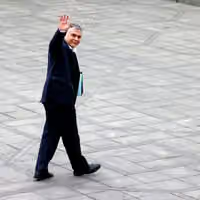
Abdolnasser Hemmati, governor of the Central Bank of Iran, used a special broadcast on Wednesday to argue that the country's monetary crisis remains under control. "Some thought hyperinflation would happen," he said. "For now, it has not."

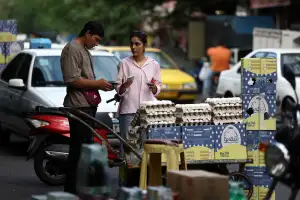
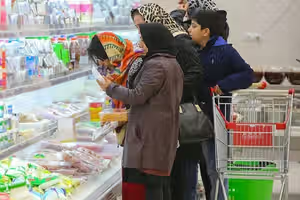
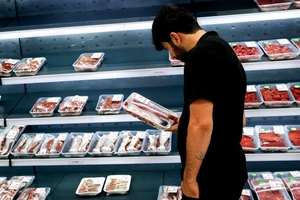
Later in the same program, describing how the government has kept the country running, he offered a defense that its critics will find more revealing than reassuring. Go into the market, he said, and you will see that basic goods are there. "I know it's expensive, but it's there."

The rebuttal arrived the same day. In an interview with Khabar Online, Farshad Momeni, professor of economics at Allameh Tabatabai University in Tehran, was asked whether Iran stands on the threshold of hyperinflation. "Hyperinflation has already happened," he answered.

While the two men argued over the name, Hemmati was proposing to raise the state food coupon by 23 percent, to 12.3 million rials a month. At market exchange rates, that is about $6.40.

An argument about a word

Both men are, in a narrow sense, right, and the gap between them is a definition.

The standard economists use, set out by Phillip Cagan in 1956, puts hyperinflation at 50 percent a month. By that measure Iran is nowhere near it: monthly inflation in the month of Tir (ended on July 22) was 3.1 percent. Looser conventions treat triple-digit annual rates as hyperinflation, and by that measure parts of the Iranian economy have already crossed the line.

Which is where Momeni takes his stand. He cites the statistics center's own reports showing that inflation lands hardest on low-income groups and deprived provinces. "Triple-digit inflation has already turned up in some regions in these official reports," he said, "and if we look at unofficial reports, the picture is far worse."

The dispute is not academic point-scoring. "Hyperinflation" has become one of the most heavily used words in Iranian economic discourse, deployed by lawmakers, newspapers and economists with increasing frequency and decreasing precision.

Iranians have lived with double-digit inflation for the better part of five decades, which is Momeni's own point: with one or two exceptions, he says, Iran's economy has been held captive by inflationary policies for 55 years.

A word that has described the ordinary condition of Iranian life for half a century stops carrying information. The reaching for a bigger one is a sign that the old word has stopped working, and that people are trying to name something they have not felt before.

The official figures give the reaching some grounding. Point-to-point inflation in Tir stood at 87.9 percent, and for food and drink at 128.1 percent. Those rates sit on top of a minimum wage of about 166 million rials a month, roughly $87 at market rates, and typical earnings of 200 to 300 million rials, about $105 to $157. Against food prices that have more than doubled in a year, a $6.40 coupon covers a fraction of a week.

What inflation does to a country

Momeni's larger argument is that inflation of this duration is not an economic problem that also has social effects; it is a solvent.

He points to John Maynard Keynes in The Economic Consequences of the Peace, who wrote that inflation beyond a certain point makes every contract unstable.

"That includes all contracts," Momeni said: "the constitution, ordinary laws, even the rules governing family life. In that atmosphere, kleptocracy takes the place of cooperation and trust." He notes that even Lionel Robbins, a market fundamentalist by his description, warned that phenomena such as Nazism and fascism were born of high inflation.

He also reaches for a historical case that carries an unmistakable warning for the government he is addressing. Analysts asking why the Chinese public accepted the fall of the nationalist government, he said, tend to answer that Mao and his allies controlled inflation in each province they took, while the nationalists could not.

Momeni's sharpest criticism is reserved for how officials talk about all this. They warn about the dangers of inflation as though they were bystanders.

"They play the role of the opposition themselves," he said. "They perform these deadly tricks and then hold a funeral for the consequences." Officials, he argued, should be reporting their remedies, not their alarm.

He extends the same skepticism to the labor figures. Official unemployment stands at 7.6 percent, which he called one of the most astonishing claims available, given a Plan and Budget Organization report showing that only one third of the working-age population is employed, with two thirds playing no part in national production.

Inflation and joblessness compound, he said, and "when inflation and unemployment come together, we have entered the abyss of misery."

The governor's toolkit

Hemmati's account of the government's response is a catalogue of technical interventions carried out under severe constraint.

He said oil exports have almost entirely stopped, that Iran's foreign reserves are blocked by the United States while neighbors in the same position can still draw on theirs, and that about $12 billion of Iranian funds in Qatar, which was to have been made accessible under earlier understandings, remains frozen. Preliminary banking agreements had been signed, he said, but nothing operational has followed.

On Iraq, he said Baghdad had promised to address its outstanding debts, while noting that Iraq's own oil revenues had slowed and that its payments to its own employees had been delayed.

He said a meeting with Iraq's prime minister had produced agreement to use Iranian funds held at the Trade Bank of Iraq as backing for guarantees to Iranian contractors. At the BRICS summit he proposed what he called a financial corridor among member states, using their digital assets to reduce dependence on other countries' currencies.

Hemmati's own figures show the strain behind the reassurance. Foreign currency allocated for basic goods and agriculture over five months was about 8 percent lower than a year earlier, and currency available to manufacturers fell roughly 30 percent.

The coupon program alone requires about 870 trillion rials a month, some $455 million, and the government drew $2.5 billion from the National Development Fund before the new year (March 20) to keep it running for four months. He said the government does not want to fund it by printing money.

He was blunt about the limits. Purchasing power has fallen, he said, and while Turkey raised wages in step when its inflation reached 60 to 70 percent, Iran's fixed-income earners, teachers, workers, civil servants, the bottom three income deciles, receive increases of 20 to 25 percent that leave them further behind each year.

The end of the chain

Whatever the argument is called at the top, its shape at the bottom is not in dispute.

Mostafa Pourdehghan, a member of parliament's industries and mines committee, has warned that Iran is heading towards hyperinflation, putting liquidity at a record 170 quadrillion rials and citing Hemmati for a figure of minus three percent economic growth over five months. He has called for an emergency committee on inflation and prices.

Below that, according to reporting by the ILNA news agency, companies that laid workers off and later recalled them have not paid wages since late May, and the returning workers have lost both the substitute income they found and their entitlement to unemployment insurance.

Akbar Shokat, executive secretary of the Workers' House in Qom province, said most of the workforce lives below the poverty line after years of wage suppression and has almost no resilience left, warning that workers could not endure more than another two months. In July, about 1,600 workers at the Tabriz Machine Manufacturing group struck over unpaid wages.

Hemmati and Momeni are arguing about which word describes the Iranian economy. In the shops, where a month's wages no longer reach the end of the month, the argument was settled some time ago.

Most Viewed

Can Iran's fragile economy survive Trump's 'Economic D-Day'?
1
ANALYSIS

Can Iran's fragile economy survive Trump's 'Economic D-Day'?

2
ANALYSIS

UAE trade halt threatens one of Iran’s remaining economic lifelines

3
ANALYSIS

Turkey’s gas pivot leaves Iran with fewer cards to play

4

With the war quieting, Iran's hijab crackdown gathers pace again

5

Trans woman prisoner says she was raped in Iran Intelligence Ministry detention

Banner
Banner
•
•
•
  • Can Iran's fragile economy survive Trump's 'Economic D-Day'?

    Can Iran's fragile economy survive Trump's 'Economic D-Day'?

  • First red meat, now dairy: Iran’s household diet keeps shrinking

    First red meat, now dairy: Iran’s household diet keeps shrinking

  • War or government failure? Record inflation fuels political battle in Iran

    War or government failure? Record inflation fuels political battle in Iran

  • Iran faces region’s harshest mix of wartime contraction and inflation

    Iran faces region’s harshest mix of wartime contraction and inflation

  • Iran’s 7% unemployment rate masks deeper jobs crisis, experts say

    Iran’s 7% unemployment rate masks deeper jobs crisis, experts say

  • Why so few Iranians have jobs despite low unemployment

    Why so few Iranians have jobs despite low unemployment

  • Iranian workers report  layoffs, months of unpaid wages

    Iranian workers report layoffs, months of unpaid wages

Spotlight

  • Ghalibaf's hunger warning sparks hardline backlash over showing weakness
    INSIGHT

    Ghalibaf's hunger warning sparks hardline backlash over showing weakness

  • Iran crude loadings plunge to one-seventh of pre-war level as blockade bites
    ANALYSIS

    Iran crude loadings plunge to one-seventh of pre-war level as blockade bites

  • Turkey’s gas pivot leaves Iran with fewer cards to play
    ANALYSIS

    Turkey’s gas pivot leaves Iran with fewer cards to play

  • Can Iran's fragile economy survive Trump's 'Economic D-Day'?
    ANALYSIS

    Can Iran's fragile economy survive Trump's 'Economic D-Day'?

  • The unlikely return of European diplomacy in the Iran-US conflict
    ANALYSIS

    The unlikely return of European diplomacy in the Iran-US conflict

  • For Iranian journalists, exile can last a lifetime
    OPINION

    For Iranian journalists, exile can last a lifetime

Banner

More Stories

Ghalibaf's hunger warning sparks hardline backlash over showing weakness

Aug 21, 2026, 22:00 GMT+1
•
Maryam Sinaiee
100%
Iranian Parliament Speaker Ghalibaf during a visit to Najaf in Iraq.

A warning by parliament speaker Mohammad Bagher Ghalibaf that Iran cannot endure if its people go hungry has exposed tensions in Tehran over acknowledging economic strain, with hardliners arguing that signs of weakness will encourage further US pressure.

Speaking at a meeting with Iranian and Iraqi businesspeople at the Iranian Embassy in Baghdad on Thursday, Ghalibaf stressed that economic strength must accompany military power.

“No matter how much military power we have, if people are hungry and we do not have financial circulation and economic growth, we will not endure,” he said. He also called for planning to confront what he described as unjust sanctions.

His remarks drew criticism from hardline commentators, who argued that acknowledging the impact of US economic pressure could help Washington.

Masoud Barati, a former state television presenter, wrote on X that Ghalibaf’s comments, coming as US President Donald Trump escalated his economic campaign against Iran, conveyed “a message of weakness.”

He said such a message reinforced the image of a weak Iran and encouraged the enemy to increase pressure. Warnings against projecting weakness were also a recurring theme in Friday prayers across Iran, whose broad themes are set by a government institution.

The dispute comes as the Trump administration prepares what Treasury Secretary Scott Bessent has described as the “toughest sanctions in history” on Iran, combining the existing US blockade with unprecedented sanctions aimed at collapsing the Islamic Republic.

Bessent also said the United States was seeking the “greatest coordinated economic isolation in the history of the world” and would press allies and other countries, including China, to join the campaign.

US Vice President JD Vance has said Tehran will not be able to withstand the pressure indefinitely, whether for “a couple of weeks or a couple of months or possibly longer.”

Vance acknowledged that Iran is also applying economic pressure on the United States, but said Tehran is feeling the greater impact.

Iranian-Canadian political analyst Shahir Shahid-Sales argued in a post on X that increasing economic pressure would not leave the Islamic Republic passively watching its own collapse.

“This system has no choice but to launch a widespread war, especially when such a decision is backed by high and false confidence,” he wrote, warning that ordinary Iranians would pay the price of the confrontation.

Tehran rejects pressure campaign

Iran’s Foreign Ministry on Thursday condemned the broad economic and trade sanctions, calling them evidence of the “anti-human, lawless and hegemonic nature” of the US government.

“Sanctions and economic pressure are the other side of the coin of war and military aggression,” the ministry said.

Foreign Minister Abbas Araghchi, meanwhile, dismissed what Trump has called “Economic D-Day” as a diversion from America’s own economic problems.

“The so-called ‘Economic D-Day’ is a diversion from America's own crisis: unprecedented debt and surging interest costs,” Araghchi wrote on X. “Doubling down on failed policies will only bring further defeat—and enmity of Iranians. US economic terrorism threatens global economy and sovereignty worldwide.”

In another post, he described the “most crushing economic operation in history” as a repeated scenario destined to fail.

President Masoud Pezeshkian, however, has repeatedly acknowledged Iran’s deteriorating economic situation in speeches and interviews, adding to the contrast between Tehran’s public dismissal of Washington’s strategy and concerns voiced by senior officials about conditions at home.

Friday prayers rally against US pressure

Friday prayer leaders across Iran responded extensively to US officials’ warnings over the economic campaign, while reiterating support for keeping the Strait of Hormuz closed.

Habibollah Ghafouri in Kermanshah described the renewed talk of sanctions and economic blockade as a clear admission of the “enemies’ failure against the Iranian nation and the Islamic front” after what he called their failure on the military front.

In Ardabil, Hassan Ameli called Trump’s statements a “major psychological operation,” saying they were intended to influence public sentiment and Iran’s markets.

In Semnan, Morteza Motiei argued that the United States was facing its own high costs, logistical challenges and international pressure rather than inflicting greater damage on Iran.

In Sari, Mohammad-Bagher El-Eini said Iran had seized control of the Strait of Hormuz and was holding America “by the throat,” vowing that the pressure would continue until the United States was destroyed and predicting the eventual destruction of US military forces.

Reza Nouri, the Friday prayer leader in Bojnourd, also warned regional countries over what he described as a naval blockade of Iran, saying that if Iran could not import or export goods, “no one should be able to do so.”

The contrasting messages point to a growing tension in Tehran’s response to Washington’s economic campaign: while senior officials acknowledge the need to strengthen the economy and prepare for prolonged pressure, hardliners fear that publicly admitting economic vulnerability could encourage the United States to intensify it.

Iran crude loadings plunge to one-seventh of pre-war level as blockade bites

Aug 21, 2026, 20:54 GMT+1
•
Dalga Khatinoglu
100%
A still image from a video obtained by Reuters on June 5, 2026, shows US forces conducting an interdiction of the sanctioned stateless oil tanker Davina in the Indo-Pacific region, according to the U.S. Indo-Pacific Command.

Iranian crude loadings have fallen to about one-seventh of their pre-war level under the US naval blockade, while Chinese receipts of Iranian oil and fuel exports have also dropped sharply, tanker-tracking data reviewed by Iran International shows.

Data from commodities intelligence firm Kpler shows Iran has loaded an average of about 287,000 barrels per day (bpd) of crude so far this month, compared with roughly 2 million bpd before the Middle East war.

China, meanwhile, has received an average of just 523,000 bpd of Iranian crude so far this month. That compares with an average of about 800,000 bpd over the previous two months and more than 1.7 million bpd at the beginning of the war.

The United States reimposed a maritime blockade against the Islamic Republic in mid-July. As a result, more than 40 million barrels of Iranian oil stored on tankers in the Persian Gulf and Gulf of Oman have become effectively trapped, Kpler estimates.

Iran has stored 83 million barrels of oil outside the blockade zone, including 43 million barrels in the South China Sea, Yellow Sea and East China Sea. But with China sharply reducing its purchases, Tehran could run out of oil available for delivery to China in roughly five months if the current export rate persists.

Iran also exported around 256,000 bpd of fuel oil, or mazut, last year. Exports remained at roughly 220,000 bpd during the first two months of this year, but have plunged to just 61,000 bpd this month.

Iran had also been exporting a similar volume of LPG before the war. Those exports have now almost come to a halt.

According to Central Bank of Iran (CBI) data, the country’s crude oil and fuel oil exports were worth $57.5 billion last year, accounting for about 55% of Iran’s total exports. Crude oil, petroleum products and LPG together accounted for roughly 65% of the country’s total exports.

The sharp decline in exports of these commodities is likely not only to leave the government facing a massive budget shortfall, but also to create serious difficulties in securing the foreign currency needed to finance imports.

Iran imported nearly $78 billion worth of goods last year, including about $3 billion in gasoline, CBI data shows. Even if the country were to maintain its non-oil exports at last year’s level, they would not be sufficient to finance even half of its goods imports.

The situation is particularly difficult because Iran’s steel industry, which had generated as much as $5 billion a year in export revenues for the Islamic Republic, has been severely damaged by the recent war. The domestic market is now also facing a shortage of steel.

Iran was also a net importer of services last year, running a deficit of about $15 billion. Combined with its $78 billion in goods imports, that means Iran needed roughly $93 billion in foreign exchange to cover goods imports and its net services deficit.

Even if Iran manages to maintain its remaining non-oil exports at last year’s level, those revenues would cover only around one-third of those needs if crude oil, petroleum products, LPG and steel exports are excluded.

The pressure could increase further after US President Donald Trump on Wednesday threatened an “economic D-Day” against Iran, pledging economic warfare and isolation on an unprecedented scale after saying Tehran had failed to make a deal.

The threatened measures could make sanctions evasion more difficult and expose Iran’s already weakened foreign trade to additional challenges.

With the war quieting, Iran's hijab crackdown gathers pace again

Aug 21, 2026, 10:09 GMT+1
•
Maryam Sinaiee
100%

The men who spent the war demanding control of the Strait of Hormuz have returned to demanding control of women's clothing. As the fighting subsides, Iran's hardliners are pressing to revive a hijab law the state itself suspended for fear of new protests.

The push is coming from figures with real leverage, including inside the judiciary, and it has two aims: harsher enforcement of the dress code now, and an end to the suspension of Iran's strict Hijab and Chastity law.

Tehran Prosecutor Ali Salehi said on Monday the judiciary was preparing to move against cafes, restaurants and clothing stores for "committing acts contrary to public chastity and selling unconventional clothing."

On Thursday he went further, ordering judicial authorities to identify and confront what he called "organized and networked actors" promoting unveiling, whom he accused of spreading corruption in public places and offending public sentiment.

The closures were already underway. In recent weeks authorities have shut cafes, restaurants, shops and sports clubs in more than 15 cities, including Tehran, over hijab violations by customers or staff.

  • Iran seals dozens of businesses in renewed hijab crackdown

    Iran seals dozens of businesses in renewed hijab crackdown

Women have also been blocked from obtaining motorcycle licenses, despite a government decision sent to police in February.

The reformist daily Shargh wrote on Wednesday that the resistance appeared to have little to do with law or road safety, and everything to do with what women would be wearing on the bikes.

'Hijab is a flag'

The pressure is louder on the street and online than in the institutions.

Hijab has moved to the front of the placards and slogans at the nightly pro-government rallies, according to social media users who follow them. Those gatherings drew some unveiled women in the early weeks of the war. They are far smaller now, and the crowd is almost entirely hardline.

Their target is often President Masoud Pezeshkian, who has not submitted the Hijab and Chastity law to government bodies for implementation, and whom demonstrators accuse of letting unveiled women multiply.

Pezeshkian has not objected to the law itself. The decision to freeze it was taken above him, out of fear that enforcing it would set off a new wave of anti-government protests.

Female hardliners have held their own gatherings in cities including Isfahan and Mashhad. Outside the governor's office in Isfahan, one placard carried a line attributed to Israeli Prime Minister Benjamin Netanyahu: "Unveiled women are our free soldiers."

Online, hardliners have been circulating footage of women walking, exercising, dancing and singing in shopping centers, cafes and streets, demanding that the authorities act against women they call "naked."

"Do you see the widespread wave of hijab tweets? The message is completely clear: the authorities have made up their minds to put an end to this situation. I can't wait for the operational phase to begin as soon as possible," one hardline user wrote.

The argument they make for themselves is that the veil is not a rule but a banner. "Hijab is the flag of the Islamic Republic and must not be allowed to fall," runs a common formulation.

"Hijab is not merely a secondary religious ruling; hijab is a flag," a hardline cleric posted. "If there is leniency over it, it will lead to the destruction of the family and the weakening of other religious laws." His patience, he warned, and that of others like him, could run out.

Other users have been keeping score. One noted that the same voices who spent the war demanding control of the Strait of Hormuz, guaranteed revenues from the waterway and a seat at the table of global oil pricing had "returned to factory settings," their attention back on women’s clothing.

A law too dangerous to use

The Hijab and Chastity law, finalized in 2024, is harsher than anything before it, and includes provisions that would let civilian groups confront women over their clothing.

It has never been enforced. Implementation was suspended over fears it would set off protests on the scale of those that followed Mahsa Amini's death, and the Supreme National Security Council's decision still stands.

The freeze carries the late supreme leader's authority. Interior Ministry spokesman Ali Zeynivand said this month that it was decided under Ali Khamenei and has not changed, and that Pezeshkian, too, supports it.

Meanwhile, the streets have moved. Unveiled women are far more visible than a year ago, and many now dress in ways that would have been unthinkable in public not long before.

Women's rights activists warn against reading that as the end of compulsory hijab. Women employed in government offices and institutions are still held to the dress code, and unveiled women are still turned away from some buildings and services unless they cover their hair, arms and legs.

Some users see the easing as a product of the war rather than a change of policy, and expect it to end with the fighting. "If the situation becomes more stable, I doubt the authorities will refrain from bringing their repressive forces back onto the streets to enforce hijab on women," one wrote.

Even among those who support compulsory hijab, some think a crackdown now would backfire. Morteza Panahian, a young cleric who has also criticized the refusal to license women motorcyclists, wrote that anyone blaming the spread of unveiling on the law's suspension had evidently never read the law.

"This law is so impossible to implement that, if it is promulgated, the pace of unveiling will double," he wrote.

Turkey’s gas pivot leaves Iran with fewer cards to play

Aug 21, 2026, 05:00 GMT+1
•
Umud Shokri
100%
A worker at a natural gas facility in Iran. Turkey imported 4.536 bcm of Iranian gas in the first half of 2026, up 34 percent from a year earlier.

The expiry of a 25-year gas contract has exposed a shift in the Iran-Turkey energy relationship, with Ankara now enjoying more supply options while Tehran risks losing one of its most dependable export markets.

The contract expired on July 29 after governing Iranian pipeline gas supplies to Turkey for 25 years. Signed in 1996, with deliveries beginning in 2001, it provided for up to 9.6 billion cubic meters (bcm) of gas annually through the Tabriz-Ankara pipeline.

Turkish sector sources said the war prevented the two sides from holding negotiations on a new agreement before the deadline, while existing gas flows could continue temporarily under force-majeure arrangements. No new long-term contract has been publicly announced.

The expiry is particularly significant because Iranian supplies were rising sharply immediately before the agreement lapsed. Turkey imported 4.536 bcm of Iranian gas in the first half of 2026, up 34 percent from a year earlier. In June alone, Iran supplied 883 million cubic meters, narrowly behind Azerbaijan and ahead of Russia among Turkey’s pipeline suppliers.

That complicates any assumption that the expiry automatically means the end of Iranian gas exports to Turkey. Instead, it has opened a period in which Ankara must decide how much Iranian gas it still needs and under what terms, while Tehran risks losing or reducing one of its relatively stable sources of export revenue.

The uncertainty has become more consequential as Washington intensifies economic pressure on Tehran. US President Donald Trump on Wednesday announced what he called an “Economic D-Day” against Iran, threatening economic consequences for countries whose financial institutions, businesses or government entities provide Tehran with what he described as economic lifelines.
Trump did not name Turkey or specify how the campaign would affect its purchases of Iranian natural gas. But the announcement adds another potential complication to any attempt by Ankara and Tehran to turn the temporary post-expiry arrangement into a new long-term agreement.

Iran’s gas vulnerabilities

Iran holds the world’s second-largest proven natural gas reserves, yet its export performance remains far below its potential. Production has long been constrained by aging fields, limited investment, insufficient access to technology and exceptionally high domestic consumption.

The South Pars field, shared with Qatar, remains central to Iranian gas production. Israeli strikes in March damaged processing facilities linked to the field and temporarily disrupted exports, although production was subsequently restored at several offshore platforms and gas was redirected to other processing facilities.

The damage has not yet been fully repaired. Iranian Oil Minister Mohsen Paknejad said in August that the war had knocked out about 95 million cubic meters of gas production and that reconstruction of four damaged refineries was continuing. He said the lost capacity was expected to return to the network by the end of September.

Rystad Energy estimates that repairing energy-related infrastructure damaged across the region could cost between $34 billion and $58 billion. Iran accounts for the largest number of affected facilities, with its repair bill potentially reaching $19 billion under the consultancy’s high-damage scenario.

These wartime losses compound problems that predate the conflict. Sanctions have restricted access to investment, technology and international markets, while domestic demand for electricity generation, heating and petrochemicals frequently takes priority over exports.

For Tehran, the Tabriz-Ankara pipeline has therefore been more than simply another commercial route. It has provided revenue, political leverage and a direct energy relationship with one of the region’s largest economies. A substantial reduction in exports to Turkey would leave Iran more dependent on limited pipeline sales to Iraq and Armenia, swaps and other short-term arrangements.

Turkey’s stronger hand

Turkey enters the post-contract period in a far stronger position than when the agreement was signed three decades ago.

Its annual gas demand generally ranges between 50 and 60 bcm, but its supply portfolio has become increasingly diversified. Russia remains a major supplier through Blue Stream and TurkStream, while Azerbaijan supplies gas through the Southern Gas Corridor. LNG has also become an increasingly important component of Turkish supply.

Turkey has expanded LNG import and storage capacity and signed long-term supply agreements with international producers, while domestic production from the Black Sea has continued to grow. Those developments give Ankara substantially more flexibility than it possessed when Iranian pipeline gas became a major part of its energy system.

That does not mean Iranian gas has become irrelevant. Turkish Energy Minister Alparslan Bayraktar said before the contract expired that Turkey could still need the Iranian pipeline for supply security. Turkish sector sources have also described Iranian gas as among the country's cheapest sources.

The combination gives Ankara considerable leverage. Iran still offers competitively priced pipeline gas delivered through existing infrastructure, but Turkey is no longer as dependent on that supply and has more alternatives with which to negotiate.

What happens after the expiry

Several outcomes remain possible. Turkey and Iran could eventually negotiate another long-term supply agreement, reach a shorter transitional arrangement, reduce contracted volumes or retain Iranian gas primarily as a source of additional supply during periods of high demand.

For Turkey, the calculation will involve not only price and physical supply but also reliability and geopolitical risk. Iranian gas has repeatedly been affected by winter shortages, infrastructure problems and now war, while tighter US economic pressure could create additional uncertainty surrounding payments and future contractual arrangements.

For Iran, the stakes are considerably higher. Reduced exports to Turkey would cut foreign-exchange earnings and further expose the gap between Iran’s enormous gas reserves and its limited ability to monetize them internationally.

The expiration of the old agreement therefore does not yet represent the end of the Iran-Turkey gas relationship. Gas continues to move, and both countries retain reasons to preserve the connection.

But the balance underlying that relationship has changed. Turkey has more suppliers, more infrastructure and greater bargaining power, while Iran faces damaged facilities, sanctions, war and renewed US efforts to restrict its remaining sources of foreign revenue.

The question is no longer whether the 25-year contract will expire. It already has. The question now is whether the gas trade that survived its expiry can be converted into another durable agreement — and on whose terms.

Gasoline survey reignites debate over politically risky fuel reform in Iran

Aug 21, 2026, 01:33 GMT+1
•
Maryam Sinaiee
100%

A gasoline policy survey by Iran’s energy optimization chief has reignited debate over how the Pezeshkian administration should tackle the country’s fuel deficit without triggering another politically dangerous price shock.

The poll was conducted by Esmail Saghab-Esfahani, Iran’s vice president and head of the Organization for Optimization and Strategic Management of Energy, who launched it on X on Monday and closed it two days later.

Under Iran’s current system, subsidized gasoline quotas are allocated to vehicles through fuel cards, with motorists able to buy a limited monthly amount at a lower price and additional fuel at a higher rate.

Saghab-Esfahani’s survey offered three alternatives: keeping the existing system while giving each citizen an additional tradable 30-liter quota; selling gasoline above current quotas at 870,000 rials per liter; or limiting supply to domestically produced gasoline without additional imports.

About 50% favored a model that would maintain existing quotas while allocating an additional 30 liters of gasoline per person based on national ID numbers. The additional quota could be transferred or sold to others at a mutually agreed market price.

Another 34% supported supplying gasoline beyond existing quotas at about 870,000 rials per liter, while 15% favored supplying gasoline in line with domestic production without additional imports.

Slightly more than 14,000 people took part. Critics, however, questioned whether the results could be considered representative of public opinion, citing the relatively low use of X in Iran, particularly in rural areas.

Iran’s gasoline imbalance is estimated at about 10% of consumption, according to the Khorasan newspaper, which has argued that the problem needs to be addressed but warned against using a policy that could create a much larger economic and social shock.

The economic newspaper Donya-e-Eqtesad argued that the results should not be interpreted as a definitive expression of public support for gasoline reform.

“People have shown greater preference for the option that, compared with queues at gas stations and 870,000-rial gasoline, imposes less direct harm on them,” the newspaper wrote. “This difference is important, because the policymaker should not conclude from the higher vote that society has accepted all aspects of the plan.”

The newspaper also questioned why the survey did not include a fourth option combining non-price and structural measures, such as reducing the use of fuel-intensive vehicles, expanding imports of hybrid and electric cars, improving fuel-efficiency standards, developing public transportation, combating smuggling and gradually reforming the auto industry.

It also argued that shifting gasoline quotas from vehicles to individuals would not necessarily reduce consumption if fuel remained cheap and vehicles continued to be inefficient. At best, it said, the measure could make the distribution of subsidies fairer and reduce smuggling or misuse of some fuel cards.

The methodology also drew criticism from users who participated in the discussion. Mohammad Reza Felfalani, a civil-society activist working on water, energy and environmental issues, wrote: “It is unfair to ask people to make a decision or assessment with this amount of data. If you yourselves are designing a plan with this amount of data, give us the right to worry about Iran’s future.”

Financial markets analyst Mohammad Shahrestani warned that none of the proposed options would be cost-free under current economic conditions.

“None of these ideas will be without cost under the current economic and livelihood conditions; a cost that may be irreparable,” he wrote, challenging those who oppose negotiations to offer a solution to the fuel problem that they can implement.

Another commenter warned that any gasoline reform would risk failure unless the government first explained how it intended to control the prices of goods and services that could rise as higher transportation costs feed through the economy. The user warned that such a plan could become vulnerable to unrest on the scale of the January protests.

Hardliner roots of the proposal

Saghab-Esfahani says he does not belong to any political faction, but his positions have often been close to those of conservative hardliners such as former presidential candidate Saeed Jalili. His appointment by President Masoud Pezeshkian in November 2025 drew criticism from reformists.

He has personally shown greater support for a model linking gasoline rations to individual citizens rather than vehicles. The model is among the policies previously promoted by Jalili and featured prominently in his campaign during the last presidential election.

That connection has led some critics to accuse Saghab-Esfahani of framing the survey’s choices in a way that would produce a result favorable to his preferred model and to political groups aligned with him.

One commenter accused the government of trying to impose a proposal developed by supporters of former President Mahmoud Ahmadinejad and Jalili over the past eight years.

“You ignored the criticism of every expert and now want to topple the Pezeshkian government by forcing this plan through, and then you stage a survey?” the user wrote.

Another argued that the wording of the choices was designed to steer respondents toward the government’s preferred option, warning that giving every citizen a tradable gasoline credit could become the Pezeshkian administration’s “Achilles’ heel” during wartime.

A further commenter said none of the proposed options could solve the problem and accused the government of using the poll to seek legitimacy for a predetermined policy.

Warnings over a price shock

Many Iranian experts and media outlets acknowledge the need to address the gasoline imbalance while warning against a sudden price shock. The central disagreement is whether consumption should be controlled through sharp price increases or through a combination of quotas, gradual price adjustments, demand management, public transportation and supply-side reforms.

The Khorasan newspaper, in an editorial titled “Do Not Perform Surgery for a 10% Deficit,” argued that if the core problem is an imbalance of roughly 10% between gasoline production and consumption, the government should not resort to a policy capable of creating a much larger economic and social shock.

“The dimensions of the potential consequences may be much greater than the original problem,” the paper argued.

The warning carries particular weight in Iran, where previous fuel-price increases have triggered unrest. A gasoline price increase in 2019 led to widespread protests that were violently suppressed, while an earlier increase in 2007 sparked riots in several parts of the country, including Tehran.

For the Pezeshkian administration, the challenge therefore goes beyond how gasoline quotas are allocated. It must address a persistent fuel imbalance without allowing a reform intended to ease pressure on the energy system to become a new source of economic hardship, political conflict and social unrest.