Ground attack on Iran is a 'delusional' idea, border chief says
Iran's border police commander said on Wednesday that talk of a possible ground attack on the country was "delusional," adding that Iran's borders were secure and its armed forces remained intact.
“Claims about a possible ground attack on Iran are delusional, and enemy movements can never undermine the country’s authority and security,” Aliakbar Javidan said.
He said the deaths of senior commanders had not disrupted military operations because replacements were in place.
Javidan added that border guards and residents in Kordestan, Sistan-Baluchestan and Khuzestan were helping secure the country’s frontiers.
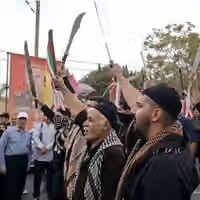
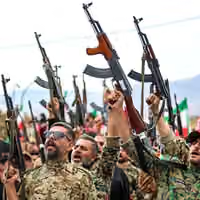
A protester with a poster featuring the late Iranian Supreme Leader Ali Khamenei on his head joins a demonstration with Houthi supporters in solidarity with Iran and Lebanon, amid the U.S.-Israeli conflict with Iran, in Sanaa, Yemen, on March 6, 2026. Khaled Abdullah/Reuters
Six people were killed when Iran-backed Houthis attacked a vessel in Bab el-Mandeb, an escalation experts say reflects not a second front in the Iran war but two conflicts converging, as the Houthis pursue their own interests while adding pressure on Iran’s adversaries.
Analysts disagree over how directly Tehran is involved and what is driving the Houthis back into action after largely sitting out the Iran war. But whether Tehran is directing them or benefiting from decisions they make independently, renewed Houthi activity puts additional pressure on Iran's adversaries, particularly Saudi Arabia.
On Tuesday, the Houthis fired missiles at the Tanzania-flagged cargo ship Tihamah in the Bab el-Mandeb strait, killing four crew members and two members of the government-allied National Resistance Forces, according to Yemeni authorities.
Later on Tuesday, the Houthi-affiliated Al-Masirah network said the group targeted another vessel carrying what it described as Saudi “military equipment” in the Bab el-Mandeb.
Houthis pursue their own war
The Houthis' return to action appears rooted first in their own calculations inside Yemen.
Kamran Bokhari, a senior resident fellow at the Middle East Policy Council and strategic forecaster, describes Iran's so-called Axis of Resistance as a corporate brand in which some groups operate more like Iranian-controlled subsidiaries, while the Houthis resemble an independent franchise.
“They'll come in and participate in a conflict and they'll act as and when they see that it's in their interest to do so,” Bokhari told Iran International. “They're not like, you know, Iran says jump and they say how high?”
For months, that interest appeared to lie in staying out of the Iran war while its trajectory remained uncertain.
The calculation began to change following a confrontation involving an Iranian aircraft bound for Houthi-controlled territory. Saudi Arabia struck a Yemeni airfield after the aircraft attempted to land, helping trigger a renewed cycle of attacks between the Houthis and Riyadh.
The escalation also comes amid growing activity by Saudi-backed government forces and UAE-backed southern separatists inside Yemen.
“It's all domestic, is what I'm trying to say. It has nothing to do with Iran,” Bokhari said of the immediate Houthi calculation.
But that domestic struggle is unfolding in a regional environment transformed by the Iran war.
Iranian disruption around the Strait of Hormuz has already increased pressure on Saudi Arabia and other Persian Gulf states. Renewed Houthi activity around Bab el-Mandeb means Riyadh increasingly has to contend with threats around two critical waterways.
Saudi Arabia is also trying to build a stronger security architecture around itself. The recently signed Saudi-Pakistani-Turkish defense pact could give the kingdom greater regional support as it confronts those threats.
That may give the Houthis an incentive to press Riyadh now.
“The Houthis want to be able to extract concessions from the Saudis before the grid goes up, if you will,” Bokhari said.
Their ultimate objective, he argues, remains establishing themselves as Yemen's dominant political and military power and forcing Riyadh to accept that they cannot simply be eliminated.
Iran benefits
But the Houthis' pursuit of their own objectives does not mean Tehran is a bystander.
Fatima Al-Asrar, a Yemen and Iran specialist, sees the renewed Houthi pressure as increasingly intertwined with Iran's broader strategy against the United States.
“Of course, they [Iran] see it as an extension to them. They're no longer hiding it,” Al-Asrar told Iran International, pointing to Iranian rhetoric linking pressure around the Strait of Hormuz and Bab el-Mandeb.
She said Tehran is closely watching growing US fatigue with the Iran war and sees the approaching midterm elections as an opportunity to increase pressure on Washington.
“They're very transparent, very calculating, and they're using the Houthis on that front in order to press their advantage,” she said.
New reporting from Saudi-owned Asharq Al-Awsat raises the possibility of a more direct Iranian operational role.
Citing Yemeni security sources, the newspaper reported on Tuesday that IRGC officers are overseeing aspects of the Houthi escalation and that an Iranian official, Ali Mohammad Rezaei, is supervising an operations room managing military and security affairs in Houthi-controlled territory. Iranian officers have also helped establish additional missile and drone launch positions, according to the report.
Iran International has not independently verified the claims.
What will this lead to?
In July of this year, US President Donald Trump has warned Washington would hold Tehran responsible for renewed Houthi attacks, describing the group as an Iranian “Surrogate and/or Proxy” and threatening military punishment against both.
But retired Royal Navy Commander Tom Sharpe, who served for 27 years and commanded four warships, told Iran International that he doubts Trump will want to launch another major military campaign against the Houthis.
“He definitely doesn't want to be embroiled on a second tangent here,” Sharpe told Iran International.
Bab el-Mandeb also does not carry the same strategic weight as the Strait of Hormuz, Sharpe said, because ships have alternative routes, albeit at considerably greater cost and distance.
Yet Iran can still benefit.
Greater Houthi disruption could complicate shipping and potentially force the United States and its partners to devote resources to another strategic waterway.
“I think they'll be pleased,” Sharpe said of Tehran. “If it does draw away resources, US resources from the Gulf of Oman, then that's in Iran's favor.”
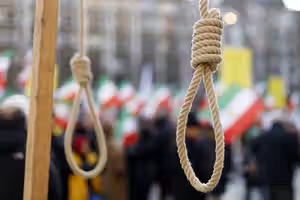
Iran has carried out at least 916 executions since the start of 2026, including 15 so far in August, the Abdorrahman Boroumand Center for Human Rights in Iran said on Tuesday.
The actual number of executions was likely much higher because Iranian authorities withhold information about many cases, the US-based rights group said.
It said many protesters were also facing charges that could carry the death penalty and criticized their trials as rushed and lacking due process.
The center said Iranian authorities were using death sentences and executions to intimidate the public and deter further protests.
Executions since March
The figures come amid growing concern from the UN over Iran's use of the death penalty, particularly in cases involving people arrested over anti-government protests.
UN human rights chief Volker Türk said last week that Iran had executed at least 56 people on national security-related charges since March 19, including 27 in cases linked to protests earlier this year.
Türk said executions and death sentences had increased since March, while more than 100 other people faced similar charges that could result in execution.
He called on Iranian authorities to halt all executions and move toward abolishing the death penalty.
Iranian authorities executed 20-year-old Arvin Kheirkhah at Shahroud prison on Aug. 1 after he was sentenced to death over his involvement in protests in January, according to information obtained by Iran International.
Kheirkhah had been convicted by a Revolutionary Court on charges including moharebeh, or "waging war against God."
His family gathered outside the prison before his execution in an effort to stop the sentence from being carried out.
Isfahan protest case
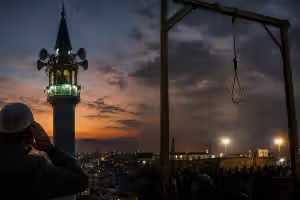
Authorities also hanged Amirhossein Safari and Abolfazl Sepahi in Isfahan's Alikhani Square in late July. They were among 12 young men sentenced to death in a case stemming from January protests in the city.
Iranian authorities accused the defendants of involvement in the deaths of four security personnel as well as arson and vandalism.
Two other defendants in the same case, Golmohammad Mohammadi and Erfan Esfandiari, were executed on July 19.
A group of UN human rights experts urged Tehran in July to halt executions in the case, raising concerns about closed proceedings, alleged ill-treatment and the use of confessions broadcast on state television.
"Sentencing 12 people to death in one hearing, in a closed courtroom and without clarity as to each defendant's individual responsibility violates established fair trial standards," the experts said.
They said the defendants, who ranged from their late teens to early twenties, had faced arbitrary detention, enforced disappearance and, in some cases, ill-treatment.
File photo shows commercial vessels near the Strait of Hormuz amid ongoing shipping disruptions.
The maritime confrontation around Iran widened Tuesday as US forces struck an Iran-bound vessel and Tehran-backed Houthis attacked a ship in Bab el-Mandeb, even as Pakistan and Qatar signaled progress in mediation over the Strait of Hormuz.
Pakistan’s Interior Minister Mohsin Naqvi met President Masoud Pezeshkian and Foreign Minister Abbas Araghchi in Tehran as Islamabad continued its mediation efforts.
Pakistan’s Defense Minister Khawaja Asif separately said signals from recent days suggested the US and Iran were close to “some sort of an arrangement,” while Qatar said Iran-Oman negotiations had reached an advanced stage.
The diplomatic push came as Washington escalated enforcement of its naval blockade. US Central Command said a Navy helicopter fired two Hellfire missiles at the Panama-flagged Vela Nova after its crew ignored repeated warnings and continued toward an Iranian port, disabling the vessel’s steering gear.
CENTCOM said the blockade remained “in full effect,” adding that US forces had redirected 55 commercial vessels, disabled three and boarded two as of Tuesday.
A deck cargo ship was also attacked by Yemen’s Iran-backed Houthis in the Bab el-Mandeb Strait on Tuesday, killing three crew members, Reuters reported, citing Yemeni coast guard sources and government military officials.
Asharq Al-Awsat reported the same day, citing Yemeni security sources, that IRGC officers were overseeing the Houthis’ escalating military operations in Yemen. Iran’s envoy to the group, Ali Mohammad Rezaei, was personally supervising an operations room managing military and security affairs in Houthi-controlled areas, according to the report.
Tehran, meanwhile, maintained that progress on shipping arrangements with Oman would not by itself reopen the strait. Supreme National Security Council Secretary Mohsen Rezaei said Hormuz would remain closed unless Washington changed its behavior and accepted Iran’s conditions, and that any agreement with Oman on a transit route would be separate from the broader closure.
Mohammad Mokhber, an adviser to Supreme Leader Mojtaba Khamenei, reinforced that position, saying the strait “will not be reopened until Iran’s conditions are met.”
Pressure on shipping also persisted. The Joint Maritime Information Center said IRGC attacks, attempted attacks and harassment continued in the strait, including UAV overflights, hailing and targeted surveillance of merchant vessels.
IRGC spokesperson Hossein Mohebi also warned that energy networks, power plants and global internet-linked infrastructure could be at risk if Iran were threatened again. He said the US had “30 to 40 warships in the region” before the recent 40-day war but that “not even one US warship” remained in the Persian Gulf.
Despite the continuing confrontation, oil flows showed signs of recovery. US Energy Secretary Chris Wright said the seven-day average for oil leaving the Strait of Hormuz had risen to nearly 9 million barrels per day, with total regional flows averaging about 15 million barrels per day when pipeline and export-facility shipments were included.
The Tuesday front page of state-run newspaper Hamshahri features Mojtaba Khamenei at the center and his latest appointments, along with the headline: The new lineup of power
Iran's latest military appointments are consolidating its command structure after the recent war, with hardliners portraying the reshuffle as a shift toward a more unified and offensive posture.
Six veteran military and security figures have been given key positions across the General Staff of the Armed Forces, the Islamic Revolutionary Guard Corps (IRGC), the IRGC Navy and the Basij, in changes that Iranian media and political figures have described as a reorganization of the country's security architecture.
Mehr News Agency said the appointments did not represent the emergence of an entirely new generation at the top of the armed forces, but argued that the changes in commanders' roles and positions were significant.
Their central message, it said, was the "reorganization of the command structure in line with the country's new security environment," combining the experience of veteran commanders with Iran's new defense requirements.
Ibrahim Rezaei, a member of parliament's National Security and Foreign Policy Committee, said the appointments would make the armed forces more offensive and increase "synergy between the armed forces and other state and governmental structures."
Hardliners see message to Washington
Hardline media and political activists have largely interpreted the appointments through the language used in the new commanders' mandates. In particular, the instruction to newly appointed IRGC commander-in-chief Ahmad Vahidi to prepare for "powerful offensive operations against the enemy" has been presented as a message of defiance to the United States.
Ehsan Salehi, a political analyst writing in the hardline Hamshahri newspaper, said the appointments would make Iran "harder for Trump, more difficult to resolve and more unpredictable."
He also linked the appointment of Mohsen Rezaei as secretary of the Supreme National Security Council to a broader message to Washington, arguing that escalation or continued threats and violations of agreements would make Iran's foreign policy and defense posture more aggressive and its influential decision-makers more hardline.
Hardline politician Mohammad-Mehdi Esmaili said the appointments had "consolidated the resistance camp against compromise."
Journalist Nizameddin Mousavi similarly described the reshuffle as a "firm response" to Donald Trump's claim that Iran's senior military commanders had been eliminated. Most of the newly appointed military and security officials, he said, were experienced commanders dating back to the Iran-Iraq war, demonstrating Khamenei's ability to rebuild and reorganize Iran's military leadership.
Reshuffle may strengthen negotiating position
The appointments, however, do not necessarily signal outright opposition to negotiations with Washington.
The emergence of senior military figures in key command and security positions could instead shift the balance toward officials willing to negotiate from what they regard as a position of greater military strength, rather than toward those opposed to negotiations altogether.
Vahidi, who represented the IRGC on the Supreme National Security Council at the time, supported the Islamabad agreement, as did nearly all the other members of the council.
Some Iranian commentators have therefore argued that the reshuffle could ultimately strengthen the case for an understanding with Washington rather than close the door to diplomacy.
Political science professor Morteza Nemati-Zargaran wrote on X that "the appointment of the military commanders appears to be tipping the balance in favor of an understanding with the United States."
Military command structure consolidated
One of the most consequential changes is the further integration of the General Staff of the Armed Forces and the Central Headquarters of Khatam al-Anbiya, a process that appears to have entered a new stage with the appointment of Ali Abdollahi as chief of the General Staff.
Khamenei's decree appointing Abdollahi specifically called for completing the integration process. The Khatam al-Anbiya headquarters has traditionally directed joint military operations, while the General Staff has been responsible for strategic planning.
According to Iranian media and government-aligned analysts, the restructuring, reportedly under consideration since last year on Khamenei's orders, is intended to streamline the chain of command, reduce duplication and bring strategic planning and battlefield operations closer together.
The Student News Network (SNN) said closer integration of the two functions would "shorten the chain of command and minimize the distance between strategic decision-making and operational implementation."
Rouydad24 described the appointments and restructuring as the beginning of "a profound review of the country's defense structure and doctrine" following the recent military confrontations.
The changes, it added, could allow Tehran to increase the resilience of its military structures, reduce parallel functions and rely on more unified command to maximize its defensive and offensive capabilities while preserving Iran's bargaining power and strategic deterrence.
Taeb appointment puts focus on internal security
The appointment of Hossein Taeb as head of the Basij has raised a different concern: the possibility that Iran will increasingly treat domestic unrest as part of a broader security threat linked to foreign adversaries.
Khamenei's decree emphasized "people-based defense," expanding the public intelligence network, using new technologies and organizing neighborhoods.
The language has prompted speculation that future domestic protests could be viewed more explicitly through the lens of threats posed by external enemies.
Conservative politician Abdolreza Davari said the appointment showed that the Basij would no longer serve merely as the IRGC's reserve force, but could become a nationwide social network for the country's security apparatus, extending into neighborhoods and villages.
According to Davari, Khamenei had sent someone close to him to lead an organization whose mission was to "turn people's capabilities into a security network."
Hardline journalist Hossein Kazerouni wrote on Telegram that the emphasis showed that "the domestic front is also considered part of the battlefield of the future."
Pro-Islamic Republic commentator Mohammad-Sadegh Alizadeh said the Basij's new mandate suggested the organization would become more military and intelligence-oriented, with an expanded information-gathering network and greater use of new technologies.
"We should expect new developments in the expansion of the intelligence network and new equipment," he wrote on X.
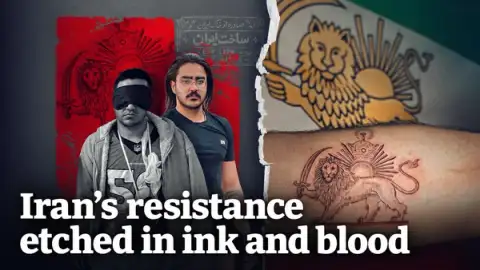
Iranian security forces shot protester Farid Ramezani during the January protests in Tehran, then targeted his Pahlavi crown tattoo as he lay wounded before killing him with a shot to the forehead, a source familiar with the case told Iran International.
Ramezani, 29, was shot on the evening of Jan. 8 in Tehran's Ariashahr neighborhood, said the source who could not be named for fear of retribution from Iranian authorities.
Ramezani was among hundreds of thousands of protesters who took to the streets of Tehran on Jan. 8 as nationwide demonstrations against the Islamic Republic intensified.
A video obtained by Vahid Online from Ariashahr that same night shows security forces opening a barrage of gunfire on protesters, with repeated shots heard as people scream and run from the scene.
On that night, security forces fired three bullets at Ramezani in total: the first brought Ramezani to the ground, the second was fired at the finger bearing the crown tattoo, and the third struck his forehead and killed him, according to the source.
After his death, Ramezani's family came under intense pressure from security agencies, the source said. Authorities demanded money from the family for the three bullets used to kill him, describing the payment as a “bullet fee,” and withheld his body for about two weeks.
Security agencies also barred the family from burying him in Tehran. His body was transferred to Hashjin in Khalkhal county, in the northwestern province of Ardabil, where he was buried.
The source said security forces imposed tight restrictions on the funeral, preventing a public ceremony and barring the display of Iran’s pre-1979 Lion and Sun flag, a symbol widely used by opponents of the Islamic Republic, at the burial site.
The Pahlavi crown tattooed on his finger is associated with the monarchy which ruled Iran before the establishment of the Islamic Republic in 1979.
Monarchist and other symbols associated with pre-1979 Iran have increasingly appeared among opponents of the clerical establishment.
The targeting of Ramezani's tattoo is not the first such case reported during the January protests. Last month, Iran International reported that security agents used a blade and box cutter to cut away skin and flesh bearing tattoos of Reza Shah Pahlavi and an imperial crown from the arm of 21-year-old protester Amirhossein Nobakht Pardasti before later killing him with a gunshot, according to sources close to his family.
Similar cases have also been documented during earlier protest movements.
One of the best-known was Majidreza Rahnavard, a protester executed in Mashhad in December 2022, following the Woman, Life, Freedom protests.
Rahnavard had a Lion and Sun emblem tattooed on his left forearm. Images released after his arrest showed the arm badly injured and immobilized in a cast and bandages.
A person close to Rahnavard told Iran International that security agents repeatedly struck the tattooed arm with batons and stun guns because of the emblem, eventually breaking it.