• العربية
  • فارسی
BrandBrand
  • Iran Insight
  • Politics
  • Economy
  • Analysis
  • Special Report
  • Opinion
  • Podcast
  • Live TV
  • Iran Insight
  • Politics
  • Economy
  • Analysis
  • Special Report
  • Opinion
  • Podcast
  • Live TV
  • Theme
  • Language
    • العربية
    • فارسی
  • Iran Insight
  • Politics
  • Economy
  • Analysis
  • Special Report
  • Opinion
  • Podcast
  • Live TV
All rights reserved for Volant Media UK Limited
volant media logo
PODCAST

Iran’s oil lifeline could run dry by mid-December, Kpler says

Negar Mojtahedi
Negar Mojtahedi

Iran International

Oct 10, 2026, 15:33 GMT+1
An oil worker at an Iranian oil facility.

For the first time in Iran’s history, revenue from crude oil and condensate exports could dry up entirely by mid-December if the US blockade remains in place, according to the head of crude oil analysis at Kpler.

“Revenues from crude and condensate will drop to zero for the first time ever,” Homayoun Falakshahi told Iran International's Eye for Iran, warning that Tehran could lose between $3 billion and $6 billion in monthly oil income.

That makes December the critical month as the last Iranian oil shipments already outside the blockade zone make their way to Chinese buyers.

According to Kpler, just eight million barrels of Iranian crude remain on the water outside the blockade, down from nearly 90 million barrels in mid-July. Falakshahi expects those remaining shipments to be discharged by around October 18.

With Chinese refiners typically taking another one to two months to settle payments, Tehran could receive its final proceeds from those shipments by mid-December.

The looming revenue shortfall follows a halt in Iranian oil shipments. Kpler data shows that Iran loaded no crude oil or condensate onto tankers throughout September, the first full month without loadings since the 1979 Islamic Revolution.

The last recorded loading took place around August 26 or 27.

Even during the 1979 revolution, the Iran-Iraq war and successive rounds of Western sanctions, Iranian crude continued reaching international buyers. During the COVID-19 pandemic, shipments fell as low as 300,000 barrels per day in some months, compared with typical volumes of around 1.7 million to 1.8 million, but never stopped entirely.

“This is a first in history,” Falakshahi said.

A financial lifeline under threat

Oil exports remain Iran’s largest source of foreign currency despite years of efforts to reduce the government’s dependence on petroleum income.

Falakshahi said much of Iran’s oil trade with China continues to be settled in dollars despite US sanctions, making the disappearance of those payments particularly consequential for an economy already struggling with currency depreciation.

He said expectations of dwindling oil income may have contributed to the rial’s recent decline. A prolonged loss of foreign exchange could put further pressure on the currency and government finances.

The squeeze could also affect Tehran’s ability to finance regional allies, although Falakshahi said the extent would depend on government priorities. Tehran could choose to preserve such support while cutting spending at home.

Sustained economic pressure could also affect Tehran’s negotiating calculus with Washington, he said, though he doubted the leadership was ready to make significant compromises over its nuclear program.

Why sanctions-evasion methods may not work

Iran has spent decades developing networks to circumvent Western sanctions and maintain oil exports, but Falakshahi said a physical blockade makes those methods far more difficult to replicate.

Unlike financial restrictions, which Tehran has historically navigated through intermediaries, disguised shipments and alternative trading arrangements, the current blockade prevents tankers from physically leaving Iranian waters.

One potential workaround has attracted attention as independent Chinese refiners increasingly turn to Iraqi crude to replace Iranian supplies: transporting Iranian oil through Iraq and disguising its origin before exporting it to China.

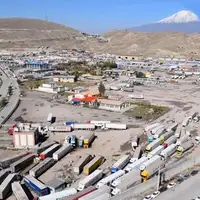
But moving even 50,000 to 70,000 barrels per day across the Iraqi border would require thousands of truck movements, Falakshahi said.

“You’d probably see videos of it on the internet,” he said.

He estimated that moving enough crude by truck to fill a single large tanker could take around 20 days, compared with roughly one large tanker Iran previously loaded each day.

Iraq continues to import Iranian natural gas, but payments owed to Tehran are held in a restricted account at Iraq’s central bank because of US sanctions. Falakshahi said Baghdad would be unlikely to facilitate large-scale Iranian oil shipments at the risk of further US sanctions.

Overland routes offer little relief

Rail offers limited alternatives. Falakshahi said the connection to China reaches Tehran, far from Iran’s main oil-producing regions, while the pipeline supplying the capital has capacity of only around 200,000 barrels per day.

Turkmenistan is also reportedly restricting rail transit through its territory over concerns about US sanctions.

Even if Tehran managed to move small quantities through neighboring countries, road and rail would be unlikely to replace the volumes previously exported by sea.

“Iran has a history of evading sanctions successfully to an extent,” Falakshahi said. “But this seems a lot more challenging.”

Pressure extends beyond oil

The blockade is also restricting Iran’s ability to import commodities as oil revenue approaches a potential halt.

Falakshahi said shipments of agricultural products, including corn and wheat, have declined sharply, while alternative supply routes through the Caspian Sea offer only a fraction of the capacity available through Persian Gulf ports.

For Tehran, the immediate question is whether the blockade will remain in place long enough to exhaust the final payments from oil already sold.

If it does, December could mark the first time in Iran’s modern oil-producing history that crude and condensate export revenue falls to zero, cutting off the Islamic Republic’s principal source of foreign exchange with no clear route to restoring exports while the blockade remains in place.

Most Viewed

Iran turns on Pakistan as Saudi defense pact takes effect
1

Iran turns on Pakistan as Saudi defense pact takes effect

2

Iranian security forces face wave of deadly attacks in restive southeast

3

'Three golden weeks': Trump’s no-strike pledge fuels calls in Iran to act first

4

Iraq creates PMF unit to take faction drones as arms plan advances - Erem News

5

Trump rules out Iran attack before midterms, Tehran says ready for prolonged war

Banner
Banner
Banner

Spotlight

  • Iran’s oil lifeline could run dry by mid-December, Kpler says
    PODCAST

    Iran’s oil lifeline could run dry by mid-December, Kpler says

  • 'Three golden weeks': Trump’s no-strike pledge fuels calls in Iran to act first

    'Three golden weeks': Trump’s no-strike pledge fuels calls in Iran to act first

  • J’Accuse! Tehran defends French students, silences Iranian youth
    OPINION

    J’Accuse! Tehran defends French students, silences Iranian youth

  • US pressure hits Iranians harder than rulers, 68% in poll say
    VOICES FROM IRAN

    US pressure hits Iranians harder than rulers, 68% in poll say

  • Saudi Aramco hires US firm to upgrade shared oil field as Iran lags behind

    Saudi Aramco hires US firm to upgrade shared oil field as Iran lags behind

  • Iran looks for escape routes as US sanctions close in
    INSIGHT

    Iran looks for escape routes as US sanctions close in

Banner
•
•
•

More Stories

Iran detains football coach over child sexual abuse allegations

Oct 10, 2026, 10:34 GMT+1
100%

Iranian judicial authorities have detained a football coach in the western city of Divandarreh after five people filed complaints alleging sexual abuse connected to a youth football club.

Mohammad Jabbari, chief justice of Kordestan province, said the suspect was summoned to the judiciary in Divandarreh and remanded in custody after being formally accused of sexual abuse and producing obscene footage and other material, according to the judiciary-affiliated Mizan news agency.

Jabbari said the case had been referred to Kordestan province’s Criminal Court One and that further investigations were underway. Authorities have not publicly identified the suspect.

Divandarreh prosecutor Afshar Amir-Ahmadi said the judiciary ordered the arrest after reports emerged that a local teacher and football coach had sexually abused children. He said reports circulating on social media and concerns raised by families prompted authorities to investigate.

The local football association confirmed that the detained man was a football coach in Divandarreh. Police chief Hossein Montazeri said authorities had been aware of the allegations for several weeks and that the coach had been suspended from sporting activities.

Reports point to possible wider case

Earlier reporting by local news outlets in western Iran said around 50 children and teenagers at the Setaregan Divandarreh football club may have been sexually abused, although judicial authorities have so far confirmed only five complaints.

The outlets reported that one student initially filed a complaint with Iran’s cyber police, after which other students also came forward. It also said some students reported being sexually exploited after being promised opportunities to advance in football or join better teams.

Previous cases involving young athletes

The case follows other reports of sexual abuse allegations involving minors in Iranian sports.

In Tehran, a football coach accused by the families of eight teenage boys was initially sentenced to death, but the Supreme Court overturned the sentence. After a retrial, he was sentenced to 99 lashes, two years in internal exile and a two-year ban from coaching and other sporting activities. Forensic authorities had not established rape under the legal definition used in the case.

In Mashhad, parents of 15 young footballers raised sexual abuse allegations against a coach in 2023. Other cases involving coaches and minors have also been reported in Isfahan, Shiraz and Tehran, though the final judicial outcome of some cases has not been made public.

Iran turns to Turkey, Turkmenistan for power as war strains industry

Oct 10, 2026, 08:29 GMT+1
100%
Electricity grid near capital Tehran

Iran is seeking more electricity from Turkey and Turkmenistan as war damage and other outages leave thousands of megawatts of industrial and petrochemical power capacity offline, even as Washington presses neighboring countries to help restrict Tehran’s remaining economic routes.

Mohammad Allahdad, head of Iran’s electricity company Tavanir, told ILNA that about 4,700 megawatts of generation capacity belonging to industries and petrochemical companies had gone offline for various reasons.

He said the infrastructure was now in place for petrochemical plants to receive imported electricity from Turkey through Iran’s national grid. The companies have not yet signed contracts for the supply.

“If this does not happen, supplying electricity to these industries will face challenges,” Allahdad said.

War damage drives import push

Allahdad said serious damage during the war to utilities serving petrochemical complexes had sharply increased their dependence on the national grid. Iran supplied the sector with six times as much electricity this summer as in previous years, he said.

He added that Iran currently had no plans to export electricity and was instead focused on increasing imports, particularly during the winter.

Iran is also negotiating with Turkmenistan to extend an existing electricity import agreement and increase the volume of power exchanged between the two countries, according to a government statement.

Officials have also discussed additional cross-border power lines and the possible transit of electricity through Turkmenistan to third countries, though those proposals remain subject to technical and economic studies.

US seeks to close remaining economic routes

The push for additional electricity imports comes as the United States broadens its economic campaign against Iran beyond oil exports and financial sanctions.

US Treasury Secretary Scott Bessent said this week Washington was working with Turkey and Pakistan to restrict Iran’s overland commercial routes, while describing the United Arab Emirates and Oman as partners in the broader pressure campaign.

“We did have a maximum pressure campaign. Now we have an absolute isolation campaign and it’s working,” Bessent told Newsmax.

Bessent has also said Washington is targeting Iran-linked cryptocurrency and its remaining shipping network. Treasury on Thursday sanctioned 17 vessels and their owners, saying they were part of what remained of Iran’s shadow fleet, while Bessent said the US could seize about $1 billion in Iran-linked digital assets.

The overlap puts Turkey in an unusual position, with Tehran seeking greater electricity supplies from its western neighbor while Washington says Ankara is also cooperating in efforts to constrict Iran’s remaining overland economic links.

Iran-linked actors used US AI for fake journalism, military targeting

Oct 10, 2026, 00:30 GMT+1
100%
Social media accounts for the “Ervin B. Hoskins” fake journalist persona, which OpenAI said was used in an Iran-origin influence operation to place articles in online media outlets. (OpenAI)

Iran-based and Iranian-linked actors have used two leading US artificial intelligence platforms to place articles under fake journalist identities and help develop targeting recommendations against US naval forces, according to separate investigations by OpenAI and Anthropic.

The latest disclosure came Thursday, when OpenAI said it disrupted an Iran-origin influence operation that used ChatGPT to help fake journalist personas place almost 100 articles in roughly a dozen online outlets around the world.

OpenAI dubbed the campaign “Bogus Bylines.”

The operators used seven fake journalist identities to pitch English-language articles, primarily about the US-Iran conflict. ChatGPT was used to refine drafts according to outlets’ submission requirements and prepare emails pitching them to editors.

The personas presented themselves as Western journalists, usually Americans. One, Ervin B. Hoskins, described himself as an “American freelance writer” and maintained accounts on X, Facebook, Instagram and Threads.

But OpenAI said platform transparency information showed the accounts were operated from Iran.

OpenAI identified articles under the operation’s bylines dating from July 2025 through October 2026 and said publication increased significantly after the US-Iran conflict began.

Some outlets subsequently promoted the articles through their own social media accounts, potentially exposing the material to audiences the operators could not otherwise reach.

The operators also used ChatGPT to produce batches of social media comments. Some were generated in response to posts promoting their own articles and praised or endorsed the stories, which OpenAI assessed was likely intended to make them appear more popular.

Other prompts requested comments portraying the United States as the aggressor in the conflict, Israel as an unreliable US ally and Iran as a defiant but resilient victim.

The operation generated more than two dozen batches of hostile Persian-language responses to posts by Iran International.

OpenAI said the replies it found generally received low engagement and rated that component Category 2 on its six-level IO Breakout Scale. The article-placement campaign was more successful, reaching Category 4 after repeatedly getting material published by media outlets.

OpenAI said the overall activity was consistent with a commercial actor running an influence campaign for hire but said it could not identify the actor behind it.

From influence to military targeting

The OpenAI findings follow a September report from Anthropic documenting Iranian-linked use of Claude for activities extending beyond influence operations.

Anthropic said it disrupted an “Iran-nexus threat actor” that used Claude to collect and analyze publicly available information to develop targeting recommendations against US naval forces in the region.

The actor used Claude to help construct a Python pipeline for tracking naval positions and compiling targeting handbooks.

The material included US personnel identified from captions on publicly available military photographs, ship and aircraft transponder identifiers, scripts for querying commercial satellite imagery and lists of public websites exposing US naval movements.

The actor also directed Claude to research vulnerabilities in shipboard systems, including maritime satellite communications terminals, Cisco communications equipment and industrial control products.

OpenAI and Anthropic have documented misuse by actors linked to several countries, including for cyber operations, influence campaigns and intelligence gathering, suggesting generative AI is increasingly being incorporated into activities that long predate the technology.

OpenAI concluded that the influence operations it uncovered resembled campaigns from the pre-AI era, with artificial intelligence making parts of the workflow easier.

The two investigations suggest AI is being used less to invent entirely new forms of influence and intelligence activity than to accelerate existing ones: drafting and pitching articles, manufacturing online responses, processing surveillance data, writing software and assembling open-source military intelligence.

UK court hears how alleged Iran spy operation targeted Iran International

Oct 9, 2026, 13:07 GMT+1
100%

Men accused of spying for Iran exchanged information about Iran International’s offices and presenter Kambiz Hosseini, while one defendant discussed money transfers and his legal troubles with contacts in Iran, a London court heard.

Jurors at Woolwich Crown Court were taken through photographs, messages and phone records documenting communications among the three defendants and between Mostafa Sepahvand and two men in Iran.

Sepahvand, 41, Farhad Javadi Manesh, 46, and Shapoor Qalehali Khani Noori, 57, have all pleaded not guilty to charges under Britain’s National Security Act 2023.

Prosecutors say they gathered information for Iranian intelligence to prepare for serious violence against at least one target, with Sepahvand expected to carry out an attack and the others helping to plan it.

Locations and social media

In an exchange on December 19, 2024, Sepahvand received a postcode from a UK mobile number and forwarded it to Javadi Manesh, the court heard.

The prosecutor told jurors the postcode identified the location of Volant Media, Iran International’s parent company. Sepahvand also forwarded the telephone number from which he had received it.

Messages from December 24 showed Sepahvand sending Javadi Manesh a photograph of Hosseini, a link to his Instagram account and information about Iran International’s website.

In one message, Sepahvand wrote: “go to insta and you will see both the dog and the car”.

The prosecution also reminded jurors of a video Noori had sent to Sepahvand showing a park where Hosseini walked his dog, Niko. Other messages referred to the dog’s name and a blue Volkswagen.

Jurors were shown photographs recovered from Noori’s phone depicting Malthouse Court in Brentford from several angles, taken from inside a car.

Prosecutors had previously told the court that Iran International journalist Mojtaba Pourmohsen lived there between 2019 and 2023, but the defendants appeared unaware he had moved.

  • Three Iranians spied on Iran International journalists in UK, prosecutors say

    Three Iranians spied on Iran International journalists in UK, prosecutors say

  • UK police charge man over Iran-linked foreign intelligence offence

    UK police charge man over Iran-linked foreign intelligence offence

  • Two Iranians charged over foiled plot targeting Manchester Jews

    Two Iranians charged over foiled plot targeting Manchester Jews

Money and contacts in Iran

The prosecution examined records of Sepahvand’s communications with Mostafa Ghorbani and another contact saved as “Amin Mostafa’s Friend”, both in Iran.

The exchanges included discussions about transferring money to Sepahvand and references to an account in his name at the Workers Welfare Bank.

Jurors also heard messages concerning Sepahvand’s court case in Iran. In one, Ghorbani wrote: “haji says your case will be fine”.

Sepahvand sent Ghorbani two Iranian court documents concerning vehicles linked to him. The documents included instructions to impound the vehicles and arrest Sepahvand if he was found driving them.

Shortly after sending the documents, Sepahvand called Ghorbani and the two spoke for nearly a minute and a half, according to the records presented to the jury.

In later exchanges, Sepahvand complained that nothing had happened with his case. The logs showed repeated attempts to reach Ghorbani, including unanswered calls in early January.

Prosecutors previously said Sepahvand wanted help resolving an Iranian criminal conviction, which they consider relevant to his motivation. Jurors were told not to treat the conviction itself as evidence against him.

A police witness was questioned about the dates, times and durations of calls and messages recorded in the logs, rather than asked to draw conclusions about their significance.

Defendants dispute prosecution’s account

According to the prosecution’s account of his defense, Sepahvand accepts conducting surveillance for Iran but says he feared the consequences of refusing and deliberately did a poor job. Prosecutors reject that account.

Javadi Manesh and Noori accept visiting locations and taking photographs and videos but say they did not know they were assisting Iranian intelligence, according to the prosecution.

Trump rules out Iran attack before midterms, Tehran says ready for prolonged war

Oct 8, 2026, 22:57 GMT+1
100%
US President Donald Trump in Sparrows Point, Maryland, October 6, 2026. White House

US President Donald Trump said Thursday the United States would not attack Iran before the November 3 midterm elections and that "productive" talks were underway, after reports of US preparations for possible large-scale strikes.

Trump said on Truth Social that Washington was having “productive discussions” with Iran and would not attack the country before the November 3 elections. He said, however, that the US blockade of Iranian ports would remain in place.

Trump had made similar remarks ahead of previous military action against Iran. In June 2025, he said he would decide within two weeks whether the United States would join Israel’s war against Iran, citing a “substantial chance” of negotiations. US forces struck Iranian nuclear sites days later.

Also days before the 2026 war, Trump said he preferred a diplomatic solution with Iran while also laying out the case for possible military action.

The remarks offered the clearest timeline yet for a pause in renewed US strikes, while leaving open the possibility of military action after the elections.

On the Iranian side, President Masoud Pezeshkian said during a meeting with Russian President Vladimir Putin that Tehran had not left the negotiating table and was working on its response to the latest US proposal.

Foreign Minister Abbas Araghchi provided further detail Thursday, saying Iran had received Washington’s response to Tehran’s “seven-day plan” and was reviewing it.

Araghchi said Tehran would deliver its response within the next few days and that messages continued to pass between Iran and the United States through mediators.

Reports of US military preparations

The talks are continuing as Washington prepares for the possibility of renewed military action.

Senior US officials told Israeli military chief Eyal Zamir earlier this week that the White House and Pentagon had instructed US forces to prepare for a possible large-scale attack on Iran within the next three weeks, Israel’s Channel 12 reported Thursday.

The network cited a senior US official and another source briefed on the conversation. Zamir warned that an attack within that timeframe could lead to the postponement of Israel’s October 27 election, based on an assessment that Iran would respond with heavy missile fire against Israel.

Trump’s pledge not to strike Iran before the US midterms appears to rule out that timeline, but does not remove the prospect of renewed military action after the November 3 vote.

No boots on the ground

Defense Secretary Pete Hegseth said Thursday Washington was not seeking to “nation build” in Iran or deploy large numbers of ground troops to control territory, framing the US objective as preventing Tehran from obtaining a nuclear weapon.

Hegseth said Iran could achieve that outcome “the easy way or the hard way,” but that Trump would ultimately decide how to proceed. If military action became necessary, he said, it would be “swift and decisive.”

Mediators are also seeking more room for diplomacy. They have asked Trump to give them additional time for negotiations before any potential attack on Iran, Al Hadath reported Thursday, citing a US source.

In his meeting with Putin, Iran’s Pezeshkian said there was no end to the war in sight as long as the United States continued what he described as unilateralism.

Iranian Defense Ministry spokesperson Reza Talaei-Nik also told the state TV that the country’s arms-production capacity was sufficient to sustain a prolonged war.

“We currently have the production capacity needed for a sustained and prolonged war within our production system,” Talaei-Nik added.

He said Defense Ministry personnel were working alongside missile launch crews, drone units and Revolutionary Guards and army naval and air forces to use battlefield experience to upgrade weapons and equipment based on emerging threats.

Hormuz remains a flashpoint

Iran’s warnings also focused on the Strait of Hormuz, a key issue in negotiations with Washington.

Revolutionary Guards commander-in-chief Ahmad Vahidi said Thursday that the United States and other “extra-regional” powers had no right to interfere in the strait or the Persian Gulf, warning that threats or unauthorized naval movements would face a forceful response.

Vahidi described the Strait of Hormuz as a strategic “red line” for the Islamic Republic and said the Guards’ naval forces were equipped with precision-guided missiles, attack drones, fast boats, electronic warfare capabilities and coastal defenses.

His warning came as tensions over shipping intensified. Reuters reported Thursday that vessel traffic through the strait had fallen to its lowest level in more than two months following a surge in attacks on tankers, while Tehran warned regional countries against attempts to establish oil-export routes it had not authorized.