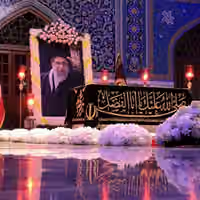
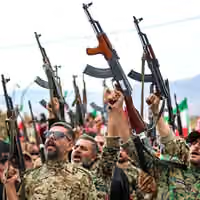
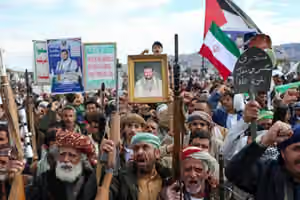
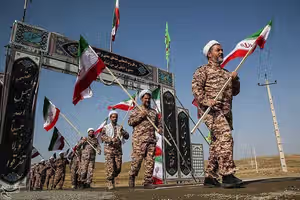
Men wield machetes during the IRGC-backed "Jan-Fadayan" rally, held along the route from Azadi Square to Golestan-e Shohada cemetery in Isfahan, Iran, October 1, 2026.
Footage and images showing men wielding machetes and swords at an IRGC-backed rally in the central Iranian city of Isfahan have renewed scrutiny of the Islamic Republic's history of using unofficial armed groups to suppress anti-government protests.
The October 1 event, dubbed "Jan-Fadayan," or "Those Willing to Sacrifice Their Lives," brought together members of the Basij paramilitary force, religious organizations and other participants, according to Iranian state media.
Organizers described the gathering as a demonstration of public readiness and mobilization capabilities.
Iranian lawyer Ali Mojtahedzadeh described the public display of bladed weapons as a "show of force with weapons" and called on local security authorities to explain why it had been permitted.
A review of statements by senior Islamic Revolutionary Guard Corps (IRGC) commanders and former security officials shows that the use of unofficial groups, including individuals described as criminals and street thugs, to confront protesters dates back decades.
From the 1999 student protests to the 2009 crackdown
One of the earliest documented accounts dates to July 1999, when security forces and allied groups attacked Tehran University student dormitories, triggering widespread demonstrations.
Iranian security and plainclothes forces confronting protestors during the 2009 Iranian election protests following the disputed presidential election.
Ali Hashemi, a former deputy security minister at Iran's Intelligence Ministry, said in an audio recording published by Iran International that approximately 250 individuals described as "thugs and hooligans" were organized during the student protests.
Hashemi said the experience later served as a model for deploying similar groups during the mass demonstrations that followed Iran's disputed 2009 presidential election.
He also described the use of individuals with criminal records to beat detainees, including at the notorious Kahrizak detention center, referring to authorization from judicial authorities.
Hashemi said similar individuals were subsequently deployed during protests in 2017, 2018 and November 2019.
One of the most explicit accounts came from Hossein Hamedani, a senior IRGC commander responsible for security operations in Tehran during the 2009 unrest.
Iran's then Supreme Leader Ali Khamenei (L) receives a gesture of respect from Islamic Revolutionary Guard Corps (IRGC) Brigadier General Hossein Hamedani (R) during a meeting in Tehran, Iran, in this handout photo released by the official website of the Leader on October 10, 2015.
Hamedani said the Revolutionary Guards identified approximately 5,000 people who had participated in disturbances but were not affiliated with political parties or movements. He described them as "criminals and thugs."
According to Hamedani, these individuals were initially prevented from leaving their homes on days when protests were planned, but some were later recruited and organized into three battalions.
"I then made them members of the battalions," he said.
Explaining the strategy, Hamedani said that training fighters required recruiting individuals accustomed to handling "blades and machetes."
Hamedani also described preparations to confront protesters during Ashura, a major Shiite religious observance, in December 2009.
He said cinemas, schools and religious halls were made available to pro-government forces, while approximately 30 religious groups were mobilized in Tehran.
"On Ashura, these same three battalions put an end to the unrest," Hamedani said, adding that approximately 45,000 Basij members had also been deployed.
Following Hamedani's death in Syria in 2015, Mohammad Ali Jafari, then commander-in-chief of the IRGC, credited him with helping suppress the 2009 protests, saying his leadership had been crucial to ending what Iranian authorities described as "sedition."
Hamedani had also played a central role in organizing local militias supporting Syrian President Bashar al-Assad during the country's civil war.
Jafari later said Hamedani had organized approximately 100,000 local fighters in Syria.
Allegations of machete-wielding clerics in 2022 protests
Similar allegations emerged following the nationwide protests triggered by the death of Mahsa Jina Amini in morality police custody in September 2022.
In 2024, former lawmaker Mohammad Ashrafi Esfahani accused a group of clerics associated with influential religious figure Alireza Panahian of attacking protesters with knives and machetes while dressed as civilians.
He alleged that the men returned from the streets wearing bloodstained clothes before changing into clerical robes.
Ashrafi Esfahani also said members of the group operated in plainclothes and changed into clerical attire, including turbans, when police officers appeared to avoid being confronted.
The allegations emerged amid a legal and financial dispute between Ashrafi Esfahani and Panahian over a religious complex in Tehran and have not been independently verified.
Renewed scrutiny of unofficial armed groups
Nearly three decades after the 1999 student protests, the images from Isfahan have again raised questions about the role of unofficial groups operating alongside Iran's formal security forces.
Although the names, structures and political circumstances of the groups involved in past crackdowns have varied, accounts by former security officials and IRGC commanders describe the repeated recruitment and deployment of individuals capable of using violence against demonstrators.
The available evidence does not establish that the groups involved in different periods belonged to a single organization or were directly connected.
Nor has any organizational link been established between those previously deployed against protesters and the men seen carrying machetes and swords at the Isfahan rally.
The identities and affiliations of the armed men have not been independently verified.
Their appearance at an IRGC-backed event has nevertheless renewed attention to the Islamic Republic's documented history of mobilizing forces outside conventional security structures during periods of political unrest.
Smoke and flames rise from King Khalid Airport, after Yemen’s Iran-backed Houthis said they attacked the airport, in Riyadh, Saudi Arabia, October 8, 2026, in this screengrab obtained from a social media video.
An attack by Yemen’s Iran-backed Houthis on Riyadh’s King Khalid International Airport drew condemnation from European leaders, the United Nations and regional governments on Sunday.
The attack on Riyadh's King Khalid International Airport prompted warnings to travelers, expressions of solidarity with Saudi Arabia and calls for an end to attacks on civilian infrastructure.
European Commission President Ursula von der Leyen said Iran-backed Houthi forces are destabilizing regional transport and energy infrastructure.
“These attacks by Iran’s proxies are pushing the region into a spiral of violence,” von der Leyen said.
She described the airport strike as a dangerous escalation and called for an immediate end to attacks on civilians.
EU foreign policy chief Kaja Kallas also condemned the strike, calling it an “appalling act of terror.”
“There can be no justification for indiscriminate attacks on civilians and civilian infrastructure,” Kallas said.
UN Secretary-General António Guterres called for an immediate halt to attacks on civilians and civilian infrastructure.
“Attacks on civilians and civilian infrastructure are a violation of international law,” Guterres said.
German Foreign Minister Johann Wadephul described the strike as “a terrorist act against Saudi Arabia and civil aviation,” while British Foreign Secretary Ed Miliband urged British nationals to avoid Riyadh airport and follow Saudi authorities' instructions.
Italian Prime Minister Giorgia Meloni censured the attack and expressed solidarity with Saudi Arabia and the victims' families.
“Attacks against civilians and civilian infrastructure are unacceptable and must stop,” Meloni wrote on X.
Meloni said Italy would continue working with regional partners to promote stability and freedom of navigation.
France also condemned the attack, describing it as “heinous” and expressing its “total solidarity” with Saudi Arabia, the French Foreign Ministry said on Sunday.
France would continue supporting Saudi Arabia in defending its territory and infrastructure, including through its military assistance, the ministry said. It also called on the Houthis to immediately stop attacks and provocations destabilizing the region.
Russia also condemned the attack on Riyadh's international airport, Interfax news agency reported on Sunday.
Canadian Prime Minister Mark Carney condemned the attack and offered condolences to the families of those killed.
“There can be no justification for attacks on civilian infrastructure,” Carney said.
The Arab League and Syria also condemned the strike. Syria's Foreign Ministry said a Syrian citizen had been killed and called for international action to prevent further attacks on civilian facilities.
Pakistan reaffirmed its commitment to Saudi Arabia's security under the two countries' joint defense agreement.
“Pakistan stands in unwavering solidarity with the Kingdom of Saudi Arabia, its leadership and brotherly people,” Prime Minister Shehbaz Sharif said.
The Houthis subsequently renewed their warning to airlines, airport workers and travelers against using Saudi airports, saying Saudi Arabia bore responsibility for failed interceptions.
Iranian officials warn of further military action
Separately, Iranian officials warned against further attacks on Iran and reiterated threats over the Strait of Hormuz.
An adviser to the commander-in-chief of the Islamic Revolutionary Guards Corps said that any new attack involving missiles or aircraft would trigger a stronger Iranian response.
“Any provocation or attack with missiles or aircraft will be met with a heavier and crushing response,” Mohammad Reza Naghdi said on Sunday.
Iranian Army Deputy Coordinator Habibollah Sayyari said the military had previously struck vessels and remained prepared to do so again.
“We defended firmly and will continue to do so,” Sayyari said. “Wherever necessary, we will act to strike the enemy.”
Deputy Foreign Minister Kazem Gharibabadi said that Iran's response to any new military action would differ from its previous responses.
“Our response in the 40-day war was different from the 12-day war, and we hope our adversaries will show some rationality,” Gharibabadi said.
Gharibabadi also described the Strait of Hormuz as an Iranian waterway and said the country would use it as an instrument against its adversaries.
Lawmaker Hassan Ghashghavi said support for reviewing Iran's nuclear doctrine was growing among officials, experts and the public.
Ghashghavi also argued that Iran's control over the Strait of Hormuz was strengthening and that the waterway could not reopen until the Islamic Republic's conditions were met.
Separately, the newspaper Khorasan, which is close to Parliament Speaker Mohammad Bagher Ghalibaf, wrote that Washington and Israel had already decided to launch another war and that recent diplomatic exchanges were unlikely to alter that decision.
Nuclear dispute and maritime pressure continue
Atomic Energy Organization of Iran chief Mohammad Eslami criticized international institutions and the International Atomic Energy Agency for their response to attacks on Iranian nuclear and non-nuclear facilities.
“The silence and selective approach of international institutions and the IAEA toward direct attacks on the Islamic Republic’s nuclear and non-nuclear facilities represent an obvious and disastrous contradiction in the international system,” Eslami said.
Foreign Minister Abbas Araghchi separately maintained that US-Israeli strikes on Iranian oil and energy infrastructure had created environmental hazards, including the possible contamination of air, soil and water.
Maritime developments added another dimension to the day's security concerns.
The United Kingdom Maritime Trade Operations agency reported an encounter involving a tanker and military forces in the Gulf of Oman, hours after the US military announced that it had struck a vessel attempting to breach its naval blockade of Iran.
The agency advised vessels to remain alert as authorities examined the circumstances.
The international condemnation of the Houthi attack on Riyadh airport came alongside renewed threats from the Houthis and Iranian officials, raising concerns about further attacks on civilian infrastructure and commercial shipping across the region.
Panelists discuss the impact of US sanctions and the naval blockade on Iran's economy, financial networks and political leadership during an Iran International Insight discussion hosted by Fardad Farahzad in Washington, DC.
The US blockade and tighter sanctions enforcement are cutting into Iran’s oil income and targeting financial networks that sustain the Islamic Republic, but may still fall short of forcing Tehran into concessions, experts said at an Iran International town hall in Washington.
The discussion, hosted by Fardad Farahzad, brought together Kerri Bitsoff, a former senior official at the US Treasury Department’s Office of Foreign Assets Control (OFAC); Patrick Clawson, the Morningstar senior fellow at the Washington Institute; and Mohammad Machine-Chian, a senior economist and analyst at Iran International.
“The thing about sanctions, if they’re on the books but not enforced, they only hurt the people,” Bitsoff said, arguing that the current US campaign differed from previous rounds by focusing more heavily on enforcement and the financial intermediaries sustaining Iran’s economy.
Blockade bites
Iran faces declining oil revenues alongside damage to its energy infrastructure following the war, raising the prospect of severe economic difficulties during the coming winter, Clawson said.
President Masoud Pezeshkian had acknowledged that Iran could not export oil during the initial blockade, according to Clawson, who said the country subsequently sought alternative routes for limited shipments.
Iran had also relied on oil previously stored aboard vessels and in China, but those reserves were approaching exhaustion, he said.
Damage to natural gas infrastructure could compound the difficulties, potentially forcing greater reliance on mazut, a heavily polluting fuel used for electricity generation.
Patrick Clawson, a senior fellow at the Washington Institute, discusses the impact of US sanctions and the naval blockade on Iran's economy during Iran International's Insight panel in Washington, DC.
Iran depends on natural gas for approximately 69 percent of its energy requirements, making disruptions particularly consequential for households and industry, Clawson said.
Machine-Chian estimated that between $21 and $23 billion in export proceeds had not returned to Iran and that the blockade could cost the country another $35 billion in oil revenue.
The current campaign differs from previous sanctions because Washington is concentrating on enforcement and the intermediaries sustaining Iran's economy rather than simply announcing additional restrictions, Bitsoff said.
She pointed to restrictions imposed by the United Arab Emirates, measures against Iranian airlines and Turkish action against banks connected to Iranian transactions.
Such measures could influence officials and business figures whose continued support for the Islamic Republic depends on financial privileges and access to international markets.
Kerri Bitsoff, a former senior US Treasury official and sanctions expert, discusses the impact of US economic pressure on Iran during Iran International Insight panel.
Earlier sanctions had often pushed legitimate commerce underground while allowing networks connected to the Revolutionary Guards to profit, Bitsoff said.
Machine-Chian described the emergence of wealthy intermediaries, sometimes called sanctions merchants, who benefited from moving Iranian oil and money through opaque arrangements.
Those networks subsequently became obstacles to negotiations and economic normalization because their commercial interests depended on maintaining the existing system, he said.
Machine-Chian distinguished between sanctions that impose prolonged hardship without producing results and measures designed to achieve specific objectives within a foreseeable period.
The loss of the UAE, Machine-Chian added, as a major commercial and financial intermediary has further complicated Iran's position.
Dubai previously provided an important channel for Iranian transactions, but restrictions have forced businesses to seek alternatives through Turkey, Pakistan and Afghanistan, Machine-Chian said.
Those routes, he said, have limited capacity and cannot quickly replace the financial infrastructure previously available through the Emirates.
China and regional allies face financial constraints
China remains Iran's principal oil customer, but its commercial relationship offers fewer advantages to the Islamic Republic than commonly assumed, Bitsoff said.
Independent Chinese refineries purchase Iranian crude at substantial discounts, while payments in yuan often remain in China and are largely available for purchasing Chinese goods.
Hezbollah has struggled to maintain basic financial obligations and social support programs since the blockade began, Bitsoff said.
Machine-Chian argued that Iran's relationships with allied armed groups had become increasingly transactional, making continued financial assistance essential to sustaining their loyalty.
Political survival and prospects for negotiations
Despite the mounting pressure, the panelists differed over whether the Islamic Republic would ultimately accept Washington's demands.
Economic hardship alone was unlikely to persuade Iran's leadership to abandon its objectives, Bitsoff said.
Instead sustained pressure could influence members of the security apparatus whose loyalty depends on salaries, privileges and expectations of continued stability.
Clawson considered negotiated concessions possible, pointing to previous occasions when Iran reversed positions it had presented as nonnegotiable.
He suggested Iran could accept a three-year suspension of uranium enrichment, particularly because its facilities had been damaged and were not operational.
Machine-Chian was more skeptical, arguing that abandoning regional ambitions and nuclear objectives would challenge central elements of the Islamic Republic's political identity.
Audience members attend an Iran International Insight panel discussion in Washington, DC.
The blockade's sustainability also remains a concern because maintaining naval operations places substantial demands on American ships, crews and maintenance resources, Bitsoff said, although she expected the operation to continue.
The discussion highlighted a central uncertainty: whether sustained economic pressure will produce concessions, weaken the leadership's support structures or prolong Iran's economic difficulties without fundamentally changing its political direction.
An ambulance is parked outside King Khalid International Airport after an attack on the airport in Riyadh, Saudi Arabia, on October 10, 2026, in this screengrab obtained from social media video.
A deadly Houthi attack on Riyadh’s main airport drew a Saudi vow of retaliation on Saturday, as President Donald Trump raised the possibility of joining strikes on the group and resuming attacks on Iran.
Saudi Arabia’s civil aviation authority said 12 people were killed and 309 injured at King Khalid International Airport, making it the kingdom’s deadliest attack since a 2015 mosque bombing in the eastern city of Qatif. An American citizen was among those killed.
The Saudi-led military coalition blamed Yemen’s Iran-backed Houthis, called the attack a “war crime” and promised a decisive response, without specifying what action it would take. Hours later, it reported that a projectile had landed near King Fahd International Airport in Dammam, eastern Saudi Arabia.
Trump initially said Washington could join Riyadh in striking the Houthis and resume attacks on Iran. Asked later whether Saudi Arabia could defend itself against the group, he praised the kingdom’s capabilities.
“They're able to defend. The Saudis are good fighters. But I think the attack was a terrible thing,” he said.
The United States, Britain, Germany and Spain warned their citizens to avoid the Riyadh airport. The dead included four Saudis, two Bangladeshis, one American, one Egyptian, one Jordanian, one Syrian, one Palestinian and one Sudanese, according to the Saudi aviation authority.
Trump warns Tehran
The prospect of renewed US attacks on Iran also featured in Trump’s remarks in Tennessee on Saturday, where he accused Iranian leaders of potentially seeking to damage him politically before the November 3 midterm elections.
“They'll probably do a little bit extra before the election thinking it's going to hurt us, but we could end it really quick. They don't know how nice I've been to them.”
Trump called Iran a “lunatic country” and mocked its leaders for repeatedly threatening to kill their enemies.
US Ambassador to Israel Mike Huckabee more directly linked the Saudi attacks to Tehran, arguing that curbing Iranian support was essential to stopping the Houthis.
“Why are the Houthis even capable of doing these things? Because they're funded and they're empowered and they're trained by Iran,” Huckabee told Newsmax.
He described Washington’s confrontation with Tehran as an effort to constrain Iran-backed groups, including the Houthis, Hamas and Hezbollah.
“Getting the Iranian regime reined in is the only way to stop some of this aggression that we're seeing through the proxies,” he said.
Huckabee also argued that military and economic pressure under Trump had left Iran in its weakest position since 1979.
Calls to stand behind Saudi Arabia
US Secretary of State Marco Rubio confirmed that an American had been killed in the Riyadh attack and demanded an immediate halt to Houthi strikes. He said Washington stood with Saudi Arabia and offered condolences to the victims’ families.
“These reprehensible attacks demonstrate a blatant disregard for innocent civilian life. They must stop now,” Rubio said.
Pakistan’s Prime Minister Shehbaz Sharif invoked his country’s joint defense pact with Riyadh in underscoring Islamabad’s commitment to Saudi security.
“In accordance with the Makkah Joint Defence Agreement and the enduring bonds of brotherhood between our two countries, we reaffirm our steadfast commitment to Saudi Arabia’s sovereignty, territorial integrity and security.”
Former Qatari Prime Minister Hamad bin Jassim Al Thani urged Persian Gulf states to unite behind Saudi Arabia against threats he said originated in Yemen but were directed from abroad.
“It has now become clear that Iran is our main enemy,” he wrote on X, marking a sharp change from his advocacy in 2023 of negotiations with Tehran and opposition to confrontation.
For the first time in Iran’s history, revenue from crude oil and condensate exports could dry up entirely by mid-December if the US blockade remains in place, according to the head of crude oil analysis at Kpler.
“Revenues from crude and condensate will drop to zero for the first time ever,” Homayoun Falakshahi told Iran International'sEye for Iran, warning that Tehran could lose between $3 billion and $6 billion in monthly oil income.
That makes December the critical month as the last Iranian oil shipments already outside the blockade zone make their way to Chinese buyers.
According to Kpler, just eight million barrels of Iranian crude remain on the water outside the blockade, down from nearly 90 million barrels in mid-July. Falakshahi expects those remaining shipments to be discharged by around October 18.
With Chinese refiners typically taking another one to two months to settle payments, Tehran could receive its final proceeds from those shipments by mid-December.
The looming revenue shortfall follows a halt in Iranian oil shipments. Kpler data shows that Iran loaded no crude oil or condensate onto tankers throughout September, the first full month without loadings since the 1979 Islamic Revolution.
The last recorded loading took place around August 26 or 27.
Even during the 1979 revolution, the Iran-Iraq war and successive rounds of Western sanctions, Iranian crude continued reaching international buyers. During the COVID-19 pandemic, shipments fell as low as 300,000 barrels per day in some months, compared with typical volumes of around 1.7 million to 1.8 million, but never stopped entirely.
“This is a first in history,” Falakshahi said.
A financial lifeline under threat
Oil exports remain Iran’s largest source of foreign currency despite years of efforts to reduce the government’s dependence on petroleum income.
Falakshahi said much of Iran’s oil trade with China continues to be settled in dollars despite US sanctions, making the disappearance of those payments particularly consequential for an economy already struggling with currency depreciation.
He said expectations of dwindling oil income may have contributed to the rial’s recent decline. A prolonged loss of foreign exchange could put further pressure on the currency and government finances.
The squeeze could also affect Tehran’s ability to finance regional allies, although Falakshahi said the extent would depend on government priorities. Tehran could choose to preserve such support while cutting spending at home.
Sustained economic pressure could also affect Tehran’s negotiating calculus with Washington, he said, though he doubted the leadership was ready to make significant compromises over its nuclear program.
Why sanctions-evasion methods may not work
Iran has spent decades developing networks to circumvent Western sanctions and maintain oil exports, but Falakshahi said a physical blockade makes those methods far more difficult to replicate.
Unlike financial restrictions, which Tehran has historically navigated through intermediaries, disguised shipments and alternative trading arrangements, the current blockade prevents tankers from physically leaving Iranian waters.
One potential workaround has attracted attention as independent Chinese refiners increasingly turn to Iraqi crude to replace Iranian supplies: transporting Iranian oil through Iraq and disguising its origin before exporting it to China.
But moving even 50,000 to 70,000 barrels per day across the Iraqi border would require thousands of truck movements, Falakshahi said.
“You’d probably see videos of it on the internet,” he said.
He estimated that moving enough crude by truck to fill a single large tanker could take around 20 days, compared with roughly one large tanker Iran previously loaded each day.
Iraq continues to import Iranian natural gas, but payments owed to Tehran are held in a restricted account at Iraq’s central bank because of US sanctions. Falakshahi said Baghdad would be unlikely to facilitate large-scale Iranian oil shipments at the risk of further US sanctions.
Overland routes offer little relief
Rail offers limited alternatives. Falakshahi said the connection to China reaches Tehran, far from Iran’s main oil-producing regions, while the pipeline supplying the capital has capacity of only around 200,000 barrels per day.
Turkmenistan is also reportedly restricting rail transit through its territory over concerns about US sanctions.
Even if Tehran managed to move small quantities through neighboring countries, road and rail would be unlikely to replace the volumes previously exported by sea.
“Iran has a history of evading sanctions successfully to an extent,” Falakshahi said. “But this seems a lot more challenging.”
Pressure extends beyond oil
The blockade is also restricting Iran’s ability to import commodities as oil revenue approaches a potential halt.
Falakshahi said shipments of agricultural products, including corn and wheat, have declined sharply, while alternative supply routes through the Caspian Sea offer only a fraction of the capacity available through Persian Gulf ports.
For Tehran, the immediate question is whether the blockade will remain in place long enough to exhaust the final payments from oil already sold.
If it does, December could mark the first time in Iran’s modern oil-producing history that crude and condensate export revenue falls to zero, cutting off the Islamic Republic’s principal source of foreign exchange with no clear route to restoring exports while the blockade remains in place.
Iranian judicial authorities have detained a football coach in the western city of Divandarreh after five people filed complaints alleging sexual abuse connected to a youth football club.
Mohammad Jabbari, chief justice of Kordestan province, said the suspect was summoned to the judiciary in Divandarreh and remanded in custody after being formally accused of sexual abuse and producing obscene footage and other material, according to the judiciary-affiliated Mizan news agency.
Jabbari said the case had been referred to Kordestan province’s Criminal Court One and that further investigations were underway. Authorities have not publicly identified the suspect.
Divandarreh prosecutor Afshar Amir-Ahmadi said the judiciary ordered the arrest after reports emerged that a local teacher and football coach had sexually abused children. He said reports circulating on social media and concerns raised by families prompted authorities to investigate.
The local football association confirmed that the detained man was a football coach in Divandarreh. Police chief Hossein Montazeri said authorities had been aware of the allegations for several weeks and that the coach had been suspended from sporting activities.
Reports point to possible wider case
Earlier reporting by local news outlets in western Iran said around 50 children and teenagers at the Setaregan Divandarreh football club may have been sexually abused, although judicial authorities have so far confirmed only five complaints.
The outlets reported that one student initially filed a complaint with Iran’s cyber police, after which other students also came forward. It also said some students reported being sexually exploited after being promised opportunities to advance in football or join better teams.
Previous cases involving young athletes
The case follows other reports of sexual abuse allegations involving minors in Iranian sports.
In Tehran, a football coach accused by the families of eight teenage boys was initially sentenced to death, but the Supreme Court overturned the sentence. After a retrial, he was sentenced to 99 lashes, two years in internal exile and a two-year ban from coaching and other sporting activities. Forensic authorities had not established rape under the legal definition used in the case.
In Mashhad, parents of 15 young footballers raised sexual abuse allegations against a coach in 2023. Other cases involving coaches and minors have also been reported in Isfahan, Shiraz and Tehran, though the final judicial outcome of some cases has not been made public.