• العربية
  • فارسی
BrandBrand
  • Iran Insight
  • Politics
  • Economy
  • Analysis
  • Special Report
  • Opinion
  • Podcast
  • Live TV
  • Iran Insight
  • Politics
  • Economy
  • Analysis
  • Special Report
  • Opinion
  • Podcast
  • Live TV
  • Theme
  • Language
    • العربية
    • فارسی
  • Iran Insight
  • Politics
  • Economy
  • Analysis
  • Special Report
  • Opinion
  • Podcast
  • Live TV
All rights reserved for Volant Media UK Limited
volant media logo
INSIGHT

War puts Iran’s nuclear ambiguity under scrutiny

Behrouz Turani
Behrouz Turani

Iran International

Oct 10, 2026, 19:54 GMT+1
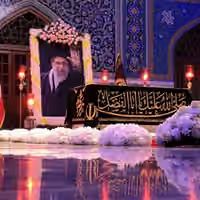
A portrait of slain Supreme Leader Ali Khamenei beside his tomb in Mashhad, Iran.

A revisionist argument is emerging in Tehran over Iran’s nuclear strategy: that its longstanding policy of nuclear ambiguity failed its most important test when it did not deter the United States and Israel from attacking, and should now be reconsidered.

Nezamoddin Mousavi, a former conservative lawmaker with longstanding ties to the Islamic Revolutionary Guard Corps (IRGC), gave unusually explicit expression to that argument this week, declaring that “nuclear ambiguity did not prevent war” and raising the prospect of revisiting Iran’s nuclear doctrine and even its membership in the Nuclear Non-Proliferation Treaty (NPT).

Mousavi, who helped found IRGC-linked media outlets, made the remarks in an interview with Ensaf News, a website close to President Massoud Pezeshkian.

Senior Iranian officials have previously hinted that Tehran could change its nuclear doctrine if sufficiently threatened. But such warnings have generally been directed outward, rather than framed as criticism of an established policy favored by slain Supreme Leader Ali Khamenei.

Mousavi, however, is effectively arguing that a policy intended to preserve strategic uncertainty while stopping short of weaponization failed to provide the deterrence its architects expected.

That diagnosis feeds into a wider debate over what lesson Iran should draw from the war: whether the failure was one of deterrence, requiring greater military leverage, or of escalation management, requiring a different approach to diplomacy.

Iran has long cited Khamenei’s fatwa prohibiting the possession and use of nuclear weapons when confronted with accusations that it might seek a bomb.

Critics, however, have questioned how absolute that prohibition would prove in an existential crisis, especially since Khamenei’s predecessor and founder of the Islamic Republic, Ruhollah Khomeini, held that preserving the state was paramount, taking precedence even over religious obligations.

Against that backdrop, Mousavi said Tehran should reassess its international commitments, the value of NPT membership and its broader deterrence strategy following attacks on Iran’s nuclear facilities.

He stopped short of explicitly advocating the acquisition of nuclear weapons.

His reasoning amounts to three premises and a conclusion: Iran refrained from building a nuclear weapon; ambiguity was supposed to contribute to deterrence; yet Iran was attacked and senior leaders and military commanders were killed. The assumptions underlying Iran’s deterrence strategy, he argues, must therefore be reconsidered.

Beyond Khamenei

Mousavi also ventured into another sensitive subject: whether Khamenei’s death would fundamentally alter Iran’s strategic direction.

He argued that he would not expect dramatic change. Foreign and security policy, he said, is not simply the product of one individual but of institutional thinking and long-term calculations developed over decades.

It reflects a distinctly conservative view of regime continuity: leaders matter, but institutions matter more. Major strategic directions, in this reading, are unlikely to change abruptly regardless of who occupies the highest office.

That also gives the nuclear debate greater significance. If Iran’s strategic direction is fundamentally institutional rather than dependent on one leader, the lessons the establishment draws from the war could outlast the present leadership.

Deterrence or de-escalation?

Not everyone in Tehran is drawing the same lesson.

An article published Wednesday in Etemad newspaper highlighted a competing strand of Iranian political thinking. Where Mousavi sees a failure of deterrence, more moderate voices see a failure to manage escalation.

The hardline argument holds that the United States and Israel seek to weaken Iran regardless of its diplomatic behavior and that negotiations cannot guarantee security while military pressure continues.

The more moderate argument sees the conflict as the product of a broader strategic environment shaped by political, regional, military and economic pressures. For this camp, the lesson is not necessarily that Iran needs greater deterrence, but that it needs more effective crisis management.

The emerging argument in Tehran, then, appears to be shifting from how this war ends to what lesson should be drawn from it: whether greater military and potentially nuclear deterrence offers the best protection against another conflict, or whether security ultimately depends on preventing the next escalation before it begins.

Most Viewed

Iran turns on Pakistan as Saudi defense pact takes effect
1

Iran turns on Pakistan as Saudi defense pact takes effect

2

Iranian security forces face wave of deadly attacks in restive southeast

3

'Three golden weeks': Trump’s no-strike pledge fuels calls in Iran to act first

4

Iraq creates PMF unit to take faction drones as arms plan advances - Erem News

5

Trump rules out Iran attack before midterms, Tehran says ready for prolonged war

Spotlight

  • War puts Iran’s nuclear ambiguity under scrutiny
    INSIGHT

    War puts Iran’s nuclear ambiguity under scrutiny

  • Iran’s oil lifeline could run dry by mid-December, Kpler says
    PODCAST

    Iran’s oil lifeline could run dry by mid-December, Kpler says

  • 'Three golden weeks': Trump’s no-strike pledge fuels calls in Iran to act first

    'Three golden weeks': Trump’s no-strike pledge fuels calls in Iran to act first

  • J’Accuse! Tehran defends French students, silences Iranian youth
    OPINION

    J’Accuse! Tehran defends French students, silences Iranian youth

  • US pressure hits Iranians harder than rulers, 68% in poll say
    VOICES FROM IRAN

    US pressure hits Iranians harder than rulers, 68% in poll say

  • Saudi Aramco hires US firm to upgrade shared oil field as Iran lags behind

    Saudi Aramco hires US firm to upgrade shared oil field as Iran lags behind

Banner
Banner
Banner
Banner
•
•
•

More Stories

'Three golden weeks': Trump’s no-strike pledge fuels calls in Iran to act first

Oct 9, 2026, 21:51 GMT+1
•
Maryam Sinaiee
100%
US President Donald Trump delivers remarks during a Columbus Day celebration in the East Room of the White House in Washington, D.C., US, October 9, 2026.

President Donald Trump’s pledge not to attack Iran before the November 3 US midterm elections has been greeted in Tehran as either a bluff or an opportunity, with some hardliners urging Iran to exploit the three-week window to strike first.

Trump wrote on Truth Social on Thursday that he had no intention of resuming strikes before the midterms, adding that the United States was engaged in “constructive negotiations” with Iran.

Global oil prices, which had fluctuated sharply during the week amid growing threats to shipping in the Persian Gulf and the Strait of Hormuz, fell following Trump’s remarks.

Heshmatollah Falahatpisheh, a former chairman of parliament’s National Security and Foreign Policy Committee, wrote on X that plans by the United States, Israel and their regional allies for another war with Iran had nothing to do with elections in either country.

He argued that Trump’s declaration that Washington would not attack Iran before November 3 was intended to prevent Iran from launching a “pre-emptive strike”.

Parisa Nasr, a journalist considered close to Iran’s Foreign Ministry, similarly dismissed Trump’s statement in a commentary titled “Forget Trump’s nonsense: A third war is imminent.”

“The evidence suggests that Trump’s claim that any military attack on Iran will be postponed until after the US midterm elections is, above all, more like a political game and a psychological operation,” she wrote.

Nasr argued that Washington’s calculations would depend largely on the scale of retaliation it expected from Iran.

Hardline commentator Alireza Taghaviniya also described Trump’s remarks as “deception,” pointing to US and Israeli military movements and coordination with Saudi Arabia and the United Arab Emirates as indications that a confrontation was approaching.

A window to strike first

Some Iranian hardliners argue that Tehran should use the period before the US midterm elections to launch pre-emptive attacks against American and Israeli interests.

Supporters of this approach say the objective would not necessarily be to trigger an all-out war. Instead, limited strikes could put pressure on oil markets and force Trump to accept an agreement on terms favorable to Iran.

Politician Abdolreza Davari argued on X that Trump had inadvertently exposed a weakness by ruling out a new military attack before the elections while simultaneously describing negotiations with Tehran as constructive. Davari said Trump feared the electoral cost of war.

“From today until November 3, a window of approximately three weeks has opened before Iran,” he wrote. “The Islamic Republic must use this opportunity to intensify military action as a means of bargaining and forcing Washington to accept Iran’s legitimate demands.”

In another post, he was blunter: “Grab the enemy by the throat right now and do not let go.”

The proposal drew warnings online that striking first would play into the hands of Trump and Israel.

A user identified as Mahmoud Irani argued that an Iranian attack would allow Trump to portray the United States as the victim and gain electoral advantage by retaliating: “Iran should maintain its military readiness so that, if Iran is attacked, it can counterattack Trump.”

Another user, identified as Rezvan, warned that Israeli Prime Minister Benjamin Netanyahu had been predicting an Iranian pre-emptive attack for weeks and “hopes this will happen,” either to postpone the US election or help Trump win.

Pressure at Hormuz

The debate comes as Iran is already increasing pressure in and around the Strait of Hormuz.

Iranian officials and military forces insist the waterway remains closed except to vessels Tehran authorizes, contrary to statements by Trump and other US officials, and say restrictions will remain until Washington accepts Iran’s seven conditions.

Hassan Ghashghavi, spokesman for parliament’s National Security and Foreign Policy Committee, also disputed Trump’s claim that oil shipments through the strait had increased.

“The initiative in the Strait of Hormuz is in our hands,” he told Rouydad 24, arguing that alternative routes and limited tanker movements had failed to eliminate the effects of Iran’s restrictions.

On Friday, the Islamic Revolutionary Guard Corps (IRGC) Navy said it targeted a liquefied natural gas carrier traveling south of the Strait of Hormuz along what Tehran described as an “illegal route”.

The Guards also widened their threat, saying for the first time that action against vessels using unauthorized routes would no longer be confined to the strait and that such ships could face punitive measures elsewhere in the region.

Pressure on shipping gives Tehran another means of raising the cost of the blockade without necessarily launching the direct pre-emptive strike advocated by some hardliners.

Iran turns on Pakistan as Saudi defense pact takes effect

Oct 9, 2026, 15:23 GMT+1
•
Maryam Sinaiee
100%
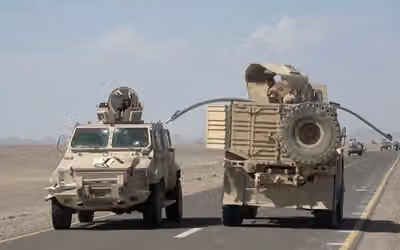
Military vehicles travel along a road during what Saudi-backed Yemeni government forces say was an advance against the Iran-backed Houthis, near Dhubab, Taiz Governorate, Yemen, in this still image taken from video released October 5, 2026.

Iran has sharpened its criticism of a Saudi Arabia-Pakistan-Turkey defense pact after it became operational, warning against intervention in Yemen and questioning Pakistan’s role as a mediator between Tehran and Washington.

The trilateral pact entered its operational phase on October 5 following an escalation in Houthi missile and drone attacks on Saudi infrastructure. Turkey and Pakistan said they had begun taking measures to support Saudi Arabia.

Under arrangements discussed by the three countries, Pakistani and Turkish forces are expected to provide military, technical and intelligence support to Saudi Arabia, including defensive capabilities inside the kingdom. Officials have said the forces will not take part in offensive operations in Yemen.

Iranian Foreign Ministry spokesman Esmail Baghaei, asked on Sunday about reports that tens of thousands of Pakistani troops could be deployed to Saudi Arabia, said: “We have also heard this rumor, and we hope it is not true.”

“The countries of the region are well aware that any intervention in the Yemen issue could have undesirable consequences for the region,” he added, expressing hope that pacts such as the Mecca agreement would not be used “against the interests and welfare of the Muslim community.”

The Saudi Arabia-Turkey-Pakistan defense pact, signed in August in Mecca, stipulates that an attack on any one of the three countries will be treated as an attack on all three.

‘Begging for security’

Foreign Minister Abbas Araghchi, without directly referring to the pact, called on neighboring countries to pursue “self-reliance” and a policy based on “genuine brotherhood.” He also said such agreements would not constrain Iran.

Several lawmakers dismissed the pact as largely symbolic. Ahmad Bakhshayesh, a member of parliament’s National Security and Foreign Policy Commission, called it a “paper and political pact.”

Sharper criticism came from committee member Ebrahim Rezaei.

“The Saudis should know that a paper agreement with Turkey and Pakistan will not bring them security, just as years of one-sided milking of the Americans did not bring them security,” he wrote on X. “Correct your policies so that you do not have to beg others for security.”

That tone has hardened as the pact has moved into its operational phase.

Alaeddin Boroujerdi, a member of parliament’s National Security and Foreign Policy Committee, said Thursday that Turkish and Pakistani involvement in the Saudi conflict with Ansarullah, as the Houthis are formally known, would neither weaken the group nor restrict its ability to operate in the Bab al-Mandeb Strait.

“The entry of Pakistan and Turkey will definitely work to their own detriment,” he told ISNA. “They should learn from history ... Saudi Arabia once had a coalition with a large number of countries, but after seven years of war in Yemen, it was defeated.”

‘Regional intervenor’

Iranian criticism has focused more heavily on Pakistan than Turkey, in large part because of Islamabad’s prominent role in mediating between Tehran and Washington.

Lawmaker Ahmad Naderi wrote on X that “Pakistan’s entry alongside Saudi Arabia into the war against the people of Yemen … shows that Pakistan should no longer be considered a mediator but a regional intervenor.”

The Tabnak news website went further, saying Iran viewed the deployment of Pakistani forces to Saudi Arabia as a threat to its security and “will not tolerate Pakistan’s military presence for military operations in the Yemen war.”

It also warned that Pakistan’s increasingly overt alignment with Saudi Arabia could heighten sectarian tensions at home and bring instability to the Iranian-Pakistani border.

Conservative commentator Hassan Hanizadeh similarly accused Saudi Arabia of seeking to create a religious divide, describing a recent meeting in Riyadh involving Saudi, Pakistani and Turkish officials as a sign of “the formation of a Shiite-Sunni polarization in the region.”

Boroujerdi pointed to potential domestic opposition in Pakistan, saying its people were “revolutionary, Muslim and highly sensitive to such issues” and that Islamabad would not have an easy path if it entered the war.

‘Alliance against the oppressed?’

Iranian state media have adopted a more confrontational tone as the pact has become operational, while giving extensive coverage to warnings from Houthi officials directed at Turkey and Pakistan.

Tasnim described the development as “Turkey and Pakistan join the Saudi war against the Yemeni people,” while Nour News, which is close to Iran’s Supreme National Security Council, asked: “Mecca alliance or alliance against the oppressed people of Yemen?!”

In a Thursday commentary, Tasnim warned that if Ankara and Islamabad participate in attacks on Yemen, “they may be directly harmed through attacks on their ships, interests and perhaps even their own territory.”

Iranian security forces face wave of deadly attacks in restive southeast

Oct 9, 2026, 09:07 GMT+1
100%

At least five Iranian military and police personnel were killed and several others wounded in four armed attacks across southeastern Iran within 24 hours, local rights group Haalvsh reported, as violence targeting security forces continued across the area.

Haalvsh, which covers developments in Sistan and Baluchestan, said more than 12 personnel were killed or wounded overall between Wednesday evening and Thursday evening in Nikshahr, Nosratabad, Faryab and Jaleq, but cautioned that the final toll could be higher because some casualties had not yet been identified.

The People's Fighters Front took responsibility for the attacks in Nikshahr, Nosratabad and Jaleq, according to Haalvsh. The alliance, announced in late 2025, includes several Baluch armed groups, among them Jaish al-Adl. The group had not taken responsibility for the killing in Faryab.

Nikshahr and Nosratabad attacks

In the Nikshahr area, Haalvsh said two vehicles carrying military personnel were attacked. Mohammadreza Okati was killed and five others were wounded, according to the outlet, which identified the wounded as Ali Najafi, Mohammadreza Hosseini, Mojtaba Mir and two others identified by the surnames Keikha and Iranmanesh.

Haalvsh said those casualties were taken to Mohammad Rasoulallah Hospital in Nikshahr, while other wounded personnel were evacuated by helicopter to medical facilities in Chabahar, Konarak and Iranshahr. It said it had not established their number or identities.

Iran's army separately confirmed on Thursday that Okati was killed when personnel from its 88th Armored Division came under fire while traveling for a shift change, but said three people were wounded.

In the Nosratabad area near Zahedan, Haalvsh said at least three security personnel were killed and two wounded when gunmen attacked a police commando patrol on the Lakhshak road. It identified two of those reported killed as Vahid Enayat and Abbas Aghaei.

  • Police officer killed in armed attack near Zahedan as violence continues in southeast Iran

    Police officer killed in armed attack near Zahedan as violence continues in southeast Iran

  • Five killed in roadside attack as violence spreads in southeast Iran

    Five killed in roadside attack as violence spreads in southeast Iran

  • IRGC says six gunmen killed in clash in Iran's restive southeast

    IRGC says six gunmen killed in clash in Iran's restive southeast

Iranian police had earlier confirmed only Enayat's death, saying officers returned fire and that several attackers were wounded before fleeing.

Police major killed in Faryab

In Faryab, Haalvsh reported that Major Mehdi Jamshidi was shot dead while traveling in a private vehicle in the center of the county.

The outlet said Jamshidi was struck by seven bullets. It also cited reports that he had been among police personnel present during a confrontation involving women and other protesters in the village of Pashmuki in June.

The People's Fighters Front had not issued a statement taking responsibility for Jamshidi's killing, Haalvsh said.

Jaleq police headquarters attacked

The fourth attack targeted the police command headquarters in Jaleq, the administrative center of Golshan County, on Wednesday evening.

Haalvsh said the People's Fighters Front announced that its fighters had used a mine, rocket-propelled grenades and other weapons in the attack and said six police personnel were hit.

Videos obtained by Haalvsh showed heavy gunfire around the facility and at least one support vehicle being targeted, according to the outlet. Haalvsh said it had not independently established the final number or identities of those killed or wounded. IranWire also reported an explosion and gunfire around the police facility.

Attacks follow weeks of violence

The latest incidents follow a series of attacks on Iranian security forces in the southeast. Earlier this week, gunmen attacked two military vehicles in Bampur, while last week a roadside attack near Zahedan and clashes in Rask and other areas produced further casualties.

Official Iranian accounts and reports from Haalvsh have repeatedly differed over casualty numbers in recent attacks. Haalvsh said the toll from the four latest incidents should therefore be treated as provisional, particularly because some wounded personnel were transferred to hospitals outside the areas where the attacks occurred.

Iraq creates PMF unit to take faction drones as arms plan advances - Erem News

Oct 9, 2026, 08:12 GMT+1
100%
Members of Iraqi Popular Mobilization Forces (PMF) take part in a military parade in Diyala province Iraq, June 26, 2021. Media Office PMF Handout via REUTERS

Iraq has created a specialized unit within the Popular Mobilization Forces to take control of drones held by armed factions as part of Prime Minister Ali Faleh al-Zaidi’s plan to bring weapons under state authority, Erem News reported on Friday, citing an Iraqi security source.

The source said three of the five factions covered by the plan had completed agreed handovers, but had not surrendered their entire arsenals. The process instead focused on heavy and specialized weapons and dismantling separate military headquarters.

The Popular Mobilization Forces, which the report said formally operates under Iraq’s commander-in-chief, had received the weapons and military headquarters covered by the agreements. It had also begun integrating faction members and severing their previous political and administrative affiliations, according to the source.

Drones placed under PMF structure

The new drone unit is intended to absorb the factions’ unmanned-aircraft capabilities into official state structures rather than leave them under independently run organizations, the source told Erem News.

But the source stressed that the agreements “do not mean complete disarmament.” Instead, they involve transferring specialized weapons and reorganizing armed formations within the PMF.

Erem News said effective control over those military capabilities would depend on completing the integration process and establishing the chain of command responsible for authorizing their use. The report did not identify the three factions that had completed the handover.

  • Iran’s security chief to push Iraqi Shia factions to approve militia integration law

    Iran’s security chief to push Iraqi Shia factions to approve militia integration law

  • Iran, Iraq discussed tighter curbs on Kurdish groups in Larijani visit, sources say

    Iran, Iraq discussed tighter curbs on Kurdish groups in Larijani visit, sources say

  • Iraq’s Iran-backed PMF militia fears terrorist label by the US

    Iraq’s Iran-backed PMF militia fears terrorist label by the US

Government seeks changes to PMF leadership

A political source close to Iraq’s Coordination Framework told Erem News that the government was also seeking amendments to the law governing the PMF, including limiting the term of its chairman to two years and bringing professional officers from the regular military into senior posts.

The proposal would directly affect the position of current PMF chairman Falih al-Fayyadh, according to the report. The source said the plan faced opposition within the Coordination Framework, particularly from Nouri al-Maliki’s State of Law coalition, which wanted any changes tied to a broader political agreement.

Two factions continue to resist

Erem News said Kataib Hezbollah and Harakat al-Nujaba remained opposed to surrendering their weapons, while other factions had accepted the principle of integration into state security institutions.

Zaidi has set June 30, 2027, as the deadline for completing the weapons-control plan and has said decisions on war and peace belong exclusively to Iraq’s constitutional authorities. According to the political source, he has also told Coordination Framework leaders that he intends to continue implementing the plan even if political agreement on some of its details stalls.

The source said Zaidi warned that failure by groups with armed wings to meet agreed commitments could expose Iraq to security, economic and political consequences, including additional sanctions or pressure, while adding that the prime minister still favored negotiations over a direct military confrontation with factions resisting the plan.

US pressure hits Iranians harder than rulers, 68% in poll say

Oct 9, 2026, 01:10 GMT+1
•
Saba Heidarkhani
100%
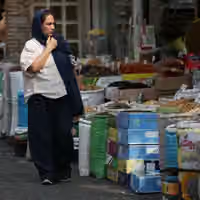
A woman walks past sacks of nuts, dried fruits and other goods at a market in Iran.

More than two-thirds of respondents to an Iran International Instagram poll said the Trump administration’s pressure on the Islamic Republic is hurting ordinary Iranians more than the authorities.

More than 56,000 people took part in the October 8 poll, with 68% saying ordinary people bear the greatest burden of US pressure. Another 23% said both the public and the government suffer, while 9% said the authorities are affected most.

Men accounted for approximately 76% of respondents and women for 24%.

The largest age group was 25 to 34, representing about 38% of participants, followed by those aged 35 to 44 at 29%. Respondents aged 18 to 24 and 45 to 54 each accounted for 12%.

Thousands of comments accompanying the poll reflected differing views on the economic consequences of US pressure, the Islamic Republic's responsibility for worsening living conditions and whether external pressure could bring political change.

Rising prices dominate concerns

The most common concern among respondents who believed ordinary Iranians were suffering most was the deterioration in daily living conditions.

Many cited rising prices, declining purchasing power, shrinking incomes and the growing financial burden on low-income households.

Others pointed to difficulties accessing medicine and medical treatment, arguing that people with fewer financial resources were particularly vulnerable to economic restrictions.

  • Officials trade blame as Iran’s economy sinks deeper

    Officials trade blame as Iran’s economy sinks deeper

"Only ordinary people are being crushed under the pressure," one respondent wrote.

Several participants argued that even when US measures target the Islamic Republic, their economic consequences ultimately reach households through higher prices and reduced access to essential goods.

Officials seen as insulated from hardship

Another recurring theme was the perceived gap between the living standards of ordinary Iranians and those of government officials.

Some respondents argued that access to wealth, foreign currency, privileged positions and state resources allowed officials and their associates to avoid some of the hardships experienced by the wider population.

"The main burden falls on the people. The government would even be happy to see people becoming poorer every day," one respondent wrote.

  • Iran drug shortages hit 800 medicines as costs could triple

    Iran drug shortages hit 800 medicines as costs could triple

Other participants said the Islamic Republic also suffers from economic restrictions through reduced revenues and limited access to financial resources, but can pass some of those costs on to the public.

For these respondents, the issue was not simply whether sanctions hurt the government or the public, but how the economic burden was distributed.

Economic hardship versus hopes for political change

The sharpest disagreement concerned whether the immediate economic costs of US pressure could be justified by the prospect of political change.

Some respondents acknowledged that ordinary Iranians were suffering but considered the hardship acceptable if it weakened the Islamic Republic or helped bring about a different political system.

"People will endure it because this suffering is worth it for a free Iran tomorrow," one wrote.

Others questioned whether worsening economic conditions would produce meaningful political change.

They argued that household finances could deteriorate far more quickly than external pressure could affect the country's political leadership.

100%
A woman shops at a market selling nuts, dried fruits and spices in Iran.

Several respondents held both US policies and the Islamic Republic's economic management responsible for the hardships facing Iranians.

Some likened sanctions to a painful medical treatment, reflecting a willingness among certain supporters of external pressure to accept short-term suffering in pursuit of longer-term political goals.

Others rejected that calculation, arguing that the prospect of political change remained uncertain while the immediate costs to families were already evident.

A divided view of US pressure

Although 68% of respondents believed ordinary Iranians were bearing the greatest burden, their answers did not necessarily show opposition to all forms of US pressure.

  • Iran says economy holding up as pressure mounts on oil, rial

    Iran says economy holding up as pressure mounts on oil, rial

Some viewed the economic consequences as unacceptable, while others regarded them as a painful but potentially necessary means of weakening the Islamic Republic.

Likewise, respondents who believed the government was suffering most did not necessarily dismiss the economic difficulties facing households.