• العربية
  • فارسی
Brand
  • Iran Insight
  • Politics
  • Economy
  • Analysis
  • Special Report
  • Opinion
  • Podcast
  • Live TV
  • Iran Insight
  • Politics
  • Economy
  • Analysis
  • Special Report
  • Opinion
  • Podcast
  • Live TV
  • Theme
  • Language
    • العربية
    • فارسی
  • Iran Insight
  • Politics
  • Economy
  • Analysis
  • Special Report
  • Opinion
  • Podcast
  • Live TV
All rights reserved for Volant Media UK Limited
volant media logo
INSIGHT

Gasoline survey reignites debate over politically risky fuel reform in Iran

Maryam Sinaiee
Maryam Sinaiee

Iran International

Aug 21, 2026, 01:33 GMT+1

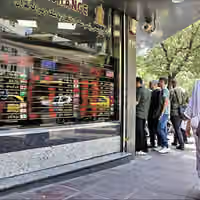
A gasoline policy survey by Iran’s energy optimization chief has reignited debate over how the Pezeshkian administration should tackle the country’s fuel deficit without triggering another politically dangerous price shock.

The poll was conducted by Esmail Saghab-Esfahani, Iran’s vice president and head of the Organization for Optimization and Strategic Management of Energy, who launched it on X on Monday and closed it two days later.

Under Iran’s current system, subsidized gasoline quotas are allocated to vehicles through fuel cards, with motorists able to buy a limited monthly amount at a lower price and additional fuel at a higher rate.

Saghab-Esfahani’s survey offered three alternatives: keeping the existing system while giving each citizen an additional tradable 30-liter quota; selling gasoline above current quotas at 870,000 rials per liter; or limiting supply to domestically produced gasoline without additional imports.

About 50% favored a model that would maintain existing quotas while allocating an additional 30 liters of gasoline per person based on national ID numbers. The additional quota could be transferred or sold to others at a mutually agreed market price.

Another 34% supported supplying gasoline beyond existing quotas at about 870,000 rials per liter, while 15% favored supplying gasoline in line with domestic production without additional imports.

Slightly more than 14,000 people took part. Critics, however, questioned whether the results could be considered representative of public opinion, citing the relatively low use of X in Iran, particularly in rural areas.

Iran’s gasoline imbalance is estimated at about 10% of consumption, according to the Khorasan newspaper, which has argued that the problem needs to be addressed but warned against using a policy that could create a much larger economic and social shock.

The economic newspaper Donya-e-Eqtesad argued that the results should not be interpreted as a definitive expression of public support for gasoline reform.

“People have shown greater preference for the option that, compared with queues at gas stations and 870,000-rial gasoline, imposes less direct harm on them,” the newspaper wrote. “This difference is important, because the policymaker should not conclude from the higher vote that society has accepted all aspects of the plan.”

The newspaper also questioned why the survey did not include a fourth option combining non-price and structural measures, such as reducing the use of fuel-intensive vehicles, expanding imports of hybrid and electric cars, improving fuel-efficiency standards, developing public transportation, combating smuggling and gradually reforming the auto industry.

It also argued that shifting gasoline quotas from vehicles to individuals would not necessarily reduce consumption if fuel remained cheap and vehicles continued to be inefficient. At best, it said, the measure could make the distribution of subsidies fairer and reduce smuggling or misuse of some fuel cards.

The methodology also drew criticism from users who participated in the discussion. Mohammad Reza Felfalani, a civil-society activist working on water, energy and environmental issues, wrote: “It is unfair to ask people to make a decision or assessment with this amount of data. If you yourselves are designing a plan with this amount of data, give us the right to worry about Iran’s future.”

Financial markets analyst Mohammad Shahrestani warned that none of the proposed options would be cost-free under current economic conditions.

“None of these ideas will be without cost under the current economic and livelihood conditions; a cost that may be irreparable,” he wrote, challenging those who oppose negotiations to offer a solution to the fuel problem that they can implement.

Another commenter warned that any gasoline reform would risk failure unless the government first explained how it intended to control the prices of goods and services that could rise as higher transportation costs feed through the economy. The user warned that such a plan could become vulnerable to unrest on the scale of the January protests.

Hardliner roots of the proposal

Saghab-Esfahani says he does not belong to any political faction, but his positions have often been close to those of conservative hardliners such as former presidential candidate Saeed Jalili. His appointment by President Masoud Pezeshkian in November 2025 drew criticism from reformists.

He has personally shown greater support for a model linking gasoline rations to individual citizens rather than vehicles. The model is among the policies previously promoted by Jalili and featured prominently in his campaign during the last presidential election.

That connection has led some critics to accuse Saghab-Esfahani of framing the survey’s choices in a way that would produce a result favorable to his preferred model and to political groups aligned with him.

One commenter accused the government of trying to impose a proposal developed by supporters of former President Mahmoud Ahmadinejad and Jalili over the past eight years.

“You ignored the criticism of every expert and now want to topple the Pezeshkian government by forcing this plan through, and then you stage a survey?” the user wrote.

Another argued that the wording of the choices was designed to steer respondents toward the government’s preferred option, warning that giving every citizen a tradable gasoline credit could become the Pezeshkian administration’s “Achilles’ heel” during wartime.

A further commenter said none of the proposed options could solve the problem and accused the government of using the poll to seek legitimacy for a predetermined policy.

Warnings over a price shock

Many Iranian experts and media outlets acknowledge the need to address the gasoline imbalance while warning against a sudden price shock. The central disagreement is whether consumption should be controlled through sharp price increases or through a combination of quotas, gradual price adjustments, demand management, public transportation and supply-side reforms.

The Khorasan newspaper, in an editorial titled “Do Not Perform Surgery for a 10% Deficit,” argued that if the core problem is an imbalance of roughly 10% between gasoline production and consumption, the government should not resort to a policy capable of creating a much larger economic and social shock.

“The dimensions of the potential consequences may be much greater than the original problem,” the paper argued.

The warning carries particular weight in Iran, where previous fuel-price increases have triggered unrest. A gasoline price increase in 2019 led to widespread protests that were violently suppressed, while an earlier increase in 2007 sparked riots in several parts of the country, including Tehran.

For the Pezeshkian administration, the challenge therefore goes beyond how gasoline quotas are allocated. It must address a persistent fuel imbalance without allowing a reform intended to ease pressure on the energy system to become a new source of economic hardship, political conflict and social unrest.

Most Viewed

Iran weighs attacks on military targets in Europe – FT
1

Iran weighs attacks on military targets in Europe – FT

2
ANALYSIS

The 60-day deadline is over. Now what does Trump do with Iran?

3
VOICES FROM IRAN

Tehran gas stations run dry as fuel price hike fears mount

4

Iran campaign urges people to fund sacrifice of 10,000 sheep for Khamenei’s health

5

Luxury Tehran property asking prices surpass Munich and Sydney

Banner
Banner
Banner

Spotlight

  • UAE trade halt threatens one of Iran’s remaining economic lifelines
    ANALYSIS

    UAE trade halt threatens one of Iran’s remaining economic lifelines

  • Can Iran's fragile economy survive Trump's 'Economic D-Day'?
    ANALYSIS

    Can Iran's fragile economy survive Trump's 'Economic D-Day'?

  • The unlikely return of European diplomacy in the Iran-US conflict
    ANALYSIS

    The unlikely return of European diplomacy in the Iran-US conflict

  • For Iranian journalists, exile can last a lifetime
    OPINION

    For Iranian journalists, exile can last a lifetime

  • Seven months on, January protests still shape Iranians’ lives
    VOICES FROM IRAN

    Seven months on, January protests still shape Iranians’ lives

  • Forced to serve in the IRGC, now fighting to stay in Canada
    INSIGHT

    Forced to serve in the IRGC, now fighting to stay in Canada

•
•
•

More Stories

UAE trade halt threatens one of Iran’s remaining economic lifelines

Aug 20, 2026, 19:27 GMT+1
•
Dalga Khatinoglu
100%
A special event honoring the Iranian community in the United Arab Emirates, held at the Dubai Exhibition Centre in Expo City Dubai on September 13, 2025. / Photo by WAM

The United Arab Emirates’ decision to halt all trade and financial transactions with Iran threatens one of Tehran’s most important routes for imports, petroleum-product sales and access to international commercial and financial networks.

The UAE Foreign Ministry said this week that all trade, commercial exchanges and financial transactions with Iran had been halted until further notice.

Afra Al Hameli, director of the Strategic Communications Department at the UAE Ministry of Foreign Affairs, said the decision came “in light of regional escalations that undermine regional and international peace and security.”

The UAE halted trade with Tehran a day after Donald Trump spoke by phone with UAE President Sheikh Mohamed bin Zayed, though it is unclear whether the decision was connected to Trump’s “Economic D-Day” campaign against Iran, announced later on Wednesday.

Trade between the two countries had already been severely disrupted after the war began in late February, when Iran launched attacks on the UAE and shipping through the Strait of Hormuz was curtailed.

In late June, however, Mohammad-Sadegh Ghannadzadeh, a deputy at Iran’s Trade Promotion Organization, said commercial exchanges with the UAE were gradually resuming through Jebel Ali Port. He said goods and containers stranded during the war were again being cleared and moved toward Iran.

The latest UAE announcement now casts doubt on the continuation of that channel.

Al Hameli also stressed that the UAE remains committed to protecting the integrity of the international financial system, complying with international law and applying the highest global standards.

That position is significant because even if political tensions eventually ease, Iranian businesses would still face serious restrictions stemming from US sanctions and Iran’s continued status as a high-risk jurisdiction subject to a Financial Action Task Force call for countermeasures.

One of Iran’s most important trading partners

The importance of the UAE to Iran can be seen in the latest official partner-by-partner trade figures available from Iranian customs.

During the first 10 months of the Iranian fiscal year that began in March 2025, Iran exported around $6.5 billion worth of non-oil goods to the UAE, equivalent to 14.3% of its non-oil exports.

  • War tests Iran’s Dubai trade lifeline

    War tests Iran’s Dubai trade lifeline

Iran imported approximately $14.8 billion worth of goods from the UAE during the same period, accounting for 30.2% of its total imports.

Before the war, the UAE was therefore Iran’s largest supplier of goods and its third-largest destination for non-oil exports, behind China and Iraq.

Its importance extended well beyond ordinary merchandise trade. The UAE was also the largest destination for Iranian fuel oil, or mazut, and a market for other petroleum products.

A blow to mazut exports and fuel supply

Data from commodity intelligence firm Kpler, reviewed by Iran International, show that Iran exported an average of around 256,000 barrels per day of fuel oil in 2025.

Nearly 70% went to the UAE, making it by far Iran’s largest market for the product.

A prolonged halt in trade therefore threatens not only Iran’s non-oil exports but one of its most important outlets for petroleum products.

The UAE had also been among the destinations for Iranian liquefied petroleum gas, or LPG, although China accounts for the large majority of Iranian LPG exports. Iran’s total LPG exports generate more than $10 billion in annual revenue.

The UAE relationship is also important from the opposite direction.

An internal Iranian Oil Ministry report previously reviewed by Iran International showed that Tehran had increasingly relied on barter arrangements to meet domestic fuel shortages, exchanging part of its mazut exports for gasoline and diesel, particularly through traders operating in the UAE.

Iran is already struggling with a gasoline supply deficit, while officials have discussed measures ranging from tighter rationing to higher fuel prices.

Restricting access to the UAE could therefore affect not only export revenue but Iran’s ability to obtain products and refined fuels needed by the domestic market.

The end of Dubai’s role as Iran’s gateway to global trade?

The UAE’s importance to Iran has never been limited to direct bilateral trade.

For decades, Dubai has served as one of the principal re-export hubs for goods entering Iran, allowing Iranian companies to obtain products manufactured in countries with which direct trade is difficult, costly or restricted.

US sanctions and Iran’s exclusion from much of the international banking system have made this intermediary role particularly important.

Goods manufactured in Europe and Asia have routinely entered Iran through UAE-based traders and logistics networks, while Iranian companies have also used Dubai as a route to reach other markets.

The financial dimension is equally important. Dubai has long been a center for Iranian exchange houses, trading companies and intermediaries that help move money across borders despite Iran’s restricted access to the global financial system.

US sanctions packages targeting Iranian oil, petrochemical and procurement networks have repeatedly designated companies and individuals based in the UAE for alleged roles in facilitating transactions on Tehran’s behalf.

A broad and sustained UAE crackdown would therefore affect more than the physical movement of goods. It could also constrain financial, logistical and commercial networks that Iran has spent years using to mitigate its international isolation.

A major new gap for Iran’s economy

The latest available Iranian customs breakdown shows that merchandise trade between Iran and the UAE totaled about $21.3 billion in just the first 10 months of the previous Iranian fiscal year.

But even that figure understates the UAE’s economic importance because it does not capture Dubai’s wider role as a re-export, logistics and financial center for Iranian businesses.

Iran is now confronting the UAE halt while already under pressure from sanctions, foreign-currency constraints, weaker foreign trade and disruptions to energy exports.

Alternative routes through Oman, Iraq, Turkey and other neighboring countries can keep some trade moving, but they lack the combination of proximity, port infrastructure, financial connectivity and established commercial networks that Dubai offered.

The UAE has given no timetable for lifting its suspension.

For Iran, the risk is therefore not simply the loss of billions of dollars in bilateral trade. A prolonged halt could close one of its most important gateways to the global economy.

Can Iran's fragile economy survive Trump's 'Economic D-Day'?

Aug 20, 2026, 18:00 GMT+1
•
Behrouz Turani
100%
An Iranian woman buys eggs in Tehran / Photo by Reuters

Donald Trump has promised an “Economic D-Day” against Iran, a threat Tehran dismissed as another failed US policy. But with inflation, shipping costs and supply strains already biting, how much more pressure can Iran’s fragile economy absorb?

President Donald Trump on Wednesday announced what he called the “most crushing economic operation ever taken against any country,” threatening unprecedented economic isolation and consequences for countries whose financial institutions, businesses or government entities continue providing Tehran with an economic lifeline.

“Oil smuggling, swap lines, cash transfers, exchange houses, ship registries, front companies — it all needs to stop NOW,” Trump wrote on Truth Social, calling on US allies to join the campaign.

Iranian Foreign Minister Abbas Araghchi dismissed the announcement on Thursday as “doubling down on failed policies,” while Iran’s Foreign Ministry called the campaign “economic terrorism” and a “crime against humanity,” saying Tehran would continue resisting US military, economic and political pressure.

The Trump administration, however, is signaling that the campaign could go considerably further than existing sanctions.

Treasury Secretary Scott Bessent told CNBC on Thursday that Washington would impose the “toughest sanctions in history” on Iran and said the administration would outline its measures on Monday.

“It is going to work in Iran and we are going to collapse this regime,” Bessent said.

He said countries continuing to do business with Tehran would face US enforcement actions. Asked whether that could include China, which buys the overwhelming majority of Iran’s shipped oil, Bessent said some conversations were better held privately.

Bessent also suggested that “maximum economic pressure” could reduce the likelihood of another major military phase, describing the economic campaign and the US naval blockade as a “one-two punch.”

Already under strain

Even before the new US economic campaign was announced, Iranian economic reporting was documenting the price the confrontation was already imposing at home: higher shipping costs, pressure on medicine supplies and further strain on household budgets.

Emergency Central Bank allocations have enabled round-the-clock clearance of wheat and pharmaceutical imports at Shahid Rajaee Port in Bandar Abbas, yet reports by ILNA and Donya-ye Eghtesad said container freight rates remained 35 to 40 percent above baseline because of persistent war-risk surcharges.

The pressure is also reaching medicine supplies. On Monday, a major pharmaceutical company in Tehran said the government could no longer provide the foreign currency it required at subsidized rates, warning that some medicines could disappear from shelves or be sold at two to three times current prices.

Donya-ye Eghtesad has linked elevated shipping costs to domestic production bottlenecks, arguing that more expensive freight raises the cost of imported intermediate goods and adds to broader inflationary pressure.

The paper said temporary customs measures were treating symptoms rather than causes, with high insurance premiums and port congestion continuing to increase raw-material costs.

“So long as transit protocols remain uncodified,” the daily wrote, “industrial input costs will remain elevated, eroding domestic purchasing power daily.”

Those pressures are hitting an economy already struggling with steep inflation. Iran’s 12-month inflation rate reached 66 percent in July, while food prices were 128 percent higher than a year earlier. War, sanctions and disruptions to trade and imports have further squeezed household purchasing power.

Cooking oil, meat and dairy products have moved beyond the reach of many working- and middle-class families. Iranian reports describe households cutting back on staples and non-essential spending, while a kilogram of lamb can consume up to 10 percent of a minimum-wage worker’s monthly income.

Housing costs have also intensified the squeeze. Rents have risen sharply in major cities including Tehran, Mashhad and Isfahan despite nominal government caps, increasing housing insecurity and pushing some families toward cheaper districts or shared accommodation.

Iranian reports increasingly describe teachers, civil servants and office workers struggling to maintain their living standards despite holding multiple jobs. Peripheral provinces including Ilam, Sistan-Baluchestan and Kurdistan face even greater economic pressure.

Less leverage at Hormuz

Compounding that vulnerability, Iran may also be losing some of the strategic leverage it hoped to gain from disrupting traffic through the Strait of Hormuz.

CNN reported Wednesday that more than 80 percent of recent liquid cargo transits through Hormuz had either used the Omani route or traveled with transponders switched off and likely followed it.

Axios separately reported that the US military was operating a shipping corridor along the Omani side of the Strait, helping 15 to 20 tankers enter or leave the Persian Gulf each night.

The reports suggest Iran could be left absorbing many of the economic consequences of disruption at Hormuz while gaining less bargaining power from it.

That also changes the context of Iran’s negotiations with Oman over navigation through the Strait. Foreign Ministry spokesman Esmaeil Baghaei said Iranian and Omani technical teams had agreed on geographic coordinates and navigation lanes for a proposed shipping scheme.

Iranian economic commentary had portrayed formalization of such an arrangement as important to lowering insurance and shipping costs. But if Washington can increasingly move vessels through an Oman-side corridor without an agreement that gives Tehran a central role, Iran may have less ability to use the Strait to extract political or economic concessions.

Iran has endured decades of US sanctions and built extensive networks to circumvent them, giving Tehran reason to doubt whether another pressure campaign can force a change in course.

But the starting point this time is different: an economy already weakened by inflation, disrupted trade and the costs of war, while one of Tehran’s most important sources of leverage appears to be eroding.

Trump has yet to spell out the full measures behind his “Economic D-Day.” Bessent says those details will come Monday. The question is whether Washington can close enough of Iran’s remaining economic lifelines to impose pressure Tehran cannot absorb — or whether the Islamic Republic can once again adapt while passing much of the cost on to ordinary Iranians.

A poem hailed as Khamenei's prophecy is an acrostic: Born of Satan

Aug 20, 2026, 13:11 GMT+1
•
Arash Sohrabi
100%
Iran's late Supreme Leader Ali Khamenei

Days before he was killed, Ali Khamenei gave a poem to a translator, a senior cleric says. Iranian outlets published it as his prophecy of his own martyrdom. Then readers ran down the first letters: I am Ali Khamenei, born of Satan.

The account comes from Mohammad-Ali Mousavi Jazayeri, the former Friday prayer leader of Ahvaz and a former member of the Assembly of Experts, in a video that spread across Persian social media this week.

Jazayeri says he heard the story from Abbas Hazbavi, an Arabic-language poet from Khuzestan. By that account, intermediaries told Hazbavi after meeting Khamenei that the leader had urgent business with him, and a call from the office followed.

Hazbavi says he went on the first day of Ramadan, around ten days before Khamenei was killed on February 28, and that the supreme leader handed him a poem and asked him to render it into Arabic. The Khuzestan news site Sobh-e Khouzestan published the interview along with the full Persian text.

Hazbavi was a plausible choice. An established religious poet, he has translated Khomeini's ghazals into Arabic and has publicly recited his own Arabic rendering of Khamenei's verse. The office would have had his number.

The poem reads, on the surface, exactly as its promoters wanted. "Alas, I came late to my purpose," one line runs, "and heard the meaning of martyrdom from the beloved's lips." Another appears to name the month: "If the tyrant has marked my body as his target, in Esfand my soul will set out after the lovers." Khamenei was killed on the ninth day of Esfand (February 28).

The trouble is in the margin. Taking the first letter of each of the poem's 22 hemistiches in order produces a sentence: man Ali Khamenei zadeh-ye Sheytanam. "I am Ali Khamenei, born of Satan."

The device is a classical one. Persian poets have used the acrostic, known in traditional prosody as movashshah, for centuries to conceal a name or a dedication in the opening letters of successive lines. Twenty-two letters forming a grammatical sentence is not coincidence; someone built it deliberately.

Who that was is the question the story leaves open. Iran International cannot verify Jazayeri's account, Hazbavi's, or the poem's authorship, and there is no evidence that Khamenei wrote the poem.

What the establishment's own account supplies is the route the poem travelled: through the supreme leader's office, into a translator's hands, and out into print under Khamenei's name. Every step of that journey is described by his admirers, not his enemies.

100%
Left: ILNA's report presenting the poem as Ali Khamenei's own, under the headline "The leader who counted the moments to martyrdom." Right: the same address today, after the agency removed it.

It landed among outlets primed to want it. The verses ran on ILNA, Hamshahri and Khabar Online, among others, at a time when Iranian media were combing Khamenei's life for signs he had foreseen his own end.

ILNA's version, headlined "The leader who counted the moments to martyrdom," has since been taken down.

Too late to delete

On Persian social media, where the poem returned to circulation this week with the first letters marked in red, the mood has been close to disbelief.

"Apparently Khamenei ordered a poem he could pass off as his own," one widely shared post said. "The poet delivered, all right. Now the state sites have finally noticed and they're deleting it."

"At first I thought it was a joke," another user wrote. "They've pulled it from a lot of sites, but it's still up on the eulogists' channels."

Others turned to the question of where the poem came from. "So someone inside the leader's own house did this," one post said, speculating about who in Khamenei's circle might have arranged it.

One user drew out the reversal at the heart of the affair: "They wanted to show a miracle, that he foresaw his own martyrdom. The very poem they are using as proof says the opposite: that he was born of Satan."

The appetite the poem fed is well documented. In the weeks after Khamenei's killing, Iranian media ran a steady stream of material presenting him as having anticipated it, including a genuine ghazal of his that Hamshahri Online published under the headline "The ghazal the martyred leader wrote for his own martyrdom."

The flood has been large enough that Khamenei's own Office for the Preservation and Publication of Works has had to issue a denial over a different poem attributed to him after a cleric recited it publicly, saying the attribution and the story around it "are entirely untrue."

Jazayeri's own history gives the episode a final turn. In 1989, when the Assembly of Experts chose Khamenei to succeed Khomeini, it was Jazayeri who proposed that the new leader be addressed as an ayatollah rather than by his actual, lesser clerical rank.

Thirty-seven years later, the same cleric put his name to a poem whose hidden line calls him the son of the devil.

The phrase itself has been used against Khamenei before. In January, the US ambassador to Israel, Mike Huckabee, called him "a true son of Satan" in a post on X.

What is new is where Iranians found it this week: inside a poem his own admirers were circulating as scripture.

Luxury Tehran property asking prices surpass Munich and Sydney

Aug 19, 2026, 11:07 GMT+1
•
Hooman Abedi
100%
A luxury house in northern Tehran

Some luxury apartments in northern Tehran are being advertised above the price of central Munich or Sydney: 25 billion rials, about $13,228, per square meter, according to Farhikhtegan newspaper, which examined the listings.

Eleven of 16 properties examined in the affluent neighborhoods of Aghdasiyeh and Elahiyeh were advertised above 10 billion rials ($5,291) per square meter, the Iranian daily said on Wednesday.

It has to be noted that the Tehran figures are sellers' asking prices for a small selection of high-end properties, not completed transactions, while the international figures represent broader city-center apartment prices.

Average asking prices across Tehran were around 2.3 billion to 2.5 billion rials ($1,217-$1,323) per square meter, with completed sales likely to be lower than advertised prices, Farhikhtegan said.

Monthly salaries for many Iranian workers are commonly put at around 200 million to 250 million rials, equivalent to roughly $105 to $132.

100%
A luxury house in northern Tehran

Multimillion-dollar properties in northern Tehran

A 500-square-meter property in Aghdasiyeh was advertised at 15 billion rials ($7,937) per square meter, giving it a total asking price of around 7.5 trillion rials ($3.97 million), according to the newspaper.

Another property measuring 600 square meters was offered at 18 billion rials ($9,524) per square meter, or approximately 10.8 trillion rials ($5.71 million).

  • Tehran rents hit three times many workers’ monthly pay

    Tehran rents hit three times many workers’ monthly pay

An 850-square-meter residential property marketed for redevelopment carried an asking price of 22 billion rials ($11,640) per square meter, putting the entire property at about 18.7 trillion rials ($9.89 million).

Prices in the sample climbed further in Elahiyeh. A 2,000-square-meter property marketed for redevelopment was advertised at 25 billion rials ($13,228) per square meter, equivalent to about 50 trillion rials ($26.46 million).

A 510-square-meter unit in a residential tower carried the same per-square-meter price, taking its total asking price to roughly 12.75 trillion rials ($6.75 million).

Tehran luxury prices overtake selected global cities

Farhikhtegan separately estimated luxury residential property in northern Tehran at $13,369 per square meter and compared that figure with average apartment prices across 30 cities.

Munich stood at $13,217 per square meter and Sydney at $13,067, according to the comparison. Shenzhen followed at $12,947, Taipei at $12,922 and Luxembourg at $12,793.

The Tehran estimate draws on luxury properties in some of the capital's most expensive neighborhoods, while the international figures cover broader city-center apartment markets.

International data focused specifically on luxury housing paints a different picture.

Knight Frank's Wealth Report 2026 defines prime property as the most desirable and expensive homes in a market, generally representing the top 5% by value.

Its data show that $1 million bought 42.1 square meters of prime residential property in Sydney at the end of 2025, implying a value of about $23,800 per square meter. The equivalent figures were about $30,400 in London, $29,500 in New York and $16,100 in Dubai.

Those figures put northern Tehran's listings in a different context. At an open-market exchange rate of around 1.89 million rials to the dollar, a property advertised at 25 billion rials per square meter was equivalent to about $13,228, below the prime residential values recorded by Knight Frank in Sydney, London, New York and Dubai.

The contrast highlights how Tehran can appear more expensive than Sydney when selected high-end listings in the Iranian capital are compared with average city-center apartments abroad, but cheaper when measured against Sydney's prime residential segment.

Tehran is not included in Knight Frank's international prime residential index, meaning no standardized ranking between the Iranian capital and the cities covered by its data is available.

  • Skyrocketing rents push Iranians back to parents’ homes, shared housing

    Skyrocketing rents push Iranians back to parents’ homes, shared housing

Dollar pricing reaches high-end property market

The rial's depreciation has also led some owners of expensive properties to advertise rents or sale prices directly in dollars, Farhikhtegan said.

  • Dollar-pegged pizza in Tehran points to a different kind of regime change

    Dollar-pegged pizza in Tehran points to a different kind of regime change

Previous listings cited by the newspaper included furnished apartments offered for monthly rents of roughly $1,100 to $4,200, with some landlords seeking dollar payments to limit the erosion of rental income as the rial loses value.

100%
A luxury house in northern Tehran

However, most residential sales and rental agreements remain denominated in Iran's currency.

The growing divide between incomes and housing costs has reshaped living arrangements for some Iranians, pushing tenants to cheaper cities or Tehran’s outskirts, back into their parents’ homes, or into shared apartments to split expenses.

The 60-day deadline is over. Now what does Trump do with Iran?

Aug 19, 2026, 02:56 GMT+1
•
Negar Mojtahedi
100%
US President Donald Trump seated next to Pete Hegseth

With the 60-day period set by the June US-Iran memorandum now over and no final agreement in place, Washington faces a choice between intensifying pressure, renewing major strikes or settling into a prolonged and unstable holding pattern.

President Donald Trump said Tuesday that there were “no talks or conversations going on, or scheduled” with Iran and that the US naval blockade remained in force.

A White House official told Semafor that Trump’s Truth Social post amounted to calling off talks with Iran for the foreseeable future.

The message appeared to contradict Jared Kushner, who just a day earlier described contacts with different parts of the Iranian government as unusually “robust” and spoke of “very positive and active conversations.”

The IRGC, meanwhile, has denied Trump’s claim that US officials were holding back-channel talks with Revolutionary Guard officials.

The conflicting accounts underscore one of the central uncertainties after the 60-day deadline passed: how much of the confrontation visible in public reflects what may be happening behind the scenes.

Interviews with three analysts and former officials suggest the end of the 60-day period does not necessarily leave Washington with a binary choice between launching another major offensive and walking away.

A third possibility is emerging: an extended and highly unstable holding pattern in which Washington intensifies economic pressure, maintains the blockade and avoids a return to the intensive military campaign seen earlier in the conflict, while retaining the option of renewed strikes.

Neither war nor peace

Former US Ambassador John Craig said he believes Trump has been persuaded by his military and foreign-policy advisers that further major military action would not necessarily resolve the conflict, particularly the nuclear issue.

“I think this is going to go on for quite a while, simply because there doesn't seem to be any other alternative,” Craig told Iran International.

Craig described that status quo as one in which the United States continues trying to keep ships, oil and goods moving through the Strait of Hormuz while Iran carries out lower-level attacks and probes against regional targets, all without a meaningful diplomatic process capable of producing an agreement.

“So no peace,” Craig said. “Not very high level of attacks and kinetic actions, but still no agreement and no process — even more important, no process to find an agreement.”

But Craig stressed that what is visible may tell only part of the story.

He said it is impossible to know what preparations could be taking place during the apparent lull, including whether new targeting packages are being assembled, intelligence operations are underway or assistance is being provided to people inside Iran.

“We don't know everything that is going on,” Craig said.

Ilan Berman, senior vice president of the American Foreign Policy Council, similarly said the current situation could persist well beyond the end of the 60-day period.

“I have the growing feeling that this status quo could persist for some time,” Berman told Iran International.

One reason, he said, is domestic US politics. With midterm elections approaching, the opportunity for attempting a quick and decisive conclusion to the conflict may already have passed.

Instead, Washington may increasingly conclude that time is on its side.

Berman said countries around the Persian Gulf, Central Asia and elsewhere are also using this period to build infrastructure and alternative transport corridors aimed at reducing vulnerabilities exposed by the conflict, particularly the dependence of global trade on the Strait of Hormuz.

“This isn't a great situation,” Berman said, “but time ends up working for Washington and not for Tehran.”

Can economic pressure break the stalemate?

Iran's economy is already under extraordinary pressure.

Iran's annual inflation reached 66% in July, while food prices rose 128% year-on-year, according to the Statistical Center of Iran, severely eroding household purchasing power.

Those pressures are being compounded by sanctions, the naval blockade, disruption to Iran's energy trade and the prospect of another round of US economic measures.

For Washington, that raises the possibility that time itself, combined with escalating economic pressure, could accomplish what another major military offensive may not.

Berman described Iran's economic crisis as potentially “the transformative variant,” arguing that the danger for the government grows as the rial loses value, purchasing power collapses and basic foods become increasingly unaffordable.

“This is not a sustainable condition,” he said.

But he cautioned that economic deterioration does not automatically produce political upheaval. Tehran can attempt to soften the impact through currency measures, trade arrangements and other economic interventions.

What has changed, Berman argued, is the nature of the leadership confronting those pressures. He described the current system as increasingly rigid and militarized, leaving it potentially less willing to prioritize domestic economic development.

Casey Babb, a senior fellow and director at the Macdonald-Laurier Institute, described the current moment as a “very uncertain and fragile holding pattern.”

He said Washington could combine substantially greater economic pressure with military capabilities it has so far chosen not to fully deploy.

But Babb cautioned that economic warfare carries consequences far beyond Iran's leadership.

“There is a human cost to that as well,” he said. “Innocent Iranians are going to suffer from that as well and already are.”

Babb said the United States clearly does not want a costly conventional ground war, while Iran's leadership has shown little indication that it is prepared to make the concessions Washington is seeking.

“It will take something probably quite significant for the regime to behave differently,” Babb said.

When does the shooting start again?

None of the analysts interviewed for this story suggested the current lull means the military confrontation is over.

Berman went further, saying he expects US strikes against Iran to happen again.

“The question to me is not whether or not there are going to be strikes again, because I think there will be,” he said.

The more important question, he argued, is whether future attacks remain limited actions designed to restore deterrence — what he described as “knuckle wraps” — or become the beginning of another major phase of the war.

Berman described the confrontation as an increasingly prolonged battle of wills, contrasting it with what he said Washington had initially envisioned as a shorter conflict similar to its campaign in Venezuela.

That creates another danger.

Unlike during the Cold War, he said, Washington and Tehran lack reliable lines of communication specifically designed to keep tactical confrontations from escalating into something much larger.

The result may be neither war nor peace.

Berman compared the current moment to the end of the second act of a three-act play — the point when the action temporarily slows before the pace picks up again.

But the apparent lull may be deceptive.

As Craig emphasized, intelligence operations, military targeting and other preparations could be taking place beyond public view. Diplomatic contacts may also be more complicated than the conflicting public statements from Washington and Tehran suggest.

The visible status quo could persist for some time.

What is happening underneath it — and what eventually breaks it — is much harder to know.”