• العربية
  • فارسی
Brand
  • Iran Insight
  • Politics
  • Economy
  • Analysis
  • Special Report
  • Opinion
  • Podcast
  • Live TV
  • Iran Insight
  • Politics
  • Economy
  • Analysis
  • Special Report
  • Opinion
  • Podcast
  • Live TV
  • Theme
  • Language
    • العربية
    • فارسی
  • Iran Insight
  • Politics
  • Economy
  • Analysis
  • Special Report
  • Opinion
  • Podcast
  • Live TV
All rights reserved for Volant Media UK Limited
volant media logo

Iran government official says infiltration bill violates constitution

Aug 19, 2026, 06:19 GMT+1

A parliamentary bill aimed at countering infiltration by foreign intelligence services conflicts with Iran’s constitution and citizens’ rights, a senior aide to Iranian President Masoud Pezeshkian said on Wednesday.

Vice President for Legal Affairs Majid Ansari said the government reviewed the bill on October 19, 2025, and formally notified parliament of its opposition after finding fundamental problems across several provisions.

Most Viewed

US rules out Iran truce extension as Tehran official sets new deadline
1

US rules out Iran truce extension as Tehran official sets new deadline

2

Canada deports former Iranian official linked to 2019 protest crackdown

3

Iran weighs attacks on military targets in Europe – FT

4
OPINION

For Iranian journalists, exile can last a lifetime

5
INSIGHT

Forced to serve in the IRGC, now fighting to stay in Canada

Banner
Banner
Banner

Spotlight

  • Luxury Tehran property asking prices surpass Munich and Sydney

    Luxury Tehran property asking prices surpass Munich and Sydney

  • For Iranian journalists, exile can last a lifetime
    OPINION

    For Iranian journalists, exile can last a lifetime

  • Seven months on, January protests still shape Iranians’ lives
    VOICES FROM IRAN

    Seven months on, January protests still shape Iranians’ lives

  • Forced to serve in the IRGC, now fighting to stay in Canada
    INSIGHT

    Forced to serve in the IRGC, now fighting to stay in Canada

  • Iran’s ‘infiltration’ bill sparks backlash over sweeping reach

    Iran’s ‘infiltration’ bill sparks backlash over sweeping reach

  • To survive maximum pressure, Iran kept pumping and broke its oil company
    ANALYSIS

    To survive maximum pressure, Iran kept pumping and broke its oil company

•
•
•

More Stories

The 60-day deadline is over. Now what does Trump do with Iran?

Aug 19, 2026, 02:56 GMT+1
•
Negar Mojtahedi
100%
US President Donald Trump seated next to Pete Hegseth

With the 60-day period set by the June US-Iran memorandum now over and no final agreement in place, Washington faces a choice between intensifying pressure, renewing major strikes or settling into a prolonged and unstable holding pattern.

President Donald Trump said Tuesday that there were “no talks or conversations going on, or scheduled” with Iran and that the US naval blockade remained in force.

A White House official told Semafor that Trump’s Truth Social post amounted to calling off talks with Iran for the foreseeable future.

The message appeared to contradict Jared Kushner, who just a day earlier described contacts with different parts of the Iranian government as unusually “robust” and spoke of “very positive and active conversations.”

The IRGC, meanwhile, has denied Trump’s claim that US officials were holding back-channel talks with Revolutionary Guard officials.

The conflicting accounts underscore one of the central uncertainties after the 60-day deadline passed: how much of the confrontation visible in public reflects what may be happening behind the scenes.

Interviews with three analysts and former officials suggest the end of the 60-day period does not necessarily leave Washington with a binary choice between launching another major offensive and walking away.

A third possibility is emerging: an extended and highly unstable holding pattern in which Washington intensifies economic pressure, maintains the blockade and avoids a return to the intensive military campaign seen earlier in the conflict, while retaining the option of renewed strikes.

Neither war nor peace

Former US Ambassador John Craig said he believes Trump has been persuaded by his military and foreign-policy advisers that further major military action would not necessarily resolve the conflict, particularly the nuclear issue.

“I think this is going to go on for quite a while, simply because there doesn't seem to be any other alternative,” Craig told Iran International.

Craig described that status quo as one in which the United States continues trying to keep ships, oil and goods moving through the Strait of Hormuz while Iran carries out lower-level attacks and probes against regional targets, all without a meaningful diplomatic process capable of producing an agreement.

“So no peace,” Craig said. “Not very high level of attacks and kinetic actions, but still no agreement and no process — even more important, no process to find an agreement.”

But Craig stressed that what is visible may tell only part of the story.

He said it is impossible to know what preparations could be taking place during the apparent lull, including whether new targeting packages are being assembled, intelligence operations are underway or assistance is being provided to people inside Iran.

“We don't know everything that is going on,” Craig said.

Ilan Berman, senior vice president of the American Foreign Policy Council, similarly said the current situation could persist well beyond the end of the 60-day period.

“I have the growing feeling that this status quo could persist for some time,” Berman told Iran International.

One reason, he said, is domestic US politics. With midterm elections approaching, the opportunity for attempting a quick and decisive conclusion to the conflict may already have passed.

Instead, Washington may increasingly conclude that time is on its side.

Berman said countries around the Persian Gulf, Central Asia and elsewhere are also using this period to build infrastructure and alternative transport corridors aimed at reducing vulnerabilities exposed by the conflict, particularly the dependence of global trade on the Strait of Hormuz.

“This isn't a great situation,” Berman said, “but time ends up working for Washington and not for Tehran.”

Can economic pressure break the stalemate?

Iran's economy is already under extraordinary pressure.

Iran's annual inflation reached 66% in July, while food prices rose 128% year-on-year, according to the Statistical Center of Iran, severely eroding household purchasing power.

Those pressures are being compounded by sanctions, the naval blockade, disruption to Iran's energy trade and the prospect of another round of US economic measures.

For Washington, that raises the possibility that time itself, combined with escalating economic pressure, could accomplish what another major military offensive may not.

Berman described Iran's economic crisis as potentially “the transformative variant,” arguing that the danger for the government grows as the rial loses value, purchasing power collapses and basic foods become increasingly unaffordable.

“This is not a sustainable condition,” he said.

But he cautioned that economic deterioration does not automatically produce political upheaval. Tehran can attempt to soften the impact through currency measures, trade arrangements and other economic interventions.

What has changed, Berman argued, is the nature of the leadership confronting those pressures. He described the current system as increasingly rigid and militarized, leaving it potentially less willing to prioritize domestic economic development.

Casey Babb, a senior fellow and director at the Macdonald-Laurier Institute, described the current moment as a “very uncertain and fragile holding pattern.”

He said Washington could combine substantially greater economic pressure with military capabilities it has so far chosen not to fully deploy.

But Babb cautioned that economic warfare carries consequences far beyond Iran's leadership.

“There is a human cost to that as well,” he said. “Innocent Iranians are going to suffer from that as well and already are.”

Babb said the United States clearly does not want a costly conventional ground war, while Iran's leadership has shown little indication that it is prepared to make the concessions Washington is seeking.

“It will take something probably quite significant for the regime to behave differently,” Babb said.

When does the shooting start again?

None of the analysts interviewed for this story suggested the current lull means the military confrontation is over.

Berman went further, saying he expects US strikes against Iran to happen again.

“The question to me is not whether or not there are going to be strikes again, because I think there will be,” he said.

The more important question, he argued, is whether future attacks remain limited actions designed to restore deterrence — what he described as “knuckle wraps” — or become the beginning of another major phase of the war.

Berman described the confrontation as an increasingly prolonged battle of wills, contrasting it with what he said Washington had initially envisioned as a shorter conflict similar to its campaign in Venezuela.

That creates another danger.

Unlike during the Cold War, he said, Washington and Tehran lack reliable lines of communication specifically designed to keep tactical confrontations from escalating into something much larger.

The result may be neither war nor peace.

Berman compared the current moment to the end of the second act of a three-act play — the point when the action temporarily slows before the pace picks up again.

But the apparent lull may be deceptive.

As Craig emphasized, intelligence operations, military targeting and other preparations could be taking place beyond public view. Diplomatic contacts may also be more complicated than the conflicting public statements from Washington and Tehran suggest.

The visible status quo could persist for some time.

What is happening underneath it — and what eventually breaks it — is much harder to know.”
Trump calls off Iran talks as Tehran doubles down on Hormuz leverage

Aug 18, 2026, 21:45 GMT+1
•
Maryam Sinaiee
100%
An illustration posted by US President Donald Trump on his Truth Social account on August 18, 2026.

President Donald Trump has halted diplomatic engagement with Iran until further notice, the White House said on Tuesday, as Tehran hardens its position over the Strait of Hormuz and presses Washington to meet its demands.

Trump said Tuesday on Truth Social that no conversations with Iran were taking place and none were scheduled, adding that the US naval blockade remained “in full force and effect.”

A White House official later told Semafor that Trump’s post amounted to calling off talks with Tehran “for the foreseeable future.”

The move came as the 60-day period set by the Islamabad memorandum for reaching a final agreement reached its stated end. Iranian officials, however, dispute that the negotiating clock ever formally began, arguing that Washington failed to fulfill the commitments required for negotiations to start.

Iranian Foreign Ministry officials say the United States initially fulfilled only commitments concerning the lifting of restrictions on Iranian oil sales and the naval blockade before abandoning them, while failing to implement its other obligations altogether.

They therefore argue that negotiations with Washington never began and that the 60-day period cannot be considered to have expired in the manner described in media reports, although the memorandum says the two sides committed to reaching a final deal within a maximum of 60 days, extendable by mutual consent.

Citing that argument, the state-run IRNA news agency wrote Tuesday that although the Islamabad memorandum is not currently being implemented, it could still serve as a basis for returning to negotiations and ending the war.

“All it takes is the will on the American side to implement all of its commitments,” IRNA wrote.

Earlier in the day, Tehran-based news website Rouydad24 similarly argued that the end of the 60-day period did not necessarily mean the end of diplomacy.

The intensification of the naval blockade and economic pressure, Trump’s threat to take military action against Oman if it “gets in the way” of his administration’s dealings with Tehran, and his references to back-channel contact with the Revolutionary Guards suggested that pressure and diplomacy could still proceed simultaneously, it said, with the Strait of Hormuz emerging as Iran’s main bargaining tool.

“The existence of back-channel contacts with Iran, Oman’s efforts, and continued messaging from Pakistan and Qatar show that the path of diplomacy has not been completely closed,” Rouydad24 wrote.

It added that “the end of the 60-day period may perhaps be better understood not as the end of negotiations, but as the end of one model of negotiations.”

The editorial warned, however, that the challenge was no longer simply returning to the negotiating table. The question was whether the two sides could turn a combination of pressure, threats and confidential channels into an agreement before an incident in Hormuz or elsewhere in the region pushed the confrontation beyond their control.

‘New American Territory’

Trump on Tuesday posted, without explanation, a map showing Iran’s southern coastline, the Persian Gulf, the Gulf of Oman and the Strait of Hormuz, with the waterway circled and the words “NEW AMERICAN TERRITORY.”

For Tehran, the posts reinforced the argument that Washington is seeking to change the terms of the confrontation through pressure, making control over Hormuz an increasingly important bargaining asset.

Iranian parliament speaker and top negotiator Mohammad Bagher Ghalibaf said on Tuesday that Washington was increasing pressure on Tehran in an effort to secure concessions that were not part of the Islamabad memorandum of understanding.

“Americans think squeezing Iran harder will win concessions that were never part of the agreement,” Ghalibaf wrote on X.

“Bessent and Hegseth are way out of their league. Stop waiting for the clown crew to pull a rabbit out of their hat and clean up the mess you made,” he added, referring to US Treasury Secretary Scott Bessent and Secretary of War Pete Hegseth.

Kazem Gharibabadi, Iran’s deputy foreign minister, also responded to Trump while also referring to the long-running dispute over the name of the Persian Gulf.

“Just as Trump correctly wrote the name of eternal Persian Gulf, his illusions about the Strait of Hormuz will soon be corrected, or we will correct the delusions of this delusional man,” Gharibabadi wrote.

Hormuz remains closed

Ghalibaf also responded to Trump’s statements during an online parliamentary session broadcast on state television Tuesday, saying Tehran was using “the logic of power,” while coordinating its military and diplomatic efforts, to force the United States to accept its demands.

He said the Strait of Hormuz would remain closed until US commitments under the memorandum were implemented, including lifting the blockade, releasing frozen Iranian assets, lifting oil sanctions and ending threats and military operations on all fronts.

Ali Gholhaki, a political activist close to Ghalibaf, wrote on X on Tuesday that Iranian officials had decided in “recent meetings” that traffic through Hormuz should operate “completely according to an Iranian mechanism,” meaning only through the northern route controlled by Iran.

He said senior Iranian officials had linked reopening the Strait to “the complete lifting of the blockade,” “the release of Iran’s frozen assets” and “the lifting of sanctions.”

“A difficult and complicated step, but perhaps achievable!” he wrote.

Gholhaki also suggested that Trump’s earlier threat to bomb Oman could indicate that Muscat had agreed to an arrangement giving Iran control over passage through the Strait.

Iranian Foreign Ministry spokesman Esmail Baghaei said in recent days that Tehran and Muscat were moving closer to an agreement on a safe route for ships to pass through Hormuz.

Washington has objected to elements of the emerging Iran-Oman arrangement, including proposals involving joint management of maritime traffic and the collection of fees from vessels, underscoring the extent to which control of the waterway has become part of the wider confrontation.

Hormuz as economic leverage

Nour News, a website close to Iran’s Supreme National Security Council, argued Tuesday that Iran had succeeded in transferring the cost of disruption in the Strait to global markets and the US economy, potentially creating political costs for the Trump administration ahead of the US midterm elections.

“From this perspective, Iran’s main leverage is not military competition with the United States, but its ability to turn the geography of Hormuz into an economic and political cost for Washington,” Nour News wrote.

The argument suggests that Tehran’s strategy depends less on matching US military power than on making the consequences of continued confrontation sufficiently costly for Washington, with Hormuz serving as the main mechanism through which it seeks to exert that pressure.

For Iranian journalists, exile can last a lifetime

Aug 18, 2026, 17:50 GMT+1
•
Niusha Saremi
100%
Farahnaz Espad

Journalists are not supposed to become the story. We are usually on the other side of it. Someone lives through an event and we write about it. Someone is gone and we report their passing. A crisis unfolds and we try to find the right words to tell its story.

But sometimes life reverses the roles. The narrator becomes the subject of the story.

Today, Farahnaz Espad, one of Iran International’s finest news anchors, died of cancer at the age of 37. Hearing the news, I found myself thinking of Reza Haghighatnejad, an editor at RFE/RL’s Radio Farda and one of Iran’s most accomplished political journalists, who also died of cancer in 2022.

Perhaps because I see a bitter similarity in their fates. Two Iranian journalists; two young, talented and hardworking people whose lives were deeply bound up with Iran — with its news, its people, their concern for what was happening to it, and their hope that perhaps tomorrow life for Iranians might be a little better than it is today.

Both developed cancer far from Iran, and both died far from home.

I remember Farahnaz for her calm. For a dignity that even illness could not take from her. There was an unassuming humility and kindness in the way she carried herself, the kind some people bring into every room without even trying. She was hopeful. She was calm.

She wanted to go back to work.

Perhaps “going back to work” sounds like a small wish. But for Farahnaz, work was not merely a job. She wanted to stand in front of the camera again, read the news from Iran, begin her day with Iran and end it with Iran. Illness had kept her away from the newsroom, but it had not severed the thread connecting her to her professional life.

Reza’s death a few years ago was a reminder of much the same thing.

Reza was one of those journalists for whom Iran was never merely the subject of his work. Iran was his abiding concern — something he read about, wrote about, researched and worried about. He lived in exile, but much of his mind and his work remained in the country where he could no longer continue his professional life.

Even after death, his fate remained bitter. Reza died of cancer in Berlin at the age of 45. His body was sent to Iran so he could be buried in the soil he came from. But security forces seized his body after it arrived, preventing his family from saying goodbye to him as they wished and from burying him in his hometown.

100%
Farahnaz Espad (Left) and Reza Haghighatnejad (Right)

Sometimes I think exile, for an Iranian journalist, is more than geographical distance.

One day, you begin working as a journalist in Tehran, Shiraz, Isfahan or another city, with the simple idea that you will write about the society in which you live. Then a day comes when, to continue doing that same work, you have to leave your country. Your desk moves. Your newsroom moves. The language spoken on the street you walk down every morning changes. Your home changes. Your friends scatter. Years pass.

But the subject of your work does not change.

It is still Iran.

You wake up in a city thousands of kilometers from Tehran, and the first thing you read is news from Iran. You spend your day immersed in the crises, protests, elections, prisons, hopes and disappointments of people you may not have seen in person for years. You talk about the future of a country when you yourself do not know when you will be able to return to it without fear.

It is a strange contradiction: sometimes you spend most of your years away from your homeland while devoting most of your professional life and your thoughts to that same homeland.

Farahnaz and Reza were like that. And I do not want to remember them only through their illness and death. Cancer was the final chapter of their lives; it was not the whole book.

What came before mattered more: curiosity, work, concern, hope, friendship, laughter, long hours in the newsroom, stories written and read, questions asked, and that essential belief every journalist carries — that knowing the truth, telling it and understanding it more deeply still matters.

But there is something in both their stories that I find deeply painful.

They were people who thought about Iran, worked on Iran and wanted a better life for the people of Iran. Yet they themselves were denied one of the most basic possibilities of an ordinary life: to live at “home,” to work there, to grow old there and one day, when the time came, to close their eyes in their own country, surrounded by family and memories.

That should not be something one has to wish for.

Staying in your homeland should not be a privilege.

Exile should not be the price of journalism.

No one should have to choose between their profession and their country simply for speaking and writing.

And perhaps that is why today, as I write the news of Farahnaz’s death, I am not grieving only the loss of a friend and colleague. I grieve for a generation of Iranian journalists who packed their bags, built homes in other cities, spoke about their homeland from distant studios and newsrooms, and spent years of their lives waiting for an Iran they might one day be able to return to freely.
Some of them never got to see that day.

Reza did not.

Neither did Farahnaz.

A journalist is meant to bear witness to history, not become a victim of geography. A journalist is supposed to tell the news, not have their illness or death in exile become a headline written by their colleagues.

But sometimes that is exactly what happens.

Today we read Farahnaz’s name in the news, just as we read Reza’s a few years ago. And behind those two names, for me, one simple wish remains:

That one day Iran will be a place where its journalists can stay; where they can ask questions, write, make mistakes, write again, live, grow old — and not be forced away from “home” to do the work they love.

A day when an Iranian journalist’s share of their homeland is more than having it as the subject of their stories.

Until that day, we are left with the memory of those who are gone — and with stories that, this time, contrary to our professional habit, we have to write about the storytellers themselves.

May the memory of Farahnaz Espad and Reza Haghighatnejad live on.

Seven months on, January protests still shape Iranians’ lives

Aug 18, 2026, 12:31 GMT+1
•
Farnoosh Faraji
100%
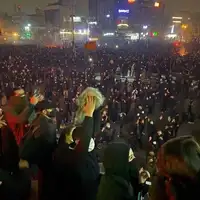
Crowds take part in anti-government protests in Tehran in January 2026.

Seven months after the January massacre, Iranians answering an Iran International call-out describe lives still bent around it: sleep and nerves that never recovered, friendships remade or broken, politics hardened, and a future they struggle to picture.

For many, life now divides in two: before January, and after. The same images return again and again in their accounts: the sound of gunfire, the people killed beside them, the friends and children who went out to protest and never came home.

“Time stopped for me after January 9,” one respondent wrote. “My life was divided into before and after the protests, and I never became the person I was before,” another said.

The responses vary widely. Some describe depression, recurring nightmares, anger and an inability to return to ordinary routines. Others say the experience made them more politically engaged and more determined to join future protests.

  • Iranians turn on Pezeshkian over protest death toll comments

    Iranians turn on Pezeshkian over protest death toll comments

Together, they offer a picture of an upheaval whose consequences for some participants and witnesses have extended from the streets into private life.

‘All those scenes keep playing like a film’

Descriptions of psychological distress were among the most frequent responses.

One person who said they witnessed young people being killed described recurring nightmares, depression, crying at night and a sense that there was no future.

“I can no longer walk with a good feeling on streets where blood was spilled or do the everyday things I used to do,” the respondent wrote.

Another described being unable to escape the memories.

“I could never return to normal life. All those scenes keep playing in front of my eyes like a film – those streets and the faces of people who were dying.”

For some, particular dates have themselves become reminders. One said seeing the numbers 8 and 9, corresponding to the dates of the protests, now causes their heart rate to rise.

Others described guilt over having survived.

“Every day, I have to answer to my conscience for breathing,” one person wrote.

The effects described went beyond grief. Some said their relationship with ordinary pleasures, familiar streets and even other people had changed.

  • 36,500 deaths in context: How Iran’s toll compares with wars and crackdowns

    36,500 deaths in context: How Iran’s toll compares with wars and crackdowns

“I don't make fun of young people anymore,” one wrote. “I realized that anyone, regardless of their job, style or appearance, can be a Kaveh the Blacksmith against Zahhak.”

The reference draws on two figures from Persian mythology: Kaveh, a blacksmith who leads a revolt, and Zahhak, a tyrannical ruler.

  • The three snakes of Zahhak

    The three snakes of Zahhak

Anger, but also determination

Anger repeatedly accompanied grief in the responses, with some saying executions, rising prices and what they see as continuing injustice had deepened rather than diminished it.

“At first I was very happy, then angry and hopeless, and then hopeful,” one wrote. “Now I am waiting and angry, with flames of suppressed anger; sometimes hopeless and sometimes hopeful. But we know we have to go to the end.”

Another wrote: “Those two nights ended, but a piece of me broke away and remained alone somewhere.”

Yet despair was not the only consequence described. Some said January had made them more willing to take risks and participate again.

  • Over 36,500 killed in Iran's deadliest massacre, documents reveal

    Over 36,500 killed in Iran's deadliest massacre, documents reveal

“I became braver and more determined to achieve freedom,” one person wrote.

“Other than some of my hair turning grey, the biggest change is that I have prepared myself to repay my debt with the next call,” another said, referring to a future call for protests.

For these respondents, the memories of January have become a reason to continue rather than withdraw.

Politics enters personal relationships

Some responses described a shift in political understanding, including greater attention to the Islamic Republic's institutions, propaganda and political currents.

“January made me understand the propaganda system of this regime and its operatives,” one person wrote. “My political knowledge increased greatly. I learned about left and right. I understood how I was being played and why this regime has lasted 47 years.”

Political divisions have also entered friendships and family relationships.

One described the biggest change simply as: “Cutting ties with fence-sitting relatives and friends!”

For some, the reaction of people around them to protesters being killed, the crackdown and arguments about Iran's political future became a new measure for deciding which relationships to maintain.

Others described the opposite effect: a stronger sense of connection with fellow Iranians.

100%
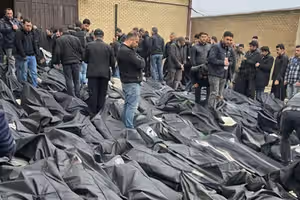
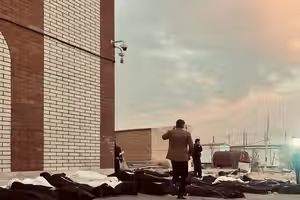
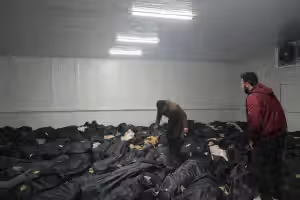
Bodies wrapped in blankets lie outside Alghadir Hospital in eastern Tehran following anti-government protests in January 2026.

“In one sentence, I am proud of my Iranian compatriots because on January 8 and 9 we stood together,” one wrote.

Another cited the “courage, strength and self-sacrifice of a nation” as one of the enduring impressions of the protests.

‘We are alone’

Several said January also changed their expectations of foreign powers and whether outside intervention could alter Iran's future.

“We are alone and should not hope for any power to save us or bring us freedom, except through our own efforts,” one person wrote.

For others, grief, anger and political determination now coexist rather than replacing one another.

  • They carry the evidence of Iran’s crackdown on their bodies

    They carry the evidence of Iran’s crackdown on their bodies

“The January protests changed something in me forever,” one respondent wrote. “Since that day, I have become angrier, more wounded and more depressed, but I have not been broken.”

For those who sent responses to Iran International, January remains more than a date marking a political confrontation. It has become a dividing line in their own lives – separating who they were before the protests from who they became afterward.

Leaked audio: Iran's Basij brace for new protests and fear being named online

Aug 18, 2026, 11:47 GMT+1
100%
File photo of an IRGC cyber unit at a computer operations center in Iran.

Officials of Iran's Basij militia can be heard on a leaked recording weighing the risk of a new round of protests and the danger that members will be identified online, a rare glimpse of the anxiety inside the force the state sends against demonstrators.

In the audio recording of a closed meeting of the Media and Cyberspace Headquarters in Pakdasht, Tehran province, officials discuss possible new demonstrations, the online identification of Basij members and plans to track anti-government activity and individuals on social media.

The meeting was held amid recent developments including the killing of Hamidreza Rajabzadeh, a Basij member and government-aligned religious singer, as well as growing concern among officials over the role and influence of social media.

The Media and Cyberspace Headquarters is made up of cyber personnel and government supporters operating under the supervision of the Revolutionary Guards.

The concerns raised at the meeting echoed recent remarks by Ebrahim Garmabdari, commander of the Revolutionary Guards in Pakdasht, who said government opponents were using sanctions, infiltration and social media to target the Islamic Republic’s governing structure.

Earlier this week, Iran’s supreme leader appointed Hossein Taeb, a veteran intelligence official, to lead the Basij paramilitary forces, giving the former protest crackdown figure a mandate to expand the paramilitary force’s grassroots intelligence network and use of new technologies.

Concerns over pressure on Basij members

Participants of the meeting raised concerns about mounting social and psychological pressure on government-aligned forces.

Referring to Rajabzadeh’s recent killing, the meeting’s lead speaker described the incident as a warning that pro-government figures could be targeted both offline and online.

He said the pressure was intended to make Basij members, mosque clerics and local base commanders regret or feel ashamed of their affiliation, potentially pushing them to adopt opposition views to avoid social rejection.

Earlier in the meeting, a participant identified as Mr. Shahbazi said the underlying tensions had not subsided and warned that public protests against the government and confrontation with security forces could continue.

Concerns over AI and exposure of Basij members

A significant part of the discussion focused on possible breaches of security systems and the exposure of Basij personnel.

The lead speaker warned that opposition networks could use artificial intelligence to identify Basij members from group photographs and obtain personal details about them for possible retaliation.

He also voiced distrust of participants’ mobile phones, suggesting that apps such as ChatGPT could be listening to their conversation in real time.

Social media blamed for unrest and economic problems

The discussion also turned to social media, with the speaker criticizing filtering policies while also blaming the internet and platforms such as Instagram for a range of political, social and economic problems.

He said blocking Instagram, Telegram and WhatsApp had only increased public anger, but described online platforms as a major factor behind unrest, rising prices, cultural change and even the election of relatively moderate Masoud Pezeshkian.

He also said foreign intelligence services including Mossad were exploiting economic hardship to recruit young people and obtain information through online platforms by offering incentives such as free internet access, servers and VPN configurations.

A 2025 survey by the Iranian Parliament Research Center indicates that the vast majority of Iranians (81%) rely on VPNs to bypass internet censorship.

Order to monitor anti-government activity

The meeting also included what participants described as a “top secret” directive instructing cyber personnel to monitor platforms including Instagram and document protest-related and anti-government activity by residents of Pakdasht.

The meeting leader said the monitoring should apply without exception, instructing personnel to take screenshots even when close relatives posted protest-related content.

He told them to send the screenshots through the Iranian messaging app Eitaa along with identifying information including the person’s father’s name, national ID number, phone number and workplace address so action could be taken against them.

Warning of protests over fuel prices

Toward the end of the meeting, a Pakdasht IRGC cyber official warned of the possibility of widespread and violent protests in the near future, including over increases in fuel prices.

He said that in the “next unrest,” even people who did not own vehicles could take to the streets because of accumulated anger and attack targets including banks, fire trucks, ambulances and, in particular, Basij members.