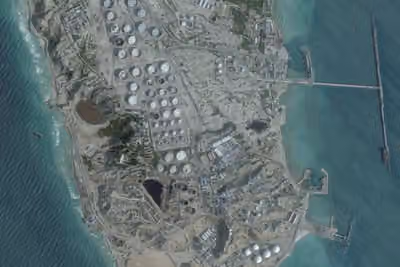
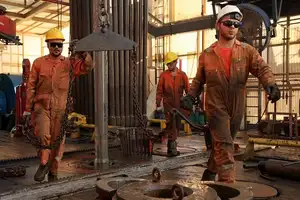
File photo released by ISNA in September 2013 shows a worker during the installation of an oil rig in Changuleh, Mehran county, Ilam province, western Iran.
Donald Trump’s maximum pressure is usually scored by counting tankers and tracking the rial, but Iran’s budget points to a deeper cost: more than $80 billion in NIOC bank debt and sovereign-fund arrears, repeatedly deferred as Iranians shoulder the burden.
On August 5, a state bank froze the accounts of the National Iranian Oil Company, NIOC, over about $1 billion owed to the sovereign wealth fund, two years past due. A separate case was already running: a $1.5 billion tax assessment the company says it simply cannot pay. Enforcement on that one stopped only when the presidency intervened.
The episode matters because the law shielding the company is also where its condition is recorded. NIOC publishes no audited accounts, and Iran's budget shows state companies only in aggregate, leaving its debt to be reconstructed from budget provisions and disclosures by other state institutions.
This year's budget sets the amount of NIOC debt to the central bank and commercial banks being deferred at 55 billion euros, about $63.5 billion, covering principal and interest on financing for upstream oil and gas development. It appears as a single sentence at the bottom of a table in which every other figure is in rials or percentages, renewed every year since 2019.
Iran's sovereign wealth fund, the National Development Fund, has separately said NIOC is its largest debtor, with $17 billion in unpaid loans.
Those two categories alone amount to more than $80 billion. No single official document presents them as one consolidated NIOC debt figure.
Iran's entire general budget this year converts to roughly $37 billion at the open-market rate. For scale, the deferred bank debt alone is about 1.7 times what the government plans to spend in a year.
That burden grows without anyone borrowing another dollar. The debt is in foreign currency, and the rial has fallen from about 900,000 to the dollar in early 2025 to nearly 2 million today, a slide President Trump celebrated in August as his administration "destroying Iran's currency." Each step down makes the same $63 billion heavier against NIOC's rial costs and the state's domestic revenues.
That burden grows in rial terms without anyone borrowing another dollar. The debt is in foreign currency, and the rial has fallen from about 900,000 to the dollar in early 2025 to nearly 2 million today, a slide President Trump celebrated in August as his administration "destroying Iran's currency.” Each step down increases the rial value of the same $63 billion obligation and makes it larger relative to the state's domestic revenues.
Maximum pressure is usually scored from the outside: barrels tracked leaving the Persian Gulf, the rial's slide, the lengthening sanctions lists. By that scorecard the campaign is working.
A clearer measure is the condition of the company at the center of the sanctioned trade, and by that measure the campaign has worked more completely than the scorecard shows. The pressure did not stop Iran's oil. It changed the terms of the business, and the new terms have broken the company that produces it, in every sense but the accounting one.
The business model was set at the top. After the United States withdrew from the nuclear deal in 2018 and reimposed sanctions, Ali Khamenei told officials not to leave the economy waiting on "decisions to be made by others." The objective instead was to plan with the sanctions in place and, in his formulation, to neutralize them.
The oil ministry's version of neutralization was to keep production alive with domestic contractors, the Revolutionary Guard's companies among them. On its own terms, that part worked. Output that had fallen below 2 million barrels a day in 2020, the lowest in almost four decades by American government estimates, was rebuilt to about 3.6 million by mid-2024, a recovery the oil minister boasted of publicly.
Selling those barrels was another matter.
"We have unofficial or unconventional sales, all of which are secret," then-oil minister Bijan Zanganeh said in 2019, "because if they are made known America would immediately stop them." His deputy called it the grey market.
In practice, that meant selling at sanctions-driven discounts that have varied widely over time, reaching $10 to $15 a barrel below Brent through 2024 and 2025, particularly to China's independent refiners; using a shadow fleet, ship-to-ship transfers and obscured vessel identities; relabeling Iranian crude as originating elsewhere; and paying intermediaries to keep the chain moving. China has at times taken roughly 90 percent of Iran's exported crude.
Payment itself became another layer of the sanctions trade. Iranian oil proceeds have been trapped or restricted in foreign banking systems, while other sales have been settled through barter or in currencies that are difficult to repatriate freely.
India created a rupee payment mechanism for Iranian crude in 2019, and the channel stalled the same year when Indian purchases stopped. Roughly $6 billion in Iranian oil proceeds frozen in South Korea were eventually transferred to restricted accounts in Qatar as part of the 2023 prisoner exchange.
Every additional discount, commission and restriction reduces what reaches Iran. NIOC's statutory share of crude and condensate export proceeds is set at 14.5 percent, so lower realized export revenue narrows the company's own take as well.
The difference between what the model earned and what production cost was covered on credit, in foreign currency, from the central bank, state banks and the sovereign wealth fund, with parliament's authorization.
By January 2019 the state knew in writing that the arrangement was not paying for itself. The parliament's research arm reported that NIOC, then about $50 billion in debt on its own count of the previous year, could not repay what it owed. The party line continued anyway: the same parliament approved fresh lending in the same budget, and two months later wrote the first deferral into law.
The dollar figures were tracked for two more years, to about $60 billion in March 2020 and about $70 billion in March 2021. Then that series went quiet.
The liabilities themselves did not vanish from the record. Two years later the Economy Ministry put NIOC's debts for 2021 at 1,683 trillion tomans, the largest of any state company in Iran, ahead of Bank Sepah and Bank Melli. At the exchange rate of the day, that is the same $60 to $65 billion the dollar series had been reporting.
What disappeared was the ability to follow it: a comparable figure, year by year, in the currency the money was owed in. The largest corporate debt in Iran's history was reduced to one renewable sentence that for six years carried no number at all. When a number finally surfaced this February, it settled what the silence had left open. The bank debt did not go away. It was rolled forward.
The meter still runs, though not at one rate. The sovereign fund's published terms for foreign-currency oil and gas facilities are 3.5 percent for the fund plus 2.5 for the agent bank, 6 percent all-in. On the $17 billion it is owed, that alone is close to $1 billion a year, almost exactly the size of the claim that froze the company's accounts in August.
The central bank has never published its contract rate, so the future cost can only be estimated. If even a 4 percent rate were applied to the $63 billion outstanding balance, it would add more than $2.5 billion in interest over a year; at the sovereign fund's 6 percent rate, the figure would approach $3.8 billion.
What the budget does establish is that the deferred bank debt already consists of principal and interest. The cost of carrying the old debt has become part of the debt.
For comparison, $1.5 billion in foreign currency is allocated for medicine this year, in a spring when pharmacy prices jumped several hundred percent, cancer and dialysis drugs ran short, and officials blamed scarce foreign currency. Depending on the rates applied to NIOC’s different debts, the annual interest burden could exceed that amount by several billion dollars.
An Iranian who misses a single loan installment pays the contract rate plus a 6-point penalty. The oil company's interest simply accrues, uncollected, year after year. A deferral, in the end, is a bet that a better year is coming, one with a surplus large enough to settle old bills. The Islamic Republic has been promising that better year that is yet to come for forty-seven years.
Because the loans are neither collected nor written off, the central bank and the state banks carry them as sound assets, the same accounting that keeps Iran's insolvent banks upright. When those banks come up short, they overdraw at the central bank, and that is where base money is created.
The transmission is not mechanical, but it is the route by which a single failed lender, Bank Ayandeh, accounted for about a quarter of the growth in Iran's monetary base in 2022-23. The bill reaches Iranians as inflation: the tax no one votes on, taking its largest share from the poorest.
Fifteen years of records say NIOC could not pay when conditions were merely bad. With its fields bombed and its exports blockaded, repayment is beyond reach in any scenario.
And the pressure is still tightening. On August 13, Treasury Secretary Scott Bessent, who runs the Economic Fury campaign against the Islamic Republic, promised measures "like have never been seen in the history of the economic isolation of a country," on top of a blockade meant to keep anything from moving in or out of Iranian ports. Whatever they turn out to be, they are aimed at the only revenue that could ever service this debt.
Nor does the optimistic case rescue the company. Even a full lifting of sanctions would not change the arithmetic quickly, because a company with damaged fields and war-hit infrastructure would have to borrow more before it could export more.
Maximum pressure set the terms of this downfall, but the decisive choices were Tehran's: to keep pumping at any margin, to stop publishing a comparable foreign-currency debt figure after 2021, and to push the bill forward one year at a time.
The company that once symbolized Iran's oil wealth was not felled by a rival or a market. It was sacrificed, quietly, by its own state, to the nuclear program and the regional ambitions that brought the sanctions, and to the business model built to outlast them, and the receipt is one sentence long, perpetually renewed every year.
Iran’s government is considering three proposals to curb gasoline consumption as war damage, import difficulties and a widening gap between domestic production and demand put growing pressure on fuel supplies.
The options include imposing a daily cap on supplies to filling stations, tightening vehicle quotas and allowing additional gasoline to be sold at market rates, or transferring fuel allocations from vehicles to individuals and permitting citizens to trade them.
No proposal has been approved, and the government has not announced any immediate change to subsidized gasoline prices.
Esmail Saghab-Esfahani, a vice president and head of Iran's Strategic Energy Policy and Management Organization, outlined the three scenarios on state television and said the public would be informed before any decision was implemented.
Daily supplies could be capped
Under the first proposal, existing prices would remain unchanged, but filling stations nationwide would receive a combined 121 million liters of gasoline per day.
Saghab-Esfahani said pumps would stop operating once that amount had been sold, effectively imposing a nationwide daily supply ceiling without formally increasing prices.
The second proposal would divide the same 121 million liters among registered vehicles through a stricter quota system. Motorists exceeding their allocation would have to purchase additional gasoline at an unsubsidized market rate.
The third option would transfer gasoline quotas from vehicles to individuals. Every citizen would receive about 30 liters per month, whether or not they owned a vehicle, and could use or sell the allocation.
Around 30 million liters per day would separately be reserved for public transportation, conventional taxis and ride-hailing services under that proposal, in an effort to prevent fare increases.
Saghab-Esfahani said the third plan would be accompanied by a three-year program to electrify 400,000 motorcycles, convert 130,000 pickup trucks to natural gas and add 7,300 buses. He did not explain how the program would be financed or provide a detailed implementation schedule.
Conflicting production figures
In his latest remarks, Saghab-Esfahani put daily gasoline production at about 121 million liters and consumption at around 135 million, implying a shortfall of approximately 14 million liters per day.
Tehran-based news website Rouydad24 cited earlier remarks by the official that put production at about 112 million liters. The reason for the nine-million-liter discrepancy was not explained and may reflect different reporting periods or production conditions.
President Masoud Pezeshkian has said Iran spent about $6 billion importing gasoline during the Iranian year that ended March 20, 2026. Officials say falling revenue, limited access to foreign currency and obstacles affecting import routes have made that approach increasingly difficult.
Kerman plan halted before launch
The debate intensified after authorities abruptly announced and then suspended a plan to sell gasoline consumed beyond existing quotas at a sharply higher rate in southern Kerman province.
The plan was halted hours before it was due to begin following talks between Kerman’s governor and national officials. Provincial authorities said the existing system would remain in place while the proposal underwent further review.
Neither the Oil Ministry nor the government disclosed the legal basis for the plan or how the new price had been calculated. Officials also did not clarify whether Kerman had been selected for a local anti-smuggling initiative or as a test for wider changes.
Legacy of the 2019 protests
Gasoline pricing remains among the most politically sensitive issues in Iran.
An overnight nationwide price increase in November 2019 triggered protests in more than 100 cities. Rights groups documented hundreds of deaths in the ensuing crackdown, during which authorities imposed a near-total internet shutdown.
Pezeshkian promised during his 2024 presidential campaign that gasoline prices would not be increased without public consent and that more fuel-efficient vehicles would be made available before any increase.
Government officials have said no immediate price rise is planned, but all three proposals now under consideration would restrict consumption or redistribute subsidies.
The proposals leave the government seeking to address a growing supply deficit without an abrupt policy change that could further strain household finances and renew public anger over gasoline prices.
Relatives of some of Iran’s most powerful security figures, including Mohsen Rezaei’s son, were among nine people tied to an oil-sales network that sources say failed to return about $11 billion in proceeds, an Iran International investigation found.
The major corruption network involved in the sale of Iranian oil has been operating within the Islamic Republic’s Intelligence Ministry, according to multiple sources familiar with the matter.
The network was built around trusted intermediaries, known in Iran as “trustees,” who were given oil to sell as part of efforts to circumvent sanctions and were expected to return the proceeds to the state.
Iran International’s investigation found that the nine included the relatives of senior current and former officials, including a son of Supreme National Security Council Secretary Mohsen Rezaei and the sons-in-law of two former intelligence ministers.
On August 9, the Iranian Labour News Agency (ILNA), quoting Hossein Samsami, a member of parliament’s Economic Committee, named one of the trustees who he said had failed to return Iran’s oil revenue: Hossein Aghayari.
A day later, ILNA provided further details, saying Aghayari was born in 1982 and operated in Tehran using Iranian and Afghan passports. It said he had purchased 40 Iranian oil tankers, taken delivery of 90 million barrels of oil, sold it on the market and failed to return the proceeds.
Aghayari has been based in the United Arab Emirates since before the start of the 40-day war. Two oil-industry sources told Iran International that five months ago, he stayed for several days at the Ritz hotel in London using a Dominican passport.
According to the sources, Aghayari’s name and details of his activities were deliberately provided to Iran’s domestic media as part of a security operation intended to conceal the identities of the principal figures in a much larger network of Intelligence Ministry trustees.
The sources identify the leader of the network as a senior Intelligence Ministry official known as Shayan, the ministry’s director-general for fuel and energy. He was dismissed 10 days ago and, according to three sources, is expected to be arrested.
The sources say the group, known as the Shayan Network, was responsible for about $11 billion in oil-sale proceeds not being returned to the state.
How the network operated
Since the administration of former President Ebrahim Raisi took office, Iran’s budget laws have allowed executive agencies and state, military and Social Security pension funds, in coordination with the Oil Ministry, to receive Iranian crude oil and gas condensate for sale as part of efforts to circumvent sanctions and return the proceeds to Iran.
The individuals and companies entrusted with selling the oil and transferring the revenue are commonly known in Iran’s political and economic terminology as “trustees.”
The administration of President Masoud Pezeshkian has continued to use similar mechanisms for oil sales.
According to Iran International’s sources, several large patronage networks emerged around the system, including one operating within the Intelligence Ministry through the cooperation of three figures.
One was Oil Minister Mohsen Paknejad, who previously headed the Oil Ministry’s Fuel Supply Oversight Headquarters.
The other two, according to the sources, were the principal organizers of the alleged network. One was Shayan, the Intelligence Ministry’s director-general for fuel, who had previously served as a senior ministry interrogator in major oil cases.
Sources say that Shayan used his influence over cases ranging from the missing oil rigs scandal to the Crescent case to accumulate considerable wealth.
The third figure was Meysam Darzinejad Rami, director-general of the Intelligence Ministry Pension Fund, through whom the sources say legal cover was provided for the oil sales. He previously headed security at the Execution of Imam Khomeini’s Order (EIKO), the vast economic conglomerate controlled by the office of Iran’s supreme leader.
According to Iran International’s sources, Shayan and Darzinejad built an extensive oil-sales operation around nine influential trustees, one of whom was Aghayari.
Mohsen Fallahian, son of an ex-intelligence minister
One of the best-known members of the alleged network is Mohsen Fallahian, the son of Ali Fallahian, who served as intelligence minister under President Akbar Hashemi Rafsanjani.
Ali Fallahian has been widely accused of being one of the architects of the Islamic Republic’s campaign of assassinations against opponents abroad, including during the period when Shapour Bakhtiar, the last prime minister under Mohammad Reza Shah Pahlavi, was killed in Paris.
Mohsen Fallahian runs a company in Iran called Sepehr Sanat Negin, whose stated business activities were changed to include oil and gas operations in October last year.
Iran International’s sources say Fallahian obtained authorization to establish an oil-storage facility at Shahid Rajaei Port in Bandar Abbas through his father’s influence and subsequently joined the Shayan Network’s oil-selling operation.
According to the sources, Mohsen Fallahian lives in the UAE and trades oil under another identity, “Mohsen A.,” using a Turkish passport. In one instance alone, the sources say, he converted 200 million dirhams in Iranian oil revenue into cryptocurrency and transferred it to a European country.
Ali Rezaei, son of Mohsen Rezaei
Ali Rezaei, son of Iran’s newly appointed security chief Mohsen Rezaei, is also identified by the sources as one of the Shayan Network’s trustees.
Rezaei is married to the daughter of Leili Boroujerdi, a granddaughter of Ruhollah Khomeini. For years, he served as deputy for communications at the Secretariat of the Expediency Discernment Council, effectively serving as his father’s deputy.
Iran International’s sources say Rezaei has for some time been living at the Address Mall hotel in Dubai, where he works as an oil trader. They allege that he is among the Shayan Network trustees who have failed to return hundreds of millions of dollars in oil-sale proceeds.
Ali Bayandorian, a trustee for several networks
Another member of the alleged network identified by Iran International’s sources is Ali Bayandorian, 52, who was born in Tehran and lives on Morvarid Street in Tehran’s Saadat Abad neighborhood, although he spends much of the year in the UAE.
The United States sanctioned Bayandorian in January 2020 over his links to Triliance Petrochemical, a Hong Kong-based broker that the US Treasury said facilitated sales of Iranian petroleum and petrochemical products on behalf of the National Iranian Oil Company.
Iran International’s sources say Bayandorian sells oil and petrochemical products through a network of companies registered in Iran and Southeast Asia. They also allege that he handles financial transactions related to sanctioned oil sales and pays kickbacks to Shayan through an account in the UAE belonging to one of his wife’s relatives, a woman named Neda.
Before joining the Shayan Network, according to the sources, Bayandorian was a trusted intermediary for a network associated with the Supreme National Security Council.
Because he worked with several parallel networks, the sources say, he sometimes failed to pay Shayan’s share on time or in full. Shayan therefore created a rival for him: Ahmad Maroufkhani, chairman of the board of the Oil Products Exporters’ Union, whom the sources describe as one of the Intelligence Ministry network’s second-tier trustees.
Ehsan Sakhaei, son-in-law of Rouhani’s intelligence minister
Ehsan Sakhaei is another person identified by the sources as a trustee in the Shayan Network. He is 51, a Swiss citizen and the son-in-law of Mahmoud Alavi, who served as intelligence minister under President Hassan Rouhani.
According to Iran International’s sources, Sakhaei lives in Dubai’s Vision Tower.
Six years ago, during a Bank Mellat corruption trial, Sakhaei was accused of acting as a fixer who used his father-in-law’s influence to secure multibillion-toman debt write-offs for major bank debtors.
Iran International’s sources say Sakhaei has failed to return several hundred million dollars in proceeds from Iranian oil sales.
Ehsan Tahayori, son of an IRGC brigadier general
Ehsan Tahayori is a well-known Iranian currency dealer who, according to Iran International’s sources, failed to hand over $700 million in Iranian oil revenue in one case alone.
Tahayori, owner of the Arz Iran currency exchange, is the son of IRGC Brigadier General Shams-Ali Tahayor, also known as General Tahayori.
Iran International’s sources identify Tahayori as the principal suspect in a one-billion-dirham fraud involving Iran’s NIMA foreign-exchange system. They also allege that he was released and helped to flee with the assistance of the Intelligence Ministry.
Two sources told Iran International that authorities in the UAE arrested Tahayori during the war and that he is now in prison.
Photographs published earlier and reported to show his luxury cars at his villa in Lavasan had caused controversy in Iran.
Rouhollah Razavi, son-in-law of a Paydari Front spokesman
Another figure identified by the sources is Rouhollah Razavi, the son-in-law of Majid Mottaghifar, spokesman for the hardline Paydari Front.
Iran International’s sources say it was through this political connection that Razavi became one of Shayan’s trusted intermediaries and describe his office in Tehran’s Kamranieh neighborhood as a hub for backroom oil deals.
The sources allege that Razavi has retained more than $1 billion in oil-sale proceeds and provided information about rival trustees in an effort to push them out of the market.
Mohammad-Hadi Momenin, major bank debtor and oil broker
Another trustee identified by the sources is Mohammad-Hadi Momenin, born in 1989.
Iran International’s sources allege that Momenin controls approximately $2 billion in Iranian oil revenue that has not been returned. His name has appeared on the boards of more than 40 companies in Iran.
Last year, when the names of major bank debtors were released, it emerged that Momenin owed Karafarin Bank 743 billion tomans.
The sources say he fled the UAE for Oman during the war and later traveled from there to China, where they say he is refusing to respond to his creditors.
Ehsan Dastgheyb, son of Iran’s ‘Bribery King’
The ninth individual identified by the sources is Ehsan Dastgheyb, son of Abdollah Dastgheyb, a nephew of a former Shiraz Friday prayer leader who is known as Iran’s “Bribery King.”
Ehsan Dastgheyb lives in Dubai and sells fuel oil for the Shayan Network, according to Iran International’s sources. They allege that he, too, has failed to return a large sum of money to Iran.
Network comes under pressure
Following Shayan’s dismissal, Iran International’s sources say both he and Meysam Darzinejad Rami are expected to be arrested and that the network has come under increasing pressure.
The sources say the Shayan Network is only one of several networks of trustees involved in Iranian oil sales and estimate that intermediaries across these networks have collectively failed to return as much as $110 billion in oil revenue.
They also say Oil Minister Paknejad could soon be dismissed, although he has mobilized his political connections in an effort to remain in office.
Iran's oil minister Mohsen Paknejad
On July 24, Tehran prosecutor Ali Salehi said 59 cases had been opened against managers of trustee companies, with 43 reaching the indictment stage. He said 22 defendants had been sent to prison and that Interpol Red Notices were being pursued for 15 fugitives.
The prosecutor did not publicly identify the 15 fugitives, making it impossible from the announcement to determine whether any members of the Shayan Network were among them.
Iran International’s sources expressed doubt that the alleged network would be fully pursued, pointing to the powerful connections of those involved: they include sons and sons-in-law of former intelligence ministers, the son of the secretary of the Supreme National Security Council, and people connected to the Paydari Front and influential clerical families.
According to the sources, the Shayan Network alone was responsible for about $11 billion in Iranian oil-sale proceeds that were not returned to the state.
File Photo: Shipping containers at Shahid Rajaei port in Chabahar, southeastern Iran.
Iran says its non-oil trade has fallen by around 30% since the war began, but figures from several of its biggest trading partners point to far steeper declines in some of the country’s most important commercial relationships.
Trade with China has fallen to roughly a quarter of last year’s level by one measure, while commerce with Turkey, India and the European Union has also contracted sharply as war and disruption in the Strait of Hormuz reshape Iran’s foreign trade.
Mohammad-Sadegh Ghanadzadeh, a senior official at Iran’s Trade Promotion Organization, said both non-oil exports and imports fell by roughly 30% during the first four months of the current fiscal year, from March 21 to July 22.
The government has stopped regularly publishing detailed foreign trade statistics since the war began, making a fuller assessment difficult.
Iranian customs data show the country recorded slightly more than $34 billion in non-oil trade during the same four-month period last year, including $15 billion in exports.
China trade plunges
China is Iran’s largest trading partner, accounting for roughly one-third of the country’s non-oil foreign trade.
Chinese data put non-oil bilateral trade at around $10 billion in 2025—substantially lower than Iranian figures, in part because the two countries classify and record parts of their trade differently, including sanctioned Iranian commodities.
According to Chinese customs records, trade with Iran totaled less than $823 million during the first four months of the war, from March through June. That is roughly one-quarter of the level recorded during the same period a year earlier.
The disruption has also sharply increased transportation costs.
Majidreza Hariri, chairman of the Iran-China Chamber of Commerce, said transporting goods from China to Iran by sea or land now costs four times as much as before the war, with shipping a container costing as much as $13,000.
Major partners hit harder
Trade with several of Iran’s other major partners has also contracted sharply.
The United Arab Emirates, Iran’s second-largest trading partner, has largely halted trade with Tehran. Before the war, annual trade between Iran and the UAE stood at around $27 billion, about 80% of it Emirati exports to Iran.
The precise impact on trade with Iraq, Iran’s third-largest trading partner, remains unclear. But official data from Turkey, its fourth largest, show Turkish exports to Iran fell by almost half between March and June to around $716 million, while imports from Iran dropped 37% to $907 million.
India has recorded a similar decline. Its exports to Iran fell by around 60% during the first four months of the war to approximately $150 million.
Indian imports from Iran moved sharply in the opposite direction, reaching around $1 billion in the first half of the year — four times the level recorded during the same period last year—after India bought several shipments of Iranian crude oil and liquefied petroleum gas.
Health Minister Mohammad-Reza Zafarghandi recently said India, Iran’s largest supplier of pharmaceutical raw materials, had stopped shipments after the IRGC closed the Strait of Hormuz.
He said India had made the resumption of pharmaceutical exports conditional on free passage for Indian vessels through the waterway.
Where has the trade gone?
Taken together, available data suggest Iran’s trade with several of its largest established partners has contracted substantially more than the 30% overall decline reported by Tehran.
The discrepancy suggests commerce with other countries may have partly cushioned those losses.
Russia, Pakistan, Iraq, Afghanistan and Central Asian states are among the possible destinations, though the absence of regularly published Iranian customs figures makes it difficult to establish how much trade has shifted or where.
The broader picture nevertheless shows the economic fallout from the war extending well beyond Iran’s oil exports, weakening some of Tehran’s most important commercial relationships even as the full extent of the shift remains obscured by the lack of detailed Iranian data.
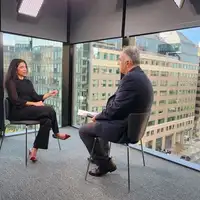
Kerri Bitsoff (left) in an interview with Iran International's Kambiz Tavana in Washington DC on August 13, 2026.
Sanctions can make Iran’s military and nuclear activities costlier and more difficult but cannot bring down the Islamic Republic on their own, former US Treasury official and weapons procurement expert Kerri Bitsoff told Iran International.
“Sanctions can't topple a regime on their own. That's not what they're for,” said Bitsoff, who previously worked at the Treasury Department’s Office of Foreign Assets Control, the agency responsible for administering and enforcing US economic sanctions. “They are intended to increase pressure.”
For Bitsoff, who worked on nonproliferation and weapons procurement at OFAC and is now executive director of investigations at TANGOS, the distinction is central to understanding what decades of US sanctions against Iran can and cannot accomplish.
Rather than expecting sanctions themselves to produce political change, she said their effect should be measured by how much they increase the cost and difficulty of the activities Washington is trying to constrain.
“They make everything that the regime does related to those more expensive, slower and more difficult to obtain,” she said, referring to activities such as Tehran’s nuclear and weapons programs. Sanctions, she added, are also intended “to set conditions for something else to happen” and “can't be alone.”
That argument comes after years in which successive US administrations have expanded, eased or more aggressively enforced different layers of sanctions against the Islamic Republic. Washington restored broad nuclear-related sanctions after withdrawing from the 2015 nuclear deal in 2018, targeting areas including Iran’s banking, energy and shipping sectors. President Donald Trump launched a renewed “maximum pressure” policy in February 2025, directing the Treasury Department to pursue a “robust and continual sanctions enforcement campaign” aimed at denying Tehran and its allied groups access to revenue.
Bitsoff said those measures should not be judged simply by how many Iranian individuals, companies or organizations Washington places on sanctions lists.
Enforcement matters more than numbers
“Numbers are not a good measure of the impact of sanctions and whether they are important,” Bitsoff said. “You can sanction thousands of individuals and entities within Russia, within Iran, within North Korea, and that's not really the answer.”
The more meaningful test, she said, is whether sanctions change the behavior of actors outside the targeted country — the banks, buyers, suppliers, shipping companies and intermediaries that allow sanctioned governments to continue obtaining money and material.
That often requires Treasury officials to identify specific weak points in complex networks rather than simply placing restrictions on an entire sector. Bitsoff described sanctions policy as operating on two levels: broad measures designed to restrict areas such as oil revenue or access to the financial system, and day-to-day operational measures targeting individual transactions, companies and procurement networks.
Weapons procurement provides one example of how that pressure works. Sanctions may not stop Iran from producing a missile or drone, Bitsoff said, but they can increase the cost of securing the components needed to build them and force manufacturers to rely on inferior alternatives.
“You raise the cost of procuring parts and components,” she said. “You force them to get worse parts and components, so their finished weapons are less effective.”
The effects can take years to become visible, she said, and may eventually be measured in missile failure rates or the ability of adversaries to jam drones and develop other countermeasures.
Iran’s reliance on foreign components has remained a focus of US sanctions. Treasury actions in 2025 and 2026 targeted networks in China, Hong Kong, the UAE and elsewhere accused of supplying Iran with drone components, missile propellant ingredients and other military goods. In June, OFAC sanctioned another group of China- and Hong Kong-based individuals and companies it said had supported weapons procurement for the Revolutionary Guards and Iran’s defense ministry.
Oil sanctions work differently, Bitsoff said. Rather than necessarily preventing a barrel of Iranian crude from reaching a customer, the restrictions can make every stage of that journey more expensive.
An Iranian shipment may have to pass through several intermediaries, rely on aging tankers carrying higher insurance costs, undergo ship-to-ship transfers and be sold at a discount to a limited pool of buyers willing to accept the risk of dealing in sanctioned oil. Ship managers, operators and others involved in the trade may also demand premiums because they risk becoming sanctions targets themselves.
“By the end of it,” Bitsoff said, Iran can be forced to absorb a “huge discount,” meaning export volumes alone do not provide a complete measure of whether sanctions are working.
The US Treasury has described many of the same methods in its recent actions against Iran’s oil trade, citing front companies, intermediary brokers, ship-to-ship transfers, falsified documents and manipulation of vessel identities. In April, Treasury said China was buying about 90% of Iran’s oil exports and that independent Chinese refineries, commonly known as teapots, accounted for most of those purchases.
Bitsoff said enforcement can therefore be thought of as a dial that Washington can turn up or down even when the underlying sanctions remain on the books.
She pointed to the period after the United States left the nuclear agreement in 2018, when tougher enforcement drove major buyers with exposure to the US financial system away from Iranian oil.
She contrasted that with the early years of the Biden administration, when she argued Washington eased enforcement as it sought to revive negotiations with Tehran, allowing Iran’s oil trade with China to adapt around smaller buyers with less exposure to the US financial system.
“The whole idea is to change behavior,” she said. “You don't wanna just sanction something and then walk away.”
Without continued enforcement, she said, companies treat a designation as a one-time event and find ways to adjust their operations around it. “If you don't keep up with that, if you don't make that enforcement visible, people are just going to keep doing what they want to do.”
Iran's sanctions evasion machine
Keeping up has become more difficult because Iran has spent years developing mechanisms to circumvent the restrictions imposed on it, Bitsoff said, describing a system largely developed by the Revolutionary Guards and the broader state during the intense sanctions pressure of the early 2010s.
“They have a sanctions evasion machine that works pretty well,” she said.
The core of that system has remained relatively consistent, relying on shadow banking, buyers willing to trade with Iran and efforts to avoid transactions vulnerable to the US financial system. But Bitsoff said Tehran has repeatedly adapted the mechanics when new opportunities appear, from deceptive tanker practices and cash smuggling to newer methods involving cryptocurrency.
“The pattern I can discern is that they'll just use anything at their disposal to evade sanctions,” she said.
China now occupies an especially important place in that system, both as the dominant destination for Iranian oil and as a source of components used by Iran’s military industries. The Treasury Department has increasingly targeted Chinese refiners, ports, shipping companies and procurement networks as part of the maximum-pressure campaign, including a June action against China- and Hong Kong-based actors accused of facilitating weapons purchases for the IRGC and defense ministry.
“Most evasion of sanctions, especially related to Iran, happens through China,” Bitsoff said. “Those are the front companies that move money. They're the buyers of oil. They're the suppliers of weapons components.”
That makes pauses in enforcement against China particularly significant, she argued, because companies and intermediaries watch US actions when deciding how much sanctions risk they are prepared to accept.
Bitsoff said this helps explain why sanctions cannot be regarded as an on-off mechanism capable either of completely stopping Iran’s activities or, at the other extreme, being dismissed as ineffective because those activities continue. Their purpose, in her view, is degradation: reducing revenues, increasing costs and making military and nuclear programs harder to sustain.
That pressure also has a domestic dimension, she said, because Iran’s leadership must contend with economic mismanagement while the public sees resources being directed toward military programs and allied armed groups rather than economic opportunity at home.
“The population knows that it's funneling money not to them, not to economic growth, not to opportunities, but back to its proxies, back to its nuclear program, back to its weapons program,” Bitsoff said.
But she stopped short of arguing that economic pressure can determine the Islamic Republic’s political future. Instead, she said sanctions can help establish the conditions in which other forces operate, with political change ultimately depending on Iranians themselves.
“The Iranian people are the ones that have to use that pressure,” Bitsoff said, adding that alongside sanctions, the United States should be “thinking of any possible way we can support that.”
A man gestures towards the camera as he fills up his car at a gas station in Tehran, Iran
The aborted move in Kerman Province revived one of the most politically explosive questions in Iran: how to curb gasoline consumption without repeating the upheaval that followed the last major nationwide price increase in 2019.
Authorities in Kerman announced Thursday that gasoline consumed beyond the existing monthly quota would be sold at 872,000 rials per liter, roughly 17 times the current non-quota price. The measure was halted within hours, fueling speculation that it had been intended as a test for broader changes.
Under the current system, private-car owners receive 60 liters a month at 15,000 rials per liter and another 50 liters at 30,000 rials. Once that allocation is exhausted, gasoline costs 50,000 rials per liter.
The last nationwide gasoline price increase, imposed without warning in November 2019, triggered widespread protests and a deadly crackdown.
After the Kerman scheme was withdrawn, Esmail Saghab-Esfahani, vice president and head of the Organization for Optimization and Strategic Energy Management, appeared on state television to assure citizens that the government had no plan to increase gasoline prices.
Fars news agency, which is affiliated with the Revolutionary Guards, cited a government source Friday as saying an increase had been ruled out for now.
Mohammad-Saeed Ahadian, an adviser to parliament speaker Mohammad-Bagher Ghalibaf, said the heads of the three branches of government had decided against an increase and were considering alternatives.
A widening gasoline deficit
The retreat does little to resolve the problem that prompted the debate: Iran is increasingly consuming more gasoline than it produces.
Saghab-Esfahani said gasoline consumption had reached around 135 million liters a day, compared with domestic production of approximately 121 million liters. The daily shortfall must be covered through imports or strategic reserves.
Saghab-Esfahani also said the recent war had damaged some gasoline production capacity and made imports through southern Iran more difficult. He warned that the gap between production and consumption could reach 70 million liters a day within three years.
Increasing production enough to address the problem would require between $13 billion and $30 billion in investment, he said, money the government cannot afford.
Signs of tightening supply have already emerged, with images circulating on social media in recent days showing long lines of vehicles at fuel stations.
Searching for an alternative
With economic growth below zero and access to foreign currency under pressure, the government faces a choice between raising prices and fundamentally changing how gasoline subsidies are distributed.
One alternative gaining support would shift subsidized gasoline quotas from vehicles to individuals, an idea long promoted by hardliners and associated with former presidential candidate Saeed Jalili.
A version of the scheme was briefly tested on Kish Island under President Ebrahim Raisi before being abandoned.
Supporters argue that the current system disproportionately benefits wealthier households with multiple cars, while more than 40% of Iranian households without private vehicles receive no direct benefit.
Under the proposed model, individuals would instead receive gasoline allocations linked to their national ID or bank accounts and could use or sell them.
Economist Sadegh al-Hosseini, a prominent supporter of the proposal, argued that control over the subsidy should effectively be transferred from the state to citizens.
“Gasoline quotas should be given to people for free based on production, and people themselves should determine the price by trading their quotas,” he wrote on X.
Divisions over reform
The abrupt launch and cancellation of the Kerman scheme has exposed wider divisions within Iran’s political establishment over how to address the fuel problem.
Saghab-Esfahani supports linking gasoline quotas to national ID numbers rather than simply raising prices. His intervention drew criticism from reformist figures who warned of the political risks surrounding any changes to gasoline policy.
Abdollah Ramezanzadeh, spokesman for former President Mohammad Khatami’s government, criticized the handling of the issue in a post addressed to Pezeshkian.
“Entrusting the determination of energy prices—the most political and perhaps the most security-sensitive economic issue in the country—to someone with minimal political and security experience and no experience in crisis management has caused the current confusion over gasoline prices,” he wrote.
“The society is agitated and you have no room for mistakes.”
Ali Gholhaki, a political activist close to Ghalibaf, also pointed to resistance elsewhere in the establishment.
“Using pricing tools under the current circumstances to control fuel consumption is highly sensitive, and some important institutions in the country are also opposed to it,” he wrote.
The Kerman reversal leaves the underlying problem untouched. Iran has a widening gasoline deficit, but the most obvious corrective tool—higher prices—remains perilous under the long shadow of the 2019 upheaval.