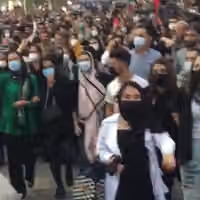
Crowds take part in anti-government protests in Tehran in January 2026.
Seven months after the January massacre, Iranians answering an Iran International call-out describe lives still bent around it: sleep and nerves that never recovered, friendships remade or broken, politics hardened, and a future they struggle to picture.
For many, life now divides in two: before January, and after. The same images return again and again in their accounts: the sound of gunfire, the people killed beside them, the friends and children who went out to protest and never came home.
“Time stopped for me after January 9,” one respondent wrote. “My life was divided into before and after the protests, and I never became the person I was before,” another said.
The responses vary widely. Some describe depression, recurring nightmares, anger and an inability to return to ordinary routines. Others say the experience made them more politically engaged and more determined to join future protests.
Together, they offer a picture of an upheaval whose consequences for some participants and witnesses have extended from the streets into private life.
‘All those scenes keep playing like a film’
Descriptions of psychological distress were among the most frequent responses.
One person who said they witnessed young people being killed described recurring nightmares, depression, crying at night and a sense that there was no future.
“I can no longer walk with a good feeling on streets where blood was spilled or do the everyday things I used to do,” the respondent wrote.
Another described being unable to escape the memories.
“I could never return to normal life. All those scenes keep playing in front of my eyes like a film – those streets and the faces of people who were dying.”
For some, particular dates have themselves become reminders. One said seeing the numbers 8 and 9, corresponding to the dates of the protests, now causes their heart rate to rise.
Others described guilt over having survived.
“Every day, I have to answer to my conscience for breathing,” one person wrote.
The effects described went beyond grief. Some said their relationship with ordinary pleasures, familiar streets and even other people had changed.
“I don't make fun of young people anymore,” one wrote. “I realized that anyone, regardless of their job, style or appearance, can be a Kaveh the Blacksmith against Zahhak.”
The reference draws on two figures from Persian mythology: Kaveh, a blacksmith who leads a revolt, and Zahhak, a tyrannical ruler.
Anger, but also determination
Anger repeatedly accompanied grief in the responses, with some saying executions, rising prices and what they see as continuing injustice had deepened rather than diminished it.
“At first I was very happy, then angry and hopeless, and then hopeful,” one wrote. “Now I am waiting and angry, with flames of suppressed anger; sometimes hopeless and sometimes hopeful. But we know we have to go to the end.”
Another wrote: “Those two nights ended, but a piece of me broke away and remained alone somewhere.”
Yet despair was not the only consequence described. Some said January had made them more willing to take risks and participate again.
“I became braver and more determined to achieve freedom,” one person wrote.
“Other than some of my hair turning grey, the biggest change is that I have prepared myself to repay my debt with the next call,” another said, referring to a future call for protests.
For these respondents, the memories of January have become a reason to continue rather than withdraw.
Politics enters personal relationships
Some responses described a shift in political understanding, including greater attention to the Islamic Republic's institutions, propaganda and political currents.
“January made me understand the propaganda system of this regime and its operatives,” one person wrote. “My political knowledge increased greatly. I learned about left and right. I understood how I was being played and why this regime has lasted 47 years.”
Political divisions have also entered friendships and family relationships.
One described the biggest change simply as: “Cutting ties with fence-sitting relatives and friends!”
For some, the reaction of people around them to protesters being killed, the crackdown and arguments about Iran's political future became a new measure for deciding which relationships to maintain.
Others described the opposite effect: a stronger sense of connection with fellow Iranians.
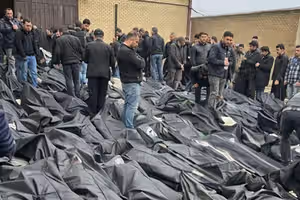
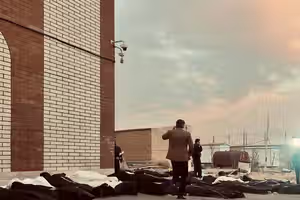
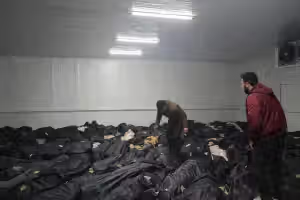
Bodies wrapped in blankets lie outside Alghadir Hospital in eastern Tehran following anti-government protests in January 2026.
“In one sentence, I am proud of my Iranian compatriots because on January 8 and 9 we stood together,” one wrote.
Another cited the “courage, strength and self-sacrifice of a nation” as one of the enduring impressions of the protests.
‘We are alone’
Several said January also changed their expectations of foreign powers and whether outside intervention could alter Iran's future.
“We are alone and should not hope for any power to save us or bring us freedom, except through our own efforts,” one person wrote.
For others, grief, anger and political determination now coexist rather than replacing one another.
“The January protests changed something in me forever,” one respondent wrote. “Since that day, I have become angrier, more wounded and more depressed, but I have not been broken.”
For those who sent responses to Iran International, January remains more than a date marking a political confrontation. It has become a dividing line in their own lives – separating who they were before the protests from who they became afterward.
File photo of an IRGC cyber unit at a computer operations center in Iran.
Officials of Iran's Basij militia can be heard on a leaked recording weighing the risk of a new round of protests and the danger that members will be identified online, a rare glimpse of the anxiety inside the force the state sends against demonstrators.
In the audio recording of a closed meeting of the Media and Cyberspace Headquarters in Pakdasht, Tehran province, officials discuss possible new demonstrations, the online identification of Basij members and plans to track anti-government activity and individuals on social media.
The meeting was held amid recent developments including the killing of Hamidreza Rajabzadeh, a Basij member and government-aligned religious singer, as well as growing concern among officials over the role and influence of social media.
The Media and Cyberspace Headquarters is made up of cyber personnel and government supporters operating under the supervision of the Revolutionary Guards.
The concerns raised at the meeting echoed recent remarks by Ebrahim Garmabdari, commander of the Revolutionary Guards in Pakdasht, who said government opponents were using sanctions, infiltration and social media to target the Islamic Republic’s governing structure.
Earlier this week, Iran’s supreme leader appointed Hossein Taeb, a veteran intelligence official, to lead the Basij paramilitary forces, giving the former protest crackdown figure a mandate to expand the paramilitary force’s grassroots intelligence network and use of new technologies.
Concerns over pressure on Basij members
Participants of the meeting raised concerns about mounting social and psychological pressure on government-aligned forces.
Referring to Rajabzadeh’s recent killing, the meeting’s lead speaker described the incident as a warning that pro-government figures could be targeted both offline and online.
He said the pressure was intended to make Basij members, mosque clerics and local base commanders regret or feel ashamed of their affiliation, potentially pushing them to adopt opposition views to avoid social rejection.
Earlier in the meeting, a participant identified as Mr. Shahbazi said the underlying tensions had not subsided and warned that public protests against the government and confrontation with security forces could continue.
Concerns over AI and exposure of Basij members
A significant part of the discussion focused on possible breaches of security systems and the exposure of Basij personnel.
The lead speaker warned that opposition networks could use artificial intelligence to identify Basij members from group photographs and obtain personal details about them for possible retaliation.
He also voiced distrust of participants’ mobile phones, suggesting that apps such as ChatGPT could be listening to their conversation in real time.
Social media blamed for unrest and economic problems
The discussion also turned to social media, with the speaker criticizing filtering policies while also blaming the internet and platforms such as Instagram for a range of political, social and economic problems.
He said blocking Instagram, Telegram and WhatsApp had only increased public anger, but described online platforms as a major factor behind unrest, rising prices, cultural change and even the election of relatively moderate Masoud Pezeshkian.
He also said foreign intelligence services including Mossad were exploiting economic hardship to recruit young people and obtain information through online platforms by offering incentives such as free internet access, servers and VPN configurations.
The meeting also included what participants described as a “top secret” directive instructing cyber personnel to monitor platforms including Instagram and document protest-related and anti-government activity by residents of Pakdasht.
The meeting leader said the monitoring should apply without exception, instructing personnel to take screenshots even when close relatives posted protest-related content.
He told them to send the screenshots through the Iranian messaging app Eitaa along with identifying information including the person’s father’s name, national ID number, phone number and workplace address so action could be taken against them.
Warning of protests over fuel prices
Toward the end of the meeting, a Pakdasht IRGC cyber official warned of the possibility of widespread and violent protests in the near future, including over increases in fuel prices.
He said that in the “next unrest,” even people who did not own vehicles could take to the streets because of accumulated anger and attack targets including banks, fire trucks, ambulances and, in particular, Basij members.
X-ray images show more than 100 pellets lodged in each leg of a patient wounded in Iran’s January crackdown.
I stop people from bleeding to death. As a trauma and vascular interventional radiologist in Los Angeles, I find catastrophic bleeding and stop it within minutes. Still, I wasn’t prepared for what I saw in victims of Iran’s January protests inside and outside the country.
Iran’s repression follows survivors through three places: into the hospital, where their wounds may identify them; into their bodies, where pellets and pain remain; and into exile, where scars, flashbacks and fear continue years later.
Every injured protester I advised feared the healthcare system; not the physicians trying to help them, but what might happen if their wounds identified them.
Healthcare should be a red line. Patients must be able to seek treatment without being punished for their wounds, and clinicians must be free to treat them without intimidation. Yet UN experts reported that Iranian security forces entered medical facilities, attempted to arrest wounded protesters and detained people in and around them.
From Los Angeles, I joined physicians working through MAHSA Medical to provide free, confidential telehealth guidance to injured civilians. I also worked through a network of doctors in the United States connected to colleagues and relatives practicing inside Iran.
Through WhatsApp and Telegram, I spoke directly with injured civilians and examined them on live video whenever security and connectivity allowed. We reviewed photographs, medical imaging and prerecorded audio and video from homes where protesters were hiding.
Patients told us they feared that even seeking antibiotics or pain medication from a pharmacy could flag them as protest casualties. They suffered silently at home while we tried to provide what limited care we could from thousands of miles away.
During one live video call, I saw a young man with a deep wound across his right hand and significant active bleeding. He said security forces had attacked him with a machete-like blade, cutting to the tendons. The injury required formal evaluation and likely surgical repair, but he feared its pattern would identify him as a protester.
Instead of a hand-surgery suite, we discussed temporary stabilization using household materials. Even while bleeding and in severe pain, he remained remarkably composed. After years of treating catastrophic trauma, I had never witnessed that combination of physical pain, acute fear and resolve. This was not equivalent care. It was harm reduction when seeking ordinary care felt dangerous.
The pellet injuries were even more pervasive. Patients ranged from teenagers to women in their 70s. Some had clusters of 20 or more fragments in one region; others carried more than 100. I reviewed pellets involving the face and eyes, neck, chest, hands, hips, upper thighs and urogenital region—near structures whose injury can cause blindness, catastrophic bleeding, nerve damage, sexual or reproductive harm, disability or death.
In the cases I reviewed, I estimated that more than 95% of the retained pellets could never safely be removed. Fragments were embedded between the small joints of hands and knuckles, within or beside larger joints and near delicate neurovascular structures. Searching surgically for each tiny fragment could damage a nerve, blood vessel, tendon or joint and cause more harm than leaving it in place.
That does not make the pellets harmless. They can chronically irritate nerves and joints, causing pain, stiffness, reduced mobility and recurrent inflammation. Unlike a single projectile with one wound track, a shotgun discharge can scatter dozens of permanent foreign bodies across tissues too delicate to explore safely.
The eyes reveal the scale of this harm. During the January 2026 crackdown, more than 400 gunshot-related eye injuries were documented at a single Tehran hospital, according to physicians cited by the Guardian.
Doctors described permanent blindness and eyes damaged beyond repair. This continued a pattern seen during the 2022 Woman, Life, Freedom uprising, when ophthalmologists reported at least 580 significant eye injuries. The nationwide toll remains unknown.
As a trauma and vascular interventional radiologist in Los Angeles, I stop catastrophic bleeding within minutes. Still, I wasn’t prepared for the injuries suffered by victims of Iran’s January protests.
Years after the streets fall silent, a pellet lodged beside a nerve or within a joint can turn an ordinary movement into both pain and memory. Each bend of a finger can evoke the gunfire, fear and moment the survivor was wounded.
But the wounds can also become evidence against the wounded. Reuters reported that Revolutionary Guards and police sought hospital records to find protesters who had already been discharged. The Associated Press reported that some physicians removed pellets or altered records to help patients avoid detection.
A retained pellet does not prove a person’s beliefs or conduct, but in this environment it can become a physical marker of suspected protest participation. Identification can expose a survivor to arrest, detention and prosecution, including proceedings carrying the death penalty.
Medical records, scans and forensic examinations should be preserved securely, not transformed into instruments of surveillance. When the injured avoid hospitals, they lose not only treatment but contemporaneous documentation of what happened.
I encounter the other end of this process as a volunteer physician evaluator with the Physicians for Human Rights Asylum Network. In a forensic medical evaluation, I assess whether an asylum seeker’s scars, chronic injuries and psychological symptoms are medically consistent with the history of persecution the person reports.
Medicine cannot decide whether someone legally qualifies for asylum, identify an assailant from a scar alone or prove every detail of an event. It can document findings, consider alternative explanations and explain how closely the clinical evidence corresponds to the account provided.
One man, now in his early 40s, reported that his persecution began in his mid-20s and recurred over nearly two decades. His family operated a wedding hall where music and men and women celebrating together drew repeated Basij or IRGC intervention. He described repeated detention, including solitary confinement without meaningful legal process. In one assault, he suffered penetrating knife wounds to his thigh and posterior chest, requiring emergency vascular surgery and about a month in hospital.
Years later, I documented extensive scarring, diminished pulses, muscle loss and chronic vascular and neurological complications medically consistent with severe penetrating trauma near the femoral artery. Such an injury can cause massive hemorrhage, shock, loss of the limb and death. A wound cannot prove an assailant’s subjective intent, but it can establish that the violence was life-threatening.
Nearly two decades after the persecution began, he still reported pain, nightmares, insomnia, flashbacks and hypervigilance. News from Iran and disrupted communication with his family impaired his concentration and work. He had escaped the immediate danger, but the danger continued to organize his life.
I have seen the same continuum in other survivors: scars medically consistent with accounts of beatings and lashings, alongside panic, dissociation, depression and hypervigilance that can persist long after someone has escaped. Not every enduring injury is visible, and no single symptom can prove what happened. But trauma-informed forensic evaluation can document what violence leaves behind.
Executions and deportation remain part of the stakes, but they are not the center of this medical story. Amnesty International has documented protesters subjected to incommunicado detention, denial of medical care and torture-tainted proceedings, including cases carrying the death penalty. For survivors seeking protection abroad, return can mean renewed exposure to the institutions they identify as their persecutors.
The response must begin with protecting the independence of medicine. Iranian clinicians must be able to treat patients without intimidation or punishment. International investigators should document attacks on patients, health workers and facilities. Governments reviewing asylum claims should protect confidentiality and provide access to qualified forensic evaluation.
No one should have to choose between leaving a disabling injury untreated and revealing themselves to those they fear.
As an Iranian American, this work is personal. But my medical conclusions must rest on examinations, imaging, clinical evidence and candor about what those findings can and cannot establish. A wound is not merely a mark of what happened to one body. Properly treated and independently documented, it can become part of the record of what happened to a society.
Iran’s authorities may try to frighten the wounded away from hospitals, intimidate those who treat them and suppress the evidence left behind. Medicine cannot stop that machinery alone. But it can care for the injured, protect the integrity of their stories and preserve what repression is designed to make disappear.
Two women sit at a cafe in Tehran, one looking at her mobile phone
Iranian lawmakers have advanced sweeping legislation that could send people to prison for speaking to journalists, academic cooperation and unauthorized contact with foreign embassies, dramatically expanding the conduct security agencies could treat as foreign infiltration.
The bill would also give the Intelligence Ministry and the Revolutionary Guards’ Intelligence Organization a central role in establishing prohibited foreign links, potentially handing prosecutors a broad new set of offenses in a judicial system repeatedly criticized by rights groups over due process.
Parliament approved the general framework of the bill on Sunday, though its current text has not been made public.
The latest publicly available draft contains 19 articles imposing prison terms, professional bans and other penalties across journalism, academia, civil society, culture and communications with foreign individuals and organizations.
Approval of the general framework does not mean lawmakers have approved each provision, and the final legislation could differ substantially.
But if its central provisions survive, the legislation would create an extensive new framework for prosecuting alleged foreign influence as authorities intensify prosecutions over perceived links to foreign governments and media.
What could land someone in prison?
Among the most far-reaching provisions is Article 7, which would prohibit sending messages, photographs, videos, audio or other data to non-Iranian media or people engaged in media activity abroad.
The offense would carry a prison sentence, with potentially harsher punishment if the communication occurred under a work arrangement, was deemed intended to undermine national security or took place during “crisis,” “unrest” or “rioting.”
Article 6 would prohibit interviews or other communication with media deemed hostile, including American or Israeli-funded outlets. Speaking to other foreign media would require notification through an Intelligence Ministry system, with failure to notify also punishable by imprisonment.
Under Article 5, the Intelligence Ministry would annually publish a list of foreign governments, universities and institutions approved for scholarships, academic agreements, conferences and scientific cooperation.
Collaboration with institutions outside that list could bring imprisonment, as could sending medical, research or archaeological samples to them.
Private individuals and organizations communicating with foreign embassies or institutions would meanwhile need to notify authorities and obtain written authorization, with limited exceptions for personal and civil-status matters.
NGOs, associations and political parties would be barred from accepting financial benefits from foreign governments, institutions or embassies without approval from a committee including the Intelligence Ministry and IRGC Intelligence.
Violations could bring imprisonment, lengthy bans on social and cultural activity and dissolution of the organization.
Film, documentary, theater, music and book projects involving “prohibited foreign direction or support” could result in permanent professional bans if authorities determine that they question religious rules, portray Iran negatively or promote what the bill calls anti-Islamic culture.
Organizing certain foreign-linked courses or workshops, including online programs, could also bring prison terms, as could knowingly participating in them.
Broad crimes, powerful investigators
The breadth of the prohibited conduct is compounded by the powers given to Iran’s security agencies.
The draft names the Intelligence Ministry and IRGC Intelligence as the principal investigative authorities responsible for presenting evidence of prohibited foreign direction or involvement to judicial authorities.
The criteria they would be tasked with establishing are broad.
Article 1 covers people acting under the supervision, direction, training or guidance of a wide range of foreign governments, international organizations and other non-Iranian entities.
Potential harms include damaging national security or territorial integrity, but also undermining public trust in the political system or reducing electoral participation. Severe prison sentences are envisaged in some circumstances.
Another provision indicates that ignorance of a prohibited foreign connection would not necessarily eliminate criminal liability if authorities conclude negligence or carelessness resulted in harm.
Cases would be heard by Revolutionary Courts, which could also order confiscation of assets and professional bans.
New charges in a system under scrutiny
By criminalizing a much wider range of foreign contacts and communications, the bill could give investigators and prosecutors additional charges in cases involving alleged foreign links.
That prospect is particularly consequential given the record of Iran’s Revolutionary Courts and security agencies.
Human Rights Watch has documented restrictions on access to independent lawyers in national security cases and said Revolutionary Courts regularly fall short of fair-trial standards.
The group reported in February that state-affiliated media had broadcast hundreds of purported confessions, including statements describing collaboration with foreign intelligence agencies and sharing protest footage with Persian-language media abroad.
Amnesty International has similarly documented what it describes as systemic denial of access to lawyers and forced confessions during the January crackdown, including detainees being made to confess to sending protest images to media outside Iran.
The overlap with conduct contemplated by the proposed legislation is striking.
The bill would therefore arrive in a system already accustomed to prosecuting alleged foreign connections, but with a substantially expanded range of conduct explicitly available for prosecution.
It would also criminalize certain foreign-directed economic activity and allow enhanced punishment for other crimes committed under alleged foreign supervision or guidance.
If passed into law in its available or a similar form, the legislation would move the concept of foreign “infiltration” far beyond conventional espionage.
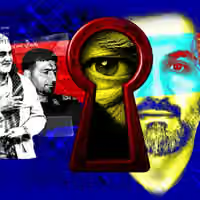
Jafar Pourkabgani, a lawmaker representing the southern Iranian province of Bushehr and a former longtime member of the IRGC and Basij, personally fired at protesters during nationwide demonstrations in January, witnesses told Iran International.
Armed forces opened fire on protesters on January 8 and 9 from the rooftops of the Quran Mosque, a nearby Basij facility and surrounding buildings on Ashouri Street in the city of Bushehr, witnesses said.
Several people who said they were present identified Pourkabgani as one of the armed men in the area. Some said he carried a handgun, while others described him as holding a Kalashnikov-style rifle.
One witness said Pourkabgani shouted “Labbaik ya Khamenei,” an expression of allegiance to then-Supreme Leader Ali Khamenei, as he fired.
Other accounts described the lawmaker as a leading figure among the armed personnel deployed in the area.
Gunfire against at least 19 people attributed to Pourkabgani
Accounts collected by Iran International attributed the shooting of at least 19 people to Pourkabgani. Witnesses said at least two of those struck by his gunfire have died.
It was not immediately possible to independently establish the identities of all those shot, the weapons used or the precise circumstances of the deaths.
Some residents of Bushehr refer to Pourkabgani by the nickname “Jafar the Axe,” according to local accounts.
Pourkabgani has longstanding ties to the Quran Mosque, one of the locations from which witnesses said gunfire was directed at protesters. Public accounts identified him as head of the mosque’s board of trustees for at least part of the period between 2014 and 2022.
Pressure on bereaved families
One local source with knowledge of the matter said that Pourkabgani visited the homes of some bereaved families after protesters were killed and sought to persuade them to say their children had been killed by “terrorists,” which the families rejected.
Pourkabgani has not publicly addressed the allegations that he personally fired at protesters or pressured bereaved families.
Decades in security and local government roles
Pourkabgani joined the IRGC in the early 1980s and subsequently held security, executive and political positions in Bushehr.
In 2004-05, while holding the rank of IRGC colonel, he headed the local Basij unit responsible for enforcing the Islamic Republic’s doctrine of “enjoining good and forbidding wrong.” Accounts of the unit’s activities included searches of homes, confiscation of equipment and arrests.
He served as governor of Bushehr from about 2005 to 2013 and headed the county’s election headquarters during the disputed 2009 presidential election.
Pourkabgani later served on the Bushehr City Council, including as its chairman, before entering parliament as the representative for Bushehr, Ganaveh and Deylam.
Residents have also said that he was involved in the authorities’ response to the November 2019 protests and the 2022 Woman, Life, Freedom protests.
During the 2022 protests, Pourkabgani was injured in a knife attack in Bushehr’s Kouti neighborhood while serving on the City Council.
Calls for harsh punishment
After the January 2026 protests, Pourkabgani publicly described demonstrators as “rioters” and the demonstrations as a “terrorist operation.”
He called on the judiciary to identify protesters and create official files on them, further demanding that they face the “harshest punishment.”
Viewers who contacted Iran International pointed to what they described as a stark contradiction between Pourkabgani’s position as a representative of the public and the allegations that he fired at the people he was elected to represent.
More than 36,500 Iranians were killed by security forces during the January 8-9 crackdown on nationwide protests, making it the deadliest two-day protest massacre in history, according to documents reviewed by Iran International's Editorial Board.
Iran International's Editorial Board confirmed the death toll on January 25 after reviewing classified documents, field reports, and accounts from medical staff, witnesses, and victims’ families.
Iranian protestors met with security forces during January uprisings.
As Iran confronts military pressure abroad and mounting economic strain at home, signs are emerging that the Islamic Republic is increasingly turning its attention to another potential threat: renewed unrest on its own streets.
While veteran hardliners are returning to key positions overseeing forces responsible for domestic repression, cobblestones are being ripped out of historic pedestrian areas and replaced with asphalt.
Municipal officials have described the work as traffic management, but Iran International reporter Mehdi Sepahvand’s reporting suggests it could make the areas easier for security forces to penetrate and control during unrest.
Analysts say the developments, against a backdrop of uncertainty over the country’s new leadership, suggest the state is thinking beyond the current war to the possibility of another confrontation at home.
The return of Hossein Taeb, one of the Islamic Republic’s most feared security figures, to command the Basij is perhaps the clearest signal.
Omid Memarian, a senior Iran analyst at the think tank DAWN, said Taeb’s return shows the state is prioritizing control of the population.
Photo of Hossein Taeb
‘An undeclared coup’
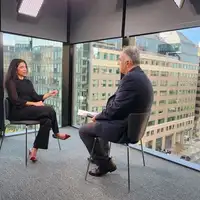
“They are very much nervous, concerned about people and their demands,” Memarian told Eye for Iran, adding that the leadership understands “the domestic situation can explode at any moment.”
Taeb, Memarian said, was brought back not to reconcile with Iranians, but to consolidate loyalists and signal that authorities are prepared to “crush any dissent.”
For Kamran Bokhari, a senior resident fellow at the Middle East Policy Council and strategic forecaster, the reshuffle raises a more fundamental question: who is making these decisions?
With Iran’s new Supreme Leader remaining unseen and unheard publicly, Bokhari questioned the extent of his authority and argued that a small group within the security establishment may effectively be running the system.
“The point is who is making these appointments?” he said.
Bokhari went further, describing the emerging arrangement as an “undeclared coup” by the Revolutionary Guards, in which he believes the IRGC is consolidating authority while preserving the appearance of a functioning constitutional system.
Jason Brodsky, policy director at United Against Nuclear Iran, offered a different reading, seeing a diffusion of power in the absence of a visible Supreme Leader capable of imposing decisions across the system.
Survival is not stability
Former CIA Iran specialist Mark Fowler said the Islamic Republic has absorbed severe military damage without collapsing.
“Surviving is winning for the Iranian regime right now,” Fowler told Iran International’s Eye for Iran.
But survival does not mean stability. With Washington seeking to intensify economic pressure, Fowler said there was no single inflation rate or economic threshold at which unrest became inevitable.
“It’s just a question of who cries uncle first,” he said.
Authoritarian governments can tolerate considerable hardship among their populations because their leadership is insulated from much of it, Fowler said.
“They’re more than happy to allow people to suffer,” he added.
Economic hardship does not automatically produce revolt. But the longer it persists, the more consequential the state’s ability to contain discontent becomes.
Beneath people’s feet
Perhaps the most striking sign cited by those who see preparations for future unrest can be found not in the leadership compound, but beneath people’s feet.
In central Tehran, cobblestones are being removed from historic pedestrian areas and replaced with asphalt.
The changes affect parts of central Tehran around District 12 and the Grand Bazaar, historically an important center of political mobilization, as well as areas near universities where students have repeatedly participated in protests.
Cobblestones can be dislodged and used as projectiles. Pedestrian streets also contain bollards, benches, trees and restaurant tables that can impede motorcycles and security vehicles while giving protesters places to congregate or seek cover.
Turning them into vehicle-accessible thoroughfares could change that equation.
“By changing these pedestrian zones into thoroughfares for cars, they are actually paving the way for swift action during protests,” Sepahvand said.
The changes, he added, create “plain sight and direct shooting range” for security forces.
Sepahvand said authorities have also put pressure on restaurants and gathering places where Iranians, including women appearing without mandatory hijab, have carved out small spaces of social freedom.
Those spaces allow communities to form, he said, something authorities understand can eventually translate into collective action.
“The government is sure that they are going to be facing more and more protests,” Sepahvand said.
The Islamic Republic is bringing veterans of repression back into senior positions, positioning the Basij for a greater domestic role and, according to Sepahvand’s reporting, altering public spaces in ways that could make future protests easier to suppress.
The Islamic Republic has survived the war so far. Its next test may come not from across its borders, but from the streets at home.