• العربية
  • فارسی
Brand
  • Iran Insight
  • Politics
  • Economy
  • Analysis
  • Special Report
  • Opinion
  • Podcast
  • Live TV
  • Iran Insight
  • Politics
  • Economy
  • Analysis
  • Special Report
  • Opinion
  • Podcast
  • Live TV
  • Theme
  • Language
    • العربية
    • فارسی
  • Iran Insight
  • Politics
  • Economy
  • Analysis
  • Special Report
  • Opinion
  • Podcast
  • Live TV
All rights reserved for Volant Media UK Limited
volant media logo

Trump calls off Iran talks as Tehran doubles down on Hormuz leverage

Maryam Sinaiee
Maryam Sinaiee

Iran International

Aug 18, 2026, 21:45 GMT+1
An illustration posted by US President Donald Trump on his Truth Social account on August 18, 2026.

President Donald Trump has halted diplomatic engagement with Iran until further notice, the White House said on Tuesday, as Tehran hardens its position over the Strait of Hormuz and presses Washington to meet its demands.

Trump said Tuesday on Truth Social that no conversations with Iran were taking place and none were scheduled, adding that the US naval blockade remained “in full force and effect.”

A White House official later told Semafor that Trump’s post amounted to calling off talks with Tehran “for the foreseeable future.”

The move came as the 60-day period set by the Islamabad memorandum for reaching a final agreement reached its stated end. Iranian officials, however, dispute that the negotiating clock ever formally began, arguing that Washington failed to fulfill the commitments required for negotiations to start.

Iranian Foreign Ministry officials say the United States initially fulfilled only commitments concerning the lifting of restrictions on Iranian oil sales and the naval blockade before abandoning them, while failing to implement its other obligations altogether.

They therefore argue that negotiations with Washington never began and that the 60-day period cannot be considered to have expired in the manner described in media reports, although the memorandum says the two sides committed to reaching a final deal within a maximum of 60 days, extendable by mutual consent.

Citing that argument, the state-run IRNA news agency wrote Tuesday that although the Islamabad memorandum is not currently being implemented, it could still serve as a basis for returning to negotiations and ending the war.

“All it takes is the will on the American side to implement all of its commitments,” IRNA wrote.

Earlier in the day, Tehran-based news website Rouydad24 similarly argued that the end of the 60-day period did not necessarily mean the end of diplomacy.

The intensification of the naval blockade and economic pressure, Trump’s threat to take military action against Oman if it “gets in the way” of his administration’s dealings with Tehran, and his references to back-channel contact with the Revolutionary Guards suggested that pressure and diplomacy could still proceed simultaneously, it said, with the Strait of Hormuz emerging as Iran’s main bargaining tool.

“The existence of back-channel contacts with Iran, Oman’s efforts, and continued messaging from Pakistan and Qatar show that the path of diplomacy has not been completely closed,” Rouydad24 wrote.

It added that “the end of the 60-day period may perhaps be better understood not as the end of negotiations, but as the end of one model of negotiations.”

The editorial warned, however, that the challenge was no longer simply returning to the negotiating table. The question was whether the two sides could turn a combination of pressure, threats and confidential channels into an agreement before an incident in Hormuz or elsewhere in the region pushed the confrontation beyond their control.

‘New American Territory’

Trump on Tuesday posted, without explanation, a map showing Iran’s southern coastline, the Persian Gulf, the Gulf of Oman and the Strait of Hormuz, with the waterway circled and the words “NEW AMERICAN TERRITORY.”

For Tehran, the posts reinforced the argument that Washington is seeking to change the terms of the confrontation through pressure, making control over Hormuz an increasingly important bargaining asset.

Iranian parliament speaker and top negotiator Mohammad Bagher Ghalibaf said on Tuesday that Washington was increasing pressure on Tehran in an effort to secure concessions that were not part of the Islamabad memorandum of understanding.

“Americans think squeezing Iran harder will win concessions that were never part of the agreement,” Ghalibaf wrote on X.

“Bessent and Hegseth are way out of their league. Stop waiting for the clown crew to pull a rabbit out of their hat and clean up the mess you made,” he added, referring to US Treasury Secretary Scott Bessent and Secretary of War Pete Hegseth.

Kazem Gharibabadi, Iran’s deputy foreign minister, also responded to Trump while also referring to the long-running dispute over the name of the Persian Gulf.

“Just as Trump correctly wrote the name of eternal Persian Gulf, his illusions about the Strait of Hormuz will soon be corrected, or we will correct the delusions of this delusional man,” Gharibabadi wrote.

Hormuz remains closed

Ghalibaf also responded to Trump’s statements during an online parliamentary session broadcast on state television Tuesday, saying Tehran was using “the logic of power,” while coordinating its military and diplomatic efforts, to force the United States to accept its demands.

He said the Strait of Hormuz would remain closed until US commitments under the memorandum were implemented, including lifting the blockade, releasing frozen Iranian assets, lifting oil sanctions and ending threats and military operations on all fronts.

Ali Gholhaki, a political activist close to Ghalibaf, wrote on X on Tuesday that Iranian officials had decided in “recent meetings” that traffic through Hormuz should operate “completely according to an Iranian mechanism,” meaning only through the northern route controlled by Iran.

He said senior Iranian officials had linked reopening the Strait to “the complete lifting of the blockade,” “the release of Iran’s frozen assets” and “the lifting of sanctions.”

“A difficult and complicated step, but perhaps achievable!” he wrote.

Gholhaki also suggested that Trump’s earlier threat to bomb Oman could indicate that Muscat had agreed to an arrangement giving Iran control over passage through the Strait.

Iranian Foreign Ministry spokesman Esmail Baghaei said in recent days that Tehran and Muscat were moving closer to an agreement on a safe route for ships to pass through Hormuz.

Washington has objected to elements of the emerging Iran-Oman arrangement, including proposals involving joint management of maritime traffic and the collection of fees from vessels, underscoring the extent to which control of the waterway has become part of the wider confrontation.

Hormuz as economic leverage

Nour News, a website close to Iran’s Supreme National Security Council, argued Tuesday that Iran had succeeded in transferring the cost of disruption in the Strait to global markets and the US economy, potentially creating political costs for the Trump administration ahead of the US midterm elections.

“From this perspective, Iran’s main leverage is not military competition with the United States, but its ability to turn the geography of Hormuz into an economic and political cost for Washington,” Nour News wrote.

The argument suggests that Tehran’s strategy depends less on matching US military power than on making the consequences of continued confrontation sufficiently costly for Washington, with Hormuz serving as the main mechanism through which it seeks to exert that pressure.

Most Viewed

US rules out Iran truce extension as Tehran official sets new deadline
1

US rules out Iran truce extension as Tehran official sets new deadline

2
ANALYSIS

To survive maximum pressure, Iran kept pumping and broke its oil company

3

State TV host sparks backlash over ‘southern Iran for southern Lebanon’ remark

4
EXCLUSIVE

Leaked audio: Iran's Basij brace for new protests and fear being named online

5
INSIGHT

Forced to serve in the IRGC, now fighting to stay in Canada

Banner
Banner

Spotlight

  • For Iranian journalists, exile can last a lifetime
    OPINION

    For Iranian journalists, exile can last a lifetime

  • Seven months on, January protests still shape Iranians’ lives
    VOICES FROM IRAN

    Seven months on, January protests still shape Iranians’ lives

  • Forced to serve in the IRGC, now fighting to stay in Canada
    INSIGHT

    Forced to serve in the IRGC, now fighting to stay in Canada

  • Iran’s ‘infiltration’ bill sparks backlash over sweeping reach

    Iran’s ‘infiltration’ bill sparks backlash over sweeping reach

  • To survive maximum pressure, Iran kept pumping and broke its oil company
    ANALYSIS

    To survive maximum pressure, Iran kept pumping and broke its oil company

  • They carry the evidence of Iran’s crackdown on their bodies

    They carry the evidence of Iran’s crackdown on their bodies

Banner
•
•
•

More Stories

US rules out Iran truce extension as Tehran official sets new deadline

Aug 17, 2026, 22:11 GMT+1
100%
US President Donald Trump boards Air Force One in a file photo posted by the White House on X on Aug. 9, 2026.

The 60-day period associated with the Iran-US interim peace deal ended Monday without a breakthrough, with Washington rejecting an extension and a senior Iranian official saying the US had a few weeks to meet the agreement’s terms before further talks.

President Donald Trump said he did not expect Iran to agree to the kind of deal he considered necessary and again made preventing Tehran from obtaining a nuclear weapon the central US demand.

“They’re not going to make the kind of a deal that I feel is necessary,” Trump said Monday. “Iran cannot have a nuclear weapon. And they won’t have a nuclear weapon.”

Asked whether Washington wanted to extend the interim agreement, Trump replied: “No.”

He also said the United States had “total control” over the Strait of Hormuz through its naval blockade.

Tehran disputes 60-day deadline

Foreign Ministry spokesperson Esmaeil Baghaei disputed the characterization of Monday as the expiry of the memorandum itself, although the text of the agreement says the two sides committed to achieving a final deal within a maximum of 60 days, extendable by mutual consent.

Baghaei insisted that the 60-day period linked to the Islamabad memorandum had been intended for negotiations and was no longer relevant because Washington had breached the agreement.

He said the memorandum contained no formal 60-day deadline and that Iran would not make decisions in response to ultimatums.

Foreign Minister Abbas Araghchi had said Friday that the memorandum referred to an “end to the war,” rather than a 60-day ceasefire requiring an extension.

Iran gives US ‘a few weeks’

A senior Iranian official told Reuters that Iran had set a period of “a few weeks” for Washington to fully implement the memorandum before further negotiations could take place.

“Within the short period of a few weeks set by Iran, all the agreement’s provisions must be implemented by the US. This is a precondition for further negotiations with the US,” the official said.

Reuters reported, citing the official, that Iran had adopted a “fully offensive” posture and would be prepared to escalate in the Strait of Hormuz and across the region if diplomacy failed.

The official said Tehran’s timeframe would be conveyed to Washington and regional governments through mediators.

Contacts continue without agreement

Trump also confirmed that his administration had established a direct backchannel with the Revolutionary Guards and said he was “not in a hurry” to end the war. The IRGC later denied that talks with US officials were under way.

Trump envoy Jared Kushner said later Monday that US conversations with different parts of the Iranian government were probably “more robust than ever,” but that the two sides had yet to reach an understanding.

Oil prices also rose Monday as investors grew more pessimistic about efforts to end the Iran war and shipping through the Strait of Hormuz remained constrained.

WTI settled 2.5% higher at $84.50 a barrel, while Brent rose 2.7% to $90.87, the Wall Street Journal reported. Gains accelerated after Iranian state media reported that an Emirati oil tanker had been seized in the strait.

Sanctions alone cannot topple Iran’s regime, former Treasury official says

Aug 15, 2026, 03:35 GMT+1
•
Kambiz Tavana
100%
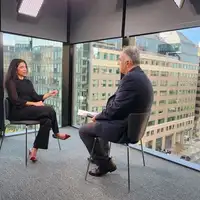
Kerri Bitsoff (left) in an interview with Iran International's Kambiz Tavana in Washington DC on August 13, 2026.

Sanctions can make Iran’s military and nuclear activities costlier and more difficult but cannot bring down the Islamic Republic on their own, former US Treasury official and weapons procurement expert Kerri Bitsoff told Iran International.

“Sanctions can't topple a regime on their own. That's not what they're for,” said Bitsoff, who previously worked at the Treasury Department’s Office of Foreign Assets Control, the agency responsible for administering and enforcing US economic sanctions. “They are intended to increase pressure.”

For Bitsoff, who worked on nonproliferation and weapons procurement at OFAC and is now executive director of investigations at TANGOS, the distinction is central to understanding what decades of US sanctions against Iran can and cannot accomplish.

Rather than expecting sanctions themselves to produce political change, she said their effect should be measured by how much they increase the cost and difficulty of the activities Washington is trying to constrain.

“They make everything that the regime does related to those more expensive, slower and more difficult to obtain,” she said, referring to activities such as Tehran’s nuclear and weapons programs. Sanctions, she added, are also intended “to set conditions for something else to happen” and “can't be alone.”

That argument comes after years in which successive US administrations have expanded, eased or more aggressively enforced different layers of sanctions against the Islamic Republic. Washington restored broad nuclear-related sanctions after withdrawing from the 2015 nuclear deal in 2018, targeting areas including Iran’s banking, energy and shipping sectors. President Donald Trump launched a renewed “maximum pressure” policy in February 2025, directing the Treasury Department to pursue a “robust and continual sanctions enforcement campaign” aimed at denying Tehran and its allied groups access to revenue.

Bitsoff said those measures should not be judged simply by how many Iranian individuals, companies or organizations Washington places on sanctions lists.

Enforcement matters more than numbers

“Numbers are not a good measure of the impact of sanctions and whether they are important,” Bitsoff said. “You can sanction thousands of individuals and entities within Russia, within Iran, within North Korea, and that's not really the answer.”

The more meaningful test, she said, is whether sanctions change the behavior of actors outside the targeted country — the banks, buyers, suppliers, shipping companies and intermediaries that allow sanctioned governments to continue obtaining money and material.

That often requires Treasury officials to identify specific weak points in complex networks rather than simply placing restrictions on an entire sector. Bitsoff described sanctions policy as operating on two levels: broad measures designed to restrict areas such as oil revenue or access to the financial system, and day-to-day operational measures targeting individual transactions, companies and procurement networks.

Weapons procurement provides one example of how that pressure works. Sanctions may not stop Iran from producing a missile or drone, Bitsoff said, but they can increase the cost of securing the components needed to build them and force manufacturers to rely on inferior alternatives.

“You raise the cost of procuring parts and components,” she said. “You force them to get worse parts and components, so their finished weapons are less effective.”

The effects can take years to become visible, she said, and may eventually be measured in missile failure rates or the ability of adversaries to jam drones and develop other countermeasures.

Iran’s reliance on foreign components has remained a focus of US sanctions. Treasury actions in 2025 and 2026 targeted networks in China, Hong Kong, the UAE and elsewhere accused of supplying Iran with drone components, missile propellant ingredients and other military goods. In June, OFAC sanctioned another group of China- and Hong Kong-based individuals and companies it said had supported weapons procurement for the Revolutionary Guards and Iran’s defense ministry.

Oil sanctions work differently, Bitsoff said. Rather than necessarily preventing a barrel of Iranian crude from reaching a customer, the restrictions can make every stage of that journey more expensive.

An Iranian shipment may have to pass through several intermediaries, rely on aging tankers carrying higher insurance costs, undergo ship-to-ship transfers and be sold at a discount to a limited pool of buyers willing to accept the risk of dealing in sanctioned oil. Ship managers, operators and others involved in the trade may also demand premiums because they risk becoming sanctions targets themselves.

“By the end of it,” Bitsoff said, Iran can be forced to absorb a “huge discount,” meaning export volumes alone do not provide a complete measure of whether sanctions are working.

The US Treasury has described many of the same methods in its recent actions against Iran’s oil trade, citing front companies, intermediary brokers, ship-to-ship transfers, falsified documents and manipulation of vessel identities. In April, Treasury said China was buying about 90% of Iran’s oil exports and that independent Chinese refineries, commonly known as teapots, accounted for most of those purchases.

Bitsoff said enforcement can therefore be thought of as a dial that Washington can turn up or down even when the underlying sanctions remain on the books.

She pointed to the period after the United States left the nuclear agreement in 2018, when tougher enforcement drove major buyers with exposure to the US financial system away from Iranian oil.

She contrasted that with the early years of the Biden administration, when she argued Washington eased enforcement as it sought to revive negotiations with Tehran, allowing Iran’s oil trade with China to adapt around smaller buyers with less exposure to the US financial system.

“The whole idea is to change behavior,” she said. “You don't wanna just sanction something and then walk away.”

Without continued enforcement, she said, companies treat a designation as a one-time event and find ways to adjust their operations around it. “If you don't keep up with that, if you don't make that enforcement visible, people are just going to keep doing what they want to do.”

Iran's sanctions evasion machine

Keeping up has become more difficult because Iran has spent years developing mechanisms to circumvent the restrictions imposed on it, Bitsoff said, describing a system largely developed by the Revolutionary Guards and the broader state during the intense sanctions pressure of the early 2010s.

“They have a sanctions evasion machine that works pretty well,” she said.

The core of that system has remained relatively consistent, relying on shadow banking, buyers willing to trade with Iran and efforts to avoid transactions vulnerable to the US financial system. But Bitsoff said Tehran has repeatedly adapted the mechanics when new opportunities appear, from deceptive tanker practices and cash smuggling to newer methods involving cryptocurrency.

“The pattern I can discern is that they'll just use anything at their disposal to evade sanctions,” she said.

China now occupies an especially important place in that system, both as the dominant destination for Iranian oil and as a source of components used by Iran’s military industries. The Treasury Department has increasingly targeted Chinese refiners, ports, shipping companies and procurement networks as part of the maximum-pressure campaign, including a June action against China- and Hong Kong-based actors accused of facilitating weapons purchases for the IRGC and defense ministry.

“Most evasion of sanctions, especially related to Iran, happens through China,” Bitsoff said. “Those are the front companies that move money. They're the buyers of oil. They're the suppliers of weapons components.”

That makes pauses in enforcement against China particularly significant, she argued, because companies and intermediaries watch US actions when deciding how much sanctions risk they are prepared to accept.

Bitsoff said this helps explain why sanctions cannot be regarded as an on-off mechanism capable either of completely stopping Iran’s activities or, at the other extreme, being dismissed as ineffective because those activities continue. Their purpose, in her view, is degradation: reducing revenues, increasing costs and making military and nuclear programs harder to sustain.

That pressure also has a domestic dimension, she said, because Iran’s leadership must contend with economic mismanagement while the public sees resources being directed toward military programs and allied armed groups rather than economic opportunity at home.

“The population knows that it's funneling money not to them, not to economic growth, not to opportunities, but back to its proxies, back to its nuclear program, back to its weapons program,” Bitsoff said.

But she stopped short of arguing that economic pressure can determine the Islamic Republic’s political future. Instead, she said sanctions can help establish the conditions in which other forces operate, with political change ultimately depending on Iranians themselves.

“The Iranian people are the ones that have to use that pressure,” Bitsoff said, adding that alongside sanctions, the United States should be “thinking of any possible way we can support that.”

Democrats turn Iran war costs against Trump as midterms near

Aug 14, 2026, 04:08 GMT+1
100%
A board displays gas prices amid the ongoing conflict with US-Israeli conflict with Iran, in Washington D.C., U.S., March 15, 2026.

US Democrats appear to be sharpening their attacks on President Donald Trump over the economic fallout from the Iran war as rising fuel and household costs become an increasingly potent issue ahead of November’s midterm elections.

The growing criticism comes as the national average gasoline price has again climbed above $4 a gallon and Democrats show signs of eroding what has traditionally been a Republican advantage with voters on the economy. Gas prices have risen by more than 25% since the Iran war began in February.

Rep. Nikki Budzinski of Illinois pointed Thursday to the latest increase in gasoline prices, saying the national average had reached a record for this point in the year.

“The national gas average just hit a historic high for this time of year—more than $4 a gallon,” she wrote on X. “Families in Central Illinois are paying the price of the war in Iran every single time they pull up to the pump.”

Rep. Andrea Salinas of Oregon said American farmers spent $1.4 billion more on diesel during the spring planting season than a year earlier, blaming the increase on the conflict.

“With Trump’s ILLEGAL war pushing fuel prices higher and higher, growers are the ones paying the price,” she wrote.

The attacks come as polling suggests the economy is becoming an increasingly difficult issue for Trump and Republicans three months before the November 3 midterms.

A Reuters/Ipsos poll released this month found 37% of registered voters preferred Democrats’ approach to the economy, compared with 36% who favored Republicans—the first Democratic advantage on the issue in roughly a decade.

A separate Washington Post/Ipsos poll last month found the economy and high prices were the most commonly cited factors in voters’ midterm choices, mentioned by 54% of registered voters. Only 33% approved of Trump’s handling of the economy, against 65% who disapproved.

Rep. Jim McGovern of Massachusetts sought to connect the war with Trump’s broader economic agenda, including tariffs and tax policy.

“Trump promised to lower prices on day one,” McGovern wrote. “Instead, his billionaires-first economic policies, stupid tariffs & illegal war with Iran are pushing prices to record highs.”

“His policy choices are making your life more expensive while the ultra rich do better than ever before,” he added.

Inflation eased slightly in July but remained above levels seen before the Iran war, while consumer prices have now risen faster than wages for four consecutive months.

Sen. Bernie Sanders sharpened the argument by contrasting federal spending on the war and tax cuts with the cost pressures facing households.

“$900 million for White House vanity projects? Approved. $1 trillion tax cut for the 1%? Approved. $1 trillion for war with Iran? Approved,” Sanders wrote.

“Lower grocery, housing or gas prices? Sorry, you're on your own. Money for billionaires. Money for war. Nothing for working people.”

The growing Democratic focus on gasoline, groceries and the Iran war suggests the party sees an opportunity to turn an issue that helped return Trump to the White House in 2024 against Republicans in November.

'Better than nukes'? Iran digs in on Hormuz as US deal nears end

Aug 14, 2026, 03:20 GMT+1
•
Maryam Sinaiee
100%
A vessel near the Strait of Hormuz, as seen from Musandam

Iran is doubling down on control of the Strait of Hormuz, with some in Tehran now arguing the strategic leverage it provides is more valuable than a nuclear weapon.

Tehran’s drive to turn that control into lasting economic and political leverage—through shipping routes, mine clearance and potentially revenues from passing vessels—is emerging as a major obstacle to extending its fragile memorandum with the United States, which expires Sunday.

Washington, meanwhile, increasingly claims it has broken Iran’s control of Hormuz.

The June 18 memorandum is formally due to expire on August 16. President Donald Trump pronounced it over after Iran attacked three ships in the Strait of Hormuz, ordering more strikes and the resumption of the US maritime blockade.

Neither side, however, has formally abandoned diplomacy. If no extension is announced before Sunday, the current state of neither war nor peace could continue. An explicit declaration that the arrangement has ended could increase the risk of renewed attacks.

‘More valuable than a nuke’

Pressure against concessions over the strait is also growing inside Tehran.

Parliament’s National Security and Foreign Policy Commission this week unanimously approved the broad outlines of legislation that would tighten Iran’s control over Hormuz.

The bill includes provisions for inspecting vessels in Iranian territorial waters, banning the passage of assets, equipment and vessels belonging to the United States, Israel and other countries Tehran deems hostile, and charging ships for maritime services.

If enacted, the legislation could constrain Tehran’s room for compromise, much as legislation passed during Hassan Rouhani’s presidency required his government to increase uranium enrichment and suspend implementation of the Additional Protocol unless banking and oil sanctions were lifted.

Alireza Salimi, a member of parliament’s presiding board, told the ISNA news agency Thursday that “the Strait of Hormuz is currently more valuable to Iran than an atomic bomb,” describing it as leverage for lifting sanctions and securing compensation for wartime losses.

Demands put talks in doubt

The tougher approach was also reflected in demands laid out shortly before his departure by Mohammad Bagher Zolghadr, the former secretary of the Supreme National Security Council.

Zolghadr said reopening the strait would require an end to attacks on Iran and its allies, the lifting of the blockade, the withdrawal of US forces from around Iran, sanctions relief, the release of frozen Iranian assets and compensation for damage caused by the wars.

It remains unclear whether those demands represented his personal position or that of the SNSC, and whether his successor, Mohsen Rezaei, will pursue the same approach.

Rezaei’s appointment this week, along with other changes at the top of Iran’s security establishment, has been welcomed by hardline opponents of the government’s approach to negotiations.

Former diplomat Kourosh Ahmadi wrote in the Shargh newspaper that if Tehran insisted on the conditions outlined by Zolghadr, “it is highly unlikely that there will be any serious negotiations between Tehran and Washington at all.”

Both sides claim control

The dispute is unfolding as Tehran and Washington offer directly competing accounts of who actually controls Hormuz.

Trump said Wednesday that the United States had complete control of the waterway and that the maritime blockade had deprived Iran of the ability to act.

The spokesman for Iran’s Khatam al-Anbiya Central Headquarters, the country’s wartime command center, rejected that assertion Thursday, saying the strait remained under Iranian control and that no vessel could pass safely without authorization from Iran’s armed forces.

Shipping-monitoring data show traffic remains a fraction of pre-war levels. Around 10 to 12 vessels have been crossing the strait daily in recent days, compared with roughly 130 to 140 before the war, with most currently using a route designated by Iran.

Tehran has also stressed that an agreement with Oman over shipping routes would not by itself be sufficient to reopen the strait.

Ali Gholhaki, a political activist close to parliament speaker and senior Islamabad negotiator Mohammad-Bagher Ghalibaf, said Iranian decision-makers currently had no intention of reopening the waterway and had blocked an agreement with Oman because of what they viewed as Muscat’s alignment with Washington.

Tehran and Muscat at odds

The disagreement with Oman offers perhaps the clearest illustration of what Tehran now wants from its control of Hormuz.

Iran has pushed for control over shipping routes and mine clearance and for mandatory payments from vessels using the waterway. Oman has instead favored a joint fund supported by voluntary contributions from governments and companies benefiting from shipping.

Few in Tehran expect Muscat to accept Iran’s terms. Ahad Azadikhah, a lawmaker aligned with Ghalibaf, recently told Khabar Online that if Oman did so, the Islamic Republic would have achieved “the victory of all victories.”

The dispute means Hormuz is increasingly intertwined with the fate of the wider Tehran-Washington dialogue. As Iran seeks to turn control of the strait into leverage over sanctions, compensation and any broader settlement, Washington may increasingly see that same leverage as something that must be neutralized before a deal can be reached.

Iran could prolong war to outlast Trump, IRGC adviser says

Aug 12, 2026, 19:08 GMT+1
100%
Senior Iranian commander Mohammad Reza Naghdi speaks to PBS

A senior adviser to the commander of Iran's Revolutionary Guards said Tehran could deliberately prolong the war until US President Donald Trump leaves office to wear down its adversaries and deter future attacks.

"One way is to prolong this war until we get to the next term of the presidency and cause attrition, so that if anyone else wants to attack Iran, they will know there is a cost," Mohammad Reza Naghdi told PBS NewsHour on Tuesday.

Naghdi made the comment after being asked directly whether Iran's objective was to drag out the war and wait until Trump was out of office.

He said Iran needed to establish enough deterrence to prevent future attacks.

"We have to attain deterrence so that the enemy never dares to attack us, so we can live with security," he said.

Civilian ships in Strait of Hormuz

Naghdi also defended attacks by Iranian forces on non-military vessels attempting to cross the Strait of Hormuz.

Asked why Iran had attacked civilian ships on at least two occasions this week, Naghdi said Tehran needed to control shipping routes during wartime.

"When we are at war, vessels need to pass through a region we can control," he said. "When they leave an area that we control, it could be that they're transporting supplies for the enemy."

Asked whether attacking civilian vessels violated international law, Naghdi said Iran had the right to control routes it viewed as a threat during a war.

"When you're in a state of war, any thoroughfare deemed to be a threat, we can control it," he said.

His comments came as shipping through the Strait of Hormuz has fallen sharply amid the conflict and attacks on commercial vessels.

Khamenei absence due to security, Naghdi says

Naghdi was also asked why Supreme Leader Mojtaba Khamenei had not appeared publicly during the war.

"Naturally, it is due to security," Naghdi said when asked whether his absence was for security reasons. "Certainly, there is no other reason."

Asked whether he had personally seen Khamenei, Naghdi declined to answer.

"Let's leave this matter alone," he said.

PBS said it asked the White House for a response to Naghdi's remarks.

"It would be wise for Iran to agree to a deal," the White House said in a statement cited by PBS, adding: "Otherwise they know what will happen."