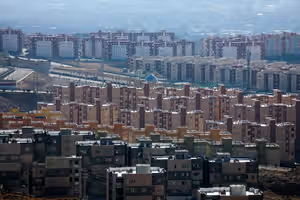
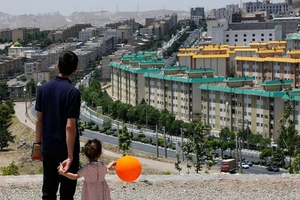
Some luxury apartments in northern Tehran are being advertised above the price of central Munich or Sydney: 25 billion rials, about $13,228, per square meter, according to Farhikhtegan newspaper, which examined the listings.
Eleven of 16 properties examined in the affluent neighborhoods of Aghdasiyeh and Elahiyeh were advertised above 10 billion rials ($5,291) per square meter, the Iranian daily said on Wednesday.
It has to be noted that the Tehran figures are sellers' asking prices for a small selection of high-end properties, not completed transactions, while the international figures represent broader city-center apartment prices.
Average asking prices across Tehran were around 2.3 billion to 2.5 billion rials ($1,217-$1,323) per square meter, with completed sales likely to be lower than advertised prices, Farhikhtegan said.
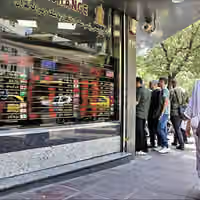
Monthly salaries for many Iranian workers are commonly put at around 200 million to 250 million rials, equivalent to roughly $105 to $132.
A luxury house in northern Tehran
Multimillion-dollar properties in northern Tehran
A 500-square-meter property in Aghdasiyeh was advertised at 15 billion rials ($7,937) per square meter, giving it a total asking price of around 7.5 trillion rials ($3.97 million), according to the newspaper.
Another property measuring 600 square meters was offered at 18 billion rials ($9,524) per square meter, or approximately 10.8 trillion rials ($5.71 million).
An 850-square-meter residential property marketed for redevelopment carried an asking price of 22 billion rials ($11,640) per square meter, putting the entire property at about 18.7 trillion rials ($9.89 million).
Prices in the sample climbed further in Elahiyeh. A 2,000-square-meter property marketed for redevelopment was advertised at 25 billion rials ($13,228) per square meter, equivalent to about 50 trillion rials ($26.46 million).
A 510-square-meter unit in a residential tower carried the same per-square-meter price, taking its total asking price to roughly 12.75 trillion rials ($6.75 million).
Tehran luxury prices overtake selected global cities
Farhikhtegan separately estimated luxury residential property in northern Tehran at $13,369 per square meter and compared that figure with average apartment prices across 30 cities.
Munich stood at $13,217 per square meter and Sydney at $13,067, according to the comparison. Shenzhen followed at $12,947, Taipei at $12,922 and Luxembourg at $12,793.
The Tehran estimate draws on luxury properties in some of the capital's most expensive neighborhoods, while the international figures cover broader city-center apartment markets.
International data focused specifically on luxury housing paints a different picture.
Knight Frank's Wealth Report 2026 defines prime property as the most desirable and expensive homes in a market, generally representing the top 5% by value.
Its data show that $1 million bought 42.1 square meters of prime residential property in Sydney at the end of 2025, implying a value of about $23,800 per square meter. The equivalent figures were about $30,400 in London, $29,500 in New York and $16,100 in Dubai.
Those figures put northern Tehran's listings in a different context. At an open-market exchange rate of around 1.89 million rials to the dollar, a property advertised at 25 billion rials per square meter was equivalent to about $13,228, below the prime residential values recorded by Knight Frank in Sydney, London, New York and Dubai.
The contrast highlights how Tehran can appear more expensive than Sydney when selected high-end listings in the Iranian capital are compared with average city-center apartments abroad, but cheaper when measured against Sydney's prime residential segment.
Tehran is not included in Knight Frank's international prime residential index, meaning no standardized ranking between the Iranian capital and the cities covered by its data is available.
Dollar pricing reaches high-end property market
The rial's depreciation has also led some owners of expensive properties to advertise rents or sale prices directly in dollars, Farhikhtegan said.
Previous listings cited by the newspaper included furnished apartments offered for monthly rents of roughly $1,100 to $4,200, with some landlords seeking dollar payments to limit the erosion of rental income as the rial loses value.
A luxury house in northern Tehran
However, most residential sales and rental agreements remain denominated in Iran's currency.
The growing divide between incomes and housing costs has reshaped living arrangements for some Iranians, pushing tenants to cheaper cities or Tehran’s outskirts, back into their parents’ homes, or into shared apartments to split expenses.
A police officer closes the entrance of RAF Akrotiri, a British sovereign base in Cyprus, which was hit by a drone overnight on March 2, 2026.
Iran has considered attacking military targets in Europe if US President Donald Trump escalates the war, the Financial Times reported on Wednesday, citing two insiders.
Iranian forces had assessed possible strikes against US assets in southeastern Europe, including Bulgaria, which approved the use of Bezmer Air Base by US refueling aircraft last month, the sources said.
Cyprus, where a British air base was hit by a drone in March, was also identified as a potential target for retaliation against a renewed US offensive, according to one of the sources.
Iran’s forces had separately examined attacks on subsea fiber-optic cables in the Strait of Hormuz if the conflict intensified, according to the report.
One source said Tehran was preparing to expand the war if Trump acted on threats to attack Iranian infrastructure. The other said Iran would place “no limits” on its response to US military action.
The sources described last month’s strike on a US base in Jordan, which killed three American service members, as Tehran’s most accurate long-range attack to date and evidence of its ability to hit targets farther afield.
“This was also a message to Europe: it can receive missiles, so it should know where it should stand in this war,” the first insider said. “A very big mistake, such as hitting our infrastructure, could make the war go beyond the region and reach Europe.”
Iran has not publicly confirmed the reported plans.
Military analysts told the FT that Iran could target US assets in southern and southeastern Europe with medium-range ballistic missiles, but questioned their accuracy and Tehran’s stockpile of longer-range weapons.
Iran’s recent elevation of hardliners to senior security and military posts has also deepened expectations within Tehran of renewed conflict, according to the report.
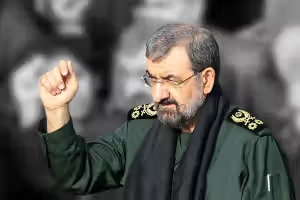
Referring to Mohammad Bagher Ghalibaf, Tehran’s chief negotiator, and Mohsen Rezaei, Iran’s top security chief, the second insider said Iran “is sending a clear message that if you don’t reach an agreement with Ghalibaf, you have to deal with Rezaei.”
“The message is: ‘Don’t be mad, because I’m madder than you are.’”
Meanwhile, negotiations over reopening the Strait of Hormuz remained stalled and Trump said there were no talks scheduled with Tehran.
US President Donald Trump seated next to Pete Hegseth
With the 60-day period set by the June US-Iran memorandum now over and no final agreement in place, Washington faces a choice between intensifying pressure, renewing major strikes or settling into a prolonged and unstable holding pattern.
President Donald Trump said Tuesday that there were “no talks or conversations going on, or scheduled” with Iran and that the US naval blockade remained in force.
A White House official told Semafor that Trump’s Truth Social post amounted to calling off talks with Iran for the foreseeable future.
The message appeared to contradict Jared Kushner, who just a day earlier described contacts with different parts of the Iranian government as unusually “robust” and spoke of “very positive and active conversations.”
The IRGC, meanwhile, has denied Trump’s claim that US officials were holding back-channel talks with Revolutionary Guard officials.
The conflicting accounts underscore one of the central uncertainties after the 60-day deadline passed: how much of the confrontation visible in public reflects what may be happening behind the scenes.
Interviews with three analysts and former officials suggest the end of the 60-day period does not necessarily leave Washington with a binary choice between launching another major offensive and walking away.
A third possibility is emerging: an extended and highly unstable holding pattern in which Washington intensifies economic pressure, maintains the blockade and avoids a return to the intensive military campaign seen earlier in the conflict, while retaining the option of renewed strikes.
Neither war nor peace
Former US Ambassador John Craig said he believes Trump has been persuaded by his military and foreign-policy advisers that further major military action would not necessarily resolve the conflict, particularly the nuclear issue.
“I think this is going to go on for quite a while, simply because there doesn't seem to be any other alternative,” Craig told Iran International.
Craig described that status quo as one in which the United States continues trying to keep ships, oil and goods moving through the Strait of Hormuz while Iran carries out lower-level attacks and probes against regional targets, all without a meaningful diplomatic process capable of producing an agreement.
“So no peace,” Craig said. “Not very high level of attacks and kinetic actions, but still no agreement and no process — even more important, no process to find an agreement.”
But Craig stressed that what is visible may tell only part of the story.
He said it is impossible to know what preparations could be taking place during the apparent lull, including whether new targeting packages are being assembled, intelligence operations are underway or assistance is being provided to people inside Iran.
“We don't know everything that is going on,” Craig said.
Ilan Berman, senior vice president of the American Foreign Policy Council, similarly said the current situation could persist well beyond the end of the 60-day period.
“I have the growing feeling that this status quo could persist for some time,” Berman told Iran International.
One reason, he said, is domestic US politics. With midterm elections approaching, the opportunity for attempting a quick and decisive conclusion to the conflict may already have passed.
Instead, Washington may increasingly conclude that time is on its side.
Berman said countries around the Persian Gulf, Central Asia and elsewhere are also using this period to build infrastructure and alternative transport corridors aimed at reducing vulnerabilities exposed by the conflict, particularly the dependence of global trade on the Strait of Hormuz.
“This isn't a great situation,” Berman said, “but time ends up working for Washington and not for Tehran.”
Can economic pressure break the stalemate?
Iran's economy is already under extraordinary pressure.
Iran's annual inflation reached 66% in July, while food prices rose 128% year-on-year, according to the Statistical Center of Iran, severely eroding household purchasing power.
Those pressures are being compounded by sanctions, the naval blockade, disruption to Iran's energy trade and the prospect of another round of US economic measures.
For Washington, that raises the possibility that time itself, combined with escalating economic pressure, could accomplish what another major military offensive may not.
Berman described Iran's economic crisis as potentially “the transformative variant,” arguing that the danger for the government grows as the rial loses value, purchasing power collapses and basic foods become increasingly unaffordable.
“This is not a sustainable condition,” he said.
But he cautioned that economic deterioration does not automatically produce political upheaval. Tehran can attempt to soften the impact through currency measures, trade arrangements and other economic interventions.
What has changed, Berman argued, is the nature of the leadership confronting those pressures. He described the current system as increasingly rigid and militarized, leaving it potentially less willing to prioritize domestic economic development.
Casey Babb, a senior fellow and director at the Macdonald-Laurier Institute, described the current moment as a “very uncertain and fragile holding pattern.”
He said Washington could combine substantially greater economic pressure with military capabilities it has so far chosen not to fully deploy.
But Babb cautioned that economic warfare carries consequences far beyond Iran's leadership.
“There is a human cost to that as well,” he said. “Innocent Iranians are going to suffer from that as well and already are.”
Babb said the United States clearly does not want a costly conventional ground war, while Iran's leadership has shown little indication that it is prepared to make the concessions Washington is seeking.
“It will take something probably quite significant for the regime to behave differently,” Babb said.
When does the shooting start again?
None of the analysts interviewed for this story suggested the current lull means the military confrontation is over.
Berman went further, saying he expects US strikes against Iran to happen again.
“The question to me is not whether or not there are going to be strikes again, because I think there will be,” he said.
The more important question, he argued, is whether future attacks remain limited actions designed to restore deterrence — what he described as “knuckle wraps” — or become the beginning of another major phase of the war.
Berman described the confrontation as an increasingly prolonged battle of wills, contrasting it with what he said Washington had initially envisioned as a shorter conflict similar to its campaign in Venezuela.
That creates another danger.
Unlike during the Cold War, he said, Washington and Tehran lack reliable lines of communication specifically designed to keep tactical confrontations from escalating into something much larger.
The result may be neither war nor peace.
Berman compared the current moment to the end of the second act of a three-act play — the point when the action temporarily slows before the pace picks up again.
But the apparent lull may be deceptive.
As Craig emphasized, intelligence operations, military targeting and other preparations could be taking place beyond public view. Diplomatic contacts may also be more complicated than the conflicting public statements from Washington and Tehran suggest.
The visible status quo could persist for some time.
What is happening underneath it — and what eventually breaks it — is much harder to know.”
A conscript sitting on a metal bench at a train station in Iran
Iranian men conscripted into the Revolutionary Guards for their compulsory military service fear they and their families could lose the right to remain in Canada, after letters warned the mandatory stint may amount to membership in a terrorist organization.
The Unheard Conscript Advocacy Network, a community group for former Iranian conscripts and their families, says more than 500 people within its roughly 1,300-member Telegram group have reported receiving procedural fairness letters in recent weeks.
The letters give applicants 30 days to respond to concerns raised by immigration officers before a decision is made.
Canada has previously told Iran International that compulsory service in the Guards does not automatically make someone inadmissible and that applications are assessed individually. But several letters reviewed by Iran International reveal a tension between that position and what former conscripts say they are experiencing.
In one case, internal Officer Decision Notes reviewed by Iran International show a former conscript answering a procedural fairness letter with his military completion card and evidence that his service was compulsory.
The officer accepted that the service was mandatory and found him inadmissible anyway, writing that there is "no exemption for individuals whose membership arose through mandatory service." The application was refused.
In a separate case, an August 6 letter acknowledges that the applicant completed "mandatory military service" with the Guards as a soldier between 2009 and 2010, with duties that included kitchen and canteen work and occasional driving.
"I am therefore concerned that you served in the IRGC and that you may be inadmissible to Canada," the officer wrote, citing the provision of Canadian immigration law covering membership in an organization believed to engage in terrorism. The applicant was given 30 days to respond.
The consequences can reach beyond the former conscript. In another letter reviewed by Iran International, the government told the wife of one man that her application could also be refused if her husband is found inadmissible over his service.
‘Now we are the victims’
"Fatima," who asked Iran International to use only her first name because of security concerns, moved to Canada with her husband and two daughters in 2022.
Her husband completed compulsory military service between 2003 and 2005. The family applied for permanent residence in March 2024, before Canada designated the entire Revolutionary Guards a terrorist entity.
"We brought our children here to give them more opportunity, to give them a better life," Fatima told Iran International. "How come we were supporters of this regulation and now we are the victims of that?"
Iran International reviewed the family's immigration correspondence along with official documentation confirming the husband's service.
A document issued by Iran's Public Conscription Organization states that he completed 20 months of compulsory service and received a military service completion card; the family later obtained further verification of the record's authenticity from the same body.
Fatima said her husband, who holds a bachelor's degree in computer science, spent his conscription assigned to a small repair room fixing personal computers that personnel brought in. "He wasn't doing anything for the organization," she said. "People brought their computers there if there was an issue."
The stakes run through the whole family. If her husband is found inadmissible, so are their daughters, one of whom is 18 and has been accepted into a program at the University of British Columbia.
"If IRCC refuses our PR application because of my husband's conscription, and if we are inadmissible to Canada, then both my daughters are going to be inadmissible too," Fatima said.
Sam, a member of the Unheard Conscript Advocacy Network, said the 500-plus letters documented inside the group are likely a fraction of the national total. The group argues that former conscripts are effectively being asked to prove a negative: that compulsory service did not amount to voluntary membership in the Guards.
Canada's own immigration system has examined the difference between conscription and membership.
In a 2022 Response to Information Request on Iran's armed forces, the Immigration and Refugee Board cited Saeid Golkar, a scholar specializing in the Guards and the Basij, who explained that men subject to compulsory service apply through the Public Conscription Organization, which assigns them to the regular army, the police or the Guards.
Sources consulted by the board indicated conscripts do not choose the branch in which they serve. Golkar has also argued that conscription should not provide a blanket exemption from scrutiny.
The distinction was raised in Parliament days before Canada listed the Guards. Appearing before the House of Commons foreign affairs committee on June 10, 2024, University of Ottawa professor Thomas Juneau warned that broad measures could sweep up people who were never the target.
"There are hundreds of thousands of current and former members," Juneau told MPs, warning that "innocents" could be caught in the net. He argued for "targeted" and "surgical" measures while stressing that genuine Guards activity in Canada posed a serious threat.
Nine days later, on June 19, 2024, Canada formally listed the Revolutionary Guards as a terrorist entity under the Criminal Code. Iran International has previously reported on former conscripts whose immigration cases became uncertain after the designation.
Political pressure grows
Correspondence obtained by the advocacy network this year deepens the confusion over how Ottawa applies the policy.
In a February letter, Aaron McCrorie, vice-president of the Canada Border Services Agency's intelligence and enforcement branch, wrote that the 2024 designation made "anyone that had served in the Guard Corps inadmissible to Canada." The same letter says all cases are "reviewed, assessed, and decided on an individual basis." The two sentences describe two different policies.
Iran International asked Immigration, Refugees and Citizenship Canada what standard officers use to distinguish compulsory service from voluntary membership, whether uniform national guidance exists, how many former conscripts have received procedural fairness letters, and how many have been found inadmissible.
IRCC spokesperson Anahita Beladi said compulsory service in the Guards does not automatically make an applicant inadmissible and that each case is assessed individually. Procedural fairness letters, she said, are not final findings but a chance for applicants to explain their service.
"The final decision is made by an IRCC officer after considering the applicant's response, all relevant information, applicable jurisprudence, and any recommendations made by partners, including the Canada Border Services Agency and Canadian Security Intelligence Service."
Beladi said the agency does not currently hold data in a form that would show how many applicants completed compulsory service in the Guards, or how many letters have been issued over it.
The issue has now spilled into federal politics.
At an Iranian community town hall in North Vancouver, British Columbia, on Saturday, Conservative Leader Pierre Poilievre accused the government of risking action against the wrong people.
"I think they're risking going after law-abiding decent people who are actually against the IRGCs, but who have already been victimized through conscription," Poilievre told Iran International.
"The listing of terrorist organizations was meant to go after the perpetrator, not the victim. I would encourage the government to go after the actual terrorists, not their victims."
Conservative candidate Stephen Curran said Parliament should challenge the practice if conscripts are being swept into enforcement.
"They are targeting people that are innocent... victims of the regime in Tehran," Curran said. "If this is actually taking place, I think we would have to raise a very strong critique of it in Parliament and make sure that we're calling it out."
For Fatima, the policy debate is no longer abstract. Her family, she said, publicly supported Canada's designation of the Guards and joined demonstrations against the Islamic Republic.
"We supported that policy, IRGC as a terrorist organization," she said. "Now we are the victim of that."
File photo released by ISNA in September 2013 shows a worker during the installation of an oil rig in Changuleh, Mehran county, Ilam province, western Iran.
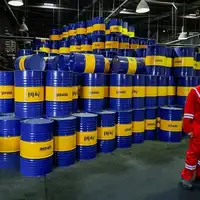
Donald Trump’s maximum pressure is usually scored by counting tankers and tracking the rial, but Iran’s budget points to a deeper cost: more than $80 billion in NIOC bank debt and sovereign-fund arrears, repeatedly deferred as Iranians shoulder the burden.
On August 5, a state bank froze the accounts of the National Iranian Oil Company, NIOC, over about $1 billion owed to the sovereign wealth fund, two years past due. A separate case was already running: a $1.5 billion tax assessment the company says it simply cannot pay. Enforcement on that one stopped only when the presidency intervened.
The episode matters because the law shielding the company is also where its condition is recorded. NIOC publishes no audited accounts, and Iran's budget shows state companies only in aggregate, leaving its debt to be reconstructed from budget provisions and disclosures by other state institutions.
This year's budget sets the amount of NIOC debt to the central bank and commercial banks being deferred at 55 billion euros, about $63.5 billion, covering principal and interest on financing for upstream oil and gas development. It appears as a single sentence at the bottom of a table in which every other figure is in rials or percentages, renewed every year since 2019.
Iran's sovereign wealth fund, the National Development Fund, has separately said NIOC is its largest debtor, with $17 billion in unpaid loans.
Those two categories alone amount to more than $80 billion. No single official document presents them as one consolidated NIOC debt figure.
Iran's entire general budget this year converts to roughly $37 billion at the open-market rate. For scale, the deferred bank debt alone is about 1.7 times what the government plans to spend in a year.
That burden grows without anyone borrowing another dollar. The debt is in foreign currency, and the rial has fallen from about 900,000 to the dollar in early 2025 to nearly 2 million today, a slide President Trump celebrated in August as his administration "destroying Iran's currency." Each step down makes the same $63 billion heavier against NIOC's rial costs and the state's domestic revenues.
That burden grows in rial terms without anyone borrowing another dollar. The debt is in foreign currency, and the rial has fallen from about 900,000 to the dollar in early 2025 to nearly 2 million today, a slide President Trump celebrated in August as his administration "destroying Iran's currency.” Each step down increases the rial value of the same $63 billion obligation and makes it larger relative to the state's domestic revenues.
Maximum pressure is usually scored from the outside: barrels tracked leaving the Persian Gulf, the rial's slide, the lengthening sanctions lists. By that scorecard the campaign is working.
A clearer measure is the condition of the company at the center of the sanctioned trade, and by that measure the campaign has worked more completely than the scorecard shows. The pressure did not stop Iran's oil. It changed the terms of the business, and the new terms have broken the company that produces it, in every sense but the accounting one.
The business model was set at the top. After the United States withdrew from the nuclear deal in 2018 and reimposed sanctions, Ali Khamenei told officials not to leave the economy waiting on "decisions to be made by others." The objective instead was to plan with the sanctions in place and, in his formulation, to neutralize them.
The oil ministry's version of neutralization was to keep production alive with domestic contractors, the Revolutionary Guard's companies among them. On its own terms, that part worked. Output that had fallen below 2 million barrels a day in 2020, the lowest in almost four decades by American government estimates, was rebuilt to about 3.6 million by mid-2024, a recovery the oil minister boasted of publicly.
Selling those barrels was another matter.
"We have unofficial or unconventional sales, all of which are secret," then-oil minister Bijan Zanganeh said in 2019, "because if they are made known America would immediately stop them." His deputy called it the grey market.
In practice, that meant selling at sanctions-driven discounts that have varied widely over time, reaching $10 to $15 a barrel below Brent through 2024 and 2025, particularly to China's independent refiners; using a shadow fleet, ship-to-ship transfers and obscured vessel identities; relabeling Iranian crude as originating elsewhere; and paying intermediaries to keep the chain moving. China has at times taken roughly 90 percent of Iran's exported crude.
Payment itself became another layer of the sanctions trade. Iranian oil proceeds have been trapped or restricted in foreign banking systems, while other sales have been settled through barter or in currencies that are difficult to repatriate freely.
India created a rupee payment mechanism for Iranian crude in 2019, and the channel stalled the same year when Indian purchases stopped. Roughly $6 billion in Iranian oil proceeds frozen in South Korea were eventually transferred to restricted accounts in Qatar as part of the 2023 prisoner exchange.
Every additional discount, commission and restriction reduces what reaches Iran. NIOC's statutory share of crude and condensate export proceeds is set at 14.5 percent, so lower realized export revenue narrows the company's own take as well.
The difference between what the model earned and what production cost was covered on credit, in foreign currency, from the central bank, state banks and the sovereign wealth fund, with parliament's authorization.
By January 2019 the state knew in writing that the arrangement was not paying for itself. The parliament's research arm reported that NIOC, then about $50 billion in debt on its own count of the previous year, could not repay what it owed. The party line continued anyway: the same parliament approved fresh lending in the same budget, and two months later wrote the first deferral into law.
The dollar figures were tracked for two more years, to about $60 billion in March 2020 and about $70 billion in March 2021. Then that series went quiet.
The liabilities themselves did not vanish from the record. Two years later the Economy Ministry put NIOC's debts for 2021 at 1,683 trillion tomans, the largest of any state company in Iran, ahead of Bank Sepah and Bank Melli. At the exchange rate of the day, that is the same $60 to $65 billion the dollar series had been reporting.
What disappeared was the ability to follow it: a comparable figure, year by year, in the currency the money was owed in. The largest corporate debt in Iran's history was reduced to one renewable sentence that for six years carried no number at all. When a number finally surfaced this February, it settled what the silence had left open. The bank debt did not go away. It was rolled forward.
The meter still runs, though not at one rate. The sovereign fund's published terms for foreign-currency oil and gas facilities are 3.5 percent for the fund plus 2.5 for the agent bank, 6 percent all-in. On the $17 billion it is owed, that alone is close to $1 billion a year, almost exactly the size of the claim that froze the company's accounts in August.
The central bank has never published its contract rate, so the future cost can only be estimated. If even a 4 percent rate were applied to the $63 billion outstanding balance, it would add more than $2.5 billion in interest over a year; at the sovereign fund's 6 percent rate, the figure would approach $3.8 billion.
What the budget does establish is that the deferred bank debt already consists of principal and interest. The cost of carrying the old debt has become part of the debt.
For comparison, $1.5 billion in foreign currency is allocated for medicine this year, in a spring when pharmacy prices jumped several hundred percent, cancer and dialysis drugs ran short, and officials blamed scarce foreign currency. Depending on the rates applied to NIOC’s different debts, the annual interest burden could exceed that amount by several billion dollars.
An Iranian who misses a single loan installment pays the contract rate plus a 6-point penalty. The oil company's interest simply accrues, uncollected, year after year. A deferral, in the end, is a bet that a better year is coming, one with a surplus large enough to settle old bills. The Islamic Republic has been promising that better year that is yet to come for forty-seven years.
Because the loans are neither collected nor written off, the central bank and the state banks carry them as sound assets, the same accounting that keeps Iran's insolvent banks upright. When those banks come up short, they overdraw at the central bank, and that is where base money is created.
The transmission is not mechanical, but it is the route by which a single failed lender, Bank Ayandeh, accounted for about a quarter of the growth in Iran's monetary base in 2022-23. The bill reaches Iranians as inflation: the tax no one votes on, taking its largest share from the poorest.
Fifteen years of records say NIOC could not pay when conditions were merely bad. With its fields bombed and its exports blockaded, repayment is beyond reach in any scenario.
And the pressure is still tightening. On August 13, Treasury Secretary Scott Bessent, who runs the Economic Fury campaign against the Islamic Republic, promised measures "like have never been seen in the history of the economic isolation of a country," on top of a blockade meant to keep anything from moving in or out of Iranian ports. Whatever they turn out to be, they are aimed at the only revenue that could ever service this debt.
Nor does the optimistic case rescue the company. Even a full lifting of sanctions would not change the arithmetic quickly, because a company with damaged fields and war-hit infrastructure would have to borrow more before it could export more.
Maximum pressure set the terms of this downfall, but the decisive choices were Tehran's: to keep pumping at any margin, to stop publishing a comparable foreign-currency debt figure after 2021, and to push the bill forward one year at a time.
The company that once symbolized Iran's oil wealth was not felled by a rival or a market. It was sacrificed, quietly, by its own state, to the nuclear program and the regional ambitions that brought the sanctions, and to the business model built to outlast them, and the receipt is one sentence long, perpetually renewed every year.
Zahhak Receives the Daughters of Jamshid, a manuscript illustration made in Tabriz, Iran, in the 1520s, in ink, gold and opaque watercolor on paper. Courtesy of Khalili Collections / CC-BY-SA 3.0 IGO.
In the Persian classic Shahnameh, Ferdowsi tells the story of Zahhak, the usurper king who is kissed on each shoulder by Ahriman, the spirit of evil, and finds two black snakes growing from the wounds.
Cut them off and they grow back. The only way to keep them quiet is to feed them, every day, with the brains of two young men. Zahhak reigns for a thousand years on a diet of sacrificed youth, propped up not by loyalty but by appetite.
The story has always worked as a parable for Iranian tyranny. What I think it misses, applied to the Islamic Republic today, is the arithmetic. Ali Khamenei did not build two snakes. He built three.
The Artesh, Iran’s conventional army, was the first snake, inherited from the Shah and never fully trusted. The IRGC was the second, created in 1979 specifically because the revolution did not trust the first. The Basij was folded into the IRGC as its third head.
It is worth remembering that all three answer, on paper as much as in practice, to a single neck. The Iranian constitution names the Supreme Leader as Commander-in-Chief of the Armed Forces in their entirety, Artesh, IRGC and Basij alike. There is no independent chain of command outside the Supreme Leader’s authority for a general to retreat into. Politicians and Western commentators in both London and Washington keep waiting for one of these heads to turn on the body. They’re waiting for the wrong signal, because they’re analysing 1979, not 2026.
When the Shah’s generals stood aside in February 1979, they did so because the Artesh of that era was a conscript institution led by officers who owed their careers to a monarch, not a movement, and who had no ideological stake in what came next. That Artesh is not today’s Artesh.
Ali Khamenei spent decades solving exactly that problem. Senior appointments in today’s Artesh are subject to security and ideological vetting tied to the Supreme Leader’s military apparatus. The Middle East Forum has documented how senior promotions require approval from the Supreme Leader’s office following scrutiny of an officer’s security and ideological background. The men at the top of the Artesh are appointees of the system, not survivors of it.
This is why this month’s move to complete the integration of the Armed Forces General Staff with the Khatam al-Anbiya Central Headquarters matters more than it has been given credit for. Mojtaba Khamenei, who inherited a system his father spent more than four decades constructing, has now moved to formalise a process of centralisation that had earlier been discussed but was not visibly underway in operational terms.
The lesson learned from 2025 and the Twelve-Day War, according to Iran’s own state reporting, was that redundant command structures slow decision-making. The latest restructuring is intended to reduce that redundancy and further narrow the distinction between the operational command of the Artesh and the IRGC. The underlying logic is clear: the system has little interest in preserving institutional space in which one military arm might begin to think or act independently of the others.
I would also gently push back on those looking for salvation in Iran’s reformists. Pezeshkian’s presidency provides a civilian face and international cover for the negotiating track, and that function matters. But it is not independence.
Ghalibaf is a former senior IRGC commander who has spent decades inside the Islamic Republic’s political and security establishment. Araghchi is a capable diplomat entrusted with representing Tehran in negotiations. Both men operate inside the system’s tolerances, not outside them. Reading their willingness to negotiate as evidence of a moderate faction pulling against a hardline one mistakes tactics for structure.
When Iran has had to cede ground, at Bürgenstock or Islamabad, it has ceded it in the way a company reprices a product: reluctantly, and only as far as survival requires. Ghalibaf gets attacked by the influential ultra-hardline Paydari Front for talking to Americans, and he absorbs it, because someone in the system has to run the diplomatic track.
None of this means the system is stable in the way it looks stable. Ali Khamenei is dead. His son, who has still not been seen or heard in public, inherited the office by appointment and is still consolidating the very apparatus his father designed. The strain is real. But strain inside a structure is not the same as a fracture between its parts. The three heads bicker over how much brain they are fed and by whom, not over whether to keep feeding.
So when I hear commentary asking whether this is the moment the Artesh finally breaks from the regime, or whether Ghalibaf represents the pragmatic wing that might yet reform the system from within, I think of Zahhak.
Nobody in that story is saved by one of the snakes deciding it has had enough. The snakes do not turn on the king. The rupture comes from outside the machinery of the court: Kaveh the blacksmith rises first, turning private grievance into public revolt, rallying the people and creating the conditions for Fereydun’s return. Fereydun then defeats Zahhak and binds him at Damavand. Until that structure itself breaks, all three snakes answer to the same shoulders.