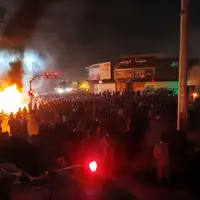
The accounts and materials focus on January 8 and 9, when anti-government protests were taking place across Iran and large crowds took to the streets in several cities in Alborz, a province bordering the capital. Security forces responded with live fire in several areas, according to witnesses.
Verified footage, eyewitness testimony and information gathered from several cities across the province describe security operations inside medical facilities, bodies left in streets and the removal of corpses in municipal garbage trucks.
Iran International could not independently corroborate every account or casualty figure because of communications restrictions and the lack of unrestricted access. The details in this report are therefore based on testimony and information from local sources.
Cultural sites turned into firing posts
In Fardis, a city west of the capital, a public library was converted into an ammunition store and staging point, while schools and mosques were used as gathering places for armed personnel, residents said.
Security forces were deployed at a traffic police building adjacent to the city's main cinema, using tear gas, stun grenades and live ammunition against protesters, according to testimonies.
On the evening of January 9, shooters took positions on the cinema roof and surrounding buildings and opened fire on crowds below, multiple sources said.
Forces began firing in bursts around 10 p.m. without appearing to select individual targets, one resident said, describing elderly men in the streets who had been struck by live ammunition or pellets.
Bodies were kept inside the cinema for two days before being removed, several others said. Security personnel also forced residents to delete footage they had recorded.
Gunfire from government buildings
Similar patterns emerged elsewhere in Alborz, where security forces fired from or near government and police buildings.
In Hashtgerd, a city about 70 kilometers west of the capital, forces used Kalashnikov and G3 rifles as well as DShK heavy machine guns. Some of the shooting came from an area containing the local governor's office and police headquarters, local sources said.
Twelve-year-old Sana Tosangi was killed by direct gunfire on January 9 after two bullets struck her in the back and head near government buildings, people familiar with her death said. Shooters were also positioned on the governor's office and a nearby shopping center.
In Meshkin Dasht, special police units used loudspeakers to tell residents that conditions were calm before opening fire after people emerged from their homes.
In Eshtehard, gunfire was reported near a police station and governor's office. A truck carrying bodies was later taken to a largely abandoned cemetery as the number of dead increased, local sources said.
In another part of Alborz, cranes were used to destroy access points to alleys, making it harder to move between the main road, residential streets and medical facilities.
Clinics raided, bodies found bound
Medical facilities in Fardis also came under security control.
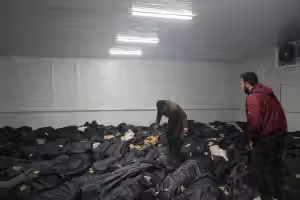
The morgue at one clinic quickly reached capacity, while security forces entered another medical facility and detained staff members and wounded protesters. Witnesses said security forces shot some wounded protesters inside the clinic.
Security personnel also took jewelry and personal belongings from wounded or dead women, several people who described events at the facilities said.
“The basement of the clinic was full of bodies,” one resident told Iran International.
Another clinic refused to admit some wounded people, information gathered by Iran International showed.
Iran International's verification team used visual and audio analysis and matched architectural features across submitted footage to identify the dental section of another clinic as the location where some of the images were recorded.
The footage shows bodies inside the medical facility, including several people whose hands and feet were bound. Three people identified by sources as members of the same family were among the dead visible in the footage.
Bodies removed in garbage trucks
Bodies were also left in streets after the shooting, according to testimony from the area.
Plainclothes personnel traveling in vehicles without license plates left bodies in pairs at alley entrances and forced passing drivers at gunpoint to transport corpses, several residents said.
One said that when people contacted the municipality about bodies in the streets, an employee responded by comparing the corpses to garbage.
The testimony and verified footage reviewed by Iran International describe the use of civilian and government infrastructure across Alborz during the January crackdown, from cultural venues and administrative buildings to medical facilities, while restrictions on independent access continue to hinder a full accounting of the deaths.