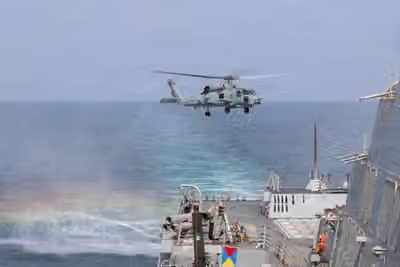
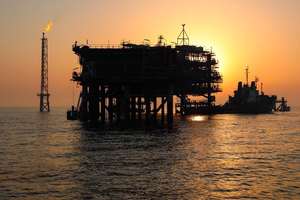
A vessel near the Strait of Hormuz, as seen from Musandam
Iran is doubling down on control of the Strait of Hormuz, with some in Tehran now arguing the strategic leverage it provides is more valuable than a nuclear weapon.
Tehran’s drive to turn that control into lasting economic and political leverage—through shipping routes, mine clearance and potentially revenues from passing vessels—is emerging as a major obstacle to extending its fragile memorandum with the United States, which expires Sunday.
Washington, meanwhile, increasingly claims it has broken Iran’s control of Hormuz.
The June 18 memorandum is formally due to expire on August 16. President Donald Trump pronounced it over after Iran attacked three ships in the Strait of Hormuz, ordering more strikes and the resumption of the US maritime blockade.
Neither side, however, has formally abandoned diplomacy. If no extension is announced before Sunday, the current state of neither war nor peace could continue. An explicit declaration that the arrangement has ended could increase the risk of renewed attacks.
‘More valuable than a nuke’
Pressure against concessions over the strait is also growing inside Tehran.
Parliament’s National Security and Foreign Policy Commission this week unanimously approved the broad outlines of legislation that would tighten Iran’s control over Hormuz.
The bill includes provisions for inspecting vessels in Iranian territorial waters, banning the passage of assets, equipment and vessels belonging to the United States, Israel and other countries Tehran deems hostile, and charging ships for maritime services.
If enacted, the legislation could constrain Tehran’s room for compromise, much as legislation passed during Hassan Rouhani’s presidency required his government to increase uranium enrichment and suspend implementation of the Additional Protocol unless banking and oil sanctions were lifted.
Alireza Salimi, a member of parliament’s presiding board, told the ISNA news agency Thursday that “the Strait of Hormuz is currently more valuable to Iran than an atomic bomb,” describing it as leverage for lifting sanctions and securing compensation for wartime losses.
Demands put talks in doubt
The tougher approach was also reflected in demands laid out shortly before his departure by Mohammad Bagher Zolghadr, the former secretary of the Supreme National Security Council.
Zolghadr said reopening the strait would require an end to attacks on Iran and its allies, the lifting of the blockade, the withdrawal of US forces from around Iran, sanctions relief, the release of frozen Iranian assets and compensation for damage caused by the wars.
It remains unclear whether those demands represented his personal position or that of the SNSC, and whether his successor, Mohsen Rezaei, will pursue the same approach.
Rezaei’s appointment this week, along with other changes at the top of Iran’s security establishment, has been welcomed by hardline opponents of the government’s approach to negotiations.
Former diplomat Kourosh Ahmadi wrote in the Shargh newspaper that if Tehran insisted on the conditions outlined by Zolghadr, “it is highly unlikely that there will be any serious negotiations between Tehran and Washington at all.”
Both sides claim control
The dispute is unfolding as Tehran and Washington offer directly competing accounts of who actually controls Hormuz.
Trump said Wednesday that the United States had complete control of the waterway and that the maritime blockade had deprived Iran of the ability to act.
The spokesman for Iran’s Khatam al-Anbiya Central Headquarters, the country’s wartime command center, rejected that assertion Thursday, saying the strait remained under Iranian control and that no vessel could pass safely without authorization from Iran’s armed forces.
Shipping-monitoring data show traffic remains a fraction of pre-war levels. Around 10 to 12 vessels have been crossing the strait daily in recent days, compared with roughly 130 to 140 before the war, with most currently using a route designated by Iran.
Tehran has also stressed that an agreement with Oman over shipping routes would not by itself be sufficient to reopen the strait.
Ali Gholhaki, a political activist close to parliament speaker and senior Islamabad negotiator Mohammad-Bagher Ghalibaf, said Iranian decision-makers currently had no intention of reopening the waterway and had blocked an agreement with Oman because of what they viewed as Muscat’s alignment with Washington.
Tehran and Muscat at odds
The disagreement with Oman offers perhaps the clearest illustration of what Tehran now wants from its control of Hormuz.
Iran has pushed for control over shipping routes and mine clearance and for mandatory payments from vessels using the waterway. Oman has instead favored a joint fund supported by voluntary contributions from governments and companies benefiting from shipping.
Few in Tehran expect Muscat to accept Iran’s terms. Ahad Azadikhah, a lawmaker aligned with Ghalibaf, recently told Khabar Online that if Oman did so, the Islamic Republic would have achieved “the victory of all victories.”
The dispute means Hormuz is increasingly intertwined with the fate of the wider Tehran-Washington dialogue. As Iran seeks to turn control of the strait into leverage over sanctions, compensation and any broader settlement, Washington may increasingly see that same leverage as something that must be neutralized before a deal can be reached.
Members of Iran's Parliament debate a bill in a hybrid (online/in-person) session, July 27, 2026
A dispute in Iran’s parliament over the terms for reopening the Strait of Hormuz is threatening to complicate negotiations in Muscat, as lawmakers challenge a proposed role for Oman and Pakistan in monitoring shipping through the waterway.
The dispute centers on plans for a three-country verification mechanism being discussed as Iranian, Omani and Pakistani technical committees work on the operational details of a temporary navigation arrangement.
Hardline lawmakers argue that the government cannot implement the proposed arrangement without parliamentary debate and a formal vote, raising a broader dispute over constitutional authority and military jurisdiction.
Their opposition is focused particularly on third-party verification. Hardliners argue that sharing vessel-tracking responsibilities with Pakistani or Omani personnel, even within a joint cell, would undermine the IRGC Navy’s authority over screening in the Persian Gulf.
Commentators aligned with this view have also warned that external verification channels could be exploited by Western intelligence, potentially giving NATO or US naval forces access to information about Iranian coastal movements under the guise of commercial monitoring.
Regional shield or security risk?
Reformist outlets Shargh and Etemad have argued that involving Pakistan and Oman would instead provide Tehran with a diplomatic shield by reducing pressure for direct US or NATO naval escorts inside the strait’s traffic lanes.
Writing in Shargh, Ahmad Zeidabadi warned that blocking regional verification “does not defend our sovereignty; it locks our economy into a suffocating siege,” adding that a functioning Muscat-Islamabad verification mechanism offered Iran a way to avert deeper economic damage.
Foreign Ministry spokesman Esmaeil Baghaei, meanwhile, reaffirmed that any US or NATO military escorts within the strait’s traffic lanes remained prohibited under the draft terms, even as third-party verification continued to be considered in Muscat, according to IRNA.
Parliament pushes tougher terms
The dispute comes as lawmakers are also considering legislation that could further constrain Tehran’s room for compromise over Hormuz.
Iranian media reported that parliament held a closed-door session over the National Security and Foreign Policy Commission’s draft bill restricting the movement of vessels linked to countries Tehran considers hostile.
Hardline lawmakers have pushed for a mandatory transit charge of 5% to 7% on non-exempt commercial bulk cargo to fund coastal defense and infrastructure repairs, alongside tighter inspection requirements.
Pro-Pezeshkian lawmakers and National Security Committee spokesman Hassan Ghashghavi have argued that the proposed verification cell is a technical mechanism operating under the Supreme National Security Council framework rather than a new international treaty requiring lengthy parliamentary ratification.
Government representatives have also warned that imposing statutory tolls could undermine the Muscat negotiations and discourage foreign shipping lines from using Iranian ports.
The competing approaches reflect a wider struggle in Tehran over what Iran should seek to preserve from its wartime control of Hormuz: maximum control and economic leverage, or a regional mechanism that could restore shipping without opening the waterway to a greater US or NATO role.
The dispute could prove consequential for the Muscat talks, as any agreement requiring Omani or Pakistani participation in monitoring traffic would have to overcome objections from lawmakers, while tougher statutory restrictions on shipping could further narrow the government’s room to negotiate.
An Islamic Republic supporter holds a picture of Supreme Leader Mojtaba Khamenei
Supreme Leader Mojtaba Khamenei’s latest appointments to Iran’s top security and paramilitary institutions are not routine personnel changes but a reflection of his priorities for tighter control over the institutions directing war and domestic repression.
The defining struggle in Tehran is not between moderates and hardliners. It is a contest within the hardline establishment and the Islamic Revolutionary Guard Corps (IRGC) over power, patronage, and coercion.
The transition has occurred during a very turbulent time for the Islamic Republic, in the midst of a war with both the U.S. and Israel and only months after the largest anti-regime uprising. Mojtaba has also remained largely out of public view for months, fueling uncertainty over his status and capacity to lead. This vacuum gave rival security networks room to advance their own interests, but Washington should not mistake competition within the regime for a pragmatic opening.
The SNSC is the body that coordinates defense, intelligence, and foreign-policy decisions and its resolutions take effect only after approval by the supreme leader. The secretary therefore operates at the intersection of war, diplomacy, and internal security. Rezaei commanded the IRGC from 1981 to 1997, founded its intelligence unit, and served as Mojtaba’s military adviser since March. Mojtaba first named him his representative on the council and Pezeshkian then formally appointed him secretary.
The removal of Rezaei’s predecessor, Mohammad Bagher Zolghadr, is equally revealing. He held the secretary position for less than five months, an extraordinarily short tenure for a post usually held for years. Pezeshkian had reportedly asked him to remain and later acknowledged unspecified “differences,” exposing the friction between the presidency and Mojtaba’s emerging power center.
Zolghadr was a close ally of Ahmad Vahidi, the IRGC commander who played a central role in running the country during the war, while Rezaei has shown he is fully aligned with Mojtaba. Replacing one hardline IRGC veteran with another, therefore, reflects a shift in networks rather than ideology, placing the regime’s most important security forum under Mojtaba’s orbit.
The dispute over the Memorandum of Understanding (MoU) between Washington and Tehran deepened that divide. Zolghadr voted in favor of it, while Rezaei had publicly questioned the agreement and later argued that Mojtaba had favored a different path. Zolghadr’s support for the memorandum made him less compatible with a leader determined to impose his own authority on the security establishment.
Taeb’s appointment is equally significant. He and Mojtaba both served in the Habib battalion during the Iran-Iraq War, beginning an alliance that later extended into years of behind-the-scenes schemes to influence Iranian politics. Taeb was sidelined late in Ali Khamenei’s rule after his removal as head of the IRGC Intelligence Organization in 2022, but Mojtaba has now restored him to lead the Basij once again.
The Basij paramilitary embeds itself across various sectors of Iranian society and mobilizes regime loyalists to surveil and repress dissidents. Taeb sharpened that coercive machinery during his tenure, a record that later drew sanctions from the United States, Canada, the European Union, and the United Kingdom. Mojtaba now has a trusted loyalist at the center of the institution most crucial for suppressing another nationwide uprising.
Taeb’s appointment decree instructed him to strengthen the Basij’s ‘intelligence network,’ expand its use of technology and improve coordination with other regime bodies. The priority is unmistakable: consolidation at the top and more effective control of the streets.
Ali Khamenei’s death was bound to trigger a struggle for power. For decades, access to political office, economic privilege, and security authority depended on proximity to him and his office. His death disrupted that system of patronage.
Mojtaba’s task is threefold. He must strengthen his own network, balance the influence of officials tied to rival centers of power, and sideline networks that flourished under his father and were opposed to Mojtaba. Rezaei’s elevation and Taeb’s return serve that purpose.
Washington should treat this reshuffle as a warning that Mojtaba is placing loyalists at the helm of the institutions that shape external and internal national security doctrines. This should put an end to Washington’s hope that pragmatists inside the regime can lead the country toward a different path.
The United States should reject bargains that strengthen the regime without verified changes in Tehran’s conduct. It should work with Israel and the Arab states of the Persian Gulf to deter Iranian aggression and constrain Tehran’s military partnership with Russia and China. It should also deny the regime’s repressive organs the finance and technology they need while expanding support for the Iranian people confronting the regime’s apparatus of oppression.
Current members of Iran's Supreme National Security Council
Iran’s Supreme National Security Council brings together the country’s most powerful officials, but its workings are less straightforward than its name suggests, as even its secretary, often dubbed Iran’s security chief, does not automatically have a vote.
That distinction has come into sharper focus with Mohsen Rezaei’s appointment as secretary of the council. Rezaei was first appointed by Supreme Leader Mojtaba Khamenei as one of his two representatives on the SNSC, giving him a constitutional seat and a vote. President Masoud Pezeshkian then appointed him secretary, putting him in charge of the council’s secretariat as well.
The order was notable, as in recent decades, the more familiar pattern had been for the president to choose a secretary first and for the Supreme Leader to subsequently appoint the same person as one of his representatives, effectively giving the secretary a vote.
With Rezaei, the process worked the other way around: Khamenei placed him on the council first, and Pezeshkian followed by making him secretary.
The move was welcomed by some hardliners as a sign that Pezeshkian was deferring to the new Supreme Leader and demonstrating his loyalty, amid lingering uncertainty over Mojtaba Khamenei’s authority after months out of public view.
The episode also highlighted something that is often lost in descriptions of the SNSC: being secretary and being a voting member are two separate things.
What is the SNSC?
The Supreme National Security Council was created in its current form when Iran’s Constitution was revised in 1989, shortly after the end of the Iran-Iraq war and the death of Islamic Republic founder Ruhollah Khomeini.
Article 176 of the Constitution gives it three broad responsibilities: determining defense and national security policies within the general policies set by the Supreme Leader; coordinating political, intelligence, economic, social and cultural activities related to national security; and mobilizing the country’s resources against internal and external threats.
Its remit is therefore much broader than military affairs. Questions involving war and peace, nuclear policy, negotiations with foreign governments, sanctions, domestic unrest, internet restrictions, intelligence matters and major regional security issues can all fall within its orbit.
The president chairs the council, but that does not mean the president controls it. The SNSC was designed to bring together several centers of power that do not answer to the president alone, including the judiciary, parliament, the armed forces and the Supreme Leader’s office.
And there is another important limit on its authority: its decisions do not become binding simply because the council approves them. Under the Constitution, SNSC resolutions take effect only after approval by the Supreme Leader.
Once approved by the Leader, no other state body, including parliament or the judiciary, has a formal veto over them.
Who are the permanent members?
Article 176 provides for 10 officials who hold seats on the council by virtue of their positions.
They are the president, who chairs the council; the speaker of parliament; the head of the judiciary; the chief of the Armed Forces General Staff; the official responsible for planning and budget affairs; two representatives appointed by the Supreme Leader; the foreign minister; the interior minister; and the intelligence minister.
Those 10 positions form the fixed constitutional core of the SNSC.
The two representatives of the Supreme Leader are particularly important. They are not representatives of the government or of another state institution. They sit directly on behalf of the Leader and have the same right to vote as the other constitutional members.
At present, those two seats are held by Saeed Jalili and Mohsen Rezaei.
Who can be added when needed?
The Constitution also names three additional categories of officials who can join the council depending on the issue being discussed.
These are the highest-ranking officer of the regular Army, the highest-ranking officer of the Revolutionary Guards, and the minister responsible for the matter under consideration.
That distinction matters because the Army and IRGC commanders are often casually described as permanent members of the SNSC. In practice, they attend many important meetings and may appear to be part of the council’s standing membership. Constitutionally, however, their participation is tied to the subject before the council.
When they participate in that capacity, they are members of the council for that discussion and have the right to vote.
The same applies to an additional minister. If the council is discussing an issue that directly concerns energy, communications, health, transport or another government portfolio, the relevant minister can be brought in as a member for that issue and can vote.
This means the number of voting members is not necessarily the same at every meeting. The council has 10 fixed members, but the number can rise depending on which military commanders or ministers are required for a particular discussion.
In June, Iranian state media reported that twelve out of the thirteen voting members of the Council voted to approve the Memorandum of Understanding (MoU) with the United States.
Who can attend without a vote?
The SNSC can also invite other officials whose expertise or institutional role is relevant to a discussion.
That could include, for example, the head of state broadcaster IRIB, the central bank governor, the head of the Atomic Energy Organization, senior police officials, economic officials or military commanders who do not hold one of the positions specifically named in Article 176.
Their presence does not make them members of the council.
They may brief the SNSC, take part in discussions or answer questions, but they do not acquire voting rights simply because they have been invited to a meeting.
This creates an important distinction between three categories of people in the room: fixed constitutional members, issue-specific constitutional members who can vote, and invited officials who can participate but cannot vote.
Why the secretary is different
The secretary is one of the most visible figures associated with the SNSC and often acts as the day-to-day face of Iran’s national security establishment.
But there is an unusual feature in the Constitution: the secretary is not listed among the council’s members.
The secretary runs the secretariat, helps prepare meetings, coordinates between institutions, follows up on decisions and can be entrusted with major diplomatic or security files. The president appoints the secretary.
But that appointment alone does not give the secretary a seat or a vote.
For most of the SNSC’s history, this apparent gap has been resolved by giving the secretary another position at the same time: one of the Supreme Leader’s two representative seats.
That second appointment, not the secretaryship itself, is what gives the secretary voting rights.
The result has been a long-running arrangement in which one person usually wears two hats. He is the president’s appointee as head of the secretariat and, separately, the Supreme Leader’s representative as a voting member of the council.
That dual role also gives the secretary political weight that goes well beyond administration. He does not merely organize the meeting; he sits inside the decision-making body and speaks and votes as one of the Leader’s representatives.
Which appointment usually comes first?
There has never been a constitutional requirement that one appointment precede the other.
In recent decades, however, the most common pattern has been for the president to appoint a secretary and for the Supreme Leader to then appoint the same person as his representative.
That happened with Ali Shamkhani in 2013. President Hassan Rouhani chose him as secretary, and Ali Khamenei appointed him as one of his representatives shortly afterward.
The same happened with Ali-Akbar Ahmadian in 2023, when President Ebrahim Raisi appointed him secretary and Khamenei named him as his representative at around the same time.
When Ali Larijani returned to the SNSC in August 2025, Pezeshkian appointed him secretary first, and Khamenei subsequently gave him one of his two representative seats.
But this order has not been universal.
When Larijani first became SNSC secretary under Mahmoud Ahmadinejad in 2005, he was already one of Khamenei’s representatives on the council before the president appointed him secretary.
The same legal separation is visible in the case of Saeed Jalili. Ahmadinejad appointed him secretary in 2007, but he was not made one of Khamenei’s representatives until months later. After leaving the secretaryship in 2013, Jalili kept his seat as the Leader’s representative, showing clearly that the two offices are independent of one another.
The broader historical pattern is therefore not that the president always chooses first and the Leader follows. It is that the two positions have usually been combined, regardless of which appointment came first.
Zolghadr was the bigger institutional exception
If Rezaei’s appointment was unusual because of the order in which the two posts were assigned, Mohammad-Baqer Zolghadr’s short tenure earlier in 2026 was unusual for a more fundamental reason.
After Ali Larijani’s death in March, Pezeshkian appointed Zolghadr as secretary of the SNSC. But Zolghadr was not publicly appointed as one of the Supreme Leader’s two representatives.
That meant the two roles were separated in a way rarely seen in the council’s history. Zolghadr ran the secretariat but, on the publicly available record, did not hold a constitutional voting seat merely by virtue of being secretary.
The distinction became especially visible during deliberations over the Iran-US agreement in June, when a public account of the vote listed the participating members but did not include Zolghadr among those casting ballots.
Who has served as secretary?
Hassan Rouhani became the SNSC’s first secretary after the council was established in its current form in 1989. He served for about 16 years, spanning the presidencies of Akbar Hashemi Rafsanjani and Mohammad Khatami, and became closely associated with Iran’s national security and early nuclear diplomacy.
Ali Larijani replaced him in 2005 under President Mahmoud Ahmadinejad. Larijani was already one of Khamenei’s representatives on the council before becoming secretary. He served until 2007 and resigned amid disagreements with Ahmadinejad over Iran’s nuclear strategy.
Saeed Jalili succeeded him and served from 2007 to 2013. He became one of Khamenei’s representatives months after taking over as secretary and remained in that representative seat even after leaving the secretariat.
Ali Shamkhani was appointed by President Hassan Rouhani in 2013 and served for nearly a decade. Khamenei also appointed him as his representative, preserving the dual-role arrangement. Shamkhani became one of the most prominent figures in Iran’s regional diplomacy and remained secretary until 2023.
Ali-Akbar Ahmadian, a senior former IRGC commander, replaced Shamkhani under President Raisi in 2023. He too served simultaneously as secretary and as one of Khamenei’s representatives.
Ali Larijani returned for a second tenure in August 2025 after Pezeshkian appointed him secretary. Khamenei then appointed him as one of his representatives. Larijani remained in the role until his death in March 2026.
Mohammad-Baqer Zolghadr succeeded him and served for several months. Unlike his immediate predecessors, he was not publicly given one of the Leader’s two seats, leaving him without a vote in his capacity as secretary.
Mohsen Rezaei replaced Zolghadr in August 2026. This time the order was reversed: Mojtaba Khamenei first appointed Rezaei as his representative, and Pezeshkian then made him secretary.
How decisions are made
The SNSC is often described as Iran’s highest national security body, but it is better understood as a place where the Islamic Republic’s major power centers are brought together to negotiate and formalize policy.
The president chairs the meetings. The heads of parliament and the judiciary participate. Key ministers are present. The Armed Forces General Staff has a permanent seat. The Army and IRGC can join as voting members when required. The Supreme Leader has two direct representatives inside the room.
The precise voting procedures are less transparent than the membership rules. Article 176 establishes who belongs to the council but does not publicly lay out a single detailed voting formula for every type of decision.
In practice, deliberations can involve bargaining before a matter ever reaches a formal vote. Sensitive decisions may already have been discussed with the Leader’s office, the armed forces or other senior bodies before they come before the SNSC.
And even after a majority or other required threshold is reached, the process is not finished.
The Constitution says SNSC resolutions become effective only after the Supreme Leader approves them.
That gives the Leader influence at several points in the process. He sets the broad national security policies within which the council operates, appoints two voting members directly and retains the final authority to approve its decisions.
The president, meanwhile, controls another important part of the institution: he chairs the council and chooses the secretary who runs its day-to-day machinery.
Replacing a single ship carrying essential goods to Iran would require about 2,500 trucks, a Chamber of Commerce official warned, saying land routes cannot offset the US maritime blockade and negotiations are the only realistic way to restore trade.
Davoud Rangi, vice chair of the chamber’s Import Management Committee, said Iran receives around 400 to 500 ships carrying essential goods each year, making any attempt to replace maritime imports with overland transport impractical.
“Mobilizing this number of trucks is far-fetched for us, and even if they were mobilized, transportation costs would rise sharply,” Rangi told Eghtesad News on Thursday.
He said Iranian authorities should not count on land corridors as a substitute for the country’s southern ports because neighboring states could restrict border traffic at short notice and the routes lack the capacity to handle the necessary volume of goods.
Neighboring governments could close a border “with a single order,” he said, adding that the justification would not necessarily have to be political or military and could instead involve quarantine or veterinary restrictions of the kind Iran has faced before.
Rangi said land routes through countries such as Turkey or Pakistan might accommodate around one million tons of cargo annually, but could not come close to replacing Iran’s maritime trade.
“At a small scale, perhaps one million tons of cargo a year could be brought in through Turkey or Pakistan, but 23 million tons, or even half of that, is simply inconceivable,” he said.
The warning comes as Iran’s southern ports remain under pressure from the war. IRGC attacks on commercial vessels in the Strait of Hormuz have escalated regional tensions in recent weeks, while the United States intensified economic pressure on Tehran through a maritime blockade.
The outlook for negotiations between Tehran and Washington over reopening the Strait of Hormuz remains uncertain, with concerns also growing over a possible expansion of the regional conflict.
Negotiations seen as only viable way out
Rangi said negotiations and a reduction in military tensions were the only practical route to lifting the blockade and restoring the regular flow of essential goods into Iran.
Attempting to rely instead on overland corridors would impose heavy losses on importers, he said, because of both limited capacity and sharply higher transportation costs.
The blockade is also complicating Iranian exports, particularly containerized trade.
Rangi said vessels carrying bulk commodities could more easily be allowed to pass, while container ships pose a greater problem because individual containers cannot practically be separated from the rest of a ship’s cargo.
“We are extremely vulnerable on the southern route, in Bandar Abbas and Chabahar, but along the northern and western corridors the situation is much better for exports than for imports,” he said.
Iran’s economy has already come under mounting pressure in recent months from the continuing conflict, tighter sanctions and a sharp decline in the value of the rial.
Surging inflation and falling purchasing power have further strained household finances, making essential goods increasingly difficult to afford for a large part of the population.
File photo shows s motorist in Iran fills up a white SUV at a petrol station.
A plan to sell petrol at a much higher “refinery cost” rate in southern Kerman province was halted hours before it was due to begin, the provincial fuel distribution company said on Thursday.
The petrol was scheduled to go on sale from early Thursday at 872,000 rials ($0.47) per liter, Ahmad Salarifar, the manager of the National Iranian Oil Products Distribution Company in Kerman, said.
The suspension, he said, followed a conversation between the provincial governor and national officials and was ordered so that a program on fuel consumption management and anti-smuggling measures could be examined further. Petrol will continue to be sold at existing rates until further notice, Salarifar said.
Monthly salaries for many Iranians are commonly put at around 200 million to 250 million rials ($108 to $134). Filling a typical 50-liter tank at the proposed price of 872,000 rials per litre would have cost 43.6 million rials ($23), a sum equivalent to roughly one-fifth of a monthly wage at the upper end of that range and more than 17 times the cost at the current 50,000-rial ($0.027) station-card rate.
Iran introduced a three-tier petrol pricing system in December 2025. Private cars initially received 60 litres at 15,000 rials ($0.008) and 100 litres at 30,000 rials ($0.016) each month, with any extra volume charged at 50,000 rials on a station card. The second subsidised tranche was later cut, leaving a total national quota of 110 litres while the two lower prices remained unchanged.
Plan halted hours before launch
Provincial authorities have not said how long the review will last or whether the higher price will be introduced later.
The suspension came only hours after Ali Asghar Zakeri-Harandi, the deputy governor of Kerman for civil affairs, announced that 204 filling stations in the province were ready to sell petrol at the “full refinery cost” rate.
The plan, he said, would take effect from early Thursday under national decisions by the country’s fuel headquarters. Neither the Oil Ministry nor the government has published details of the decision or how the 872,000-rial figure was calculated.
Motorists queue at a gas station in Iran.
Higher rate far exceeds current charges
The Kerman announcement came less than a month after government spokeswoman Fatemeh Mohajerani said the government had no plan to change petrol prices. She repeated on July 28 that no final decision had been taken on the station-card rate and that any change would be announced officially.
A manager of a filling station in Kerman told Iran International that the provincial oil distribution office called stations on Wednesday evening to say the higher-priced petrol would start from early Thursday at selected sites.
A second call later the same night said the plan had been cancelled following talks with the regional oil company. The manager said the reversal was linked to concern over possible public reaction, adding that security forces normally present in the province had been redeployed elsewhere and that the higher price was still expected to be introduced soon.
Sudden fuel price increases have triggered major unrest in the past. In November 2019, an overnight rise of 50 percent on the subsidized quota and up to 300 percent on volumes above it sparked protests across more than 100 cities. Rights groups documented hundreds of deaths in the subsequent crackdown, and a near-total internet shutdown was imposed for several days.
Provincial officials have not clarified whether the Kerman plan was a local pilot or part of a wider national test. Its abrupt suspension before launch has left unanswered questions about the legal basis, the method used to set the price, and the government’s longer-term approach to reducing fuel subsidies.