• العربية
  • فارسی
Brand
  • Iran Insight
  • Politics
  • Economy
  • Analysis
  • Special Report
  • Opinion
  • Podcast
  • Iran Insight
  • Politics
  • Economy
  • Analysis
  • Special Report
  • Opinion
  • Podcast
  • Theme
  • Language
    • العربية
    • فارسی
  • Iran Insight
  • Politics
  • Economy
  • Analysis
  • Special Report
  • Opinion
  • Podcast
All rights reserved for Volant Media UK Limited
volant media logo

Caspian Sea hits 200-year low as Iran debates the treaty meant to divide it

Aug 13, 2026, 14:34 GMT+1
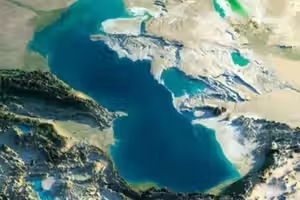
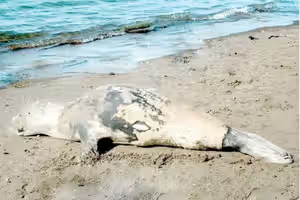
A view from the Caspian Sea coast

The Caspian Sea is falling by as much as 20 centimeters a year and stands at its lowest level in two centuries, an Iranian environment official said, a warning that lands just as Tehran reopens the argument over how to divide a sea that is shrinking on all five of its owners.

Mohammad Reza Kan’ani, head of the Environmental Protection Department in the northern province of Mazandaran, said Thursday that the Caspian’s water level was declining by around 10 to 20 centimeters annually, attributing much of the decline to rising temperatures, climate change and increased evaporation.

The Caspian’s water temperature had risen by about 1.5 degrees over the past two decades while evaporation had increased by an estimated 10% to 15%, he added.

Kan’ani warned that continued retreat of the shoreline could have serious consequences for coastal infrastructure, local economies and ecosystems dependent on the Caspian, including wetlands.

About 25% of the Caspian’s water comes from precipitation and 75% from rivers, Kanani said, with the Volga – which flows through Russia into the northern Caspian – accounting for the overwhelming majority of river inflow.

Shina Ansari, head of Iran’s Department of Environment, gave an even broader measure of the retreat this week, saying the Caspian’s level had fallen by around two to 2.5 meters over the past decade.

She described the decline as one of the region’s most serious environmental challenges and said reduced river inflows, alongside climate change, were contributing to the crisis.

Without cooperation among the five Caspian littoral states – Iran, Russia, Azerbaijan, Kazakhstan and Turkmenistan – the consequences could extend to ports, coastal communities and the wider ecosystem, Ansari warned.

Falling waters meet a renewed legal dispute

The environmental warnings come as the Caspian has returned to the center of political debate in Iran over the government’s effort to ratify the 2018 Convention on the Legal Status of the Caspian Sea.

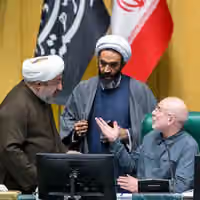
Hossein-Ali Haji-Deligani, deputy chairman of parliament’s Article 90 Committee, criticized what he called the government’s rush to approve the convention, saying this week that it could effectively reduce Iran’s share from 20% to between 3.5% and 5%.

That claim requires important qualification.

The 2018 convention does not assign Iran – or any of the five littoral states – a fixed percentage of the Caspian or its seabed. Instead, it establishes territorial waters and fishing zones while leaving seabed boundaries to be negotiated between neighboring states.

Iran’s southern seabed boundaries with Azerbaijan and Turkmenistan therefore remain unresolved.

The frequently cited figure of 20% was a post-Soviet Iranian negotiating position based on dividing the Caspian equally among its five littoral states, rather than a previously established treaty entitlement.

Nor did the earlier Iran-Soviet treaties formally grant Iran 50% of the Caspian. Agreements concluded in 1921 and 1940 established a bilateral Iran-Soviet legal regime, including equal navigation rights and exclusive arrangements between the two countries, but did not divide the sea or its seabed into equal territorial halves.

After the Soviet Union collapsed in 1991, four former Soviet republics emerged as independent Caspian states. Russia subsequently reached agreements with several of them to divide northern seabed resources along modified median lines, while Iran resisted that approach and pushed for an equal 20% division if the seabed was to be partitioned.

Iran ultimately signed the five-state legal-status convention in 2018, but the agreement deliberately left the final division of seabed sectors unresolved. Tehran also stressed at the time that the method for drawing baselines – an important issue because Iran’s concave southern coastline can disadvantage it in maritime delimitation – remained to be negotiated.

The current ratification debate therefore does not amount to a parliamentary vote assigning Iran a specific percentage of the Caspian. The more consequential question is whether Tehran should fully commit to the five-state framework before its own seabed boundaries and the baseline methodology have been settled.

Pollution adds to pressure on a shrinking sea

The falling water level is only one of several environmental threats facing the Caspian.

Iranian environmental officials have also warned of mounting pollution, shrinking fish stocks and destruction of coastal habitats.

Touraj Sadeghi, head of marine ecosystem protection at the Gilan provincial environmental department, told ISNA that untreated municipal and industrial sewage, waste dumping, petroleum leaks, excessive agricultural fertilizers and pesticides, and illegal fishing were among the main sources of environmental degradation.

Many cities along Iran’s Caspian coast still lack adequate municipal wastewater treatment systems, he said, while rivers carry thousands of tons of domestic, industrial and oil-related pollution into the sea each year.

Such pollution reduces water quality, damages natural habitats and contributes to deaths among fish and bird populations, Sadeghi said.

The Caspian supports distinctive wildlife including sturgeon, Caspian seals and migratory birds, but Iranian officials warn that the combination of pollution, habitat degradation and a rapidly retreating shoreline is increasingly threatening the resilience of the ecosystem.

Most Viewed

US ship strike tests Tehran’s narrative of victory in Hormuz
1
INSIGHT

US ship strike tests Tehran’s narrative of victory in Hormuz

2
ANALYSIS

Iran loses ground in oil market as neighbors rebound

3
INSIGHT

Iran hardliners tout offensive posture as Khamenei reshapes military command

4

US strikes Iran-bound ship as mediators signal Hormuz breakthrough

5
ANALYSIS

From Hormuz to Bab el-Mandeb, conflict converges on vital shipping lanes

Banner
Banner

Spotlight

  • Iranian forces used cultural sites, medical clinics in Alborz crackdown

    Iranian forces used cultural sites, medical clinics in Alborz crackdown

  • Iran seals dozens of businesses in renewed hijab crackdown

    Iran seals dozens of businesses in renewed hijab crackdown

  • Iran hardliners see shift on US talks in Rezaei appointment
    INSIGHT

    Iran hardliners see shift on US talks in Rezaei appointment

  • Security by design: why Tehran is tearing up cobblestones
    ANALYSIS

    Security by design: why Tehran is tearing up cobblestones

  • Iran loses ground in oil market as neighbors rebound
    ANALYSIS

    Iran loses ground in oil market as neighbors rebound

  • When the language of home is no longer the language of life
    ANALYSIS

    When the language of home is no longer the language of life

Banner
  • Iran moves to ratify Caspian Sea pact with seabed rights still unsettled

    Iran moves to ratify Caspian Sea pact with seabed rights still unsettled

  • Caspian seals face extinction threat as deaths continue

    Caspian seals face extinction threat as deaths continue

  • As Caspian states pursue energy growth, Iran watches

    As Caspian states pursue energy growth, Iran watches

  • Iran says Caspian Sea a foreign policy priority on par with Persian Gulf

    Iran says Caspian Sea a foreign policy priority on par with Persian Gulf

  • Gorgan Gulf remains at risk as Caspian levels fall

    Gorgan Gulf remains at risk as Caspian levels fall

•
•
•

More Stories

Land routes cannot replace Iran’s blocked sea trade, chamber official warns

Aug 13, 2026, 12:30 GMT+1
100%

Replacing a single ship carrying essential goods to Iran would require about 2,500 trucks, a Chamber of Commerce official warned, saying land routes cannot offset the US maritime blockade and negotiations are the only realistic way to restore trade.

Davoud Rangi, vice chair of the chamber’s Import Management Committee, said Iran receives around 400 to 500 ships carrying essential goods each year, making any attempt to replace maritime imports with overland transport impractical.

“Mobilizing this number of trucks is far-fetched for us, and even if they were mobilized, transportation costs would rise sharply,” Rangi told Eghtesad News on Thursday.

He said Iranian authorities should not count on land corridors as a substitute for the country’s southern ports because neighboring states could restrict border traffic at short notice and the routes lack the capacity to handle the necessary volume of goods.

Neighboring governments could close a border “with a single order,” he said, adding that the justification would not necessarily have to be political or military and could instead involve quarantine or veterinary restrictions of the kind Iran has faced before.

Rangi said land routes through countries such as Turkey or Pakistan might accommodate around one million tons of cargo annually, but could not come close to replacing Iran’s maritime trade.

“At a small scale, perhaps one million tons of cargo a year could be brought in through Turkey or Pakistan, but 23 million tons, or even half of that, is simply inconceivable,” he said.

  • Iran loses ground in oil market as neighbors rebound

    Iran loses ground in oil market as neighbors rebound

The warning comes as Iran’s southern ports remain under pressure from the war. IRGC attacks on commercial vessels in the Strait of Hormuz have escalated regional tensions in recent weeks, while the United States intensified economic pressure on Tehran through a maritime blockade.

The outlook for negotiations between Tehran and Washington over reopening the Strait of Hormuz remains uncertain, with concerns also growing over a possible expansion of the regional conflict.

Negotiations seen as only viable way out

Rangi said negotiations and a reduction in military tensions were the only practical route to lifting the blockade and restoring the regular flow of essential goods into Iran.

Attempting to rely instead on overland corridors would impose heavy losses on importers, he said, because of both limited capacity and sharply higher transportation costs.

The blockade is also complicating Iranian exports, particularly containerized trade.

Rangi said vessels carrying bulk commodities could more easily be allowed to pass, while container ships pose a greater problem because individual containers cannot practically be separated from the rest of a ship’s cargo.

“We are extremely vulnerable on the southern route, in Bandar Abbas and Chabahar, but along the northern and western corridors the situation is much better for exports than for imports,” he said.

Iran’s economy has already come under mounting pressure in recent months from the continuing conflict, tighter sanctions and a sharp decline in the value of the rial.

Surging inflation and falling purchasing power have further strained household finances, making essential goods increasingly difficult to afford for a large part of the population.

Iran province suspends plan for sharply higher petrol price

Aug 13, 2026, 11:39 GMT+1
100%
File photo shows s motorist in Iran fills up a white SUV at a petrol station.

A plan to sell petrol at a much higher “refinery cost” rate in southern Kerman province was halted hours before it was due to begin, the provincial fuel distribution company said on Thursday.

The petrol was scheduled to go on sale from early Thursday at 872,000 rials ($0.47) per liter, Ahmad Salarifar, the manager of the National Iranian Oil Products Distribution Company in Kerman, said.

The suspension, he said, followed a conversation between the provincial governor and national officials and was ordered so that a program on fuel consumption management and anti-smuggling measures could be examined further. Petrol will continue to be sold at existing rates until further notice, Salarifar said.

Monthly salaries for many Iranians are commonly put at around 200 million to 250 million rials ($108 to $134). Filling a typical 50-liter tank at the proposed price of 872,000 rials per litre would have cost 43.6 million rials ($23), a sum equivalent to roughly one-fifth of a monthly wage at the upper end of that range and more than 17 times the cost at the current 50,000-rial ($0.027) station-card rate.

  • Iran officially rolls out higher gas price under new three-tier system

    Iran officially rolls out higher gas price under new three-tier system

Iran introduced a three-tier petrol pricing system in December 2025. Private cars initially received 60 litres at 15,000 rials ($0.008) and 100 litres at 30,000 rials ($0.016) each month, with any extra volume charged at 50,000 rials on a station card. The second subsidised tranche was later cut, leaving a total national quota of 110 litres while the two lower prices remained unchanged.

Plan halted hours before launch

Provincial authorities have not said how long the review will last or whether the higher price will be introduced later.

The suspension came only hours after Ali Asghar Zakeri-Harandi, the deputy governor of Kerman for civil affairs, announced that 204 filling stations in the province were ready to sell petrol at the “full refinery cost” rate.

The plan, he said, would take effect from early Thursday under national decisions by the country’s fuel headquarters. Neither the Oil Ministry nor the government has published details of the decision or how the 872,000-rial figure was calculated.

100%
Motorists queue at a gas station in Iran.

Higher rate far exceeds current charges

The Kerman announcement came less than a month after government spokeswoman Fatemeh Mohajerani said the government had no plan to change petrol prices. She repeated on July 28 that no final decision had been taken on the station-card rate and that any change would be announced officially.

A manager of a filling station in Kerman told Iran International that the provincial oil distribution office called stations on Wednesday evening to say the higher-priced petrol would start from early Thursday at selected sites.

A second call later the same night said the plan had been cancelled following talks with the regional oil company. The manager said the reversal was linked to concern over possible public reaction, adding that security forces normally present in the province had been redeployed elsewhere and that the higher price was still expected to be introduced soon.

  • Fuel shortages and rationing push Iranians into gasoline black market

    Fuel shortages and rationing push Iranians into gasoline black market

Sudden fuel price increases have triggered major unrest in the past. In November 2019, an overnight rise of 50 percent on the subsidized quota and up to 300 percent on volumes above it sparked protests across more than 100 cities. Rights groups documented hundreds of deaths in the subsequent crackdown, and a near-total internet shutdown was imposed for several days.

Provincial officials have not clarified whether the Kerman plan was a local pilot or part of a wider national test. Its abrupt suspension before launch has left unanswered questions about the legal basis, the method used to set the price, and the government’s longer-term approach to reducing fuel subsidies.

Iran seals dozens of businesses in renewed hijab crackdown

Aug 13, 2026, 11:16 GMT+1
•
Reza Akvanian
100%
Image shows a cozy book-cafe scene in Tehran.

Iranian authorities have sealed at least 42 cafés, restaurants, shops, sports clubs and other businesses across the country in the past three weeks, over compulsory hijab rules and what officials describe as violations of Islamic norms.

The figure is based on individual closure cases reported separately by state media and rights groups.

The closures were reported in at least 17 cities, including Tehran, Mashhad, Yazd, Kerman, Ardabil and Birjand, and affected cafés and restaurants, women's gyms, shops and a cultural center.

In just three weeks, the number of closures has already reached about 22% of the 191 cases HRANA documented over the entire previous Iranian calendar year.

Cafés, shops and gyms targeted

Among the latest cases, an optician in Qaen was sealed on Wednesday after authorities said customers and employees had failed to comply with compulsory hijab rules.

The Yin Yang café in Khomein was sealed over what authorities described as "improper hijab" and Instagram content, while a women's clothing store called Shabnam Maison in Kerman was also shut.

A café-restaurant in Tehran's Velenjak district was sealed a day earlier. Authorities in Ardabil also closed three coffee shops and arrested 16 people in connection with the businesses.

Hossein Salari, Ardabil's deputy prosecutor, said inspections of cafés would increase and authorities would act against shops selling clothing that he described as contrary to Islamic law or harmful to "public chastity."

Three cafés in Mashhad, Bojnourd and Birjand were sealed on August 10. Authorities also shut the Zhovan café in Minudasht on August 9 and the Arghavan café-bookstore in Mashhad on August 5.

The enforcement has extended beyond cafés. Two sports clubs in Borujerd were sealed by judicial order on August 4, while authorities shut a Shahr-e Ketab bookstore in Babol the same day.

Four women's sports clubs were also sealed in Yazd, while authorities in Abadeh shut five businesses and arrested a café operator.

In Dezful, the local prosecutor announced the closure of 15 cafés and hookah lounges on July 23.

Enforcement rises sharply in Mashhad

Authorities have used terms including failure to observe compulsory hijab, "violations of norms," failure to observe "Islamic standards," and promotion of indecency to explain the closures.

Some businesses have also faced other accusations. Authorities in Ardabil cited alleged gambling and promotion of corruption among the reasons for closing three cafés.

One café in Mashhad was cited for issues including failing to list matcha on its price list and selling cakes and desserts without required health certification. Police described the alleged violations at four women's gyms in Yazd only as "disciplinary offenses."

Official figures from Mashhad point to a sharp rise in closures.

Mohsen Sayadi, the city's head of trade inspection and supervision, said authorities sealed 104 businesses during the first four months of the current Iranian year, which began on March 21, compared with five during the same period a year earlier - an increase of about twentyfold.

100%
Friends gathered at a cafe in Tehran to watch a match together.

Pressure extends to social media

The enforcement has also extended online.

HRANA said that between July 11 and August 1, authorities sealed at least 23 businesses, blocked or seized at least 72 social media pages and accounts, and required the operators of 21 pages to publish statements pledging compliance.

Those affected included bloggers, content creators, athletes, artists, fashion and beauty workers, online businesses, travel agencies and cafés.

HRANA also reported that authorities had identified and removed 56 Instagram pages in Qazvin and deleted 3,258 pieces of content from social media pages belonging to 32 businesses in Rasht.

Businesses face wider pressure

The closures come as businesses are also struggling with falling purchasing power and broader economic pressure.

Iranian authorities have previously sealed businesses that joined strikes, supported anti-government protests or did not enforce compulsory hijab, including during the 2022 Woman, Life, Freedom protests and demonstrations earlier this year.

Many Iranian women have increasingly appeared in public without the mandatory headscarf since 2022, while authorities have continued to use business closures and action against social media accounts to enforce compulsory hijab rules.

Iran International's Negar Mojtahedi wins top Canadian journalism honor

Aug 13, 2026, 10:24 GMT+1
100%
Iran International's reporter Negar Mojtahedi during an interview

Iran International's Negar Mojtahedi has won Canada's 2026 Bill Good Award, part of the Jack Webster honors regarded as western Canada's preeminent journalism awards, cited for reporting that bridged the gulf between the West and Iran, often at risk to her own safety.

"Reporting on war, state violence and human rights violations, often at great risk to her personal safety, Negar has helped bridge the gulf between the West and Iran and increased cultural understanding," the Jack Webster Foundation said in announcing the award.

The foundation also praised Mojtahedi, a first-generation immigrant, for challenging negative stereotypes and serving as a role model for journalists seeking more equitable representation of their communities.

The Bill Good Award was created to mark the retirement of its namesake, one of Canada's most trusted broadcast voices, after a 50-year career spanning CTV, CKNW and CBC. Unlike the foundation's juried categories, its recipient is chosen directly by the board, and past honorees have been drawn from the country's most established newsrooms, from CBC to the Vancouver Sun.

"No other award in Western Canadian journalism instills a sense of pride greater than a Webster," the foundation says of its honors.

Mojtahedi is an investigative reporter, documentary filmmaker and host of Eye for Iran, Iran International's weekly English-language podcast, based in British Columbia.

  • Iran International wins four WAN-IFRA Middle East digital media awards

    Iran International wins four WAN-IFRA Middle East digital media awards

  • Negar Mojtahedi, Iran International awarded 2025 TLN media freedom award

    Negar Mojtahedi, Iran International awarded 2025 TLN media freedom award

The award caps a run of international recognition for the network and its journalists stretching back less than two years.

Last year, the Transatlantic Leadership Network in Washington presented Mojtahedi its Freedom of the Media Award for excellence in international reporting, an honor whose past recipients include the Iranian dissident journalist Masih Alinejad; Iran International was recognized at the same ceremony.

In May, the network took four top prizes at the 2026 WAN-IFRA Digital Media Awards Middle East, run by the World Association of News Publishers, including two for a secure Telegram bot that lets Iranians submit verified footage and reports from inside the country, alongside awards for its interactive map of the 12-day war and its Woman, Life, Freedom coverage. The bot advanced to the global stage of the competition, where the network placed among the Middle East's top-performing organizations.

The same month, Art of Resistance, a short documentary produced by the network's parent company Volant Media and directed by Iran International correspondent Mehran Abbassian, won Best Short Documentary at the Swedish Cinema House Film Festival, with Abbassian named Best Director.

The Webster foundation also named Surrey Now-Leader journalist Tom Zytaruk the recipient of the Bruce Hutchison Lifetime Achievement Award and CBC producer Anne Penman the recipient of the Shelley Fralic Award.

The honors will be presented at the Webster Awards gala in Vancouver on November 2.

Over 150,000 disabled Iranians await nursing allowances

Aug 12, 2026, 21:12 GMT+1
100%
A woman with lower-limb disabilities receives support in a rehabilitation centre in Iran.

More than 152,000 people with severe disabilities remain on a waiting list for nursing care payments because of insufficient funding, the rehabilitation deputy of Iran’s State Welfare Organization said on Wednesday.

A shortage of credit is the main reason for the long queue and responsibility for allocating the necessary resources rests with the Plan and Budget Organization, Fatemeh Abbasi told the ISNA news agency.

Payments to those who qualify will begin as soon as possible once the funds are assigned, Abbasi said.

The nursing allowance is available only to those classified as having severe or very severe disabilities under Article 7 of the 2018 Law on the Protection of the Rights of Persons with Disabilities.

Government support still falls far short of the real costs faced by people with disabilities, a report published on Tuesday by the newspaper Payam-e Ma said. Treatment, rehabilitation, equipment, transport and ongoing care consume a large share of household income, the paper added.

The actual cost of hiring a carer is several times higher than the state payment and families are forced to cover most of the expense themselves, Behrouz Morovati, director of the Campaign for the Rights of People with Disabilities, told the newspaper.

  • Iran cuts living allowances for many people with disabilities

    Iran cuts living allowances for many people with disabilities

Payments lag real care costs

The organization must operate within the framework of the annual budget approved by the Cabinet, Abbasi said. Payments stop in a limited number of cases when a person’s disability classification is revised from severe or very severe to moderate, she noted.

Delays have also affected livelihood assistance, with payments for many recipients halted since June on the grounds of a lack of funds, the ILNA news agency reported in July.

Of roughly 600,000 people eligible for livelihood assistance, only about 245,000 currently receive it, leaving more than 300,000 still waiting, Morovati told Payam-e Ma.

Some of those who do receive the payment also get a monthly stipend of around 21 million rials ($11).

Combined, the two forms of support amount to roughly 100 million to 110 million rials ($53–$59), a sum that bears little relation to the actual cost of living and the extra needs of people with disabilities, Morovati said.

100%
A young man in a wheelchair is assisted with paperwork in a public building in Iran.

Support levels trail global peers

By comparison, France’s adult disability allowance stands at about €1,042 a month for people with limited other income. Australia’s Disability Support Pension for a single adult reaches roughly A$1,201 per fortnight, or about A$2,600 a month, and can be paired with individualised packages under the National Disability Insurance Scheme that cover personal care.

Germany’s long-term care insurance pays cash benefits ranging from €347 a month at the lower care grade to €990 at the highest, with higher amounts available for formal services.

Nordic systems such as Norway’s typically replace 66 percent of prior earnings, subject to minimums and caps.

Even in those countries extra disability-related expenses frequently exceed benefits, yet the absolute gap between official payments and real care costs remains markedly wider where baseline amounts stay at the levels recorded in Iran and eligibility for nursing support is restricted to the most severe categories.

The distance between available payments and the actual expenses of care continues to leave large numbers of disabled people and their families carrying the main financial burden themselves.