Iranian children play football on the shores of the Strait of Hormuz as cargo vessels pass in the background, August 5, 2026
With a deadline to fully reopen the Strait of Hormuz only days away, parts of Iran’s media are increasingly treating any easing of tensions not as a return to normality but as a brief window to replenish essential supplies before the confrontation potentially resumes.
The debate comes amid speculation that the 60-day arrangement agreed with the United States could be extended by another 30 to 60 days, while Oman continues efforts to broker a temporary reopening of the waterway.
An ILNA report published less than a week before the deadline cited diplomatic sources as saying the atmosphere surrounding the talks had become more positive, though no final agreement had been reached.
The proposed arrangement would not constitute a broader political settlement, but a temporary de-escalation mechanism allowing commercial shipping to resume under monitored conditions.
One source described it as a “technical and security understanding,” with shipping lanes potentially restored in phases.
A ‘golden opportunity’
The possibility of even a temporary reopening has prompted debate in Tehran over how Iran should use what some commentators describe as a “60-day golden opportunity.”
Writing in the moderate Etemad newspaper, Hossein Salahvarzi argued that any easing of tensions would provide a narrow but valuable chance to stabilize trade after months of disruption.
Political de-escalation alone, he warned, would not restore normal commerce. Ships must be willing to enter the region, insurers must accept the risks, freight rates must fall and ports must be able to handle incoming cargo.
Salahvarzi urged authorities to prioritize imports of medicine, grain, livestock feed, critical spare parts and industrial inputs, warning that without clear planning, essential goods could remain stuck in bureaucratic queues until the window closes.
The argument reflects a wider sense of urgency in Iranian coverage, with any reopening increasingly portrayed as a temporary opportunity rather than the beginning of a durable return to normal trade.
ILNA similarly noted that even a short period of stability could reduce freight and insurance costs and ease pressure on essential imports.
Hardliners resist reopening
But the prospect of reopening Hormuz continues to face strong political resistance in Tehran.
Hardline lawmakers on Thursday dismissed the chances of arrangements negotiated with Omani and Pakistani intermediaries succeeding and insisted that the strait should remain closed.
Foreign Ministry officials have also publicly expressed doubts over whether the mediation will produce an agreement.
The competing positions expose a broader disagreement over how Iran should use its remaining leverage over Hormuz: whether to exploit a temporary opening to relieve pressure on its economy or preserve restrictions on shipping as a bargaining tool in negotiations with Washington.
ILNA said Oman had been mediating intensively on a temporary arrangement, while Persian Gulf Arab states, China and Pakistan were also pushing for de-escalation because of the disruption to regional trade.
“No country in the region benefits from a closed Hormuz,” the agency quoted a diplomatic source as saying.
Any agreement would nevertheless remain conditional and reversible, with deep mistrust between Tehran and Washington leaving it vulnerable to another military incident.
For those urging Tehran to seize the opportunity, that uncertainty is precisely the point. A temporary reopening would offer Iran a chance to replenish essential supplies and ease pressure on trade, but with little confidence that calmer conditions in the Persian Gulf will last.
A headline strap on Iranian state TV on August 14 announces an agreement between the ministries of health and "khavarejeh," Kharijite affairs, instead of "kharejeh," foreign affairs. The difference is one letter.
One extra letter on Iranian state TV turned Abbas Araghchi into the minister of the Kharijites, the sect that abandoned Shia Islam's first imam and killed him, prompting some Iranians to read it as the broadcaster's latest shot at the man negotiating with Washington.
The setting was routine government business: a signing ceremony between two ministries, with footage showing Araghchi alongside Health Minister Mohammad-Reza Zafarghandi. The headline strap announced an agreement between the ministries of health and, in Persian, khavarejeh, Kharijite affairs, instead of kharejeh, foreign affairs. The difference is a single letter vav. A screenshot was circulating within minutes.
Within hours, the strap was a national argument. "Abbas isn't the foreign minister anymore. He's the minister of the Kharijites now," one widely shared post said of the man leading Iran's talks with Washington.
Another user drew the lineage: "Zarif was America's foreign minister. This one turned out to be the Kharijites'." Mohammad Javad Zarif, the architect of the 2015 nuclear deal, spent years being mocked with that title by the broadcaster's favorite guests; to many, the strap was the same insult upgraded, from serving the enemy to heresy.
The reformist daily Etemad asked the question on everyone's screen: "Mistake or mischief?" One viral post refused the innocent reading outright: "With this budget, this many staff, editors, broadcast supervisors and layer after layer of managers, you don't get to say 'it was a typo.'" The post tagged Peyman Jebelli, the broadcaster's hardline chief.
The name Kharijites means "those who went out," and the story behind it is Islam's first civil war, remembered as the First Fitna. In 657 AD, at the Battle of Siffin, followers of Imam Ali, the first imam of Shia Islam, pressed him to accept arbitration with his rival Muawiya rather than fight on. When the arbitration went badly, the same men turned on Ali for accepting it, declared that "judgment belongs to God alone," walked out of his camp and made war on him. Ali crushed them at Nahrawan; three years later, a Kharijite assassin's poisoned blade killed him at prayer.
In the Islamic Republic's political language, no insult reaches deeper. "Kharijite" means the traitor within, the pious-faced insider who deserts the rightful leader, the author of fitna, the sedition that splits the faithful.
The late supreme leader Ali Khamenei's own commemorations dwelt on Nahrawan as the hardest of Ali's wars, fought against old companions whose foreheads were calloused from prayer, and his loyalists spent the years after the 2009 protests hanging the word on the opposition.
One user reached for exactly that memory this week, asking a government supporter: "So does your definition cover 2005 and 2009 as well?"
The alibi written into the alphabet
The typo has a linguistically respectable defense, which is part of what makes the episode so perfectly Iranian. Persian preserves a silent vav in a handful of ancient words, a fossil of pronunciation lost a thousand years ago: "sister" is written khvahar but said khahar. A typist's hand trained on those spellings could, in theory, plant the ghost letter in kharejeh on autopilot.
The defenders made that case. "It's a typo, not sabotage. Stop making a mountain out of a molehill," one wrote. Another blamed simple ignorance, at the establishment's expense: "Pure illiteracy at the mullahs' broadcaster. They figured if 'sister' takes the silent vav, 'foreign' must take one too."
The skeptics' answer was the broadcaster's record, which is where the story stops being about spelling.
A seminar, then a knife fight
What happened next may be the most Iranian part of all: the country fell into a theological flame war over the year 657, conducted in quote-tweets, as a proxy for a live question of war and peace.
One camp insisted the label fits the diplomats. "The Kharijites were the negotiation camp. That's the historical record," one post read. Another cast Araghchi in an even older role: "He's standing right where Amr ibn al-As stood, and his caliph is Muawiya," a reference to the silver-tongued arbitrator who outfoxed Ali's side at the table.
The rival camp threw the word back across the aisle. "The Kharijites were the ones pushing the imam into talks with the devil, and when it all went wrong, they blamed the imam," one wrote, a reading with a sharp contemporary edge, since hardline media have spent recent weeks portraying Supreme Leader Mojtaba Khamenei as having opposed the negotiating process that produced the Islamabad agreement.
Another user completed the thought: "The Kharijites were inside Ali's own government. They kept pressuring him to negotiate, and when the whole thing blew up, they said: we had nothing to do with it."
Others turned the word on the broadcaster's own patrons: "If anyone here fits the Kharijites, it's Jalili and his gang. Extremism is all they've got." A government supporter fired back: "If only you people read some history. The Kharijites were the ones with no seat at the table, endlessly kicking at the government of the day to get one. Exactly like you."
And beneath the seminar, a threat. One account declared "the Kharijites' coup is near," amplifying a post that urged toppling President Masoud Pezeshkian's government before, it said, the government topples the system.
The broadcaster with a record
The reason so few Iranians extend the benefit of the doubt is that the strap did not appear on a neutral screen.
The Islamic Republic of Iran Broadcasting is run by Jebelli and his cultural deputy Vahid Jalili, the brother of Saeed Jalili, the hardline politician who styles his circle a shadow government, and it has spent months in open warfare with the state's own diplomats.
In recent weeks alone, the broadcaster censored Pezeshkian's disclosure that the late supreme leader had privately ordered officials to negotiate with Washington while publicly ruling talks out; cut short a live interview with parliament speaker and chief negotiator Mohammad Bagher Ghalibaf; ignored a formal order from its own supervisory board to stop censoring senior officials; and answered a complaint from Araghchi with a sneer that it could not give him "24/7 coverage."
The timing gives the letter a forward edge. Jebelli's five-year term expires within weeks, and whether the new supreme leader reappoints the current management has become an early test of the postwar balance between the war camp and the talks camp.
A one-letter insult to the chief diplomat, aired on Jebelli's channels while his renewal hangs in the balance, is either spectacular carelessness or a message about who does not fear the outcome.
One establishment, two masks
A caution belongs here, and some Iranians supplied it themselves. The fight between the broadcaster and the diplomats is real enough to produce casualties, but the moderate-versus-hardliner frame is also the Islamic Republic's most exportable fiction; every actor in this drama supports the system, and the menace of one camp has always been useful to the bargaining of the other.
As one user put it: "It's an open division of labor. America and Israel attack from the outside, the Ahmadinejad crowd and the shadow government undermine from the inside."
A typo that cannot be proven deliberate is the perfect weapon for a factional war that cannot be proven real.
In Persian, the silent vav is written but never pronounced. On Iranian state television, it was the only letter that spoke.
A board displays gas prices amid the ongoing conflict with US-Israeli conflict with Iran, in Washington D.C., U.S., March 15, 2026.
US Democrats appear to be sharpening their attacks on President Donald Trump over the economic fallout from the Iran war as rising fuel and household costs become an increasingly potent issue ahead of November’s midterm elections.
The growing criticism comes as the national average gasoline price has again climbed above $4 a gallon and Democrats show signs of eroding what has traditionally been a Republican advantage with voters on the economy. Gas prices have risen by more than 25% since the Iran war began in February.
Rep. Nikki Budzinski of Illinois pointed Thursday to the latest increase in gasoline prices, saying the national average had reached a record for this point in the year.
“The national gas average just hit a historic high for this time of year—more than $4 a gallon,” she wrote on X. “Families in Central Illinois are paying the price of the war in Iran every single time they pull up to the pump.”
Rep. Andrea Salinas of Oregon said American farmers spent $1.4 billion more on diesel during the spring planting season than a year earlier, blaming the increase on the conflict.
“With Trump’s ILLEGAL war pushing fuel prices higher and higher, growers are the ones paying the price,” she wrote.
The attacks come as polling suggests the economy is becoming an increasingly difficult issue for Trump and Republicans three months before the November 3 midterms.
A Reuters/Ipsos poll released this month found 37% of registered voters preferred Democrats’ approach to the economy, compared with 36% who favored Republicans—the first Democratic advantage on the issue in roughly a decade.
A separate Washington Post/Ipsos poll last month found the economy and high prices were the most commonly cited factors in voters’ midterm choices, mentioned by 54% of registered voters. Only 33% approved of Trump’s handling of the economy, against 65% who disapproved.
Rep. Jim McGovern of Massachusetts sought to connect the war with Trump’s broader economic agenda, including tariffs and tax policy.
“Trump promised to lower prices on day one,” McGovern wrote. “Instead, his billionaires-first economic policies, stupid tariffs & illegal war with Iran are pushing prices to record highs.”
“His policy choices are making your life more expensive while the ultra rich do better than ever before,” he added.
Inflation eased slightly in July but remained above levels seen before the Iran war, while consumer prices have now risen faster than wages for four consecutive months.
Sen. Bernie Sanders sharpened the argument by contrasting federal spending on the war and tax cuts with the cost pressures facing households.
“$900 million for White House vanity projects? Approved. $1 trillion tax cut for the 1%? Approved. $1 trillion for war with Iran? Approved,” Sanders wrote.
“Lower grocery, housing or gas prices? Sorry, you're on your own. Money for billionaires. Money for war. Nothing for working people.”
The growing Democratic focus on gasoline, groceries and the Iran war suggests the party sees an opportunity to turn an issue that helped return Trump to the White House in 2024 against Republicans in November.
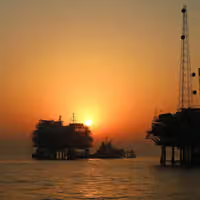
A vessel near the Strait of Hormuz, as seen from Musandam
Iran is doubling down on control of the Strait of Hormuz, with some in Tehran now arguing the strategic leverage it provides is more valuable than a nuclear weapon.
Tehran’s drive to turn that control into lasting economic and political leverage—through shipping routes, mine clearance and potentially revenues from passing vessels—is emerging as a major obstacle to extending its fragile memorandum with the United States, which expires Sunday.
Washington, meanwhile, increasingly claims it has broken Iran’s control of Hormuz.
The June 18 memorandum is formally due to expire on August 16. President Donald Trump pronounced it over after Iran attacked three ships in the Strait of Hormuz, ordering more strikes and the resumption of the US maritime blockade.
Neither side, however, has formally abandoned diplomacy. If no extension is announced before Sunday, the current state of neither war nor peace could continue. An explicit declaration that the arrangement has ended could increase the risk of renewed attacks.
‘More valuable than a nuke’
Pressure against concessions over the strait is also growing inside Tehran.
Parliament’s National Security and Foreign Policy Commission this week unanimously approved the broad outlines of legislation that would tighten Iran’s control over Hormuz.
The bill includes provisions for inspecting vessels in Iranian territorial waters, banning the passage of assets, equipment and vessels belonging to the United States, Israel and other countries Tehran deems hostile, and charging ships for maritime services.
If enacted, the legislation could constrain Tehran’s room for compromise, much as legislation passed during Hassan Rouhani’s presidency required his government to increase uranium enrichment and suspend implementation of the Additional Protocol unless banking and oil sanctions were lifted.
Alireza Salimi, a member of parliament’s presiding board, told the ISNA news agency Thursday that “the Strait of Hormuz is currently more valuable to Iran than an atomic bomb,” describing it as leverage for lifting sanctions and securing compensation for wartime losses.
Demands put talks in doubt
The tougher approach was also reflected in demands laid out shortly before his departure by Mohammad Bagher Zolghadr, the former secretary of the Supreme National Security Council.
Zolghadr said reopening the strait would require an end to attacks on Iran and its allies, the lifting of the blockade, the withdrawal of US forces from around Iran, sanctions relief, the release of frozen Iranian assets and compensation for damage caused by the wars.
It remains unclear whether those demands represented his personal position or that of the SNSC, and whether his successor, Mohsen Rezaei, will pursue the same approach.
Rezaei’s appointment this week, along with other changes at the top of Iran’s security establishment, has been welcomed by hardline opponents of the government’s approach to negotiations.
Former diplomat Kourosh Ahmadi wrote in the Shargh newspaper that if Tehran insisted on the conditions outlined by Zolghadr, “it is highly unlikely that there will be any serious negotiations between Tehran and Washington at all.”
Both sides claim control
The dispute is unfolding as Tehran and Washington offer directly competing accounts of who actually controls Hormuz.
Trump said Wednesday that the United States had complete control of the waterway and that the maritime blockade had deprived Iran of the ability to act.
The spokesman for Iran’s Khatam al-Anbiya Central Headquarters, the country’s wartime command center, rejected that assertion Thursday, saying the strait remained under Iranian control and that no vessel could pass safely without authorization from Iran’s armed forces.
Shipping-monitoring data show traffic remains a fraction of pre-war levels. Around 10 to 12 vessels have been crossing the strait daily in recent days, compared with roughly 130 to 140 before the war, with most currently using a route designated by Iran.
Tehran has also stressed that an agreement with Oman over shipping routes would not by itself be sufficient to reopen the strait.
Ali Gholhaki, a political activist close to parliament speaker and senior Islamabad negotiator Mohammad-Bagher Ghalibaf, said Iranian decision-makers currently had no intention of reopening the waterway and had blocked an agreement with Oman because of what they viewed as Muscat’s alignment with Washington.
Tehran and Muscat at odds
The disagreement with Oman offers perhaps the clearest illustration of what Tehran now wants from its control of Hormuz.
Iran has pushed for control over shipping routes and mine clearance and for mandatory payments from vessels using the waterway. Oman has instead favored a joint fund supported by voluntary contributions from governments and companies benefiting from shipping.
Few in Tehran expect Muscat to accept Iran’s terms. Ahad Azadikhah, a lawmaker aligned with Ghalibaf, recently told Khabar Online that if Oman did so, the Islamic Republic would have achieved “the victory of all victories.”
The dispute means Hormuz is increasingly intertwined with the fate of the wider Tehran-Washington dialogue. As Iran seeks to turn control of the strait into leverage over sanctions, compensation and any broader settlement, Washington may increasingly see that same leverage as something that must be neutralized before a deal can be reached.
Members of Iran's Parliament debate a bill in a hybrid (online/in-person) session, July 27, 2026
A dispute in Iran’s parliament over the terms for reopening the Strait of Hormuz is threatening to complicate negotiations in Muscat, as lawmakers challenge a proposed role for Oman and Pakistan in monitoring shipping through the waterway.
The dispute centers on plans for a three-country verification mechanism being discussed as Iranian, Omani and Pakistani technical committees work on the operational details of a temporary navigation arrangement.
Hardline lawmakers argue that the government cannot implement the proposed arrangement without parliamentary debate and a formal vote, raising a broader dispute over constitutional authority and military jurisdiction.
Their opposition is focused particularly on third-party verification. Hardliners argue that sharing vessel-tracking responsibilities with Pakistani or Omani personnel, even within a joint cell, would undermine the IRGC Navy’s authority over screening in the Persian Gulf.
Commentators aligned with this view have also warned that external verification channels could be exploited by Western intelligence, potentially giving NATO or US naval forces access to information about Iranian coastal movements under the guise of commercial monitoring.
Regional shield or security risk?
Reformist outlets Shargh and Etemad have argued that involving Pakistan and Oman would instead provide Tehran with a diplomatic shield by reducing pressure for direct US or NATO naval escorts inside the strait’s traffic lanes.
Writing in Shargh, Ahmad Zeidabadi warned that blocking regional verification “does not defend our sovereignty; it locks our economy into a suffocating siege,” adding that a functioning Muscat-Islamabad verification mechanism offered Iran a way to avert deeper economic damage.
Foreign Ministry spokesman Esmaeil Baghaei, meanwhile, reaffirmed that any US or NATO military escorts within the strait’s traffic lanes remained prohibited under the draft terms, even as third-party verification continued to be considered in Muscat, according to IRNA.
Parliament pushes tougher terms
The dispute comes as lawmakers are also considering legislation that could further constrain Tehran’s room for compromise over Hormuz.
Iranian media reported that parliament held a closed-door session over the National Security and Foreign Policy Commission’s draft bill restricting the movement of vessels linked to countries Tehran considers hostile.
Hardline lawmakers have pushed for a mandatory transit charge of 5% to 7% on non-exempt commercial bulk cargo to fund coastal defense and infrastructure repairs, alongside tighter inspection requirements.
Pro-Pezeshkian lawmakers and National Security Committee spokesman Hassan Ghashghavi have argued that the proposed verification cell is a technical mechanism operating under the Supreme National Security Council framework rather than a new international treaty requiring lengthy parliamentary ratification.
Government representatives have also warned that imposing statutory tolls could undermine the Muscat negotiations and discourage foreign shipping lines from using Iranian ports.
The competing approaches reflect a wider struggle in Tehran over what Iran should seek to preserve from its wartime control of Hormuz: maximum control and economic leverage, or a regional mechanism that could restore shipping without opening the waterway to a greater US or NATO role.
The dispute could prove consequential for the Muscat talks, as any agreement requiring Omani or Pakistani participation in monitoring traffic would have to overcome objections from lawmakers, while tougher statutory restrictions on shipping could further narrow the government’s room to negotiate.
An illustration released by US Central Command depicts one-way attack drones operating across air, surface and subsurface domains.
The US-Iran standoff is hardening around the Strait of Hormuz, with Washington saying it can sustain maritime pressure indefinitely and Tehran signaling readiness for a prolonged confrontation and more offensive operations.
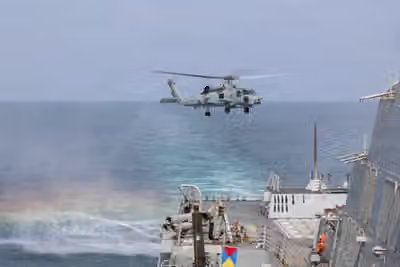
The United States is preparing to send the USS George Washington to the Middle East in a previously scheduled rotation, while Defense Secretary Pete Hegseth said Thursday that rotating ships would allow the US Navy to maintain its blockade for as long as necessary.
“Indefinitely the United States Navy can maintain a blockade like that because we'll rotate ships in and out, as we have, and we'll continue to,” Hegseth told reporters.
The George Washington is expected to replace the USS Abraham Lincoln, the Wall Street Journal reported, citing US officials. The Lincoln was redirected to the Middle East in January ahead of the US war against Iran and has now spent more than 250 days deployed.
CENTCOM also announced Thursday the creation of its first multinational, multi-domain attack drone task force, building on the use of one-way unmanned systems during Operation Epic Fury and strikes on Iranian port facilities in July.
Task Force Falcon Strike will use one-way attack drones in the air, on the surface and below it, with US Special Operations Command Central personnel leading the unit and regional partners being formally invited to join.
Iran signals offensive posture
In Tehran, Mohammad Mokhber, an adviser to Supreme Leader Mojtaba Khamenei, said Thursday that Khamenei’s strategy was to shift the war to an offensive posture if Iran’s conditions were not met.
That emphasis was also reflected in Khamenei’s appointment of six senior military commanders earlier this week.
His decree naming Ahmad Vahidi commander-in-chief of the IRGC instructed him to strengthen the force’s capabilities for “maximum deterrence” and maintain readiness for “powerful offensive operations against the enemy.”
IRGC Navy commander Ali Azmaei, also formally appointed this week, said Thursday that the Strait of Hormuz remained closed and that no movement through it escaped the force’s notice.
Rasoul Sanaei-Rad, a senior military official, said Iran was preparing for “worst-case” war scenarios and needed offensive capabilities alongside defensive ones. “Our fighters have their fingers on the trigger,” he said, adding that Iran would seek to impose a much heavier defeat if attacked again.
All about Hormuz
Hormuz remains the immediate test of those competing claims of endurance.
Iran’s Khatam al-Anbiya Central Headquarters said Thursday that no commercial ship or oil tanker could safely pass through the waterway without Tehran’s permission and oversight.
The United States, meanwhile, says its blockade remains in force. CENTCOM said that as of Wednesday, US forces had redirected 59 commercial vessels, disabled three and boarded two others while enforcing what it calls its “steel wall blockade” against Iran.
Off the water, diplomatic contacts have continued despite the military buildup.
Foreign Minister Abbas Araghchi warned Washington Thursday against what he called a “bigger miscalculation” over the Strait of Hormuz, while Vice President Majid Ansari said war and negotiations were “complementary” and that Iran would pursue its objectives in the waterway and the wider region.
The parallel military and diplomatic tracks have yet to produce a breakthrough over Hormuz. Instead, Thursday’s statements suggested both sides are preparing for the possibility that the standoff will last.